
牛津译林版八年级英语下册Unit4AgoodreadGrammar教案
Unit4 A good read
Grammar
教学目标
1学会正确使用“特殊疑问词+动词不定式’’的结构。
2学会正确使用must和have to。
教学内容
四会内容
词汇:hand review return
词组:hand in write about and so on ask for help with writing On time 句型:Millie has decided what to read.
Daniel did not say who to talk to about this book.
Simon forgot when to meet his friends.
Kitty cannot decide which to choose first.
Sandy is wondering where to ask for help.
Amy does not know how to write the report.
Mr Wu is always there to help us.
“I must run away from them,” Gulliver thought.
I have to use them to reach the box on the fridge.
You must not smoke in the library.
We do not have t o go to school at weekends.
三会内容
词汇:renew
教学步骤
A Using question words + to-infinitives
Step I复习
1根据前一课时布置的家庭作业, 教师问学生:We have read an extract from Gulliver's Travels, but it’s not a complete story and we don’t know what happened next. I'm wondering about what happened next. Can you tell me?
2教师挑选几位不同层次的学生念自己编写的故事结局, 或者让读过原著的学生讲述故事的结果。
1教师呈现Reading部分出现的句子, 让学生关注划线部分:
(1) One of these small men began talking to me, but I could not understand him.
I did not know what to say either.
(2) I did not know how to get away.
2教师告诉学生:We can use a question word with a to-infinitive after a verb.
3补充练习:同义句转换。
(1) Gulliver did not know where he could find other people.
Gulliver did not know ________ _________ ________ other people. (where to find)
(2)Gulliver wondered who he could ask for help.
Gulliver wondered ________ ________ _______ _________ help. (who to ask for)
(3) Gulliver did not know how he could break the ropes.
Gulliver did not know _________ ________ __________the ropes. (how to break)
(4) Gulliver found out what he could do with the tiny man.
Gulliver found out __________ ____________ ____________ with the tiny man. (what to do) (5) Gulliver decided when he should leave Lilliput.
Gulliver decided ___________ _________ _________should leave Lilliput. (when to leave) 提醒学生没有why to 结构。
Step III操练
1教师说:Amy and Daniel are talking about their Reading Week. Use the correct question words and to-infinitives to complete their conversation on page 55.
2全班核对答案, 然后让学生分角色朗读完整的对话。
3教师板书并解释新的词组或句型。
B Usi ng must and have to
Step I呈现
l教师问:We must obey school rules when we're at school. What school rules do we have? What must we do? What mustn’t we do? 学生尽可能多的回答。
(1) We must wear school uniforms.
(2)We must get to school on time.
(3)We must keep quiet in the school library.
(4)We mustn’t throw rubbish on the ground.
(S)We mustn’t pick the flowers in the garden.
2教师对学生解释:We u se must when the speaker feels that something is necessary. We use must not to say that something is not allowed.
3教师接着问:If you’re ill and the doctor asks you to stay at home, what’ll you have to do?学生回答:I’ll have to ask for le ave and stay at home. 教师再问:Do you have to go to school at weekends? 学生回答:No, we don’t have to.
4教师对学生解释:We use have to when the situation makes something necessary. We use do
not have to to say that it’s not necessary to do something.
S提醒学生:Have to has different forms:has to, had to, will have to and have/has got to. Step II操练
1教师问:What rules must we obey when we’re in the library?鼓励学生用must、 mustn’t、have to、don’t have to说出尽可能多的规则。
2教师说:Amy is telling her cousin Shirley some library rules. Look at page 56. Complete what she says with must, must not, have to or do not have to. 全班核对答案, 并且让学生解释理由, 加深理解。
Step III活动
1教师让学生四人一组讨论制订班级公约, 用must、must not、have to、do not have to造句。
教师说:Let’s work out some class rules using must, must not, have to and do not have to. 教师巡视并帮助学生解决语言困难, 提供语言帮助。
2每组派一名代表朗读讨论的班级公约, 小组之间互相评价。
Step IV家庭作业
1记忆词汇、词组和句型。
2复习本课所学语法。
3完成教师布置的相关练习。
4预习Integrated skills。
+Unit+4+Agood+read+Grammar教案 牛津译林版八年级英语下册
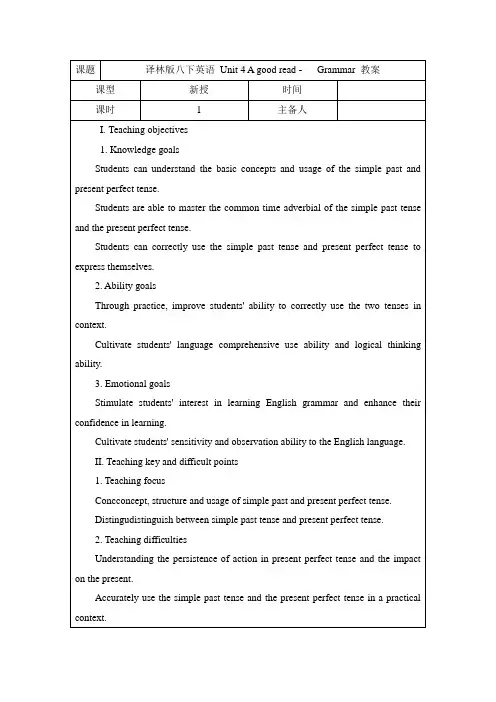
课题译林版八下英语Unit 4 A good read - Grammar 教案课型新授时间课时 1 主备人I.Teaching objectives1. Knowledge goalsStudents can understand the basic concepts and usage of the simple past and present perfect tense.Students are able to master the common time adverbial of the simple past tense and the present perfect tense.Students can correctly use the simple past tense and present perfect tense to express themselves.2. Ability goalsThrough practice, improve students' ability to correctly use the two tenses in context.Cultivate students' language comprehensive use ability and logical thinking ability.3. Emotional goalsStimulate students' interest in learning English grammar and enhance their confidence in learning.Cultivate students' sensitivity and observation ability to the English language.II. Teaching key and difficult points1. Teaching focusConcconcept, structure and usage of simple past and present perfect tense.Distingudistinguish between simple past tense and present perfect tense.2. Teaching difficultiesUnderstanding the persistence of action in present perfect tense and the impact on the present.Accurately use the simple past tense and the present perfect tense in a practical context.III. teaching method1. Teaching method: explain the grammar rules and usage of simple past tense and present perfect tense.2. Practice method: consolidate the knowledge learned through practice and improve students' language use ability.3. Discussion method: Organize students to discuss relevant grammar points to deepen their understanding of knowledge.4. Induction method: guide the students to summarize the characteristics and differences of the two tenses.IV teaching process(1) Lead in (5 minutes)1. Show pictures or videos about events in the past and things that continue to the present, such as "a person went to the park yesterday" and "a person has lived in the city for five years now."2. Ask the students how to describe these situations in English, and guide them to think about different tense expressions.(2) Knowledge explanation (10 minutes)1. Simple past timeConcept: An action or state of existence at a certain time in the past.Structure: subject + verb past formula + other.Time adverbial: yesterday, the other day,last...,...ago et al.For example: I visited the Palace Museum with my grandparents the other day.2. Now is in the perfect tenseConcept: represents the effect or result of past actions on the present, or the action or state that continues from the past to the present.Structure: Subject + has / has + the past participle of the verb + other.Timbial language: already, ever, trust, recently, not yet, so far, up to now, until / till now, etc.For example: Daniel has lived in Beijing for two years.(Iii) Comparative analysis (15 minutes)1. Organize students to compare the usage and time symptoms of simple past tense and present completion tense, and complete the form:Ttense usage time adverbialAction or presence in a simple past state yesterday, the other day,last...,...ago et al Present perfect tense Impact or consequences of past actions on the present; actions or states continuing from the past to the present already, ever, trust, recently, not yet, so far, up to now, until / till now, etc2. Let the students discuss the difference between the two tenses, and the teacher will summarize and supplement them.(4) Practice and consolidation (10 minutes)1. Complete the exercises in the textbook, such as Simon is showing Millie some pictures. Complete his sentences with the correct forms of the words in brackets., etc.2. Give some sentences, let the students judge whether the simple past or the present, and explain why.For example: I saw the film yesterday. (simple past, because there is a clear past time "yesterday")He has finished his homework. (Now finish time, emphasize the impact on the present "work is completed")(V) Expand the application (5 minutes)1. Create a situation for students to have a dialogue between the simple past tense and the present completion tense.For example: A: Have you ever been to5. Teaching reflectionIn this teaching, through the introduction of pictures and videos has stimulated the students' interest in learning, so that the students can quickly enter the learning state. In the link of knowledge explanation, the method of comparative analysis is used to let the students clearly understand the difference and usage of simple past time and present perfect tense. Practice consolidation link, through various forms ofpractice, such as filling in the blanks, judgment, dialogue, etc., to help students to deepen the understanding and mastery of knowledge. Expand the application link, let the students use the knowledge learned in the actual situation, improve the students' comprehensive use of language ability.However, there are also some shortcomings in the teaching process. Some students do not have a thorough understanding of the continuous movements in present perfect tense, and they are easy to make mistakes when using them. In the future teaching, we should strengthen the practice and explanation of this aspect, and give some more vivid examples to help students understand. At the same time, in the design of teaching activities, can be more diversified, increase the group competition and other forms, improve the students' participation and enthusiasm.。
牛津译林版八年级下册Unit 4《A good read》教学设计5
牛津译林版八年级下册Unit 4《A good read》教学设计5一. 教材分析《A good read》是人教版牛津译林八年级下册的一篇文章,主要介绍了一本好书对人们的影响。
文章通过讲述一个男孩在阅读一本好书过程中的感悟,让学生了解阅读的重要性,激发他们的阅读兴趣。
本课内容与学生的生活紧密相连,有利于激发他们的学习兴趣和积极性。
二. 学情分析八年级的学生已经具备了一定的英语基础,对阅读和写作有了一定的认识。
但部分学生在阅读过程中可能会遇到生词和长难句的理解问题,因此需要在教学过程中给予他们必要的帮助。
此外,学生对不同文化背景下的阅读习惯和观念可能了解不多,需要在教学过程中进行适当的引导和拓展。
三. 教学目标1.知识目标:–能够掌握并正确运用本课中所学的单词和短语。
–能够理解文章的主旨和作者的观点。
2.能力目标:–能够运用所学知识进行阅读理解,快速获取信息。
–能够就阅读话题进行简单的交流和讨论。
3.情感目标:–激发学生对阅读的兴趣,培养良好的阅读习惯。
–提高学生对不同文化背景下的阅读观念的认识。
四. 教学重难点•掌握本课中的单词和短语。
•理解文章的主旨和作者的观点。
•理解文章中长难句的意思。
•运用所学知识进行阅读理解。
五. 教学方法1.任务型教学法:通过完成各种任务,激发学生的学习兴趣,提高他们的学习积极性。
2.情境教学法:创设真实的阅读情境,帮助学生更好地理解文章内容。
3.合作学习法:鼓励学生进行小组讨论,培养他们的团队协作能力。
六. 教学准备1.教师准备:–熟悉教材,明确教学目标。
–准备相关的教学材料和教具。
2.学生准备:–预习课文,了解文章大意。
–收集有关阅读的资料和观点。
七. 教学过程1.导入(5分钟)–利用图片或实物引导学生谈论阅读的话题。
–提问:你们平时喜欢阅读吗?都喜欢读什么类型的书?2.呈现(10分钟)–快速阅读课文,让学生获取文章大意。
–引导学生关注文章标题和作者,了解文章主题。
牛津译林版八年级下册Unit 4《A good read》教学设计4
牛津译林版八年级下册Unit 4《A good read》教学设计4一. 教材分析《A good read》是人教版牛津译林八年级下册的一篇阅读文章,主要介绍了关于读书的方法和好处。
通过本课的学习,学生可以提高阅读理解能力,学习到更多的阅读技巧和策略,同时也能增强对英语文化的理解。
二. 学情分析八年级的学生已经具备了一定的英语基础,对于阅读理解也有一定的掌握。
但是,部分学生对于阅读技巧和策略的运用还不够熟练,需要老师在教学中进行引导和培养。
同时,学生对于英语文化的了解还不够深入,需要通过课堂的学习来进行拓展。
三. 教学目标1.知识目标:学生能够掌握本课中的重点单词和短语,理解文章的大意和细节信息。
2.能力目标:学生能够运用阅读技巧和策略进行阅读理解,提高阅读能力。
3.情感目标:学生能够培养对英语文化的兴趣,增强学习的积极性。
四. 教学重难点1.重点:学生能够掌握本课中的重点单词和短语,理解文章的大意和细节信息。
2.难点:学生能够运用阅读技巧和策略进行阅读理解,对英语文化进行深入理解。
五. 教学方法采用任务型教学法,通过设置不同的任务,引导学生进行自主学习、合作学习和探究学习。
同时,运用启发式教学法,引导学生主动思考,提高解决问题的能力。
六. 教学准备1.教师准备:备好课件,准备好相关教学材料。
2.学生准备:预习本课内容,提前了解相关背景知识。
七. 教学过程1.导入(5分钟)通过提问方式引导学生谈论关于读书的方法和好处,激发学生的学习兴趣。
2.呈现(10分钟)教师通过课件展示本课的重点单词和短语,引导学生进行认读和学习。
3.操练(10分钟)学生通过阅读文章,回答相关问题,巩固所学知识。
教师可设置不同难度的题目,以满足不同层次学生的需求。
4.巩固(10分钟)学生进行小组讨论,分享彼此的阅读心得和体验,加深对文章内容的理解。
5.拓展(10分钟)教师引导学生进行阅读拓展,例如阅读类似的文章或相关背景资料,提高学生的阅读能力。
译林版八年级英语下册Unit4A good read教案之Grammar(第4课时)
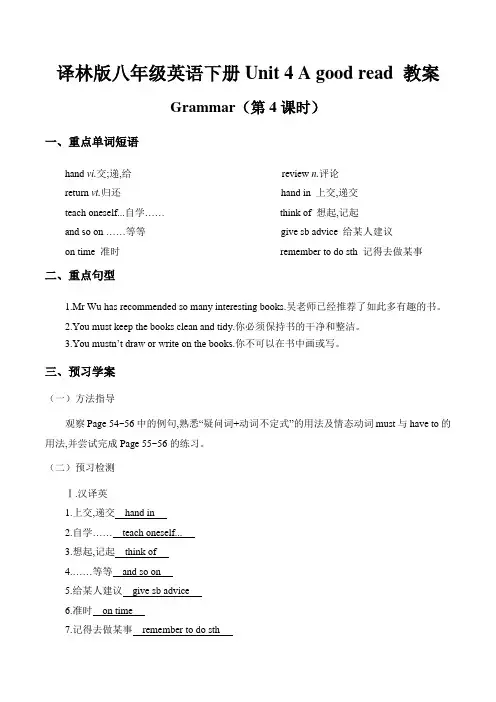
译林版八年级英语下册Unit 4 A good read 教案Grammar(第4课时)一、重点单词短语hand vi.交;递,给review n.评论return vt.归还hand in 上交,递交teach oneself...自学……think of 想起,记起and so on ……等等give sb advice 给某人建议on time 准时remember to do sth 记得去做某事二、重点句型1.Mr Wu has recommended so many interesting books.吴老师已经推荐了如此多有趣的书。
2.You must keep the books clean and tidy.你必须保持书的干净和整洁。
3.You mustn’t draw or write on the books.你不可以在书中画或写。
三、预习学案(一)方法指导观察Page 54~56中的例句,熟悉“疑问词+动词不定式”的用法及情态动词must与have to的用法,并尝试完成Page 55~56的练习。
(二)预习检测Ⅰ.汉译英1.上交,递交hand in2.自学……teach oneself...3.想起,记起think of4.……等等and so on5.给某人建议give sb advice6.准时on time7.记得去做某事remember to do sthⅡ.用方框中所给的单词填空,每个词限用一次what,when,which,where,how,who1.I don’t know who to talk to and where to get help when I’m in trouble.lie is the top student in her class but she doesn’t know how to make friends.3.She can’t decide which to do first when she gets a lot of things to do.4.Mary always doesn’t know what to speak in public.5.Daniel’s father often tells him when to do his homework.四、教学过程Step1情景导入复习Reading中含有“疑问词+动词不定式”的句子,解释“疑问词+动词不定式”的用法。
牛津译林版初中英语八年级英语下Unit4 A good read grammar教案+课件
8B Unit 4 A good readGrammarTeaching aimsBy the end of this lesson, students are expected to1.activate their imagination on Gulliver’s voyage to Lilliput;e the model verbs must and have to correctly;3.grasp how to use the structure “question words + to-infinitives”;4.be more aware of the importance of reading.Teaching proceduresStep 1 Preparation1. Watch a video about Gulliver’s voyage to Lilliput.2. Have a free talk on the video.(The purpose is to arouse students’ interest and be familiar with the new teacher.) Step 2 Presentation and PracticePart A---the use of model verbs must and have to1. Present the background information.2. Learn the grammar point through the king’s words and Gulliver’s diary.3. Have a conclusion.4. Do exercises as a consolidation.Part B---the use of the structure “question words + to infinitives”5. Present the background information.6. Introduce the grammar point through Gulliver’s diary.7. Instruct students to learn the grammar point by themselves.8. Do exercises as a consolidation.(The purpose is to have students grasp the use of the two grammar points in situations, and reinforce the usage through different forms of activities.)Step 3 Production1. Present the background information.2. Discuss the thank-you letter in groups, using the grammar points learnt previously.(The purpose is to encourage students to practice using the grammar points learnt previously.)Step 4 Progress1. Discuss the importance of reading.(The purpose is to have students be more aware of the importance of reading.) Homework1. Find one more novel in English you are interested in and enjoy it.Thank you!。
牛津译林版八年级英语下册Unit4AGoodRead教学设计
(二)教学设想
1.课堂活动设计:
-采用任务型教学法,引导学生通过完成一系列任务,达到掌握知识的目的;
-利用多媒体教学手段,如PPT、视频等,展示不同类型的文学作品,提高学生的学习兴趣;
-组织小组讨论、角色扮演等活动,培养学生的合作意识和口语表达能力。
2.教学策略:
3.学生尝试撰写简单的书评,教师进行个别指导并给予反馈。
- “Now, try to write a book review using what we have learned. I will give you individual guidance and feedback.”
(五)总结归纳
1.教师引导学生回顾本节课所学内容,总结词汇、语法和阅读策略的运用。
- “Now, let's look at some examples and learn how to use the present simple tense and past simple tense to describe the story.”
3.讲解阅读策略,如预测、扫读、细读等,并结合课文实例进行分析。
3.教师布置课后作业,要求学生继续阅读,巩固所学知识。
- “For homework, please continue to read and practice what we have learned in this class.”
五、作业布置
1.阅读作业:要求学生课后阅读一本自己喜欢的英文书籍,类型不限,并尝试运用本节课所学的阅读策略,如预测、扫读、细读等,提高阅读效率。阅读后,学生需完成一份书评,不少于100词,以书面形式表达对所读书籍的理解和感受。
牛津译林版八年级英语下册《Unit4Agoodread》教案
课堂达标
一、根据句意及中文提示填写单词。
1. It is terrible for your car to crash(碰,撞)the big tree.
2.There are five(手指)on each hand.
Step 3.Skimming
Skim the text and then answer the following questions:
1.Why was Gulliver so tired?
2.What started climbing over Gulliver?
Step 4. Scanning
3. It was dark.The police(继续)searching for the lost children.
4. You can’t do it.I can’t ,(也).
5.The game can test your(知识)of English.
6.You can wait for him(直到…为止)he comes back.
Step 2. Presentation
1.Present the new words and expressions
2.Match the words on the left with the meanings on the right.Part B1,on page 45
3.Check he answers.
4.How big was the small man?
5.How many tiny people climbed over Gulliver’s body?
最新牛津译林版中学八年级英语下册《Unit 4 A good read》教案
Unit 4 A good read教学目标知识与能力:1.To introduce the different kinds of books.2.To discuss the favourite books.过程与方法:1.to discuss what books are the Ss’ favourite in group.2.to talk about their favourite books in class.情感态度与价值观:To train the Ss’ interest in liking reading books.To develop a good habit to read books教学重点1.To introduce the different kinds of books.2.To discuss the favourite books.教学难点1.To introduce the different kinds of books.2.To discuss the favourite books.课前预习1.Preview the new words.2.Listen to the tape and read the dialogue.教学方法Listening 、reading、acting Discussing and pair work.教学用具Recorder and multimedia教学过程二次备课Step 1. Lead-in1.Having a free talkT: Do you like reading books?Why? S:……T: What kind of books do you like best? S:……T:Do you like reading story books? S:……Step 2.Having a presenting1.Show some pictures of different kinds of books and introduce eachof them.Travel books:Health books:Food books:Fiction books:History books:Science books:Make the students know that the main content of each type of bookWrite the type of book under each picture.Check the answersStep 3.DiscussionListen to the tape and then answer the following questions1.What is Millie reading ?2.What does Sandy think about the history book?3.What kind of book does Sandy like?4.Was the story of the ugly man Quasimodo moving?Check the answersRead after the tapeWork in pairsStep 4. Comic stripListen to the tapeQuestionsRead after the tapeWork in pairs.Act out the dialogueStep 5 Doing a taskDivide the stuents into four of a group and the do a survey about Which type of book would you like to read ?Give some reasons.What kind of book do you like?I like …Why ?Because …What about you ?I like … because…Make a conclusion and write a reportPresent the reportStep 6 Homework1. Read the text book and learn the new words and phrases by heart.2. Finish the exercises in the workbook.课堂达标一、A 根据句意及汉语提示完成单词。
牛津译林版英语八下Unit 4《A good read》(Grammar)教学设计
牛津译林版英语八下Unit 4《A good read》(Grammar)教学设计一. 教材分析《A good read》是人教版牛津译林英语八年级下的一个单元,主题是关于书籍和阅读。
本课的主要内容是通过介绍两本书的评价,让学生学会如何使用过去时态和现在时态描述事件的顺序。
教材中包含了丰富的阅读材料,有助于提高学生的阅读兴趣和阅读能力。
二. 学情分析学生在学习这个单元前,已经掌握了动词的过去式和现在式的变化规则,同时也具备了一定的阅读理解能力。
但学生在阅读长篇文章时,可能会遇到生词和难句,影响阅读理解。
因此,在教学过程中,需要帮助学生克服这些困难,提高他们的阅读能力。
三. 教学目标1.知识目标:学生能够正确使用过去时态和现在时态描述事件的顺序。
2.能力目标:学生能够读懂文章,提高阅读理解能力。
3.情感目标:激发学生对阅读的兴趣,培养良好的阅读习惯。
四. 教学重难点1.重点:学生能够正确使用过去时态和现在时态描述事件的顺序。
2.难点:学生能够读懂文章,提高阅读理解能力。
五. 教学方法1.任务型教学法:通过完成各种任务,激发学生的学习兴趣,提高学生的参与度。
2.互动式教学法:教师与学生,学生与学生之间的互动,促进知识的传递和能力的培养。
3.情境教学法:创设情境,让学生在真实的环境中学习,提高学生的应用能力。
六. 教学准备1.教师准备:准备好教材、多媒体教具、教学卡片等教学资源。
2.学生准备:学生提前预习课文,了解文章大意。
七. 教学过程1.导入(5分钟)教师通过提问方式引导学生谈论他们喜欢的书籍和阅读体验,激发学生的学习兴趣。
2.呈现(10分钟)教师通过多媒体展示两本书的评价,让学生听懂并理解文章的内容。
3.操练(15分钟)学生分角色朗读文章,模仿文章中的评价语言。
教师引导学生运用过去时态和现在时态描述事件的顺序。
4.巩固(10分钟)学生分组讨论,总结文章的主旨大意,并用自己的话进行表达。
教师巡回指导,纠正学生的错误。
牛津译林版英语八下Unit 4《A good read》单元教学设计
牛津译林版英语八下Unit 4《A good read》单元教学设计一. 教材分析《牛津译林版英语八下Unit 4 A good read》讲述了阅读的重要性和如何选择适合自己的读物。
通过本单元的学习,学生能够更好地理解文章内容,提高阅读兴趣,并学会如何根据自己的兴趣和需求选择合适的书籍。
本单元主要内容包括:阅读的重要性、如何选择适合自己的读物、分享阅读心得等。
二. 学情分析学生在进入八年级下学期时,已经具备了一定的英语基础,能够听、说、读、写简单的英语句子。
但部分学生对阅读仍存在恐惧心理,认为阅读难度较大,难以理解。
因此,在教学过程中,需要关注学生的心理状况,激发他们的学习兴趣,帮助他们建立自信心。
三. 教学目标1.知识目标:–能够熟练朗读并理解Unit 4课文内容。
–掌握阅读的基本技巧,如略读、寻读等。
–学会如何根据自己的兴趣和需求选择合适的书籍。
2.能力目标:–能够运用所学知识进行日常交流,分享阅读心得。
–提高学生的阅读速度和理解能力。
3.情感目标:–培养学生对阅读的兴趣,激发他们主动阅读的动力。
–培养学生相互鼓励、共同进步的良好学习氛围。
四. 教学重难点•熟练朗读并理解Unit 4课文内容。
•掌握阅读的基本技巧,如略读、寻读等。
•如何根据自己的兴趣和需求选择合适的书籍。
•提高学生的阅读速度和理解能力。
五. 教学方法1.任务型教学法:通过完成各种任务,激发学生的学习兴趣,提高他们的参与度。
2.合作学习法:鼓励学生相互讨论、分享,共同解决问题,培养团队精神。
3.情境教学法:创设真实情境,让学生在实际环境中运用所学知识,提高实际操作能力。
六. 教学准备1.教材:牛津译林版英语八下Unit 4 A good read。
2.多媒体设备:电脑、投影仪等。
3.教学资源:相关阅读材料、图片等。
4.课堂用具:黑板、粉笔等。
七. 教学过程1.导入(5分钟)利用多媒体展示一些名人读书的照片,引导学生谈论阅读的重要性。