
Unit 5 Antarctica 课文讲解
▪ Part 3 (Paras 4-end): The reasons why Antarctica
is uninhabitable.
Part I: General Introduction to Antarctica
Seen from space, the astronauts tell us, the most distinctive feature of our planet is the ice sheet of Antarctica which “radiates light like a great white lantern across the bottom of the world”. This ice sheet covers 5,500,000 square miles (an area greater than the United States and Central America combined); it averages more 7,000 feet in thickness; it contains more than 90 per cent of the world’s ice and snow, and if suddenly it melted the oceans would rise to such a height that every other person on earth would be drowned. Antarctica is in fact our planet’s largest and most spectacular natural phenomenon
authority to his explanation. f) He also uses parallel structures as an effective way of
describing what life in the Antarctic.
In this sort of cold if you try to burn a candle the flame becomes obscured by a hood of wax, if you drop a steel bar it is likely to shatter like glass, tin disintegrates into loose granules, mercury freezes into a solid metal, and if you haul up a fish through a hole in the ice within five seconds it is frozen so solid that it has to be cut with a saw.
Thickness & Snow and ice
▪ it averages more 7,000 feet in thickness
▪ it contains more than 90 per cent of the world’s
ice and snow, and if suddenly it melted the oceans would rise to such a height that every other person on earth would be drowned
Writing techniques
1. What type of writing is this text? an Expository writing
2. What writing skills does the writer use to make “Antarctica” sense to the reader? a) The writer states the central theme at the beginning of the
text to arouse the reader’s interest. b) He shows to the reader many vivid pictures of Antarctica by
using description and narration. c) He supports his views with many concrete data, statistics and
tommorrow?
▪ How to protect this place?
▪ WHAT is the writer concerned about ?
Textual cture
▪ Part 1 (para 1): General introduction to Antarctica
▪ Part 2 (paras2-3): Comparison between the Arctic
Yet climate by itself was not the main drawback to the unveiling of Antarctica; an even greater drawback, at least in the early stages, was the nature of the sea—the Southern Ocean—which surrounds it. (the last para )
facts to make his writing more convincing. d) He uses comparison to highlight how uninhabitable the
Antarctic is. e) He directly quotes the words of scientists to give more
Mind map of Para 3: Comparison
Arctica
Antarctica
1. Surrounded by the landmass of Europe,
America and Asia
2. cold
3. thousands of families, plants and animals
1. Isolated by oceans
2. Much colder 3. No habitation and very
few living creatures
Creatures In the Arctic
Creatures In the Antarctic
Part 3 The reason why Antarctica is uninhabitable
Part 2: Comparison between the Arctic and the Antarctic
①People used to regard the Arctic and the Antarctic as much alike. ②In fact their differences outweigh their similarities./ ③ The Arctic is closely hemmed in by the populated landmasses of Europe, America and Asia; the Antarctic in contrast is in splendid isolation, divided from the nearest land by vast reaches of the most tempestuous seas on earth. /④Another big difference is the climate. ⑤We are so inclined to think of both the Arctic and Antarctic as cold, that we tend to forget how much colder the latter is. /⑥North of the Arctic Circle tens of thousands of families live in comfort all the year round; hundreds of children are born every year. ⑦South of the Antarctic Circle,in contrast, there is no habitation that a man can describe as home; the only plants are a handful of mosses and lichens; the only landlife simple one-celled creatures and wingless flies; no human child has ever been born there.
第6次课的教学内容及目标
▪11. 对南极洲有个基本认知。 ▪2. 以问答和画思维导图的形式理解课文内容。 ▪3. 学习写作手法。
homework
▪ 复习作业: ▪ 1. 听并阅读全文。
▪ 2. 熟读第一段。
▪ 预习单词 ▪ 摘抄
▪ (以上作业上课前交)
It is not hard to see why. The basic essentials to life are rainfall, warmth and a degree of stillness. The Arctic, at times, provides all three; the Antarctic seldom provides any——witness the descriptions of those who have been there. (para 4) …
Why is Antarctica uninhabitable?
[英语学习]unit 5 Dinner at Joanne‘s
![[英语学习]unit 5 Dinner at Joanne‘s](https://360docs-1393072327.cos.ap-beijing.myqcloud.com/d2efffc8f242336c1fb95e86.webp)
4. What sort of things can go wrong in such a restaurant?
h
3
Active reading 1: Navigation
Text organization
Conflict
Climax
Ending
Mohre
5
Active reading 1: Navigation
Setting
When
Where
Mood
On Christmas Eve
In a famous restaurant Joanne’s on the 46th street in New York
h
ቤተ መጻሕፍቲ ባይዱ16
Active readingL1a:nRgeusaoguercPoeisnts
Senator Rogers was a Democrat in her third term of office, who knew Capitol Hill inside out but who had nevertheless managed to keep her credibility with her voters as a Washington outsider
Mhore
15
Active readingL1a:nRgeusaoguercPoeisnts
➢ Partnership refers to the position of being one of two or more people who own a company as partners. A junior partner is a newer or younger partner who has less responsibility or fewer shares than a senior partner.
2020年牛津深圳版英语八年级下册Unit5讲义
2020年⽜津深圳版英语⼋年级下册Unit5讲义Unit 5 Save the endangered animalsCulture Corner西⽅⼈⾮常看重狗的忠诚,喜爱它,赞美它。
英语中关于狗的习语有很多,如a lucky dog(幸运⼉),a clever dog(聪明⼩孩),work like a dog(拼命⼯作),Every dog has its day.(⼈⼈皆有得意⽇。
)等等。
cat也是西⽅⼈“宠物⽂化”中的重要成员,⼈们多⽤cat来形容⼥⼈,模特⼉步就叫catwalk(猫步),an old cat 指“脾⽓坏的⽼太婆”,⽽形容某⼈病得厉害⽤as a sick cat, like a cat on hot bricks则与中⽂的“像热锅上的蚂蚁”表达同样的意思。
除把猫狗视为宠物外,许多西⽅⼈还把bird视为宠物,在英语俚语⾥,an old bird指“⼀个古怪的⼈”,bird brain是“傻⽠、开⼩差的⼈”,a little bird指“消息灵通或暗中提供消息的⼈”,birds of a feather则指“志趣相投者”。
⼀.知识⽬标⼆.⼀起学A. Reading⼀、词汇讲解1. Pandas in the wild usually eat bamboo. 意思是“在野⽣环境中”。
in the wild 意思是“在野⽣环境中”。
e. g. Are the animals living in the zoo or in the wild? 这些动物是⽣活在动物园⾥还是在野外?2. Pandas like to live on their own. 熊猫喜欢独⾃居住。
On one's own 意思是“独⾃”,相当于by oneself.e.g. I am able to finish the job on my own. 我能独⾃把⼯作做完。
3. They need to eat a lot to stay healthy, so they spend more than 12 hours a day eating. 它们需要吃⼤量的⾷物以保持健康,所以他们每天花12个⼩时来进⾷。
新外研版高中英语选择性必修2Unit5课文翻译
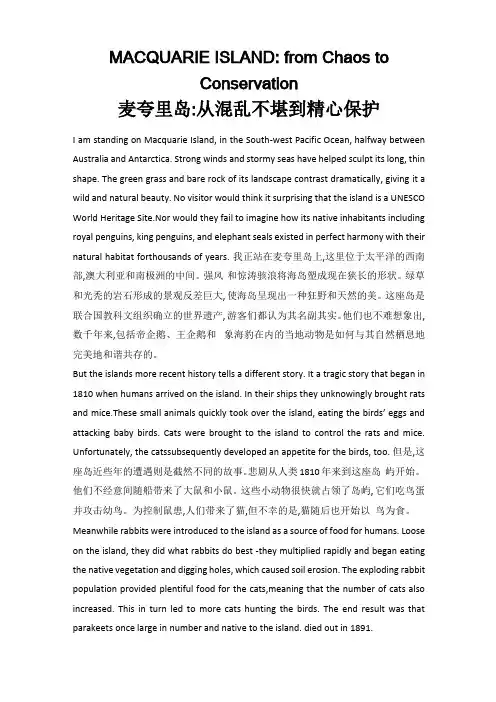
MACQUARIE ISLAND: from Chaos toConservation麦夸里岛:从混乱不堪到精心保护I am standing on Macquarie Island, in the South-west Pacific Ocean, halfway between Australia and Antarctica. Strong winds and stormy seas have helped sculpt its long, thin shape. The green grass and bare rock of its landscape contrast dramatically, giving it a wild and natural beauty. No visitor would think it surprising that the island is a UNESCO World Heritage Site.Nor would they fail to imagine how its native inhabitants including royal penguins, king penguins, and elephant seals existed in perfect harmony with their natural habitat forthousands of years. 我正站在麦夸里岛上,这里位于太平洋的西南部,澳大利亚和南极洲的中间。
强风和惊涛骇浪将海岛塑成现在狭长的形状。
绿草和光秃的岩石形成的景观反差巨大, 使海岛呈现出一种狂野和天然的美。
这座岛是联合国教科文组织确立的世界遗产, 游客们都认为其名副其实。
他们也不难想象出,数千年来,包括帝企鹅、王企鹅和象海豹在内的当地动物是如何与其自然栖息地完美地和谐共存的。
But the islands more recent history tells a different story. It a tragic story that began in 1810 when humans arrived on the island. In their ships they unknowingly brought rats and mice.These small animals quickly took over the island, eating the birds’ eggs and attacking baby birds. Cats were brought to the island to control the rats and mice. Unfortunately, the catssubsequently developed an appetite for the birds, too. 但是,这座岛近些年的遭遇则是截然不同的故事。
新概念英语青少版2a课文Unit5:All About Ants关于蚂蚁
新概念英语青少版2a课文Unit5:All About Ants关于蚂蚁新概念英语青少版2a课文Unit 05 Lesson 9:All About AntsROBERT:Look at this webpage, Mum. It’s about ants.妈妈,看看这个网页,是讲蚂蚁的。
KAREN: Ants? Why are you looking up ants ?蚂蚁?你查蚂蚁干啥?ROBERT: Why not? Ants are really interesting. They do really interesting things.为什么不呢?蚂蚁很有趣,它们做的事业非常有趣?KAREN: What kind of things ?比如呢?ROBERT: Well, they usually live in dry place. But they can survive under water for two weeks .嗯,它们通常住在干燥的地方,但它们却能够在水下存活2周。
KAREN: Really ? Do they breathe under water ?真的吗?它们在水下呼吸吗?ROBERT:It doesn’t say .这个没说。
ROBERT: Oh, Mum, how about this ? Ants always stretch their legs in the morning .哦,妈妈,这个怎么样?蚂蚁总会在早晨伸伸腿。
KAREN:You’re joking !你在开玩笑吧。
ROBERT: No, really !没有,是真的。
KAREN: Do they usually yawn in the morning ,too ?它们早上伸懒腰吗?ROBERT:Well, funnily enough, they do !额,有趣吧,它们早上要伸懒腰。
Unit 5 What an Adventure 单词拓展 课件-高中英语外研版必修第三册
helmet /ˈhelmɪt/ n.头盔,钢盔
nut /nʌt/ n.坚果(仁)
astonish /əˈstɒnɪʃ/ v.使吃惊,使惊讶
astonished adj.感到惊讶的
astonishing adj.令人惊讶的 surprise
astonishment n.惊讶 ray /reɪ/ n.光线,光束
permit /pəˈmɪt/ v.允许,准许,许可 n.许可证,执照
permission n.允许,许可
permit sb. to do sth
允许做某事
permit sb. doing sth
fascinated /ˈfæsɪneɪtɪd/ adj. 被迷住的,被吸引住的
fascinating adj.迷人的
bleeding /ˈbliːdɪŋ/ n.流血,失血 adj.流血的 bleed v.流血,出血 bleed-bled-bቤተ መጻሕፍቲ ባይዱed blood n.血;出身,血统
liquid /ˈlɪkwɪd/ n.液体,液态物 adj.液态的;流动的
injury /ˈɪndʒəri/ n.伤,损害 injured adj.受伤的 the injured 伤员 do sb. an injury/ do an injury to sb. 伤害某人
depth /depθ/ n.深,深度 deep adj.深的,深刻的 deeply adv.深深的;非常;及其 deepen v.使加深
broad /brɔːd/ adj.宽的,阔的 broaden vt.加宽,扩宽
in broad daylight 在大白天
beneath /bɪˈniːθ/ prep. 在…之下,在…正下方 under, below
牛津译林版英语八年级上册《Unit 5 Wild animals Reading 1 Giant p
牛津译林版英语八年级上册《Unit 5 Wild animals Reading 1 Giant pandas》说课稿5一. 教材分析《Unit 5 Wild animals Reading 1 Giant pandas》是人教版初中英语八年级上册的一篇阅读文章。
本篇文章主要介绍了大熊猫的生活习性、生活环境以及保护大熊猫的重要性。
文章语言简练,内容丰富,插图生动,适合学生学习。
通过本篇文章的学习,学生可以提高自己的阅读理解能力,了解大熊猫的相关知识,增强对野生动物保护的意识。
二. 学情分析八年级的学生已经具备了一定的英语基础,能够运用英语进行简单的交流。
但学生在阅读理解方面还存在一定的困难,尤其是一些生词和短语的理解。
因此,在教学过程中,教师需要帮助学生理解文章中的难点,提高学生的阅读理解能力。
同时,学生对野生动物保护的意识还不够强烈,通过本篇文章的学习,可以提高学生的环保意识。
三. 说教学目标1.知识目标:学生能够掌握文章中的生词和短语,理解文章的主要内容。
2.能力目标:学生能够提高自己的阅读理解能力,能够运用所学知识进行简单的交流。
3.情感目标:学生能够增强对野生动物保护的意识,关心环境保护。
四. 说教学重难点1.教学重点:学生能够掌握文章中的生词和短语,理解文章的主要内容。
2.教学难点:学生能够理解文章中的一些细节内容,如大熊猫的生活习性、生活环境等。
五. 说教学方法与手段在本节课的教学过程中,我将采用任务型教学法和情境教学法。
通过设置一些任务,让学生在完成任务的过程中学习英语,提高学生的学习兴趣和参与度。
同时,我还将运用多媒体教学手段,如图片、视频等,为学生提供丰富的学习资源,帮助学生更好地理解文章内容。
六. 说教学过程1.导入:通过展示一些关于野生动物的图片,引导学生谈论野生动物,激发学生的学习兴趣。
2.阅读理解:学生独立阅读文章,回答相关问题。
教师针对学生的回答进行讲解,帮助学生理解文章内容。
大学精读第二册课文第五单元
The V illain in the Atmosphere (大气层中的恶棍)The villain in the atmosphere is carbon dioxide.大气层中的恶棍乃是二氧化碳。
It does not seem to be a villain. It is not very poisonous and it is present in the atmosphere in so small a quantity — only 0.034 percent — that it does us no harm.二氧化碳看上去不像一个恶棍。
它毒性不大,在大气层中的含量极小——只占0.034%——不会对我们造成任何伤害。
What's more, that small quantity of carbon dioxide in the air is essential to life. Plants absorb carbon dioxide and convert it into their own tissue, which serve as the basic food supply for all of animal life (including human beings, of course). In the process they liberate oxygen, which is also necessary for all animal life.再者,空气中的那一点点二氧化碳对生命至关重要。
植物吸收二氧化碳并将其转化成它们自己的组织,充当所有动物(当然也包括人类)的基本食物供给。
在这一过程中,植物释放氧气,而氧气又是所有动物生命所不可缺少的。
close4RT But here is what this apparently harmless and certainly essential gas is doing to us:然而,这一看上去无害而且无疑又必不可少的气体却正在对我们产生影响。
Unit 5 Section A Grammar focus-4c 课件
2. 含有双宾语的句子,主动句中的间接宾语或者直接 宾语都可 变为被动语态中的一个主语,另一个保留不变。变为主语的若
是主动句中的直接宾语在变为间接宾语前则需加介词to 或 for。
常用双宾语的动词:show/give/offer/send /bring/ lend/teach/buy 例如:The teacher gives the pupils some advice.
主语 一般现在时的被动语态
【归纳总结】
语态
主动语态
主语是动作 的__执__行__者_
说 系明_主__语__和__谓__语____的关
被动语态
主语是动作 的_承__受____
者
3. 被动语态的动词结构: be done 4. 注意助动词be有的____人__称__、___数__和__时__态__变化
Active voice: People grow tea in Hangzhou.
一般现在时的被动语态
Passive voice: Tea is grown (by people) in Hangzhou.
一般现在时的被动语态
在英语中,动词有两种语态,即主动语态和被动语态。 主动语态表示主语是动作的执行者。 eg:Many people speak English.(谓语speak的动作是由主语many
Practice Fill in the blanks according to grammar focus.
1. 你的衬衫是棉的吗?__A_re_ your shirts _m__a_d_e __o_f_ cotton? 2. 是的, 而且它们产于美国。Yes, they are. And they were _m__a_d_e __in_ the US. 3. 飞机模型是由什么制成? W__h_a_t_’s_ the model plane _m__a_d_e_ of? 4. 它是由旧木头和玻璃制成。It’s made of _u_s_e_d_w__o_o_dand _g_la_s_s__. 5. 茶产自中国哪里?_W__h_e_r_e __is_ tea _p_r_o_d_u_c_e_d_ in China? 6. 茶产自很多不同的地区。It’s produced in many _d_if_fe_r_e_n_t_ a_r_e_a_s_. 7. 茶是如何制成的?_H__o_w_ is tea _p_r_o_d_u_c_e_d__? 8. 茶树种植在山坡上。当茶叶长成后, 它们被手工采摘下来,然后送去加工。
剑桥国际少儿英语第五册kb5文本说课讲解
剑桥国际少儿英语第五册kb5文本说课讲解剑桥国际少儿英语第五册k b5文本WelcomeDan:Hi,Shari. Did you have a good holiday?Shari: Yeah. Lovely, thanks, Dan. Do you know Alvin? He lives near me and he’s new at school.Dan: Hi, Alvin. Nice to meet you.Alvin: Hi, Dan.Alvin:What’s that on the board?Shari:It’s a poster about a new school ezine.Dan: What’s an ezine?Shari: It’s an Internet magazine.Dan: Oh!Dan: Look. It’s a competition for the best ezine in the school. Shari:Oh,that’s interesting. And there’s a prize! Shall we try and write one?Alvin: Good idea, but what shall we write about?All: Hmm.Alvin: Oh! Can we write about sport and computers? Dan: We can write about anything we like.Shari:Let’s write our fir st ezine on our school so Alvin can learn about it.Dan: Ok.Alvin: Great!Dan: S ee you outside school at four o’clock. Alvin and Shari: See you!U1 Time for televisionNarrator:It’s ten to four. Dan, Shari and Alvin are in thelibrary.Alvin: Look at this, Dan. Fun Time is on TV1 at ten past four.Shall we watch it?Dan: Wait a minute. Animals is on Tv2 at twenty past four. Shari:Let’s watch that because we all like it.Dan: Yeah, that a good idea, but what time is it now?Shari: It’s five to four. If we want to watch it, we have to leave now.Alvin: Come on, th en, let’s go!Dan: Phew. Just in time. It’s quarter past four.Shari: Hi, Dad. Can we put TV2 on, please? We want to watch Animals.Mr. Nelson: Oh, I’m sorry, Shari. Not today. The golf’s on TV3 and you know I love golf.Alvin: What time does it finish, Mr. Nelson?Mr. Nelson:Oh, don’t worry. It finishes at twenty-five past seven!Three children: Oh!Shari: Well, boys, I think we can watch TV another day.Alvin:You’re right. Let’s go and write so mething about TV for our ezine.Dan: Yeah. We can’t watch TV, but we can write about it. Mr. Nelson: SssshhhhThree children:Ooh!U2 People at work 工作中的人们Dan:What are we going to write about for our ezine this week? Shari: I don’t know. Have you got any i deas, Alvin?Alvin: Er, no, but let’s have a look at the exhibition on jobs and think about it.Dan: Look at this nurse. That’s an interesting job. I think I’m going to be an nurse when I’m older. Shari: Hmm. A nurseis OK, but I think I’m going to be a de ntist. What are you going to do, Alvin?Alvin:I’m not sure, but I’m going to have an exciting job. Teacher: Everybody has to leave the school building now, please. Walk quickly, but don’t run.Shari:Oh, no! I hope the school isn’t going to burn down. Teach er: It’s OK, everybody. It’s only a practice.Alvin:That’s a really exciting job. I’m going to be a firefighter. Shari:Well, now we know what we’re going to write about in this week’s ezine! jobs.Dan:Let’s write about famous people’s jobs.Shari and Alvin: Yeah!Dan: Yee ha! We’re going to win that prize!U3 City life 城市生活Mr. Grey:OK, kids. We’re going to meet back here at half past five. Don’t get lost!Dan: No problem, Dad! It’s ten past two now, so we’ve got more than three hours.Shari: We want to get some interesting information for our ezine, so where shall we go first?Alvin: Tower Bridge is the most famous bridge in London. Let’s go there.Shari: How do we get there?Alvin:Let’s look at the map…. Now, we’re outside the station. That’s here.Da n: We have to go straight along thi s road. We don’t go across the river. We turn left here…Dan: Ok, now we’re at a corner. Do we want to go left or right, Alvin?Alvin: Er, I don’t know. I think we take the third street on theright, then walk past this park.Shari: Er, boys…turn the map round! We’re going in the wrong direction.Shari: Excuse me. Can you tell us how to get to Tower Bridge, please?Woman:Look, dear. It’s just across the street. It’s behind you.U4 Disaster! 灾难!Shari: That was amazing!Alvin: It was really scary as well.Alvin:Now we’ve got a great project for our ezine…Disasters! Shari and Dan: Yeah!reporter:Well, hello, children. Are you getting warm? Shari, Dan, and Alvin:Yes!reporter:Can you tell me what happened?Shari: It was hot and sunny this morning, so we decided to sail to the small island for a picnic with my dad.Alvin: When we were sailing to the island, the sky went dark. R eporter: Were you listening to the weather on the radio? Dan: The radio was on, but we weren’t listen ing to the wea ther. We were listening to music.Reporter: Why didn’t you go back to the beach?Dan:Because we were very near the island.We decided to wait there for the weather to get better…but it didn’t.A storm started. Shari: We were walking up the beach, looking for somewhere safe to stay,when lighting hit the boat and it caught fire. Reporter: What a disaster!。
研版2019必修第一册unit5课文讲解
and keep its place in the natural world for a long time to come.
不过,对黑脉金斑蝶行为的研究也使得人们对这种生物有了更多的认识。
人们已经在共同努力,记录它的迁徙,并确保它有足够的食物。如果这些
努力产生效果,黑脉金斑蝶的数量在未来有可能会再次回升。我们对这个
the solution to ……的解决办法 be in trouble处于困境中 human activity人类活动 the number of… …的数量 destroy the natural environment破坏自然环境 cut down砍倒;减少
The research on the monarch’s behaviour has however led to a greater awareness
move from A to B 从A地移动到B地 at certain times 在特定的时间 annual 一年一度的 migration n.迁徙 migrate v.迁徙
in search of寻找
Every autumn, millions of these beautiful insects with fine black and orange wings begin a long and difficult journey. Somehow they manage to travel around 4,000 kilometers south and find their way to California or Mexico. However, until recently no one knew how they did this. 每年秋天,数百万这种翅膀橙黑相间的美丽昆虫都会开始漫长而艰辛的旅 程。它们总是设法完成大约4000公里的南行之旅,成功到达加利福尼亚或 墨西哥。然而,直到最近人们才明白它们是如何做到的。