
Unit11__How_was_your_school_trip单元复习课件
句型转换
本单元以“学校旅行”为话题, 围绕这一话题主要谈论过
去的事情, 学习一般过去时的用法。体现本单元话题及语言综
合运用能力的话题作文“记一次野营 / 野餐 / 郊游 / 旅行”等旅 行日记是各地英语中考书面表达所常考查的。
【习作在线】 请根据下表提示, 以“A Great School Trip”为题写一篇
一般情况
以不发音字母e 结尾的动词
加-ed
加-d
look-looked
live-lived use-used stop-stopped plan-planned study-studied worry-worried 清辅音后 读作/t/; 浊辅音和 元音后读 作/d/; /t/ 和/d/后面 读/Id/。
19. along the way 沿线 20. after that 之后 21. buy sth. for sb. 为某人买某物 22. all in all 总的来说 23. take a / the train 乘火车 24. be interested in 对……感兴趣 25. not… at all 根本不……
My mother me cook breakfast.
5. 他一点也不喜欢这次旅行。
He
like the trip
4. taught; how to
.
5. didn’t; at all
答案: 3. went on
Ⅳ. 词汇串记
My last weekend was 场)in the 3 1 (极好的). We visited a 4 2 (农
句子谓语结构种类 肯定句 否定句 一般疑问句
be+表语谓语结构
was/were
wasn’t/weren’t
Was/ Were ...?
实义动词谓语结构
动词的过去式
didn’t+动词原形
Did. . . +动词原形. . . ?
(四)动词过去式的构成
动词过去式的构成分为规则与不规则两类。规则动词过
去式的构成及发音如下表: 类 别 构成方法 例 词 读 音
• • • • • • • • • •
9. learn about 了解 10. from… to… 从……到…… 11. grow strawberries 种植草莓 12. pick strawberries 采草莓 13. in the countryside 在乡下 14. go fishing 去钓鱼 15. at night 在夜晚 16. a lot of 许多;大量 17. come out 出来 18. go on a school trip 去学校郊游
疑问句, 并作肯定回答)
—
—
your mother happy to see you again?
, .
答案: 3. Did; go; No; he didn’t 4. Was; Yes; she was
• 5.I watch TV every evening.(用过去时改写) watched • I ____________ TV yesterday evening. • 6.It was a fine day yesterday.(对划线部分提问) ______ ____________ the ____________ yesterday? How was weather 7.He did his homework last night.(改为否定句) He __________ his homework last night. didn't ____________ do 8.I was in the supermarket yesterday afternoon.(对划线 部分提问) were you yesterday afternoon? _________ ____________ Where 9.I saw some seals(海豹).(改为一般疑问句) _________ you ____________ ____________ seals? Did see any
答案: 1. wasn’t
3. He went to Beijing with his friends last week. (改为
一般疑问句, 并作否定回答)
— he to Beijing with his friends last
week?
— , .
4. My mother was happy to see me again. (改为一般
4. slow
9. feed
7. interested
8. everything
1. (2013·滨州中考)I know a little about Thailand, as
I there three years ago. B. have gone
A. have been
C. will go
D. went
摘)apples. We also painted some paintings(油画)on the farm.
1. 6. 2. 7. 3. 8. 4. 9 5. 10.
答案: 1. excellent
5. quite 10. pick 6. flowers
2. farm
3. countryside
4. rode
5. swam
Ⅱ. 句型转换 1. She was a dancer 10 years ago. (改为否定句) She a dancer 10 years ago.
2. I did my homework last night. (改为否定句) I my homework last night. 2. didn’t do
unit11 How was your school trip?
单元复习课件
• • • • • • • • •
短语归纳 1. go for a walk 去散步 2. milk a cow 挤牛奶 3. ride a horse 骑马 4. feed chickens 喂小鸡 5. talk with 与……谈话 6. take photos 拍照 7. quite a lot 相当多 8. show… around 带领……参观
以重读闭音节 结尾的动词, 末 尾只有一个辅 音字母
双写这个辅音 字母, 再加-ed
以辅音字母加y 变y为i再加-ed 结尾的动词
【实战演练】 Ⅰ. 用所给动词的适当形式填空 1. It 2. (be)rainy last Sunday. (be)your parents at home last night? (visit)my grandparents with my
【思路点拨】 (1)体裁: _______。 记叙文 (2)人称: _________。 第三人称 (3)时态: ___________。 一般过去时
【佳作鉴赏】 A Great School Trip
Last weekend all the teachers and students of Class1,
—It
.
2. 我们摘了一些苹果带回了家。 We some apples and them home. 2. picked; took
答案: 1. How was; was excellent
3. 昨天他参加了学校旅游。 He a school trip yesterday.
4. 母亲教我如何做早饭。
Grade7visited Mount Tai. They met at the bus station at seven last Saturday morning and then they went to Mount Tai by bus.
It took them about three hours to get there. They took some
a cow
a horse chickens
6. in the countryside
7. fire station 8. all in all
答案: 1. milk
2. ride
3. feed
4. interested in
5. 许多
6. 在乡下; 在农村7. 消防站
8. 总的说来
Ⅲ. 句型攻关 1. ——你上周的旅行怎么样? — ——棒极了。 your trip last week?
Grade 7 visited_____________________________________
__________________________________________________ __________________________________________________
【解析】选D。考查动词的时态。由时间状语three years ago 可知as引导的原因状语从句时态用一般过去时, 所以选择答案 D。
2. (2013·济南中考)My uncle lost his ID card yesterday
morning. , a school boy found it and sent it back to
(乡下). We got there on a
(慢的)train. We
saw 5
(相当)ang the way.
We were
7
(感兴趣的)in 9
8
(一切事物). The farmers 10 (采
taught us how to
( 喂食 )the chickens and
英语短文, 介绍七年级一班去泰山(Mount Tai)校游的情况。
七年级英语下册人教版Unit_11_How_was_your_school_trip_全单元课件
4. put _____p_u_t_(过去式) 5. pour ____p_o_u_r_in(g现在分词)
6. wish _____w_i_sh_(es 复数) 7. fun ____f_u_n_n_y(形容词)
选择填空 1. ___B_ Emily at her aunt’s last night?
A. Is B. Was C. Did 2. ____C_ he sleep late last night?
A. Is B. Was C. Did 3. My mother _______Csome cakes for us
TF
2c PAIRWORK
A: What did Carol do? B: She picked some strawberries.
2d Role-play the conversation.
Key phrases
1. I saw quite a lot. 我看见许多(牛)。 quite adv. 相当;十分;很 例如: She sings quite well. 她唱得非常好。
• feed sth to sb 把食物喂给某人/物 • feed sb on / with sth 喂某人/物食物
• take a photo / picture ( of sb/sth) •
1b Listen and circle the three things Carol did on
her school trip in 1a.
some trees and _____p_l_a(ypelady) some games after that.
人教版七年级英语下册《Unit 11 How was your school trip》公开课课件
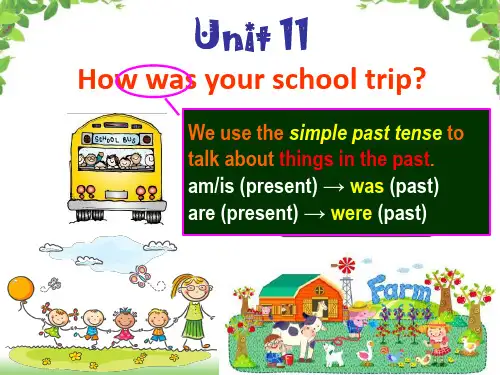
2) 副词 adv. yesterday, luckily 3)动词 v. worry 2. 句型:How was your school trip?
It was great.
Talk about the picture.
unit11 How was your school trip 单元复习课件
5. 他一点也不喜欢这次旅行。
He
like the trip
4. taught; how to
.
5. didn’t; at all
答案: 3. went on
Ⅳ. 词汇串记
My last weekend was 场)in the 3 1 (极好的). We visited a 4 2 (农
Ⅰ. 词汇速记
1. 相当; 完全(adv. ) 2. 种植(v. )
3. 采摘(v. )
4. 担心; 担忧(v. ) 答案: 1. quite 2. grow 3. pick 4. worry
5. farm(v. &n. )
6. lucky(adj. ) 7. paint(v. )
→
→ →
(n. )农民; 农场主
a cow
a horse chickens
6. in the countryside
7. fire station 8. all in all
答案: 1. milk
2. ride
3. feed
4. interested in
5. 许多
6. 在乡下; 在农村7. 消防站
8. 总的说来
Ⅲ. 句型攻关 1. ——你上周的旅行怎么样? — ——棒极了。 your trip last week?
【思路点拨】 (1)体裁: _______。 记叙文 (2)人称: _________。 第三人称 (3)时态: ___________。 一般过去时
【佳作鉴赏】 A Great School Trip
Last weekend all the teachers and students of Class1,
Unit11How+was+your+school+trip+课件22-23学年人教版英语七年级下册

so expensive
Underline (划线) the phrases and the sentences
1.参加学校郊游
go on a school trip
2.沿途
along the way
3.教我们怎么制作机器人 teach us how to make robots
answer the questions.
1. Did Helen and Jim go on the same trip? Yes, they did. They went on the same trip.
2. How do they feel about the trip? Helen thought the trip was really interesting and exciting, but Jim didn’t like the trip at all.
go to the countryside great
A: __H_o_w__w_a_s__ your school trip? B: It was great. A: _W__h_a_t_d_i_d__ you do? B: We went to the countryside.
We had a really good time!
1.Where did Helen go on June 15th? She went to the science museum. 2.How did she go there? She went there By train. 3.Did she learn anything at the science museum? Yes, she did. She learned a lot about robots. 4.What did the guide teach Helen to do? The guide taught her how to make a model robot. 5.Did she take any photos? Yes, she did. She took a lot of great photos. 6.What did she buy for her parents? She bought some lovely gifts for her parents.
Unit11-How-was-your-school-trip复习课件(共40张)

P142
1. We _w_e_n_t_(go) to the cinema last night. The
film _w__a_s_(be) very good.
2.Jim _d_i_d_(do) a lot yesterday. Hew__e_n_t(go) shopping andc_o_o_k_e_d(cook) supper.
last
week
month
term
3.与yesterday 连用:
Monday
yesterday
morning aftern yesterday
第13页,共40页。
4.与one 连用 : (liányòng)
morning
evening
one day
第27页,共40页。
He _________some nice gifts _______ his mother for her birthday last Sunday.
11.昂贵的
12.缓慢的
13.去旅行
→ expensive 反义词 cheap
→ slow 反义词 fast
go on a trip
14.沿途
along the way
15.照相(zhào
take photos
xiàng)
16.给某人买某物 buy sb sth=buy sth for sb
17.总的来说
studied worried
第19页,共40页。
规则(guīzé)动词过去式词尾-ed的读音
读音规则 读 音
在浊辅音和元 音后面
/d/
例词
moved /mu:vd/ played enjoyed
人教版七年级下册英语课件:Unit 11 How was your school trip_Section A(1a-2d) (共39张PPT)
Eric: I weRntefaisdhitnhgeevceorny vdeary.sAatnidonI fed the chickens waigthaimny, tghraenndpfial.lI_it_nw_a_tsh_s_eo_m__u_c_h_f_u_n. Peter: Soubnldasngkosodb.He_lo_ow_w_w_.a_s_t_h_e_w__ea_t_h_e_r_th_e_r_e?
4. Did Eric watch the stars at night? Yes, he did.
2d P62
L1ine.tRg’rosoleusppeslea; ywthhe iccohnvegrrsoatuiopn 2. Rodleopelsaytthhee cboensvetr.sation
A: Did he _ri_d_e__a_h_o_r_s_e last weekend? B: Yes, he did.
2a Listen and check ( ) the questions you hear. P62
___ What did the farmer say? ___ Did you grow any apples? ___ What did you see? ___ Do they grow apples? ___ Did you learn anything? ___ Did you eat them? ___ Did you ask him any questions? ___ Were they good?
1. How was Eric’s trip last week? It was excellent.
人教版七年级英语下册《Unit11Howwasyourschooltrip》SectionB课件1
3aLookatthepicturesofBob’pletehisdiaryentry.
June23rd Yesterdaymyschoolvisitedthezoo.Itwasreally_______.W ewenttherebybus.Atthezoo,Isawalotof________andItook exciting somephotos.MyclassmatesandIalsowenttothe________ animals giftshop __andboughtsome________.Itwasagreatday.
•
1.go-went 2.visit-- visited 3.is— was 4.get— got 5.see— saw 6.learn— learned 7.can— could 8.teach— taught 9.take— took 10.buy-- bought 1tshopandg ifts
lovely soexpensive notexpensive •
June15th TodayIwentonaschooltrip.Wevisitedthescience museumanditwasreallyinteresting.Wegottheres fastbytrain.Wesawsomefarmsandvillagesalong heway.Atthemuseum,Ilearnedalotaboutrobots. didn’tknowtheycouldplaychesswithus.Itwasso ool!Thentheguidetaughtushowtomakeamodelro bot.Itookalotofgreatphotos,too.Afterthat,Iwent othegiftshopandboughtsomelovelygiftsformypa ents.Theyweren’texpensive.Allinall,itwasanex itingday.
河北省石家庄市第四十二中学人教版七年级英语下册教学课件Unit11Howwasyourschooltrip复习课件
3)Mr.Zhang taught us a lot of ___ on the ___.
A
A . farming , farm
B . farmer ,farm
C . farming ,farmer
学校的郊游 去散步 打扫房间 去年 担心某人/某物 有一些担忧 出来 参观博物馆 根本不 爬山 画画
school trip go for a walk clean the room last year worry. about sb./sth. have some worries come out visit a fire station not…at all climb a mountain draw pictures
经典范文
My school trip组
卷网
Last Sunday we had a school trip .We visited the science museum and it was really interesting .At the museum ,we saw lots of things on show and we also learned a lot about robots .They could do lots of things like humans ,and they were so cool .I took a lot of photos ,too .After that ,I went to the gift shop and bought some lovely gifts .They were beautiful but cheap !All in all ,it was an exciting day!
新教材7下unit11How_was_your_school_trip单元归纳AllUPK
2012版新目标英语七年级下Unit 11How was your school trip?单元归纳一.语法:一般过去时1. 用法:表示在过去某个时间或某一段时间内发生的动作或存在的状态。
2. 常用的时间状语,即标志词:yesterday, last night, last week, last year, last Monday, two days/years ago , just now, in 1999, at the age of 5, one day ….3. 常用的句式:1)含有be动词的:肯定句:主语+ was / were + 其它。
否定句:主语+ was/ were + not +其它。
一般疑问句:Was/ Were +主语+ 其他?肯定回答:Yes, 主语+ was/ were.否定回答:No, 主语+ wasn’t/ weren’t.特殊疑问句:疑问词+一般疑问句?2)含有实意动词的:肯定句:主语+ did + 其它。
(did代表动词的过去式)否定句:主语+ didn’t do +其它。
(do代表动词的原形)一般疑问句:Did + 主语+ do+ 其他?肯定回答:Yes, 主语+ did.否定回答:No, 主语+ didn’t.特殊疑问句:疑问词+一般疑问句?4. 动词过去式的构成:规则动词:见课本114页不规则构成:见课本142页二重点词组1.school trip 学校旅行53.luckly you你真幸运。
2.go for a walk 去散步k a cow 给奶牛挤奶4.ride a horse 骑马5.feed chickens 喂鸡6.talk with the farmer和农民交谈7.take photos /a photo拍照8.quite a lot许多9.ask some questions问一些问题10.grow apples种苹果11.show sb. around sp.带某人参观某地12.learn a lot 学到很多13.grow strawberries种植草莓14.from...to... 从…到…15.pick some strawberries摘草莓16.take sth home带…回家st week上周18.visit my grangparents看望我的祖父母19.go fishing 去钓鱼20.so much 如此多的21.so clean 那么干净22.watch the stars 看星星23.go to the zoo去动物园24.go to a farm去农场st year去年26.a lot of fun很多乐趣27.so much fun这么多的乐趣28.climb the mountains 爬山29.a lot of flowers 许多花儿30.eat lunch 吃午饭31.play games 做游戏e out 出来33.visit a museum 参观博物馆34.visit a fire station参观消防站35.go to the countryside去乡下36.go on a school trip参加学校旅行37.science museum科学博物馆38.by train 坐火车39.along the way沿途40.play chess with sb... 和…下棋41.how to do sth 如何做某事42.make a model robot做一个机器人模型43.the gift shop礼品店44.buy sth for sb为某人买…45.all in all总的来说46.take the train to... 坐火车去…47.on the slow train在缓慢的火车上48.be interested in…对…感兴趣49.not...at all 一点也不,根本不50.at the zoo=in the zoo在动物园51.this summer今年夏天52. have a nice weekend有个愉快的周末三.词汇辨析中常用something 。
Unit 11 单元知识点复习课件 人教版七年级英语下册
5. quite a lot 相当多;许多 ✓ quite 作副词,意为“相当;完全”。 ✓ a lot 后面不能直接跟名词,a lot of 相当于lots of,其后可接可数名词复数或不可数名词。 ✓ quite a lot意为“许多”,如果后面接名词, 则用quite a lot of。
【辨析】quite与very
walk作动词,“走路;散步”,后接地点名 词时,要加上介词to,其后接here,there,home 等地点副词时,不加介词to。
Your home is near the school, so you can walk home. We walk to school every day.
2. milked a cow 给奶牛挤奶 ✓ milk 在此处作动词,意为“挤奶”。
拓展not at all单独使用时的用法: ① 可作为当别人表示感谢的应答语,意为“不
客气;不用谢”。 — Thank you very much. — Not at all.
② 可作为别人称赞或带感谢性质的客套语,意 为“别客气”。 — It’s very kind of you. — Not at all.
含义
总的来说
all in all
总共,合计
句子位置/适用句型
常用于句首 句首或句末
in all at all
根本
常用于否定句中 not (…) at all 根本不
他们总共筹集了一万元。 They raised 10,000 yuan _i_n_a_l_l__.
总的来说,她是一位优秀的老师。 __A_ll__in__a_ll_, she is an excellent teacher.
_________ .