
(广州沈阳通用)八年级英语上册Module4SchoollifeUnit7Memory(第3课时)语法课件牛津深圳版
9._If__ my grandma wears glasses, she can see better.(用 if 或 unless 填空) 10.I won’t buy that backpack _u_n_l_e_s_s _ it costs less than ¥20.(用 if 或 unless 填空)
主现从现句型。 【解析 2】
(1)If the temperature falls to below zero, water turns into ice. 如果气温降到零度以下, 水就会结成冰。 (2)The weather gets cool if there is a heavy rain in summer. 在夏天如果下一场大雨,天 气会变凉快。 【讲解 2】从以上两个句子可以看出,表示条件的从句用一般现在时,用 if 引导,表示
A.Unless
B.If
C.Though
( A )3.I won’t come to see you ________ I am asked to.
A.unless
B.because
C.if
( B )4.—Do you know when he will come back tomorrow?
—Sorry, I don’t know. When he ______ back, I’ll tell you.
b.you’ll remember to get all the things.
3.If you write a shopping list,
c.they’ll tell you what homework to do.
4.If I see him,
d.you’ll find out its meaning.
【讲解 1】从以上两个句子可以看出表示条件的从句用一般现在时,用 if 引导;表示结
果的主句用:一般将来时,这种句型简称为主将从现句型。
【小试牛刀】连线搭配完整句子。
1.If you go to bed earlier,
a.I’ll tell you.
2.If you telephone your classmates,
A.if
B.because
C.unless
二、按要求完成下列句子。
1.Dr. Wang will give us a talk if it is fine tomorrow.(同义句转换) Dr. Wang __w_i_ll_n_o_t__ give us a talk _u_n_l_e_ss__ it is fine tomorrow.
A.is
B.isn’t
C.will be
( B )7.If you______ carefully, you ______ the report well.
A.will listen ; will be understood
B.listen; will understand
C.will listen ; understand
可以用_w_h_e_n_来替代。如:When/ If I am hungry, I usually have a full meal.
【总结 2】 (1)if 从句可以放在句首,也可以放在句末。如果把 if 从句放在句首,常用逗号将其与 主句隔开。如: If it is fine tomorrow, we will go out. We will go out if it is fine tomorrow. 如果明天天气好,我们将去郊游。 (2)if 引导的条件状语从句中通常不用一般将来时。在需要表达将来含义时,一般用 现在时表示。
(3)如果条件和结果之间存在必然联系时,所表示的是客观事实,必定会发生的结果 时,如自然现象、客观真理等,通常用主现从现句型表示;如果条件和结果之间 没有必然联系,所表示的只是个人想ห้องสมุดไป่ตู้和行为,可能会发生的结果时,通常用主 将从现句型表示。
【语法要点二】由 if…not / unless 引导的条件状语从句
—If you _________ too many sweets, you ________ better.
A.eat; feel
B.stop eating; will feel
C.will eat; feel ( C )10.The art club is for members only. You can’t go in ______you are a member.
A.will come
B.comes
C.come
( B )5.—Would you like to go shopping with us tomorrow?
—Sure, ________ I am busy.
A.since
B.unless
C.when
( B )6.She will come to help us if she _________ too busy tomorrow.
Unit 7 Memory
第3课时 语法
栏目导航
课时精讲 课时过关 课后拓展
课时精讲
【语法要点一】由 if 引导的条件状语从句 主将从现句型。 【解析 1】
(1)If it doesn’t rain tomorrow, I’ll go for a picnic with you. 如果明天不下雨,我就和你 去野餐。 (2)He will stay if you need his help. 如果你需要他的帮助,他会留下来。
a.it melts. b.it dies. c.they grow. d.it turns into ice. e.it floats. f.it breaks. g.it becomes steam.
【小结 2】 当谈论客观真理和普遍现象时, 主句和从句都用___一__般__现__在____时。在这种情况下, if
3.Unless you keep ice-cream in a fridge, it melts. =_I_f_ you _d__o_n_’t_ keep ice-cream in a fridge, it melts.
4.You will lose marks in the exam unless you improve your handwriting. = You __w_i_ll_l_o_s_e__ marks in the exam_i_f_ you _d_o_n_’_t_ improve your handwriting.
5.If you look it up in the dictionary,
e.you’ll not feel tired in the morning.
【小结 1】 当谈论将来可能出现的情况时, 主句用一般将来时, 从句用__一__般__现__在__时, 也就是:
“主___将___从__现____”。
2.People get tired if they work for a long time.(同义句转换) People __w_i_ll_n__o_t _ get tired _u_n_l_e_ss__ they work for a long time.
3.Linda will have free time. She’ll take memory lessons.(合并句子) Linda will take memory lessons _i_f_ she _h_a_s_ free time.
【解析 3】 (1)If you do not work hard, you will not succeed. 如果你不努力工作,你就不会成功。 (2)Unless you work hard, you will not succeed. 除非你努力工作,否则你不会成功。
【讲解 3】从以上两个句子可以看出 unless 意为“除非”,和 if…not(如果……不……)的 意思相近,可以互换使用,用于引出某事发生或成立所必需的条件。在 unless 引导的从句中,通常用一般现在时,主句用一般将来时。
( C )8.I’m waiting for my friend. _________, I’ll go shopping alone.
A.If she comes
B.If she will come C.If she doesn’t come
( B )9.—Mum, my tooth hurts so much.
【小试牛刀】翻译下列句子。 1.Don’t come in unless I call you.
__不__要__进__来__,__除__非__我__叫__你__。_______
2.My father won’t take me there unless I get good marks. _我__父__亲__是__不__会__带__我__去__的__,__除__非__我__拿___到__好__成__绩__。__
6.You will feel worse unless you take more exercise.(用 if 改写句子) You _w_o_n_’_t_ feel worse _i_f_ you take more exercise.
7.Unless you are careful, the car may hit you.(用 if 改写句子) _I_f_ you are careful, the car _m__a_y_n_o_t_ hit you.
八年级上册英语第四单元

八年级上册英语第四单元The Fourth Unit of Eighth Grade English Textbook: Unit 4In the eighth grade English textbook, the fourth unit covers various topics that aim to enhance students' English language skills. This unit primarily focuses on expanding vocabulary, practicing grammar, and improving reading and writing abilities. Let's explore the different components of this unit in detail.Vocabulary Expansion:The first part of Unit 4 concentrates on expanding students' vocabulary. It introduces new words and phrases related to different themes such as travel, food, and hobbies. The unit includes exercises and activities to help students grasp the meaning and usage of these words. It also encourages students to use the newly learned vocabulary in conversations and written exercises to reinforce their understanding.Grammar Practice:The second part of Unit 4 provides a comprehensive review of various grammar topics. Students will revise and practice the usage of tenses, adjectives, adverbs, and sentence structures. The unit emphasizes the correct usage of grammar rules through exercises, examples, and discussions. Students will engage in activities that promote the application of grammar in practical contexts.Reading Comprehension:The third part of Unit 4 focuses on improving students' reading comprehension skills. It includes a variety of interesting texts such as stories, newspaper articles, and informational texts. These texts are chosen to engage students and expose them to different genres. Students will practice reading, understanding the main ideas, identifying supporting details, and making inferences. The unit also provides exercises and questions to assess students' comprehension and critical thinking abilities.Writing Skills:The fourth part of Unit 4 aims to enhance students' writing skills. It includes writing prompts, guidelines, and examples to guide students in various writing tasks. Students will learn to write descriptive paragraphs, opinion essays, and formal letters. They will focus on organizing their ideas, using appropriate vocabulary, and structuring their writing. The unit encourages students to express their thoughts and opinions effectively through writing.Listening and Speaking:The fifth part of Unit 4 focuses on developing students' listening and speaking abilities. It includes audio materials and activities to improve students' listening comprehension. Students will practice listening to conversations, speeches, and interviews, and answering questions based on the audio clips. In addition, the unit includes speaking exercises that encourage students to communicate in English, express their opinions, and participate in discussions.Cultural Awareness:Unit 4 also incorporates cultural awareness activities. It introduces students to different aspects of English-speaking cultures, such as traditions, festivals, and famous landmarks. These activities promote cultural understanding and encourage students to appreciate and respect diverse cultures.In conclusion, the fourth unit of the eighth-grade English textbook provides a comprehensive approach to English language learning. It covers vocabulary expansion, grammar practice, reading comprehension, writing skills, listening and speaking, and cultural awareness. Through various exercises and activities, students are given opportunities to develop their language skills, express their thoughts, and engage in meaningful communication.。
八年级上册英语第四单元
八年级上册英语第四单元以下是人教版八年级上册英语第四单元的部分内容及中文意思:Unit 4 What's the best movie theater?Section A1. - What's the best movie theater?- Town Cinema. It's the closest to home. And you can buy tickets the most quickly there.- Which is the worst clothes store in town?- Dream Clothes. It's worse than Blue Moon. It has the worst service.- What do you think of 970 AM?- I think 970 AM is pretty bad. It has the worst music.中文译文1. - 最好的电影院是哪家?- 城镇电影院。
它离家最近。
你可以在那里最快地买到票。
- 镇上最差的服装店是哪家?- 梦幻服装店。
它比蓝月亮还差。
它的服务最差。
- 你觉得970 AM 怎么样?- 我认为970 AM 相当差。
它的音乐最差。
Section B1. Everyone is good at something, but some people are truly talented. It's always interesting to watch other people show their talents. Talent shows are getting more and more popular. All these shows have one thing in common: They try to look for the best singers, the most talented dancers, the most exciting magicians, the funniest actors and so on. All kinds of people join these shows. But who can play the piano the best or sing the most beautifully? That's up to you to decide. When people watch the show, they usually play a role in deciding the winner. And the winner always gets a very good prize.中文译文1. 每个人都有擅长的事情,但有些人确实有天赋。
广州沈阳通用八年级英语上册Module4SchoollifeUnit7Memory第3课时语法课件牛津深圳版
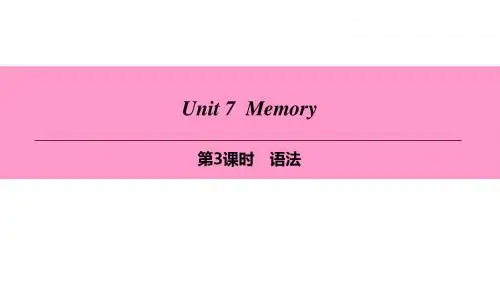
5.If you look it up in the dictionary,
e.you’ll not feel tired in the morning.
【小结 1】 当谈论将来可能出现的情况时, 主句用一般将来时, 从句用__一__般__现__在__时, 也就是:
“主___将___从__现____”。
【小试牛刀】翻译下列句子。 1.Don’t come in unless I call you.
__不__要__进__来__,__除__非__我__叫__你__。_______
2.My father won’t take me there unless I get good marks. _我__父__亲__是__不__会__带__我__去__的__,__除__非__我__拿___到__好__成__绩__。__
3.Unless you keep ice-cream in a fridge, it melts. =_I_f_ you _d__o_n_’t_ keep ice-cream in a fridge, it melts.
4.You will lose marks in the exam unless you improve your handwriting. = You __w_i_ll_l_o_s_e__ marks in the exam_i_f_ you _d_o_n_’_t_ improve your handwriting.
【小结 3】 unless 引导条件状语从句,意思是:_除__非___, 可以用 if… not 转换。
可以用_w_h_e_n_来替代。如:When/ If I am hungry, I usually have a full meal.
2019教育秋牛津深圳版(广州沈阳通用)八年级英语上册10分钟课堂课件:Module4 Unit8 English Week(共116张
要点精讲 思维导图
第1课时 Vocabulary 【要点7】 communicate
要点精讲 举例 We learn a language in order to communicate. 我 们学习语言是为了交流(思想)。 You are learning something, so communication is needed. 你正在学习,所以交流是必需的。 In life, you have to communicate with others. 一生 中,你必须和别人交流。
_S_o_m_e__s_tu_d_e_n_t_s_p_u_t_o_n_a_n__E_n_g_l_is_h_p_l_a_y_. _O_th_e_r_______
4st.u我de建nt议s t人oo们k 讲pa得rt 慢in一an点E。ng(liasdhvsisinegsinbg.
competition. to do sth. )
要点精讲 思维导图
第1课时 Vocabulary 【要点5】advise
要点精讲 举例
I will do as you advise. 我会按照你建议的行事。 Take my advice and stay away from him!听我的忠 告,离他远点! I advise you to be careful. 我劝你要小心谨慎。
要点精讲 举例
Her spoken English is not very good. 她的英语口语 不是非常好。
要点精讲 应用
(1) He can _s_p_e_a_k__________ (speech) French very well. (2) I want to improve my _s_p_o_k_e_n______ (speech) English.
牛津深圳版(广州沈阳通用)八年级下学期UNIT 4 练习题

1. Good books ______again and again.A. should be readedB. should be readC. must readD. ought to read2.So far, the moon ____ by man already.A. is visitedB. will be visitedC. has been visitedD. was visited3. People who______to the party are very excited.A. have invitedB. has been invitedC. will inviteD. have been invited4. With the help of the people around China, many beautiful new buildings______here and there in the earthquake-hit area in Sichuan.A. can seeB.can be seenC. will seeD. see5. Half of the work ______by now.A.has finishedB.has been finishedC. have been finishedD. finished6. The books may______for a month.A.be keptB.be borrowedC. keepD. borrow7. --How many Chinese astronauts into space since 2003?--Twelve, including two women.A. were sentB. sentC.have been sentD. have sent8. In the past few years, thousands of films______all over the world.A. have producedB. have been producedC. are producingD. are being produced9.To make our city more beautiful , rubbish ______into the river .A. needn’t be thrownB. mustn’t be thrownC. can’t throwD. may not throw10.The children must .A. look afterB. be taken good careC. look the sameD. be taken good care ofKey:1-5 BCDBC 6-10 ACBBDUnit 41. The film ________ (show) many times since last Sunday.2. ________ the book ________ (return)?3. Information in short-term memory ________ (can, not, keep) very long4. Your homework must ________(hand) iin today.5. Can the book ________(read) out of the library?Key :1.has been shown 2.Has returned 3.can ’t be kept 4.be handed 5.be read1. 这台电视这儿能修理。
牛津深圳版(广州沈阳通用)八年级英语上册课文翻译
牛津深圳版(广州沈阳通用)八年级英语上册课文翻译Dinosaurs are a group of reptiles that lived on Earth for over 60 n years before XXX of the world and came in different sizes。
Some were as tiny as chickens。
XXX。
XXX flying.Dinosaurs lived on Earth over 60 n years ago。
inhabiting us ns of the。
Some were as small as chickens while others were as large as ten elephants and some could even fly.While many dinosaurs were herbivores。
XXX.Dinosaurs lived on Earth for over 150 n years before XXX remains unknown。
but we can learn about them through their fossils.Once upon a time in India。
there was a king who loved playing chess。
One day。
a wise old man came to his kingdom and the king challenged him to a game。
promising the old man any prize he desired if he won。
The old man requested one grainof rice for the first square of the chessboard。
two for the second。
Module4Unit7课文原文及翻译牛津深圳版八年级英语上册
沪教版八年级英语上册课文原文及翻译Module 4 Unit 7 Module 4 School life Unit 7 MemoryReadingHenry, Paula and Millie write for the school newspaper.They have written the short articles below to help students improve their memory.Memory CornerHenry A great way to help you remember something is to imagine a picture of it in your mind.If you make the picture big, strange or silly, you will remember it better.For example, to remember the word “smiles”,we can imagine there is a “mile” between the first letter and the last letter.This makes it the longest word in the world.Remember.A picture is worth a thousand words.Paula A good method for remembering the spelling of a word is to make a short sentence with each letter of the word.For example, if you want to remember how to spell the word “because”,you can use the sentence “Big elephants can always understand small elephants”.Millie You will forget something very quickly unless you understand it well.For example, you may have trouble remembering the list of steps in the water cycle.However, it is easier to remember these steps if you understand how the water cycle works. 亨提,保拉和米莉写的校报。
Module4Unit1-2024-2025学年初中英语八年级上(外研版)上册教案
Module 4 Planes, ships and trains一、学习目标:A. 单词和短语:road, accident, except, far, far away, crowded, choice, classmate, all the time, journey, book, outside, close, park, however, costB. 交际用语:1. What happened?2. Don’t worry.3. —Who lives the closest to school?— Lingling lives closest.4. — What is the most comfortable way to go to school for Betty?— By taxi.5. —What’s the most expensive way to go to school?— Going by taxi is the most expensive.6. How do you get there?7. What’s the cheapest way?8. What’s the best way to get there?9. —What’s the cheapest way to travel from London to Paris?— The cheapest way is by coach.10. It’s the most comfortable way, but it’s the most expensive.11. He lives farthest from school.12. It is the fastest and the second cheapest.13. The more information, the better.C. Skills: 1) Listening and understanding familiar topics (transportation)2) Comparing modes of transportation.3) Reading and finding specific transportation4) Writing a short passage comparing modes of transportation.D. Around the world: The longest railwayE. Task: Making a holiday plan for a family trip to a city in China.二、重点及难点:Superlative adjectives and adverbs (-est, most); irregular superlatives.三、教学设计:Unit 1 He lives the farthest from school.ⅠTeaching modelListening and speakingⅡTeaching methodPWP approachⅢTeaching aims1. Key vocabulary: road, accident, except, far, far away, crowded, choice, classmate,close, all the time2. Key structures:superlative adjectives and adverbs (-est, most); irregularsuperlatives.3. Key sentences:1) What happened?2) Don’t worry.3) — Who lives the closest to school?— Lingling lives closest.4) — What is the most comfortable way to go to school for Betty?— By taxi.5) —What’s the most expensive way to go to school?— Going by taxi is the most expensive.ⅣTeaching aidsTape recorder, OHP, videoⅤTeaching StepsStep 1 Warming-up1. Work in pairs. Show some pictures and ask “How do you often go to school/work?”“How do you often travel?”2. Look and say something about the pictures.Step 2 New wordsUsing pictures or sentences to learn the new words.Step 3 Listening and vocabulary1. Ask the students to read the words in Activity 1.2. Look at the pictures in Activity 1 carefully.3. Now match the words with the pictures.5. Check the answers with the students.Step 4 Look, listen and match.1. Ask the students to read the words in Activity2.2. Play the recording and ask the students to listen to the recording carefully.T: Listen and match the words in the box with the pictures in Activity 1. You need to use one word more than once.3. Check the answers with the students.Step 5 Reading1. Listen and answer the questions.1) How does Lingling go to school? Why?2) How do you think Betty will go to school?2. Ask the students to read the conversation silently.3. Ask the students to read the conversation again and complete the table.3. Check the answers.Step 6 Complete the sentences.1. Ask the students to read the words in the box in Activity 4.2. Read the sentences.1) The _________________ way to go to school is by taxi.2) Tony lives the __________ from school.3) Lingling’s home is the _________ to school, so she always walks.4) For Betty, going to school by bike is the ______ choice.3. Complete the sentences with the correct words from the box.4. Check the answers.Step 7 Language points1. Maybe I should go to school by taxi. 或许我应该坐出租车去上学。
牛津深圳版(广州沈阳通用)八年级英语上册 期末连词成句总复习(无答案)
连词成句总复习1. born, 1940s, he, in, was, the ( . )_______________________________________2. learn, we, from, can, about, dinosaurs, fossils, their( . ) _____________________________3. lived, 1425, he, from, 1519, to( . ) _____________________________________________4. they, do, any, have, questions ( ? ) _____________________________________5. have, may, some, I, noodles ( ? ) _____________________________________6. do, bread, we, not, any, have ( . ) _____________________________________7. not, there, anybody, the, in, is, room(.)___________________________________8. by, there, the, is, anybody, window ( ? ) ___________________________________9. English, us, important, is, to ( . ) _____________________________________10. great, is, help, it, with, a, studies, your( . ) _______________________________11. as, dinosaurs, big, are, as, elephants( . ) _________________________________12. king, to, the, him, a, challenged, game ( . ) _______________________________13. ordered, king , his, the, men, collect, to, rice ( . ) ___________________________14. Jim, a, me, promised, present ( . ) _____________________________________15. promised, Jim, my, to, advice, follow ( .) ________________________________16. not, he, any, was, lazy, more ( . ) _____________________________________17. 12, equals, 3, plus, 9 ( . ) _____________________________________18. 3, is, minus, 9, 6 ( . ) _____________________________________19. 3, equals, 9, multiplied, 27, by ( . )_____________________________________20. by, 3, equals, 9, divided, 3 ( . ) _____________________________________21. can, calculate, we, computers, to, use ( . )________________________________22. do, computers, what, with, can, we ( ? ) _______________________________23. may, unaware, you, be, of, them. ( . ) _______________________________24. for, attending, thank, the, you, meeting ( . ) _______________________________25. father, smoke, to, my, used ( . ) _______________________________26. bad, is, health, it, for, our ( . ) _______________________________27. Tom, too, time, much, playing, spends, computer, games( . ) ____________________________28. had, stop, we, better, animals, people, killing, from ( . ) ________________________________29. bag, is, than, my, expensive, yours, more ( . ) ________________________________________30. laptop, the, is, among, red, beautiful, the, most, three ( .)________________________________31. perhaps, is, wheel, the, the, greatest, history, invention, in(.)________________________________________________________________32. allow, each, other, they, with, to, people, keep, in, touch ( . )________________________________________________________________33. change, way, inventions, our, life, of ( . )__________________________________________________________________34. people , ballpoint pen, use, over, all, world, the, every, day(.)__________________________________________________________________35. help, inventions, people, a, life, better, live( . )_____________________________________________________________________ 36. Unit 4, important, one, the, of, lessons, is most ( . )_____________________________________________________________________ 37. we, English, speak, as, can,often, as, we,should (.)_____________________________________________________________________ 38. people, mobile, phones, the, world, across, own (.)_____________________________________________________________________ 39. got, a, who, better, in, English, mark?_____________________________________________________________________ 40. in, home, I, glad, be, a, to, their, am, guest(.)_______________________________________________41. Chinese, they, little, me, a, are, teaching(.)__________________________________________________________________ 42. with, students, weekdays, the, spend, us, the, studying(.)__________________________________________________________________ 43. families, they, Beijing, around, their, with, host, tour(.)__________________________________________________________________ 44. experience, has, far, fantastic, been, a, so, it(.)__________________________________________________________________ 45. introduced, teachers, to, Chinese, the, us, painting, have(.)__________________________________________________________________ 46. touch, my, I, to, in, new, friends, with, play, keep(.)__________________________________________________________________ 47. can’t, I, to, them, wait, meet(.)__________________________________________________________________ 48. the, has, gone, educational, well, exchange(?)__________________________________________________________________ 49. us, something, we, with, bring, should(?)__________________________________________________________________ 50. UK, have, I, the, been, never, to(.)__________________________________________________________________ 51. has, seen, Sarah, the, Wall, not, yet, Great(.)__________________________________________________________________ 52. visited, she, Tower, Bridge, has, ever(?)__________________________________________________________________ 53. you, waiting, what, are, for(?)__________________________________________________________________ 54. can, experience, culture, you, a, different(.)55. have, up, now, they, given(.)__________________________________________________________________ 56. capture, have, for, they, years, to, city, ten, tried, our(.)__________________________________________________________________ 57. it, Greeks, the, want, them, to, take, didn’t, with(.)__________________________________________________________________ 58. it, a, succeeded, through, they, capturing, trick, in(.)__________________________________________________________________ 59. since, haven’t, this, I, like, childhood, my, laughed(.)__________________________________________________________________ 60. can, get, we, town, to, faster, the(.)__________________________________________________________________ 61. to, soldier, my, be, a, is, dream(.)__________________________________________________________________ 62. prize, class, our, won, has, first(.)__________________________________________________________________ 63. afraid, Trojans, were, they, of, the(.)__________________________________________________________________ 64. the, jokes, they, Greeks, made, stupid, about(.)__________________________________________________________________ 65. men, stole, of, his, a, gold, Sparta, lot, from(.)__________________________________________________________________ 66. since, have, I, ten, worked, ago, here, years(.)__________________________________________________________________ 67. years, grandma, for, dead, his, been, two, has(.)__________________________________________________________________ 68. came, to, they, ten, city, ago, years, our(.)__________________________________________________________________ 69. Greece, I, been, to, never, have(.)__________________________________________________________________ 70. is, interesting, it, for, Tom, to, basketball, play (.)______________________________________________________________ 71. write, they, for, the, newspaper, school,(.)________________________________________________________________ 72. makes, this, it, the, longest, world, in,word, the ( . )__________________________________________________________________ 73.picture, is , a ,words, worth, thousand(.)__________________________________________________________________ 74. we, won’t, to, party, the, go, unless, invites, he, us(.)75.if , put, salt, you, water, into,disappears, it(.)__________________________________________________________________ 76. you, if, wood, water, put, into, it, floats(.)__________________________________________________________________ 77.will, late, be, you, school, for, unless, now, leave, you(.)_____________________________________________________________________ 78. was, a, there, also, competition, speaking(.)________________________________________________________________ 79. Tom, so, is, he, that, happy, won ( . )________________________________________________________________ 80. gave, it, a, me, to, chance, words, learn, new( . )__________________________________________________________________ 81. advise, to, people, I, slowly, speak( . )__________________________________________________________________ 82. had, you, go, better, see,and, a doctor.( . )__________________________________________________________________ 83. took, students, an, part, in, singing, English, competition ( . )__________________________________________________________________ 84. head, the, teacher, gave, speech, a, the, to, school,whole ( . )__________________________________________________________________ 85. ought, read, to, you, more, read, books, English ( . )__________________________________________________________________ 86. it, should, we, now, discuss ( ? )___________________________________________________________________________ 87. knows, Tim, nobody, was, why, angry ( . )___________________________________________________________________________。
+期中Units1-4单元作文范文 牛津深圳版(广州沈阳通用)八年级英语上册
八年级英语1-4单元作文范文Unit 1Thomas Edison is one of the greatest inventors and scientists in the world.He was born in the United States in February, 1847. At the age of 8, he went to school. From an early age, he was interested in science and showed great intelligence. Edison worked hard all his life, often working day and night. He had more than 2,000 inventions, including the electric light, the phonograph and so on. His inventions changed the world. He died in 1931 at the age of 84.From him, we learn that the secret to success is not when or where you were born, but what you are doing and how you will do it in your life, just as his famous saying “Genius is one percent inspiration and ninety-nine percent perspiration.”.Unit 2Activities on HolidaysOur school carried out a survey on students’holiday activities recently. The results are as follows:30 percent of the students study by themselves during the holidays. They read books or do their homework. 30 percent of the students chat or play games online. Then, 25 percent of the students watch TV or listen to some music. 10 percent of the students like to do some sports, such as playing basketball and football. There are still 5 percent of the students. They travel or do some voluntary work.In my opinion, we should have a meaningful holiday. Don’t spend too much time playing online games. We should make good use of the holidays.Unit 3As we all know, computers play an important role in our daily lives. But every coin has two sides.On one hand, computers make our lives convenient. For example, we can use computers to solve difficult problems, and gain more knowledge at a fast speed. They can also help to open up our eyes to the outside world. On the other hand, computers truly bring some problems. Some students spend too much time playing computer games and making friends online. It is harmful to their health and study. What's more, if we depend on computers too much, we will be lazy and it will be difficult for us to be independent thinkers.From my point of view, we should use computers in a right way. We had better not use computers on weekdays. During holidays, we can surf the Internet to look for useful information.Unit 4Science and technology is very important to the development of a country.Shenzhen is well-known as a city of technology and innovation. Last month, our school held the science festival. It was very exciting. Let me tell you something about it.During the festival, we enjoy the Robot Show. We saw all kinds of robots on the playground. Some of them could even talk to us. We also made and launch the rockets. Many of the students took part in this activity. One of our students invented a Cook Robot. It could make cakes and fry potatoes for us. I tasted the cake, and it was delicious. Some of the students in Grade 9 invented a driverless bike. It could move itself. We were amazed at that. Some invented a special desk, which could be a bed when we wanted to sleep at noon.This science festival was very successful. Students know the importance of science and become more and more interested in science and technology.假如你是李华,你的美国朋友Tony 对中医很感兴趣。