
四年级英语上册:Unit 7《At school》(第1课时)
Summary
学校设施类单词: school, classroom, library, office, playground, toilet 描述某处有某物: There is/are + 某物 (+ 其他)。
Homework
1. 听录音,跟读单词。 2. 抄写单词4遍英语,1遍汉语。 3. 预习Listen and say。
=There aren’t any cars in the city.
按要求改写下列句子。
There is a plate on the desk. (改为否定句) —Th—er—e i—sn—’t a—p—la—te—on—th—e—de—sk—. —————— There aren’t any students in the classroom. (改为肯定句) T—he—re—a—re—so—m—e —stu—d—en—ts—in—th—e c—la—ss—ro—om—. —
There’s a library in our school. There are many classrooms in our school. There be句型遵循就近原则。 There is + 单数名词 + 其他。 re填空.
There __i_s__ a playground in our school. There __a_re__ four offices in our school. There __a_re__ many buildings in the city. There __i_s__ a boy in the shop.
Do you know?
There’s a cat in the house.
There are some cars in the city.
变否定句时,要在is/are后面加not。 There is not cat in the house。
=There isn’t a cat in the house。 There are not some cars in the city。
playground
Do a survey
There are twenty-four classrooms in my school. There’s a computer room …
Let’s talk
There are twenty-four classrooms in my school. There’s a computer room …
Module2 My family, my friends and me
Unit7 At school
第1课时: Look and learn Do a survey
Sing a song
Free talk
Do you like our school?
school
Look and learn
What’s in our school? There are many classrooms in our school.
classroom
Look and learn
What’s in our school? There are some offices in our school.
office
Look and learn
What’s in our school? There are some toilets in our school.
toilet
Look and learn
What’s in our school? There’s a library in our school.
library
Look and learn
What’s in our school? There’s a playground in our school.
Do you know?
There’s a library in our school. There are many classrooms in our school.
There be结构: There is/are + 某物 (+ 其他)。 There be句型表示某地有某物。
Do you know?
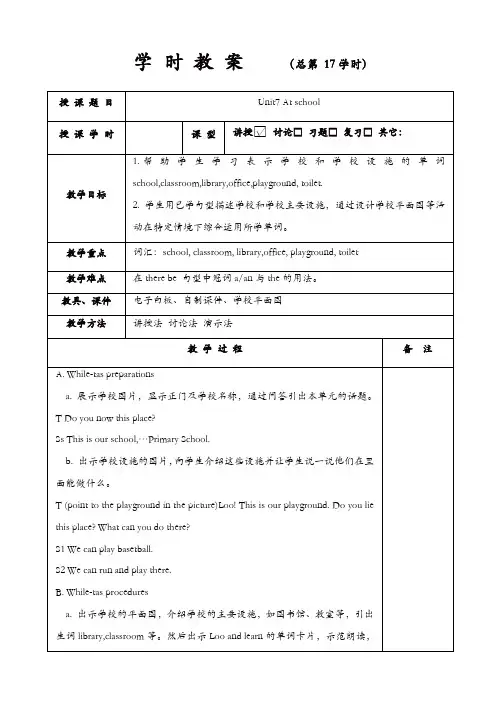
沪教版牛津英语四年级上册Unit 7 At school(教案)

了解字母o在开音节中的发音。
词汇:school, office, busy, computer, man, library, playground, classroom, toilet, animal, pupil, try.
句型:There is/ There are...
教学难点
在there be句型a/an与the的用法
T; What food do you like?
Ss: I like ...
T: What do you like doing?
Ss: I like...
T: What can you do?
Ss: I can ...
T: Can you ...?
Ss: Yes, I can. No, I can’t.
教学目标
掌握本单元的核心词汇
能用There is/ There are...句型简单描述学校设施及功能。
能正确运用That’s not true. Come on! Go and try!等日常用语来表达观点、鼓励别人。
能正确读出元音字母o在开音节中的发音。
热爱学校,树立自信心,培养关心、鼓励、帮助他人的思想。
Ss: He’s a fireman.
播放录音,跟读单词,P35.
Learn the new words. Listen and repeat.
school, classroom, library, office, playground, toilet.
播放录音,跟读语段。P34引出重点句型。
There’s a computer room.
Mr Owl: What’s the matter?
Rabbit: I’m sad. I can’t swim and I can’t climb trees. I’m not a good pupil.
小学英语沪教版四年级上册《Unit 7 At school》教案

Module 3 Places and activitiesUnit 7 At school教材分析本课是教材Module 3 Unit 7的教学设计。
本单元的语言功能项目是To revise vocabulary and expressions to describe “At school”.主要话题是The students are able to use the key words correctly, 本课内容贴近学生的生活和学习实际,为学生操练对话创设了一个真实的语言情景,有利于学生在比较接近实际的情景中听听说说,从而培养他们运用英语进行交际的能力。
教学目标【知识目标】1. To revise vocabulary and expressions to describe “At school”.2. To guess meaning from context.3. The students are able to use the key words correctly.【能力目标】To use the sentences in context.【情感目标】利用多种游戏或活动形式培养学生对英语学习的浓厚兴趣。
教学重难点【教学重点】The students are able to use the key words correctly.【教学难点】通过阅读活动,引导学生通过阅读抓住关键信息,了解故事大意,通过角色扮演,让学生巩固和运用本单元所学核心词汇和句型。
课前准备Tape recorder, Multimedia.教学过程Step 1. Warm up1. Listen and sayFree talkT: What do you know about “At school”?Look at the pictures on P34 and PPT. Talk about “At school”. Encourage them to talk about the topic. To introduce them to the topic.2. ListeningPlay the listening materials, stop when necessary. And then check the answers.To train the students’ ability of catching the information of the listening materials.Step 2. Presentation1. Look and learnLead them to read and explain the “At school”.My school is beautiful, what about you?To review the related knowledge.2. Make and say(1) Learn the rules in P35.(2) Finish the exercise on P35 and group work to work out the usage method of the “At school”.(3) Walk around to exam the situation and check the answers for them.(4) List the method of for them.To develop their interest and lead them to the conclusion.Step 3. Practice1. Say and actLet the students look PPT and act the scene.To make them get familiar with the details of the text and train their ability of saying and reading.2. Learn the letters(1) Learn the letters in P37.(2) List the letters for them. To develop their interest and lead them to the conclusion.Step 4. Homework1. Dictation.2. Use the new words to make sentences on your own or check them in a dictionary.。
2017秋上海教育版英语四年级上册unit_7《at_school》教案【精品】
2) What’s in her school?
(There’s a playground, a computer room, many classrooms and a library in it.)
3) What can the students do in the library?
教学目标
1.学生在正确认读单词的基础上,通过阅读Listen and say的语段,了解如何用核心句型There is/are…介绍学校不同的设施。
2.通过As and answer问答练习,帮助学生操练There are…句型。
教学重点
词汇:busy, many
句型:There’s a computer room. There’re many computers.
(They can read boos in the library.)
c.将学生分成四人一组,教师在黑板上出示学校各种设施的图片,要求学生先在小组内用There is/are…等句型介绍,随后邀请部分小组成员上与全班交流。
d.出示Loo and learn的图片,用本单元所学There is/are…等句型进行介绍,并顺势提问:What’s in our school?让学生试着回答。然后要求学生两人一组结对,根据As and answer的范例进行问答练习。
S1 What is No. What can you do in the library?
S2 I can read boos in the library.
B. While-tas procedures
a.出示学校的图片,用新句型There is/are…介绍学校的设施,并板书新句型,让学生跟读。
牛津上海版(深圳)四上unit 7《at school》(第1课时)ppt课件

4.如图所示是某学校为学生配备的智能学生
证。智能学生证除了记录学生个人信息资料
外,还具有定位(判断学生“在校”或“离
校”)及紧急呼救等功能。智能学生证实现
定位或呼救功能时,主要是利用( )
A.超声波
B.次声波
C
C.无线电波 D.红外线
5.在地震救灾中,我们利用“北斗卫星导航
系统”对发生灾情的位置进行定位,卫星导
教学目标
1.知识与技能 (1)了解电磁波的产生和传播; (2)知道光是电磁波,电磁波在真空中的 传播速度; (3)知道波长、频率和波速的关系。
教学目标
2.过程与方法 (1)通过演示了解电磁波的存在,电磁波在 真空中的传播; (2)通过观察图表,认识电磁波在不同波段 有不同的作用。 3.情感态度与价值观
声音的传播靠固体、液体、气体等 介质,电磁波的传播需要介质吗?
把一个移动电话放在真空 罩中,并给这个移动电话打电话。 这个移动电话能够收到此信号吗?
由实验可以看到,放在真 空罩中的移动电话可以收到罩 外传给它的电磁波。这说明电 磁波在真空中可以传播。
月球上没有电磁波,声音无法传播。 但是电磁波可以在真空中传播。所以宇航 员在月球上可以用电磁波通信。
由于微波可以 深入食物内部,所 以用微波炉烧饭时 食物的内部和外部 几乎同时变熟、省 时、省电。
食物中的水分子比其 他分子更容易吸收微波 的能量,所以含水量高 的食物在微波炉中温度 上升更快。微波炉中不 能使用金属容器,因为 会损坏微波炉。
微波同其他频率的电 磁波一样,过量的照射对 人体有害。微波炉的外壳 是金属壳,炉门的玻璃上 有金属屏蔽网,可以减少 电磁波的泄漏,使炉外的 电磁波不超过允许值。
2.下列说法错误的是( D ) A.无线电波的传播也是能量的传递 B.我们生活的空间充满电磁波 C.雷达利用电磁波监测空中目标 D.雷雨天打雷时,收音机中发出的“咔、咔 ”声,是由于雷声的响度太大造成的
沪教版四年级上册英语Unit7 At school讲义

Unit 7At school 一、基本知识点(一)词汇:school [skuːl]office [ˈɒfɪs]busy [ˈbɪzi]computer [kəmˈpjuːtə]many [ˈmɛni]library [ˈlʌɪbrəri]playground [ˈpleɪɡraʊnd]classroom [ˈklɑːsruːm]toilet [ˈtɔɪlɪt]animal [ˈanɪm(ə)l]pupil [ˈpjuːpɪl]try [trʌɪ](二)短语:climb treesteachers’ officecome onrun fastin our schoolrun and play(三)句型:1. Welcome to our school.欢迎来到我们的学校。
2. There are many computers in it.里面有许多的电脑。
3. There are twenty-four classrooms in my school.我们学校有24个教室。
4. What’s the matter?怎么了?5. What’s in your school?你们学校有什么?(四)重难点、易错点:1. there be 句型2. many much 用法区别3. 学习表示学校建筑物的词汇playground library 等4. 音标:[o]5. 写作:学会如何介绍自己的学校Welcome to our school.There is ...There are ...二、典型例题1. There ________ a computer room.A. amB. isC. are【解析】答案:B 根据句意:“有一个电脑室”。
可知单数,所以为is。
2. There ________ no classrooms in the school.A. amB. isC. are【解析】答案:C 根据句意:“学校里没有教室”。
四年级上册英语课件Unit 7《At school》(第1课时)牛津上海版(三起)
Unit7 At school
第1课时: Look and learn Do a survey
Sing a song
Free talk
Do you like our school?
school
Look and learn
What’s in our school?
Do you know?
There’s a library in our school.
There are many classrooms in our school.
There be结构:
There is/are + 某物 (+ 其他)。
There be句型表示某地有某物。
Do you know?
toilet
Look and learn
What’s in our school? There’s a library in our school.
library
Look and learn
What’s in our school?
There’s a playground in our school.
There are many classrooms in our school.
classroom
Look and learn
What’s in our school? There are some offices in our school.
office
Look and learn
What’s in our school? There are some toilets in our school.
【精品】2017秋上海教育版英语四年级上册unit_7《at_school》教案
S1 What’s in our school?
S2 There is a library in our school. There are…classrooms.
S1 What’s in our classroom?
S2 There are many dess and chairs in our classroom. There is a blacboard.
T It’s a room for the teachers.The teachers can wor in it.What is it?
S1 It’s No.1.
T Yes, it’s the teachers’office. Office. O-F-F-I-C-E,office.
Ss Office. O-F-F-I-C-E,office.
S1 This is our school. It’s very big. It has a library. We can read in it.
C. Post-tas activities
a.学生结对进行“听并改错”活动。教师分发给每组学生A、B两张纸,一个学生朗读自己纸上的内容,另一个学生根据同伴所读,并将自己改正后的内容读给同伴、校对答案。
S1 We can play basetball.
单元教学设计英语四年级Unit7AtSchool
单元教学设计Unit7《 At School 》单元教学设计教学目标设计学习评价设计教学策略设计Unit 7《At School》第一课时教学设计教学目标设计教学策略设计物和文本名字一一联系起来。
♦然后回到文本,让学生再次朗读,并找到文中的rhyming words, 并用“The word ____ rhymes with the word ____.”句式来小组交流讨论。
♦然后就是让学生再看两首诗歌,Twinkle Twinkle Little Star 和He and I,找出两首诗歌中的rhyming words♦熟悉了rhyming words之后,我们再一起观察这两首诗rhyming words的不同位置,分析出另一个诗歌的重要形式特点:rhyming pattern.Twinkle Twinkle Little Star: AABB rhyming patternHe and I: ABBA rhyming pattern♦然后回到我们课文Recess,学生通过小组分享,通过小组活动分析出这首诗歌的rhyming pattern:ABCBABCB.♦至此,我们已经讨论了诗歌很重要的两个特点:rhyming words和rhyming pattern。
现在,老师继续追问学生,“What is the rhytm of a poem?”。
学生自己小组讨论分享。
然后,班级共同分析Suzy banged her elbow/Samantha skinned her knee,这两句诗歌的rhythm,然后由此体会并知道,The rhythm is formed by stressed(dum) and unstressed(de) syllables in words. It creates a regular beat in the poem.♦然后,运用已知的关于rhythm的知识,小组讨论Recess这首诗歌的rhythm,并带着rhythm去朗读诗歌感受诗歌的韵律美。
牛津上海版四上Unit 7《At school》ppt课件
Summary
学校设施类单词: school, classroom, library, office, playground, toilet 描述某处有某物: There is/are + 某物 (+ 其他)。
Homework
1. 听录音,跟读单词。 2. 抄写单词4遍英语,1遍汉语。 3. 预习Listen and say。
Do you know?
teachers’ office teachers’ desk
Do you know?
Teachers’ Day
Do you know?
There’s a big playground in our school. There are many books in the library.
=There aren’t any cars in the city.
按要求改写下列句子。
There is a plate on the desk. (改为否定句) —Th—er—e i—sn—’t a—p—la—te—on—th—e—de—sk—. —————— There aren’t any students in the classroom. (改为肯定句) T—he—re—a—re—so—m—e —stu—d—en—ts—in—th—e c—la—ss—ro—om—. —
classroom
Look and learn
What’s in our school? There are some offices in our school.
office
Look and learn
What’s in our school? There are some toilets in our school.
上海教育版英语四年级上册Unit 7《at school》word教案
学时教案(总第17学时)学时教案(总第18学时)写作语言要连贯1.了解“连贯”这个概念,学会判断语句是否连贯。
2.引导学生掌握语言连贯的方法,使学生说话和写作时做到语言连贯,衔接紧密。
教学重点引导学生掌握语言连贯的方法。
教学难点培养学生认真审题,准确运用语言的习惯。
1课时一、新课导入写文章和说话一样,不能颠三倒四,要语言连贯,衔接紧密,前后照应。
如何做到这一点呢?今天我们来学习几种方法。
二、文题展示1.下面这段文字不连贯,试着根据提示重写。
(具体材料见教材P90“写作实践”部分)2.每逢节日来临,人们欢声笑语,处处都洋溢着浓厚的节日气氛,你也一定沉浸在欢乐之中吧。
以《节日》为题,写一篇散文。
不少于500字。
3.你做过饭吗?或者制作过模型、修过自行车吗?试就你某次动手做事的经历写一篇作文。
题目自拟。
不少于500字。
三、写作指导写文章和说话一样,应当做到语言连贯,衔接紧密,而不能前后脱节,条理混乱。
连贯,是从句子前后逻辑关系的角度提出的要求。
无论是一段话还是一篇文章,都由许多句子组成,如果这些句子不连贯就可能给读者的理解带来困难。
那么,如何才能够在写作中做到语言连贯呢?1.保持话题的统一。
一段话不管有多少句子,都应围绕一个中心,语意才能顺畅。
话题往往就是主语,在连续表述中,最好不要轻易改变主语,否则语言的连贯感就会随之减弱。
例如《昆明的雨》中写菌子的那部分文字,作者提到了牛肝菌、青头菌、鸡枞、干巴菌、鸡油菌等,还穿插了一个坐火车采鸡枞的笑话。
虽然内容很杂,但都围绕“昆明的菌子极多”这个话题,句子之间的意思是连贯的,所以读起来并不让人觉得杂乱。
2.表述角度要一致。
在写作的过程中,说明一个意思,描述一个对象,总要有一个表述的角度,或以事物发生发展的时间顺序的角度,或按照地点转移的空间顺序的角度,或按照人称的角度,一个复句或意思联系紧密的几个句子,只有表述角度前后一致了,语言才会连贯。
例如下面一段文字:“他出生在江南水乡一个书香门第,5岁时就在私塾读书,12岁时适逢辛亥革命,便又进了新式学堂,他父亲送他到欧洲留学时刚满18岁,他的学问正是在新旧冲突、中西融合的文化背景下造就的。