
人教版新版英语七年级下册说课稿 Unit3 How do you get to school
人教版新版英语七年级下册说课稿Unit3 How do
you get to school
课题:Unit3howdoyougettoschool?Lesson1SectionA(1a~1c)
各位领导,各位老师,大家中午好:
今天我说课的内容是由人民教育出版社2012年最新修订的初中英语七年级下册Unit3Howdoyougettoschool?的第1课时,本课为该单元基础知识导入课,整个说课我将分三部分进行讲述,即教材分析、教学环节的设计和教学程序。
一、教材分析
(一)教材的地位和作用:
第三单元第1课时是以讨论学生以何种方式上学为中心话题,这是日常口语交流中非常实用和重要的内容。
根据新课标对学生交际能力的培养要求,我将本课设计为以PPT展示为主的一堂英语导入课。
(二)教学目标的确立和依据
为了不仅要完成正常的教学任务,还要有效地培养学生的口语交际和实践能力,确定如下教学目标:
1、知识目标:熟练掌握常见交通工具以及询问以何种方式去某地的表达法。
2、能力目标:提高学生听、说、读、写及知识自学的综合能力。
3、情感目标:通过本课学习,使学生在人际交往中学会尊重,学会沟通,更学会交换不同的看法以增进情谊。
(三)重点和难点
1、重点:根据新课标要求,本课的重点为常用交通工具的熟记以及了解某。
人教版新目标英语七年级下册《Unit3Howdoyougettoschool》说课稿5

人教版新目标英语七年级下册《Unit 3 How do you get to school》说课稿5一. 教材分析《Unit 3 How do you get to school》是人教版新目标英语七年级下册的一单元,本单元的主题是关于学生上下学的交通方式。
通过本单元的学习,学生可以掌握有关交通方式的基本词汇和句型,并能够用英语进行简单的交流。
教材通过真实的语境和生动的语言,培养了学生运用英语进行日常交流的能力。
二. 学情分析面对七年级的学生,他们已经掌握了一些基本的英语语法和词汇,对于日常的交流已经有了一定的掌握。
但是他们对于交通方式的相关词汇和表达可能还不够熟悉,因此,在教学过程中,我们需要注重引导学生掌握相关词汇和句型,并能够灵活运用。
三. 说教学目标1.知识目标:学生能够掌握关于交通方式的基本词汇,如bus, trn, bike等,并能够正确运用它们进行表达。
学生能够掌握并运用一般现在时描述自己的日常活动。
2.能力目标:学生能够通过听、说、读、写的训练,提高自己的语言运用能力。
学生能够通过pr work, group work等形式,提高自己的合作交流能力。
3.情感目标:学生能够积极参与课堂活动,增强对英语学习的兴趣。
学生能够了解不同的交通方式,增强环保意识。
四. 说教学重难点1.重点:学生能够掌握关于交通方式的基本词汇和句型,并能够正确运用。
学生能够运用一般现在时描述自己的日常活动。
2.难点:学生能够熟练运用一般现在时进行描述,能够正确运用相关词汇和句型进行交流。
五. 说教学方法与手段1.教学方法:采用任务型教学法,通过设定各种任务,引导学生运用英语进行交流。
采用交际法,让学生在真实的语境中学习英语。
2.教学手段:利用多媒体课件,为学生提供丰富的视觉和听觉材料。
利用板书,帮助学生理解和记忆。
六. 说教学过程1.引入:通过提问学生上学的方式,引入本课的主题。
2.呈现:通过展示图片和真实情境,呈现本课的主要词汇和句型。
新人教版七年级英语下册教案— Unit 3 How do you get to school?(第1课时)
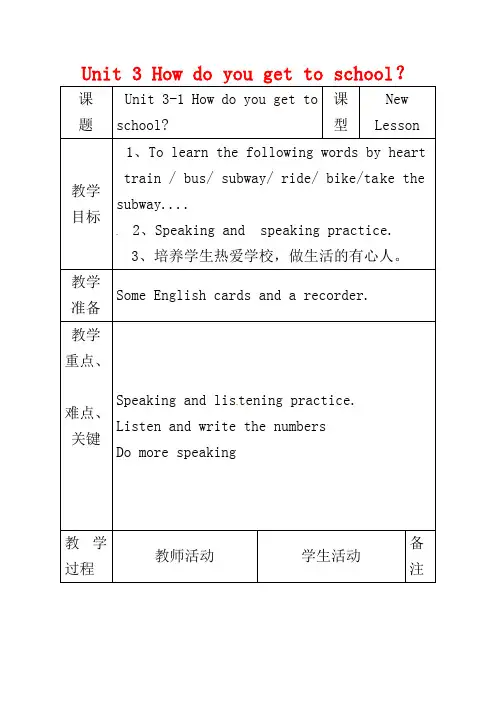
课 题
Unit 3-1 How do you get to school?
课型
New Lesson
教学目标
1、To learn the following words by heart train / bus/ subway/ ride/ bike/ta ke the subway....
4、T o check.
1、T o look at the picture and read the phrases given.
2、To read and match the words with the pictures.
3、To re ad their answers.
4、To check each other.
2、To look at the picture in 1a and make new ones with their partners.
15’
15’
板书设计
How do youБайду номын сангаасget to school?
I take the train take the bus
take the subway
Ride a bike
Do more speaking
教学过程
教师活动
学生活动
备注
Step1
1a
1、To read the instructions to the class.
2、To class the stu dents to read the verb-phrases one by one.
3、To tell them to m atch the words with the pictures.
人教新目标版英语七下Unit3《Howdoyougettoschool》说课稿1
人教新目标版英语七下Unit 3《How do you get to school》说课稿1一. 教材分析《人教新目标版英语》七年级下册Unit 3《How do you get to school》主要讨论了学生上下学的交通方式。
本节课的主要内容包括词汇学习、句型练习和情景交际。
教材通过呈现不同学生的交通方式,引导学生进行英语交流,培养他们的口语表达能力。
同时,本节课还涉及到了日常生活中的实际问题,使学生能够将所学知识运用到实际生活中。
二. 学情分析根据我对所教班级学生的了解,他们在英语学习方面具备了一定的基础,能够听懂并运用一些基本的英语句子。
然而,学生在口语表达方面还存在一定的困难,尤其是在描述日常生活方面。
此外,部分学生对于交通方式的概念和表达还不够熟悉,需要在课堂上进行针对性的引导和训练。
三. 说教学目标1.知识目标:学生能够掌握表示交通方式的词汇,如bus, subway, car,bike等;能够运用句型“How do you get to school?”和“I get to school by…”进行问答。
2.能力目标:学生能够在日常生活中运用所学的交通方式词汇和句型进行口语交流。
3.情感目标:培养学生热爱生活、关注环保的意识,教育他们选择绿色出行方式。
四. 说教学重难点1.重点:学生能够掌握表示交通方式的词汇和句型,进行简单的日常英语交流。
2.难点:学生能够灵活运用所学的交通方式词汇和句型,描述不同的上下学交通方式,并在实际情景中进行交流。
五. 说教学方法与手段1.教学方法:采用任务型教学法,让学生在实际情景中进行英语交流,提高他们的口语表达能力。
2.教学手段:利用多媒体课件、图片、卡片等辅助教学,激发学生的学习兴趣,提高课堂参与度。
六. 说教学过程1.导入:通过展示不同的交通方式图片,引导学生谈论日常生活中常见的交通方式,为新课学习做好铺垫。
2.新课呈现:教师展示教材中的情景图,引导学生观察并回答问题:“How do you get to school?”,学生用所学生过的交通方式进行回答。
人教版英语七年级下册Unit3howdoyougettoschool单元整体说课稿
知识与技能:学生能够掌握描述不同交通方式的动词短语,并运用这些短语进行问答;学生能够使用地图和方向词描述路线;学生能够听懂并运用本单元的词汇和句型进行日常交流。
过程与方法:通过小组合作、任务驱动等方法,培养学生的合作意识和解决问题的能力;通过听力、口语、阅读等多种教学活动,提高学生的英语综合运用能力。
(二)学习障碍
在学习本节课之前,学生已经掌握了基本的英语语法和词汇,具备一定的听说读写能力。然而,他们可能在前置知识或技能方面存在以下不足:
1.对交通方式的相关词汇和表达不够熟悉,可能在表达时出现困难;
2.对地图和方向词的理解不够深入,容易在描述路线时产生混淆;
3.口语表达能力有待提高,部分学生在实际情境中可能无法流畅地进行英语交流。
2.角色扮演:学生模拟真实场景,扮演问路人和指路人,进行对话练习;
3.课堂游戏:设计“Transportation Matching”游戏,让学生在游戏中巩固新学的词汇;
4.口语练习:组织学生进行“Ask and Answer”活动,两人一组,互相询问对方的交通方式。
(四)总结反馈
在总结反馈阶段,我将采取以下方式引导学生自我评价,并提供有效的反馈和建议:
1.利用PPT展示一组与交通方式相关的图片,如公交车、自行车、地铁等,让学生猜测并说出这些交通方式的英文表达;
2.播放一段关于不同交通方式的短视频,引导学生关注并思考:“How do people get to school in different countries?”;
3.教师提出问题:“How do you get to school?”,邀请几名学生回答,借此引出本节课的主题。
情感态度与价值观:培养学生热爱生活、关心环境、遵守交通规则的良好品质;通过学习不同国家的交通方式,拓宽学生的国际视野。
人教新目标版英语七下Unit3《Howdoyougettoschool》说课稿5

人教新目标版英语七下Unit 3《How do you get to school》说课稿5一. 教材分析本次说课的教材为人教新目标版英语七年级下册Unit 3 How do you get to school? 本节课主要讨论人们的交通方式以及相关的日常对话。
通过学习本节课,学生能够掌握相关词汇和句型,学会询问和描述他人的交通方式,提高他们的口语表达能力。
二. 学情分析通过对学生的了解,他们已经掌握了基本的日常英语对话,并且对于描述自己的日常生活经验有一定的兴趣。
但是,部分学生可能在口语表达方面还存在困难,需要教师在教学过程中给予更多的关注和引导。
三. 说教学目标1.知识目标:学生能够掌握与交通方式相关的词汇和句型,如by bus,on foot等。
2.能力目标:学生能够用英语询问和描述他人的交通方式,提高他们的口语表达能力。
3.情感目标:通过学习本节课,学生能够增强对英语学习的兴趣,提高团队合作意识。
四. 说教学重难点1.重点:学生能够掌握与交通方式相关的词汇和句型,并运用到实际对话中。
2.难点:学生能够正确使用疑问词how来询问他人的交通方式,并在对话中进行适当的反馈。
五. 说教学方法与手段本节课采用任务型教学法,通过设定各种真实的交通情境,引导学生进行口语交流。
同时,运用多媒体教学手段,如图片、视频等,帮助学生更好地理解和记忆相关词汇和句型。
六. 说教学过程1.导入:教师通过展示各种交通工具的图片,引导学生进行口语描述,如“This is a bus. I go to school by bus.”,激发学生的学习兴趣。
2.新课呈现:教师通过播放一段视频,展示不同人的交通方式,引导学生学习相关词汇和句型。
3.课堂活动:教师学生进行小组活动,用英语讨论他们的交通方式,并鼓励他们向全班展示。
4.巩固练习:教师设计一些练习题,让学生运用所学知识进行回答,如“How does your friend go to school?”。
人教版英语七年级下册Unit3说课稿

(一)导入新课
为了快速吸引学生的注意力和兴趣,我计划采用以下导入方式:首先,我会播放一段关于各种交通方式的短片,让学生直观地感受到本节课的主题与日常生活息息相关。接着,我会提出一个问题:“你们知道吗?在不同的国家,人们上下学的方式有哪些不同呢?”让学生进行思考和讨论。通过这种方式,我可以激发学生的好奇心和求知欲,使他们积极主动地参与到课堂中来。
(二)教学反思
在教学过程中,我预见到可能出现的问题或挑战,如部分学生对疑问句的构造和使用不够熟练,以及对交通方式的特殊表达理解不够。为了应对这些问题,我将提供更多的练习机会,耐心地进行个别辅导,并利用互动教学工具进行巩固。课后,我将通过学生的作业和课堂表现来评估教学效果。如果有必要,我会调整教学方法和策略,以提高教学效果。具体的反思和改进措施可能包括增加课堂互动环节,设计更多有针对性的练习,以及及时与学生和家长沟通,了解学生的学习进展和需求。
3.情感态度与价值观:培养学生对环保、安全出行的意识,教育学生选择合适的交通方式,既能保护环境,又能确保自身安全。
(三)教学重难点
1.教学重点:本节课的重点是让学生掌握交通方式的表达和运用,能够用英语询问和回答他人上下学的交通方式。此外,培养学生运用所学知识进行日常交流也是重点。
2.教学难点:本节课的难点在于让学生正确运用疑问句询问和回答交通方式,以及如何将所学知识运用到实际生活中。对于一些交通方式的特殊表达,如by bike, on foot等,学生可能容易混淆,需要教师进行重点讲解和练习。
(五)作业布置
课后作业的布置情况如下:我要求学生用英语写一篇关于自己上下学的短文,要求能够正确运用所学知识,如交通方式的表达和疑问句的运用。作业的目的是让学生在实际写作中巩固所学知识,提高英语写作能力。同时,通过作业的完成情况,我可以了解学生对课堂所学知识的掌握程度,为后续教学提供参考。
七年级英语下册Unit3HowdoyougettoschoolSectionB(第4课时)说课稿
七年级英语下册 Unit 3 How do you get to school Section B(第4课时)说课稿一. 教材分析《七年级英语下册》Unit 3 How do you get to school Section B(第4课时)的主要内容是通过询问和描述同学们上学的交通方式,来培养学生的日常英语交流能力。
这一课时包含了一个听力活动,两个口语练习和一个写作任务。
通过这些活动,学生能够进一步掌握询问和描述交通方式的表达方法,并能够在实际生活中运用。
二. 学情分析七年级的学生已经掌握了基本的日常英语交流词汇和句型,对询问和描述交通方式的话题也有一定的了解。
但部分学生可能在听力理解和口语表达方面存在困难,需要教师的引导和帮助。
此外,学生的学习兴趣和动机对于本课的学习效果至关重要。
三. 说教学目标1.能够听懂、会说、会读关于交通方式的词汇和句型,如by bus, onfoot, ride a bike等。
2.能够用英语询问和描述同学的上学交通方式,并进行简单的交流。
3.能够运用所学知识,写一篇关于同学上学交通方式的短文。
4.培养学生的日常英语交流能力,提高他们对英语学习的兴趣和动机。
四. 说教学重难点1.重点:掌握关于交通方式的词汇和句型,能够用英语询问和描述同学的上学交通方式。
2.难点:听力理解能力和口语表达能力较弱的学生在实际交流中可能会遇到困难。
五. 说教学方法与手段1.交际法:通过模拟真实场景,让学生在实际交流中运用所学知识。
2.任务型教学法:通过完成听力、口语和写作任务,提高学生的综合语言运用能力。
3.小组合作学习:鼓励学生相互合作,共同完成学习任务。
4.教学辅助手段:多媒体课件、图片、卡片等。
六. 说教学过程1.热身(5分钟):教师与学生进行简单的英语交流,检查学生的英语水平。
2.听力活动(10分钟):学生听录音,回答问题,了解同学们上学的交通方式。
3.口语练习(15分钟):学生分小组,用英语询问并描述同学的上学交通方式。
七下UNIT3说课稿
How do you get to school?今天说课的题目是Unit3下How do you get to school?Section B (2a-2c) 部分。
今天我将从教材分析,学情分析,教学目标的制定,教学重难点,教法分析,学法指导,教学过程,板书设计,等8个方面来说。
一教材分析:How do you get to school?处于人教版七年级下册第三单元,本单元以询问交通方式为话题,距离,时间为话题。
本节课处于第四课时,是一节阅读课。
通过2a,2b,2c的学习。
二学情分析对于七年级下册的学生来说,他们在经过七年级一学期的英语学习后已具有了一定的英语基础知识,同时也具备一些运用语言知识的能力。
在这样的基础上,学生对于讨论跟他们生活息息相关的内容还是比较感兴趣的。
这节课以图片吸引了学生的注意,有利于阅读的进行。
三教学目标的制定1. 语言知识目标:1) 能掌握重点单词和短语:2) 阅读短文,获取相关信息的能力。
2. 情感态度价值观目标:通过阅读短文,让学生体会自己来之不易的生活,让自己怀有感恩的心,去帮助其他的人。
四、教学重难点1. 教学重点:1) 通过读、写的训练,来让学生们能真正在实际活动中运用所学的知识。
2. 教学难点阅读训练五、教法分析用幻灯片将本课所需要的录音、图片、文字、制成多媒体课件,使抽象的语言变得直观,为学生运用英语进行交际创设情景。
通过老师讲解和学生共同探讨来达到一定的教学目标。
六学法指导通过快速阅读和细读的办法让学生,掌握阅读策咯。
通过小组探讨,让学生领会阅读技巧。
通过巩固练习让学生加强记忆。
七教学过程Step1 情景导入吸引学生的注意力,导入新课First guess1. Fast reading2. Careful reading 3 Read againⅢ1. Let's work on 2c. Let's read the passage again and complete the sentences with the words from the passage. 检测环节Ⅳ. Language pointsⅤ.小结VI 作业八板书设计How do you get to school ?between …and …crossbe afraid of …He’s like a father to me.like “像”。
人教新目标版初中英语七年级下册 Unit3 How do you get to school SectionA 1a—2c(说课稿)
English Speaking MaterialEdition: Grade 8 Go for itTitle : Unit3 How do you get to school? SectionA 1a—2cSpeaker: liao xiao’eContents: 5 partsPart 1 Analysis of the teaching material1. Status of the teaching materialThis unit is mainly about how to get to places. Section A 1a -2c is to tell students how to talk about means of transportation by using the sentence patterns: ---How do/does sb get to…?---Sb take(s) the ….---How long does it take?---It takes …minutes .It’s very important because it is the grammar focus of this topic. It’s also one of the most important contents that is included in the grammar items of “ENGLISH COURSE STANDARD”.a. Knowledge aims(1)New words: subway,train,forty,fifty,sixty,seventy,eighty,ninety,hundred,minute,take.(2)Useful phrases: get to, take the bus/train…, ride the bike, walk to(3)Useful expressions:---How do/does sb get to…? ---Sb take(s) the …---How long does it take ? ---It takes …minutesb. Ability aims:(1) Enable the students to use different means of transportation to talk about how to get to places.(2) Develop the students’communication skills.(3) Develop the students’ability of listening, speaking, reading and writing.c. Moral education aims:Teach students to choose the right means of transportation to protect our environment.3. Teaching key points and difficult points in this class(1) Key points: Get the students to use How do/does sb get to…? and How long does it take ?to talk about how to get to places.(2) Difficult points: the expression of different means of transportationPart 2 Analysis of teaching methods1. “Six-step”teaching method2. “Task-based”teaching methodPart 3 Analysis of Learning Methods1. The students will take part in some activities like pair-work, making a survey and guessing to improve their abilities of using language.2. They will learn more because of the song, the movie and the competition.Part 4 Analysis of Teaching ProceduresStep1. Warm-up and Revision (5 minutes)P u r p o s e:T o m a k e t h e s t u d e n t s m o r e i n t e r e s t e d i n t h i s c l a s s b y e n j o y i n g t h e m o v i e a n d a t t h e s a m e t i m e s o m e p i c t u r e s c a n p r o v i d e s i t u a t i o n s t o r e v i e w l e a r n t k n o w l e d g e f o r t h e n e x t s t e p.1. Enjoy the movie to lead in the topic and attract students’attention.2. Review transportations by using some pictures. According to the pictures, use the “Brain-storm”to ask the students to say out the different transportations as much as possible. It can encourage students take in part in the class quickly.3. Review tools of transportation by using a guessing game. They can arouse the students’interest and have the students go over the learnt words. If the students’answers are right, say congratulations.Step2. Presentation (7 minutes)P u r p o s e:T o p r e s e n t t h e k e y w o r d s o n e b y o n e f o r t h e s t u d e n t s t o l e a r n a n d g r a s p t h e m e a n i n g.P i c t u r e s c a n p r o v i d e a r e a l s i t u a t i o n f o r s t u d e n t s t o u n d e r s t a n d t h e c o n v e r s a t i o n b e t t e r.This part is very important, so I’ll spend more time on it.1. Show some pictures of transportations to the students and get the students to say something about them. It can widen the students’eyes.2. Help the students make a small conclusion about the tools oftransportation.3. Going to the short phrases learning at the basic of the tools of transportation is easy for the students to learn.Step3. Practice (16 minutes)P u r p o s e:T o f o r m a b e t t e r s u r r o u n d i n g f o r t h e s t u d e n t s t o p r a c t i c e t h e c o n v e r s a t i o n s a n d l e t t h e s t u d e n t s s p e a k E n g l i s h a s m u c h a s p o s s i b l eThis part is the most important part, it’ll take us about 16 minutes.1. Give students a competition: Who has a good memory? First give students 5 seconds to memorize. Then hide the pictures. At last, ask students to say the names out. If the students’answers are right, encourage them.2.Ask the students to go into the book 1a to write down some useful phrases by working in pairs, then ask two students to report their answers.3. Leading the students into the sentences patterns with the help of the short phrases teaching can make the class easy.Step4. Listening and speaking (12 minutes)P u r p o s e:T h i s s t e p c a n i m p r o v e s t u d e n t s’l i s t e n i n g a b i l i t y,b u t w e m u s t p a y a t t e n t i o n t o p r e-l i s t e n i n g a n d p o s t-l i s t e n i n g.This part is also very important, it will take us about 12 minutes.1. First play the tape, next check the answers, then play the tape andask students to follow it, finally make the students retell the answers. This can help the students grasp the pattern more quickly. T o begin with, students read together, the individual student reads. Students are at the age of 13 or 14, they are eager to show their abilities.2. Doing a survey and making a report.I want them to connect the topic with our daily lives. Students can do this activity in small groups. First talk freely, then write it down and report it. Group work can help the students to set up their self-confidence, especially those who are not interested in English.Step5. Extension(4 minutes)P u r p o s e:T o l e t S s k n o w t h e h o t t o p i c a n d h e l p S s to choose the right means of transportation to protect our environment.M a k e t h e s t u d e n t s k n o w t h e“C A R F r e e D a y”a n d m o r e a n d m o r e c a r s m a k e t h e a i r d i r t i e r a n d d i r t i e r.S o w e m u s t c h o o s e t h e r i g h t means of transportation t o p r o t e c t o u r e n v i r o n m e n t.Step6. Summary (1 minute)P u r p o s e:T o l e t S s k n o w w h a t t h e y l e a r n t i n t h i s c l a s s a n d h e l p t h e s t u d e n t s t o s e t u p t h e i r s e l f-c o n f i d e n c e.Part 5 Reflection after Teaching1. I design many activities to enrich my lesson. I think the teacher and the students can finish the teaching aims very well.2. A few students may have difficulty in writing a report. Time mightbe a problem.3. I hope I can find out some multi-activities to solve the problem of writing.This is my English speaking material. If there are some mistakes in it, I hope your advice.That’s all. Thank you very much.。
人教版七年级英语下册Unit3Howdoyougettoschool单元整体说课稿
2.过程与方法目标:
(1)通过情境创设,让学生在实际语境中学习交通方式的表达。
(2)引导学生通过观察、模仿、实践等途径,掌握交际对话的技巧。
(3)培养学生合作学习的能力,提高课堂参与度。
3.情感态度与价值观目标:
(1)培养学生热爱生活、关注环保的意识,提倡绿色出行。
4.常用短语:usually, often, sometimes, by bus, on foot等。
5.交际对话:询问和回答别人上下学的交通方式。
(二)教学目标
1.知识与技能目标:
(1)学生能够听懂、会说、会写本单元所学的交通方式词汇和句型。
(2)学生能够运用所学知识进行简单的交际,询问和回答别人的交通方式。
1.师生互动:通过提问、回答、对话等形式,教师引导学生积极参与课堂讨论,及时反馈学生的学习情况,并提供必要的帮助。
2.生生互动:组织小组活动,让学生在小组内进行角色扮演、讨论和游戏,鼓励他们互相纠正错误,共同完成任务。
3.小组竞赛:通过设定竞赛规则,激发学生的竞争意识,增强团队合作精神,同时也能够提高学生的参与度。
人教版七年级英语下册Unit3Howdoyougettoschool单元整体说课稿
一、教材分析
(一)内容概述
本节课为“人教版七年级英语下册Unit3 How do you get to school”单元整体说课稿。本单元在课程体系中属于第三单元,是学生在学习了基础词汇和简单句型后的一个重要单元。它旨在帮助学生掌握交通方式的表达方式,并在此基础上培养学生的交际能力。
(2)通过本单元的学习,让学生学会关心他人,关注他人的出行方式。
(3)培养学生积极向上的学习态度,增强自信心。