
外研版四年级英语上册Module 3 Unit 1 What are they doing?授课课件【新版】
知识点 7
/drɪŋk/ v. ( 动词) 喝,饮用
例句: I’m drinking water. 我正在喝水。 短语: drink water 喝水 一词多义: drink n. (名词)饮料 加法记忆法: dr + ink (墨水) = drink (喝,饮用) 对应词: eat 吃
Amy: What are they doing? Daming: They’re rowing a dragon boat.
Amy: Look at the men between the big trees. What are they doing?
Daming: They’re playing chess. Amy: Look at these girls. What are they drinking?
知识点 3
/'piːpl/ n. ( 名词) 人,人们
例句: There are many people in the park.公园里有许多人。
形近词: purple 紫色
易错点 提示
people 当“人,人们”讲时,是集体名词,表示
复数意义,两个或者两个以上的人用people。
知识点 4
/bəʊt/ n. ( 名词) 船
例句:There is a boat on the river. 河上有一条船。 发音:字母组合oa 在boat 中发/əʊ/。 短语: the dragon boat 龙舟; take a boat 乘船 形近词: coat 外套
知识点 5
/men/ n. ( 名词) 男人 ( 复数) [四会]
A:What are they doing? A:What are they drinking? B:They’re playing chess. B:They’re drinking milk.
我会说 四个人一组,两个同学一起做动作,一个同学用“What are they doing ?”询问,另一个同学用“They + are + 动词的 ing 形式 + 其他.”回答。四人轮流进行。
三、选词填空。 1. __D_r_i_n_k__(eat / drink) some soya milk, please. 2. Look at the __c_lo_c_k___.
It’s three _o_’_c_lo_c_k__(clock, o’clock).
本节课我们学习了以下知识,请同学们一定加 强巩固,以便能和同学们进行灵活交流哦! 重点词汇:Kid, can, see, interesting, boat, men, between,
Module 3
四年级上册
What are the kids doing? WhLeabharlann t are they doing?
They’re listening to music.
They’re playing football.
知识点 1 —What are the kids doing?这些小孩正在干什么? —They’re listening to music. 他们正在听音乐。
2 将Listen, read and act out.的对话朗读流利。
例句: Look at the men. 看那些男人。 词形变化: man(单数)→ men ( 复数)
对应词: women 女人(复数) 魔法记忆: women (女人) 去掉wo(我)就是男人(men)。
知识点 6
/bɪ'twiːn/ prep. ( 介词) 在……中间
例句: There is a house between the two big trees. 两棵大树中间有一所房子。
Mime and say.
What are they doing?
They’re rowing a
Yes!
boat.
一、单项选择。
1. I get ___A_____the bus at the bus stop.
A. on
B. to
C. for
2. There are ____B____people in the park.
树上有许多鸟。 同义短语: a lot of 许多
/'ɪntrəstɪŋ/ adj. (形容词) 有趣的
例句: We have lots of things to do. 我们有许多事情要做。
thing /θɪŋ/ n. ( 名词) 东西,物品,事情 形近词: thin 瘦的 加法记忆法: thin(瘦的) + g = thing东西,物品,事情 词形变化:something 某事,某物
A. so much B. lots of
C. a lot
3. This storybook is very___B_____.
A. Interest B. interesting
C. interested
二、用所给词的适当形式填空。 1. Lingling can_p_l_a_y_i_n_g_(play)basketball well. 2. There are lots of __p_e_o_p_le__(people) in the supermarket.
drink, clock, hungry 重点短语:get on, lots of 重点句式:—What are the kids doing?
—They’re listening to music. We can see lots of interesting things. Me too.
1 熟记本节课所学的句型、短语和单词,必须会 听、说、读、写。
/kɪd/ n. ( 名词) 小孩[四会]
复数: kids 例句: The kids are watching TV.小孩正在看电视。 发音: 字母i 在kid 中发/ɪ/。 同义词: child 小孩
询问“某人(复数)正在干什么?”的句型结构及回答。
句型结构:What + are + 主语(复数) + doing ? 回答:They’re + 动词的ing 形式 + 其他. 典例 —What are they doing, Mum? —They ____C____ playing football. A. am B. is C. are
Daming: Let’s get on the bus. We can see lots of interesting things. Amy: OK.
Daming: Look at the people in the park. Amy: What are they doing?
Daming: They’re doing taijiquan. Look at the people on the lake.
含有情态动词can 的陈述句的句型意义及结构 用法: can 表示能力,意思是“能,能够”,后面跟 动词原形,表示一个人能做某事。
句型结构: 主语 + can + 动词原形( + 其他). 例句: He can swim. 他会游泳。
/kæn/ modal v. (情态动词)能,能够
例句:I can play football well. 我能踢好足球。 发音:字母c 在这里发/k/。 加法记忆法: c + an(一个)=can 能,能够 一词多义: can n. ( 名词) 金属罐
典例 —What do you want to ___B____? —A cola, please. A.drinks B.drink C.drinking
点拨:从具体的语境可以看出,应该是问:您想喝什 么?所以应该用drink。
知识点 8
/klɒk/ n. ( 名词) 钟
例句: I have a clock. 我有一个钟表。 形近词: lock 锁,o’clock 点钟
Daming: They’re drinking soya milk! Amy: Look at the clock. It’s twelve now. I’m hungry.
Daming: Me too. Let’s go!
知识点 2 We can see lots of interesting things. 我们能看见许多有趣的事情。
复数: clocks
典例 My mother buys two new ___B_____. A. clock B. o’clock C. clocks
知识点 9
/'hʌŋɡri/ adj. ( 形容词) 饥饿的
例句: He is hungry. 他饿了。 发音: 字母u 发/ʌ/。 形近词: angry 生气的 对应词: full 饱的
/siː/ v. ( 动词) 看见 发音: 字母组合ee 在see 中发/iː/。 例句: I can see you. 我能看见你。 短语: see you later 再见 同音词: sea 大海
lots of 许多 例句: There are lots of birds in the trees.
外研版-英语-四年级上册-外研版四年级 Module 3 Unit 1 教材全解
Unit 1 What are they doing?他们正在做什么?教学目标:情感目标:培养学生学习英语的兴趣。
知识目标:掌握句型What are you doing?能力目标:能询问别人正在做什么,描述自己在做什么。
知识详解重难点1.询问“他们正在做什么?”的句型及其答语——What are they doing? They're...课文应用:What are they doing? 他们正在做什么?They're doing taijiquan.他们正在打太极拳。
句型结构问句:What are they doing?答语:They are+动词-ing形式十其他.重点解析这个句子是一个现在进行时的特殊疑问句。
what意为“什么”,位于句首,引导特殊疑问句。
they是人称代词,意为“他们”。
are不翻译成“是”,它只是与doing 一起构成现在进行时,表达“正在……”。
要点提示当人称代词是第三人称单数she,he,it时,be动词要用is。
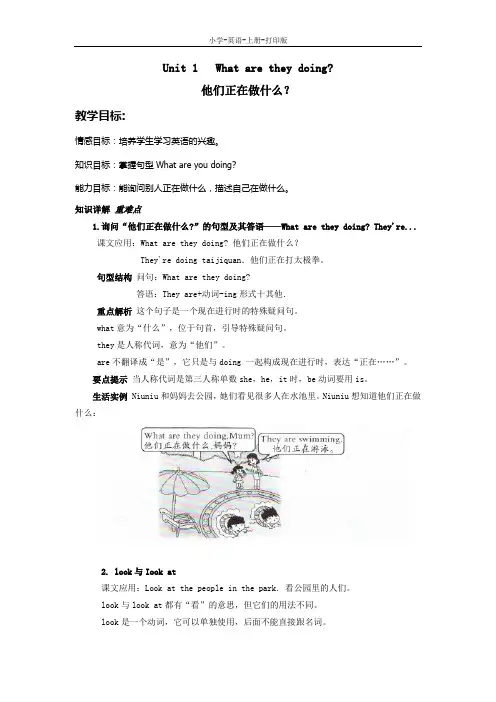
生活实例Niuniu和妈妈去公园,她们看见很多人在水池里。
Niuniu想知道他们正在做什么:2. look与Iook at课文应用:Look at the people in the park. 看公园里的人们。
look与look at都有“看”的意思,但它们的用法不同。
look是一个动词,它可以单独使用,后面不能直接跟名词。
例如:Look,that is my father. 看,那是我父亲。
Look,I have a new book. 看,我有一本新书。
look at是一个短语,后面可以接名词或代词,意思是看某人或某物。
例如:Look at this bird.看这只鸟。
Look at me.看我。
知识详解拓展点1.let's的自述课文应用:Let's get on the bus.让我们上公共汽车吧。
大家好!我是let's,我很热情,我总是建议或邀请别人和我一起做一些事情。
四年级上册英语说课稿 Module 3 Unit 1 What are they doing 外研版
四年级上册英语说课稿 Module 3 Unit 1 What are they doing外研版(三起)一、背景和目的本篇文档是一份根据外研版三起英语四年级上册 Module 3 Unit 1 设计的英语说课稿。
本单元主要介绍现在进行时态,并围绕“what are they doing”这一问题展开。
本文旨在通过课堂实践的经验和整合外部资源,为英语教师提供一些教学思路和实践经验。
二、教学内容本节课的主要内容是现在进行时的用法,以及问答句“What are they doing?”及其答复。
本节课也介绍了动词-ing形式的构成方法,并鼓励学生使用现在进行时来描述周围的环境和正在进行的活动。
本节课还通过游戏、歌曲和视频等多种形式来激发学生的兴趣,并促进学生的语言输出。
三、教学过程1. 导入环节•外教展示视频,让学生看到场景,提问“What are they doing?”,引起学生的兴趣。
•展示几个图片,让学生说出图片中人物正在做的事情,奖励出色的回答。
•师生互动问答,让学生复述前面学过的动词,引导学生想到现在进行时的用法。
2. 语言输入•展示正在进行的活动的图片,让学生模仿老师说“What’s he/she/they doing?”,寻找正在进行的动作。
通过游戏来帮助学生巩固新的单词。
•介绍动词-ing形式,让学生可以正确地使用现在进行时描述活动。
例如,“I am reading a book”,“He is dancing”等。
•给学生留足时间练习拼读和正确发音,以及应用新的语法知识。
3. 语言输出•外教给学生展示一个视频,让学生跟随视频练习描述正在进行的活动,例如,游泳、绘画或者跑步等。
•学生分组,展示自己正在进行的活动。
鼓励学生使用完整句子进行描述,并互相校对发音。
•教师提供一些参考问题,例如“What are you doing?”,“What ishe/she doing?”等。
让学生练习回答与之相对应的问题。
外研版四年级上册Module_3_Unit_1_What_are_they_doing
What are they doing?
They are swimming.
What are they doing?
They’re playing basketball.
They’re playing table tennis.
Homework
• What are they doing ? 他们正在做什么? • 回答: They're +动词ing... 他们正在...
• • listen to music 听音乐 play football 踢足球
• • • • • • • • • • • •
let's= let us 让我们 get on 上车 lots of 许多 lots of interesting things 许多有趣的事情 do taijiquan 打太极拳 on the lake 在湖面上 row a dragon boat 划龙舟 between big trees 在树之间 play chess 下国际象棋 drink soya milk 喝豆浆 Me too.我也是
打太极拳 划龙舟 row a dragon boat play chess 下国际象棋来自do Taijiquan
drink soya milk
喝豆浆
What are they doing?
They are playing football.
What are they doing?
They are flying a kite.
New words
New words
• • • • • • chess/tʃes/ 国际象棋 play chess下象棋 drink/driŋk/ 喝 soya milk 豆浆 clock/klɔk/ 钟 hungry/'hʌŋgri/饥饿的 Me too.我也一样
外研版(三起)-英语-四年级上册-Module 3 Unit 1 What are they doing?教材分析

小学-英语-上册-打印版
《What are they doing?》教材分析
教材版本:外研版(三年级起点)四年级上册
授课内容:Module 3 Unit 1 What are they doing? 第一课时
课型:对话课
执教:李文娟
本课主要是通过大明、Amy乘坐公共汽车,沿途看到不同地方的人们正在做一些有趣的事情,通过他们的谈论,以此来继续学习现在进行时的表达方法。
在第二模块学生已经学习了现在进行时的一些知识,包括重点句型:What are you doing? I’m listening to music. What’s Tom doing? He’s reading a book. 本课要学习的句型是:What are they doing? They’re…,与前一模块相比,第三模块只是人称的变化,这样的教材编排对于学生来说循序渐进,易于理解和掌握。
另外对于动词的ing形式的构成和发音,学生在第二模块通过观察、感知、比较已经发现规律并进行了总结,这对于本节课的继续学习奠定了基础。
教学重点:
单词:kid people man-men between drink interesting boat
句型:What are they doing/drinking? They’re …
教学难点
理解现在进行时的含义,能在具体的语境中正确、恰当地运用所学知识与他人进行交际。
小学-英语-上册-打印版。
外研版小学四年级英语上册Module 3教案
Unit 1 What are they doing?【学情分析】The pupils of Grade 4 are so active that they like to do the actions. But they can't master too many words imediately. In this unit, there are lots of new words and phrases. So the teacher asked them to preview them. And the teacher designed many activites to draw their attention.【教学目标】1. Knowledge aimsa. Master the words “kid, interesting, people, boat, men, between, drink, clock, hungry”.(Because there are so many words in this unit, so I asked the pupils to preview the new words.)b. Know the phrases“do taijiquan, row a dragon boat, play chess, drink soya milk”.c.Ask and answer with”What are they doing? They are….”。
2. Ability aimsThe students can communicate with each other.3. Emotion aimsThe students love to communicate with others.【重点难点】1. New words and phrases.2. The PresentContinuous Tense.【教具准备】PPT课件、单词卡片、人物头像、CD-ROM【教学方法】情景教学、游戏、合作探究、任务型教学法【教学过程】Step 1: Warming up and revision1.Greeting. Classes begin. Good morning, boys and girls. How are you? I’m fine, too.2.Boys and girls. Let’s chant together, ok? Chant: two little black birds.(Two little black birds sitting on a hill, one named Jack and one named Jill, fly away Jack, fly away Jill, come back Jack and come back Jill.)3.You did a very good job. Boys, are you ready for the class? Girls, are you ready? Sit down, please.4.Ok, first let’s review.( Chant:Listen, listening. I’m listening to music. Write, write, writing. I’m writing a letter. Play, play, playing. I’m playing football. Talk, talk, talking. I’m talking to you. Ask and answer:What is he/she doing?)Step 2: New ConceptsLead in: What are they doing? What are the kids doing? Learn the new word: kid. Read one by one. Kids are equal to children.A.1.Let’ s watch and listen.2.This time, let’s follow.B.Look at the picture. Guess what it is. Bus Let’s get on the bus. We can see lots of interesting things. Interesting: play balloon.3.Let’s go! Look, there are lots of p eople in the park. People:three by three. What are they doing? They are doing taijiquan.4.Look! They are rowing a drgon boat. Boat:read quietly/loudly. Show me your fingure:boys spell, girls spell. Close your eyes, spell.5.Oh, look at them. This is a man, this is another man. They are men. Men:e prounce e. Ask anyone to spell and read. They are sitting between the trees. Boys/girls read. They are playing chess.6.Oh there are two girls. They are drinking soya milk. drink. Act and read. Ask the students to teach. Read: drink soya milk.C. Games:7.Now boys and girls, you should watch carefully. And quickly read the phrases.8.Well done. Are you tired. Let’s relax. Stand up, please. Act out the phrases. Sit down, please. Now I’ll ask some group come here to act.and you should answer me what they are doing?(The teacher give them some phrases on the paper.)10.You still want to play, yes? Now, guess what they are doing?D.11. We should return to our text. Now watch and listen carefully.Open your books, turn t o Page 14. Let’s read.12. Practice these dialogue in your group. After that I’ll ask you to show it.Step 3:SummaryWhat have we learned today?Chant together:What are you doing? They’re doing taijiquan. What are you doing? They’re rowing a dragon boat. What are you doing? They’re drinking soya milk. What are you doing? They’re playing chess.Step4: HomeworkOn your way home, you may meet lots of people. Try to say what are the people doing.Unit 2What's the elephant?【教学目标】a、知识目标:1.能听说认读单词:drawing pictures,jumping, singing, dancing, running,horse.2.能听懂、会说本课句型“What are they doing? They are…What is …doing ?She is… He is… It’s…”b、技能目标:培养学生听、说、做、读的能力。
四年级上册英语教案-Module 3 Unit 1 What are they doing (2)

四年级上册英语教案-Module 3 Unit 1 What are they doing (2)外研社(三起)一、教学目标1.知识目标:能够掌握单词fishing, sunbathing, cycling并能正确使用句型“What are they doing?”和“I’m/We’re/They’re…”进行交际表达。
2.能力目标:培养学生观察、分析、表达和交流的能力。
3.情感目标:激发学生对英语学习的兴趣,积极参与课堂活动。
二、教学重难点1.教学重点:掌握单词fishing, sunbathing, cycling。
能正确使用句型“What are they doing?”和“I’m/We’re/They’re…”进行交际表达。
2.教学难点:让学生能在未有老师提示下,根据图画与句子的判断进行正确的对话。
三、教学准备1.课件、图片等多媒体教具。
2.单词卡片、板书工具等教具。
四、教学过程1. Warm-up让学生用I am, We are, They are或者Im, Were, Theyre 将以下句子补充完整。
1._____ reading.2._____ dancing.3._____ drawing.4._____ playing football.2. Presentation1.让学生看图片,按照老师的指示一起说出图片中人物正在干什么,老师可以给予一些提示,如“用竿子”,“在浴盆里”,“坐在车子上”等等。
2.让学生学习新单词fishing, sunbathing, cycling。
老师可以使用图片、单词卡片或者真实场景帮助学生获得新单词。
3.教师让学生观察图片,问他们正在干什么?给他们一个你自己造句,“What are they doing?”来回答老师的问题。
然后教师给学生演示如何说句型。
外研版四年级英语上册Module3Unit1Whataretheydoing(第1课时)教案
作
1、学生几人一组朗读对话。
2、What are they doing ?
They are + 动词ing .
展
示
反
馈
1、Let̓s ________ the bus . We can see _____ interesting thing.
2、Look _______ the people _____ the lake.
情感态度价值观
通过丰富多彩的活动,激发学习英语的现在进行时如:They̓re playing football.并熟练运用。
教学难点
现在进行时的运用及回答。
学 具
录音机、磁带、单词卡片
教 学 过 程
环节
教 师 活 动
学 生 活 动
效果反思
导
入
新
课
1、师生对话:
What are you doing ?
3、Look at the men ______ the big trees.
释
难
解
疑
Let̓s 以及定冠词the 的用法。
Let̓s后面接动词原形。
the用于名词之前表示某些人、某些物 ,如:That is the book.
拓
展
训
练
1、many 许多,后接可数名词复数。如:There are many books
Module 3 Unit 1 What are they doing
主备教师
审核教师
课 题
?
课 型
新授课
课 时
1
教学目标
知识与技能
1、孰记单词,短语,会读、会写、会用。 2、学习句型:询问他们正在做的事情及回答。
四上Module 3 Unit 1 What are they doing说课稿
Module 3 Unit 1 What are they doing ?说课稿尊敬的各位领导、老师大家好!我是来自哈尔脑乡中心小学的教师邹源,今天我说课的题目是外研版三年级起点四年级上册Module 3 Unit 1 《What are they doing ?》。
我从教材分析、学情分析、教学目标、教学重难点、教法和学法、教学过程、板书设计七个方面进行本次说课。
一、教材分析本课主要是延续上一个模块继续学习现在进行时态。
本课讲到Amy 和Daming 去逛公园,Amy不知道公园里的人们在做些什么,于是就用句型What are they doing ?与Daming进行问答。
二、学情分析本课的教学对象是学过一年英语的四年级学生,此阶段学生天真活泼,好奇心强,有较强的模仿能力和求知欲望,而且富有一定的逻辑思维能力,对英语的喜欢已初步体现出个性。
但在单词的学习过程中,还是较容易出现发音不到位或发音不准确的语音错误。
三、教学目标1、知识目标语句:What are they doing ?They are ….单词:can、see、interesting、thing、people、 row 、boat、men、between、chess、drink、clock、hungry 短语:get on 、lots of 、play chess、dragon boat2、能力目标能够运用所学句型和短语描述人们正在进行的动作。
3、情感目标学会细心观察,与他人合作和关心他人。
四、教学重难点1、重点:学习问句What are they doing ?及答语They aredoing sth..2、难点:能清晰准确地发出本课所学单词的音。
五、教法和学法:为了完成以上教学目标,更好的突出重,难点。
按照学生的认知规律和本课教材特点,我设计了:情境教学法、视听法、问答法、小组合作学习法。
六、教学过程Step 1 热身1、Greetings2、Sing a song “I am listening to music.”鼓励学生根据歌词内容做出相应的动作。
四年级上册英语教案-Module 3 Unit 1 What are they doing (4)
四年级上册英语教案-Module 3 Unit 1 What are they doing (4)外研社(三起)教材简介《外研社(三起)英语》是由外研社出版的面向小学生的英语教材。
本教材充分融入了课程的多元化、问题的引导和思维的培养等教育教学理念,注重培养学生的语言能力和语言应用能力。
模块介绍Module 3是《外研社(三起)英语》四年级上册的教学模块之一,包含了5个单元。
Unit 1是该模块的第一个单元,名为“What are they doing”。
教学目标1.理解和运用动词短语What are they doing?进行聆听、口语、阅读和写作活动。
2.集成语言技能,培养学生的听说读写能力。
3.发掘学生的多元智能,开拓思维,促进学生全面发展。
教学重点1.动词短语What are they doing?2.手势动作的学习和理解。
3.动词短语的扩展和运用。
教学难点学生掌握动词短语What are they doing?的使用和运用。
教学准备教师:图片、PPT、音频设备、录音设备等。
学生:学生活动手册、笔、本、彩色笔等。
教学过程Step 1 Revision1.T: Class, do you remember the actions in the last lesson? Let’s say it together.Ss: Sure. Playing football, running, swimming, dancing, singing and jumping.2.T: Great, I am happy to see you remember it.Step 2 Presentation1.T: What are they doing now? (Show a picture of people doing different actions) Can you guess?Ss: …2.T: Let’s chant. (Teach the chant)What are they doing? (Pointing to each picture)What are they doing?Let’s find out. (Point to our ears and mouth)3.Play the audio to help the students understand and chant.Step 3 Practice1.T: Can you do it with me? (Gesture to each picture and the students will say What are they doing?).2.Students practice with their partners.3.T: Ok, now let’s change. You do the gesture and let your partner guess.4.Students practice with their partners.Step 4 Consolidation1.T: Let’s write one sentence for each picture.2.Ss: (Write the sentence)3.T: Let’s check the answers.Step 5 Extension1.T: Can you add more actions to the chant? Think about it.Ss: (Think about it)2.T: Show me your answers.Ss: (Raise their hands and share their answers)T: Excellent.Step 6 Assessment1.T: Let’s make a dialogue. (Show a picture of two people doing the actions.)2.T: Who can be the person A and who can be the person B?3.Ss: (Volunteer to play the roles)4.T: Ok, let’s start.Step 7 Homework1.T: Please write a short paragraph about what you like to do at home.Step 8 Summary1.T: In this class, we learned。
外研版四年级上册what-are-they-doing说课稿
外研版四年级上册what-are-they-doing说课稿Book 3 Module 3 Unit1 What are they doing?一、说教材今天我说课的内容是外研版小学英语第四册第四模块第一单元。
本课将继续学习现在进行时,重点是让学生能用现在进行时进行问答。
通过学习,学生将提高用英语进行交流的能力。
1.教学目标(1)认知目标:让学生掌握如何用英语描述别人正在发生的动作。
(2)情感目标:让学生体验学习,参与,合作的乐趣。
(3)创新目标:在认知和技能掌握的基础上,发挥学生的想象力,通过动作表现正在做的事情。
2、重、难点:熟练运用目标中单词与句型,并能用现在进行时进行问答。
二、说教法、说学法1、情景教学法2、任务教学法3、TPR三、说教学过程为了关注每个学生的情感,激发他们的兴趣,通过感知,体验,实践,参与和合作等方式,实现任务目标。
因此,我设计了以下五个环节。
第一环节:导入----巧妙导入(5’)学生齐唱歌曲:Are you doing it too? 通过歌曲复习:listen-listening, do-doing, read-reading等学过的现在分词词语,引出了本课学习的重点:现在进行时。
很好地提出了本课的教学目标,What are they doing?第二环节:重点句型的学习—创设语言环境,激发学生兴趣(10’)这一环节是本课的重难点,我用一下步骤进行教学。
1、利用课件来展示do Taijiquan,play chess,row a dragonboat,drink soya milk这4个动作画面,并领读短语;2、给动词加ing,组成现在分词形式:就是do-doing Taijiquan, play-playing chess, row-rowing a dragon boat, drink-drinking-soya milk;3、给短语加上主谓结构,形成完整的句子;4、用what are they doing?进行师生问答、生生问答的形式进行操练巩固。