
Lecture 2 古希腊罗马神话 英文版 教学课件
The Olympian Gods (
• Hermes (Mercury 墨丘 利): Messenger of the gods; protector of travelers, thieves, and merchants; son of Zeus. –赫尔墨斯 • Hephaestus (Vulcan伏 尔甘): God of fire; blacksmith of the gods; son of Zeus and Hera. 赫淮斯托斯 • Ares (Mars马尔斯): God of war; son of Zeus and Hera. –阿瑞斯
)
The Olympian Gods (
)
• Athena (Minerva 密涅瓦): Goddess of wisdom, arts and crafts (制造技艺), and war; daughter of Zeus. • Apollo (Apollo): God of sun, prophecy, medicine, music, poetry, and archery (箭术); son of Zeus. • Artemis (Diana): Goddess of Moon, hunting, and chastity (贞 洁); daughter of Zeus and twin sister of Apollo. - 阿耳忒弥斯
Demeter(Ceres)
Demeter is the goddess of corn, grain, and the harvest. She is the daughter of Cronus and Rhea. It is Demeter that makes the crops grow each year. The first loaf of bread from the harvest is sacrificed to her. Demeter is the goddess of the earth, of agriculture, and of fertility in general. Sacagricultural products, poppy, narcissus and the crane. Demeter is intimately associated with the seasons. Her daughter Persephone was abducted by Hades to be his wife in the underworld. In her anger at her daughter's loss Demeter laid a curse on the world that caused plants to wither and die, the land became desolate. Zeus became alarmed and sought Persephone's return. However, because she had eaten pomegranate while in the underworld Hades had a claim on her. Therefore, it was decreed that Persephone would spend four months each year in the underworld. During these months Demeter grieves her daughter’s absence, and withdraws her gifts from the world, creating winter. Her return brought the spring. Demeter is also known for founding the Eleusinian Mysteries. These were huge festivals held every five years. They were important events for many centuries. Yet, little is known of them as those attending were sworn to secrecy. The central tenant seems to have been that just as grain returns every spring after its harvest and wintery death, so too the human soul could be reborn after the death of the body.
•
• •
•
Vocabulary
• • • • 1. Demeter (Ceres): cereal: 谷物 2. Ares (Mars) marshal: n.& v. (陆军,空军) 元帅, 列举,排列,整理 martial: 好战的,军事的 martial art: 武艺,武术 (kungfu功夫) martial law: 军事管制法,戒严令 3. Hestia (Vesta) vestal: adj. & n. 贞洁的,纯洁的,贞 洁的女人,处女
The Olympian Gods (
• Demeter (Ceres 刻瑞斯): Goddess of grain, sister of Zeus. -得墨忒耳 • Hestia (Vesta 维斯太): Goddess of the hearth and symbol of the home and family, sister of Zeus. -赫斯 提 • Aphrodite (Venus): goddess of beauty and sexual love. According to Hesiod (赫西奥 德), she sprang from the foam of the sea; but according to Homer (荷马), she was the daughter of Zeus. -阿弗洛狄特
)
Another three Important Gods
• Hades (Pluto普鲁托): ruler of the Underworld and brother of Zeus. –哈得斯 • Dionysus: god of wine and son of Zeus. –狄俄尼索斯 • Pan: goat-god of the forest and pastures, the son of Hermes. – 潘 (山羊状的神)
Hestia(Vesta)
• Hestia (Vesta) was the Greek goddess of the hearth (壁炉前的地板) or fireplace (壁炉) and symbol of the home and family, the eldest daughter of Cronus and Rhea. Because of the importance of fire in life, the hearth was worshiped daily throughout the Greek world, with her sacred fire (圣火) burning and prayers offered to her before and after meal. In Rome, there was a small round temple honoring Vesta in the Forum of Rome (罗马广 场). In the temple she was represented not by a statue but by a fire burning on an altar (祭坛), which was kept burning continuously by priestesses known as vestal virgins. There were six vestal virgins, young unmarried women, and each of them served for 30 years, enjoying certain special rights in Roman political affairs and greatly respected by the people.
Demeter(Ceres)(P46,P51)
•
• • • • • •
Demeter (Ceres) was the daughter of Cronus and Rhea, and sister of Zeus, Poseidon and Hades. She was the goddess of grain and the harvest. By Zeus she had a daughter Persephone. Hades, the god of the Underworld, kidnapped Persephone to be his bride. Missing her daughter, Demeter was so sad that she wandered throughout the world looking for her, neglecting her duties. As a result, the earth became barren and people died of famine. To save the life of the earth, Zeus persuaded Hades to allow Persephone to come back to her mother of part of the year.
• • • • •
Aphrodite (Venus)
Lecture 2 古希腊罗马神话 英文版 教学课件

)
The Olympian Gods (
)
• Athena (Minerva 密涅瓦): Goddess of wisdom, arts and crafts (制造技艺), and war; daughter of Zeus. • Apollo (Apollo): God of sun, prophecy, medicine, music, poetry, and archery (箭术); son of Zeus. • Artemis (Diana): Goddess of Moon, hunting, and chastity (贞 洁); daughter of Zeus and twin sister of Apollo. - 阿耳忒弥斯
•
• •
•
Vocabulary
• • • • 1. Demeter (Ceres): cereal: 谷物 2. Ares (Mars) marshal: n.& v. (陆军,空军) 元帅, 列举,排列,整理 martial: 好战的,军事的 martial art: 武艺,武术 (kungfu功夫) martial law: 军事管制法,戒严令 3. Hestia (Vesta) vestal: adj. & n. 贞洁的,纯洁的,贞 洁的女人,处女
Hestia(Vesta)
• Hestia (Vesta) was the Greek goddess of the hearth (壁炉前的地板) or fireplace (壁炉) and symbol of the home and family, the eldest daughter of Cronus and Rhea. Because of the importance of fire in life, the hearth was worshiped daily throughout the Greek world, with her sacred fire (圣火) burning and prayers offered to her before and after meal. In Rome, there was a small round temple honoring Vesta in the Forum of Rome (罗马广 场). In the temple she was represented not by a statue but by a fire burning on an altar (祭坛), which was kept burning continuously by priestesses known as vestal virgins. There were six vestal virgins, young unmarried women, and each of them served for 30 years, enjoying certain special rights in Roman political affairs and greatly respected by the people.
希腊罗马神话课程(王磊)lecture2
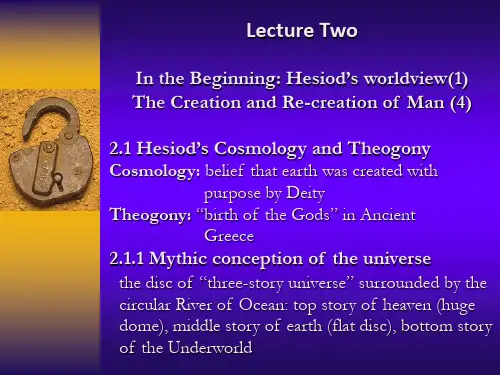
2.2 The Creation and Re-creation of Man (4)
2.2.1 Man’s alienation from the divinity and nature • Trick played on Zeus (white bones of ox covered with glistening fat v.s. meat, entrails and fat covered with tripe 肚肠) → white bones burned on smoky altars fire withheld from mortal men • Fire stolen in a hollowed fennel (茴香) stalk • Pandora as a tempting snare to men • fashioned by Hephaestus with gifts from various gods and goddesses → animals killed and (unnaturally) cooked before they are consumed; Pandora to preside
• Cronus and Rhea have 6 sons, afraid of being overthrown by prophesy, he swallows kids
• Cronus = human stupidity, jealousy; Rhea = protective, maternal • Rhea gets advice from Gaia, tricks Cronus into eating rock and has son Zeus raised on Crete by Amalthea, goat nurse → cornucopia
希腊神话 罗马神话PPT
Greek myths Roman myths Interrelationships Mythological stories
01
Greek myths
Greek Mythology is a group of traditional tales told by the ancient Greeks about the deeds of gods, heroes and their relations with human beings. The Greek mythology is an important part of the ancient culture which has vast and deep influence on the whole western culture. Its great influence upon the English language and literature is beyond description. A great number of words and idioms in the English language come from the Greek mythology.
Apollo
The sun-god Apollo
Among the crowd of Olympian gods the one most widely admired was Apollo.He was the son of Zeus and Let to.According to Greek mythology, Leto was driven by Hera from land to land at last Poseidon took Pity on her and brought the island of Delos out of water for her to live on.There she gave birth to the twins ,Apollo and Artemis. Apollo was me sun-god.He wore a purple robe.He usually sat in his bright eastern palace early in the morning and madeready to start his daily journey across the sky.During the day hed rove his carriage of gold and ivory , and brought light, life and love to the great world below. Iate in the afternoon he came to the end of his journey in the far western sea and got on his golden boat to return to his eastern home.
希腊神话 英文PPT课件
Cronus(克罗诺斯) : 天空之神。
Rhea(瑞亚) : 时光女神。
Oceanus(俄刻阿诺斯) : 水之神。
Tethys(泰西斯) : 沧海女神。俄刻阿诺斯之妻。
Crius(克瑞斯) : 生长之神。
Lapetus (伊阿佩托斯) : 灵魂之神 。阿忒拉斯、普罗米修斯、厄庇 米 修斯和墨诺提俄斯之父。
希腊神话讲了很多古希腊的故事,有神、英雄的故事以及他们和普通人 类之间的关系。
The Greek mythology is an important part of the ancient culture which has vast and deep influence on the whole western culture.
stood a high mountain. its cloudy top
rushed into the very heavens.on the top of the mountain , the home of the gods was
bathed in brightness.
• 传说,风中有个遥远的国度,在马其顿和希腊
宇宙之初,只有卡俄斯(即“混沌”)。卡俄斯 和盖亚创造了大海、大山、神还有妖怪,并赋予他 们生命。后来盖亚与她的儿子乌拉诺斯结婚,由此 产生了以克罗诺斯为首的12泰坦。
.
6
The eternal mythology
• The Olympian Gods between Macedon
and Thessaly of eastern Greece there
东部的色萨利之间矗立着一座神圣高山,大雾
弥漫的山顶直插云霄。仙境般山顶上,众神们
的乐园沐浴在神圣光辉之中,时间在这里静止,
希腊罗马神话的课件

在世界文艺史,特别是欧美近代文艺史上,希腊神话,以及由此脱胎而来 的罗马神话,曾经发挥了重要的作用。希腊艺术,史诗,悲剧,雕刻和 绘画等,无不采用神话为题材,这一事实对近代和现代文坛巨匠的选材 倾向颇有影响。就文学价值而言,希腊神话对于世界文学的影响绝不亚 于《红楼梦》,莎士比亚有很多作品取材于希腊神话,包括《罗密欧与 朱丽叶》、《仲夏夜之梦》、《维纳斯与阿多尼斯》等等。如果读过 《简· 爱》,会发现里面提到过很多希腊神话的名字,特别是有点教养 的绅士、淑女们对希腊神话的典故能运用自如。意大利的但丁,德国的 歌德等这些欧洲文学巨匠,都经常回过头去从神话里汲取素材和典故。 美国的著名诗人著名小说家也是如此。这样,神话故事渗透到世界文学 的机体中去,其魅力有增无减,历久不衰。关于这几点,在一本关于希 腊神话的书上得到了证实,这本书是这样写的: 在西方,对希腊神话了解的多寡,一向是衡量一个人受教育程度的标志。 希腊神话早已成为整个西方文化不可分割的一部分,并不断影响着西方 的社会文化及文学艺术的发展。因此有人讲,不懂得希腊和罗马神话, 就在相当的程度上失去了欣赏和了解欧美文艺的机缘。这种讲法绝不过 分。所以,对于一个学习英语的人来说,了解一点神话故事知识是非常 必要的。
Types of stories: Divine myths: these are stories about gods and goddesses. Many of the stories are about the creation of Earth. The tale of Nu Wa mending the sky is a good example. Fable myths: these stories are about animals that have human characteristics. Many of the stories contain moral teachings. Aesop’s Fable.
希腊罗马神话英文讲义
1 The Beginning of the worldBefore earth and sea and heavens became known the face of nature was one crude, formless mass. Land and sea and air were mingled together. The universe was a uniform darkness, without sun and moon, and the earth was no more than an embryo heap. In the middle of the pervading gloom sat Chaos and his wife, the goddess of Night (Nyx), who reigned but did not rule, for the whole space was lifeless. Centuries later, with the birth of Light and Day, earth and sea and air came into existence. Still later, the union of Gaea (Earth) and Uranus (Heaven) gave birth to the Titans, the Cyclopes and the Centimani, all giants in stature and strength. Afraid that his own gigantic children might usurp his throne, Uranus drove them all back to the earth, and thus roused the resentment of the mother Gaea. At her instigation one of her sons, Kronus (Saturn), attacked and wounded Uranus with a sickle he had taken from his mother, and took over as supreme ruler of the universe. He married his own sister Rhea and entrusted the management of the sun to his brother Hyperion and the moon to his sister Phoebe. He ruled his realm peacefully until an oracle prophesied that he would one day be dethroned by one of his own children. To avert the disaster he took the excessive precaution of swallowing up all his five children one by one immediately after their birth. These were Hestia (Vesta), Demeter (Ceres), Hera (Juno), Poseidon (Neptune) and Hades (Pluto). When Rhea bore the last child, Zeus (Jupiter) by name, Kronus wanted to get rid of him in the same fashion. But the mother wrapped up a piece of stone in the infant’s swathes and handed it over to the unsuspecting father. Thus Zeus was saved, and sent to Mt Ida, where the mountain nymphs did all their power to protect him from any harm. By the time Kronus became aware of the deception it was too late, for young Zeus suddenly appeared before him and easily deposed him. With the help of a nauseous potion, Zeus forced his father to disgorge his five brothers and sisters. But Kronus and his Titans were not reconciled to their defeat. They made war on Zeus and his brothers and sisters. Acting on the advice of his mother Rhea, Zeus released the Cyclopes from under the earth and armed himself of their thunderbolts, for the Cyclopes were thunderbolt-makers. The rebellious Titans were soon reduced to submission and cast down into Tartarus. Zeus became the undisputed ruler on Olympus. He made his sister Hera his queen, and distributed power among his brothers and sisters and his sons and daughters. Among others, Poseidon ruled over the vast expanse of seas and oceans, and Pluto was created lord of the lower world. Thus, for untold centuries, the Olympians reigned supreme in the universe, lording it over man and beast alike, until they were dethroned and superseded by a new, monotheistic faith.2 The Olympian GodsBetween Macedon and Thessaly of northern Greece there stood a lofty mountain range whose cloudy summit rushed into the very heavens. On the culminating point of the range, Mt Olympus, was bathed in bliss and brightness the home of the gods,where Zeus ruled as the father of gods and men. Zeus was not an autocrat by any standards. All the gods submitted to his final word, it was true, but Zeus made them all sit on a committee, a council of twelve members, embracing six gods and six goddesses. First in the Olympian crowd sat Zeus himself, the overlord of gods and men and the wielder of the thunderbolt. Next to him was Hera, his proud and jealous queen. Poseidon, as has been told earlier, was ruler of the sea, and Hades, king of the lower world, had no seat in the council chamber. Apollo was the god of the sun, music, poetry and prophecy, while his twin sister Artemis (Diana) was the goddess of the moon and the chase. Athena (Minerva), the goddess of wisdom and patroness of domestic arts, personified pure intellect; Hestia, the goddess of the hearth, represented home life and family happiness. The blustering Ares (Mars) was the god of war, and the charming Aphrodite (Venus) the goddess of love and beauty. The lame god of fire, Hephaestus (Vulcan), was the forger of the thunder-bolts of Zeus and the fashioner of arms and all sorts of metal work for the gods and heroes. The wing-footed messenger Hermes (Mercury) was the god of invention and commerce and patron of thieves. And the goddess of grains and harvests, Demeter, supervised agriculture and stood for mother of civilization.All the major gods mentioned above assumed human forms of peerless beauty and grace. Often moved by human feelings and desires, they frequently gave way to fits of anger and jealousy and became involved in the ceaseless brawls of the world of man. Among themselves at Olympus they intrigued and scrambled for supremacy; down in the world of mortals they experienced rivalries and frustrations, and enjoyed earthly friendships and loves. A crowed of immortal celestials who looked and behaved in a perfectly human fashion-- that is what the pantheon at Olympus actually was.3 PrometheusPrometheus (forethought) was a Titan. In the war between Zeus and the giants he had stood on the side of the new Olympian gods. Out of clay he fashioned the first man, to whom. Athena gave soul and holy breath. Prometheus bestowed on his creation the gift of fire, which raised man above all animals. Later, at a joint meeting of gods and men held to decide what part of burnt offerings should be allotted to the gods and what to men, Prometheus cut up an ox and divided it into two portions: under the skin he placed the flesh, and under the fat he put the bones, for he new the greedy Zeus loved fat, Zeus saw through the trick and felt displeased at the Titan’s favor towards men. So in a masterful fashion he deprived mankind of the gift of fire. However, Prometheus managed to steal fire from heaven and secretly brought it down to men. Flying into a rage at this wanton act of defiance, Zeus had him chained to a rock on Mount Caucasus, where a ravenous vulture ever tore at his liver which ever grew again. His period of ordeal was to be thirty thousand years. Prometheus faced his bitter fate firmly and never quailed before all the fiery majesty of Zeus. The two were at last reconciled by Heracles (Hercules), who, coming over in quest of the golden apples (see p.164), slew the eagle and set the benefactor of mankind free.4 PandoraAfter the theft of fire Zeus became increasingly hostile to men. One day he commanded his son Hephaestus to mold an image of a beautiful maiden out of clay and asked the gods and goddesses to endow her with different kinds of gifts. Among others, Athena clothed her in a gorgeous robe and Hermes gave her the power of telling lies. A charming young lady, she was the first woman that ever lived. Zeus called her Pandora, for she had received from each of the gods and goddesses a gift which was harmful to men.Zeus decided to send her down to men as a present. So Hermes the messenger brought her to Epimetheus (afterthought), brother of Prometheus. The greatness of her beauty enslaved the hearts of all who looked upon her, and Epimetheus joyfully received her into his house. He had quiet forgotten Prometheus’warning never to accept anything from Zeus. The pair lived a happy life for some time. Then misfortune befell the human world.When he was preoccupied with teaching men the art of living, Prometheus had left a big cask in the care of Epimetheus. He had warned his brother not to open the lid. Pandora was a curious woman, and had been feeling bitterly frustrated that her husband had repeatedly forbidden het to take a look at the contents of the cask. One day, when Epimetheus was out, she lifted the lid and out from it came strife and war, plague and all the sickness, theft and violence, grief and sorrow, and all the other evils that the human world was henceforward to experience. Only hope stayed within the mouth of the jar and never flew out. So men always have hope within their bosoms.5 The Four AgesThere had been four ages since the human world first came into existence, the Golden Age, the Silver Age, the Age of Bronze and the Age of Iron.The Golden Age was the best of all. It was an age when Kronus sat on the throne. Bounteous nature satisfied all the wants of men. There were no extremes of cold and heat. And the evils of the human world were still kept in the cask which Epimetheus guarded and Pandora was not yet made to open. Men lived a blissful life, for ever young, always feasting and revelling, and knowing neither toil nor sorrow. When death came it came like a peaceful sleep, and they became good spirits watching over mortal men.The Silver Age was one in which the human race was somewhat inferior in body and mind. The period of helpless infancy lasted a hundred years, and the time of manhood, short and troubled, men spent in ignorance and evil. They no longer worshipped the gods and offered no sacrifices. However, as the race of the Silver Age was not entirely devoid of virtue, they had some honor and lived on as spirits under the earth. During the Age of Bronze men further degenerated. Clad in bronze and armed with weapons of bronze, they lived in houses of bronze. Ruthless and ferocious, theydelighted in war and perished in ceaseless internecine strife. When they died they descended into the darkness of the lower world.The last age, that of Iron, was one of endless care and grief. There was no family love, no sense of filial duty, and no friendship and hospitality. Nor was there any faith, truth and justice. Evil was rampant, might was right, and the flames of war scorched the earth. It was a race of men deserted by gods.6 The FloodTowards the end of the Age of Bronze the human world became very wicked. Men grew greedy, insolent and impious. Neither right nor law respected any longer, and the rule of hospitality was forgotten. Disguised in human form, Zeus visited Arcadia and Thessaly, and was disguised with the deadly sins of men. He decided to clear the earth of them all. Without hesitation he released the rainy south wind and called upon the merciless Poseidon to help. Soon the whole world was submerged in a boundless ocean, and the entire human race perished in the unprecedented flood, all but two humble Thessalians.These were an old childless couple, kind and pious and contented with life. The man was called Deucalion and his wife Pyrrha. Son of Prometheus, Deucalion had been forewarned by his father of the forthcoming flood and had made himself a huge chest. When the roaring deluge came the couple took refuge in it and floated for nine days until it touched land again on Mt Parnassus.The once bustling world presented an unnerving sight. It was now all death and devastation. Feeling lonely and insecure, the old couple prayed to the gods for help. An oracle instructed them to cast the bones of their mother about. The son of the wise Titan, having divined the true meaning of the mysterious command, started throwing stones behind him. A miracle occurred. The stones that the man cast became men; those that the woman threw were turned into women. To Deucalion a son was born later, Hellene by name, who had three sons, Aeolus, Dorus and Xuthus. Aeolus and Dorus became the ancestors respectively of the Aeolians and Dorians. Xuthus had two sons, Ion and Achaeus: the former the progenitor of the Ionians, and the latter of the Achaeans. The land was repeopled, and the Heroic Age had begun.7 Zeus and HeraAfter he had deposed his father, Zeus looked about for a spouse. And one of his sisters, the beautiful and majestic Hera, won his heart. He wooed the lady and was only too readily accepted. At the marriage feast, to which all the residents of Olympus were invited, Hera was declared queen of Heaven and goddess of marriage. They were perfectly happy for a time, but not for long. For Zeus was somewhat lecherous while Hera was intolerably jealous. Despite the fact that Zeus was all-ruling and all powerful, he frequently found it necessary to be on the look-out for his queen. Whenever he slipped down Olympus to seek new love, he saw to it that someclouds were spread to throw his wife off the scent. Hera, for her part, while ultimately submitting to the will of Zeus, kept the father of gods and men under close and constant observation, and was never accommodating enough to reconcile herself with her husband’s new attachments. She had been for ever on the run, trying to keep track of Zeus and devise ways of revenge not always on the all-conquering god, but rather on his hopeless mistresses. Zeus was always able to get away, but the ladies were often left behind to the tender mercies of the queen. Zeus’ zest for life knew no limits, while Hera’s persecution of her rivals and their children were relentless and not at all always justifiable. She viciously transformed comely Callisto into an ungainly bear; she maliciously kept Io wandering in the form of a heifer, giving her no peace; and she spared no effort to molest Heracles until the hero was tormented to a miserable death. Not infrequently did she inflame the rage of Zeus so that the father of gods and men punished her severely. On one occasion Zeus hung her in the clouds, tying two heavy anvils to her dangling feet. But apart from these petty squabbles and miner imperfections of character, they were quite a happy, almighty couple, revered as king and queen of heaven, he, a sky-god, bringer of light, arbiter of right and wrong and giver of reward and punishment, and she, a special guardian of women and a goddess who presided over childbirth.Zeus and Hera had three children, Ares, Hephaestus and Hebe. Ares (Mars) was the hateful god of war and Hephaestus the physically handicapped god of forge. But Hebe was for ever young, rosy and blooming, representing youth and happiness. At the celestial table on Olympus she had served to bear cups of wine to the gods and was ever at the wish of Zeus to pour out nectar. On one solemn occasion, however, the goodness tripped over something and fell, and was thus forced to resign her office. She was endowed with the power of restoring youth and vigor to gods and men. When Heracles had lived out his earthly life span and his soul had come up to Olympus to take his rightful seat there, she married the hero and lived a blissful life .8 IoIo was the daughter of a river-god. She was loved, wooed and won by Zeus. Hera became so jealous that she flew down from Olympus one day to wreak vengeance on her rival. Zeus, however, had foreseen her arrival and changed Io into a beautiful white heifer. Seeing the deceit, Hera requested the heifer as a present and Zeus had to yield to her wish. Then she entrusted the heifer to the care of a hundred-eyed monster, Argus, from whose ever-wakeful eyes no escape was possible. Unable to endure to see her so unhappy, Zeus sent Hermes down to destroy the monster. Disguised as a shepherd, Hermes lulled Argus to sleep with his dulcet songs and tedious stories, then slew him and set Io free. But Hera’s jealous wrath was not to be appeased yet. She sent a gadfly to harry the heifer and drive her from land to land. In her agony the heifer passed over the strait which divides Europe and Asia. Whence the stripe of water got its name Bosporus, the way of the cow. She wandered over the sea, which incidentally derived from her its name the Ionian Sea. Eventually she arrived in Egypt where she was restored to her natural form. She settled downand gave birth to a son. Some of her descendants remained in Egypt and ruled as kings for a long time.9 CallistoIn the charming retinue of Artemis (Diana) there was a beautiful nymph called Callisto. Zeus loved her passionately and often sought her company. Before the year was out she bore him a son, Arcas by name, who later became the eponymous ancestor of the Archadians. Zeus’frequent absences from Mt Olmpus aroused Hera’s suspicions. In time the vengeful queen discovered the truth and devised an effectual scheme of retaliation. One day Callisto suddenly found herself changed into a bear, with monstrous bushy jaws and blood-shot eyes, though she remained human in heart. She instantly left her son and went into hiding in the forest.Years passed. Little Arcas had matured to youthful manhood. He was hunting merrily in the woods one day when a huge gray bear suddenly appeared before him. Both were amazed, he terrified at the sight of the grisly bear, and the bear having recognized her own son in the young hunter. The young man leveled his spear at the slowly approaching bear and was about to pounce upon it when Zeus intervened to stop the folly. For he had not been able to find the whereabouts of his beloved mistress until quite recently and he had been secretly shielding her from all danger and harm. Now he transformed his son into a little bear, and sent both mother and son into the high heavens, where they have remained to this day, known as the constellation of the Great and Little Bear.10 AthenaOn one occasion Zeus suffered a racking headache. When all the gods, including Apollo, the god of medicine, had tried in vain to offer an efficacious remedy, the father of gods and men summoned Hephaestus to split open his head. This the god of fire did, and to the wonder of all the Olympians, a goddess, full-grown and full-armed, issued from the cleavage, radiating light and splendor. She was Athena, goddess of wisdom and knowledge and patroness of Athens.The story of Athena becoming patron goddess of Athens concerns the rivalry between the goddess and Poseidon. When the city of Athens was first built by a Phoenician, both Poseidon and Athena vied for the honor of naming it. It was then agreed that whoever offered the most useful object for men would became the patron of the city. Poseidon struck the ground with his trident and produced a horse, whereas Athena had an olive tree to present, an emblem of peace and plenty. As the horse was deemed as signifying strife and sorrow. Athens was named after the goddess, who forthwith took the city under her protection.Athena was the goddess of arts and crafts and woman’s handiwork. She was so deft with her hands the she tolerated no challenge to her skill in this respect. A Lydian maid, Arachne by name, did not seem to think much of A thena’s dexterity, for she frequently boasted that she could beat the goddess if she had the opportunity to doso. The goddess was quite irritated. Disguised as an old woman, she went to advise Arachne to be modest. But the ignorant craftswoman wantonly dared the goddess herself to come down and compete with her. At this blatant piece of defiance the goddess cast down her disguise and accepted the challenge. The two contestants immediately set about embroidering different designs. While the goddess worked on the story of her rivalry with Poseidon, Arachne began to weave a delicate web. When both pieces were finished, Arachne saw, to her surprise, that she had been beaten, for the goddess’ design was infinitely superior. She felt so chagrined that she tied a piece of silk to hang herself. But just before she breathed her last the goddess changed her into a spider, condemning her to weave for ever.Though often represented as fully armed, helmet and breastplate and all that, she favored patriotic defence. Almost the only goddess who was virgin and free of scandal, Athena seldom exhibited the weaknesses of the gentler sex. She cut a pretty martial figure in the world of myth, and enjoyed worship among the ancients.11 ApolloAmong the crowed of Olympian gods the one most widely worshipped was Apollo, son of Zeus and Leto (Latona). According to Greek mythology, Leto was driven by Hera from land to land until at last Poseidon took pity on her and brought the island of Delos out of water for her to live on. There she gave birth to the twins, Apollo and Artemis.Apollo was the sun-god. Dressed in a purple robe, he sat in his bright eastern palace at dawn and made ready to start his daily journey across the sky. During the day he rode in his chariot of gold and ivory, and brought light, life and love to the vast world below. At dusk he came to the end of his journey in the far western sea and got on his golden boat to return to his eastern abode.Apollo was the god of music and poetry. He was the inspirer of all emotions which find expression in lofty song. With his lyre of gold and the harmonious accents of his god-like voice he led the choir of the muses at Olympus . The dulcet music from his lyre was so inspiring that stones marched into their places in rhythmic time and of their own volition when he help Poseidon build up the walls of Troy . On one occasion, challenged to a contest by the mortal musician Marsyas, he first excelled him and then flayed him to death for his presumption. On another he lost out to Pan at a musical contest and transformed the ears of the judge, King Midas, into those of an ass.His son, Orpheus, inherited such skill from the father that his harp moved man and beast alike .Apollo was the god of prophecy. As revealer he made known the hidden things of Zeus. Men turned to him for advice and guidance in cases of perplexity. Though seldom in direct intercourse with mortals, he granted a special communication of counsel through oracles. His oracle at Delphi was the most renowned because the most stoutly believed of all.Apollo represented youthful, manly beauty. His golden hair, stately bearing andradiant air all combined to make him the admiration of the world. A fair maiden, by the name of Clytie, was so enamoured of his beauty and glory that from dawn to dusk she knelt on the ground, her hands outstretched towards the sun-god, and her eyes gazing at his golden-wheeled carriage racing across the azure sky. Though her love was not requited she had never changed her mind about Apollo. The gods were moved at the pathetic sight, and metamorphosed her into a sunflower.Apollo was also the god of health and healing. His son, Aesculapius, possessed such magic power to call back the dead to life that Zeus felt it advisable to get rid of the mortal physician with his thunderbolt and thus put an end to such interference with his divine authority. Apollo was not happy about this at all. As the Cyclopes had helped make the thunderbolts for Zeus, Apollo would have certainly slain the meddlesome giants had the father of gods and men not intervened himself. Apollo was banished from Olympus to serve a mortal on earth for a year . Because of his more intimate intercourse with the human world he knew more about the bitter life of the mortals, and he was obviously more sympathetic towards them. He slew Python, the monster, which made havoc on a vast area around, and was incidentally known at times by the alias Pythia. “The fire-robed god” thus was a blessing to the world of man.12 DaphneDaphne was a lovely blooming nymph. As she was frolicking in the woods one day she saw Apollo the sun-god gazing at her with more than amazement and admiration in his eye. The beaming face of the sun put her to flight. The eager Apollo followed her closely behind, calling out to her to stop. His passion having been kindled by her beauty and grace, he was afraid that this might be the last time he saw her. The nimble nymph made the best of her legs, but the ardent Apollo pressed hard upon her. Through rough fields and pathless woods she ran, but the sound of his pursuing feet ever grow nearer. As he ran he entreated his beloved to slow down, for he feared that she might tumble over and bruise her sparkling skin on the rugged roads. But the fugitive nymph never cared so much as to throw one glance backwards. At last she was quite breathless and cried to her father, a river-god, for help. No sooner had prayer been uttered than answered, for she had instantly found herself glued to the ground and a layer of soft bark growing over her fair skin. She had been turned into a laurel tree. Sighing, Apollo embraced the tree trunk, which responded by shrinking back. To show his undying love for the nymph, he decided that the laurel would be his favourite tree and should be the prize of honour and renown for deathless poets and poetry. Thus the most accomplished poet always desires to be made a poet laureate.13 NiobeNiobe, the queen of Thebes, had indeed good reason to be proud of herself. On both sides of her family, she was descended from the gods. Her husband was a gifted andaccomplished musician. And she was both wealthy and powerful. But what made her the happiest lady in the world was her fourteen children, seven manly sons and seven beautiful daughters. They were all so strong and fair that the whole world looked upon them with admiration.It happened at the time that every spring the Theban women gathered at the temple of Leto to offer laurels at the altars of the great mother who had given birth to two grand children, Apollo and Artemis. The piety and reverence shown by her women made Niobe jealous and wrathful. When the priestess of Leto called the women again to the shrine of the mistress of Zeus one spring, Niobe decided to put an end to the folly once and for all. In her pretty flowing robe she came to the gathering and reproached the crowd for their fanatical faith in a goddess whom they had never seen. She declared herself nobler and greater, and demanded to be worshipped in place of Leto, who, she said, was no more than a humble mother of two children. The frightened women yielded their allegiance to the queen, and left the shrine in silence. Leto was neglected.Standing on top of a hill overlooking Thebes, Leto saw all this and was bent on her vengeance. She sought out Apollo and Artemis and told them the story. Before long, the impatient avengers arrived outside Thebes in hidden clouds. The seven sons of Niobe were frolicking on the playground, two practising horsemanship and two wrestling while the other princes happily stood by. Apollo held out his bow. One by one the princes fell under his unfailing shafts. Even the youngest, who prayed for mercy, was not spared.Niobe was utterly changed. She was all sorrow and grief, but her insolent spirit was not subdued. She came to the dead bodies of her sons with her daughters and let out a torrent of irreverent language at Leto and her children. This time it was Artemis’turn to draw her bowstring. Almost in a twinkling of an eye all the seven vivacious daughters fell, weltering in their blood, and soon ceased to breathe. Niobe became numb of feeling. She sat amidst the fourteen dead bodies, motionless, her eyes blank, her tears coursing down her cold cheeks. Her excruciating anguish had turned her into a stone! Later, a gust of wind swept her to her homeland in Asia, where she could still be seen sitting on top of a hill, tears of bitterness streaming out of her strong sockets.14 ArtemisJust as Apollo drove his golden chariot across the heavens during the day, worshipped as the sun-god, so Artemis raced across the sky in solemn pomp at night, revered as the moon-goddess. Sitting in an airy chariot drawn by milk-white steeds, “the queen of wide air” shed silver light all over the sleeping world below. Though she remained single all her life the maiden heart of the goddess was at least for once thrilled as she saw the beautiful youth Endymion sleeping. She might have felt tenderness towards Orion, but she had probably regarded him more as a hunting companion. She was chaste and fair and serene. She was the paragon of maiden modesty andgrace. Just as Apollo represents manly beauty, so Artemis stands for feminine chastity and virginity. As their patron goddess she took it upon herself to protect marrying girls and young women in trouble. It was to her altar that those maidens turned for love and happiness.The twin sister of Apollo was also the goddess of hunting and wild life. Dressed in a short hunting-suit coming up to the knee and followed by a team of boisterous lovely nymphs, Artemis had always her bow of pearl and crystal-shining quiver with her and roamed the forest in pursuit of game. When she felt hot and tired she would retire to a spring to bathe. It was here that young Actaeon inadvertently came and suffered cruel treatment at the hands of the goddess. Indeed, the goddess could be thoroughly ruthless and ceased to be lovely the moment the wicked side of her nature got the upper hand in her. The tragedy of Niobe was just a case in point.15 ActaeonWhen she was tired with hunting Artemis used to bathe in a little mountain spring.One hot summer afternoon she was refreshing herself in the cool,quiet brook with her nymphs when she heard a rustle behind the bushes .She felt quite annoyed to find that a young hunter was peeping admiringly at her naked form.Her nymphs gave a shrill cry and crowded around the goddess.But young Actaeon had seen the huntress.Actaeon loved the chase.He had been scouring the woods every day.On this particular afternoon he felt so tired with running about that he unwittingly came over to the spring in search of water,and thus surprised t Artemis bathing.The irritated goddess was not to be appeased.She splashed water in the hunter's face,and no sooner had the water drops fallen on Actaeon than he was transformed into a stag .Just at this moment he heard the howling of his pack of fifty hounds coming up to him.He was suddenly seized with fear ,and presently fled.The dogs,all driven mad by the goddess,pursued him closely behind.Running as fast as his legs could carry him,Actaeon was soon out of breath .Feeling certain that he was doomed,he dropped to the ground and made no further attempt to stir.The dogs closed in on their former master and tore him to pieces.16 OrionOrion was a giant hunter.He was the beautiful son of Poseidon.One day,when hunting in the forest,he caught sight of Artemis' nymphs,the seven Pleiades.He was so fascinated with their beauty that he started chasing them.In despair the charming maidens prayed to Artemis for help and were sent up by the goddess to the heavens as a constellation. Later he fell in love with another maiden,Merope by name,but impetuous and impatient,he ravished the maiden and enraged her father,King Oenopion of Chios.The king made him drunk and put out his eyes .Following the sound of the Cyclopes' hammer,he went to Hephaestus,who sent a guide to travel。
Lecture-1-古希腊罗马神话-英文版-教学课件
5、寻找原型
• 伊阿宋寻找金羊毛 • 古希腊神话寻找金羊毛—中世纪骑士传
奇寻找圣杯—文艺复兴时期《巨人传》寻 找神瓶,流浪汉小说寻找父亲和争取生存 权利—19世纪俄国文学探求真理,寻找出 路,托尔斯泰《战争与和平》《安娜·卡列 尼娜》《复活》—20世纪文学寻找自我和 寻找精神理想(美)索尔·贝娄 《雨王亨德森》
Classical Greek and Roman
Mythology
Lecturer: Peng Xiaoling (彭晓玲)
Requirement and Evaluation
• Requirement: • 1. Punctual
attendance’
• 2. Active participation in the class
Therefore, there is some truth in the saying that
without certain knowledge of Greek and Roman mythology, one can never fully understand and appreciate western culture. (eg. literature, arts,… character)
Da Vinci, 1506
Arts
大理石雕塑 希腊古典时期
Jacopo Carucci Pontormo 1512-13 意大利佛罗伦萨乌斐兹美术馆.jpg
Other Aspects
❖ Apollo Program ❖ Poseidon Submarine ❖ Trident I & II missile
Lecture 8-10 古希腊罗马神话 英文版 教学课件
• And Agelaus, also unable to use a weapon against the infant, left him exposed on Mount Ida, hoping he would perish there (cf: Oedipus); he was, however, suckled by a she-bear.
• III. After the war:
• 1. The Wooden Horse • 2. The Fall of Troy • 3. The Returns
I. Before the War
• The famous Trojan War resulted from an incident at the wedding feast of Peleus, the King of Phthia, and Thetis, a sea nymph.
• 1. The Sacrifice of Iphigenenia • 2. The Quarrel Between Achilles
andween Achilles and
Hector • 4. The Death of Achilles, and Ajax
Classical Greek and Roman Mythology
Lecture 8-10
Part III: The Trojan War
• I. Before the war:
• 1. Paris and Hellen • 2. Odysseus • 3. Achilles
Lecture-1-古希腊罗马神话-英文版-教学课件
原型理论(Myth Archetype Theory )
Plato (427-347 BCE) discussed his "Forms", postulating that all objects have an "ideal" "form" or structure. In particular, he taught that these "Forms" were pure or perfect objects of mathematical or other conceptual knowledge. He felt that these "pure" forms existed only in the realm of knowledge and never in the reality of human everyday existence. Individual things in the realm of appearance are beautiful only insofar as they participate in, correlate with, or approach in structure these universal "Forms" of Beauty.
原型理论(Myth Archetype Theory )
Karl Jung (1875-1961) took the concept of Plato's "Forms" further and presented his own Theory of Archetypes. In Jungian Psychology an Archetype is "an unconscious idea, pattern of thought, image, etc., inherited from the ancestors of the race and universally present in individual psyches". In simpler terms we could basically refer to an archetype as an "instinct". That is, in essence, an instinctual idea, pattern of thought, image, etc., inherited from the ancestors of the race and universally present in individual psyches. We now believe that the image of the "ideal" human face is indeed an "Archetype"; a subconscious image which we are born with and carry throughout our lives.
希腊神话_英文PPT讲解
Advised by his mother, Grouns beats Uranus, severs the link between sky and earth, and becomes the new king of the cosmos. Gronus copulates with his sister, Rhea to bring about Zeus and siblings, the future of older Olympians.
Hestia: the goddess of the Hearth of war.
Hermes: the god of thieves and commerce.
Hephaestus:the god of fire and the forge(熔炉).
Apollo: the god of light.
Artemi: the goddess of chastity,virginity,the hunt,
the moon,and the natural environment.
Athena: the Greek virgin goddess of reason, .
Aphrodite : the goddess of love,desire and beauty.
the Gods
Zeus :
the god of the sky.
Hera:
the goddess of marriage and childbirth.
Poseidon: the god of the sea,protector.
Hades: the god the dead andwealth.
• Hera(Juno), A proud and green-eyed woman. Queen of marriage, women, childbirth, heirs, kings and empires. She is daughter of Cronus and Rhea, Zeus’s sister.She was usually depicted as a beautiful woman wearing a crown and veil and holding a royal, lotus-tipped staff Her sacred animals are the heifer, the lion, the peacock and the cuckoo