
2019-2020学年人教版英语必修四新素养同步练习:Unit 4 Body language 1 Section Ⅰ 知能演练轻松闯关 Wor
Ⅰ阅读理解AThe National Oceanic and Atmospheric Administration (NOAA)this week showed its yearly Arctic(北极的) report. It included a list ofproblems that the Arctic was facing. “Arctic sea ice remains younger,thinner and covers less area than in the past,”the NOAA report said. The report’s lead author, Emily Osborne, said that full Arctic area was experiencing the greatest change in human history.Scientist Walid Abdalati used the word “scary”to describe what was happening in the Arctic. He is a former chief scientist at the American space agency NASA and the director of the University of Colorado’s environmental science program. “It’s a new Arctic. We’ve gone from white to blue,”Abdalati said, describing the increasingly icefree waters.The report said continued warming in the Arctic was driving change in the environmental system in predicted, and also unexpected, ways. “A more concerning problem was the recordlow(历史新低的) levels of winter sea ice in the Bering Sea,”scientists said. “The Bering Sea early this year lost an area of ice—the area of Idaho,”said Dartmouth College professor Donald Perovich. He is a cowriter of the report. The western American state of Idaho is over 200,000 square kilometers.Gay Sheffield is a marine(海洋的) animal scientist at the University of Alaska Fairbanks. She is studying the record-low ice and its effects. She lives in Nome, an Alaskan city that sits on the Bering Sea. She has noticed the decrease in sea ice herself. And she told other scientists this week at the yearly American Geophysical meeting that her town still had open water. This is extremely unusual for the month of December.She also said the area around Nome had seen environmental change because of the lack of sea ice, adding that many species of ocean life had died...【解题导语】本文是一篇说明文。
科学家发现,北极的冰融化得很快,很多地方都没有冰了,这一变化对那里的环境也造成了影响。
1.What did the NOAA report show this week?A.The Arctic was losing its ice quickly.B.A lot of new sea ice formed in the Arctic.C.Humans were faced with a list of problems.D.Humans were experiencing the greatest change ever.A解析:细节理解题。
根据第一段中的It included a list of problems that the Arctic wasfacing. “Arctic sea ice remains younger, thinner and covers less area than in the past,”...可知,这个报告表明北极的冰正在快速融化。
2.How does Walid Abdalati most probably feel about the Arctic’s condition?A.Interested.B.Confused.C.Concerned. D.Excited.C解析:推理判断题。
根据第二段中的Scientist Walid Abdalati used the word “scary” to describe what was happening in the Arctic.及It’s a new Arctic. We’ve gone from white to blue 可推断,北极的情况让Walid Abdalati很担心。
3.What can we learn about Gay Sheffield’s town?A.It is very far from the Arctic.B.It doesn’t have a lot of marine animals.C.It has become much colder than before.D.It usually has no open water in December.D解析:推理判断题。
根据第四段中的...her town still had open water. This is extremely unusual for the month of December.可知,一般情况下十二月份的时候那里户外的水都结冰了。
BWhat do hand gestures mean around the world? Here are some commonhand gestures. If you don’t want to use them wrongly, read on.In most of the world, the thumbsup(翘起大拇指) sign means the samething. You are basically saying that “everything is OK” or showing acceptanceor praise. But in the Middle East, it is a very bad gesture. Well, let’s just sayit’s better to avoid it if you’re there. Putting your thumb up in Thailand is not a good way to make friends, either.The sign of the horns(角) is a hand gesture with different meanings and uses in different cultures. It is formed by extending the index finger(食指) and the little finger while holding other fingers down. In most of the world, “rock on”is the first thing that comes to mind when you see these horns. But in some countries like India, it is the same as “touch wood”in meaning, which is related to keeping bad luck away.In most of the world, people will consider the beckoning(招手示意) sign to be “come here”. But this gesture also has other meanings. In Japan and other parts of Asia, beckoning is a sign of disrespect and it’s only used for dogs or other homeraised animals. You really need to take this seriously because in Philippines, you could even be taken into prison for using it!The “V”sign, if done correctly, is safe all around the world. The “V”sign was used asa sign of peace, and specially became popular during the Vietnam War. Today the whole world considers this as a positive sign, connected with peace or being happy. However, the “V”sign can have a negative meaning if it appears with the hand palm facing yourself. In England and Australia, doing the sign this way basically means “up yours”.【解题导语】本文是一篇说明文。
2019_2020学年高中英语Unit4BodyLanguage单元测试新人教版必修4
Unit 4 Body languageⅠ.阅读理解(共8小题;每小题2分,满分16分)阅读下列短文,从每题所给的A、B、C和D四个选项中,选出最佳选项。
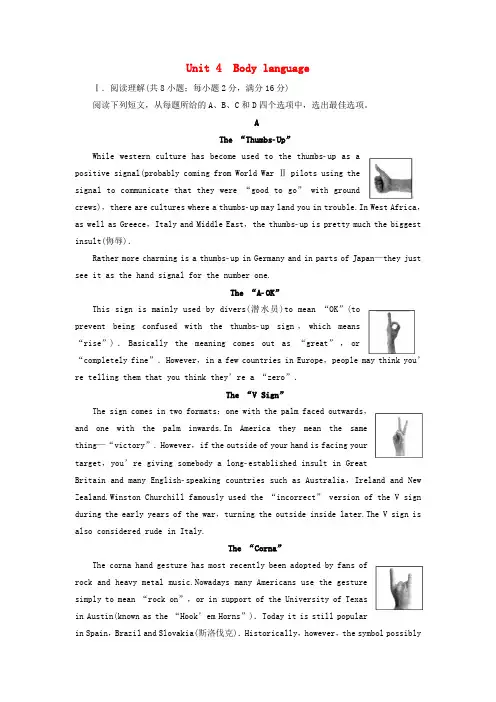
AThe “ThumbsUp”While western culture has become used to the thumbsup as apositive signal(probably coming from World War Ⅱ pilots using thesignal to communicate that they were “good to go” with groundcrews),there are cultures where a thumbsup may land you in trouble.In West Africa,as well as Greece,Italy and Middle East,the thumbsup is pretty much t he biggest insult(侮辱).Rather more charming is a thumbsup in Germany and in parts of Japan—they just see it as the hand signal for the number one.The “AOK”This sign is mainly used by divers(潜水员)to mean “OK”(toprevent being confused with the thumbsup sign,which means “rise”).Basically the meaning comes out as “great”,or“completely fine”.However,in a few countries in Europe,people may think you’re telling them that you think they’re a “zero”.The “V Sign”The sign comes in two formats:one with the palm faced outwards,and one with the palm inwards.In America they mean the same thing—“victory”. However,if the outside of your hand is facing yourtarget,you’re giving somebody a longestablished insult in GreatBritain and many Englishspeaking countries s uch as Australia,Ireland and New Zealand.Winston Churchill famously used the “incorrect” version of the V sign during the early years of the war,turning the outside inside later.The V sign is also considered rude in Italy.The “Corna”The corna hand gesture has most recently been adopted by fans ofrock and heavy metal music.Nowadays many Americans use the gesturesimply to mean “rock on”,or in support of the University of Texasin Austin(known as the “Hook’em Horns”).Today it is still popularin Spain,Brazil and Slovakia(斯洛伐克).Historically,however,the symbol possiblydates back to Ancient Greece.( )1.The pilots in World War Ⅱ used to make the “ThumbsUp” sign to show ______.A.the plane was very goodB.the plane was ready to take offC.they were going to land on the groundD.they were thankful to the ground crews( )2.What information can we get from the passage?A.The “V Sign” was first used by Winston Churchill.B.Italians often use the “ThumbsUp” to praise others.C.You are most likely to see the “Corna” in a heavy metal music concert.D.The “AOK” and the “ThumbsUp” have the same meanings to divers.( )3.If you travel abroad,you’d better not use the “V Sign” in ______.A.Greece or Italy B.Germany or JapanC.Ireland or Italy D.Spain or Brazil( )4.What is the main purpose of the passage?A.To show the importance of body language.B.To tell us how to use body language properly.C.To describe some kinds of body language.D.To tell us how to understand others’ body language.【答案与解析】1.B 细节理解题。
人教版高中英语必修四 Unit4 Body language 训练卷(一) (含答案)
C. atD. in
14.When the war broke out,thousands of young mencame forward,willing to defend their country ________ the enemy.
A.againstB. to
C. asD. of
C. WhateverD. Wherever
三、翻译句子(每小题3分,共15分)
21.On graduating from university,he went to teach in a village.
_________________________________________________________________
A. intoB. out of
C. toD. from
17.The latest evidence confirmed__________his conclusion was right.
A. whenB. what
C. thatD. which
18.Our solution proved effective_________our spirit.
3.I like her f___________expression which is very sweet and natural.
4.Now that the m__________________is cleared up, we can get back to work.
5.Science and technology have made m_________changes to the way we live.
2019-2020学年人教版英语必修四新素养同步讲义:Unit 4 Body language 6 单元要点回扣 Word版含答案
Ⅰ重点单词重点词汇夯实练1.statement n.陈述;说明Soon afterwards he made his first public statement(state) about the affair.2.represent vt.代表;象征;表现;描写;描绘;声称①Fortunately, the top student represented(represent) his school and made a speech at the meeting.②At the meeting, she expressed her satisfaction, representing(represent) her university.3.curiously adv.好奇地The curious boy looked at the box curiously and then he opened it out of curiosity.(curious)4.approach vt. & vi.接近;靠近;走近n.[U]接近;[C]方法;途径;通道①As autumn approached(approach), the plants in the garden changed.②We will have to adopt a more scientific approach __to protecting the traditional customs.5.defence n.防御;保卫In time of war, lots of money will be spent on defence and many measures will be taken to defend a country from being attacked.(defend)6.major adj.主要的vi.主修She majors in history. However, the majority(major) of her friends major in science.7.misunderstand vt.误解;误会If you misunderstand somebody, it’s likely to lead to a misunderstanding.(misunderstand)8.spoken adj.口语的The teacher often asks us to make use of every chance we get to improve our spoken(speak) English.9.facial adj.面部的My brother’s facial(face) expression suggested that he was very happy.10.truly adv.真实地;真诚地;真正地To tell you the truth, I’m truly grateful for your helping me make my dream come true.(true)11.anger n.怒气;怒火①As a matter of fact, much of our stress, disappointment, anger(angry) or worry comes from little things.②She was angry with him for not being able to attend his birthday party.12.hug vi.& vt.拥抱n.拥抱Jim came up and gave me a big hug(给了我一个大大的拥抱) as soon as he saw me.阅读词汇排查练1.simply ad v.简单地;只2.Muslim n.& adj. 穆斯林(的);伊斯兰教信徒的3.posture n. 姿势;体态4.crossroads n.十字路口5.frown v i. 皱眉;蹙额6.misread v t. 读错;误解7.fist n.拳头8.yawn v i. 打呵欠9.cassette n. 磁带Ⅱ重点短语会书写会应用1.defend against防御;保卫……以免2.be likely to 很可能……;有希望……3.in general 总的来说;通常4.in defence 保卫;防御5.at ease 舒适;快活;自由自在6.turn one’s back to背对;背弃7.lose face 丢脸1.The man became angry and shouted at his son. In general, he is a nice man and seldom loses his temper.2.If Tom doesn’t keep his promise, he’ll lose face.3.I’m a little nervous. Give me a cup of tea to put me at ease.4.I was about to greet Mr White on the street when he turned his back to me, which made me disappointed and embarrassed.5.When the door was opened suddenly, the boy covered his head with his hands as if in defence.Ⅲ重点句型1.Judging(judge) from the appearance, it is very peaceful, but in fact, a war will break out soon.2.Working(work) harder at English, you’ll make greater progress.3.Looking(look) out through the window, we saw a beautiful scenery.4.To__finish(finish) the work ahead of time,we have to work hard.5.The fire lasted nearly a day, leaving(leave) nothing valuable.Ⅴ话题写作根据要求运用本单元所学知识完成下面小作文,并背诵成文。
2019-2020学年人教版英语必修四新素养同步练习:Unit 4 Body language 3 Section Ⅲ 知能演练轻松闯关 Wor

Ⅰ品句填词1.I was cooking in the kitchen when my son came dashing(猛冲) in, with something in his hand.2.The sofa in the living room also functions(起……作用) as a bed in order to save space.3.The information the man told us yesterday was false(假的). I mean, we were cheated by him.4.William stayed up late last night, so he yawned(打哈欠) from time to time at class.5.It is said that most of the flights(航班) have been delayed as a result of the heavy snowstorm.6.Alice is not in the dormitory(宿舍) at this moment; she must have gone to the library.7.The mother hugged(拥抱) her child before she put him to bed.8.I think he feels a lot of anger(愤怒) towards his father who treated him very badly as a child.9.She kissed her baby on the cheek(面颊) and reminded him to go to bed early.10.An accident happened at the crossroads(十字路口) a few metres away from the bank.Ⅱ选词填空up__and__down strangely.2.Mr Thompson, together__with his wife and children, is waiting for the bus now.3.He pretended he didn’t see me and turned__his__back__to me.4.Most people are afraid of losing__face. If they fail once, maybe they won’t give themselves another chance.5.My mother was not angry. On__the__contrary,__she praised me for my sending the old man back home.6.Just don’t take exercise too close__to bedtime because exercise may make you sleepless.Ⅲ完成句子1.由于英国英语和美国英语有一些不同,出现一些误解是很正常的。
2019-2020学年人教版英语必修四新素养同步讲义:Unit 4 Body language 1 Section Ⅰ Word版含答案

握手是人与人问候的基本礼仪,但方式不同,表达的意义也大不相同。
The Secret of the Successful HandshakeThe secret of the successful handshake is no secret anymore.Management consultant Robert E. Brown explains what shaking handsis all about in his book, The Art, the Po w er, the Magic: Ho w to ReadHands That Talk.For example, to do the “AllAmerican Handshake”,you have to look into another person’s eyes, hold his or her whole hand, two or three times. According to Brown, this is the handshake of a good listener and trustworthy person.Politicians and salespeople often use the “TwoHanded Handshake”because it’s extrafriendly. They put their left hand on the other per son’s arm or shoulder as they shake hands. This can feel too friendly to some people, so it’s best to use it with good friends.Watch out for people with handshakes that pull your fingers, or twist(扭转) your hand. If you get one of these handshakes, the person is trying to intimidate(恐吓) you.Two more uncomfortable handshakes are the “Palm Pinch”and the “Dead Fish”. A Palm Pincher shakes your hand with only a few fingers. In the Dead Fish handshake, the person’s hand slides out of the handshake. It’s possible that the people with these handshakes areembarrassed(尴尬的) or shy.Shaking hands is an important part of body language. It can identify someone as truthful, friendly, powerful, or nervous. It’s hard to be successful without knowing about a good handshake such as the AllAmerican. If this isn’t your natural handshake, don’t worry. Mr Brown says that you can change your handshake with lots of practice. So, go on out there and start shaking hands. Just think of all the people you can meet!Section ⅠWarming Up & Reading—Comprehending重点单词写作词汇1.dormitory n. 宿舍2.canteen n. 食堂3.approach v t.& v i. 接近;靠近;走近n. 接近;方法;途径4.cheek n. 面颊5.major adj. 主要的6.adult n. 成人;成年人adj. 成人的;成熟的7.dash v i. 猛冲;突进8.flight__n. 飞行;航班拓展词汇9.likely adj.可能的→unlikely adj.不可能的10.statement n.陈述;说明→state v.陈述;说明11.greet v i.& v t.迎接;问候→greeting n.迎接;问候;招呼12.represent v t.代表;象征→representation n.代表,代表团;代理→representative adj.代表性的n.代表,代理人13.association n.社团;联系;联想→associate v.把……联系起来14.curious adj.好奇的→curiously ad v.好奇地→curiosity n.好奇心15.defend v t.保护;保卫→defence n.防御;保卫16.misunderstand v t.误解;误会→misunderstanding n.误解;误会阅读词汇17.simply ad v. 简单地;只18.Muslim n.& adj. 穆斯林(的);__伊斯兰教信徒(的)19.posture n. 姿势;体态20.crossroads n. 十字路口重点短语1.put__up 举起;抬起2.in__defence 保卫;防御3.kiss__sb.on__the__cheek 亲吻某人的脸4.be__likely__to 很可能……;有希望……5.in__general 总的来说;通常6.defend...against 防御;保卫……以免受重点句型1.the first/second/.../last+名词+to do...:The__first__person__to__arrive(第一个到达的人) was Tony Garcia from Colombia, closely followed by Julia Smith from Britain.2.状语从句的省略:She stepped back appearing surprised and put up her hands,as__if__in__defence(好像是在自卫).3.not all...表示部分否定:Not__all__cultures(并不是所有文化) greet each other the same way, nor are they comfortable in the same way with touching or distance between people.ⅠFast-readingSkim the text and do the following exercises.1.What does the text mainly talk about?A.Communication. B.Spoken language.C.Body language. D.Different cultures.答案:C2.Match the main idea of each paragraph.Para.1A.To suggest studying international customs.Paras.2-3 B.To meet the international students at the Capital International Airport.Para.4 C.To introduce the students to each other and explain their different ways of greeting.Para.5 D.To explain different cultural “body language”in some countries.答案:BCDAⅡCareful-readingRead the text carefully and choose the best answer.1.In which of the following countries do people greet each other in the same way?A.Colombia and Britain.B.Spain and Italy.C.France and Jordan.D.China and Japan.2.How does the text develop?A.By giving examples. B.By giving data.C.By giving definition. D.By making comparisons.3.What’s the purpose of the second paragraph?A.To give examples of mistakes the international students make.B.To give examples of cultural differences in body language.C.To show how surprised we are by their different behavior.D.To show how important body language is.4.What can we learn from the passage?A.Never too old to learn.B.When in Rome, do as the Romans do.C.Four eyes see more than two.D.Every country has its own customs.答案:1-4.BABBⅢStudy-readingAnalyze the following difficult sentences in the text.1.They shook hands and then kissed each other twice on each cheek, since that is the French custom when adults meet people they know.本句是一个复合句。
2019-2020学年人教版高中英语必修四同步作业:Unit 4 Body language课后限时作业11 Word版含答案

课后限时作业(十一)(见课时作业P21)Ⅰ.单句语法填空(建议用时:7分钟)1.By the end of 2007, about half a million people had flooded into the city, __making__(make) up around 10 percent of its total population.解析句意:到2007年底,大约50万人涌进那座城市,占那座城市总人口的大约10%。
half…people与make up之间为主谓关系,故用现在分词形式。
2.Not __having made__(make) full preparations, we put off the sports meeting.解析句意:因为没有做好充分的准备,我们把运动会延期了。
we与make之间为主谓关系;prepare的动作应发生在谓语动作put off之前,故用having made。
3.Every year, many graduates travel from one place to another, __hunting__(hunt) for a well -paid job.解析句意:每年很多毕业生从一个地方到另一个地方,寻找高薪的工作。
many graduates与hunt之间为主谓关系,故用现在分词形式作伴随状语。
4.The police are sparing no effort to search for the missing boy, __giving__(give) his parents a ray of hope.5.He got up late and hurried to his office, __leaving__(leave) the breakfast untouched.解析He与leave之间为主谓关系,故用现在分词形式作伴随状语。
2019-2020学年人教版英语必修四新素养同步讲义:Unit 4 Body language 2 Section Ⅱ Word版含答案
Section ⅡWarming Up & Reading—Language Pointsgreet v i.& v t.迎接;问候(教材P25)There are many different ways to greet someone using words.使用语言会有很多不同的方式问候某人。
(1)greet sb.with...用……迎接某人;用……向某人打招呼(2)greeting n. (常用复数形式)问候;祝贺;贺词①He greeted all the guests warmly as they arrived.客人到达时他都热情接待。
②Please give my greetings to Miss Macleod.请代我向麦克劳德小姐问好。
[即学即练]——单句语法填空①She greeted(greet) us with a smile when she saw us in the street.②She sent us a card with birthday greetings(greet).represent v t.代表;象征;表现;描绘;声称(教材P26)Yesterday,another student and I, representing our university’s student association,went to the Capital International Airport to meet this year’s international students.昨天,我和另外一个同学代表我们大学的学生会,到首都国际机场迎接今年的留学生。
represent sb.as/to be...把某人描绘成……represent oneself as/to be... 自称……represent sth.to sb. 向某人说明或传达某事①Representing our school, I’m glad to tell you something about these activities.我非常高兴代表我们学校告诉你们有关这些活动的一些事情。
2019-2020学年人教版英语必修四新素养同步练习:Unit 4 Body language 4 Section Ⅳ 知能演练轻松闯关 Wor
Ⅰ单句语法填空1.Charlie Chaplin appears on the stage, wearing a small hat and holding a walking(walk) stick.2.Jackson stood in front of his son, trying(try) to control his anger.3.The headmaster came up to the boys playing(play) basketball on the playground.4.Though feeling(feel) upset, Helen pretended to be cheerful when she came back home after work.5.His uncle died, leaving(leave) him a large amount of money.6.My grandmother doesn’t like to sit here doing(do) nothing all day long.7.Taking(take) a deep breath, they dived into the cold water and saved the drowning(drown) boy.8.Our monitor didn’t change much after graduation, except getting(get) a little fatter.9.His parents got killed in the earthquake, leaving(leave) him an orphan.10.Having__waited(wait) in the queue for half an hour, Joey realized that he had left his wallet at home.Ⅱ阅读理解In the United States, many teachers keep fish, hamsters(仓鼠), and other animals in their classrooms. Teachers say students learn important lessons from the animals. More than 70 percent of teachers who have classroom pets say the animals help students learn responsibility. Research also shows that classroom pets can reduce stress.“Pets can comfort kids who are having a bad day,”says Lisa Robbins, who works for a group called Pets in the Classroom.But others think pets should be expelled from classrooms. In January, the Durango School District in Colorado began following a no-pet policy(政策). Now animals can be brought into Durango schools for certain lessons, but they can’t stay. Officials were worried that animals might create problems for kids with allergies(过敏症). They were also concerned about the animals getting proper care.Here’s what two of our readers think.Having classroom pets gives students a fun way to learn about animals. In my class last year, we had a class pet named Elliot. Our teacher also used him to teach us about different subjects. For example, in math, we calculated how much it costs to feed Elliot for a year.Pets also help kids learn how to work as a team. My classmates and I took turns feeding Elliot and cleaning his tank.If teachers are worried about students with allergies, they could get pets that don’t have fur.—D’Lasia Mays, Texas Classroom pets can take away valuable class time. Some students might have a hard time focusing on the teacher when there are animals in the room.Plus, having a classroom pet can cause safety problems. You never know how an animal will react to students. Even a cute little hamster might hurt a kid who sticks his or her hand in its cage.—Patrick McKinney, Ohio 【解题导语】本文是一篇议论文。
2019-2020学年人教版英语必修四新素养同步讲义:Unit 4 Body language 4 Section Ⅳ Grammar Word版含答案
Section ⅣGrammar现在分词(短语)作状语1.(教材P26)I stood for a minute watching(watch) them and then went to greet them.2.(教材P26)Then Akira Nagata from Japan came in smiling(smile), together with George Cook from Canada.3.(教材P26)In the same way that people communicate with spoken language, they also express their feelings using(use) unspoken “language”through physical distance,actions or posture.4.Having smoked(smoke) too much, he has suffered from lung cancer.5.Hearing(hear) the news, they jumped for joy.现在分词(短语)作状语的用法现在分词(短语)在句中作状语来修饰谓语动词或整个句子,表示动作发生的时间、原因、条件、结果、方式、让步或伴随状况。
1.作时间状语(相当于一个时间状语从句)◆Walking in the park, she saw an old friend.=When/While (she was) walking in the park, she saw an old friend.当她在公园里散步时,她看到了她的一个老朋友。
当表示正在进行的动作时,可直接在分词前面加上when或while,此时也可理解为状语从句的省略。
2.作原因状语(一般可转换成由as或because引导的原因状语从句)◆Being ill, he couldn’t go to school.=As he was ill, he couldn’t go to school.因为生病了,他无法去上学。
2019-2020学年人教版英语必修四新素养同步讲义:Unit 4 Body language 3 Section Ⅲ Word版含答案
Section ⅢLearning about Language & Using Language重点单词写作词汇1.false adj. 错误的;假的2.hug v i.& v t. 拥抱3.rank n. 等级;军衔4.ease n. 安逸;舒适v t. 减轻(痛苦、忧虑)5.function n. 作用;功能;职能v i. 起作用;运转拓展词汇6.facial adj.面部的→face n.脸7.subjective adj.主观的→subject n.主题;对象8.truly ad v.真实地;真诚地;真正地→true adj.真实的→truth n.真实;真理9.respectful adj.恭敬的→respect n.尊敬,尊重;方面;敬意v t.尊敬,尊重;遵守10.anger n.怒气;怒火→angry adj.生气的阅读词汇11.frown v i. 皱眉;蹙额12.misread v t. 读错;误解13.fist n. 拳头14.yawn v i. 打呵欠15.cassette n. 磁带重点短语1.at ease 舒适;快活;自由自在2.lose face 丢脸3.turn one’s back to 背对;背弃4.look away from... 把目光从……上移开;不看5.in most cases 在大多数情况下6.base on 以……为基础/根据重点句型1.even if 引导让步状语从句:It is possible to “read” others around us, even if they do not intend for us(即便他们并不想让我们) to catch their unspoken communication.2.不定式作表语:The most universal facial expression is, of course, the smile—its function is to show happiness and put people at ease(表示快乐和使人放松).3.with复合结构:With so many cultural differences between people(人们之间的文化差异非常多), it is great to have some similarities in body language.ⅠFast-readingRead the text and match the main idea of each part.Part 1 (Para.1) A.Examples of some universal body language.Part 2 (Paras.2-6) B.Body language is sometimes more importantthan spoken language.Part 3 (Para.7) C.There are differences in body language, and it’simportant for us to know them.答案:BACⅡCareful-readingRead the text carefully and choose the best answer.1.Why may a person smile if he loses face?A.To show his anger. B.To hide his embarrassment.C.To threaten others. D.To laugh at others.2.If you are not interested in others’talking, you may ________.A.look away from him or yawnB.turn toward and look at somethingC.fix your attention on the speakerD.stand at a little distance with open hands3.Suppose you are a teacher in America,you’ll tell your students to ________ when others are talking.A.avoid looking at others directlyB.look directly at othersC.glance at othersD.look down at others4.We can infer from the text that ________.A.we can communicate successfully with others using body languageB.people from different countries will not misunderstand each other using body language C.we should try to learn more about other countries’ customsD.all around the world,people express the same idea using the same body language答案:1-4.BABC①means 方法,方式(单复数同形)②intend for sb.to do sth.打算让某人做某事③unspoken[ʌn'spəʊkən]adj.未说出口的;非口语的④misread[ˌmIs'riːd]v t.(misread[mIs'red],misread)读错;误解misread...as把……误解为……⑤universal[ˌjuːnI'vɜːs l] adj.普遍的,广泛适用的⑥facial['feIʃl]adj.面部的⑦function['fʌŋkʃn]n.作用;功能;职能v i.起作用;运转⑧at ease舒适;快活;自由自在ease[iːz]n.安逸;舒适v t.减轻(痛苦、忧虑)put sb.at ease 使舒适,使自在⑨truly['truːlI]ad v.真实地;真诚地;真正地⑩false[fɔːls]adj.错误的;假的(反义词:true)⑪anger['æŋɡə]n.怒气;怒火in anger 生气地,愤怒地⑫lose face丢脸⑬frown['fraʊn]v i.皱眉;蹙额⑭turn one’s back to背对⑮fist[fIst]n.拳头⑯threaten['θret n] v.威胁,恐吓⑰up and down 上下波动;来回⑱from side to side 左右来回(摇摆)⑲look away from 把目光从……上移开⑳yawn[jɔːn]v i.打呵欠○21in most cases 在大多数情况下○22roll one’s eyes 转动眼球○23likely 在此用作副词,意为“很可能”,修饰其后的动词。