
人教版八年级英语上册教案unit1wheredidyougoonvacation
ThingsJanedidorsaw
Didshelikeit?(Yes/No)
Whyorwhynot?
triedparagliding
Yes.
Itwasexciting.
ateMalaysianyellownoodles
Yes.
Theyweredelicious.
walkedaroundGeorgetown
5.Workon2b&2c
Task1:ReadJane’sdiaryentriesabouthervacationandanswerthequestions.
T:Janelikestowriteadiarywhenshetravels.Let’sreadherdiaryentriesandanswerthequestions.
3.能熟练运用下列句型进行交流:Howwas...?/Howwere...?
【教学重难点】
1.掌握本课时出现的生词及表达方式。
2.进行听力训练,提高综合听说能力。
3.阅读短文,获得相关信息,提高学生们的综合阅读能力。
4.听力训练。
【课前准备】
录音机,电脑,多媒体课件。
┃教学过程设计┃
一、创设情境,切入主题
Leadin&Presentation
T:Myshoesareverycheap(写在黑板上).Theycostonly50yuan,andIlikethemverymuch.Ithinktheyarebeautiful.CanyougivememoreadjectivesthatIcanusetodescribemyshoes?
hadonebowlofriceandsomefishwithherfamily
Yes.
Ittastedgreatbecauseshewashungry.
GiveSsafewminutestofillinthechart.EncourageSstounderlinethedifficultphrasesorsentencesandexplainthemifnecessary.
(2)Whatactivitiesdoyoufindenjoyable?
HavetwoorthreeSspresenttheirreportstotheclass.
YoucangiveSssomehelpfulphrases:someinterestingplaces,somewherewarm/cool,buysomethingspecial.
【教学目标】
1.能正确使用下列词汇:decide,try,paragliding,bird,bicycle,building,trader,wonder,difference,top,wait,umbrella,wet,below,enough,hungry
2.能熟练运用下列短语:becauseof,feellike,decidetodosth.,enjoydoingsth.,arrivein/at
(1)great(2)friendly(3)exciting(4)delicious(5)expensive
3.Workon1e
T:Now,getintopairsandanswerthefivequestionsin1eaccordingtowhatyouheardjustnow.Writeyouranswersinyourbook.
1cAnswers:
(1)ShewenttoHongKong.
(2)Yes,shedid.Shewenttoafunpark.
(3)Yes,shedid.
(4)Yes,shedid.
T:Listenagain.Fillintheblanks.
WhatdidLisasayabout...?
1dAnswers:
2.feellike
3.decidetodosth.
4.enjoydoingsth.
5.arrivein/at
6.makeadifference
EncourageSstoputtheiranswerstoallfivequestionsintoashortparagraph.Forexample:
LisawenttoHongKongonvacation.Shewenttoafunpark,andshethinkstheparkisexciting.Shesaysthepe(1)arrivein/at=reach=getto
(2)decidetodosth.=makeadecisiontodosth.=makeupone’smindtodosth.
(3)feellikedoingsth.=wouldliketodosth.
(4)Iwonder...
(5)Whatadifferenceadaymakes!
2dAnswers:
(1)went(2)Malaysia(3)did(4)family(5)sunny(6)paragliding(7)rode(8)father(9)was(10)waited(11)wet(12)umbrella(13)enough
Task2:ImagineJanewenttoPenangHillagainandhadagreatday.Fillintheblanksinherdiaryentrywiththecorrectformsoftheverbsinbrackets.
Yes.
Shelikedtheoldbuildingsthereandwonderedwhatlifewaslikeinthepast.
wenttoPenangHill
No.
Becauseofthebadweather,theywerewetandcold.Theycouldn’tseeanythingbelow.
三、布置作业
用所给动词的适当形式填空。
mother________(buy)anewschoolbagformeyesterday.
________you________(start)tolearnEnglish?
aunt________(take)ustodinneratarestaurantbutthefood________(is)notgoodatall.
I________(am)inAmerica,I________(make)alotofnewfriends.
________(have)agreatsalelastweekend.
【板书设计】
Unit1Wheredidyougoonvacation?
SectionB(1a-2e)
1.becauseof
S1:Fantastic!
S2:Wonderful...
T:That’sgreat!Now,canyoutellmewhichadjectivesyouhavementionedarepositiveandwhicharenegative?
(教师把positiveadjectives&negativeadjectives板书在黑板上并在对应的地方写上相应的形容词)
设计意图:虽然学生学了不少形容词,但是学生并不清楚形容词如何用得恰当且又有何区别,通过讨论和板书,学生可以清楚地知道形容词可以有褒义和贬义之分,有些甚至是中性的。
二、展开过程,探究新知
1.Workon1a&1b
T:Lookatthepicturesandmatchthemwiththewordsinthebox.
4.Workon2a
T:Getintogroupsofthreeorfouranddiscussthefollowingonepersoninthegrouptosharewhatyouhavediscussedwiththeclass.
(1)Whatdopeopleusuallydoonvacation?
HaveSsclosetheirbooksandcallouteachverbinbrackets.Sswillthensaythecorrectpasttenseformoftheverb.
2eAnswers:
(1)was(2)went(3)walked(4)started(5)saw(6)stopped(7)drank(8)walked(9)got(10)was(11)looked
(6)Themovieisboring.
1aAnswers:(1)f(2)a(3)c(4)e(5)b(6)d
Next,haveSslookatthewordsin1aagain.Explainthatahappyfaceshowsthatthewordispositive,andasadfaceshowsthatthewordisnegative.
EncourageSstogivetheiranswersinfullsentences,like:
(1)Cakesaredelicious.
(2)Theringisexpensive.
(3)Thetalentshowisexciting.
(4)Theeraserischeap.
(5)Thefoodisterrible.
(6)Becauseof+wordsorphrases=because+clause
on2d&2e
Task1:CompletetheconversationaboutJane’striptoPenangusingtheinformationinthediaryentries.
HaveSsworkonthisactivityfortheirhomework.
1bAnswers:
Happyface(delicious,exciting,cheap)
人教版英语八年级上册Unit1Wheredidyougoonvacation1a2d优秀教学案例

3. 此外,我还将设计一些角色扮演的活动,让学生模拟假期中的实际场景,进行实际的对话交流,提高学生的口语表达能力。
(二)问题导向
1. 在教学过程中,我将提出一些问题,引导学生进行思考和讨论。例如,我可能会问学生:“你在假期中去了哪里?”和“你在这个地方做了什么?”等问题,让学生通过思考和回答问题,复习和运用所学知识。
二、教学目标
(一)知识与技能
1. 学生能够掌握并正确运用一般过去时,描述自己的假期经历。通过本节课的学习,学生能够理解并运用核心句型 "Where did you go?", "What did you do?" 和 "How was it?" 来询问和描述假期活动。
2. 学生能够听懂并能够运用本节课的重点词汇,如 "beach", "mountain", "zoo", "restaurant" 等,来描述假期的地点和活动。
2. 接着,我会提出一些问题,如“你在假期中去了哪里?”和“你在这个地方做了什么?”等,让学生分享自己的假期经历,并复习和运用所学知识。
3. 然后,我会引导学生关注本节课的主题“Where did you go on vacation?”,让学生思考和讨论他们去过的地方,为学习新的语言知识做好准备。
2. 任务型教学法的运用:通过设计各种真实、具有挑战性的任务,如小组讨论、角色扮演等,让学生在完成任务的过程中自然而然地学习和运用英语。这种教学法不仅能够提高学生的参与度和积极性,还能够培养学生的合作意识和解决问题的能力。
人教版英语八年级上册Unit1WheredidyougoonvacationSectio
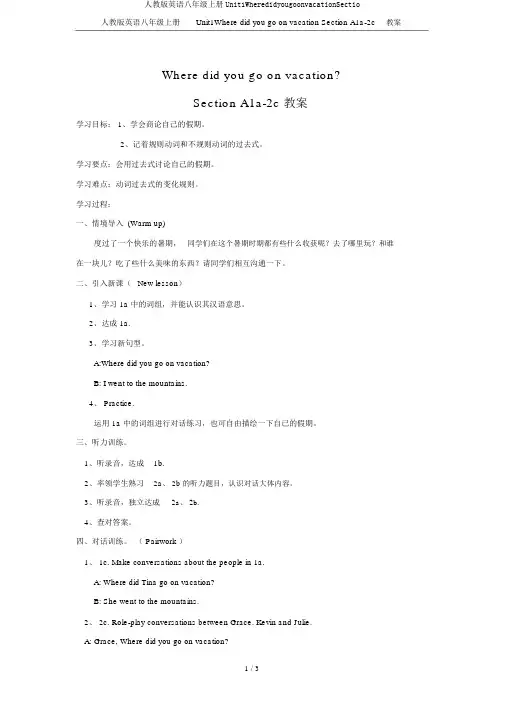
人教版英语八年级上册Unit1Where did you go on vacation Section A1a-2c教案Where did you go on vacation?Section A1a-2c 教案学习目标: 1、学会商论自己的假期。
2、记着规则动词和不规则动词的过去式。
学习要点:会用过去式讨论自己的假期。
学习难点:动词过去式的变化规则。
学习过程:一、情境导入 (Warm up)度过了一个快乐的暑期,同学们在这个暑期时期都有些什么收获呢?去了哪里玩?和谁在一块儿?吃了些什么美味的东西?请同学们相互沟通一下。
二、引入新课(New lesson)1、学习 1a 中的词组,并能认识其汉语意思。
2、达成 1a.3、学习新句型。
A:Where did you go on vacation?B: I went to the mountains.4、 Practice.运用 1a 中的词组进行对话练习,也可自由描绘一下自已的假期。
三、听力训练。
1、听录音,达成1b.2、率领学生熟习2a、 2b 的听力题目,认识对话大体内容。
3、听录音,独立达成2a、 2b.4、查对答案。
四、对话训练。
( Pairwork )1、 1c. Make conversations about the people in 1a.A:Where did Tina go on vacation?B:She went to the mountains.2、 2c. Role-play conversations between Grace. Kevin and Julie.A: Grace, Where did you go on vacation?B: I went to New York City.A:Oh, really? Did you go with anyone?B:Yes, I went with my mother.3、 Practice like 2d.五、语法角 .Where did you go on vacation?How was the food?Did you go out with anyone?第一单元的要点语法是要修业生会咨询过去式的特别疑问句和一般疑问句,并能对其作正确回答,在此基础上,要修业生应掌握一些常用的动词的过去式。
人教版教材八年级英语上册Unit-1:Where-did-you-go-on-vacation教案

Unit 1 Where did you go on vacation?(听说课)一、教学时间:20xx年X月X日二、教学对象:八年级学生三、教学内容:教学教材:人民教育出版社《新目标》教学单元:第一单元《Where did you go on vacation》教学课时:本单元第一课时教学话题:谈论假期,谈论过去。
四、学情分析:1、学生情况:学生经过一年的英语学习,有一定的基础。
八年级的学生英语学习兴趣浓厚,思维活跃,求知欲强,也掌握了一些学习英语的基本方法与技巧。
但学生仍要多以游戏教学、竞赛教学、角色扮演等活动激发他们的学习兴趣,以此陶高课堂效率。
2、教学内容:本课的内容是通过围绕“假期”这一主题,讨论过去的活动,学习常见动词过去式并学会使用询问假期的功能句。
3、教学条件:(1)黑板、投影仪、PPT(2)教师拥有的专业教学技能和知识水平,能够胜任本节课的教学任务。
五、教学目标:1、知识目标(1)学习be动词及go、play、buy、have、stay、visit、feed等的过去时,并能使用动词的过去时回答提问。
(2)学习一般过去时,并能将一般过去时运用到功能话题中,讲述并回答自己过去的活动:I did ... / I went.../It was...(3)掌握使用What、Where、When、How、Why询问过去的一般句型:Where did you do....?Where did you go...?What did you do...?How was....?能熟练使用这些句型及其相应回答讨论假期。
2、语言技能目标(1)听懂假期话题的情景对话“where did you go on vacation? I went....”中的关键信息。
指认图片。
(2)听懂Grace、Kevin 、Juile三人假期所去的地方,提取录音中的关键信息,完成2a,并复述你所听到信息。
(3)掌握询问他人假期的一般句型:where did you go on vacation? How was your....? It was.....等,并能熟练运用于同学讨论。
人教版八年级英语上册Unit1:where-did-you-go-on-vacation教案

Where did you go on vacationSection A(二)Aims1.Match the vocabulary : were rainyMaster and use: How was your vacation ? how were the beaches?where did you go?Difficult1.The vocabulary : were rainy fishnguage: Where did you go on vacation? I went to the mountains/ New York City /beach /summer camp How was your vacation ? how were the beaches?ImportantUse the language to talk about past events.教学步骤教学步骤、时间Step 1Free talk教师活动学生活动媒体应用Ask the question : Where did you go last Students talk about Sunday?events in the past.Step 2 Presentation (16’)(3a)(用班里的学生为例做练习)Point out the pictures in the photo album. Ask studentsto describe what they see.( In Picture 1 there is aman with a bowl of soup .There is also a waiter. Helooks angry .)Describe what theysee in picture 1 andpicture 2Fill in the blanks inthe conversation(In picture 2 there is a beautiful beach .There isa man. He looks unhappy .)(学生看3a 部分)Read the first two lines of the dialogue to the practice and act.class.Point out the answer was in the first line.Listen .Then point out the blanks in the rest of the lines(学生看图互问)Step 3the Work with the teacher.of the dialogue. Read the conversation toPractice(36)Work with a partner class saying the word blank for each blank line:(6')and act out.How blank the beaches?Then say , Write the word was or were in each Read and learn.blank. Ask students to complete the activity on Make their owntheir own .conversationPoint to picture 3 and ask students to say what 多媒体放映图一图二they see.Then read the words under thepicture .Pronounce any new words and explainwhat they mean ,if necessary Say:In this picturea girl is on a bus. The girl is taking a bustrip . Ask , What does relaxing mean ?Does it mean you are excited or quiet?How do you look when you relax?H students don ’ t know the meaningrelaxing,ofdemonstrate by leaning back in your seat andhalf 一 closing your eyes.Say a dialogue with a student . point tothe food picture. Ask , How was the food? Do asend example, if you wish .Move around the room monitoring theirwork . Offer language or pronunciation support Practice in pairs.as needed.The student replies ,itHave two students perform the example was awful .conversation ,or perform it yourself with one work in pairs多媒体student(you ask the questions).Look at picture6 ,放映Point out that the conversations starts off with Practice thethe sentences in the speech bubbles.conversation below .For example ,Ask and answerA :where did you go?questions.B: I went toA: What was the weather like?B: It was hot and humid .Say: First fill in the chart with the information Something in theabout your last vacation , Say where you went , pictures.Step 4the weather was like,what you ate, and Act it out多媒体whatPracticeFill in the chart with放映what else you did . As students fill in the chart(10')move around the classroom, monitoring progress Their own informationand offering help as necessary。
人教版英语八年级上册Unit1Wheredidyougoonvacation教案

Unit 1 Wheredid you go on vacati on?一.必记单词1. anyone pron.(不定代词)任何人nothin g pron. (不定代词)没有什么,没有一件东西someth ing pron.(不定代词)某事;某物everyon e pron. (不定代词)每人;人人;所有人someon e pron.(不定代词)某人anywhe re adv. (不定副词)在任何地方2. wonderful adj. 精彩的;绝妙的3. few adj. & pron. 不多;很少quite a few 相当多;不少Notice:few, a few, little,a little用法a few + 可数名词肯定句a little + 不可数名词肯定句few + 可数名词否定句little + 不可数名词否定句4. most adj., adv. & pron. 最多;大多数5. myself pron.我自己;我本人yourse lf pron.你自己;您自己yourse lvespl. 你们自己Notice:反身代词第一、二人称的反身代词由物主代词加-self构成。
第三人称的反身代词由代词宾格加-self构成。
Oursel ves 我们自己himsel f 他自己hersel f 她自己itself它自己Themsel ves他们自己6. hen n. 母鸡pig n. 猪bird n. 鸟duck n. 鸭7. seem v. 好像;似乎;看来8. boredadj. 厌倦的;烦闷的9. diaryn. 日记;记事簿10. activi ty n. 活动11. decide v. 决定;选定decide to do sth. 决定去做某事12. try v.& n. 尝试;设法;努力Notice: try to do sth.与try doingsth.辨析try to do sth.(尽力、设法去做某事)表示想尽一切办法要把某事办成,强调付出一定的努力设法去完成try doingsth.(尝试着做某事)表示一种尝试、做做看的想法,不一定付出很多努力Eg.: I tried calli n g him, but no one answe red. I ’m tryin g to learn Engli s h well. 13. bicyc l e n. 自行车;脚踏车 14. build i ng n. 建筑物;房子 Notic e: build (建造,建筑)+ ing ==== build i ng(建筑物) build (建造,建筑)+ er ==== build e r(建设者,建筑者) 15. trade r n. 商人 16. wonde r v . 想知道;琢磨 17. diffe r ence n. 差别;差异 ( diffe rent adj. 不同的,有差异的) 18. top n. 顶部;表面19. wait v . 等待;等候 (wait for sb./sth. 等待某人/某物) 20. umbre lla n. 伞;雨伞21. wet adj. 湿的;潮湿的;下雨的 22. below prep.& adv . 在···下面;到···下面 反义词 above 超过;在···之上 23. enoug h adj. & adv . 足够的(地);充足的(地);充分的(地) 巧记eno u gh 在句中的位置:修饰名词很自由,可以前来也可后, 若是修饰形或副,一定后置要记住。
人教版八年级英语上册教案Unit 1 Where did you go on vacatio

Period 4 (Section B 2a-2e)设计说明本节课从“Let’s have a chant.”入手进行复习热身,通过看图学习生词、师生问答、朗读与翻译,全面学习本课时的重点词汇;本课时另一个重点是Jane的日记内容,通过读前、读中与读后的各项任务的操练,让学生充分理解日记中的内容,并对课文中重点词的用法进行合作探究。
教学目标1. 知识目标:(1)掌握单词和短语:enjoyable,activity,decide,try,paragliding,bird,bicycle,building,trader,wonder,difference,top,wait,umbrella,wet,below,enough,hungry,as,hill,feel like,because of。
(2)阅读两篇旅游日记,学会用英语描述假期情况。
2. 能力目标:(1)通过阅读两篇英文日记,获得相关信息,提高学生的综合阅读能力。
(2)学会用英语描述假期情况,从而学会写旅行日记。
3. 情感目标:通过阅读旅行日记,谈论假期经历,增进相互了解并享受生活的乐趣。
重点难点1. 重点:(1)掌握本课时出现的生词及短语。
(2)阅读短文,获得相关信息,提高学生们的综合阅读能力。
(3)掌握英语日记的书写格式。
2. 难点:(1)学生阅读策略的指导和运用。
(2)文本中长难句的理解。
教学准备1. 让学生搜集马来西亚的图片,了解这个国家的风土人情。
2. 教具:与本课词汇有关的图片及材料,多媒体课件、录音机和磁带。
教学过程Step 1Warming up & Leading inStep 2PresentationT:Look at the pictures. Let’s learn the new words. What’s this?S1:It’s a bicycle. (板书bicycle)T:Do you usually go to school by bicycle?S1:Yes,I do.T:In Picture 2,what are these?S2:They’re umbrellas. (板书umbrella)T:What’s he doing?S3:He’s trying paragliding. (板书try paragliding)T:Is he flying like a bird? (板书bird)S3:Yes,he is....Step 3Practice the new words1. Read the new words after the tape.2. Read and translate the following words and phrases into Chinese.activity 活动decide 决定;选定umbrella 伞;雨伞bird 鸟building 建筑物;房子trader 商人wonder 想知道;琢磨difference 差别;差异because of 因为top 顶部;表面wait 等待;等候wet 湿的;潮湿的;下雨的bicycle 自行车;脚踏车hungry 饥饿的as 像……一样;如同hill 小山;山丘try 尝试;设法;努力paragliding 滑翔伞运动enjoyable有乐趣的;令人愉快的feel like 给……的感觉;感受到below在……下面;到……下面enough 足够的(地);充足的(地);充分的(地)Step 4Reading1. Before readingTask 12a 1. Discuss the two questions with your partner.(1)What do people usually do on vacation?(2)What activities do you find enjoyable?2. Give students some possible answers:People usually go to some places of interest on vacation.I find fishing enjoyable.3. Students discuss the two questions. Write down their answers. Let several groups report their answers.Task 2T:Today I will show some pictures about Malaysia to let you know more about it.And show some exciting and interesting videos to you about paragliding. Let’s know about it.2. While readingT:Are you excited? Do you want to try paragliding? Now we’ll learn Jane’s diary entries about her vacation. She went to Penang in Malaysia. She went to the beach and tried paragliding. Now,let’s know about her vacation.Task 12b Read Jane’s diary entries. Answer the questions:Did Jane have a good time on Monday? What about on Tuesday?Check the answers and find out relative sentences.Answers:Yes,she did. Jane didn’t have a good time on Tuesday.Task 22c Read them again. Fill in the chart.Answers will vary.Task 3(1)Read the diary entries carefully,and fill in the blanks.Jane went to Penang in Malaysia. She went with her family. The weather was sunny and hot on Monday,so they went paragliding on the beach. In the afternoon,they rode bicycles to Georgetown. But the next day was not as good. Jane and her father went to Penang Hill but the weather became bad and it started to rain. They waited a long time for the train and they were wet and cold because they forgot to bring an umbrella. And that was not all! They didn’t bring enough money with them,so they only had one bowl of rice and some fish. But it tasted great!(2)Retell the text.Step 5Cooperative inquiryGet the class to read the following sentences and sum up.①It was sunny and hot,so we decided to go to the beach near our hotel.My father and I decided to go to Penang Hill today.We wanted to walk up to the top,but then it started raining a little so we decided to take the train.②I felt like I was a bird. =I felt like a bird.I feel like eating dumplings for dinner tonight.③And because of the bad weather,we couldn’t see anything below.=And because the weather was bad,we couldn’t see anything below.Lisa didn’t go to school because of her cold (感冒).=Lisa didn’t go to school because she had a cold.④My father didn’t bring enough money,so we only had one bowl of rice and some fish.Linda is old enough to go to school this year.a. decide+to do sth. 意为“决定做某事”。
人教版八年级英语上册教案 Unit 1 Where did you go on vacation Section A(1a-2d)
Unit 1Where did you go on vacation?Section A(1a-2d)【教学目标】1.能正确使用下列词汇:anyone,anywhere,wonderful,most,few2.能熟练运用下列短语:stay at home,go to the mountains,go on vacation,quite a few,study for tests,go with my mother3.能熟练运用下列句型进行交流:Did you buy anything special?I went to New York City.Did you go anywhere interesting?—Where did you go on vacation?—I went to the mountains.【教学重难点】1.恰当地使用不定代词和动词过去式描述过去的事情。
2.用所学的功能语言交流假期去了哪里旅行。
3.掌握本课时出现的新词汇。
【课前准备】录音机,多媒体课件,电脑。
┃教学过程设计┃【板书设计】Unit 1Where did you go on vacation?Section A(1a-2d) 重点词汇:anyone,anywhere,wonderful,few重点短语:stay at home,go on vacation,quite a few,study for tests重点句型:—Where did you go on vacation?—I went to New York City.—Did you buy anything special?—Yes,I did./No,I didn’t.。
人教版八年级英语上册教案:Unit 1 Where did you go on vacation 教案
Unit 1 Where did you go on vacation?Section A 1 (1a-2d)一、教学目标:1. 语言知识目标:1) 能掌握以下单词:anyone, anywhere, wonderful, quite a few, most, something, nothing, everyone, of course, myself, yourself能掌握以下句型:①—Where did you go on vacation? —I went to the mountains.②—Where did Tina to on vacation? —She went to the beach.③—Did you go with anyone? —Yes, I did./No, I didn’t.2) 能了解以下语法:—复合不定代词someone, anyone, something, anything等的用法。
—yourself, myself等反身代词的用法。
3)一般过去时态的特殊疑问句,一般疑问句及其肯定、否定回答。
2. 情感态度价值观目标:学会用一般过去时进行信息交流,培养学生的环保意识,热爱大自然。
二、教学重难点1. 教学重点:1) 用所学的功能语言交流假期去了什么旅行。
2) 掌握本课时出现的新词汇。
2. 教学难点:1) 复合不定代词someone, anyone, something, anything等的用法。
2) yourself, myself等反身代词的用法。
三、教学过程Ⅰ. Lead-in1. 看动画片来进入本课时的主题谈论上周末做了些什么事情,谈论过去发生的事情。
Ⅱ. Presentation1. Show some pictures on the big screen. Let Ss read the expressions.2. Focus attention on the picture. Ask: What can you see? Say: Each picture showssomething a person did in the past. Name each activity and ask students to repeat: Stayed at home, Went to mountains, went to New York City 6. Went to the beach, visited my uncle, visited museums, went to summer camp3. Now, please match each phrase with one of the pictures next to the name of the activity,point to the sample answer.4. Check the answers. Answers: 1. f 2. b 3. g 4. e5. c6. a7. dIII. Listening1. Point to the picture on the screen.Say: Look at the picture A. Where did Tina go on vacation? She went to mountains. Ask: What did the person do in each picture?2. Play the recording the first time.3. Play the recording a second time.Say: There are three conversations. The people talk about what did on vacation. Listen to the recording and write numbers of the names in the right boxes of the picture.4. Check the answers.IV.Pair work1. Point out the sample conversation. Ask two Ss to read the conversation to the class.2. Now work with a partner. Make your own conversation about the people in the picture.3. Ss work in pairs. As they talk, move around the classroom and give any help they need.4. Let some pairs act out their conversations.V. Listening1. Tell Ss they will hear a conversation about three students’ conversations. Listen for the first time and fill in the chart. Then listen again and check Yes, or No.2. Let Ss read the phrases in the chart of 2b.3. Play the recording the first time. Ss listen and fill in the chart.4. Play the recording a second time for the Ss to check “Yes, I did.”or “No, I didn’t. ”5. Check the answers with the Ss.VI. Pair work1. Let two Ss read the conversation between Grace, Kevin and Julie.2. Let Ss work in pairs and try to role-play the conversation.3. Ask some pairs to act out their conversations.VII. Role-play1. First let Ss read the conversation and match the people and places they went.2. Let Ss act out the conversations in pairs.3. Some explanations in 2d.Homework:用英语询问你的一位好朋友,她(他)假期去了哪里?看到了什么?并将此对话写在作业上。
人教版八年级英语上册Unit1Wheredidyougoonvacation教学设计
(一)教学重难点
1.重点:一般过去时态的运用,以及旅游相关词汇和句型的掌握。
2.难点:
(1)如何引导学生运用一般过去时态描述旅游经历,注意动词过去式的变化规则。
(2)如何帮助学生将所学的旅游词汇和句型灵活运用于实际情境,提高口语表达能力。
(二)教学设想
1.创设情境:通过展示丰富的旅游图片和视频,激发学生的兴趣,引导他们进入旅游话题的讨论。
教学内容:
1.词汇:beach, mountain, go camping, go skating, take a trip等。
2.句型:一般过去时态描述旅游经历,如:I went to the beach. We had a great time.
3.课文:阅读理解,了解不同旅游方式的优缺点。
教学步骤:
人教版八年级英语上册Unit1Wheredidyougoonvacation教学设计
一、教学目标
(一)知识与技能
1.能够听懂并准确说出关于旅游的词汇和句型,如:beach, mountain, go camping, go skating, take a trip等。
2.能够运用一般过去时态描述过去的旅游经历,如:I went to the beach. We had a great time.
3.能够通过阅读和理解课文,获取有关旅游的信息,提高阅读理解能力。
4.能够运用所学知识,进行小组讨论和交流,分享自己的旅游经历。
(二)过程与方法
1.通过听、说、读、写的实践活动,提高英语综合运用能力。
2.运用多媒体教学资源,激发学生的学习兴趣,提高学习效果。
3.采用小组合作学习,培养学生合作、交流和解决问题的能力。
人教版八年级英语上册Unit1Wheredidyougoonvacation单元整体优秀教学案例
人教版八年级英语上册Unit1Wheredidyougoonvacation单元整体优秀教学案例
一、案例背景
本案例背景以人教版八年级英语上册Unit1 "Where did you go on vacation?"为例,本单元主要围绕假期旅行的话题展开,通过学习让学生掌握一般过去时的运用、询问和描述过去发生的事情、以及常用的旅游词汇等。
(五)作业小结
1.作业布置:布置一些与旅游话题相关的作业,如写一篇关于假期的短文、制作一个旅游日志等,让学生在课后巩固所学知识。
2.作业反馈:教师对学生的作业进行及时的反馈和评价,鼓励他们继续努力,提高他们的学习效果。
3.课后反思:鼓励学生对本次课堂学习和作业完成情况进行反思,帮助他们发现自己的优点和不足,提高自我调整和改进的能力。
2.生活情境:结合学生的生活经验,设计一些与旅游相关的情境,让学生在真实生活中运用英语进行交流,提高他们的语言运用能力。
3.角色扮演:让学生分组扮演不同角色,如旅游顾问、游客等,进行角色扮演活动,让学生在模拟情境中运用所学知识,提高他们的口语表达能力。
(二)问题导向
1.启发式提问:通过提出引导性问题,激发学生的思考和探究欲望,引导学生主动参与到学习过程中。
2.层层递进:设计一系列由浅入深的问题,引导学生逐步深入探讨课文内容,帮助他们更好地理解和掌握知识。
3.任务驱动:设计一些具有挑战性的任务,让学生在完成任务的过程中思考和解决问题,提高他们的解决问题的能力。