
Lesson 1 Coming to My Party
Can you come to my party教案
Can you come to my party教案Unit 5 Can you come to my party? Teaching aims: 1. Learn how to make, accept, decline invitation. 2. Talk about obligations with 鈥渉ave to鈥?3. Talk about the schedule.Sentence structure 1. Can you come to my party? Sure, I鈥檇love to.\ I鈥檇like to. Sorry, I can鈥檛. I have to 2. What鈥檚the day? What day is it today? What鈥檚the date today? Vocabulary can, have to, have a piano lesson, help, invite, another, weekend, too much, join, the day after tomorrow, the day before yesterday, play tennis, on Friday evening, go to the mall, this evening, really, busy, study for the test, whole & all, come over Procedures Period 1 Step 1 Lead in 1. Can you help me? Hello, everyone! Yesterday I received an invitation letter from my dear friend; she invites me to go to her Halloween party. But I have something important to do. I鈥檓studying for a test. I don鈥檛know what to do. What should I say? Can you help me?2. Repeat the words above in Chinese. Tell them my obligations in Chinese so that the students can use target phrase 鈥渉ave to鈥?鏄ㄥぉ锛屾垜鏀跺埌浜嗕竴灏佹垜3. Ask one student to answer my question. 鈥淛ulia, can you come to my party?鈥?4. Introduce the topic of this unit. Step 2 1a~1c 1. Tell students to lookat the book and find talk about the obligations. (Section A, 1a) Look at the pictures and learn the phrases. have a piano lesson lesson涓巆lass give sb. a lesson each sb. a lesson help my parents 涓?help sb. with something 2. 1b Listen and check the answers. 3. Learn some language points while listening on the Saturday afternoon, how about鈥? next time 4. Groupwork.Divide the students into groups of four and make conversations. Ask one group to act it out. Step3 1. Listen to the tape and finish 2a, 2b 2. Pairwork. Read the passage and learn the language points too much, this weekend, another time, thank for Step4 grammar (3 minutes) 1. Can you鈥︼紵鎯呮€佸姩璇峜an鍦ㄨ繖閲岃捣寰佹眰瀵?2. ?3. 鍚﹀畾鍥炵瓟銆?Step5 homework Make some conversations. Period2 Procedures: 2c~3b Step1 1. Check the homework by asking the questions 2. 3a Read the invitation. 3. Fill in the blanks. Divide the class into two groups (boys and girls) Step2 1. Learn some language points (3a&3b) whom, have fun, call 2. ask the students to read Eliza鈥檚calendar. Make conversations. 3. in & on in the morning\afternoon\evening in 鏈堜唤銆佸洓瀛c€佸勾浠?on 鏄熸湡(鍏蜂綋鏃堕棿鐐? On ( 鍦ㄦ煇澶╋紝鍦ㄦ煇澶╃殑涓婂崍銆佷笅鍗堟垨鏅氫笂) on Sunday morning on June 30 this morning, this Monday 4. Learn some language points call, join, go the mall Step3 1. 1a&1b show the words on the screen 2. Let the students write the words below the correct days on the calendar in 1a 3. Learn how to ask and answer questions about days What鈥檚today? (鏄熸湡+鏃ユ湡) What day is it today? What date is it today? What day is today? What鈥檚the date today? Step4 1. Listen to the tape and finish the exercises 2a&2b. 2. While listen to the tape for the second time, read after the tape. Step5 homework 2c pairworkPeriod3 Procedures: Step1 1. Read the e-mail message. 2. Analyze the e-mail and fill in the blanks thanks鈫抋pology鈫抔iving reasons鈫抩bligations鈫抜nvitation 3. Language points: Thank you for鈥?(涓衡€︹€﹁〃绀烘劅璋? Thank you for helping me. \ Thank you for your invitation. busy: be busy with sth Kate is busy with her homework. be busy doing sth jack is busy practicing for the school concert. training涓嶅彲鏁?go to the movies make a movie the movies=cinema Let鈥檚go to the movies Step 2(3b) 1. Review the grammar. Use present progressive to present future. 2. Ask the students to fill in the blanks in 3b. 3. language point: callsb=call sb up Step 3 (3d) 1. Read the conversation in the box together. 2. Write down everything you have to do next week.(for social practice) Step 4 (Self check 1 ) 1. Let the students to fill in the blanks with the words given. 2. Learn the language points: on weekdays, Step 7 (Self check 2) 1. Language points: go to the mall, geography, culture club, whole & all (the whole day, all day), come over, free take a piano lesson have a math lesson lesson涓巆lass ehave five classes\lessons in the morning.。
Unit9can-you-come-to-my-party知识点

的,可获得的”
up with sb 赶上某人
catch fire 着火
catch a cold 感冒
to do 拒绝做某事
没有。。。。(后面接名词,代词,动名词)可与 if 引导的否定状语从句进行
转换)
surprised to do sth 对做某事感到惊讶
be surprised at sth 对某事感到惊讶
19、look forward to 盼望;期待
20、the opening of… ……的开幕式/落成典礼
21、reply in writing 书面回复
22、go to the concert 去听音乐会
23、not…until
直到……才
24、meet my friend 会见我的朋友
25、visit grandparents 拜访祖父母
How 修饰 adj 6. I'm really busy this week. 这个星期我真的很忙。 be busy with+n 忙于某事 Betty is busy with her homework.
3
be busy +doing sth 忙于做某事 = Betty is busy______ (do) her homework. 7. class 与 lesson 区别: ① 在着重指“课时”时,可互换使用。
14、look after
照看;照顾
15、accept an invitation 接受邀请(accept 是主动而且高兴地接受;receive 表示
被动地“收到”,但不一定是接受,如收到信)
16、turn down an invitation 拒绝邀请
17、take a trip
八年级英语上册 Unit 9 Can you come to my party?单元知识归纳

Unit 9 Can you come to my party?a课文翻译Section A 2dJeff:Hey,Nick,can you come to my house on Saturday?My cousin Sam from Xi'an is going to be here.Nick:Oh,Sam!I remember we went bike riding together last fall when he visited you.Jeff:Yes,that's right.Nick:I'd love to come,but I'm afraid I can't. I have an exam on Monday so I must prepare for it.Jeff:That's really too bad!①Oh,but Sam isn't leaving until next Wednesday.②Can you hang out with us on Monday night?Nick:Sure!③Catch you on Monday!杰夫:嘿,尼克,星期六你能来我家吗?我来自西安的表弟萨姆打算到这儿。
尼克:哦,萨姆!我记得去年秋天他来看你时,我们一起骑自行车旅行过。
杰夫:是的,很对。
尼克:我想去,但是恐怕不行。
星期一我有一次考试,所以我必须为此而准备。
杰夫:那真是太糟糕了!哦,但是萨姆直到下周三才要离开。
你可以在周一晚上和我们去闲逛吗?尼克:当然可以了!周一见你们!知识详解1.—Jenny,can you come to my party on Saturday afternoon?詹妮,星期六下午你能来参加我的聚会吗?—Sure,I'd love to.当然,我很愿意。
【解读】本句是一般疑问句。
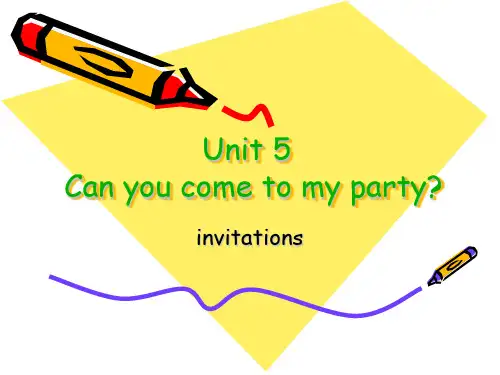
Can you come to my party完整课件
5. have much homework to do ____有___很__多__作__业__要__写
6. have to go to the doctor ________得__去__看__医__生
7. have to study for a test ________得___学__习__准__备考试
love to. conversation 3 May, can you come to my party tomorrow? I’m sorry. I have to help my mom. conversation 4 Claudia, can you come to my party on Saturday? I’m sorry. I’m going to the movies. conversation 5 Say, Paul. Can you come to my party on Saturday? I’d love to.
I’m sorry I can’t. I_h_a_v_e_t_o_g_o__h_ik_in. g I’m sorry I can’t. I h_a_v_e__to__g_o_t_o__.
with my family.
the Great Wall
3. Can you come to my party? I’m sorry I can’t. I_h_a_v_e_a_n__E_n_g_li_s.h
2. have to go to my guitar lesson ___得__去__上__吉__他__课______
3. have __我__父__母_
4. have to do exercises __________得__做__做__运__动_____
八年级英语上册 Unit 5《Can you come to my party》教案 人教新目标版

Unit 5 Can you come to my party?I. Analysis of the Teaching Material1.Status and FunctionThe topic of this unit is about invitation. It teaches the students how to give or receive an invitation. It’s close to the everyday life. So we’d better raise the students learning interest first.2.Teaching aids and demands(1)Knowledge ObjectsStudents must learn to make invitation. They must learn to say yes and say no to aninvitation and give their reasons.(2)Ability ObjectsTo improve the students’ ability of listening, speaking, reading, writing.(3)Moral ObjectsWe teach this lesson in order to learn how to accept or refuse an invitation of foreigncountries politely. It will teach the students good manners. If he or she holds a partyat home, He or she will feel happy when they can do something for others.(4)Teaching Key PointsThe key vocabulary and the key phrases of this unit(5)Teaching DifficultiesUsing the target language to improve the abilities of the studentsII. Target languageCan you come to birthday party?Yes, I’d love to.Sorry, I can’t. I have to look after my mother.When is the party?It’s at six on Monday.III. VocabularyTomorrow, weekday, invitation, match, whole, whom, another, concert, pity, free, American,Chemistry, training…IV. Learning StrategiesInductingCooperatingV. Teaching procedures.It includes five periods. (5个课时)The First PeriodI. Teaching Aims and DemandsKey vocabulary and phrasesTarget languageTo improve the students ability of Listening and speakingII. Teaching Key Points(1) Key PhrasesStudy for a test, have a piano lesson, go to the doctor, visit my aunt (2) Target language_ Can you come to my party on Sunday?_ Sure, I’d love to._ Can you come to my party on Sunday?_ Sorry, I have too much homework this weekend.I have to help my mum.I have to go to the doctor.III. Teaching DifficultiesUsing the target language to practice the oral English in pairsIV. Teaching MethodsCommunicative methodsPairworkV. Teaching Aids多媒体VI. Teaching ProceduresStep 1Before the class, let the students listen to the music, this can guide to the new lesson. Afterthis, ask thestudents to watch the movie, this can guide to the target language.Step 2 (1a)Learn the phrases and do the exercise in 1a.The answer is: b, d, a, c, eStep 3 (1b and 1c )First let the students read the dialogue in the picture. Then listen to it. (This activity provides guided oral practice using the target language). After the listening practice, ask the student to practice some invitations and refusals.Step 6 (Blackboard design)Unit 5How about…? politeWhat about…? impolite The second periodI Teaching aims and demands1. Knowledge ObjectsKey vocabularyTarget languageGrammar focus2. Ability Objects_ ListeningII. Teaching key points1. key vocabularyhey, baseball game, too much homework2. Target languageA: Hey, Dave! Can you come to the movies on Saturday? B: I’m sorry, I can’tI have too much homework.I have to help my mum.I have to go to my guitar lesson.I have to visit my aunt.III Teaching difficultiesGrammar focusIV Teaching methodsListening and speaking methods.Communicative approachPairwork.VI Teaching procedureStep IGreet the class and check the homeworkStep II (2a)First, make the preparation for listening. Read the sentences twice to the class. The first time you can read “can”, the second time you can read “can”. Then let the students listen .The answers for activity 2a are : 1. can’t , 2.can 3. can’t 4. can’t 5.canStep III (2b)Ask a student to read the sentences in the box.. Tell the students these are the reason why people can’t go to the party. Listen to the recording again and number the reasons 1~3 why they can’t go to the party .The answers are : a . 2 d . 3 e . 1Step IV (2c)This is an oral practice about the target the language . You can ask the student if they can give other reasons besides the ones in 2a . If they can, make a dialogue in pair . ( First , ask two who can do it well to make a model dialogue , then let them do it in pairs .Step V . ( Grammar focus)First , let the students read the sentences in the grammar box . Then write “ have to , has to ” on the blackboard , and tell them they are used to say no to an invitatio n . And then write “ be going to do something ” on the blackboard , tell the students we can say no to an invitation by talking about the future plan . After that , let them do exercises in order to master to the grammar .Step V. Blackboard designUnit 51. have to /has to + verbThey have to go to the acting lesson on Sunday.Lucy has to help her mom with the housework.Do they have to go to the acting lesson on Sunday.Yes, they do. / No, they don’t.Does Lucy have to help her mom with the housework?Yes, she does. / No, she doesn’t.2. Can you come to…? Sure, I’d love to. / Sorry, I can’t. I haveto…Can she come to…? No, she can’t. She has to…Step VI . HomeworkPlease write as many reasons as you can to refuse an invitationThe Third PeriodI Teaching aims and demands1. Vocabulary and phrases Oral practice2. Ability objectsReading, writing, communicative competenceII. Teaching key PointsReview vocabulary items and grammar focusIII. Teaching difficultyOral practice using the target languageI. Teaching methodsReading, writing methods and communicative approachV. Teaching proceduresA computerVI. Teaching proceduresStep IGreet the class and let a student to make a duty report. And then check the homeworkStep II (3a writing)Show the invitation in 3a to the students. Ask the students to fill in the blanks according to the information of the invitation.The answers are: can, party, when, on Friday, June 30 4:30Step III (oral practice)Practice the dialogue in 3a in pairs and then let some of the act the dialogue.Step IV (writing)Let the students fill in the card with details of an event. Then call your friends and invite them to the event.Step V Invite a friend (oral practice)Tell the students how to do the activity: Student A, you are Eliza. Look at page 82. Eliza , invite Lu Qing to go to the mall . Look at the calendar for this week and find a time when you can both go there.Use the dialogue in the box to start the activity , and then ask more questions to learn when both people aren’t busy . Help students to start the work, give them a hand if needed.The answers: Lu Qing and Eliza are both free on Wednesday afternoon , Friday afternoon , Saturday and SundayStep VI. SummaryToday we have learnt how to write an invitation and done a lot of practice.Step VII HomeworkGive your best friend an invitation to an event.The student who receives it must give a reply.Step III . Blackboard designUnit 51. Lu Qing and Eliza are both Free on :2. have fun /have a great timeWednesday afternoon 3. join/take part inFriday afternoon 4. have a piano lessonSaturday have a swimSunday have a lookThe Fourth Period I. Teaching aims and demands.Target languageOral practiceII. Ability objects.Listening skillSpeaking skillCommunicative competenceIII. Teaching key points1.Key vocabulary.Sunday, Monday, Tuesday, Wednesday, Thursday, Friday, Saturday Yesterday, today, tomorrow, the day after tomorrow2.Target language.What’s today?It’s Monday the 14th.Can you play tennis with me?When?Today.Sorry, I can’t.IV. Teaching difficulties.The target languageV. Teaching methods.Listening and speaking methods.VI. Teaching aids.A calendarA computerVII. Teaching procedure.Step 1Greet the class and check the homework.Step 2 (Section B 1a)Show the students a calendar, and ask a student to point out today’s date. Point to the number which shows the dates, and ask the students to copy them into the calendar in their book.Read the dates and let the students read after you.Step III (1b)1.Show the words on the screen:Yesterday, today, tomorrow, the day after tomorrow, weekday2.Let the students write the words below the correct days on the calendar in 1a.Step IV (1c)First ask two students to read the dialogue in the box. Then let them practice it in pairs by using the calendar in 1a.Step IX Blackboard designThe Fifth period I. Teaching aims and demands.1. Knowledge objectsE-mail messageWriting practiceReading practice2Ability objectsReading and writing skillCommunicative competenceII. Teaching key pointsReading passage主语+verb+-ing I have to…III. Teaching difficultiesReading and wring practice.IV. Teaching methodsReading and writing methods and communicative approach.V. Teaching aidsA calendarVI. Teaching proceduresStep 1Greet the class, do the duty report.Step 2 (3a )First, read the e-mail message to the students. Ask the students if they have any questions.If they do, answer them. Then let the students fill in the calendar on the book. After this, explain the key language points to them.Language points:1. Thank you for… (为……表示感谢)Thank you for helping me.Thank you for your invitation.2On ( 在某天,在某天的上午、下午或晚上)I’m going to the dentist on Sunday.Unit 5Sunday, Monday, Tuesday, Wednesday, Thursday, Friday, Saturday The____ the_____ the_____ the______ the_____ the____ the_____ Yesterday, today, tomorrow, the day after tomorrowOn Friday afternoon, I often play soccer.The answers to the calendar are:SundayMonday Cousin’s birthday partyTuesday Go to the dentistWednesdayThursday Tennis trainingFriday Study for the chemistry testSaturday Go to the moviesStep 3 (3b)First, tell the students when we talk about our future plans, we often use: I’m+verb+ing When we talk about what we must do, we use have to.Ask the students to fill in the blanks in 3b.The answers are: shopping, go to see, a test, I’m going, my family.Step 4 (3c)Let the students write an e-mail message to a friend. Say why you can’t visit next.Before the exercise, ask the students to give some possible answers and write them on the blackboard. So the students will feel easy to finish the writing exercise. After they finish it, Let them to correct it in groups first. Each group chooses theirs best one to read in front of the whole class.Step 5 ( planning a party )First read the conversation in the box together. Then ask the students to turn to page 88. Write down everything you have to do next week. Write in all the things you have to do .Ask the students to look at the list. Ask them “What day are you free?” This is when you can have your party.Step 6 (Self check 1 )Let the students to fill in the blanks with the words given. Change the forms of the words if possible. Then make their own sentences. The answers are: visit, playing, have to, study, comeStep 7 (Self check 2)Imagine you are Marie. Read the information and look at your schedule. Write replies to the invitation.VII. Summary and homeworkToday we have learnt how to write a e-mail to a friend. You can write another one to your frien after class.Step 8 Blackboard designUnit 51. Thanks for…2. on Sunday at 4:00Thanks for helping me. I’m going to the dentist on Sunday.Thanks for your invitation. I often get up at 4:00.。
人教版八年级英语上册Unit9 Can you come to my party教案

Unit 9Can you come to my party?第一课时Section A (1a~1c)§自主学习案根据句意及首字母提示完成单词。
1.She didn't go to school and stayed in bed because she had the f lu.2.Can you come and h elp me with my English?3.Can I m eet my friend tomorrow, Mom?4.I must go to see a d octor because I feel ill.5.My mother prepares for b reakfast for our family every morning.§课堂导学案Step 1准备与热身(Preparation)Hello,class.We are learning Unit 9 today.But first look at this sentence:Can you come to my party? What does it mean?You are correct. It means “你能来参加我的聚会吗?”“Can” means “能,行”. You may answer like these: Yes,I can.I can come to the party./No. I can't.I have to do my homework. In these sentences both can and have to are model verbs. They are part of the predicates.Can you come to school? Yes, I can./No, I can't.I have to see a doctor.Can you get to school by bus? Yes, I can./No, I can't.I have to walk.Step 2呈现与输入(Presentation)Please look at the picture on page 65. The boy in the middle is going to hold a party.Can everyone come to the party?Help my parents, prepare for an exam, meet my friends,have the flu, go to the doctor.Please read these expressions loudly. And match the words with the picture.Areyou OK? Let's check the answers.Step 3练习与体验(Practice)You are great ! As you see, there are some people in the picture.Do you know who's who?Now please listen to the conversation.Pay attention to Sun Ning's words carefully.He says the names of each person he is inviting. When I play the recording for the first time,you just listen carefully. When I play the recording for the second time,please write the names of each person next to his or her picture. You have to complete the activity on your own.OK, let's go!Now let's talk as they do in the conversation.In other words, we are going to talk in imitation of the conversation we have just heard and read.Step 4运用与生成(Production)Now please make your own dialogues in groups of four. Suppose you are the students in the picture. One of you is inviting the other three students to his party. The other students are saying if he can go or not.If you can't go, remember to give a reason.When you practice, please pay attention to the pronunciation and intonation.I'll offer vocabulary and pronunciation support if you need.Step 5巩固与提高(Progress)【探究点】Can you come to my party on Saturday afternoon? 你能在周六下午来参加我的聚会吗?Can you…?句型是熟人和朋友之间常用的表达邀请或请求的用语。
八年级英语集体备课教案Unit-5-Can-you-come-to-my-party教案
八年级英语第五单元集体备课教案主备教师:崔丽芬Unit 5 Can you come tomy party教材分析: 本单元以“Invitaions” 为话题,学会向别人提出礼貌地邀请、接受或婉言拒绝别人的邀请,学会谈论自己的计划安排。
学习本单元后,学生将能谈论自己或别人必须做的事并能根据日程表中的计划安排自己的活动,自己制作英文请柬。
并能在学习语言的过程中了解中西方在接受和回绝邀请方面的文化差异,增强他们在日常生活中的沟通和交流能力。
一、教学目标:学会使用can作出邀请。
学会接受邀请和拒绝邀请的表达方式。
学会表达计划好将来要做的事。
二、教学重难点:教学重点:语言结构:用Can……?发出邀请。
用Sure, I’d loveto. 接受邀请。
用I’m sorry,I can’t.Ihave to……/I’mv isiting…拒绝邀请并说明理由。
句型:Can youcome to my party?Sure, I’d love to.I’m sorry, I can’t. I have to ……教学难点;1. 使用Can……?发出邀请。
2. 使用Ihave to ……句型说明原因。
3.进行时表示未来计划。
三、情感、态度与价值观培养学生使用礼貌用语的能力,营造积极乐观的人际氛围,增进人与人之间的友谊,学会坦诚的与人相处,用英语交谈,培养交际能力,激发学生的主动性,激励学生自主学习。
四、课时设计:(5课时)Period 1: SectionA: 1a-2cPeriod2: SectionA: 3a-part4Period 3:Section B:1a-2c and part4Period 4: Section B: 3a-3cPeriod5:Revision and Selfcheck五、教学活动设计:本单元围绕“邀请和请求许可”这一话题,设计了三个任务型活动:Task1:对话展现提出邀请和接受邀请及拒绝邀请的英文表达。
初中英语《Unit 5 Can you come to my party(1)》优质课教案、教学设计
Unit5 Can you come to my party? SectionA 教学设计教材分析:本单元主要围绕“can you come to my party?”这一主题展开各种教学活动,并以这一主题引出怎样接受或拒绝别人的邀请。
本节课是第一课时,内容为1a-2d 部分,围绕“邀请”这一话题,开展教学活动,并以这一主题引出怎样接受或拒绝别人的邀请。
本课旨在创造一个轻松、愉快的学习、交流环境,是一个涵盖听、说、读、写、演,学生通过“任务---探究---创造--- 评价”型教学的方法,在有趣、开放式的语言环境中,学会观察、思考、讨论、模仿运用语言和总结,培养学生综合运用这些知识进行英语交际的能力能力。
学情分析:本单元教材面对的是七年级下学期的学生,基本上都有四五年的英语学习年龄。
对于英语的基本学习出现以下问题:学得会,看得懂,会做题,可是不会说或不敢说。
同时学生的英语能力产生了一定的差距,特别是在知识和语言技能上的差距比较明显。
他们有一定的兴趣,渴望被肯定,但由于差距,有的学生接受能力差反映能力慢,害怕当众说英语,不敢表现自我。
教学理念:本单元语法以情态动词can 的用法为主,句型也是简单的表达难度不大,根据新课程标准提倡的任务型教学,在课堂教学中我们设计了不同形式的任务,以便充分训练学生的听、说、读、写技能,培养学生综合运用英语进行交际的能力,我结合本单元的题材,以视频中老鼠的wedding party 进行warm up,再以三个问题导入课文,课堂中利用图片、笑脸和苦脸引导学生使用语言,重在“语言应用”教学目标:1.知识目标:a.学习,理解掌握和运用以下单词: prepare, prepare for, exam,flu,go to the doctor.help parentb.学习,理解掌握和运用以下词组①prepare for an exam; ②help my parents; ③go to the doctor; ④meet my friend; ⑤have the flu; ⑥on Saturday afternoonc.学习,理解掌握和运用以下句子:A: Can you come to my party on Saturday afternoon?B: Sure, I’d love to.C: Sorry, I can’t. I have to prepare for an exam.D: I’m sorry, too. I must go to the doctor.E: Thank you for asking/inviting me/your invitation.2.能力目标:a.能够提出邀请、接受邀请、婉言拒绝别人的邀请。
八年级英语上册-Unit-9-Can-you-come-to-my-party单元综合检测
Unit 9 Can you come to my party单元综合检测班级_____ 姓名______ 成绩______一、首字母填空1 I’m going to go shopping t________。
2 My father is usually busy on w_________ 。
but he's not busy on weekends.3 We are going to watch the football m_______ at 5:00pm.4 If you are f______ this evening, you can come to my birthday party。
5 How many Chinese l_________do you have every week?6 Mary c_____go to the party this evening。
She has t______much homework.7 I can’t go to the movies with you.。
I am b_________ my little sister.8 Can you go to the c______ with me?9 I have to do my geography p___________ on Saturday afternoon.10 Can you come o__________ to my house tomorrow?11 He isn’t free t______ !0:00 pm。
二、翻译下列短语1 顺便来我家____________2 去看牙医____________3 太多的家庭作业____________4 准备化学考试____________5 讨论科学报告____________ 6后天 ____________7和我的爷爷一起去钓鱼____________8 文化俱乐部____________9 参加校队的网球训练____________10 直到10点钟_______________三、用所给词的适当形式填空1 Can she _______ (come ) to my party?2 Thanks a lot for your _________(invite)。
人教版小学三年级下册英语试题(答案及解释)
人教版小学三年级下册英语试题(答案及解释)(共50道题)下面有答案和解题分析一、综合题1.We _______ (have) a birthday party next weekend.2.She _______ (write) a letter to her friend now.3.We _______ (make) a cake for the party.4.We _______ (go) to the park last weekend.5.Tom is helping his dad in the garden. They are planting some __________ in the__________. Tom also waters the plants with a __________. After they finish, they sit on the grass and enjoy the __________.6.She _______ (take) the dog for a walk every morning.7.How many days are there in a week?A. 7B. 5C. 10D. 68.They _______ (be) happy about the news.9.We _______ (not/understand) this lesson.10.Which animal has wings and can fly?A. DogB. BirdC. ElephantD. Fish11.Which of these is a color?A. DogB. GreenC. TableD. Chair12.She ________ (do/does) her homework in the evening.13.Where does a fish live?A. In the treeB. In the skyC. In the waterD. In the ground14.Jack is packing for his camping trip. He needs to bring a __________ for the tent, a __________ for the campfire, and a __________ for cooking. Jack is excited about sleeping under the stars and roasting marshmallows by the fire.15.How do you say "早安" in English?A. Good nightB. Good morningC. GoodbyeD. Hello16.Which of these is a number?A. ThreeB. CarC. TableD. Spoon17.What do we use to clean our body?A. TowelB. ShampooC. SoapD. Spoon18.He _______ (read) a book right now.19.We _______ (not/go) to school on Sundays.20.Yesterday, I __________ (wake) up late and __________ (miss) the bus. I__________ (decide) to walk to school instead. On the way, I __________ (meet) my friend Jack, and we __________ (walk) together. When we __________ (arrive) at school, we __________ (be) a bit late, but we __________ (not/miss) the class.21.Which of these is a fruit?A. BananaB. CarrotC. OnionD. Lettuce22.She _______ (run/runs) very fast.23.He _______ (study) hard for his exams.24.My father __________ (1) a doctor. He __________ (2) work in a hospital. My mother __________ (3) a teacher. She __________ (4) teach in a school. My brother__________ (5) play basketball every day, but I __________ (6) like playing football.25.Which one is a shape?A. ChairB. CircleC. TableD. Car26.Lucy loves animals. She has a pet __________ at home. It is very cute and likes to __________ in the yard. Lucy also enjoys going to the zoo. Her favorite animal there is the __________ because it is so big and strong. She often goes to the zoo with her__________ and they take pictures of the animals. After the visit, they always have a__________ in the zoo’s café.27.Which one is a verb?A. RunB. DogC. RedD. Table28.I _______ (am/are) a teacher.29.We _______ (have) lunch at noon.30.She _______ (is / are / am) eating an apple right now.31.Where is the cat? It is __ the table.A. onB. inC. underD. next32.Which sentence uses the verb "to be" correctly?A. She am a student.B. She is a student.C. She are a student.D. She be a student.33.Choose the correct word to complete the sentence: She ______ a doctor.A. isB. areC. amD. be34.They _______ (is / are / am) coming to my party tomorrow.35.What do you call a baby cat?A. PuppyB. KittenC. CubD. Calf36.Which of these is a bird?A. DogB. CatC. LionD. Eagle37.Which of these is an animal?A. DogB. CarC. TableD. Chair38.Which of these is an insect?A. ButterflyB. DogC. FishD. Elephant39.They _______ (go/goes) to the park every weekend.40.What is the opposite of "big"?A. LargeB. HugeC. SmallD. Tall41.I _______ (not/like) to eat spicy food.42.We _______ (watch) a movie at the weekend.43.My sister __________ (love) to play the piano. She __________ (practice) every day, and she __________ (play) beautiful songs. Yesterday, she __________ (perform) at a concert and __________ (receive) many compliments. I __________ (be) very proud of her.44.When I ______ (be) younger, I ______ (love) to play outside. My friends and I______ (ride) our bikes and ______ (have) fun together. Now, I ______ (stay) inside more often, but I still ______ (remember) those days.45.I _______ (be) tired after the long day.st week, we __________ (have) a school sports day. My class __________ (compete) in the relay race, and I __________ (run) the last part. I __________ (feel) very excited because it __________ (be) my first time running in a race. When I__________ (cross) the finish line, everyone __________ (cheer) for me. In the end, our team __________ (win) the race, and we __________ (celebrate) with ice cream.47.How do you say "早上好" in English?A. Good nightB. Good morningC. Good afternoonD. Goodbye48.Sally is preparing for her school presentation. She is going to talk about her favorite animal, the __________. She has made a __________ with pictures and facts about the animal. Sally is very nervous, but she knows the information well. She practices speaking in front of her __________ to get ready for the big day.49.We _______ (take/takes) the bus to school every day.50.He _______ (be) at school now.(答案及解释)。