
人教新目标英语九年级Unit5全单元教案
人教新目标英语九年级Unit 5 What are the shirts made of?Section A 1 (1a-2d)一、教学目标:1. 语言知识目标:1) 能掌握以下单词:chopsticks, coin, fork, blouse, silver, glass, cotton, steel, grass,leaf, produce, widely, be known for, process, pack 能掌握以下句型:①—This ring looks nice. Is it made of silver?—Yes, and it was made in Thailand.②What is it made of/from?③China is famous for tea, right?④Where is tea produced in China?2) 能够用英语描述及询问物品的制作材料,正确理解被动语态的用法及句子结构。
2. 情感态度价值观目标:了解一些日常用品的制成材料,增加生活常识,养成良好的生活习惯;了解一些地方知名产品或传统艺术品的制作过程以及制作材料,培养学生的民族自豪感及爱国主义精神。
二、教学重难点1. 教学重点:1) 掌握本课时中出现的生词2) 能够用英语描述及询问物品的制作材料3)正确理解被动语态的用法及句子结构。
2. 教学难点:理解被动语态的用法及句子结构。
三、教学过程Ⅰ. Warming up1. Present the sentence structure, using the pictures on the big screen:—What’s the golden medal made of?—It’s made of gold.—Is this table made of wood?—No, it isn’t. It’s made of glass.—Is Butter made from meat?—No. It’s made from milk.II. Presentation1. Show some pictures on the big screen. Try to learn the new words using “be made of”structure.Learn the new words: chopsticks, coin, fork, blouse, silver, glass, cotton, steel, grass, leaf2. Ss discuss with their partner and try to learn the new words.3. Give Ss five more minutes to remember the new words.4. Work on 1a:Let Ss read the things and materials in 1a. Discuss with their partners and match them with the materials. More than one answer is possible.What are these things usually made of? Match them with the materials. More than one answer is possible.Check the answers with the Ss.III. Listening1.T: Tell Ss they will hear a conversation about some things and material. Listen andmatch the products with what they are made of and where they were made.2. Let one student read the words in the box, Play the recording for the Ss to listen.3. Ss try to listen and match the things with the material and here they were made.4. Play the recording again. Let Ss answer the questions.1) How much did Susan pay for the three shirts?29 dollars.2) What does Anita feel about the three shirts?Cheap.3) What are the shirts made of?Cotton.4) Where were they made?America.5) Where did Susan buy the chopsticks?Korea.6) How does Anita like the chopsticks?Cool.7) What else does Susan show?Ring.8) Where was the ring made?Thailand.9) What will Susan do with the ring?She give it to her friend.IV. Pair work1. Read the conversation in the box in 1c.2. Ss try to made conversations using the information in 1b.e.g. A: Your new shirt looks very nice. Is it made of cotton?B: No, it isn’t. It’s made of silk.3. Let some pairs read out their conversations.V. ListeningPre-listeningfair adj. 公平的; 合理的; 美丽的fair n. an event at which people orbusinesses show and sell productsa book faira trade fairWork on 2a:T: Let’s listen to another conversation between Nick and Marcus.1. What are they talking about? First, let’s look at the pictures and the phrases in 1a.(Let one students read the phrases in 2a.)Listen and check ( √) the main topic of Nick and Marcus’ conversation.____ the science museum____ the art and science fair____ environmental protection____ a model plane____ a beautiful painting____ grass and leaves2. Play the recording for the Ss to listen and check the phrases.3. Play the recording again to check the answers.Work on 2b:1. Let Ss read the sentences below. Explain some main sentences for the Ss. Make sure they know what to do.2. Let Ss read the questions in 2b. Make sure they understand the meaning of each question.Play the recording for the Ss to answer the questions. (If necessary, using the pause button.)1) Where is the art and science fair?_________________________2) Do Nick and Marcus have to pay to go?_________________________3) What is the model plane made of?_________________________4) What is the painting made from?__________________________3. Play the recording again and mark true or false.1) The art and science fair is just inside the science museum.2) The fair is mainly about planes and paintings.3) All the works at the fair were made by university students.4) The model plane is very big.5) The painting is made of wool and grass.6) The students are asked to pay for the art and science fair.7) The students are interested in environmental protection and recycling.VI. Pair work1. Tell Ss to make a conversation using the information in 2a and 2b.e.g.A: What did you see at the art and science fair?B: I saw a model plane.A: What is it made of?B: It’s made of steel, glass, and plastic.2. Let Ss make their own conversations.3. Practice their conversations in pairs.VII. Role-play1. Work on 2dRead the conversation and complete the blanks.1) Chinese _____________ tea both in the past and now.2) _________ I know, tea plants _________ on the sides of mountains.3) When the leaves are ready, they _______ by hand and then _______ for processing.4) The tea ____________ and sent to many different countries and places around China.5) People say that tea ___________ ____ health _____ business!2. Read the conversations and Let Ss read after the teacher.3. Ask Ss to role-play the conversation in groups.VIII. Language points1. What is the model plane made of?What is the painting made from?be made of与be made from 辨析两词组都是“由……制成的”之意。
Unit5SectionA1a-2c教案:人教版九年级全册英语

Unit 5 What are the shirts made of?教学设计Section A 1a-2c(Listening & Speaking)【教学背景分析】一、课标要求二、单元教学背景分析本节课选自于人教版新目标九年级U5 What are the shirts madeof ?SA1a-2c。
本单元的教学话题是“Things made in China”, 功能是谈论物品由什么制造而成以及产地和制造者等。
主要语法是一般现在时的被动语态,在后面的U6&U7分别还会继续深入介绍一般过去时被动语态以及含有情态动词的被动语态。
本单元将带领学生了解“中国制造”这一全球流行的现象,领略中国的传统艺术文化,比如:孔明灯、剪纸、泥塑等独特魅力。
本单元教材设置内容丰富,难度适中,很容易引起学生的兴趣,将学生带入独特的艺术世界。
将英语学习和中国特色结合起来,也是本单元教材设置的一大特色。
能够极大地激发学生对于中国传统艺术的热爱,使本单元的语言学习更有文化底蕴。
三、单元学情分析学生在之前学习中已经接触过了被动语态,如:U2中A Christmas Carol is a famous short novel written by Charles Dickens. U4中be used to do等表达,大部分学生已经对被动语态有了一定的认知基础,能够在阅读中辨识出被动语态,因此在本单元让学生掌握被动语态的用法并不困难。
另外,通过本次月考发现学生在听说考试中出现的问题。
听的部分最容易在第二节听问句选应答,因为只有一次机会,所以学生在之前的准备时间应该做好充分的听前预测,以便迅速和准确地找到答案。
说的方面在表达部分普遍分值在3分,分析原因是没有策略,不打草稿,临时想怎么说就怎么说,不会充分利用120秒的准备时间。
学生的能力训练渗透在平时的教学中是尤为重要的,所以钛通过平时的训练来加强和提升听说成绩。
新目标九年级英语复习九年级 UNITs5-6表格教案
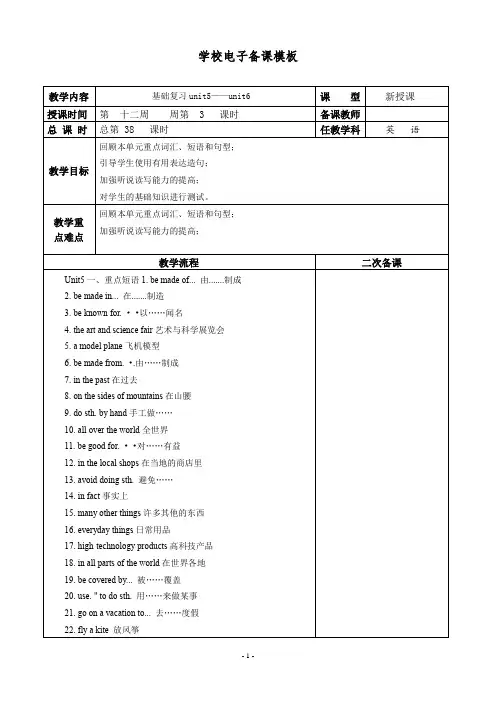
3. be used for. sth.被用于
4. shoes with special heels有特殊鞋跟的鞋子
5. shoes with lights有灯的鞋子
6. the style of the shoes鞋子的样式
7. hot ice-cream scoop冰激凌加热勺
think of a game that could be played in the winter.
当他是大学老师时,他被要求想出一种能在冬天玩的运动。
7. Basketball has not only become a popular sport to play, but it has also become a popular sport towatch.
26. sky lantern孔明灯
27. a fairy tale一个神话故事
28. at a very high heat在高温下
29. rise into...升入……
30. send out发送……
31. in trouble陷人困境
32. put.. . on...把……放到……
二、重点句型,What is/are..•made of/from?
20. use. " to do sth.用……来做某事
21. go on a vacation to...去……度假
22. fly a kite放风筝
23. the international kite festival国际风華节
24. be painted with...被画上.......
25. turn into...变成
九年级英语全册Unit5ItmustbelongtoCarla(第1课时)教案人教新目标版

Unit 5 It must belong to Carla.第一课时: New wordsTeaching and Learning Goals:Learn the new words of Unit5 in one class. Memorize the words by reading and using them. Learn the use of them and try to spell the words in this unit。
Students try to learn how to read and remember the words and phrases , and howto learn individually and collectively。
Teaching and learning stepsStep 1 Learn to read the words on P148-1491.Students try to read the words using the phonetics by themselves.2.Then read with their partners in groups.3.Get some individual students to read and correct their pronunciations. Follow the teacher because they can hear the teacher pronounce the word clearly and correctly。
4.Read after the tape.5.Read aloud and the teacher walk around to see if they have any question. Get some individual students to read again to see if everyone can read correctly. (设计意图:利用音标读单词是一种能力,9年级学生已初步具有这种能力。
人教版新目标九年级英语Unit5单元集体备课教案
5)People say that teais good forbothhealthandbusiness!
环节说明:将听、说、读、写的任务结合起来不仅锻炼了学生的语言综合运用能力,还巩固了学生对目标语言的学习、识记和运用。
4.完成教材3b的任务,要求学生再次阅读短文,回答3b中所提出的问题。(5分钟)
5.再细读一遍3a的短文,写出3c中所给的词分别指代什么。(3分钟)
环节说明:将听、说、读、写的任务结合起来不仅锻炼了学生的语言综合运用能力,还巩固了学生对目标语言的学习、识记和运用。
教学反思
首备人
九年级组
复备人
课型
课时
A:Whatdid you see at the art and science fair?
B:I saw a modelplane.
A:What is itmade of?
B:It’s made ofsteel.
A:Wherewas it made?
B:It is madeinBeijing.4.大声朗读听Fra bibliotek材料。(1分钟)
Step 3完成教材2a-2d的任务
【操作案例】
1.要求学生翻开课本P34,要求学生听第一遍录音,完成2a,2b的听力任务。(1分钟)
2.要求学生听第二遍录音,并逐句进行跟读。(2分钟)
3.听力内容巩固训练。要求学生根据所听到的内容完成下列各句。完成后要求若干学生给出自己的答案。以巩固对听力内容的了解。(4分钟)
②The paper is made from trees.
英语人教版九年级上册Unit5全单元教案
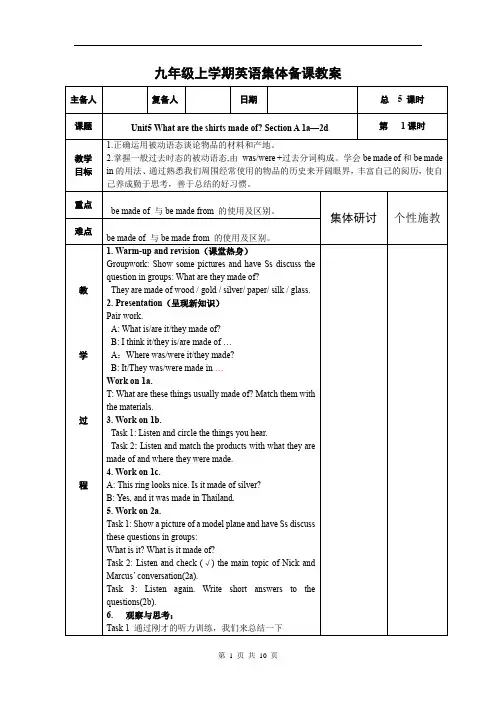
B: It/They was/were made in…
Work on 1a.
T: What are these things usually made of? Match them with the materials.
3.Work on 1b.
(2)Tea plants are grown on the sides of mountains......
10.小结。检测本课教学成果。
作
业
设
计
Homework:
介绍自己一样最感兴趣的物品,介绍制作者,何时制作的,有哪些材料做成,有何用途(be used for)等。
板
书
设
计
Section A1 (1a-2d)
Task 2:Listen and check (√) the main topic of Nick and Marcus’conversation(2a).
Task 3:Listen again. Write short answers to the questions(2b).
6.观察与思考:
Task1通过刚才的听力训练,我们来总结一下
Task2:Read the passage again and write what the words in bold refer to.
Task 3:仔细阅读文章,完成下列句子。
Kang Jian is a _____________ student from Shanghai.
People would buy a _______ in Japan, some beautiful ________ in France, or a ________ in Switzerland.
人教版新目标九年级英语Unit5单元集体备课教案

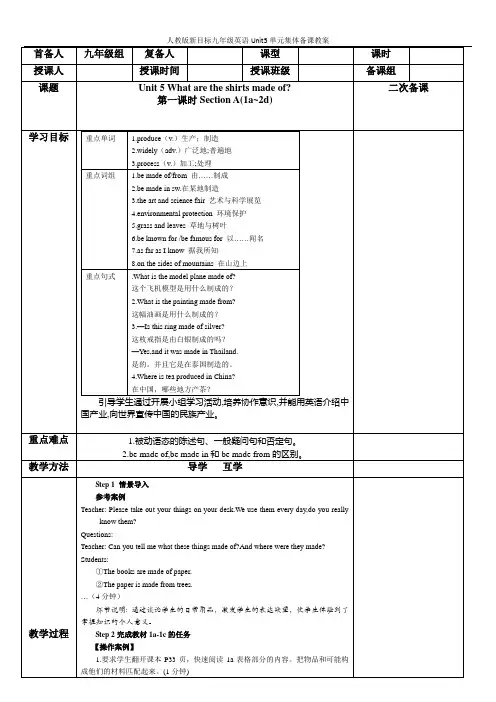
第一课时Sect i on A(1a~2d)1.produce(v.)生产;制造2.wide ly(adv.)广泛地;普遍地3.process(v.)加工;处理8.on the s ides o f mount a ins在山边上.What i s the model p lane made of?这个飞机模型是用什么制成的?2.What i s the pa in t ing made f rom?这幅油画是用什么制成的?3.—Is th i s r ing made of s i lver?这枚戒指是由白银制成的吗?—Yes,and i t was made in Tha i land.是的。
并且它是在泰国制造的。
4.Where i s t ea p roduced in China?在中国,哪些地方产茶?Teacher: P lease t ake out your th ings on your desk.We use them every day,do you rea l ly know them?Ques t ions:教学过程Step 2完成教材1a-1c的任务5.小结训练。
要求学生在规定的时间内完成一个小练习。
并请若干学生给出自己的答案。
有错误的话及时纠正。
(2分钟)用括号内所给动词的正确形式填空。
1)The apples a re sen t(send)to the fac tory f or p rocess ing.2)We are a l l r eady bu t Tom hasn’t packed (pack) h i s c lo thes ye t.3)The windows of the room are c leaned(c lean)every day.4)The bes t co t ton i s p r oduced(p roduce)in Xing J iang in China.5)The song isn’t liked (no t l ike) by mos t o f us.环节说明:通过学习1a,使学生对被动结构有所了解;通过1b,锻炼学生的听力及抓取关键信息的能力;通过1c的训练锻炼学生的口头表达能力,同时巩固对一般现在时被动结构的认识。
人教版新目标九年级英语Unit5第五单元全单元教案教学设计
人教版新目标九年级英语Unit5单元教案Unit 5 What are the shirts made of?Section A (1a-2d)学习目标1.重点单词:chopstick,coin,fork,blouse,silver,glass,cotton,steel,fair,grass,leaf,produce,widely,process,pack2.重点短语:be made of,be made in,be made from,as far as sb. know,be known for3.重点句式:What are the shirts made of?—This ring looks nice.Is it made of silver?—Yes,and it was made in Thailand.What is the painting made from?How is tea produced?As far as I know,tea plants are grown on the sides of mountains. People say that tea is good for both health and business! 学习重点1.重点短语和句型2.一般现在时态和一般过去时态的被动语态学习难点一般现在时态和一般过去时态的被动语态自主学习一、预习课本P33-34新单词并背诵,完成下面的汉译英。
1.筷子________ 2.硬币________3.叉子________ 4.衬衫________5.银器________ 6.玻璃________7.棉花________ 8.钢铁________9.展览会________ 10.草地________11.叶子________ 12.生产________13.普遍地________ 14.加工________15.包装________二、认真预习1a-2d找出下列短语和句型。
英语人教版九年级上册Unit5全单元教案
英语人教版九年级上册Unit5全单元教案Title: Unit 5 - What are the shirts made of。
n A 1a-2dObjectives:1.XXX discuss the materials and place of origin of items.2.To master the past tense passive voice。
formed by using "was/were + past participle"。
To learn the usage of "be made of" and "be made in"。
To broaden XXX with the history of commonly used items。
and to develop good XXX summarizing.1.Warm-up and nGroup work: Show pictures and have students discuss in groups what the items are made of.2.n of New KnowledgePair work:A: What is it made of?B: I think it is made of。
A: Where was it made?B: It was made in。
Work on 1a:XXX asks students what the things are usually made of and matches them with the materials.3.Work on 1b:Task 1: XXX.Task 2: Listen and match the products with their materials and place of origin.4.Work on 1c:A: This ring looks nice。
义务教育阶段九年级英语第五单元教案新目标-人教新目标版九年级全册
Unit 5 It must belong to Carla第一课时单元分析与提示教学目标语言目标:1、掌握情态动词must, might, could, can’t的用法;2、学会谈论自己的推理,能灵活运用以下句型的词汇:Whose book is it? It must be Tom’s. It has his name on it.Whose ruler is it? It could/might be Jim’s. He has a blue one.Whose hair band is it? It can’t belong to Mary. Mary has short hair.plate, picnic, belong to, crucial, grateful, disappear, return, lost, owner3、学会用情态动词表达能力、客观可能性以及请求、允许、猜测和征求对方的意见。
4、学会用情态动词表达某人拥有某物认知目标掌握must, might, could, can’t的用法,理解之后通过练习和运用加以巩固。
情感目标1、通过本单元学习使学生学会用自己的生活常识来判断事物。
2、培养学生的逻辑思维和推理能力。
教学重、难点1. can 和could的用法。
1)表示能力或客观可能性,还可以表示请求和允许。
Can you finish this work tonight ?Man can not live without air.2)could也可表示请求,语气较委婉,主要用于疑问句,不可用于肯定句,答语应用can,否定用No,I’m afraid not.Could I come to see you tomorrow ? Yes, you can; No, I’m afraid not3)当表达“某件事已成功”时应用was(were) able to,而不能用couldHe was able to go to the party yesterday evening and he enjoyed himself very much.4)表示惊异、怀疑、不相信的态度(主要用于否定句、疑问句或感叹句)2. may的might的用法3. shall和should的用法4. must 的否定回答用needn’tmay的否定回答用mustn’tMust I hand in my paper today ?No, you needn’t.May I keep this novel for three weeks ?No, you mustn’t教学安排4课时第一课时:Section A 1a, 1b, 1c, 2a, 2b, 2c第二课时:Section A 3a, 3b, 4第三课时:Section B 1, 2a, 2b, 2c, 3a第一课时:Section B 3b, 3c, 4 and Self CheckUnit 5 第二课时Teaching aims本课学会用情态动词表达物品的所有者Teaching of new lesson1、Ask four students to take out the things they broughtjacket, T-shirt, CD, toy car1) Ask the other studentsT: whose jacket is this ? S: Anna’s ?T: I think it could be Anna’s. It might be Anna’s. Let’s ask her. Anna, is this your jacket?S2: No, it’s not mine. It must be Lee’sT: It can’t be Anna’s. it must belong to Lee.2) Ask the students to practice the dialogue with T-shirt, CD, toy carA: Whose … is this?B: Tom’sA: I think it could be Tom’s. It might be Tom’s. Let’s ask him. Tom, is this your …… ?C: No, it’s not mine. It must be John’sT: It can’t be Tom’s. It must belong to John.3) Say: When we talk about things we’re not sure of, we use the words: could, might, can’t and must. And pay attention to the words “belong to John”, don’t say “belong to John’s”2. Point to the picture and ask:Which items in the picture do you know ?Which items are new to you ?Clothing: hat, jacket, T-shirt.Fun things: volleyball, CD, toy car, magazine, bookKitchen things: plate, cups3. Ask the students to connect the items in the three column Section A, 1b.先让学生听第一遍,按要求完成1b,更正答案J ane’s little brother - toy car --- He was the only little kid at the picnic.Mary – book - Wanda Wilbur is her favourite author.Carla – volleyball - She loves volleyballDeng Wen-magazine- He loves cats.Grace – CD – She always listens to classical music.4. Ask the students to practice using the target language.Whose, volleyball, toy car, magazine, book, CD, must be, belong to5. 2a. This activity provides listening practice using the target language.a school T-shirt, a hair band, tennis balls.Kumi’s, Linda’s, Rita’s6. 2b. This activity provides listening and writing practice using the target language written by the teacher.Must might could or can’t7. Extension利用各种各样的实物或图片,模仿听力的对话模式,让学生进行各种猜测。
人教版九年级英语Unit 5 What are the shirts made of 全单元教案
Unit 5What are the shirts made of?Language Goal 【语言目标】Talk about what products are made of and where they weremadeKnowledge Goals 【知识目标】Key Words chopstick,coin,fork,blouse,silver,glass,cotton,steel,fair,grass,leaf(pl.leaves),produce,widely,process,product,France,local,avoid,handbag,mobile,everyday,boss,Germany,surface,material,traffic,postman,cap,glove,international,its,form,balloon,scissors,lively,heat,completeKey Phrases be known for,no matter,paper cuttingKey Sentences1.—Are your shirts made of cotton?—Yes,they are.And they were made in the US.2.—What's the model plane made of?—It's made of used wood and glass.3.—How is tea produced?—Tea plants are grown on the sides of mountains.When the leaves are ready,they are picked by hand and then aresent for processing.Key Grammar Learn to use the passive voice with present tense.Ability Goals 【能力目标】1.Develop listening,speaking,reading and writing skillsby using passive voice.2.Learn to talk about what things are made of and wherethey were made.Moral Goals 【情感目标】1.With the help of this unit's study,students can learn more about Chinese traditional culture and deepen the loveof our motherland.2.Know something about the world's manufacturing industry and see China's advantage and disadvantage in the world economic competition.Teaching Time【课时】Five periodsPeriod 1Section A(1a-2d)Period 2Section A(3a-4c)Period 3Section B(1a-1e)Period 4Section B(2a-2e)Period 5Section B(3a-3b) & Self Check本单元的话题是谈论日常生活用品是用什么材料制造的以及出产地是什么地方,要求学生学习并掌握一些日常生活用品的名称和制造的材料的基本词汇,同时在语言学习训练中接触并学习被动语态。