
人教pep版2019年六年级英语上册全册重点单词句型语法复习资料
小学六年级上册英语期期末复习资料Unit 1 How can I get there? 我怎样到达那里。
重点单词science museum 科学博物馆, post office 邮局, bookstore书店, cinema电影院, hospital 医院, crossing 十字路口, turn left 左转, turn right 右转, go straight 直走, map 地图, compass指南针, GPS 全球定位系统, stars 星星, Italian restaurant 意大利餐厅, get to 到达。
重点句型1. ---Where is the restaurant? 餐厅在哪里?----It’s next to the park on Dong fang Street. 它在东方路,在公园附近。
2.---How can we get there? 我们怎么去哪里?----Turn left at the bookstore. Then turn right at the hospital.书店左转,然后医院右转。
3. He now has GPS. 他现在有GPS。
4. What an interesting film! 多么有趣的电影!方位词复习:next to紧挨着, near在...附近, behind在...后面, beside在...旁边, in front of在...前面。
Unit 2 Ways to go to school. 上学的方式。
重点单词on foot 走路, by bike骑车, by bus 乘公交, by train 乘火车, by subway乘地铁, by ship 乘船, by plane 乘飞机, slow down 慢下来, traffic lights 交通灯, traffic rules 交通规则, go/come to school 上学, by sled 坐雪橇, by ferry坐轮渡, pay attention to 注意, traffic lights交通灯, Stop and wait at a red light 红灯停等一等, slow down and stop at a yellow light 黄灯减速并停下, Go at a green light 绿灯行。
重点句型1.---How do you come to school? 你怎么上学?----Usually, I come on foot. 通常我走路来的。
=Usually ,I come to school on foot.2.---How can I get to the Fuxing Hospital? 我怎么能到达复兴医院?----Take the No.57 bus over there. 你可以在那边乘57路公交车。
3. In the USA people on bikes must wear one.在美国骑车的人必须戴头盔。
4. Don’t go at the red light. 别闯红灯。
5. I must pay attention to the traffic lights. 我必须注意交通灯。
6. Slow down and stop at a yellow light.黄灯要减速停下。
7. Stop and wait at a red light. 红灯停下等待。
8. Go at a green light. 绿灯行。
9. In the UK you drive on the left side. 在英国,你要靠左行驶。
10. In China, people drive on the right side。
在中国,人们靠右行驶。
11. You must pay attention to the traffic lights. 你必须注意交通信号灯。
频率副词复习:always 总是, usually通常, often 经常, sometimes 有时, never 从不。
Unit 3 My weekend plan. 我的周末计划。
重点单词visit grandparents 拜访祖父母, see a film看电影, take a trip 去旅行, go to the supermarket去超市, this evening 今天晚上, this afternoon今天下午, this morning今天早上, tonight在今晚, tomorrow明天, next week下周, dictionary 词典, comic book连环画册, word book单词书, postcard 明信片, lesson 课, space travel 太空旅行, half price 半价, mooncake 月饼, Mid-Autumn Festival 中秋, get together 聚会, poem 诗, moon 月亮。
重点句型1.---What are you going to do tomorrow? 你明天打算做什么?----I’m going to have an art lesson. 我要上美术课。
2. ---What are you going to buy? 你要买什么?----I’m going to buy some word books. 我要买一些单词书。
3.---Where are you going? 你们打算去哪儿?----We are going to the cinema. 我们打算去电影院。
4.---When are you going?你们什么时候去?----Next Wednesday. 下周三。
5. We are going to see a film about space travel. 我们要去看关于太空旅行的电影。
6.---Do you have comic books? 你有漫画书吗?----Yes,here they are.有,在这里。
时间标志词:tomorrow 明天, soon 很快, next Monday 下周一, next year 明年next weekend 下周末, this afternoon 今天下午, this evening 今晚,tonight在今晚。
Unit 4 I have a pen pal. 我有一个笔友。
重点单词dancing 跳舞, singing唱歌, reading stories 读故事书, playing football踢足球, doing kung fu练功夫, does word puzzles猜字谜, listening to music听音乐, climbing mountains爬山, drawing cartoons 画漫画, studies Chinese 学中文, cooks Chinese food 做中餐, goes hiking 远足, hobby 业余爱好, good idea 好主意, amazing 令人惊奇的, join 加入, share 分享。
重点句型1.---What are his / her hobbies? 他(她)的业余爱好是什么?----He/ She likes doing kung fu and swimming. 他(她)喜欢练功夫和游泳。
2. ---Does he live in Sydney? 他居住在悉尼吗?---肯定回答:Yes, he does. 是的,他居住在那里。
----否肯回答:No, he doesn’t. 不,他没有。
3.---does he like doing word puzzles and going hiking? 他喜欢猜字谜和远足吗?---Yes, he does.语法知识1、动词变为动名词的规则:动词变为动名词,即是动词加ing。
一般要遵循以下三条规则:(1) 一般情况下,在动词的后面直接加ing。
如:play—playing read—reading do—doing go—going(2) 以不发音的字母e结尾的动词,要去掉不发音的字母e,再加ing。
如:write—writing ride—riding make—making dance—dancing(3) 以单元音加单辅音结尾的重读闭音节,要双写最后一个辅音字母,再加ing。
如:run—running swim—swimming put—putting sit—sitting2、关于第三人称单数:动词变为第三人称单数形式的规则:①一般情况下,在动词的后面直接加s。
如: read--reads make—makes write—writes②以字母s, x, o , sh , ch结尾的动词,在词尾加es。
如:do—does wash—washes teach —teaches go—goes pass—passes③以y结尾的动词分为两个情况,以元音字母加y结尾的动词,在词尾直接加s。
如:play —plays buy--buys, 以辅音字母加y结尾的动词,要把y变为i,再加es.如:study--studies④以f , fe结尾的名词,先把f,fe变为v,再加-es. 如:leaf—leaves⑤特殊变化:have--has(4)在一个第三人称单数的句子中,只要句子中出现了does或者其否定形式doesn’t.该句子中的其他动词就要使用原形。
(5)第三人称单数的肯定句在变为否定句时,在动词的前面加doesn’t. 动词恢复原形。
如:he lives in Beijing.---he doesn’t live in Beijing.(6) 第三人称单数的陈述句在变为一般疑问句时,用does开头,后面的动词也要变为原形。
如:he lives in Beijing.---Does he live in Beijing?3、注意几个单词的变化:hobby(复数形式)—hobbies story(复数形式)—stories have to(同义词)—mustUnit 5 What does he do? 他是做什么的?重点单词Factory worker 工人, postman 邮递员, businessman 商人, police officer 警察, fisherman 渔民, scientist科学家, polite 飞行员, coach教练, head teacher校长, reporter记者, secretary秘书, writer 作家, singer歌手, dancer舞蹈员, cleaner清洁工, driver 司机, university 大学, gym 体育馆, sea 海。
2019年人教版(PEP)小学英语六年级上册总复习
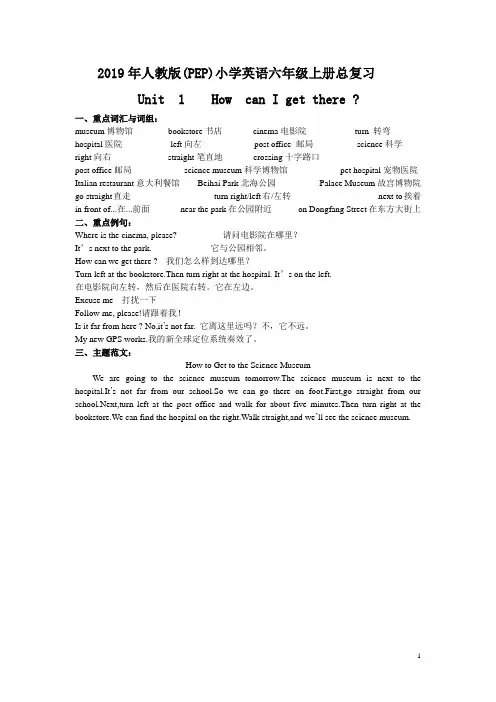
2019年人教版(PEP)小学英语六年级上册总复习Unit 1 How can I get there ?一、重点词汇与词组:museum博物馆bookstore书店cinema电影院turn 转弯hospital医院left向左post office 邮局science科学right向右straight笔直地crossing十字路口post office邮局science museum科学博物馆pet hospital宠物医院Italian restaurant意大利餐馆Beihai Park北海公园Palace Museum故宫博物院go straight直走turn right/left右/左转next to挨着in front of...在...前面near the park在公园附近on Dongfang Street在东方大街上二、重点例句:Where is the cinema, please? 请问电影院在哪里?It’s next to the park. 它与公园相邻。
How can we get there ? 我们怎么样到达哪里?Turn left at the bookstore.Then turn right at the hospital. It’s on the left.在电影院向左转,然后在医院右转。
它在左边。
Excuse me 打扰一下Follow me, please!请跟着我!Is it far from here ? No,it’s not far. 它离这里远吗?不,它不远。
My new GPS works.我的新全球定位系统奏效了。
三、主题范文:How to Get to the Science MuseumWe are going to the science museum tomorrow.The science museum is next to the hospital.It’s not far from our school.So we can go there on foot.First,go straight from our school.Next,turn left at the post office and walk for about five minutes.Then turn right at the bookstore.We can find the hospital on the right.Walk straight,and we’ll see the science museum.Unit 2 Ways to go to school一、重点词汇与词组:by乘bus公共汽车on foot步行plane飞机taxi出租车ship(大)船subway地铁train火车slow慢的stop停下 always 总是,一直 usually 通常often经常sometimes 有时候 never 从来不helmet头盔by bike/bus/plane/subway/train/ship/taxi/ferry /sled骑自行车/乘公共汽车/飞机/地铁/火车/船/出租汽车/渡轮/雪橇take the No.57 bus乘57路公共汽车on foot步行slow down慢下来pay attention to注意traffic lights 交通信号灯look right向右看cross the road横穿马路get off下车at home在家traffic rules交通规则 get to到达get on 上车be far from…表示离某地远二、重点例句:Wait!等一等!Hooray太好了!I see. 我明白了。
pep人教版六年级英语上册重点单词句型语法复习资料
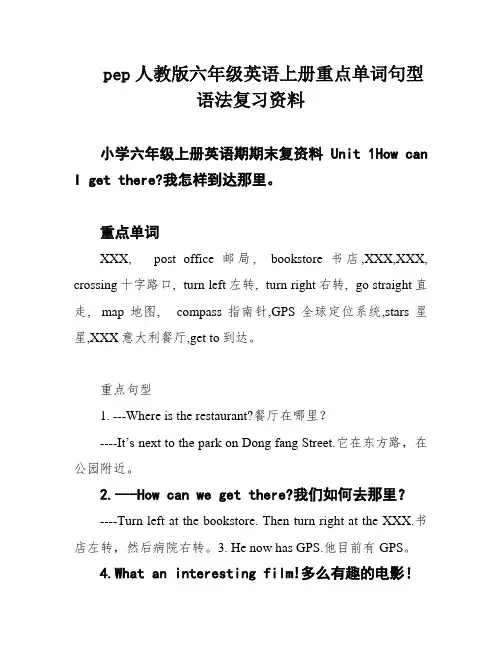
pep人教版六年级英语上册重点单词句型语法复习资料小学六年级上册英语期期末复资料Unit 1How can I get there?我怎样到达那里。
重点单词XXX, post office邮局, bookstore书店,XXX,XXX, crossing十字路口, turn left左转, turn right右转, go straight直走, map地图, compass指南针,GPS全球定位系统,stars星星,XXX意大利餐厅,get to到达。
重点句型1. ---Where is the restaurant?餐厅在哪里?----It’s next to the park on Dong fang Street.它在东方路,在公园附近。
2.---How can we get there?我们如何去那里?----Turn left at the bookstore. Then turn right at the XXX.书店左转,然后病院右转。
3. He now has GPS.他目前有GPS。
4.What an interesting film!多么有趣的电影!方位词复:XXX紧挨着,near在...邻近,XXX在...背面,XXX在...中间,in front of在...前面。
Unit 2Ways to go to school.上学的方式。
重点单词on foot走路, by bike骑车, by bus乘公交, by train乘火车,XXX乘地铁,XXX乘船,by XXX乘飞机,slow down慢下来,XXX交通灯,traffic rules交通规则,go/come to school上学,XXX坐雪橇,XXX坐轮渡,XXX注意,traffic lights交通灯,Stopandwait at a red light红灯停等一等,XXX light黄灯减速并停下,Go at a green light绿灯行。
2019年PEP小学六年级英语上册复习要点词汇句型和语法知识
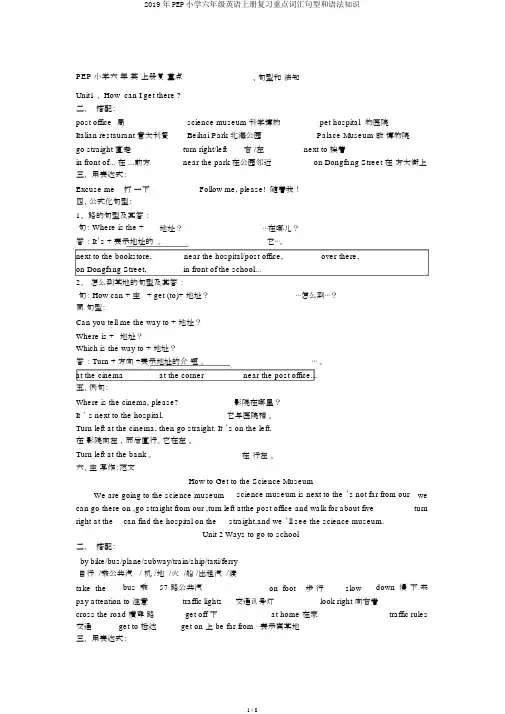
PEP 小学六年英上册复重点、句型和法知Unit1 、 How can I get there ?二、搭配:post office 局science museum 科学博物pet hospital 物医院Italian restaurant 意大利餐Beihai Park 北海公园Palace Museum 故博物院go straight 直走turn right/left右 /左next to 挨着in front of... 在 ...前方near the park 在公园邻近on Dongfang Street 在方大街上三、用表达式:Excuse me打一下Follow me, please! 随着我!四、公式化句型:1、路的句型及其答:句: Where is the +地址?···在哪儿?答: It’s + 表示地址的。
它···。
next to the bookstore,near the hospital/post office,over there,on Dongfang Street,in front of the school...2、怎么到某地的句型及其答:句: How can + 主 + get (to)+ 地址?···怎么到···?同句型:Can you tell me the way to + 地址?Where is +地址?Which is the way to + 地址?答: Turn + 方向 +表示地址的介短。
··· 。
at the cinema at the corner near the post office...五、例句:Where is the cinema, please?影院在哪里?It ’ s next to the hospital.它与医院相。
PEP六年级上册英语重点词汇、句型、语法总复习资料
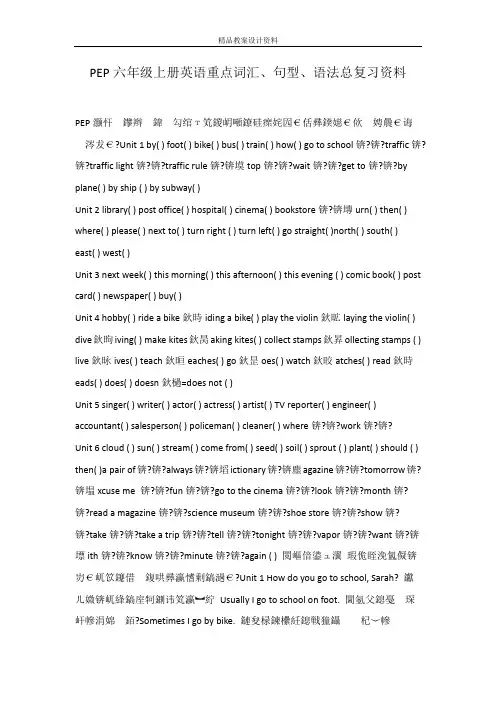
PEP六年级上册英语重点词汇、句型、语法总复习资料PEPт?Unit 1 by( ) foot( ) bike( ) bus( ) train( ) how( ) go to school锛?锛?traffic锛?锛?traffic light锛?锛?traffic rule锛?锛塻top锛?锛?wait锛?锛?get to锛?锛?by plane( ) by ship ( ) by subway( )Unit 2 library( ) post office( ) hospital( ) cinema( ) bookstore锛?锛塼urn( ) then( ) where( ) please( ) next to( ) turn right ( ) turn left( ) go straight( )north( ) south( )east( ) west( )Unit 3 next week( ) this morning( ) this afternoon( ) this evening ( ) comic book( ) post card( ) newspaper( ) buy( )Unit 4 hobby( ) ride a bike鈥時iding a bike( ) play the violin鈥昿laying the violin( ) dive鈥昫iving( ) make kites鈥昺aking kites( ) collect stamps鈥昪ollecting stamps ( ) live鈥昹ives( ) teach鈥晅eaches( ) go鈥昰oes( ) watch鈥晈atches( ) read鈥時eads( ) does( ) doesn鈥檛=does not ( )Unit 5 singer( ) writer( ) actor( ) actress( ) artist( ) TV reporter( ) engineer( ) accountant( ) salesperson( ) policeman( ) cleaner( ) where锛?锛?work锛?锛?Unit 6 cloud ( ) sun( ) stream( ) come from( ) seed( ) soil( ) sprout ( ) plant( ) should ( ) then( )a pair of锛?锛?always锛?锛塪ictionary锛?锛塵agazine锛?锛?tomorrow锛?锛塭xcuse me 锛?锛?fun锛?锛?go to the cinema锛?锛?look锛?锛?month锛?锛?read a magazine锛?锛?science museum锛?锛?shoe store锛?锛?show锛?锛?take锛?锛?take a trip锛?锛?tell锛?锛?tonight锛?锛?vapor锛?锛?want锛?锛墂ith锛?锛?know锛?锛?minute锛?锛?again ( ) 閲嶇偣鍙ュ瀷瑕佹眰浼氳儗锛?Unit 1 How do you go to school, Sarah? 钀ㄦ媺锛屼綘鎬庢牱鍘讳笂瀛︼紵Usually I go to school on foot.?Sometimes I go by bike.銆?How can I get to Zhongshan Park?You can go by the No.15 bus. 浣犲彲浠ヤ箻15?Unit 2 Where is the cinema, please? It鈥檚next to the hospital. 璇烽棶锛岀數褰遍櫌鍦ㄥ摢閲岋紵瀹冧笌鍖婚櫌鐩搁偦銆?Turn left at the cinema, then go straight. It鈥檚on the left. 鍦ㄧ數褰遍櫌澶勫悜宸﹁浆锛岀劧鍚庣洿琛屻€傚畠鍦ㄥ乏杈广€?Unit 3 What are you going to do on the weekend? 鍛ㄦ湯浣犳墦绠楀共浠€涔堬紵I鈥檓going to visit my grandparents this weekend. 杩欎釜鍛ㄦ湯鎴戞墦绠?Where are you going this afternoon? I鈥檓going to the bookstore.€?What are you going to buy? 浣犳墦绠椾拱浠€涔堬紵I am going to buy a comic book. ?Unit 4 What鈥檚your hobby?I like collecting stamps. ?He likes collecting stamps, too. ?Does she teach English? No, she doesn鈥檛. ?Does she teach you math? Yes, she does. 濂规暀浣犳暟瀛﹀悧锛??Unit 5 What does your mother do? ?She is a TV reporter. 濂规槸涓€浣嶇數瑙嗗伐浣滆€呫€?Where does she work? 濂瑰湪鍝?She works in a school. 濂瑰湪涓€鎵€瀛︽牎涓婄彮銆?How does she go to work? She goes to work by bus.氦杞﹀幓涓婄彮銆?Unit 6 Where does the rain come from? It comes from the clouds. ?How do you do that? 浣犳What should you do then锛?鎺ヤ笅鏉ワ紝浣犲簲璇ュ仛浠€涔堝憿锛?PEPт笂鍐屼笁浼氬彞鍨?1. My home is near. 鎴戠殑瀹跺緢杩戙€?2. What about you? 浣犲憿锛?3. Look at the traffic lights . 鐪嬩氦閫氱伅銆?4. Remember the traffic rules. ?5. Stop at a red light. 绾㈢伅鍋溿€?6. Wait at a yellow light. 榛勭伅绛夈€?7. Go at a green light. 缁跨伅琛屻€?8. Can I go on foot? Sure, if you like. It鈥檚not far. 鎴戣兘姝?9. Where is the 鈥?It鈥檚near the 鈥?鍦ㄥ摢閲岋紵瀹冮潬杩?10. Excuse me, is there a 鈥?near here? Yes, there is. 鎵撴壈涓€涓嬶紝鍦ㄨ繖闄勮繎鏈夋病鏈変竴瀹垛€︼紵鏄?11. Is it far from here? No, it鈥檚not far. ?涓嶏紝瀹冧笉杩溿€?12. 锟紺Thank you. 锟紺You鈥檙e welcome. 璋㈣阿锛屼笉瀹㈡皵銆?13. Where is the 鈥? 鈥?鍦ㄥ摢閲岋紵It鈥檚east/west/south/north of the 鈥?瀹冨湪鈥︾殑涓滆竟锛岃タ杈癸紝鍗楄竟锛屽寳杈广€?14. When are you going? I am going at 3 o鈥檆lock. 浣犳墦绠椾粈涔堟椂鍊欏幓锛熸垜鎵撶畻3鐐归挓鍘汇€?15. Can he go with us? Sure. 浠栬兘鍜屾?16. Let鈥檚go together.鍚с€?17. There is a stamp show on Sunday.ㄥ睍銆?18. She is a teacher. She teaches math. 濂规槸涓€浣嶈€佸笀锛屽ス鏁欐暟瀛︺€?19. Does your pen pal live in Shanghai? 浣犵殑绗斿弸浣忓湪涓婃捣鍚楋紵No, he doesn鈥檛. He lives in Beijing. 涓嶏紝浠栦笉浣忎笂娴枫€備粬浣忓湪鍖椾含銆?20. Where does she work? She works in a car company.?21. How does she go to work? She goes to work by bus.?22. Where does the 鈥?come from? It comes from the 鈥?鈥?鏉ヨ嚜浜庡摢?23. How can the water become vapour?The sun shines and the water becomes vapour. 鍦ㄥお闃崇殑鐓у皠涓嬶紝姘村氨鍙樻垚浜嗚捀姹姐€?24. How do you do that? 浣犳€庢牱First, put the seeds in the soil. 棣栧厛锛屾妸绉嶅瓙鏀捐繘鍦熷¥閲屻€?25. It鈥檚easy. 瀹冨緢绠€鍗曘€?26. What should you do then??Water them. In several days, you can see a sprout.€?27. First, hen, ext, t last, 鈥?棣栧厛锛岀劧鍚庯紝鎺ヤ笅鏉ワ紝鏈€鍚庯紝涓€銆佺幇鍦ㄨ繘琛屾椂鎬侊紙3寰嬶級1. 鐩存帴鍔爄ng锛歞o鈥昫oing draw鈥昫rawing cook鈥昪ooking answer鈥昦nswering read鈥時eading listen鈥昹istening fly鈥昮lying sing鈥晄inging play鈥昿laying 2. ng锛歸rite鈥晈riting dance鈥昫ancing take鈥晅aking have鈥昲aving make鈥昺aking ride鈥時iding dive鈥昫iving 3. ng锛?get鈥昰etting run鈥?running swim鈥晄wimming sit鈥晄itting put鈥昿utting What are you doing? I鈥檓answering the phone. 浠?濂?What ishe/she/it doing? He鈥檚/She鈥檚/It鈥檚鈥?浠栵紙濂广€佸畠锛変滑姝e湪骞蹭粈涔堬紵What are they doing? They are 鈥?鐪嬪埌like鎴杔ikes鍚庨潰鐨勫姩ing ?(be going to/will + 鍔ㄨ瘝鍘熷舰)his morning, this afternoon, this evening, tomorrow, tonight, this weekend, on the weekend, next week, next month, next year, next weekend. 锛堜粖鏅氾級浣犲皢瑕佸仛浠€涔堬紵What are you going to do (this evening)? I鈥檓going to the cinema. I鈥檓going to visit my grandparents. 浣犲皢浠€涔堟椂鍊欏幓锛?When are you going? I鈥檓going at 7:10. 浣犲皢鎬庢牱鍘诲憿锛?How are you going? I鈥檓going by bus. 浠婂ぉhere are you going this afternoon? I鈥檓going to the bookstore. 浣犲皢瑕佷拱浠€涔堝憿锛?What are you going to buy? I鈥檓going to buy a comic book. 浣犲皢鍜岃皝涓€璧峰幓锛?Who are you going with? I 鈥檓going with my parents.e 銆丼he銆両t s 1.s ead鈥時eads锛沴ive鈥昹ives锛沺lay鈥昿lays 锛泂ing鈥晄ings 2. h锛宻h鎴栭儴鍒嗕互o缁撳熬鐨勫姞es watches, teaches, goes, does, washes, passes锛?3. 杈呴煶瀛楁瘝+y缁撳熬鐨勬妸y鍙榠鍐嶅姞es ly鈥昮lies锛泂tudy鈥晄tudies 4. 鐗规畩鎯呭喌锛歨ave--has 5. 绗О鍗曟暟鍖呮嫭锛歨e; she; it; my father/friend; Amy/Hangzhou绛変竴? e likes drawing pictures. She works in a car company. It comes from the clouds. My father goes to work on foot. Li Lei often plays computer games after lunch. 6.犱簡es锛屽悗闈㈠姩璇嶅氨涓嶅彉鍖栦簡銆??Does she teach English 锛?Does your pen pal live in Hangzhou? 鍥涖€佷笉瀹氬啝璇峚鍜宎n鐨勭敤娉?a 鐢ㄤ簬杈呴煶鍥犵礌寮€澶寸殑鍗曡瘝鍓嶏紱an鐢ㄤ簬鍏冮煶鍥犵礌寮€澶寸殑鍗曡瘝鍓嶃€傦紙a,e,i,o,u锛?an鐨勫崟璇嶏細an actor锛沘n actress锛沘n artist锛沘n engineer锛沘n accountant锛沘n English book锛沘n orange锛沘n apple锛沘n old woman 浜斻€佸姩璇嶅彉鍖栦负琛ㄧず鑱屼笟鎴栦汉鐨勫崟璇?1. 鍔ㄨ瘝鍚庨潰鍔爀r锛歸ork鈥晈orker 锛泃each鈥晅eacher锛泂ing鈥晄inger锛汿V report鈥昑V reporterclean鈥昪leaner 2. 鍔ㄨ瘝鍚庨潰鍔爋r锛歛ct鈥昦ctor锛沝octor 3.鐨勭洿鎺ュ姞r锛歸rite鈥晈riter锛沝ance鈥昫ancer锛沝rive鈥昫river 4. 鍔ㄨ瘝鍚庨潰鍔爄st锛歛rt鈥昦rtist锛泃our鈥晅ourist 5. 鑱屼笟鐢峰コ鏈夊尯oliceman鈥昿olicewoman锛涙紨鍛榓ctor鈥昦ctress€?which ?what 浠€涔?when 浠€涔堟椂鍊?where whose 璋佺殑why 涓轰粈涔?how 鎬庝箞鏍?who 璋?涓冦€佷汉绉颁唬璇嶅拰鐗╀富浠h瘝I鈥昺y(鎴戔€曟垜鐨? you鈥晊our(浣狅紱浣犱滑鈥曚綘鐨勶紱浣犱滑鐨? he鈥昲is(浠栤€曚粬鐨? she鈥昲er(濂光€曞ス鐨? we鈥昽ur() they鈥晅heir(浠栦滑/濂逛滑//濂逛滑鐨?瀹冧滑鐨? an鍚庨潰鍔犲姩璇嶅師褰?What can you do? I can cook the meals. He can fly kites. She can play the violin.。
人教版pep六年级上英语总复习资料

六年级英语上册期末总复习一.重点单词(能听,说,读,写的单词)Unit 1地点:science museum科学博物馆post office邮局bookstore书店cinema电影院hospital医院pet hospital宠物医院school学校Italian restaurant意大利餐馆supermarket超市interesting 有趣的crossing十字路口turn left左转turn right右转go straight直走1. 问路的重点句型(1).句型结构:Where is + the + 地名?表示什么地方在哪里?—Where is the museum shop ?博物馆的商店在哪里?---It’s near the door. 我在大门附近。
注意:表示方位的固定短语:next to 靠近/挨着near附近/旁边beside 在…旁边in front of在….前面behind在….后面on the right 在右边on the left在左边on Dongfang Street在东方街(2) 询问这里有没有什么地方的句型句型结构:Is there a + 地名?—Excuse me, is there a post office over there ? 打扰一下, 那里有邮局吗?---Yes, there is. No, there isn’t.(3).询问怎么到达那里或者某个地方?句型结构:How can I / we get there( get to the hospital…..)?我该怎么到达那里? ---How can I get to the bookstore?---Turn right/ left at the … 在…地方向右/ 左转--- Go straight 向前直走----You can take the No.31 bus.你可乘坐31路公交车去. Unit 2交通工具:by乘坐on foot 步行by bus坐公交车by taxi坐出租车by plane坐飞机by ship坐轮船by subway坐地铁by train坐火车by ferry坐轮渡by sled坐雪橇by boat坐船slow down慢下来stop 停下wait等待helmet头盔must 必须pay attention to注意traffic lights交通信号灯look right向右看注意:交通工具前加by ,表示乘坐,但步行要用on foot1. 询问交通方式的重点句型用疑问代词how(怎样)How + do(does)+ 主语+ 来去地点?----How do you go / come to school ? 你怎样去/来上学?—— I usually go / come to school on foot . 我走路去/来上学。
人教PEP版小学英语六年级上册全册总复习重点知识点归纳整理
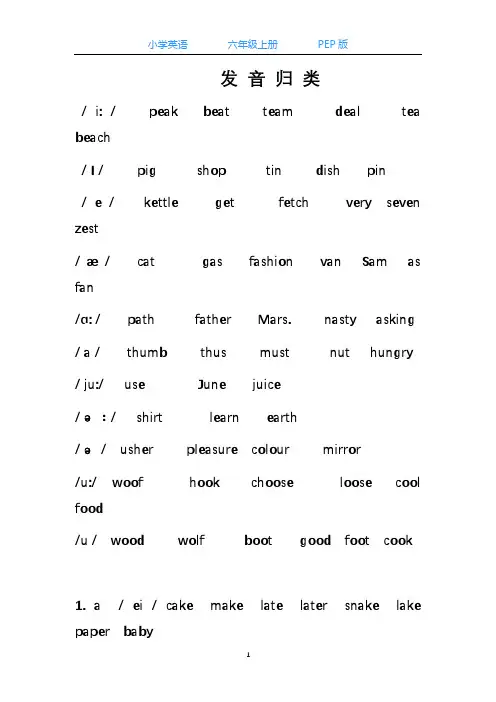
发音归类/ i: / peak beat team deal tea beach/ I / pig shop tin dish pin/ e / kettle get fetch very seven zest/ æ / cat gas fashion van Sam as fan/ɑ: / path father Mars. nasty asking / a / thumb thus must nut hungry / ju:/ use June juice/ ə:/ shirt learn earth/ ə / usher pleasure colour mirror/u:/ woof hook choose loose cool food/u / wood wolf boot good foot cook1. a / ei / cake make late later snake lake paper babya / æ /apple cat cap bag dad hat map black backa /ɑ:/ afternoon after banana dance lastclass glass grass grandma grandpa askfast fathera / ə/ china another woman breakfastaccountant bananaa / ɔ: / water a / ɒ/ watch wash want whata / i / orange2. e / i: / me he she these Chinese we returne / e / leg let bed pen desk yes egg3. i / ai / like kite bike drive time findlibrary excitedi / i / little fish big drink sit milk swimdig sister4. o / əu / Coke nose those close go homeno clotheso / ɒ/ lot dog holiday clock not boxodds hobby pot5. u / ju:/ use student cute excuse duty Tuesdayu / a / usher cut nut but bus cupjump much funnyu / ʊ / putu /u:/ June blue ruler superu / i / busy6. ea / i: / tea eat teacher please ice-creampeach jeans sneakers read meal beansclean season speak leaf leave(s) meaneast teach cleaner stream each sealseat beat wheatea / e / bread breakfast weatherea / ei / great7. ee /i:/ meet green three thirteen jeepqueen canteen sheep sweet beef weekend Halloween tree sleep need week feel seed deep between feet8. ow / au / brown how wow cow flowerdown now town crown shower ow / əu / yellow rainbow window snowy snow snowman know tomorrowrow show grow9. ou / au / mouth mouse out house ourplayground cloudy sour houseworkcloud about mountain southaccountant sprout loudou / u: / group soup coup10. th / ð / the this that these those fathermother brother with grandfathergrandmother clothes they themweather there either then othertogether anotherth / ө/ thank mouth birthday threethirteen thirty fourth eighth ninthtenth eleventh twelfth pathtwentieth thin Thursday healthynorth south month think themethinner thing something bathroom一、辨音,划线部分读音相同的打√,不同的打×(8%)()1. A. teacher B. bread()2. A. train B. wait()3. A. climb B. subway()4. A like B. pig()5. A foot B school()6. A bus B usually( ) 7.A stop B go( ) B plane二、找出划线部分发音不同与其他三个的单词。
人教版小学六年级英语上册知识点总结和复习要点
人教版小学六年级英语上册知识点总结和复习要点一、词汇积累与应用1基本词汇熟练掌握课本中出现的各类基本词汇,如名词、动词、形容词、副词等。
特别注意动词的过去式、现在分词和第三人称单数形式的变化。
例子:名词:festival(节日)、tradition(传统)、present(礼物)动词:visit(拜访)、celebrate(庆祝)、travel(旅行)形容词:happy(快乐的)、special(特别的)、interesting (有趣的)2短语与固定搭配记忆并理解课本中常用的短语和固定搭配,能够正确运用到句子中。
例子:短语:have a good time(玩得开心)、make a snowman (堆雪人)、be interested in(对……感兴趣)二、句型结构与语法1陈述句复习并巩固陈述句的基本结构,能够正确构建和表达完整的句子。
例子:陈述句:I like playing football in the afternoon.(我喜欢下午踢足球。
)2疑问句学习和掌握特殊疑问句、一般疑问句及其回答方式,能够准确理解并回答问题。
例子:特殊疑问句:What do you usually do on your birthday?(你生日通常做什么?)回答:I usually have a birthday party with my friends.(我通常和朋友们一起举办生日派对。
)3祈使句巩固祈使句的基本用法,能够正确使用祈使句表达请求、命令或建议。
例子:祈使句:Please don’t forget to bring your homework tomorrow.(请别忘了明天带作业来。
)4时态复习并巩固一般现在时、一般过去时、一般将来时和现在进行时等时态的基本用法和形式。
例子:一般现在时:She often reads books after dinner.(她晚饭后经常看书。
)一般过去时:We went to the zoo last weekend and saw many animals.(我们上周末去了动物园,看到了很多动物。