
高职高专实用英语教程教案Unit_1
Unit 1 Starting College LifeLecturer: Liu JunTeaching Objectives:Students (Ss) will be able to:●Understanding the main idea●Introduce themselves or others in a conversation.●Explain the language styles of the passages.●Mastering the key language points and grammatical structures in the text.●Understand and talk about college life.Teaching Focus:●Vocabulary: initial, pursue, objective, graduation, essential, advice, discipline, sacrifice,opportunity certificate, approach, explore, tear apart etc.●The importance of beginning in college and life●Applied writing: Business CardTime Allotment:Teaching Methods:●Explanation●Group discussion●Questions and answers●Multi-media●PerformanceTeaching Procedure:1st Period1.Introduction of this courseWelcome to College of Law & Business of Hubei University of Economics. I'm your English teacher of this term. College life is a new experience for you. College life is different from the life in your high school. You will find more time to kill by yourself. So the first thing you should do is to know how to study by yourself. College days will be the golden time in your life. Thereis a saying, “God will help those who help themselves.” This first unit we are going to learn some tips for you to begin your college life.Introduction of This Course:Teaching objects:Students in the Vocational and Three-year CollegesTeaching ideas:Focus on applicationTeaching MaterialPractical English for Vocational CollegesClass Hours:The Term Grade Evaluation SchemeFinal Examination 60%Attendance 10%Classroom Performance 30%2.Warming-up Activities:1) Group discuss/ pair workWhen confident high school students enter college, a whole new life is in front of you, a new battlefield to conquer…Video 1: Colorful College lifeDiscuss the following questions with your partners:•Where are you from?•What are your expectations of college life?•What kind of changes do you think it will bring upon your life?2) Information related.Topics of College Life•Classes•Professors/Advisors•Books•Dorm Life•Student Clubs & Organizations•Specialty•Campus Safety•Tips and Advice3.speakingWork in pairs and act the dialogues to the whole class.Task 1: Meeting with a foreign student and talking about studies, try to introduce yourself to your classmates.Tips:Glad to meet you.Where are you from?Which are you in?I’m majoring in …Task 2: Helping a foreign friend select his course at the registration officeTips:Do you know how to register for online courses?What course do you like most?4.Focus on Listening1) Word tips:Register for: to put someone’s or something’s name on an official list.e.g.: How many students have registered for English class?Credit: a unit which represents a successfully finished part of an educational course.[U] Praise, approval or honore.g.: I gave him credit for (= thought that he would have) better judgment than he showed.Credit Card: a small card which can be used as a method of payment, the money being taken from you at a later timeDorm/dormitory:Major in/at: the most important subject that a college or university student is studying.e.g.: What is your major, English or French?She was a philosophy major at an Ivy League college.2) Listening tasks:Short conversations and finish Part B and C on page 6.2nd Period1. Lead-in questions:What do you expect to learn at college?What kind of life did you expect to have before you came here?What do you expect to learn? More book knowledge or more practical social experience? Students are required to discuss the questions in pairs and then some of them were asked to report the results of the discussion.2. Intensive Reading (Text A) Pre-reading:The teacher asks the following questions:1)What’s college life like in your eyes?2)Do you think there are any differences between college and high school?3)What’s your plan for your college life?Background informationGive brief introduction of some famous universities in the U.S.3. While-reading1) Scanning and find answers to these questions as quickly as possible:1.According to the passage what kind of feeling a student will feel if he has a chance to goto college?2.What have most of you decided on when you go to college?3.Why is the initial decision very important?4.What’s the advice the author always gives to students?5.Why will it be a waste to all of the people if you limit your collegeexperience?6.How will you be exploring many of the disciplines?7.What can be established to a great extent in college?8.Is it necessary to commit yourself and stand by that commitment as you stand at theentrance of your college career?2) Intensive ReadingUnderstand the general organization of the text. Students are required to get the main idea of the text and each paragraph. (Refer to Reading Comprehension Exercise)4. Assignment1. Review the text.2. Oral passage: My ideal college life.3rd– 4th Periods1.Warming-up Activities:1)Ask some students to share their oral passage with the whole class.2)Brief review of the Reading Text A.2. Language points1) Explain the difficult words and sentences, including language and grammatical points.Focus:●Experience n.经历,阅历;经验,体验E.g.-She may lack experience, but learns very quickly. 她可能经验欠缺,但学得很快- He experienced great difficulty in getting a visa to leave the country. 他申请出国签证经历了很大的困难。
Unit 1 Going to College_高职高专英语

8. cheat: v. behave in a dishonest or deceitful way in order to win an advantage, especially in a game • He was caught cheating on the exam. n. a person who cheats • Cheats won’t obey rules they are supposed to obey. 9. be true of: valid or relevant for (someone) • That is not true of the people I am talking about.
2. on one’s own: alone; without help • I can’t carry it on my own; it’s too heavy 3. decide on/upon: choose (someone, something, or doing something) • We decided on the blue paint for the bedroom. 4. keep up: 1)remain level; remain as high as • She had to run to keep up with the other girls. 2)(cause to) remain high • Prices have kept up all the year. 3)continue (something) • I have kept up a friendship with a girl when I was at school twenty years ago.
高职高专实用英语unit1课文+译文

高职高专实用英语Unit 1Rail transportRail transportRail transport is a means of conveyance of passengers and goods by way of wheeled vehicles running on rail tracks. In contrast to road transport, where vehicles merely run on a prepared surface, rail vehicles are also directionally guided by the tracks they run on. Track usually consists of steel rails installed on sleepers/ties and ballast, on which the rolling stock, usually fitted with metal wheels, moves.Rolling stock in railway transport systems generally has lower frictional resistance when compared with highway vehicles, and the passenger and freight cars (carriages and wagons) can be coupled into longer trains. The operation is carried out by a railway company, providing transport between train stations. Power is provided by locomotives which either draw electrical power from a railway electrification system or produce their own power, usually by diesel engines. Most tracks are accompanied by a signalling system. Railways are a safe land transport systemwhen compared to other forms of transport. Railway transport is capable of high levels of passenger and cargo utilization and energy efficiency.The oldest, man-hauled railways date to the 6th century B.C. With the British development of the steam engine, it was possible to construct mainline railways, which were a key component of the industrial revolution. Also, railways reduced the costs of shipping, and allowed for fewer lost goods. The change from canals to railways allowed for "national markets" in which prices varied very little from city to city. Studies have shown that the invention and development of the railway in Europe was one of the most important technological inventions of the late 19th century. In the 1880s, electrified trains were introduced. Starting during the 1940s, the railways in most countries had their steam locomotives replaced by diesel-electric locomotives, with the process being almost complete by 2000. During the 1960s, electrified high-speed railway systems were introduced in Japan and a few other countries.译文铁路运输铁路运输是一种通过在铁路轨道上行驶的轮式车辆运输旅客和货物的方式。
高职高专新编实用英语综合教程1ThisisAmerica
麻省理工学院表示,有百分之七十五的大一学生选择该校是因 为他们对文科非常感兴趣,非常沉迷。 “介词with +名词或代词(组)”组成的一般的with 短语在 句子中可以作定语和状语。做状语的时候,它能表示时间、伴 随和条件。本句中with短语表示原因。
M.I.T says that seventy-five percent of freshmen come there with a strong interest and involvement in arts.
n. (尤指与其他事物相比)规模、程度、范围 e.g. on a large scale 很大规模
○ on a global scale 在全球范围内 v. scale sth. down/back 减少(数量);缩小
○ scale sth. up 增大,扩大规模数量 ○ eg. We are thinking of scaling down our ○ train in g pro gramm e s n ext year.
words
1、well-developed
adj. fully developed 完善的,健全的
e.g.
well-developed 是个复合词。英语中复合词是由两个或者两个以上的自由词素组成,表 达单一的语意概念。
例如,son-in-law 女婿,养子 oil-field 油田
words
of the accident. 对于这次事故,他给出了敏锐的分析。 The book is an analysis of poverty
and its causes. 这本书分析了贫困及其原因。
01
They have public colleges and universities and private ones. A big difference involves money. State schools cost less because they get money from the States that started them to local citizens. As a result, out-of-state and international students usually pay more than state residents, at least the first year.
新核心高职英语综合教程第一册第一单元教案
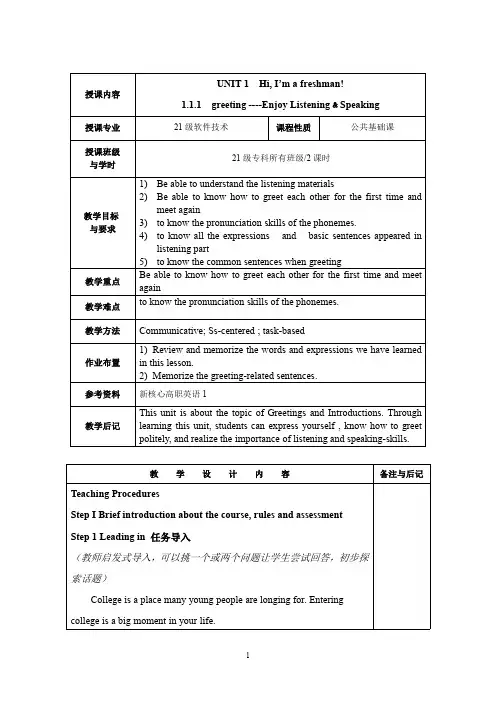
授课内容UNIT1Hi,I’m a freshman!1.1.1greeting----Enjoy Listening﹠Speaking授课专业21级软件技术课程性质公共基础课授课班级与学时21级专科所有班级/2课时教学目标与要求1)Be able to understand the listening materials2)Be able to know how to greet each other for the first time andmeet again3)to know the pronunciation skills of the phonemes.4)to know all the expressions and basic sentences appeared inlistening part5)to know the common sentences when greeting教学重点Be able to know how to greet each other for the first time and meet again教学难点to know the pronunciation skills of the phonemes.教学方法Communicative;Ss-centered;task-based作业布置1)Review and memorize the words and expressions we have learned in this lesson.2)Memorize the greeting-related sentences.参考资料新核心高职英语1教学后记This unit is about the topic of Greetings and Introductions.Through learning this unit,students can express yourself,know how to greet politely,and realize the importance of listening and speaking-skills.教学设计内容备注与后记Teaching ProceduresStep I Brief introduction about the course,rules and assessment Step1Leading in任务导入(教师启发式导入,可以挑一个或两个问题让学生尝试回答,初步探索话题)College is a place many young people are longing for.Entering college is a big moment in your life.1)Are you ready for the college life?2)Can you imagine what college life will be like?3)What are you going to do in your college life?4)Make a plan and list some important things you’d like to do in college.Step2Warming-up for the tasks热身活动Activity1.Listen and Repeat(首先可让学生尝试发一下这几个音素,然后教师讲一下发音要领和两个音素的发音差别,最后让学生根据录音进行模仿直至掌握。
新编实用英语第一册教案

第一部分课程基本信息第二部分教学设计一、课程与教材分析(一)课程分析《大学英语》是高等教育的一个有机组成部分,是大学生的一门必修的基础课程。
大学英语教学是以英语语言知识与应用技能、学习策略和跨文化交际为主要内容;以外语教学理论为指导,并集多种教学模式和教学手段为一体的教学体系,旨在培养学生英语综合应用能力,特别是听说能力,使他们在今后工作和社会交往中能用英语有效地进行口头和书面的信息交流,同时增强其自主学习能力、提高综合文化素养,以适应我国经济发展和国际交流的需要。
(二)教材分析(突出针对课程需要,合理选择教材和教参)《新编实用英语》(第五版)系列教材国家“十三五”规划教材,是严格按照国家职业教育目标和要求精心设计的立体化公共外语教材,教材内容贴合日常交际和职场需求,在主题类别、语篇类型、语言知识、文化知识等方面均与《新课标》紧密对应,历经多年教学实践,得到了广大高职高专院校师生的充分认可。
教材立足“立德树人”根本教育任务,探索外语“课程思政”建设,注重中华优秀文化的表达,助力培养德才兼备、德智体美劳全面发展的人;注重培养学生的英语学科核心素养,助力学生形成关键能力和必备品格以及形成正确的世界观、人生观和价值观,努力将大英教材的思想价值渗透作用最大化,以美育人、以德润人,以文化人,潜移默化中引导学生坚定“四个自信”,润物无声中实现“育人育才”。
教材聚焦典型生活和职业场景,以富有生活化、职业性和时代性的选材,将英语技能放在职业场景中操练,注重对学生英语基本功和职业技能的全面培养,并创设“线上+ 线下”混合式外语教学生态,资源以立体化、多模态形式呈现,是比较适合我校学生实际的教材。
二、学生情况分析(一)学生基本情况本课程是面向我校非英语专业普通专科学生的公共必修课,所教大部分学生有较强的学习积极性、主动性和自觉性,具备比较基本的英语阅读和简单写作的能力,但是听力水平普遍较低,词汇量相对有限,在写作和翻译方面能力较为欠缺。
语文版中职英语(基础模块上册)Unit1《Greetings》word教案

语文版中职英语(基础模块上册)Unit1《Greetings》word教案Unit 1 Greetings教学目标使学生通过学习本单元能用英语跟同学、老师及父母等打招呼。
使学生初步接触英语的语音、语调和节奏。
使学生能初步掌握本单元中出现的几个单词和短语。
教学内容重点朗读词汇:Hello, Morning, Monkey Munchy, Panda Pandy, Dog Doffy, Cat Catty, Teddy Bear 交际用语:Good morning!/Morning!Say hello to Teddy Bear!Hello! Hi!重点难点教学重点1. 词汇Hello, Morning, Monkey Munchy, Panda Pandy, Dog Doffy, Cat Catty, Teddy Bear2.句型Good morning!/Morning!Say hello to Teddy Bear!Hello! Hi!教学难点1.单词的记忆2.句型的掌握教学准备几个动物图片(其中包括猴子、熊猫、小狗、小猫、玩具熊)、彩笔、电脑音频及奖励用的贴画等。
教学过程第一课时目标:(1)学会说Monkey Munchy Panda Pandy Dog Doffy Cat Catty Teddy Bear(2)学会和他们打招呼。
一、开场白:(自我介绍,师生互相问好)二、导入三、认识新朋友,并学会和新朋友打招呼四、动手做手工,为动物图画涂色五、总结第二课时目标:(1)学会唱英文歌(2)学会和同学、老师打招呼一、导入(师生互相问好,回顾上节内容)二、听英文歌谣,学唱歌谣三、通过做游戏熟记打招呼用语四、总结。
2019-2020年高教版中职英语(基础模块第1册)Unit1《Nicetomeetyou!》教案
2019-2020年高教版中职英语(基础模块第1册)Unit 1《Nice to meet you!》word教案一、学情分析本单元是新生入学的第一单元,教学重点是活用招呼用语、相互了解个人基本信息、制作个人名片、学习不同职业的表达与描述以及练习发音。
就学习英语而言,职业学校的许多学生是胆大心粗,能说不会写或写不到位。
因此,教师在教学过程中应充分利用学生的特点开展相应活动。
我们可以利用学生胆大、敢说的特点,充分利用头脑风暴法采集相关素材,开展如招呼用语集锦、刨根问底探隐私、名片栏目大荟萃等活动。
教学中名片栏目的设计、描述不同职业、圆润的发音是本单元难点。
圆润的发音要靠长期的示范与坚持来实现。
名片中各栏目的设计可以集体讨论商定,个人名片设计则可以体现个性化、专业化,并决出最佳名片设计奖,教师还可以请学生一起收集生活中的名片,探讨名片的基本要素和个性特色。
职业的描述教师可以借助体态语、道具、图片、视频等来推进,还可以设计相应的练习强化学生的认知。
本单元设计分为4个课时:第一课时lead-in + listening and speaking第二课时reading and writing第三课时language in use + vocabulary consolidation第四课时unit task + pronunciation practice第一课时Lead-in + Listening & Speaking二、教材分析1.教学内容本课时系教材《英语1》(基础模块高教版)第一单元的第一课时,包括Lead-in & Listening and speaking 两部分,具体内容为:招呼用语,听懂并掌握询问和提供个人信息的词汇、句型。
2.教学重点、难点⑴教学重点:招呼用语,听懂并掌握询问和提供个人信息的词汇、句型⑵教学难点:个人信息的词汇、句型三、教学目标1.知识目标⑴掌握与个人信息相关的词汇,如name, first name; last name; name card; telephone number; age; address; e-mail address; job (engineer; manager; secretary; teacher; student; doctor; nurse; singer; fans); position(boss);⑵掌握提供或询问个人信息时所使用的句型,如:1) about greeting:Good morning. Hi. Nice to meet you.2) about personal informationWhat’s you name?Where are you from? Which company are you from?2.能力目标⑴学生能听懂关于询问和提供个人信息的对话。
新职业英语第二版职业综合英语1教案unit1(1)
(teacher expla in the structure of the text and key words and expressi ons)
Achieve (vt.)
Achieve+n. (sth good)
e.g. After 10 years of hard work, he fin ally achieved
(2)in formatio n collecti on
What do you know about "google"?
What search engine do you often use to find information about something or the In ternet?
(Ask Ss to prese nt their ideas. Kno wledge in side or outside the text is welcome.)
Task 2.List at least two compa nies for each type of the followi ng products.
Compare the brands and choose your favorite one.
Eg. Household applia nceTCL, Sony, Panasonic, Philips…
e.g. 1. The school excels in sports.
2. She has always excelled at foreig n Ian guages.
in terms of:from the point of view of; with regard to; concerning
中职英语第六册Unit1教案电子教案
张家港中等专业学校备课笔记
教学环节
教学内容
教师活动
学生活动
设计意图
Step One:
Warm-up
Use the words in the box to describe their feelings.
Ts can let the ss prepare before class and look at the pics to give us the proper answer.
C,on a ...basis意为在。。。。的基础上,例如:
On a daily/weekly/yearly basis按照每天/每周/每年一次的标准
3. Something that’s often recommended for those who want to sort out their finances is to keep a spending and saving daily.给那些想要理清自己财务状况的人常提的一个建议就是写收支日记。
A.该复合句中hat’s often recommended for those who want to sort out their finances是修饰先行词,something的定语从句,该从句中还包含了一个修饰先行词THOSE的定语从句who want to sort out their finances
学情分析
The students can use some simple sentences to ask for and give advice.In this class , they will learn more expressions.
新编实用英语综合教程1第1单元部分教案
新编实用英语综合教程1第1单元教案Unit 1 Greeting and Introducing PeopleSection I Talking Face to FaceTeaching purposes:1. The students should be able to understand greeting and introducing people and make a short conversation to greet and introduce other people.2. The students should be able to master some words and expressions in greeting and introducing people. (Key words and expressions: welcome, present a project report, business card, on business, care for, introduce)Teaching procedures:Self-introduction and requirement 10minsStep 1 Lead-in:1. Warm-up questions: 5mins1) When are business cards exchanged between people?2) What are usually written on business cards?2. Students read and translate the business cards on Page 3&4(5 mins) and PPT under theguidance of the teacher(5 mins). And then translate the following exercise on workbook P8 in groups.(7 mins)3. Learn from PPT about other useful expressions of titles.(5mins)3. Students design their own business cards.(to class over)Step 2 Sample dialogue:1. Students read the dialogues in P1 and P4 (15 mins)after the teacher and try to find out theuseful sentences and expressions for greeting people in the dialogue. (5 mins)2. Do the exercise on P5 and P6, then check their answers.(12 mins)Step 3 Students practice the dialogues in groups.1.Give students several minutes to prepare short conversations in pairs by simulating the fivesmall dialogues. (P 3 in workbook)2.Students role-play the similar situations they create, first in groups, and then in front of theclass. e.g. Please make a dialogue according to requirements. Task: Imagine you are Zhang and you meet Mr. Smith, an English teacher from the USA at the airport for the first time.Section II .Being All EarsTeaching purposes:It aims to train the students with proper listening strategies.Teaching procedures:Step 1. Pre-listening: provide the students with the new words and expressions; read through the questions and the chart in exercise 1 and 2, and make some predictions as to the content of the dialogue.(Key words and expressions:1.Canada/The United States (of America) / the United Kingdom (of Great Britain andNorthern Ireland); England--Scotland--Welsh--Northern Ireland ;Britain;2.College3.Surprise surprise partyHis visit gave me a pleasant surprise. 他的来访使我感到惊喜。