
计算机专业外文资料翻译----微机发展简史
附录外文文献及翻译Progress in computersThe first stored program computers began to work around 1950. The one we built in Cambridge, the EDSAC was first used in the summer of 1949.These early experimental computers were built by people like myself with varying backgrounds. We all had extensive experience in electronic engineering and were confident that that experience would standus in good stead. This proved true, although we had some new things to learn. The most important of these was that transients must be treated correctly; what would cause a harmless flash on the screen of a television set could lead to a serious error in a computer.As far as computing circuits were concerned, we found ourselves with an embarrass de riches. For example, we could use vacuum tube diodes for gates as we did in the EDSAC or pentodes with control signals on both grids, a system widely used elsewhere. This sort of choice persisted and the term famillogic came into use. Those who have worked in the computer field will remember TTL, ECL and CMOS. Of these, CMOS has now become dominant.In those early years, the IEE was still dominated by power engineering and we had to fight a number of major battles in order to get radio engineering along with the rapidly developing subject of electronics. dubbed in the IEE light current electrical engineering. properlyrecognized as an activity in its own right. I remember that we had some difficulty in organizing a co nference because the power engineers‟ ways of doing things were not our ways. A minor source of irritation was that all IEE published papers were expected to start with a lengthy statement of earlier practice, something difficult to do when there was no earlier practiceConsolidation in the 1960sBy the late 50s or early 1960s, the heroic pioneering stage was over and the computer field was starting up in real earnest. The number of computers in the world had increased and they were much more reliable than the very early ones . To those years we can ascribe the first steps in high level languages and the first operating systems. Experimental time-sharing was beginning, and ultimately computer graphics was to come along.Above all, transistors began to replace vacuum tubes. This change presented a formidable challenge to the engineers of the day. They had to forget what they knew about circuits and start again. It can only be said that they measured up superbly well to the challenge and that the change could not have gone more smoothly.Soon it was found possible to put more than one transistor on the same bit of silicon, and this was the beginning of integrated circuits. As time went on, a sufficient level of integration was reached for one chip to accommodate enough transistors for a small number of gates or flip flops. This led to a range of chips known as the 7400 series. The gates and flip flops were independent of one another and each had its own pins. They could be connected by off-chip wiring to make a computer or anything else.These chips made a new kind of computer possible. It was called a minicomputer. It was something less that a mainframe, but still very powerful, and much more affordable. Instead of having one expensive mainframe for the whole organization, a business or a university was able to have a minicomputer for each major department.Before long minicomputers began to spread and become more powerful. The world was hungry for computing power and it had been very frustrating for industry not to be able to supply it on the scalerequired and at a reasonable cost. Minicomputers transformed the situation.The fall in the cost of computing did not start with the minicomputer; it had always been that way. This was what I meant when I referred in my abstract to inflation in the computer industry …going the other way‟. As time goes on people get more for their money, not less.Research in Computer Hardware.The time that I am describing was a wonderful one for research in computer hardware. The user of the 7400 series could work at the gate and flip-flop level and yet the overall level of integration was sufficient to give a degree of reliability far above that of discreet transistors. The researcher, in a university orelsewhere, could build any digital device that a fertile imagination could conjure up. In the Computer Laboratory we built the Cambridge CAP, a full-scaleminicomputer with fancy capability logic.The 7400 series was still going strong in the mid 1970s and was used for the Cambridge Ring, a pioneering wide-band local area network. Publication of the design study for the Ring came just before the announcement of the Ethernet. Until these two systems appeared, users had mostly been content with teletype-based local area networks. Rings need high reliability because, as the pulses go repeatedly round the ring, they must be continually amplified and regenerated. It was the high reliability provided by the 7400 series of chips that gave us the courage needed to embark on the project for the Cambridge Ring.The RISC Movement and Its AftermathEarly computers had simple instruction sets. As time went on designers of commercially available machines added additional features which they thought would improve performance. Few comparative measureme nts were done and on the whole the choice of features depended upon the designer‟s intuition.In 1980, the RISC movement that was to change all this broke on the world. The movement opened with a paper by Patterson and ditzy entitled The Case for the Reduced Instructions Set Computer.Apart from leading to a striking acronym, this title conveys little of the insights into instruction set design which went with the RISC movement, in particular the way it facilitated pipelining, a system whereby several instructions may be in different stages of execution within the processor at the same time. Pipelining was not new, but it was new for small computersThe RISC movement benefited greatly from methods which had recently become available for estimating the performance to be expected from a computer design without actually implementing it. I refer to the use of a powerful existing computer to simulate the new design. By the use of simulation, RISC advocates were able to predict with some confidence that a good RISC design would be able to out-perform the best conventional computers using the same circuit technology. This prediction was ultimately born out in practice.Simulation made rapid progress and soon came into universal use by computer designers. In consequence, computer design has become more of a science and less of an art. Today, designers expect to have a roomful of, computers available to do their simulations, not just one. They refer to such a roomful by the attractive name of computer farm.The x86 Instruction SetLittle is now heard of pre-RISC instruction sets with one major exception, namely that of the Intel 8086 and its progeny, collectively referred to as x86. This has become the dominant instruction set and the RISC instruction sets that originally had a considerable measure of success are having to put up a hard fight for survival.This dominance of x86 disappoints people like myself who come from the research wings. both academic and industrial. of the computer field. No doubt, business considerations have a lot to do with the survival of x86, but there are other reasons as well. However much we research oriented people would liketo think otherwise. high level languages have not yet eliminated the use of machine code altogether. We need to keep reminding ourselves that there is much to be said for strict binary compatibility with previous usage when that can be attained. Nevertheless, things might have been different if Intel‟s major attempt to produce a good RISC chip had been more successful. I am referring to the i860 (not the i960, which was something different). In many ways the i860 was an excellent chip, but its software interface did not fit it to be used in aworkstation.There is an interesting sting in the tail of this apparently easy triumph of the x86 instruction set. It proved impossible to match the steadily increasing speed of RISC processors by direct implementation ofthe x86 instruction set as had been done in the past. Instead, designers took a leaf out of the RISC book; although it is not obvious, on the surface, a modern x86 processor chip contains hidden within it a RISC-style processor with its own internal RISC coding. The incoming x86 code is, after suitable massaging, converted into this internal code and handed over to the RISC processor where the critical execution is performed. In this summing up of the RISC movement, I rely heavily on the latest edition of Hennessy and Patterson‟s books on computer design as my supporting authority; see in particular Computer Architecture, third edition, 2003, pp 146, 151-4, 157-8.The IA-64 instruction set.Some time ago, Intel and Hewlett-Packard introduced the IA-64 instruction set. This was primarily intended to meet a generally recognized need for a 64 bit address space. In this, it followed the lead of the designers of the MIPS R4000 and Alpha. However one would have thought that Intel would have stressed compatibility with the x86; the puzzle is that they did the exact opposite.Moreover, built into the design of IA-64 is a feature known as predication which makes it incompatible in a major way with all other instruction sets. In particular, it needs 6 extra bits with each instruction. This upsets the traditional balance between instruction word length and information content, and it changes significantly the brief of the compiler writer.In spite of having an entirely new instruction set, Intel made the puzzling claim that chips based on IA-64 would be compatible with earlier x86 chips. It was hard to see exactly what was meant.Chips for the latest IA-64 processor, namely, the Itanium, appear to have special hardware for compatibility. Even so, x86 code runs very slowly.Because of the above complications, implementation of IA-64 requires a larger chip than is required for more conventional instruction sets. This in turn implies a higher cost. Such at any rate, is the received wisdom, and, as a general principle, it was repeated as such by Gordon Moore when he visited Cambridge recently to open the Betty and Gordon Moore Library. I have, however, heard it said that the matter appears differently from within Intel. This I do not understand. But I am very ready to admit that I am completely out of my depth as regards the economics of the semiconductor industry.Shortage of ElectronsAlthough shortage of electrons has not so far appeared as an obvious limitation, in the long term it may become so. Perhaps this is where the exploitation of non-conventional CMOS will lead us. However, some interesting work has been done. notably by HuronAmend and his team working in the Cavendish Laboratory. on the direct development of structures in which a single electron more or less makes the difference between a zero and a one. However very little progress has been made towards practical devices that could lead to the construction of a computer. Even with exceptionally good luck, many tens of years must inevitably elapse before a working computer based on single electron effects can be contemplated.微机发展简史第一台存储程序的计算开始出现于1950前后,它就是1949年夏天在剑桥大学,我们创造的延迟存储自动电子计算机(EDSAC)。
计算机专业外文资料翻译----微机发展简史
附录外文文献及翻译Progress in computersThe first stored program computers began to work around 1950. The one we built in Cambridge, the EDSAC was first used in the summer of 1949.These early experimental computers were built by people like myself with varying backgrounds. We all had extensive experience in electronic engineering and were confident that that experience would standus in good stead. This proved true, although we had some new things to learn. The most important of these was that transients must be treated correctly; what would cause a harmless flash on the screen of a television set could lead to a serious error in a computer.As far as computing circuits were concerned, we found ourselves with an embarrass de riches. For example, we could use vacuum tube diodes for gates as we did in the EDSAC or pentodes with control signals on both grids, a system widely used elsewhere. This sort of choice persisted and the term famillogic came into use. Those who have worked in the computer field will remember TTL, ECL and CMOS. Of these, CMOS has now become dominant.In those early years, the IEE was still dominated by power engineering and we had to fight a number of major battles in order to get radio engineering along with the rapidly developing subject of electronics. dubbed in the IEE light current electrical engineering. properlyrecognized as an activity in its own right. I remember that we had some difficulty in organizing a co nference because the power engineers‟ ways of doing things were not our ways. A minor source of irritation was that all IEE published papers were expected to start with a lengthy statement of earlier practice, something difficult to do when there was no earlier practiceConsolidation in the 1960sBy the late 50s or early 1960s, the heroic pioneering stage was over and the computer field was starting up in real earnest. The number of computers in the world had increased and they were much more reliable than the very early ones . To those years we can ascribe the first steps in high level languages and the first operating systems. Experimental time-sharing was beginning, and ultimately computer graphics was to come along.Above all, transistors began to replace vacuum tubes. This change presented a formidable challenge to the engineers of the day. They had to forget what they knew about circuits and start again. It can only be said that they measured up superbly well to the challenge and that the change could not have gone more smoothly.Soon it was found possible to put more than one transistor on the same bit of silicon, and this was the beginning of integrated circuits. As time went on, a sufficient level of integration was reached for one chip to accommodate enough transistors for a small number of gates or flip flops. This led to a range of chips known as the 7400 series. The gates and flip flops were independent of one another and each had its own pins. They could be connected by off-chip wiring to make a computer or anything else.These chips made a new kind of computer possible. It was called a minicomputer. It was something less that a mainframe, but still very powerful, and much more affordable. Instead of having one expensive mainframe for the whole organization, a business or a university was able to have a minicomputer for each major department.Before long minicomputers began to spread and become more powerful. The world was hungry for computing power and it had been very frustrating for industry not to be able to supply it on the scalerequired and at a reasonable cost. Minicomputers transformed the situation.The fall in the cost of computing did not start with the minicomputer; it had always been that way. This was what I meant when I referred in my abstract to inflation in the computer industry …going the other way‟. As time goes on people get more for their money, not less.Research in Computer Hardware.The time that I am describing was a wonderful one for research in computer hardware. The user of the 7400 series could work at the gate and flip-flop level and yet the overall level of integration was sufficient to give a degree of reliability far above that of discreet transistors. The researcher, in a university orelsewhere, could build any digital device that a fertile imagination could conjure up. In the Computer Laboratory we built the Cambridge CAP, a full-scaleminicomputer with fancy capability logic.The 7400 series was still going strong in the mid 1970s and was used for the Cambridge Ring, a pioneering wide-band local area network. Publication of the design study for the Ring came just before the announcement of the Ethernet. Until these two systems appeared, users had mostly been content with teletype-based local area networks. Rings need high reliability because, as the pulses go repeatedly round the ring, they must be continually amplified and regenerated. It was the high reliability provided by the 7400 series of chips that gave us the courage needed to embark on the project for the Cambridge Ring.The RISC Movement and Its AftermathEarly computers had simple instruction sets. As time went on designers of commercially available machines added additional features which they thought would improve performance. Few comparative measureme nts were done and on the whole the choice of features depended upon the designer‟s intuition.In 1980, the RISC movement that was to change all this broke on the world. The movement opened with a paper by Patterson and ditzy entitled The Case for the Reduced Instructions Set Computer.Apart from leading to a striking acronym, this title conveys little of the insights into instruction set design which went with the RISC movement, in particular the way it facilitated pipelining, a system whereby several instructions may be in different stages of execution within the processor at the same time. Pipelining was not new, but it was new for small computersThe RISC movement benefited greatly from methods which had recently become available for estimating the performance to be expected from a computer design without actually implementing it. I refer to the use of a powerful existing computer to simulate the new design. By the use of simulation, RISC advocates were able to predict with some confidence that a good RISC design would be able to out-perform the best conventional computers using the same circuit technology. This prediction was ultimately born out in practice.Simulation made rapid progress and soon came into universal use by computer designers. In consequence, computer design has become more of a science and less of an art. Today, designers expect to have a roomful of, computers available to do their simulations, not just one. They refer to such a roomful by the attractive name of computer farm.The x86 Instruction SetLittle is now heard of pre-RISC instruction sets with one major exception, namely that of the Intel 8086 and its progeny, collectively referred to as x86. This has become the dominant instruction set and the RISC instruction sets that originally had a considerable measure of success are having to put up a hard fight for survival.This dominance of x86 disappoints people like myself who come from the research wings. both academic and industrial. of the computer field. No doubt, business considerations have a lot to do with the survival of x86, but there are other reasons as well. However much we research oriented people would liketo think otherwise. high level languages have not yet eliminated the use of machine code altogether. We need to keep reminding ourselves that there is much to be said for strict binary compatibility with previous usage when that can be attained. Nevertheless, things might have been different if Intel‟s major attempt to produce a good RISC chip had been more successful. I am referring to the i860 (not the i960, which was something different). In many ways the i860 was an excellent chip, but its software interface did not fit it to be used in aworkstation.There is an interesting sting in the tail of this apparently easy triumph of the x86 instruction set. It proved impossible to match the steadily increasing speed of RISC processors by direct implementation ofthe x86 instruction set as had been done in the past. Instead, designers took a leaf out of the RISC book; although it is not obvious, on the surface, a modern x86 processor chip contains hidden within it a RISC-style processor with its own internal RISC coding. The incoming x86 code is, after suitable massaging, converted into this internal code and handed over to the RISC processor where the critical execution is performed. In this summing up of the RISC movement, I rely heavily on the latest edition of Hennessy and Patterson‟s books on computer design as my supporting authority; see in particular Computer Architecture, third edition, 2003, pp 146, 151-4, 157-8.The IA-64 instruction set.Some time ago, Intel and Hewlett-Packard introduced the IA-64 instruction set. This was primarily intended to meet a generally recognized need for a 64 bit address space. In this, it followed the lead of the designers of the MIPS R4000 and Alpha. However one would have thought that Intel would have stressed compatibility with the x86; the puzzle is that they did the exact opposite.Moreover, built into the design of IA-64 is a feature known as predication which makes it incompatible in a major way with all other instruction sets. In particular, it needs 6 extra bits with each instruction. This upsets the traditional balance between instruction word length and information content, and it changes significantly the brief of the compiler writer.In spite of having an entirely new instruction set, Intel made the puzzling claim that chips based on IA-64 would be compatible with earlier x86 chips. It was hard to see exactly what was meant.Chips for the latest IA-64 processor, namely, the Itanium, appear to have special hardware for compatibility. Even so, x86 code runs very slowly.Because of the above complications, implementation of IA-64 requires a larger chip than is required for more conventional instruction sets. This in turn implies a higher cost. Such at any rate, is the received wisdom, and, as a general principle, it was repeated as such by Gordon Moore when he visited Cambridge recently to open the Betty and Gordon Moore Library. I have, however, heard it said that the matter appears differently from within Intel. This I do not understand. But I am very ready to admit that I am completely out of my depth as regards the economics of the semiconductor industry.Shortage of ElectronsAlthough shortage of electrons has not so far appeared as an obvious limitation, in the long term it may become so. Perhaps this is where the exploitation of non-conventional CMOS will lead us. However, some interesting work has been done. notably by HuronAmend and his team working in the Cavendish Laboratory. on the direct development of structures in which a single electron more or less makes the difference between a zero and a one. However very little progress has been made towards practical devices that could lead to the construction of a computer. Even with exceptionally good luck, many tens of years must inevitably elapse before a working computer based on single electron effects can be contemplated.微机发展简史第一台存储程序的计算开始出现于1950前后,它就是1949年夏天在剑桥大学,我们创造的延迟存储自动电子计算机(EDSAC)。
微机原理的发展史
总的1.微型计算机的发展简史自从1964年第一台电子计算机ENIAC问世,半个世纪以来,计算机科学和技术飞速发展。
根据组成计算机的电子器件的发展历程,计算机发展已经历了四代,现在正向第五代计算机发展。
第一代:电子管时代。
计算机采用电子管作为逻辑与案件。
第二代:晶体管时代。
计算机用晶体管代替电子管,主存储器采用磁芯存储器,外存储器开始使用磁盘,并提供了较多的外部设备。
第三代:集成电路时代。
计算机采用了小规模和中规模集成电路,主存储器用半导体存储器,采用微程序控制技术。
第四代:大规模集成电路时代。
计算机全面采用了大规模集成电路甚至是超大规模集成电路。
计算机开始向巨型和微型发展。
微型计算机特别是多媒体计算机的开发和使用,将计算机的生产和应用推向了新的高潮。
2.8255A的实验设计概论可编程并行接口芯片8255A因为其输入和输出电平与TTL完全兼容的特性,已广泛应用于实际工程中。
通过8255A并行接口可连接两个或多个系统构成相互之间的通信或系统与外设之间通过8255A交换信息等。
交通灯的实验可以让我们在掌握8255A 典型应用电路的接法、工作方式及其应用的基础上,更好的学以致用。
3.8259A的实验设计概论8259A的中断管理功能很强,单片可以管理8级外部中断,在多片级联方式下最多可以管理64级外部中断,并且具有中断优先权判优、中断嵌套、中断屏蔽和中断结束、中断触发等多种中断管理方式。
通过运用其中断特性,进行简单的单级中断控制实验。
在实验中掌握学理论与实际相结合的学习方法。
4.典型的输入输出芯片1.可编程串行通信接口:8251A8251A是一种可编程的通用同步/异步接受发送器,用于CPU与外设之间的串行通信接口,通过编程可选择同步和异步的工作方式。
2.可编程并行通信接口:8255A8255A是一个40个引脚双列直插式封装的大规模集成电路。
采用单一的+5V 电源供电,其输入和输出电平与TTL完全兼容。
3.可编程技数器/定时器8253A8253A是一种外围电路,它可以通过软件方式设定不同的工作方式,产生各种形式的时间延迟信号,一满足各类系统提出的不同时间的要求4.DMA控制器:8237A8237A是一种高性能可编程的DMA控制器,每个集成电路上有4个独立的DMA 通道,可分别独立编程,实现外围设备与内存、内存与内存之间的高速数据传输5.中断控制器:8259A8259A是一种专门为控制优先级中断而设计的集成电路。
计算机发展史英文

电子计算机
第一台电子计算机
电子计算机的出现标志着计算机时代的真正开始。第一台电子计算机是ENIAC( Electronic Numerical Integrator And Calculator),它于1946年问世。
晶体管计算机
随着晶体管技术的不断发展,人们开始使用晶体管代替电子管来制造计算机。晶 体管计算机比电子管计算机更小、更快、更可靠。
计算机发展史英文
xx年xx月xx日
目录
• 早期计算机 • 发展中的计算机 • 现代计算机 • 未来计算机
01
早期计算机
机械计算机
莱布尼茨的机械计算机
莱布尼茨发明了一种基于齿轮和杠杆的机械计算机,它可以执行基本的算术 和逻辑运算。
帕斯卡(Pascal)的计算机
帕斯卡设计了一种简单的机械计算机,它可以进行加法和减法运算,并具有 存储和读取数据的能力。
1981年,IBM PC推出,成为个人计算机的标准。
1991年,Linux操作系统诞生,成为开源软件的代表 。
云计算与大数据
2006年,Amazon Web Services推出,云计算服务 开始商业化。
2012年,Google BigQuery推出,大数据分析进入云 时代。
2009年,Hadoop分布式计算系统诞生,大数据处理 成为可能。
生物计算机的出现将带来巨大的变革,包括改变药物设计和治 疗的方式、加速生物科学研究等。
THANKS
谢谢您的观看
发展趋势
除了科学计算和数据处理,还广泛应用于工 业控制、航空航天等领域。
随着集成电路的发展,晶体管计算机逐渐被 淘汰,为微处理器所取代。
03
现代计算机
个人计算机
1977年,Apple II型计算机问世,成为第一台成功的 个人计算机。
微型计算机与pc机发展史

微型计算机是指以微处理器为核心, 配上由大规模集成电路制作的存储器、输 入/输出接口电路及系统总线所组成的计算 机。微型计算机自出现以来,便以其集成 度 高、功能强、体积小、功耗低、价格廉、 灵活方便等一系列优点,广泛应用于国防、 航空航天、海洋、地质、气候、教育、经 济、日常生活的各个领域,并发挥着巨大 的作用。
什么是微型计算机 (PC机)
微型计算机(PC机) 的结构 微型计算机(PC机) 的历史
微型计算机(Microcomputer) 也叫做个人计算机(PersonalComputer,PC),简称微机或 PC机。 微型计算机的特点 1.易于使用 2.技术简单 3.价格低廉 微型计算机的用途 1.一般用作桌面系统 2.个人事务处理 3.网络终端
主板 用途:整个微机系统的核心 位置:主机箱内 特点:基于总线的扩展槽 主板的配置: CPU插座 芯片组(南桥、北桥) 储存器插槽 AGP插槽 总线插槽 串、并行口 电源、键盘、鼠标、硬盘、软盘、 CD-ROM等外部设备
中央处理器(CPU) 用途:通过对数值的处理和各种逻辑、控制运算实现计算机的功能。 位置:主板CPU插座 CPU 的组成部分 算术逻单元ALU 寄存器组 控制单元 处理器系统 CISC RISC Pentium处理器
输入设备 用途:将外部信息转变为数据输入到计算机中
位置:外部设备,通过外接端口与计算机相连
常用输入设备:键盘,鼠标器,触摸屏,光笔
输出设备 用途:人与计算机之间进行信息交换的主要装置 位置:外部设备,通过外接端口与计算机相连
常用输出设备:显示器,投影仪,打印机
1946
1958
现今
1964
1971
内存条 用途:连接CPU 和其他设备,起到缓冲和数据交换作用 位置:主板上
微型计算机发展史

微型计算机发展史
随着科学技术的不断发展,计算机的性能逐渐得到提高,微型计算机作为计算机革命的标志,在社会上得到了广泛的应用。
计算机发展史,要从20世纪50年代说起。
1951年,英国科学家迪米特里·埃尔德提出了装有核心存储器的计算机原理,这就是计算机的起源。
1956年,美国IBM推出的IBM702系列,是世界上第一台型号标准的大型机,它采用了核心存储器储存程序,实现了程序储存,而且它的数据处理速度达到5000次/秒,是当时的最大计算机。
随后,IBM推出了第一台微型计算机,1973年IBM推出了首款微型计算机,IBM5100,它比当时的大型机小了几十倍,但它也拥有大型机的功能,售价一万七千美元。
后来,微型计算机的价格逐渐降低,性能也得到大大提高,随着微型计算机的发展,现在的微型计算机有多种结构形式,例如电脑、笔记本电脑、平板电脑等,电脑和笔记本电脑是目前应用最为广泛的微型计算机。
电脑的发展,也改变了人类的生活方式,它不仅提高了用户的工作效率,而且拓展了人类的智慧,能够有效地处理和分析大量数据,实现快速的信息计算,帮助人类解决许多复杂的问题。
一、计算机(computer)发展简史
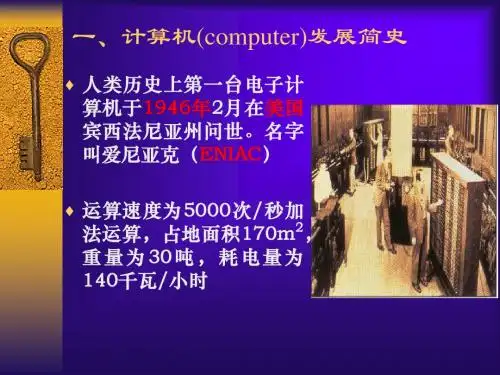
运算速度为 5000 次 / 秒加
法运算,占地面积170m2, 重 量 为 30 吨 , 耗 电 量 为 140千瓦/小时
二、个人电脑的发展
个人电脑简称PC 1981年IBM公司设
计出第一台个人电脑, 以后经过几十年的发 展,到现在的台式电 脑、笔记本电脑、掌 上电脑等。
三、电脑体系结构
名字叫爱尼亚克eniac运算速度为5000次秒加法运算占地面积170m重量为30吨耗电量为140千瓦小时二个人电脑的发展1981年ibm公司设计出第一台个人电脑以后经过几十年的发展到现在的台式电脑笔记本电脑掌上电脑等
一、计算机(computer)发展简史
人类历史上第一台电子计
算机于 1946 年 2 月在美国 宾西法尼亚州问世。名字 叫爱尼亚克(ENIAC)
主机
硬件系统
显示器 键盘 鼠标
系统软件
软件系统
(系统软件:是当计算机在执行各类信息,处理任务时,那些分类、
开发、管理与支持计算机系统资源及操作的程序:例WIND解决学习、生活、工作中实际问题的软件: 指法练习软件,Word,Excl,CAD等。)
四、电脑开机与关机
开机:先开显示器,后开主机 关机:
死机:CTRL+ALT+DEL键复位 冷起动:按主机电源直至关机再开机
五、认识键盘
Enter(回车):确定
ESC:取消
Caps Lock:锁定大写
Shift(上档):输入上面字符 Delete:删除后一个
Num Lock:锁定数字
Backspace:删除前一个
微机发展历史
微处理器的发展
第三代微处理器(1978-1984)
位数(字长):16位 代表产品:Intel 8088/8086/80286、 Motorola mc68000、 Zilog z800、出现了微型计算机例如IBM PC系列机 性能特征:采用HMOS工艺、时钟频率小于5MHZ-10MHZ、平 均指令执行时间为0.5微秒-1微秒、集成度与运算速度 比第2代提高1个数量级、可用汇编语言及高级语言并 配有软件系统 应用: 广泛
Extensions,多媒体扩展指令集)技术、二级缓存放入CPU
中、超标量指令流水线结构
应用:广泛
微处理器的发展
微处理器的发展
第六代微处理器(2005)
位数(字长):64 代表产品:Intel intaninu、Intel 酷睿(core)/core 2系列 、 AMD athlon系列 性能特征:分单核/双核/四核/八核三种、酷睿处理器采用 800MHz-1333Mhz的前端总线速率、45nm/65nm制 程工艺、 2M/4M/8M/12M/16M L2缓存、 Core 2 Duo在单个芯片上封装了2.91亿个晶体管功能强大 应用:微机服务器、图形工作站等
1957年,哈尔滨工业大学研制成功中国 第一台模拟式电子计算机。
1958年,中国第一台计算机--103型通用 数字电子计算机研制成功,运行速度每 秒1500次,标志着我国第一台电子计算 机的诞生。
1959年,中国研制成功104型电子计算机, 运算速度每秒1万次。
1960年,中国第一台大型通用电子计算 机--107型通用电子数字计算机研制成功。
第三代计算机19651970中小规模的集成电路运算速度为百万几百万次每秒半导体存储器逐步取代了磁芯存储器的主存储器地位磁盘成了不可缺少的辅助存储器第四代计算机1971至今大超大规模集成电路运算速度为几百万千万亿次每秒主存储器均采用半导体存储器主要的外存储器是磁带磁盘光盘微处理器和微型计算机诞生
微机发展简史中英文翻译
毕业设计(论文)外文翻译题目微机发展简史专业电子信息工程班级01学生李嘉亮指导教师邓亚玲西安理工大学高科学院2011 年微机发展简史IEEE的论文剑桥大学,2004/2/5莫里斯威尔克斯计算机实验室剑桥大学第一台存储程序的计算开始出现于1950前后,它就是1949年夏天在剑桥大学,我们创造的延迟存储自动电子计算机(EDSAC)。
最初实验用的计算机是由象我一样有着广博知识的人构造的。
我们在电子工程方面都有着丰富的经验,并且我们深信这些经验对我们大有裨益。
后来,被证明是正确的,尽管我们也要学习很多新东西。
最重要的是瞬态一定要小心应付,虽然它只会在电视机的荧幕上一起一个无害的闪光,但是在计算机上这将导致一系列的错误。
在电路的设计过程中,我们经常陷入两难的境地。
举例来说,我可以使用真空二级管做为门电路,就象在EDSAC中一样,或者在两个栅格之间用带控制信号的五级管,这被广泛用于其他系统设计,这类的选择一直在持续着直到逻辑门电路开始应用。
在计算机领域工作的人都应该记得TTL,ECL和CMOS,到目前为止,CMOS已经占据了主导地位。
在最初的几年,IEE(电子工程师协会)仍然由动力工程占据主导地位。
为了让IEE 认识到无线工程和快速发展的电子工程并行发展是它自己的一项权利,我们不得不面对一些障碍。
由于动力工程师们做事的方式与我们不同,我们也遇到了许多困难。
让人有些愤怒的是,所有的IEE出版的论文都被期望以冗长的早期研究的陈述开头,无非是些在早期阶段由于没有太多经验而遇到的困难之类的陈述。
60年代的巩固阶段60年代初,个人英雄时代结束了,计算机真正引起了重视。
世界上的计算机数量已经增加了许多,并且性能比以前更加可靠。
这些我认为归因与高级语言的起步和第一个操作系统的诞生。
分时系统开始起步,并且计算机图形学随之而来。
综上所述,晶体管开始代替正空管。
这个变化对当时的工程师们是个不可回避的挑战。
他们必须忘记他们熟悉的电路重新开始。
微机的发展史
微机的发展史微机是指个人计算机,它是计算机技术发展的重要里程碑之一。
本文将从微机的起源、发展和未来前景三个方面,介绍微机的发展史。
一、微机的起源20世纪60年代末,随着集成电路技术的发展,计算机体积逐渐缩小,价格逐渐下降。
1969年,美国一家计算机公司推出了第一台个人计算机,这标志着微机的诞生。
当时的微机还非常庞大,只能由专业人员操作,价格昂贵,普通人难以接触。
二、微机的发展20世纪70年代,随着微电子技术的迅猛发展,微机开始进入大众视野。
1976年,美国的一家创业公司推出了一款名为“苹果”的个人计算机,这款计算机的问世引发了一场个人计算机革命。
个人计算机从此开始走向普及,成为人们生活和工作中必不可少的工具。
在80年代,微机的发展进入了一个高速发展的时期。
各国纷纷投入资金和人力资源进行研发,推动了微机技术的不断创新。
1981年,IBM公司发布了第一台个人计算机,这款计算机的操作系统开放给其他厂商使用,从而推动了个人计算机的标准化和普及。
个人计算机市场竞争激烈,各家厂商相继推出了各种型号的微机,不断满足用户的需求。
90年代,随着互联网的兴起,微机的功能进一步扩展。
人们可以通过微机上网冲浪、发送电子邮件等,微机的作用不再局限于办公和娱乐。
同时,微机的体积也逐渐减小,性能不断提升,成本不断降低,使得微机进一步普及。
三、微机的未来前景随着科技的不断发展,微机的未来前景将更加广阔。
首先,随着人工智能技术的进步,微机将具备更强大的计算和处理能力,可以更好地满足人们的需求。
其次,随着物联网技术的普及,微机将与各种设备和传感器连接,实现智能化的控制和管理。
再次,微机将继续向轻薄化、便携化的方向发展,更加适应人们的移动办公和生活需求。
微机作为个人计算机的代表,经历了起源、发展和未来前景三个阶段。
从庞大昂贵的计算机到普及化的个人计算机,微机在不断演进和创新中,改变了人们的生活和工作方式。
随着科技的不断进步,微机的未来前景将更加广阔,我们可以期待微机在各个领域的应用和发展。
微型计算机发展史
随着社会信息化程度的提高,人们对计算机的需求越来越大,但传统的大型计算机价格昂贵、体积庞大,难以满足个人和小型组织的需求。因此,微型计算机的出现满足了这一市场需求,推动了计算机技术的普及和应用。
社会背景
02
CHAPTER
微型计算机的发展历程
总结词
第一代微型计算机以微处理器为核心,采用集成电路技术,体积小、价格低、应用范围广。
微型计算机
微型计算机具有高度的可定制性和可扩展性,可以根据用户的需求进行硬件配置和软件安装。它还具有易于使用和维护的特点,降低了计算机应用的门槛,使得计算机技术得以广泛普及和应用。
特点
1
2
3
随着集成电路和微处理器技术的出现和发展,科学家们开始尝试将计算机小型化,出现了实验性的微型计算机。
1960年代
04
CHAPTER
微型计算机的未来展望
更低功耗
随着环保意识的增强,低功耗或节能的微型计算机将成为主流,有助于减少能源消耗和环境污染。
物联网应用
随着物联网的普及,微型计算机将在智能家居、工业自动化等领域发挥更大的作用。
人工智能集成
微型计算机将更加集成人工智能技术,实现更智能化的数据处理和应用。
更快速度
总结词:微型计算机在数据处理领域的应用,使得数据分析和数据挖掘成为可能,为决策制定提供了有力支持。
自动化控制是指利用计算机对生产过程进行自动监测、控制和调节,以提高生产效率和产品质量。微型计算机在自动化控制领域的应用,使得自动化控制系统的设计和实现更加灵活和便捷。
总结词:微型计算机在自动化控制领域的应用,使得自动化控制系统更加智能化和高效化,提高了生产效率和产品质量。
微型计算机发展史
汇报人: