
八年级上册英语unit9教案
Unit 9: Can you come to my party? Teaching contentSection A (page 65-66)Teaching aimThe main content of section A is focused on making, accepting and declining invitations and talking about obligations.Through practice of listening and speaking, students can understand the sentence structure to make invitation and give a reply.Process and methodsUsing learning strategies like classifying, contrasting and Role-playing, audio, teaching pictures, slides or designing courseware (reflecting the characteristics of invitation) carry class teaching and spoken English communication activities or games through pair work conversation and practice role play activities. Values of sensibility and attitudeLearning content of section A keeps intimate relationship with students, because the topic is invitation which conjures up student’s interests. During the process of making invitations, students can increase mutual interrelationship, gain friendship and learn to take other people’s sentiment into consideration when they are engaged in a vocal conversation.Key pointsStudying how invitations made and the expression of obligation.Grammar difficultiesThe construction and usage of general questions led by can. Teaching breakthroughThe key points of section A is to learn the description of invitation through the conversation of inquiring party and movies, which requires the usage of general questions led by can and the key points of expressing invitations is to master the construction and expression of obligation.Teaching preparationTeacherMaking students be familiar with the vocabulary and phrases; making general question led by can teaching pictures or slides; preparing listening materials, designing special questions, designing slide of after-class homework; making courseware of illustration of section A or reflecting the characteristics of invitations or obligation; leading in new content through these things.StudentsReviewing vocabulary relate to obligation; conducting an invitation of party or movies with classmates.Teaching procedureThe first step: creation of setting, guidance of new course The main content of section A it to study the answering and inquiry of invitations, so when we are leading in new course we can employ the method of seeing and listening and conclusion.First, the teacher can play a guess game which is able to make students be familiar with words of obligation. Teacher can explain the guess game by inviting students to join him and making gestures. And teacher asks one or two students to play the game and the rest guess which phrase it is.Second, teacher shows some pictures and uses “can”to ask questions. After students recalled the general questions, teacher can ask: can you come to my party to introduce the aiming language purpose---the inquiry and expression of invitations. And teacher can broadcast the listening material of 1b-2c and have students imitate the pronunciation.The second step: the interaction between teacher and students.Teacher should help students finish the tasks in books and shows them the correct answers. During this process, teacher should organize pair work.The third step: cooperation and improvementTeacher can lead students carrying game of “guess game”,having students making invitations and expressing their obligation. And the students should finish the task under the guidance of teacher.Teaching procedures:Stage Number Stage Aim and Timing Teaching Activity andLanguageLearner Activity andLanguageBoard-work,Materials, OHPsOptions,Alternatives andExtensionsStage1 Lead-in&V ocabulary Activity T: Greet SS thenstart the classT>SS:"howmany words canyou remember"T:Show studentshow to playguess gameT>SS: “Canyou…”T: write downthe expressionsof obligation onthe left ofblackboardSS: recall newwordsSS: look at PPTand follow theteacher to readthe new wordsSS: guess thewords or phrasesThey shouldread andmemory newwords , whichwill be afundamental partof the lessonBoard-workDrawobligationwords on theblackboardRemembertheexpressionofobligationand tellstudents torecall theusage ofgeneralquestionsStage2The Sentence Pattern to Express&Practice T: tell SS todescribe thepicturesT: tell studentsthat they willhave listeningactivitiesT>SS: by themeans of thepractice toconsolidate thestudents tomaster the PPTand practice thenew sentences.SS: finish theassignment inthe PPT andmake a dialoguefor describe theinvitations andobligation“C an you cometo my party onSaturday?”Learn anothersentencestructure:“Would youlike come tomy party?”Recallexpressions ofMonday,Tuesday,Wednesday,Thursday,Friday,Sunday.Stage3Self-check& Conversation T: Showstudents thepictures; askwhy they can’tgo to the movieswith LiNing.Ask students toSS: answerteacher’squestionsaccording tothe pictures anduse sentence“Ihave to/must…”invite their partner to go to the movies.T: ask students to read the conversation, answer the four questions and let them make dialogues with partner. Think of their own reasons for not go to the movies.SS: answer the questions based on the role-play conversation. Practice the dialogues with partnerStage4 review& homework T>SS: reviewthe sentencestructure andexpressions ofaccept or declineinvitations.T:give studentsassignmentSS:recall theirmemory and usethe sentencepattern:“Can you …”Answer thequestion indifferent ways。
人教版八年级英语unit9整单元完整教案
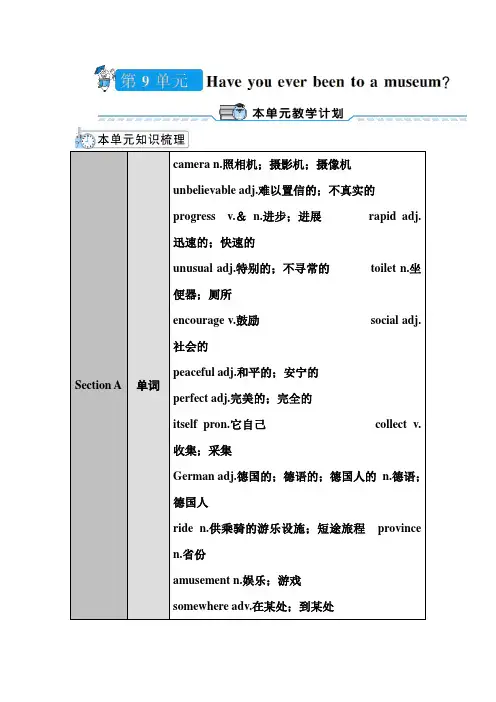
Section A 单词camera n.照相机;摄影机;摄像机unbelievable adj.难以置信的;不真实的progress v.&n.进步;进展rapid adj.迅速的;快速的unusual adj.特别的;不寻常的toilet n.坐便器;厕所encourage v.鼓励social adj.社会的peaceful adj.和平的;安宁的perfect adj.完美的;完全的itself pron.它自己collect v.收集;采集German adj.德国的;德语的;德国人的n.德语;德国人ride n.供乘骑的游乐设施;短途旅程province n.省份amusement n.娱乐;游戏somewhere adv.在某处;到某处be close to 靠近be far from 远离……thousands of 数以千计的;许许多多的whether…or…不管……还是……on the one hand…on the other hand…一方面……另一方面……句型1.On the one hand,more than three quarters of the population are Chinese,so you can simply speak Putonghua a lot of the time. On the other hand,Singapore is an English-speaking country,so it’s also a good place to practice your English! 一方面,超过四分之三的人口是华裔,因此很多时候你可以只说普通话。
另一方面,新加坡是一个说英语的国家,因此它也是一个你练习英语的好地方!2. Whether you like Indian food, Western food or Japanese food, you’ll find it all in Singapore!不管你是喜欢印度的食物、西方的食物,还是日本的食物,在新加坡你都能够找到!语法语法现在完成时(Ⅱ)知识目标能够听懂游历等方面的话题;能够运用现在完成时、一般过去时谈论过去的经历。
人教版英语八年级上册Unit 9《Can you come to my party》教学设计

人教版英语八年级上册Unit 9《Can you come to my party》教学设计一. 教材分析人教版英语八年级上册Unit 9主要讲述了关于邀请别人参加聚会的情境。
通过本单元的学习,学生能够掌握与聚会相关的词汇和表达方式,学会如何礼貌地邀请别人,并能够用英语进行简单的交流。
本单元的核心句型是“Can you come to my party?”,以及回答“Yes, I can.”和“No, I can’t.”。
二. 学情分析八年级的学生已经具备了一定的英语基础,能够听懂并运用简单的英语进行交流。
他们对学习英语有浓厚的兴趣,并且愿意积极参与课堂活动。
然而,部分学生可能在口语表达和听力方面还存在一定的困难,需要教师的引导和帮助。
三. 教学目标1.知识目标:学生能够掌握与聚会相关的词汇和表达方式,学会如何礼貌地邀请别人,并能够用英语进行简单的交流。
2.能力目标:学生能够听懂并运用核心句型“Can you come to my party?”进行交流,提高口语表达能力。
3.情感目标:学生能够在课堂上积极参与,培养合作意识和团队精神。
四. 教学重难点1.重点:学生能够听懂并运用核心句型“Can you come to my party?”进行交流。
2.难点:学生能够正确使用情态动词“can”来表达自己的能力。
五. 教学方法1.情境教学法:通过创设真实的聚会情境,激发学生的学习兴趣,提高他们的口语表达能力。
2.交际法:通过小组讨论和角色扮演等方式,培养学生的合作意识和团队精神。
3.任务型教学法:通过完成各种任务,引导学生主动参与学习过程,提高他们的自主学习能力。
六. 教学准备1.教学材料:教材、多媒体课件、录音机、磁带或音频文件。
2.教学环境:教室布置成聚会场景,悬挂气球、彩带等装饰物。
七. 教学过程1.导入(5分钟)教师以提问的方式引导学生回顾已学过的与聚会相关的词汇,如“birthday party”、“house party”等。
人教版八年级英语上册Unit9单元教学设计

2.难点:
-语法难点:一般过去时的运用,特别是在句子中的变化和动词过去式的拼写。
-阅读难点:对文章深层含义的理解,如作者的观点、态度和隐含信息。
-口语难点:流畅地运用所学词汇和句型进行表达,克服紧张和恐惧心理。
-写作难点:构建合理的文章结构,使用恰当的连接词,使文章内容连贯。
(三)学生小组讨论
1.教师将学生分成小组,每组选择一个探险话题进行讨论。
-话题可以包括:著名探险家的故事、探险活动的意义、自己或他人的探险经历等。
2.小组内部分工合作,收集资料、整理观点、准备发言。
3.各小组代表进行汇报,分享本组的讨论成果。
(四)课堂练习
1.设计词汇填空、选择题、改错题等练习,巩固新学的词汇和语法知识。
-对学习困难的学生进行个别辅导,提供额外的支持和鼓励。
3.合作学习,促进交流:
-采用小组合作形式,鼓励学生互相帮助,共同完成学习任务。
-设计小组讨论和分享环节,提高学生的合作能力和口语表达能力。
4.精讲多练,巩固语法:
-通过例句和实际操作,详细讲解一般过去时的构成和用法。
-设计多样化的练习,让学生在实际运用中巩固语法知识。
-观看一部与探险相关的英文电影或纪录片,记录并学习其中的新词汇和表达。
-参加学校或社区组织的探险活动,亲身体验探险的乐趣,将经历与同学分享。
作业布置要求:
1.学生按时完成作业,保证作业质量。
2.家长监督孩子完成作业,关注学生的学习进度和需求。
3.教师及时批改作业,给予反馈和指导,帮助学生不断提高。
-学生跟读、模仿,确保正确掌握词汇的发音和意义。
3.语法讲解:
人教版八年级英语上册Unit9 Can you come to my party教案

Unit 9Can you come to my party?第一课时Section A (1a~1c)§自主学习案根据句意及首字母提示完成单词。
1.She didn't go to school and stayed in bed because she had the f lu.2.Can you come and h elp me with my English?3.Can I m eet my friend tomorrow, Mom?4.I must go to see a d octor because I feel ill.5.My mother prepares for b reakfast for our family every morning.§课堂导学案Step 1准备与热身(Preparation)Hello,class.We are learning Unit 9 today.But first look at this sentence:Can you come to my party? What does it mean?You are correct. It means “你能来参加我的聚会吗?”“Can” means “能,行”. You may answer like these: Yes,I can.I can come to the party./No. I can't.I have to do my homework. In these sentences both can and have to are model verbs. They are part of the predicates.Can you come to school? Yes, I can./No, I can't.I have to see a doctor.Can you get to school by bus? Yes, I can./No, I can't.I have to walk.Step 2呈现与输入(Presentation)Please look at the picture on page 65. The boy in the middle is going to hold a party.Can everyone come to the party?Help my parents, prepare for an exam, meet my friends,have the flu, go to the doctor.Please read these expressions loudly. And match the words with the picture.Areyou OK? Let's check the answers.Step 3练习与体验(Practice)You are great ! As you see, there are some people in the picture.Do you know who's who?Now please listen to the conversation.Pay attention to Sun Ning's words carefully.He says the names of each person he is inviting. When I play the recording for the first time,you just listen carefully. When I play the recording for the second time,please write the names of each person next to his or her picture. You have to complete the activity on your own.OK, let's go!Now let's talk as they do in the conversation.In other words, we are going to talk in imitation of the conversation we have just heard and read.Step 4运用与生成(Production)Now please make your own dialogues in groups of four. Suppose you are the students in the picture. One of you is inviting the other three students to his party. The other students are saying if he can go or not.If you can't go, remember to give a reason.When you practice, please pay attention to the pronunciation and intonation.I'll offer vocabulary and pronunciation support if you need.Step 5巩固与提高(Progress)【探究点】Can you come to my party on Saturday afternoon? 你能在周六下午来参加我的聚会吗?Can you…?句型是熟人和朋友之间常用的表达邀请或请求的用语。
八年级英语上册-人教版-Unit 9 教学设计
八年级英语上册-人教版-Unit 9 教学设计一. 教材分析人教版八年级英语上册Unit 9主要讲述了关于过去发生的事情的描述。
通过本单元的学习,学生能够掌握过去时态的构成和用法,以及如何用英语描述过去发生的事情。
教材中包含了许多日常生活中的情境,如参观农场、做家务等,让学生在学习语言的同时,也能够了解和体验不同的生活方式。
二. 学情分析八年级的学生已经掌握了基本的英语语法和词汇,具备一定的英语听说读写能力。
但部分学生对过去时态的掌握还不够熟练,需要在教学中加以巩固。
此外,学生在描述过去发生的事情时,可能会存在表达不清晰、逻辑不严密的问题,需要通过实例和练习进行引导和纠正。
三. 教学目标1.知识目标:学生能够掌握过去时态的构成和用法,正确运用过去时描述过去发生的事情。
2.能力目标:学生能够在日常生活中运用英语描述过去发生的事情,提高英语口语表达和写作能力。
3.情感目标:通过学习本单元,学生能够了解不同的生活方式,培养对多元文化的尊重和理解。
四. 教学重难点1.重点:过去时态的构成和用法。
2.难点:如何运用过去时描述过去发生的事情,表达清晰、逻辑严密。
五. 教学方法1.情境教学法:通过设定各种情境,让学生在实际语境中运用过去时态。
2.交际法:引导学生进行角色扮演、小组讨论等互动活动,提高口语表达能力。
3.任务型教学法:通过完成各种任务,让学生在实践中掌握过去时态的用法。
六. 教学准备1.教学PPT:制作含有教材内容的PPT,用于辅助教学。
2.情景剧剧本:准备一则关于过去发生的事情的情景剧剧本,用于课堂操练。
3.作业素材:收集一些描述过去发生的事情的英语文章和图片,用于课后作业的布置。
七. 教学过程1.导入(5分钟)利用PPT展示一些过去时的图片,如“昨天”、“去年”等,引导学生思考并回答:“Can you tell me something about yesterday?”、“What did you do last year?”等问题,让学生回顾过去,引出过去时态的话题。
【人教版】新目标八年级英语上册:Unit 9 单元教学设计
【人教版】新目标八年级英语上册:Unit 9 单元教学设计一. 教材分析人教版新目标八年级英语上册Unit 9主要围绕“野生动物”的主题展开,通过介绍野生动物的生活习性和保护状况,提高学生对野生动物保护的意识。
本单元包括两个读写任务,三个听说任务以及一个综合语言运用任务。
教材内容丰富,旨在培养学生的综合语言运用能力。
二. 学情分析八年级的学生已经具备了一定的英语基础,对于日常生活中常见的事物和现象有了一定的认识。
但是,对于一些较为专业的野生动物知识以及保护意识还有待提高。
因此,在教学过程中,需要关注学生的个体差异,充分调动学生的学习积极性,引导他们主动探索和学习。
三. 教学目标1.知识目标:学生能够掌握关于野生动物的词汇和表达方式,理解课文内容,了解野生动物的生活习性和保护状况。
2.能力目标:学生能够运用所学知识进行日常交流,提高听、说、读、写的综合语言运用能力。
3.情感目标:学生能够增强对野生动物保护的意识,培养关爱动物的情感。
四. 教学重难点1.重点:野生动物的词汇和表达方式,课文内容的理解。
2.难点:野生动物保护的知识和表达,以及如何运用所学知识进行实际交流。
五. 教学方法1.任务型教学法:通过设置各种任务,引导学生主动参与学习,提高学生的综合语言运用能力。
2.情境教学法:创设各种情境,让学生在实际情境中学习英语,提高学习兴趣。
3.合作学习法:鼓励学生分组合作,进行互动交流,培养团队协作能力。
六. 教学准备1.教学课件:制作与野生动物相关的课件,辅助教学。
2.教学素材:收集一些关于野生动物的图片、视频等素材,用于教学展示。
3.课堂活动准备:准备一些与野生动物保护相关的小游戏、小组活动等,丰富课堂氛围。
七. 教学过程1.导入(5分钟)利用图片或视频展示一些野生动物,引导学生谈论自己喜欢的动物,激发学生的学习兴趣。
2.呈现(10分钟)教师通过课件展示本节课的主要内容,包括野生动物的词汇和表达方式,以及课文内容。
新人教版八年级上册英语Unit9教案
课时教案课题:Unit 9 Can you come to my party? Section A 1 (1a-2d)第课时总序第个教案课型:编写时间:年月日执行时间:年月日教学目标:1. 语言知识目标:1) 能掌握以下单词:prepare, prepare, prepare prepare prepare for, for, for, exam, exam, exam, flu, flu, flu, available, available, available, another another time, until, hang, hang out, catch 2) 能掌握以下句型:①—Can you come to my party on Saturday afternoon? —Sure, I’d love to. ②—Can you go to the movies on Saturday? —I ’m m sorry, sorry, sorry, I I ’m m not not not available. available. available. I I I have have have too too too much much much homework homework homework this this weekend. ③That That’’s too bad. Maybe another time. ④Sure. Thanks for asking. ⑤Sam isn ’t leaving until next Wednesday. 2) 能了解以下语法:用情态动词can 来表达邀请。
3)学会表达邀请,学会对邀请进行恰当的答复或拒绝。
2. 情感态度价值观目标:学会人际交往的基本常识,学会人际交往的基本常识,学会有礼貌地邀请别人以及回答别人的学会有礼貌地邀请别人以及回答别人的邀请的方式。
人教版英语八年级上册Unit9单元教学设计
(一)导入新课
1.教学活动设计:教师通过展示一张黑白的图片和一张彩色的图片,引发学生对发明改变生活的思考。
2.提问:“Can you imagine your life without colors? Who do you think made this change possible?”
人教版英语八年级上册Unit9单元教学设计
一、教学目标
(一)知识与技能
在本章节的教学中,学生将掌握以下知识与技能:
1.掌握本单元的生词和短语,如:invent, electricity, genius, battery, mad, at the age of, take apart, be full of, be interested in等,并能熟练运用这些词汇进行交流。
3.学生分享自己的想法,教师引导话题转向本课的主题——发明家和他们的伟大发明。
4.简要介绍本课将要学习的发明家——爱迪生,激发学生对新课的兴趣。
(二)讲授新知
1.教学内容:本节课主要学习一般过去时,以及与发明家和科学家相关的词汇。
2.教学方法:采用讲解、示范、练习相结合的方式进行教学。
3.教师通过展示爱迪生的发明故事,引导学生学习一般过去时的用法。
4.学习新词汇,如:invent, electricity, genius, battery, mad, at the age of, take apart, be full of, be interested in等。
5.通过例句和情景,让学生理解并掌握一般分成小组,讨论以下问题:“What are the most important inventions in your life? How have these inventions changed your life?”
Unit9SectionA(GrammarFocus-3c)教案人教版英语八年级上册
Unit9 SectionA(Grammar Focus3c)教学目标1.掌握重点单词、短语、句型2.情态动词might的用法3.学会有礼貌地发出、接受和拒绝对方的邀请教学难点1. New words and key phrases.2. Learn to make,accept and decline invitations politely.教学过程一、Lead inChristmas partyA: Can you e to my party on Saturday?B: Sure, I’d love to. /I'm sorry, I can't. I must/have to...Make an invitationA: Can you go hiking/...with me on Saturday?B: Sure, I’d love to.A: Great. See/Catch you on Saturday.A: What about you,xx?Can you... on Saturday?C: I'm afraid not. I'm not available/free. I must/have to...A: That's too bad. Maybe another time.C: Sure. Thanks for asking.Invitation & replyA: Can you e to/ go to…?B: Sure, I’d love to./ Sure. That sounds great.Sorry, I can’t. / I’m afraid not. / I’m not free. I have to/ must…prepare for a test go to the doctorhave a piano lesson help my parentsvisit my aunt do my homeworkA: Can he/she/they e to …?B: No, he/ she/ they can’t.He/ She/ They (might) have (has) to/ must…Grammar Focus3aplete the answers with might and one of the phrases in the box.watch TV on the weekend my cousin visit grandparentspractice the violin1. A: What are you going to do on Saturday?B: I'm not sure. I might ________________________2. A: What are you planning to do after school?B: I don't know. ______________________________3. A: When will you finish the science homework?B: __________________________________________4. A: Who are you going to the movies with?B: __________________________________________5. A: Are you free to e to my place on Saturday?B: __________________________________________3bplete the sentences below. Use the words in brackets to help you.1.Inviting:________________________ (can/play tennis)Accepting:_____________________2. Inviting: _________________________________________ (would like to/ go to the movies)Refusing: ____________________Reason: ___________________________________ (might have to)3. Inviting: _____________________________ (can/ hang out with us tonight)Refusing: ___________________Reason: _________________________(must)4. Inviting: __________________________________________ (would like to/e to my birthday party)Accepting:_____________________.2 You get these invitations but can't go. Write a refusal and areason.1. Invitation: "Can you e to my party on Saturday?"2. Invitation: "Let's go to the movies tomorrow night."3. Invitation: "Let's go to the concert on the weekend."4. Invitation: "Do you want to go shopping with me next week?"5. Invitation: "Can you play soccer with me after school today?"1. I’d like you to _________ (邀请) to dinner.2. They didn’t _________ (接受) his money.3. The girl __________ (拒绝) his invitation.4. Go straight down the street _______(直到) you see the bank.5. _________(悬挂) your clothes on the line.6.He _________(go) home until he finished his work.7. I like to ______ ______(闲逛) at mall with my friends.8. I have to run to ________ (赶) the bus.课堂练习同学们做exercisesthank you。
人教版英语八年级上册Unit9Writing优秀教学案例
3.小组合作:将学生分成小组,共同完成一个旅行计划的制定。这种方式能够培养学生的合作能力和团队精神,同时也能够提高他们的写作能力和表达能力。小组合作的学习方式还能够促进学生之间的交流和讨论,激发他们的创造力和想象力。
2.教师对学生的写作进行评价,关注他们的写作内容、语言表达、语法正确性等方面,并提供具体的反馈和建议。
3.鼓励学生互相评价和反馈,共同提高写作能力和表达能力。同时,教师应关注学生的情感态度和价值观的培养,引导他们正确对待评价和反馈,培养他们的自信心和积极态度。
四、教学内容与过程
(一)导入新课
1.利用多媒体展示不同旅游胜地的图片和视频,如美丽的海滩、宏伟的雪山、古老的城堡等,让学生直观地感受旅行的魅力。
4.反思与评价:让学生在写作完成后进行自我反思,思考自己在写作过程中的优点和不足,以及如何改进和提高。教师对学生的写作进行评价,关注他们的写作内容、语言表达、语法正确性等方面,并提供具体的反馈和建议。这种方式能够培养学生的自我评价和反思能力,帮助他们发现自己的优势和不足,从而不断提高自己的写作能力和表达能力。
人教版英语八年级上册Unit9Writing优秀教学案例
一、案例背景
本案例背景基于人教版英语八年级上册Unit9 "Travel"单元的写作部分。本单元主要围绕旅行的话题展开,让学生通过学习描述旅行计划的句子和词汇,学会如何用英语撰写一篇关于旅行的短文。在写作过程中,学生需要掌握如何运用所学的旅行相关词汇和句型,以及如何组织文章结构,表达自己的观点和想法。