
新人教版必修二 Unit 4 Wildlife protection-Language points
3. Daisy responded immediately . 黛西立刻做出回应。
respond vi. 回答;响应;做出反应 respond to 回答…;对…做出反应(to为介词) respond to a question 回答问题 The disease responds to the drug . 该病对这种药显出良好的反应。 He responded to my suggestion with a laugh. 他对我的建议报以大笑。 She never responded to my letter. 她从来没给我回过信。
certain adj. 某一(种) A certain Mr. Jones called while you were out .= Some Mr. Jones called while you were out . 你出去的时候有个琼斯先生打电话来过。 For certain reasons , I shall not be able to attend the meeting.
1.野生动植物 wild plants and animals
2. 照顾
3. 结果
4. 由于
look after=take care of=care for as a result as a result of suffer a heavy loss at a loss out of danger
8. They allowed tourists to hunt only a certain number of animals if they paid the farmers.如果他们付钱给农民,农民 就会允许游客狩猎一定数量的动物。
certain adj. 确定的;一定 ,此时类似于单词 sure, 但是也有一些区别,即certain既可用人作 主语,也可用物作主语,而sure 只用人作主语。 It is ______ that the earth is round. certain 地球一定是圆的。 I’m _____________that he will attend the certain /sure meeting. 我确信他会出席会议。
6. In relief Daisy burst into laughter. 黛西如释重负,突然大笑起来。
a. in relief 如释重负
b. burst into laughter 突然大笑起来 burst out + 动名词 = burst into + 名词 突然大笑起来 burst out laughing = burst into laughter 突然哭起来 burst out crying = burst into tears
n. 黛西 n. 物种;种类 n. 地毯 vi. 回答;响应;做出反应 adj. 远的;远处的 n. 毛皮;毛;软毛 n. 羚羊 n. 津巴布韦(非洲东南部国家) n. (痛苦或忧虑的)减轻或解除; 减轻痛苦的事物 10. __________ 如释重负;松了口气 in relief 11. _______ n. 笑;笑声 laughter 12. ___________________ 突然笑起来;大声笑了出来 burst into laughter 13. _______ n. 仁慈;宽恕;怜悯 mercy 14. _______ adj. 确定的;某一;一定 certain 1. _______ Daisy species 2. _______ carpet 3. _______ 4. respond _______ 5. _______ distant 6. _______ fur 7. antelope _______ 8. _______ Zimbabwe 9. _______ relief
that…
such…that…表示“如此……以致于……”,用 来引导结果状语从句,具体可以有以下结构: a / an +adj. + 单数可数名词 such + adj. +复数可数名词 that…
adj. + 不可数名词
他和蔼可亲,以致于大家都喜欢他。 He is such a kind man that we all like him. 这些鞋都太小,我穿不上。 They are such small shoes that I can’t wear them. 今天天气这么好,我们将去游泳。 It is such fine weather that we will go swimming.
4. Our fur is being used to make sweaters for people like you.我们的毛 被用来为像你一样的人们制作毛衣。
be used to do 被用来做某事 The kind of scissors is used to cut wool. 这种剪刀是用来剪羊毛的。 Can this pan be used to fry potatoes? 这个平锅能用来煎土豆吗?
5. 频临灭绝的动物 endangered animals 6. 遭受严重损失 7. 不知所措 8. 脱离危险
1.野生动植物 wild plants and animals
2. 照顾
3. 结果
4. 由于
look after=take care of=care for as a result as a result of suffer a heavy loss at a loss out of danger
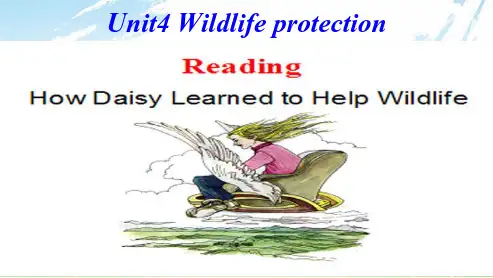
Reading : How Daisy learned to help wildlife
wildlife 1. _________ n. 野生动植物 protection 2. _________ n. 保护 wild 3. _________ adj. 野生的;野的;未开发的;荒凉的 4. _________ n. 栖息地(动植物的)自然环境 habitat 5. _________ v. 恐吓;威胁 threaten 6. _________ v. 减少;(使)变小;或变少 decrease 7. _________ vt. 危害;使受到危险 endanger 8. _________ 灭亡;逐渐消失 die out 9. _________ n. 损失;遗失;丧失 loss 10. ________ n. 保护区 reserve 11. ________ v. 打猎;猎取;搜寻 hunt 12. ________ n. 地域;地带;地区 zone in peace 13. ____________ 和平地;和睦地;安详地 in danger (of) 14. _______________ 在危险中;垂危
be used to do 被用来做某事 used to do sth. 过去常常做某事 be used for sth. 被用来…… be used to (doing) sth. 习惯于……
5. The flying carpet travelled so fast that next minute they were in Zimbabwe. 飞毯飞行得如此之快,以至于一转眼他们 就来到了津巴布韦
Children are always longing for holidays.
2. One day she woke up and found a flying carpet by her bed.有一天她醒 来,在她的床边发现了一块飞毯。
a. wake up 醒来,唤醒 wake- woke - waken b. a flying carpet 飞毯 flying现在分词表明所修饰词的用途。 c. by 在……的旁边
n. 黛西 n. 物种;种类 n. 地毯 vi. 回答;响应;做出反应 adj. 远的;远处的 n. 毛皮;毛;软毛 n. 羚羊 n. 津巴布韦(非洲东南部国家) n. (痛苦或忧虑的)减轻或解除; 减轻痛苦的事物 10. __________ 如释重负;松了口气 in relief 11. _______ n. 笑;笑声 laughter 12. ___________________ 突然笑起来;大声笑了出来 burst into laughter 13. _______ n. 仁慈;宽恕;怜悯 mercy 14. _______ adj. 确定的;某一;一定 certain 1. _______ Daisy species 2. _______ carpet 3. _______ 4. respond _______ 5. _______ distant 6. _______ fur 7. antelope _______ 8. _______ Zimbabwe 9. _______ relief
由于某些原因,我将不能出席会议。
long to do sth. 1. 渴望做某事;很想做某事 long for sth. 2. 渴望…,很想有… wake up 3. 唤醒;醒来 respond to 4. 对…作出反应;回答 be used to do sth. 5. 被用来做某事 be used for sth. 6. 被用来…… used to do sth. 7. 过去常常做某事 be used to (doing) sth. 8. 习惯于…… in relief 9. 如释重负,松了一口气 burst into laughter/tears 10. 突然大笑/哭起来 have mercy on=show mercy to 11. 同情;怜悯;可怜某人 at the mercy of 12. 任由…摆布 so … that…/ such … that … 13. 如此…以致于… It is certain that … 14. 肯定……
7. Farmers hunted us without mercy. 农民们无情地狩猎我们。
高中人教版高中英语必修二Unit4_Wildlife_Protection课件精品ppt课件
While reading:
1.Fast reading
Read the text fast and then finish the true or false exercises.
(1).Antelopes are being killed for the wool beneath their stomachs.
there to save local wildlife. 4.Because if there is no rainforest,there would be no animals ,no drugs. 5. First we should treat wild animals as our friends;
Then we must protect the environment in order to let wild animals have enough food and good living conditions; And we should collect money to protect wildlife; ......
(在危险中;垂危)
Habitats destroyed
Lack of food
Why?
Climate changed
Killed by Man
Pollution
Listening:
1.Where did Daisy go?
Tibet , Zimbabwe, Rainforest.
2.What animals did she see?
1.Because they are being killed for wool beneath our stomachs.Their fur is being used to make sweaters for people. 2.Because the government decided to help . 3.They allowed tourists to hunt only a certain mumber of animals if they paid the farmers.Good things are being done
人教必修二 Unit 4 WIldlife protection 课件(共16张PPT)

Thank you for your attention
Unit4 Wildlife Protection
Teaching aims(教学目标)
1. Let the students be aware of the situation that the endangered wildlife species are facing and the reasons .
are_d_e_c_r_e_a_si_n_g__ rapidly
How Daisy Learned to Help Wildlife
Careful Reading
Para
Main idea
Supporting details
1. Animal: _e_l_e_p_h_a_n_t_s__in Zimbabwe
2. Situation: previously hunted
2
A good example of with numbers decreasing wildlife protection rapidly
3. Result: farmers are happy
and elephants' number are
目录
Warming Up Careful Reading Homework
Fast Reading Discussion
Warming Up
wildlife: animals or plants which live or grow in natural conditions. 野生动物保护日宣传片
Supporting details
1. Animal: Tibetan _a_n_t_e_lo_p_e__
人教英语新课标必修2全册教案 Unit 4 Wildlife protection

人教英语新课标必修2全册精品教案( Unit 4 Wildlife protection) Part One: Teaching Design (第一部分:教学设计) Period 1: A sample lesson plaading(HOW DAISY LEARNED TO HELP WILDLIFE)AimsTo talk about endangeredTo read about wildlProceduresI. Warming up by learning about animalsLook abelow and llling you about the animaldangered animals.. The Giant PandabolWorld Wildlife Fund (WWF), a conservation organization. Toward the latterhal20th centuanda also became somewhat of a national emblem for , and is now usedgoldGiant Pandas are an endangeredatened bued labitat and by a very low birthrate, bwild and in captivity. About 1,600 are believed to survivwild.Milu deer is adeer. It has a long tail, wide hooves, and branc hed antlers. Aa“four unlikes,.” because the animals was havinga staga camela cow, and the tail of an ass.These animals wade known to Wury, by Father Arm and David, a Fary working in were eaten by Western and Japaat waBoxer Rebellion.These deer are now foundaround the world, and a herd of Milu deer waduced to Humankind haally tended to separate civilizawildlife in a number of ways; besidbvious dvocabulaare differing expectalegal, social, and moralThis has been readebate throughout recordedReligions havdeclared certain animals to be sacred, and in modvas provoked activxploitawildluman ba2. and tragNow you aad the texall and underliningNext you aad the text and underline all the collocations at the saHOW DAISY LEARNED TO HELP WILDLIFEnot long ago, wake u p, find…by one’s side, a flying chair, get dressed, pu’s jeans, fly away to…, turn around, with a sad face, use…to make…, kill…for…, take…from under…, take one’s picture, bdangered, darm, taapply to, hunt…for…, ma…, as a resula…from…, rub…over…, a powerful drug, pay a…, take…homeIII. Closing up by matching animals to fivategories Ddangeredappear on ddangeredlists. And people who agg animal ullowing fivateggroup the unlucky animal. Now in grouugroup all the unlucky animals found in 中国不幸动物分类名录EXTINCT(灭绝动物)-Aly indigenous to Canada that no longer exists anywXTIRPATED(根绝动物)-Alonger existingwild in Canada but occurring elsewNDANGERED (濒危动物)-Aatened wxxtirpaughout all or a significaanadian range.THREATENED(危急动物)-Alikely to bdangered in Canadaactors affecting its vulnerability aversed. VULNERABLE(弱势动物)-Aarticularly at risk because of low or declining numbers, small rangason, but not a threatenedPeriod 2: A sample lesson plan for Learning about Language(The Present Progressive Passive Voice)AimsTo learn about The Present Progressive Passive Voice To discover useful words and exTo discover useful structures.ProceduresI. Warming up by acting a text playGood morning class. To begin with we shall put our text HOW DAISY LEARNED TO HELP WILDLIFE on stage, thaact out ouNow the class acting team wxt play of HOW DAISY LEARNED TO HELP WILDLIFE!II. Discovering useful words and exDoing vocabulary exTurn to page 28 and do the vocabulary ex2 and 3. You can simply write your answblavery page of 28.2. Playing a gameLet’s gl ay the game describedage 29. The followingare to be passed on.▲ Plant native plaur backyard.▲ Do not dump weedbush.▲ Build a frog pond in your backyard.▲ Put your rubbbin.▲ Leave your pets a▲ Do not take anything ouark.▲ Encourage your friendabush as wildlife habitats. ▲ Join a community group anddo voluntary work.▲ Find out abouvation activities happening in your local area.▲ Participate in local clean-ulanting and weedcontrol activ▲ Learn About Threatened▲ Look out for wildlife▲ Refuse to buy an y radangered plant or animal product.▲ Be alert and drive slowly at dawn and dusk in rural areas where wildlife may be active.III. Studying The Pgressive Passive VPassive Voice The passive vused when focusingg affected by an aThe Passivd: Passive Subject + To Be + Past Participle Iused in business andareas wbaant thawaction. For Example: We have produced over 20 ddelast two years. Changes t Over 20 ddels have been producedast two years.If the agent (action)ant, use “by.” For Example: Tim Wilson wrote The Flight to BrunnswThe Flight to Brunnswick was wby Tim Willy verbs that take an object can be usedassive.The following chart includangedactivassivalActive PassiveTime RThey make Fords in To read and listen about dinosaursTo speak about helping the dodoTo wdodoProceduresI. Warming up by readingapeLet’s warm up by reading alouddingxtABOUT DINOSAURS on page 30.II. Listening about DINOSAURSNow I’d lll youg about DINOSAURS■In formation about DinosaurDinosaur meable lizard in Latin. They were called that because people useddinosaurs were lizards, but they wDinosauappeared about 200 million years agllion years ago, many kinds of dinosaurs became extinct. Birds are a specialdinosaur and they wly kind to live until today.There were many kinds of dinosauate plants and some ate meat. The largest dinosaurs were plant-eaters like apatosaurus and brachiosaurus. They wlargest animals to ever walk on dry landlant-eaters had special wealgat-eaters. For examplatops hadace, ankylosaurus was covered in boney plates, and stegosaurus hadail.The meat-eaters all ran aroundback legs lle dwerevery large, like tyrannosaurus, and some were small, lgnathus. It waaller sized meat-eaters that evolved into birdbirds was archaeopteryx, but it looked half like a dinosaur.There were large flying reptiles that lived at the saas dinosaurs called pterosaurs, but they wlosely related to dinosaurs. There were also many kinds of large reptiles that could swim, laurs and pleisiosaurs, but they weren’t closely related to dinosauIII. Reading and copyingNext we shall go baxt ABOUT DINOSAURS on page 30 agaad it and copy down all the exur notebook.Useful phraABOUT DINOSAURSDuringarth, livallars ago, cabeing, eggs of fiva rare newa bird-like dinosaur, climbll…from…, die ouarth, put…air, glivw for suame way, labout…, disappear from…IV. Reading to answer quRead the quable below and scaxt to answWhen did dinosaurs live on earth? When did dinosaurs die out?How did dinosaurs die out?V. Listening about the dodoHave you ever hearddodo, an animal that has also disappearedarth?The Mauritius Dodo (Raphus cucullatus, called Didus ineptus by Linnaeus)ly just Dodo, was a metre-high flightless bird. The Dodo, ww extinct, lived on fruit and nestedground.Next we are going to lape and do exand 2 on page 30 on dodo.VI. Speaking in pairs about helping the dodo Daisy: (waking) Who are you? Why are youbedroom? Chair: Excuse me. I am the famous Flying Chair. Daisy: What are you?Chair: I aake you on a trip. Where would you go? Daisy: I’d lanimals that gave f urs to maweaair: Duringaave livedarth many, many kinds of animals. But many have disappeared because of various reasons. Daisy:u are right. I learned from books thallars ago, a rare newdinosaur, a bird-like dinosaur, cabeing. It could climb trees and was very lovely. Then it died out becaugarth suddenly, putting much duaarth ganimal to live on.Chair: Buws for sure what caused all those ancientanimals to die out, disappearingaver.Daisy: I shall get dressed and puans and sweaThen let’s fly away to Tibet Ch inaantelair: Here we are in ! Turn around. Ta antelwith a sad face. Antelope: Hellds. Welu two ldly, unlwho call us to use our furs make sweaters.Daisy: Sweaters lI am wearing? Oh, I am terriblAntelope: The bad men came in groull my family membwool. Tunder our stomach.Chair: I shall take a pictuu and the antelbe shown to all the world people.Daisy: Come Antelope! Let’s have a picture taken together. We shall bElephant: Those bad men usedand kill us. But now are welld by the govand the good people. We are happy now.Daisy: Good- bye, Elephant!Chair: Take care, Daisy. We shall huur laa. Daisy: Wow! Lght. A lovelbe rubbing herself. H! What are you doing?Monkey: I am rubbing a millipedver my bodlquitoes. Daisy: How intelligent you are!: It contains a powerful drug which aquitoes. There are llants andlittle animalawhich can be helpful to man. Daisy: Is that so? I am going to taall those useful plants and animals. I will showlassmaat they understand you lovely animals andbetter. I will apply to be allowed to wlp you get a better living: Thank you so much! Some unfriendly people came to catch us, to put uWlivingDaisy: Good- b! I willwhat I learnedWWF. I will invite alllmaugThe futube bright for both you the animals and us the human beingu!2: Background informawildl 中国国家重点保护动物名录■ 国家一级保护动物最凶猛的雕:金雕1.金雕 Aquila chrysaetos2.白鹳 Ciconia ciconia3.黑麂 Muntyacu云豹 Neofelis nebulosa5.华南虎 Panthera tigris6.豹 Panthera pardusfusca7.白颈长尾雉 Syrmaticus ellioti8.黄腹角雉Tragopan caboti■ 国家二级保护动物鬣羚:真兽下纲,反刍亚目,有角下目,牛科1.鬣羚 Caumatraensis2.豺 Cuon alpinus3.金猫 Fel短尾猴 Macaca arctoides5. 猕猴 Macaca mulatta6.穿山甲 Maadactyla7.黄喉貂 Martes flavigula8.斑羚 Naemorhedus goral 9.大灵猫 Viverra zibetha 10.小灵猫 Viverricula indica 11.雀鹰 Aus12.赤腹鹰 Al苍鹰 Agentilis14.鸳鸯 Aix galericulata 15.乌雕 Aquila clanga 16.白腹山雕 Aquila fasciata 17.短耳鸮 Asio flammeus18.长耳鸮 Asio otus 19.雕鸮 Bubo bubo20.灰脸鹰 Butastur indicus 21.大鵟 Bulasius22.毛脚鵟 Buteo lagopus 23.普通鵟 Buteo buteo 24.红脚隼 Falco vus 25.灰背隼 Falco columbarius 26.游隼 Falco peregrinus 27.燕隼 Falco subbuteo 28.红隼 Falco tinnunculus 29.领鸺鹠 Glaucidium brodiei30.斑头鸺鹠 Glaucidium cuculoides 31.白鹇 Lophuraa 32.小隼ax caerul鸢 Milvus migrans34.鹰鸮 Ninox scutulata 35.小杓鹬 Numenius borealis36.领角鸮 Otus bakkamoena 37.红角鸮 Otu勺鸡Pucrasia macrolopla 39.蛇雕 Spilla40.鹰雕 Spizaetus nipal褐林鸮 Strix leptogrammica 42.草鸮 Tyto ca大鲵 Andrias davidianus44.虎纹蛙 Rana tigrina 45.拉步甲 Carabus lafossaei II. What is WWF?WWF, the global conservation organization was originally known as World Wildlife Fund.Ianged its name to World Wide Fund For Nature (ex by, among, .Probablamous name associated with WWF is HRH The Duke of Edinburgh. The Duke waPresident of WWF-Uunda2, International President of WWF (1981-1996), and is now Presidus.WWF is dedicatedg the degradalanet’s natural envand building a future in which humans live in harmony with nature, by:▲ conserving the world’s biological div▲ ensuring that the uwable natural resouustainable,▲g the redullution and wasteful consuWWF has a factual-based approavation, wuxues of global:ans and coawater, endangeredanddious threaxals and climate change. For eaues, WWF has developed measurable targets and ruan 1,200 fieldaround theworld in any year.III. AntelopeThe antelope are a groubivorous African animalamily Bovidae, distinguished by a pallowads. These animals are spread relatively evenly throughout the various subfamilies of Bovidae and many alosely related to cows or goats than eaThere are many dantelope, rangingvery big. Tally have a light and elegant figure, slender, graceful limbs, small clovand aail. Antelope have powerful hindquarters and when startled they run with a peculiar bounding stride that malook as though they are bouncing ovain like a giant rabbantelope can reach speeds of 60 milur (100 kilur), making them among the faland animals. IV. ElephantElephantidae (the elephants)ly extant familder Proboscidea. Elephantidae haliving: the Savannah Elephant and Forest Elephant (which were collectively known as the African Elephant) and the Asian Elephant (formerly known as the Indian Elephant). Duringdagwwhich are now extinct. Elephants are the largest living land mammals. At banelephant calf to weigh 100 kg (225 pounds). It takes 20 to 22a baby elephant to mature to blongest gestad of any land animal. An elephant may live as long as 60 to 70 years. The largest elephant evded was a malOld World</st1:plaBecaulaapes such as chimpanzees and gibbons aly calledAlso, a fewave the word “ape.”ame. Becauare not a singlgroudo not have aant charaat they all share and aared waining grouaapes.</v:shaangPygmy Maat 10 cm (4 inch) long (plus tail) and 120 g (4 oz) in weigale Mandrill, al(3 ft) long and weighing 35 kg (75 lb). Some are arboreal (living), some livavanna; some eat fruat leaves, and some ea; althougave tails (le)do not; some havatic colour vision like that of humaare dichromaats. Although bw and old worldlapes, have forward facingald World and New World</st1:plalook very dTo understandaudaradgroups individuall: Words and exUnit 4 Wildlale groule: He viewed lawyers aal2. ag milita: Tattacked at dawvev.1. arrange for and reserve (glse) in advance: Reserve me a seat on a flight. 2. obtain or arrange(lf) in advance: We managedve a table at Maxim’s.3. give or assign a shaa particulaausehuntn. an instaarchingg: the huubmarines. v.chase away, with as w: They hunted the unwanted immigrants oughborhood. v. 1. pursud(as of wild animals): Goeringunted wild boars in . 2. search (an area): The King used to huarch for: She huntedading glasses but was unable to locallate about a desired speedate to an undesirable extent: The oscillator hunts abouquursue or chase relentlessly: The huaced the dwoods.wildn. a wildve state untouched by civilization: He livedwild. ada state of ex: wild with anger. 2. produced without being planted or without human labor: wild strawba natural state; not tamed or domesticated or cultivated: wild garked by extreme laal: wild ideaubjectedlaint: A piano played with a wild exuberance- Louis Bromfield. 6. deviating widely from an intended course: a wild bullet. 7. (of colunds)ly vivid or loud: wild colalking or behavingirrationally 9. located in a dismalarea; desolate: a godforsaken wildads. 10. without civilizing influences: wild tribes. adv. in a wild or undomesticated manner: growing wildayment extorted by gangat of violence: Evghborhood had to pa2. the activgg: The wdemanded polduquotadddustry agag: He made trada plaarty pladbeingd: They were huddled togdefense agaancial failure; financial independence: Insurance providedagainst loss of wages due to illa covering thaddamagury: They hadallout.peaa treaalities: Peace came on Novemb2. harmonious relations; freeddisputes: Tates lived in peace toggeneral secuublic places: He was arrested for disturbing the peace.applyv. 1. apply oneself t Please apply yourself to your homework. 2. blevant or applicable: The same laws apply to you! 3. ask (g): Apply for a job(a word or name) to ag 5. givvally 6. avail oneself t Apply alure observance of laws and rules: Apply the rules to evuvice; make wloy (g) for a particular puaturalpurpose: Apply a maglduggestv. imply as a possibility: The evidence suggests a needlarificaubact of rubbing or wiping: He gavd a quick rub. v. move ovg wure: Rub my handainv.1. be capable of holdingaining 2. be divisible by: 24 contaludain; have as a: Td contains many old song0’ald; have within: This can contains wald back, as of a danger or an enemy;xpaluence of: Contabel movement.affectv.1. have aupon: Will the new rules a? 2losely andatingly: This new ruling aur buake believe wdeceive。
人教版高中英语 Book2 Unit4 Wildlife Protection Using教学课件
★Develop the reading skills and the sense of teamwork.
★Get to know the importance of wildlife protection and learn to protect them.
Enjoy a video
Reading
Animal Extinction
Fast reading
Answer the questions below. 1. When did dinosaurs live?
Tens of millions of years ago. 2.When did dinosaurs die out?
oditnhoesaruarns.i(meanlstioonrepdlianntthse?text)
Why are they in danger of disappearing?
environmental pollution
loss of habitat
endless killing for animal’s fur
Book2 Unit4 Wildlife Protection
Using Language 人教版
Free Talk:
Why should we protect the wildlife ?
Lend your ears to us! Enjoy our performance!
Learning aims
Discussion and Writing
The following expressions may help you.
• Make measures to prevent hunters hunting.(禁
人教版高中英语必修2 Unit 4 Wildlife protection 课件.
It's because of human activities that finless porpoises are endangered.It's astonishing that there are merely less than 1, 000 finless porpoises living in China.Thus, it's high time that immediate measures should be taken.Don't you think so? If possible, I hope you can help us by funding our project aimed at protecting finless porpoises.
★话题佳句 1.There is no denying the fact that it's everyone's responsibility to protect the environment. 毋庸置疑,保护环境是每个人的责任。 2.If we didn't take urgent action to live in harmony with nature, we would have nowhere to live in the future.如果我们现在不采取紧急措 施与大自然和谐相处,将来我们将无处生存。
loss
6.__________ n.保护区 reserve 7.__________ adj.安全的; 可靠的 secure 8.__________ adj.凶猛的; 猛烈的 fierce 9.__________ vt.&vi.咬; 叮; 刺痛 bite →__________ (过去式) bit →__________ bitten (过去分词) 10._________ vt.影响;感动;侵袭 affect →__________ n.喜爱;感情
高中英语 Unit 4 Wildlife protection课件 新人教必修2

2.Dinosaurs lived on the earth tens of millions of years ago,long before humans came into being (比人类的出现要早得多).(being)
3.They learned this from the way the bones were joined together (骨骼的连接方式).(join)
知识要点整合
核心词汇梳理
1.respond v.回复;回应;应答 I invited her to dinner but she did not respond. 我请她吃晚饭,但她未作回答。 The US responded by sending troops into Laos. 美国的反应是派遣军队进入了老挝。 搭配 respond to对……作出回应或反应 Clive responded to my suggestion with a laugh. 克利夫对我提的建议报以一笑。 He failed to respond to the medicine.他服了这药未见起色。
漫画欣赏
画面描述 A pair of proud compasses and a hardworking pencil.The compasses are big,drawing a circle with ease,while the pencil is small,drawing a line with great effort.
3.We used to be an endangered species. [翻译]伦敦过去是英国最大的港口城市。 London used to be Britain’s largest port.
(完整版)人教版高一英语必修二Unit4Wildlifeprotection课文对译
(完整版)人教版高一英语必修二Unit4Wildlifeprotection课文对译Unit 4 Wildlife protectionHOW DAISY LEARNED TO HELP WILDLIFE戴西如何学会了保护野生动植物Daisy had always longed to help endangered species of wildlife.Daisy常常渴望去帮助濒临灭绝的种类的野生动物。
One day she woke up and found a flying carpet by her bed. "Where do you一天她醒来发现一个正在飞行的飞毯在她床边。
want to go?" it asked. Daisy responded immediately. "I'd like to see some “你想去哪里?”它问。
Daisy立刻回答它。
endangered wildlife," she said. "Please take me to a distant land where I can “我想去看那些濒危灭绝的动物,”她说。
“请带我去那个我可以find the animal that gave fur to make this sweater." At once the carpet flew找到供给皮毛去制造这件毛衣的动物的一个遥远的地方。
”away and took her to Tibet. There Daisy saw an antelope looking sad. It said,飞毯立刻带她飞去了西藏。
在那里Daisy看到了一支看起来很伤心的羚羊。
"We're being killed for the wool beneath our stomachs. Our fur is being used to它说,“我们被杀是为了我们肚子下的毛。
人教版高中英语必修2《Unit4Wildlifeprotection》教案
人教版高中英语必修2《Unit4Wildlifeprotection》教案人教版高中英语必修2《Unit 4 Wildlife protection》教案【一】教学准备教学目标Teaching Objectives: At the end of this lesson, students shouldmaster the key w ords and expressions through the competitio n;practice their reading skills such as skimming and scanning;enhance their cooperation abilities through group work;realize the importance and emergency of protecting wildlife;教学重难点Teaching Important Points:Students can do the competition actively and master the words and expressions ;Students can finish those reading exercises by thems elves by using reading skills;Students can do the group task successfully.Teaching Difficult Points:Students can un derstand the content of the passage and do the group discussion successfully.教学过程Teaching Procedures:Part 1. Pre-reading (11’)1. A video of “THE LION KING” and some pictures of the miserable animals;2. Words and expressions competition.Part 2. While-readin g ( 20’)1. Skim the whole passage and finish the chart below.2. Read the Paragraph 1 and find out the answers to the following questions.1). How did the antelope feel?2). Why are people hunting and killing the Tibetan antelopes?3. Read paragraph 2 and choose the best answer according to the text.1). Why is the number of elephants increa sing in Zimbabwe?A. Because more elephants have come to Zimbabwe.B. Because farmers are happy and no longer kill them;C, Because those elephants don’t destroy farms any more.2). How does the government of Zimbabwe help protec t wild animals?A. It allowed tourists to hunt a small number of animals if they paid the farmers;B. It forced farmers to protect the animals.C. It put m ore wild animals into Zimbabwe.4. Read parag raph 3 and fill in the blanks.When the carpet and Daisy came to ___ ___ ______, they saw a _______ rubbing itself with a millipede _______, which can ______ mosquitoes because it ______ a powerful drug. The money told Daisy to pay more ________to the rainforest and _____ how the animals live t ogether. No forest, no animals, no _____.5. True or False statements.1. Daisy saw many antelopes in Tibet.2. Daisy’s sweater was made of sheep wool.3. The elephant used to be well protected in Zimbabwe.4. In Zimbabwe, tourists love to see the elephants.5. The farmers in Zimbabwe get nothing from the elephants now.6. This is a real story in Daisy’s life.Part 3. Post-reading ( 8’)1.Ask “Daisy” to talk about her feeling;2. Discussion: What should we do to protect wildlife?3. See a short video of Jackie Chan.Part 4. Summary and Wri ting ( 1’)Write a short passage based on the discussion.课后习题Please write a letter to WWF and provide some suggestions on how to protect wildlife.人教版高中英语必修2《Unit 4 Wildlife protection》教案【二】教学准备教学目标Improve students’ ability of extensive reading.Improve students’ a skills of listening.教学重难点1. Teaching important points:A. Improve students’ ability of extensive reading.B. Improve students’ a skills of listening.2. Teaching difficult points:A. How to finish the task in limited time.B. How to get the accurate information while listening.教学工具课件教学过程Step 1. GreetingStep 2. Daily reportStep 3. RevisionCheck the answers to the exercises done yesterday.Step 4. Extensive reading1. Ask students two questions before listening to the tape,and then listen to the recording of the text:A. When did dinosaurs live on the earth?B. Why did they die out?2. Explain the following language points:① long before 很久以前before long 不久之后Dinosaurs do live on the earth long before.Before long dinosaurs die out from the earth.② on the earth- in the worldon earth 究竟What on earth do you want?Step 5. Listening1. Explain the following difficult words to the students before listening:① o nce upon a time 曾经;很久以前② curious adj. 好奇的③ wing n. 翅膀④ trap n. 陷阱⑤ spear n. 矛2. Listen to the recording of Dodo’s Story.3. Finish Ex 1 on p30.4. Check the answers (C D B C)5. Listen to the tape again and finish ex2 on P30Step 6 Homework1. Finish Ex. 21-55 on English Weekly 15th2. Review the language points in this unit.课后小结学了这节课,你有什么收获?课后习题完成课后习题。
新人教版高中英语必修2Unit4 Wildlife protection教案
Unit 4 Wildlife protectionTeaching aims:1. TopicWildlife protection: the importance of wildlife protection, ways to protect wild plants and animals.2. Useful words and expressions:wild wildlife protection enemy loss reserve area hunt zone peace fur stomach apply suggest thick rub mosquito insect contain powerful drug affect attention whale bite effect butterfly dust recently fierce unkind lazyas a result die out in peace in dangerprotect… from pay attention to come into being3. Functional items:I. Intentions and purposeI’m going to do…I feel like doing..I would rather not…I intend/ mean/ plan to do…I’d like to do…I will do…I’m ready to do….II. ApologiesI’m so sorry that..I’m afraid that ….Thank you very much but..It’s a shame that …It was very nice of you but…4. StructuresThe present continuous passive voiceAnimals are being hunted and killed.The environment is being destroyed.Teaching proceduresPeriod 1. Speaking and listeningStep 1. Leading in1. Show Ss a video about some animals in danger.2. Show Ss some picture of some rare animals in China.Step 2. Warming up1. Ss read the passage quickly and find out:Why did so many wild animals die out?2. Ss talk about the form on page 25 and then discuss the following questions in pairs.1). What other endangered species do you know?2). Why are they in danger of disappearing?3). Do you know any wildlife that has disappeared?Step 3. Listening and talking (page 62)1. Ss look through the questions on page 62, and then listen to the tape.2. First listening: Ss listen and grasp the key words and get the main idea.3. Second listening: Ss listen and answer the questions.4. Third listening: Ss listen and write down the main idea of the passage.5. Talking: Ss read the topics on page 62 and discuss in pairs. While they are talking, try to use the following sentences:I’m so sorry that…I’m afraid that…Thank you very much but…I hate to have to say this but…The problem is….It was very nice of you but…It’s a shame that …Why didn’t you tell me that..?Homework1. Collect as much information about endangered wildlife as possible.2. Preview the next part—readingPeriod 2. ReadingStep 1. RevisionAsk: What do you think of wildlife protection today?What’s the passage about? Have you previewed it?Step 2. Pre-readingSs in groups discuss the following questions:1. Why should you worry about this?2. What do you think we should do to protect wildlife?Step 3. Reading1. Scanning: Ss read the passage quickly to get the main idea and complete the table on page 27.2. Intensive reading: Ss read the passage again and answer the questions on page 27.Step 4. Explanation1. as a result of2. die out3. rise (v)4. affect5. prevent …from6. She turned round and there was an antelope with a sad face looking at her.7. In three years they may all be gone!8. But what an experience!Homework1. Recite the key sentences in the text.2. Write a summary of the text.Period 3. Extensive readingStep 1. RevisionSs completer the summary of the text.One day, Daisy _____ a strange dream. She flew in a wonderful ______ to _____ with an _______ in Tibet. The antelope told her they were hunted because of their_____ which can be used to make ______ like hers. In three years they may all be ______ . Later, she _____ to Zimbabwe where she talked with an ______ and got to know the farmers there no longer ______ them. That’s because the _______ decided to help and the farmers finally made a lot of ______ . At last she _____ at the thick rain _____ where a monkey told her “No rain forest, no ____ and no ____.”Although finally everything was _____, she had _____ so much!Answers:dreamed, chair, talk, antelope, fur, sweaters, gone, flew, elephant, hunted, government, money, arrived, forest, animals , drugs, gone, learnedStep 2. Pre-reading1. Ss talk about what they know about the animals.2. Ss read the passage and get the main idea.Step 3. Reading (page 30)1. Check Ss’ answer.The main idea is species and the reasons for dinosaurs’ dying out.2. Ss read again and find out answers to the following questions:1). When did the dinosaurs live?2). What’s the rare new species dinosaur?3). Why did the dinosaur die out?Step 4. Reading task (page 65)1. Ss read the passage on page 65 and try to collect information for research into Milu deer.2. Ss discuss the information collected with their partner and then check themwith the whole class.HomeworkDescribe dinosaurs and Milu deer in your own words.Period 4.Learning about languageStep 1. RevisionSs try to say something about dinosaurs and Milu deer in their own words.Step 2. Practicing the useful words and expressions1. Ss finish Ex 1 and 2 on page 28.2. Check the answers with the whole class and talk about the important phrases.1). apply for sth. /apply to do sth2). Bite-bit-bitten3). Have an good/bad/no effect on …= affect4). Pay attention to : “to” is a prep. Here.Step 3. Structure learning: the present continuous passive voice1. Ss read the following sentences and try to find the rules1). Out fur is being used to make sweaters like yours.2). The environment is being destroyed.2. Ss finish Ex 2 on page 29.3. Play a game.Step 4. Practicing (page 63)1. Ss finish Ex 1 and2.2. Check the answers with the whole class.Step 5. Using structures1. Ss do Ex 1 on page 64 and pay attention to the structures of the present continuous passive voice.2. Tell Ss to remember the following expressions;…is under repair = …is being repaired…is under discussion=…is being discussedHomework1. Review what they have learnt about the present continuous passive voice.2. Finish Wb Ex 2 on page 64.Period 5. Using languageStep 1. RevisionCheck Ss’ homework.Step 2. Listening (page 30)1. Ss listen to the tape about a disappearing animal. Go through Ex 1 before listening.2. Play the tape again and check the answers.Step 3.Speaking (page 31)1. Ss talk in pairs about what they can do to help the lovely dodo.Step 4. WritingSs write the letter independently.Some writing tips:1. Collect your idea for the letter. Write an outline of your ways to help it.2. Decide the intention and the purpose of each of your ways.3. Begin your letter with your address and the solution. Then write the ways as the body of the letter.4. Finish the letter with your best wished and your signature.HomeworkSum up what you have learnt in this unit.Period 6. Integrating skillsStep 1. RevisionReview what they have learnt in this unit.Step 2. Listening (page 66)Ss listen to three letters and see if they can help to answer them. While listening, fill in the boxed on page 66.Step 3. SpeakingWork in pairs and try to talk about what advice you might give to one of the three writers.Tips:1. Look through the three problems and decide which one to answer.2. Write notes of your idea.3. Give reasons for your idea.4. Talk about them with your partners and then share your opinions with the whole class.Step 4. Writing (page 67)Ss write down their ideas in the form of a letter. Make each idea into one paragraph. And then exchange the letters with their partners to check.Step 5. Project (page 67)1. Ask the Ss to read the directions.2. Direct the Ss to prepare a project.As a student, what will you do to improve the environment?HomeworkFinish the project on page 67.Period sevenTeachers can use this period freely.Suggestion: Teachers can use this period to let Ss sum up what they have learned and explain what Ss couldn’t understand very well in this unit. Teachers can also add more practice in this period to consolidate what the Ss have learned. Finally, ask the Ss to finish checking yourself. It is very important to improve their learning.。
新人教版高一英语必修二Unit 4 Wildlife Protection全套教案
Unit 4 Wildlife ProtectionThe first periodWarming upKnowledge aims:a. help Ss to understand and master the words and expressions in warming up.b. Let the students know some basic information about the endangered animals and wildlife situation and protection.Ability aims:Encourage Ss to think and express their attitude towards the wildlife and the wildlife protection.Emotional aims:a. Help Ss understand the importance of the wildlife protection and make them be more active in the helping wildlife.b. Develop Ss’ sense of cooperative learning.Teaching Key Points:Enable the students to know some basic information about the endangered animals and wildlife protection.Encourage Ss to think and express their attitude towards the wildlife and the wildlife protection.Teaching Difficult Points:How to enable the students express themselves freely.Teaching Materials:Blackboard, multi-media, and other normal teaching tools.Teaching methods:Co-operative learningStudents-centered approach & Task-based teaching and learningTeaching Procedures:Step 1: Lead-inLead in by explaining the title and predicting what will be learned in this lesson. Step 2: ExplorationTask: let the students explore the following question:What is the problem of wild animals commonly facing?1. Show some pictures to the students. Students watch the pictures and say what the pictures tell us.References: food shortage, pollution, destruction of habitat, over-hunting.2. Show the students three more pictures and ask: what do people kill or hunt these animals for?From these pictures, students can conclude that people kill animals for food, for fur, for medicine and for works of art.3. Ask the students to give their answers to the question: What is the problem of wild animals commonly facing?Step 3: Discussion1. Let the students discuss the following question: why should we pay attention to wild animals and plants.Students discuss the question in groups and then give their opinions.2. After discussion, tell students what is wildlife protection about.Step 4: Group work1. Let the students read the report on some endangered wildlife in China at page 25, SB.2. Ask the students some questions about the report.3. Let the students describe the chart in small groups according to the sample.4. Discussion. More and more animals are killed by humans, as a student what should you do to protect the wild animals?Step 5: HomeworkWrite a composition according to the tips.假如你是一名记者,采访某动物园负责人有关国宝大熊猫的情况。