
一般现在时和一般过去时
否定: didn’t+动原
We didn’t go swimming last weekend
疑问: Did+主+动原 …? Did you go swimming last weekend?
1. Jack ___ to go to school by bike every day. ( have ) 2. My mother often ___ to work . ( walk ) 3. Sometimes Lucy _________ lunch at home .( not have ) 4. Where ___ your sister ____ ? ( work )
stopped planned tripped
studied carried
用法 1、表示过去某个时间发生的动作或存在的状态。
He was here yesterday. I got up at six thirty yesterday morning. My father was at work yesterday afternoon. Did you have a good time last summer?
4.They _d_o_n__’t_g_o_____ shopping on Monday. (not go 5.Tom _d_o_e day. (not ride) 6. My parents ___d_o_n_’_t_li_k_e___(not like ) fish. 8. What _d_o_____ you __d_o?(do ) 9.Where d_o_e_s___ your uncle _w__o_rk___? (live) 10. Whend_o_e_s_____she usually ____g_e_tup?( get)
2、表示过去经常或反复发生的动作。 My father often went to work by bus last year. When I was a child, I often listened to music.
构成
肯定: 主+ 动词过去式 We went swimming last weekend
一般现在时与一般过去时
一般现在时
一般现在时
知识结构
构成 用法 常用时间
1。主语+ 动词原形 2。 主语+ 动词的s/ es 1、表示经常、习惯性动作。 Tom often goes swimming
2、表示一种客观 事实或真理。
The moon is round。
always 总是 sometimes 有时 often / Usually经常 every day /week /year
look play start live hope use
3、末尾只有一个辅音字母的
stop
重读闭音节词,先双写这
plan
个辅音字母,再加—ed
trip
4、结尾是“辅音字母+y”的动词, study
先变“y”为“i”再加—ed
carry
looked played started lived hoped used
二、主语为三人称单数时,
肯定:主+ 动词的 s/ es Tom often goes swimming. 否定: doesn’t+动原 Tom often doesn’t go swimming. 疑问: does+主+动原 …? Does Tom often go swimming?
Yes , he does . / No , he doesn’t.
动词三人称单数形式的构成
构成规则
例词
1、一般在动词原形末尾加– s
look looks
start starts
2、结尾是 o, s , sh, ch , 的动词加 – es
go –goes
pass—passes
wash –washes watch –watches 3 、结尾是“辅音字母+y”的动词, 先变“y”为“i”再加
1. He _t_e_a_c_h_eEsnglish in a schootel.aIc_h____maths in a
school. ( teach) 2. I often __w_a_t_c_h_________TV. (watch ) My brother often ___r_e_a_d_s__books .(read) 3. He ___h_a_s________ classes every day. (have)
-es
study –studies
carry –carries
play --plays (元音字母+y 的,则不变)
一、主语不是三人称单数时
肯定: 主+ 动词原形 We often go swimming. 否定: don’t+动原 We often don’t go swimming 疑问: Do+主+动原 …? Do you often go swimming?
Yes , we do. / No , we don’t.
1. I often ____ letters to my friend. ( write ) 2. They usually ___ playing football after school . (like ) 3. Sometimes we____ _____ in PE class .( not run ) 4. When ___ you ____ up every day ? (get ) 5. The students _______ lessons on Sunday .( not have )
一般过去时
一般过去时
知识结构
构成 用法 常用时间
主语+动词的过去式
1、表示过去某个时 间发生的动作或 存在的状态。
2、表示过去经常或 反复发生的动作。
yesterday last night in 1990 two days ago
规则动词过去式的构成
构成规则
例词
1、一般在动词原形末尾加– ed 2、结尾是 e 的动词加 -- d
一般现在时与一般过去时
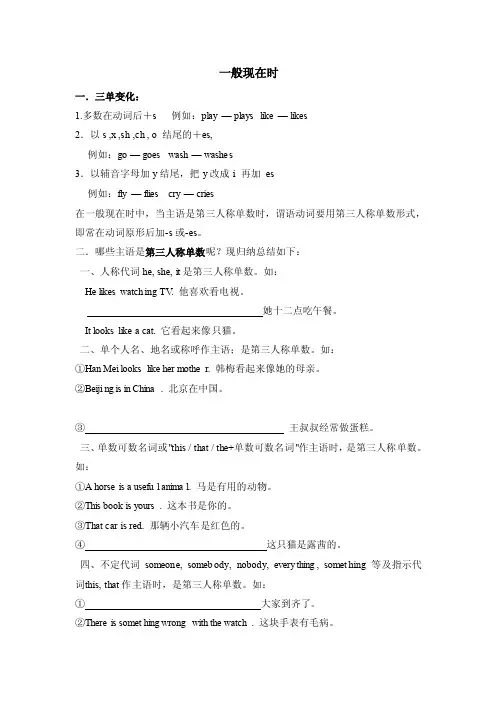
一般现在时一.三单变化:1.多数在动词后+s 例如:play — plays like — likes2.以s ,x ,sh ,ch , o 结尾的+es,例如:go — goes wash — washes3.以辅音字母加y结尾,把y改成i再加es例如:fly — flies cry — cries在一般现在时中,当主语是第三人称单数时,谓语动词要用第三人称单数形式,即常在动词原形后加-s或-es。
二.哪些主语是第三人称单数呢?现归纳总结如下:一、人称代词he, she, it是第三人称单数。
如:He likeswatchi ng TV. 他喜欢看电视。
她十二点吃午餐。
It lookslike a cat. 它看起来像只猫。
二、单个人名、地名或称呼作主语;是第三人称单数。
如:①Han Mei lookslike her mother. 韩梅看起来像她的母亲。
②Beijin g is in China.北京在中国。
③王叔叔经常做蛋糕。
三、单数可数名词或"this / that / the+单数可数名词"作主语时,是第三人称单数。
如:①A horseis a useful animal. 马是有用的动物。
②This book is yours.这本书是你的。
③That car is red. 那辆小汽车是红色的。
④这只猫是露茜的。
四、不定代词so meone, somebo dy, nobody, everyt hing,someth ing等及指示代词t his, that作主语时,是第三人称单数。
如:①大家到齐了。
②Thereis someth ing wrongwith the watch.这块手表有毛病。
③This is a pen. 这是一支钢笔。
一般现在时和一般过去式区分

一般现在时通常与时间状语如“always”、“often”、“every day”等连用;一般过去式则与时间状语 如“yesterday”、“last week”、“in 2022”等连用。
常见误区提醒
误区一
误区三
认为一般现在时只用于现在时态,实际上它 还可以表示将来时态,如“The train leaves at 5 o'clock.”(火车5点钟开。)
练习题与答案解析
1 2 3
答案
goes; walked解析第一空表示经常性动作,用一般现在时第三人称 单数形式“goes”;第二空表示昨天发生的动作, 用一般过去式“walked”。
练习题二
判断下列句子时态是否正确,不正确的请改正。
练习题与答案解析
1. I am always late for school. ( )
两者在时态上的区别
时间点不同
一般现在时表示现在的动作或状 态,而一般过去时表示过去的动
作或状态。
动词形式不同
一般现在时使用动词原形(第三 人称单数动词后加-s/-es),而 一般过去时使用动词的过去式。
使用情境不同
一般现在时用于描述经常性、习 惯性或普遍性的动作或状态,以 及客观事实或真理;而一般过去 时用于描述过去某个时间发生的
go动词
现在时为go,过去式为 went
eat动词
现在时为eat,过去式为 ate
04 句式结构差异分析
一般现在时句式结构特点
主语 + 动词原形(或第三人称单数形式) + 其他成…
I like apples.(我喜欢苹果。)
表示经常性、习惯性或普遍性的动作或状态。例如
She always wears a smile.(她总是面带微笑。)
一般现在时和一般过去时

一般现在时和一般过去时初中英语动词时态一.一般现在时一般现在时用法:1.现阶段经常性、习惯性动作;2.目前的状态;3.客观真理。
构成:用于是第三人称单数时,作谓语的行为动词要加词尾-s(-es),其他人称和数用动词原形。
句型:it is / they are / I am (动词要用原型,除单数第三人称外)主要用于下面几情况:1) 描述当前时间内经常出现、反复发生的动作或存在的状态。
在这种情景中,句子常带有表示频率的时间状语:always , every day , often , once a week (month , year , etc.) , sometimes , seldom , usually等等,以表示句中的动作或状态是习惯性的、经常性的。
例如:They raise ducks as a sideline .他们以养鸭为副业。
She doesn't often write to her family, only once a month. 她不常给家里写信,仅一月一封而已。
I cycle to work every day .我每天骑自行车上班。
It seldom rains here .这儿很少下雨。
示将来要发生的动作。
例如:I'll tell him the news when he comes back. 他回来时,我将告诉他这个消息。
If you take the job , they will talk with you in greater details. 如果你接受这份工作,他们将和你谈谈细节。
用于一般现在时的副词,除了上面提到的一些表示频率的以外,常见的还有:now, today , nowadays等等。
一般现在时是英语中应用最广泛的时态之一。
它表示1)经常性、习惯性的动作或存在的状态。
e.g. I go to school on foot. He is very busy now. 2)表示主语的特征、性格、能力、爱好等。
一般现在时与一般过去时

不规则动词的过去式 (三).不规则动词的过去式需单独记忆,下面是一些常见 不规则动词的过去 需单独记忆, 的过去时。 的过去时。 am/is-was are-were do-did sing-sang
/iwps/ httpபைடு நூலகம்///kingsoftwps/
行为动词
一般现在时
He works in a hospital.
一般过去时
He worked in a hospital.
He doesn't work in a hospital He didn't work in a hospital. Does he work in a hospital? Did he work in a hospital? Yes, he does. No, he doesn't. Yes, he did. No, he didn't.
3)标志词: )标志词: 及相关短语。 ① yesterday及相关短语。 及相关短语 例如:yesterday 例如: morning/afternoon/evening 昨天上午/下 昨天上午 下 晚上。 午/晚上。 晚上 时间状语”构成的短语。 ② “last+ 时间状语”构成的短语。 例如: 昨晚/上 例如:last night/month/spring/year 昨晚 上 个月/去年春天 去年。 去年春天/去年 个月 去年春天 去年。 一段时间+ago”组成的短语。 ③ “一段时间 ”组成的短语。 例如: 例如:three days ago 三天以前 four years ago四年以前。 四年以前。 四年以前 介词+ 时间名词”组成的短语。 ④ “介词 时间名词”组成的短语。 例如: 例如:in 1999 在1999年;on the morning of 年 December 25th 在12月25号早 月 号早
一般过去时和一般现在时

一般现在时
1) 表示经常/习惯的动作或现在的存在状态
2) 表示客观事实或普遍真理。
3) 表示主语的特征、性格、能力等
一般现在时(present simple tense)表示包括“现在”在内的一段时间内经常发生的动作或存在的状态。一般现在时是以动词原形表示的,当主语为第三人称单数时,需要在行为动词原形后加-s或-es,其构成方法与名词复数的构成法一样
2)表示过去发生的某一动作对现在造成的影响或产生的结果
3)表示刚刚完成的动作,常与just连用
4)表示过去的动作,但时间不定或不明,多用于问句,常和yet连用.
5)表示过去有过某种经历,而这种经历不可能为以ቤተ መጻሕፍቲ ባይዱ的行动所抹杀或否定。常用状语有never,ever,once,twice,before等。
一般过去时
一般过去时用来表示过去某一时间所发生的动作或存在的状态。通常句中要有表示过去的时间状语。
一般过去时由动词的过去式表示,动词be有was,were两个过去式,was用于第一、三人称单数,were用于其他情况。
构成:have/has+动词过去分词
用法:
1)表示过去发生而持续到现在而且还可能继续下去的动作或状态,往往和表示一段时间的状语连用,表明所持续的时间。
�
英文最基本的五个时态
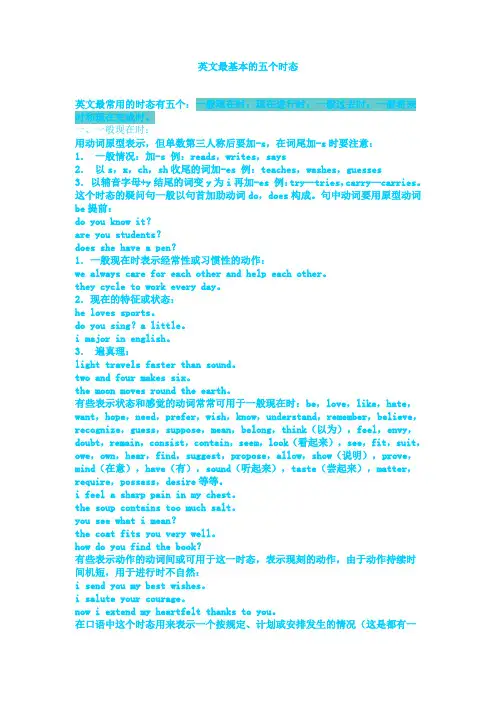
英文最基本的五个时态英文最常用的时态有五个:一般现在时;现在进行时;一般过去时;一般将来时和现在完成时。
一、一般现在时:用动词原型表示,但单数第三人称后要加-s,在词尾加-s时要注意:1.一般情况:加-s 例:reads,writes,says2.以s,x,ch,sh收尾的词加-es 例:teaches,washes,guesses3.以辅音字母+y结尾的词变y为i再加-es 例:try—tries,carry—carries。
这个时态的疑问句一般以句首加助动词do,does构成。
句中动词要用原型动词be提前:do you know it?are you students?does she have a pen?1.一般现在时表示经常性或习惯性的动作:we always care for each other and help each other。
they cycle to work every day。
2.现在的特征或状态:he loves sports。
do you sing?a little。
i major in english。
3.遍真理:light travels faster than sound。
two and four makes six。
the moon moves round the earth。
有些表示状态和感觉的动词常常可用于一般现在时:be,love,like,hate,want,hope,need,prefer,wish,know,understand,remember,believe,recognize,guess,suppose,mean,belong,think(以为),feel,envy,doubt,remain,consist,contain,seem,look(看起来),see,fit,suit,owe,own,hear,find,suggest,propose,allow,show(说明),prove,mind(在意),have(有),sound(听起来),taste(尝起来),matter,require,possess,desire等等。
时态知识点一般现在时一般过去时等
时态知识点一般现在时一般过去时等时态知识点:一般现在时、一般过去时等时态是语法中非常重要的一个概念,用来表达动词所表示的动作或状态在时间上的情况。
一般现在时和一般过去时是时态中最基本的两种,下面将对它们进行详细讨论。
一、一般现在时(Simple Present Tense)一般现在时用来表示经常发生的事件、普遍的真理、现实存在的状态或习惯等。
1. 表示经常发生的事件:例如:- I usually have breakfast at 7 am.- They often go to the park on weekends.2. 表示现实存在的状态或习惯:例如:- The sun rises in the east.- I watch TV every evening.3. 表示普遍的真理或科学事实:例如:- Water boils at 100 degrees Celsius.- The earth revolves around the sun.4. 表示感觉、看法、经验等个人态度:例如:- I love chocolate.- She hates spiders.注意事项:- 在第三人称单数形式中,动词要加上"-s"或"-es"。
- 对于一些规则动词,如work、study等,第三人称单数形式只需要加上"-s"。
- 对于以辅音字母加"y"结尾的动词,要将"y"改为"i"并加上"-es";对于以元音字母加"y"结尾的动词,直接加上"-s"。
二、一般过去时(Simple Past Tense)一般过去时用来表示过去发生的动作或状态,常常与具体的时间状语连用,如yesterday、last week等。
1. 表示过去发生的事件:例如:- I visited my grandparents last weekend.- They watched a movie together yesterday.2. 表示过去的习惯或状态:例如:- He used to live in New York.- She had a pet dog when she was a child.3. 表示过去的真理、科学事实或历史事件:例如:- The dinosaurs became extinct millions of years ago.- Columbus discovered America in 1492.4. 表示间接引语中的陈述句:例如:- He said he loved her.注意事项:- 对于大多数动词,我们只需要在动词原形的基础上加上"-ed"。
一般现在时与一般过去时
大家来找茬
I goes to school everyday. Miss Smith teach English. My watch sayes ten to five. He arrives in hangzhou an hour ago. She were an orphan and gave piano lessons to
注:表示过去反复的动 作或习惯的动作时也 得用would或used to 加动词原形。
3.At that time she spoke english very well.
表示主语过去的特征 或状态、行为等。
4.I wrote a letter yesterday. 表示在过去某段时间 内完成的动作。
2.He never wears a hat in 表示习惯、能力、特征、
winter.
性格或说话时的感觉、状
态等。
3.The earth moves around 表示客观事实或普遍真理。 the sun.
Knowledge is power.
4.The meeting is at nine 表示按规定要发生的未来的动作或
tomorrow morne leave start stay return begin 等
Train leaves at eight pm. 动词,后面常接时间状语。)
5.What time is it now? 表示说话时刻的状态或情况。
主语为第三人称时:
动词的时态一般现在时与一般过去时一般现在时
(三)现在进行时和过去进行时 1.现在进行时 (1)表示说话的瞬间正在进行的动作。 (2)表示当前一段时间内的活动或现阶段正在进行的动作,
但说话时不一定在进行。 (3)表示按计划或安排将要发生的动作,主要用于表示位
移的动词(come, go, leave, start等)。
编辑课件
Jennifer is watching a cartoon movie named Kungfu Panda now.詹尼弗正在看一部名叫《功夫熊猫》的动画电影。 Technology of communication is developing fast. 通讯技术正在迅速发展。 The plane is taking off in twenty minutes. 再过20分钟飞机就要起飞了。
编辑课件
2.过去将来时 过去将来时表示在过去看将来要发生的动作或状态, 常用于宾语从句及间接引语中。过去将来时主要用于 以下几个方面:
(1)用“would+动词原形”表示过去将要发生的动作。 I wondered when they would complete the project. 我想知道他们什么时候完成这一课题。
编辑课件
3.过去完成时 以过去时间为基点,表示发生在过去某一个动作或存 在的状态之前的动作与状态,这个过去时间点常常通 过上下文暗示来实现,或采用when, before, by the time, after引导的时间状语从句或时间状语by the end of last month, for, since等类似的状语来实现。
编辑课件
(二)一般将来时和过去将来时 1.一般将来时 (1)表示以现在来看将来某一时间要发生的动作或状态。 (2)表示意图或根据计划、安排将要发生的动作。 (3)其基本形式有shall/will+动词原形,be going to+动词
英语六种基本时态
英语六种基本时态英语中有六种基本时态,分别是一般现在时、一般过去时、一般将来时、现在进行时、过去进行时和将来进行时。
下面将逐一介绍这六种时态,并给出相应的例句。
一、一般现在时(Simple Present Tense)一般现在时用于表示经常性的动作、习惯性的行为、客观事实或普遍真理等情况。
它的基本结构是主语+动词原形。
例如:1.I go to school every day.(我每天上学。
)2.He likes playing football.(他喜欢踢足球。
)3.The sun rises in the east.(太阳从东方升起。
)二、一般过去时(Simple Past Tense)一般过去时用于表示过去发生的动作或状态。
它的基本结构是主语+动词过去式。
例如:1.We went to the beach last summer.(我们去年夏天去了海滩。
)2.She studied hard for the exam.(她为了考试努力学习。
)3.They lived in that house for ten years.(他们在那个房子里住了十年。
)三、一般将来时(Simple Future Tense)一般将来时用于表示将来发生的动作或状态。
它的基本结构是主语+助动词will+动词原形。
例如:1.I will visit my grandparents next week.(我下周会去看望我的祖父母。
)2.She will start her new job in January.(她将在一月份开始她的新工作。
)3.They will have a party on Saturday.(他们将在周六举办一次聚会。
)四、现在进行时(Present Continuous Tense)现在进行时用于表示现在正在进行的动作。
它的基本结构是主语+be动词(am/is/are)+动词ing形式。
例如:1.We are watching a movie right now.(我们现在正在看电影。