
外研版英语七年级下册Module 1 Lost and found Unit 2 Are they yours公开课课件
Read the passage again and
underline things people look for
and things people have found.
Answer the questions. 1. When do people often lose things? People often lose things when they’re travelling or when they’re in a hurry. 2. Why are there lost and found offices at airports and stations? Because people leave things on planes, on trains, on buses and in taxis.
camera
plane
phone
mobile phone
bus
taxi
airport
station
lost and found office
There are hundreds of bikes.
There is a boat.
Complete the sentences with the correct words and expression from the box. camera computer mobile phone A man is talking to a woman at the lost and found office. He’s looking for his __________. camera
Lost
A blue wallet. At school.
Call Lingling at 4182 5356.
Found
Is this your red bag?
Found at the station. Call Li at 2459 8752.
1. in a hurry 匆匆忙忙
e.g. She went to the school in a hurry.
Read the lost and found notes. Find the prompts.
Lost
My gloves. They’re blue. Call Tony at 8574 your bag?
Call Betty at 23690390.
Read the notes again and write notes for two more things.
Complete the passage with the correct form of the words and expression from the box.
airport sausage
hundreds of large station strange
lose
People in a hurry often (1)_____ lose things, and there are (2)___________ hundreds of things at lost and found offices
3. What do people do at the lost and found office? They look for things they have lost. 4. What strange things are there at the New York City Lost and Found Office? There are a large boat, three dogs, two ducks, a pig and fifteen kilos of sausages.
at (3)_________ airports and (4)_________. stations At
the New York City Lost and Found
Office, there are also some very
(5)__________ things. There are fifteen strange
kilos of (6)__________ sausages — are they yours?
And how do you lose a (7)______ large boat
on a train?
1. What do you do when you lose something? 2. Do you ever put a not on a notice board? Why or why not?
她匆匆忙忙地去学校了。
Don’t be in a hurry.
不要着急。
(there’s) no hurry 不忙, 不必着急, 有充裕的时间 hurry up 快点儿, 赶紧 e.g. There’s no hurry, so do it slowly and carefully. 不必赶时间, 所以要慢慢 地、细心地做。 Hurry up, the taxi’s waiting. 快点儿, 出租车等着呢。
Listen and read the passage, then choose the main idea of the each paragraph.
Para. 1
Para. 2 Para. 3
A. What do people do at the office? B. What strange things are there at the office? C. Why are there lost and found offices?
A man is getting on the bus. His _____________ mobile phone is lost.
1. Where and when do you think people lose things the most? 2. What do you think people look for in lost and found offices? Read the passage and check your answers.
外研版七年级下册英语第一模块《M1.Lostandfound》重要知识点总结
外研版七年级下册英语第一模块《M1. Lost andfound 》重要知识点总结M1U1 :(1)lose 的过去式、过去分词都为lostfind 过去式、过去分词都为foundlost and found box/office 失物招领箱/ 处常见用法:lose things/face/confidence(信心)be/get lost 迷路(2)an eraser 一块橡皮(3)two pairsof gloves 两副手套(4)Welcome (动词)(back) to sp. ... 欢迎(返)回某地welcome 后接副词home/here/there 等时,不加介词toeg. Welcome (动词)home.You 're always welcome(形容词) at our house. 随时都欢迎你到我们家。
They gave us a warm welcome(名词)。
他们给予我们热烈的欢迎。
(5)first of all 首先,强调顺序; above all 首先,最重要的是,强调重要性。
(6)look(动词) at=have a look(名词) at 看一下(7)I think (省略了起连接作用却没有词义的that) it 's Betty 's.该句为宾语从句,相当于in my opinion.(9)be careful with sth “小心(对待)/保管某物”be careful of/about sb./sth. “小心/当心某人/物”be careful (not) to do sth. “小心(不)做某事”(10)from now/then/1982 on 从现在/那时/1982 年开始(9)Here be(is/are)... “...... 在这”,be 动词遵循语法的“就近原则” ,同there be 句型。
eg.S1.Here isan eraser. S2.Here aretwo purple wallets.M1U2 :(1)at the lost and found office 在失物招领处(2)look for 有目的地寻找,强调动作&find 强调结果,意为“找到” 。
外研版七年级下册英语课文原文与翻译
外研版七年级下册全部课文翻译初一下册Module 1 Lost and foundM1U1 Whose bag is this? 这是谁的书包?Ms Li: Welcome back to school, everyone! First of all, come and look in the lost and found box! There are a lot of things in it. Whose bag is this?李老师:欢迎大家回到学校!首先,来看看失物招领箱!里面有好多东西。
这是谁的书包?Lingling: Oh sorry! It’s mine. Are my crayons there too?玲玲:哦,对不起!是我的。
我的蜡笔也在里面吗?Ms Li: Are these crayons yours?李老师:这些蜡笔是你的吗?Lingling: Yes, they are and this eraser too. Thank you.玲玲:是的,是我的,还有这块橡皮也是。
谢谢你。
Ms Li: Whose tapes are these?李老师:这些磁带是谁的?Daming: They’re mine.大明:是我的。
Ms Li: Here’s a purple wallet!李老师:这里有一个紫色的钱包。
Tony: It’s mine. Look! Here’s my name “Tony”! Thank you.托尼:它是我的。
看!这里有我的名字“托尼”!谢谢。
Ms Li: You’re welcome! Look at this nice watch. Is it yours too, Daming?李老师:不客气!看这块不错的表,也是你的吗,大明?Daming: No, it isn’t. I think it’s Betty’s.大明:不,不是。
我想它是贝蒂的。
七年级英语下册 Module 1 Lost and found Unit 1 Whose bag is this教案 (新版)外研版
Module 1 Lost and FoundUnit 1 Whose bag is this?本模块以失物招领为话题,共分三个课时进行。
本模块第一单元的对话是听说课型的新授课,其听说活动都是围绕失物招领这个话题进行,由失物招领这样一个场景引出,学生们在开学返回学校时,惊讶地发现失物招领处的箱子里有很多遗失的物品。
在老师的带领下,学生们一一认领回了自己的失物。
对话通过讲述这样一个故事,轻松地导入了名词性物主代词这一语法项目以及“Whose … is this?”“It ’s mine.”“ Is this … yours?”等相关句型。
为第二、三单元的学习不仅提供了话题和语境,同时也为学生们后来的学习扫清语言和文化的障碍。
通过本单元的学习,培养学生助人为乐、拾金不昧的美德,而且还能督促学生爱惜并保管好自己的物品,养成良好的生活习惯。
本单元的重点是名词性物主代词这一语法项目的使用。
难点是在特定语境下正确运用名词性物主代词,使语法知识的学习融入生活实践,培养用语言做事情的能力。
1.语言知识目标(1) 学会词汇:glove, wallet, yours, hers, lose, mine, phone (2) 理解词汇: lost and found box, be careful with, from now on(3) 复习词汇: welcome, crayon, whose, find,2.技能目标(1) 能使用名词性物主代词谈论物品所属、寻找失物主人。
(2) 能通过不同目的的听,迅速提取有用信息。
(3)能听懂,读懂,理解和复述整个对话。
(4) 能完成对话到语篇的信息转换,填写重要信息。
3.情感与态度目标通过学习培养学生助人为乐、拾金不昧的高尚品德,同时让学生们在学习过程中体验与他人合作,共同完成学习任务的乐趣。
1. 名词所有格;2. 名词性物主代词的用法PPT课件、录音机、课堂练习、奖品。
Step 1 Warming-up1. Show some pictures of school things. Say what they are.2. Look at the pictures. Match the words from the box with the pictures. Keys:1. bag2. crayons3. eraser4. football5. watch6. wallet7. gloves3. Read the words after the teacher.4. Introduce the new words.Step 2 Listening practice1. Ask the students to read through the questions in Activity2.1) Is the foot ball Tony’s?2) Are the crayons Betty’s?3) Whose gloves are these?2. Ask the students to listen to the recording carefully.3. Play the recording again, then they can check their answer with a partner.4. Call back the answer from the whole class and check the answer.Step 3 Listen and read.1. Ask the students to read the conversation silently.2. Play the recording and ask the students to listen and read the conversation.3. Read the conversation.4. Act it out.Step 4 Match.1. Ask the students to match the people with their things.Lingling crayonsDaming glovesTony tapesBetty walletMs Li watch2. Ask the students to check with a partner.3. Play the recording again .Check the answers:Keys:Lingling: crayons Daming: tapes Tony: wallet Betty: watch Ms Li: gloves 4. Learn “Everyday English”Welcome back!Please be careful with…from now on.Step 5 GrammarTeach the use of possessive pronounsStep 6 Work in pairs.1. Show some pictures of school things. Say what they are.2. Ask the students to talk about the pictures.3. Ask and answer like this:—Are the crayons Betty’s?—No, they’re not hers. They’re Llingling’s.Step 7 Complete the passage.1. Ask the students to read the words in the box in Activity 5.careful hers mine purple tape yours2. Read through the passage.Ms li: Lingling’s bag is in the lost and found box. The crayons are (1)_________ too. Daming’s (2)_________ and Tony’s (3)_________ wallet are here. Is the watch (4)_________, Daming? Please be (5)_________ with your things! And whose gloves are these? Oh sorry. They’re (6)_________.3. Complete the passage with the correct form of the words from the box.4. Ask the students to check with a partner.5. Check the answers:Keys: 1.hers 2. tapes 3. purple 4. yours 5. careful 6. mineStep 8 Listen and repeat.1. Play the recording once without stopping.2. Play the recording again and stop at the end of each line. Ask the whole class to repeat.3. Play the recording again and stop at the end of each line. Ask individual students to repeat.4. Ask the students to practice the sounds in pairs.Step 9 Work in pairs.Work in groups of three or four. Put four or five school things on the desk. Ask and answer.1. The students choose the school things. Ask and answer like this:A: Is this your pen?B: Yes, it’s mine.A: Whose pencil is it?C: It’s …2. Read through the example with the class.3. Pair them to ask and answer.4. Circulate and monitor their production.Step 10 Language pointsStep 10 Do exercises:Ⅰ.根据句意及所给图片和首字母提示补全句中所缺单词。
外研版七年级英语下册 Module 1 Lost and found Unit 1 Whose
my bag.
3. 你昨天找loo到ke李d 明for了吗?
--Did yfoinud____ Li Ming
yesterday?
whose
提问部分定语时,用“Whose +n.+ 一般疑问句?” 这是谁的衬衫? Whose shirt is it? 这是我的衬衫。 It’s my shirt. 提问部分表语时,用“Whose +一般 疑问句?” 这件衬衫是我的。
gloves are they? M: Let me see… Oh, they’re mine! Thank
Remember these
欢迎重p返hrawseelscome back 首先;第一 to 失物招领箱 first of all
许多 lost and found 小心 box 从现在开始 a lot of / lots 口语, “不客 of 气”, 用来回 be careful 答别人的感谢 with
单
第一 第二 人称 人称
数
第三 人称
第一 人称
复数
第二 第三 人称 人称
/maɪn/ mine 我的
/jɔ:z/ yours 你(们)的
/'pə:pl/ purple 紫色的; 紫红
色的
/hə:z/ hers 紫色;紫红
色
/'kεəful careful 她的
/ from now 仔细的; 认真
on
的;
Listen, read and M: Welcome balecakrnto school, everyone! First
1
Unit 1
Whose bag is this?
Xiang Yuanlan From Guqiao Middle School
2021年外研版英语七年级下册课件:Module 1 Lost and found(共71张PPT)
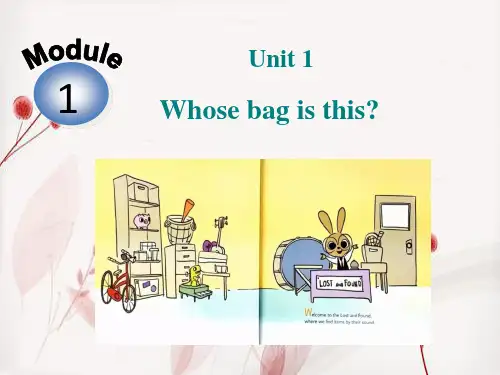
Daming: Here are some nice gloves. Whose gloves are they?
Ms Li: Let me see… Oh, they're mine! Thank you!
• Whose bag is this? • Whose tapes are these? • Here's a purple wallet. • Look at this nice watch. Is it yours too? • Here are some nice gloves. Whose gloves are they? • Everyone, please be careful with your things from now on.
There’s a lost and found box in the classroom. There are many things in it.
A: …Come and look in the lost and found box! There are a lot of things in it. Whose … is this?
Ms Li: You're welcome! Look at this nice watch. Is it yours too, Daming?
Daming: No, it isn't. I think it's Betty's.
Lingling: Yes, it's hers.
Ms Li: Everyone, please be careful with your things from now on.
Lead in
Whose bike is this?
新外研版七年级册英语下册Module1 Lost and found Unit 1课件
her Give it to _________. ( she )
3. This is a dog. _________ black. It’s its ________ colour is black. ( it )
yours Sam? 4. Is this pencil ________, _______ must look after ______ You your things well. ( you ) 5. That is not _________ English book. his _________ is at home. ( he ) His
IV. 根据汉语意思完成下列英语句子,每 空一词(含缩略形式)。 1. 首先,让我告诉你这个消息。 _____ First ___ of ____, all let me tell you the news. 2. 买一套房子要花一大笔钱。 It takes ____ a ____ lot _____ of money to buy a house. 3. 这个小男孩正面带微笑地看着我。 The little boy ____ is _______ looking ____ at me with a big smile.
What are these?
They’re Lingling’s _________. crayons
What’s this? Whose is this?
1
2
3
4
5
6
7
8
Work in pairs. Ask answer.
— Are the crayons Betty’s?
— No, they’re not hers.
外研版七年级英语下册Module 1 Lost and found Unit 1精品课件
•
9、要学生做的事,教职员躬亲共做; 要学生 学的知 识,教 职员躬 亲共学 ;要学 生守的 规则, 教职员 躬亲共 守。2021/7/232021/7/23Friday, July 23, 2021
• 10、阅读一切好书如同和过去最杰出的人谈话。2021/7/232021/7/232021/7/237/23/2021 1:17:51 AM
• 11、一个好的教师,是一个懂得心理学和教育学的人。2021/7/232021/7/232021/7/23Jul-2123-Jul-21
• 12、要记住,你不仅是教课的教师,也是学生的教育者,生活的导师和道德的引路人。2021/7/232021/7/232021/7/23Friday, July 23, 2021
Ⅰ. 选词(组)填空 mine, welcome. . . to, be careful with, from now on, first of all
1. _____, let me tell you my name. 2. We are friends now. Let’s help each other _____. 答案: 1. First of all 2. from now on
【探究总结】名词词尾加’s构成所有格 (1)一般情况在名词词尾加’s。 (2)以s结尾的名词只加’,如果复数名词不以s结尾,末尾也要 加’s。 (3)两者或两者以上多人共有同一物体时,在最后面名词词尾 加’s。 (4)并列名词各自所有时在各个名词后加’s。
【巧学助记】 名词所有格用法口诀
英语名词所有格,表示物品所有权。 名词后加 ’s,这种情况最常见。
【学以致用】
①孩子们,让我们欢迎这些新同学来到我们班。
Boys and girls, let’s _____ these new students _____ our class. ②—Thanks for your help.
七年级英语外研版下Module1LostandFound说课稿
课后,我将通过以下方式评估教学效果:
1.收集学生的课堂练习和课后作业,分析错误类型和频率。
2.与学生进行交流,了解他们的学习体验和感受。
反思和改进措施包括:
-根据学生的反馈和学习情况,调整教学方法,如增加小组合作的机会,提供更多的口语练习。
-加强对难点知识点的讲解和复习,确保学生能够扎实掌握。
1.创设情境:通过设计真实、有趣的物品丢失和寻找情境,让学生在角色扮演中自然地运用所学知识,提高他们的学习兴趣。
2.小组合作:组织学生进行小组合作,互相提问、回答,提高学生的参与度和互动性。
3.游戏活动:设计相关词汇和语法点的游戏,如“猜物品”、“接龙”等,让学生在轻松愉快的氛围中学习英语。
4.成功体验:对学生的每一次进步给予及时表扬和鼓励,让他们感受到学习英语的成就感,增强学习动机。
七年级英语外研版下Module1LostandFound说课稿
一、教材分析
(一)内容概述
本节课选自七年级英语外研版下Module 1 Lost and Found的第一单元,此模块在整个课程体系中具有重要地位。它旨在帮助学生掌握与日常生活紧密相关的英语表达方式,特别是在描述物品丢失和寻找的场景中。本节课主要知识点包括:物品名词、描述性形容词、一般现在时态、一般过去时态、疑问词的运用以及简单的对话交流。
4.学会使用疑问词,如:What、Where、When、Who等,来询问物品丢失和寻找的相关信息。
5.能够进行简单的对话交流,如:A:What did you lose?B:I lost my school ID card.
(二)教学目标
本节课的三维教学目标如下:
1.知识与技能:
外研社 初一下 M1 Lost and found Unit 1
Whose books are these?这些书是谁的?
Is this your bag?
Yes, it’s my bag .
Whose bag is this ? It’s mine . whose 谁的 mine 我的 It’s my bag . It’s mine .
Daming: Here are some nice gloves. Whose gloves are they?
Ms Li: Let me see. Oh, they‟re mine. Thank you!
Language points
1. Welcome back to ... 欢迎回到... welcome sb to +地点.欢迎某人到某地 welcome to +地点...欢迎到.... welcome back home.欢迎回家。 2.First of all,come and look ... first of all ,意为“首先”,常用于句首, 通常用逗号于句子隔开。 First of all, I want to introduce myself. 首先,我想介绍一下我自己。
Is this your book?
这是你们的书吗?
不,这不是我们的。 No, it’s not ours. 这是他们的书.It’s their book. 是他们的。 It’s theirs.
their book=theirs 他们的
Do some exercises.
• • • • • • • • • 1. _________( Whose 谁的) bag is this? It‟s________.( 我的) mine 2. Is this ________ his (他的)football? his Yes, it is. It‟s ________. (他的) my (我的)watch? 3. Is this _______ yours 你的) Yes, it is. It‟s ________.( 4. Are these________ Betty‟s (Betty) crayons? Yes, they‟re ________ crayons. her hers They are__________.
2023新外研版七年级下英语全册课文电子版
2023新外研版七年级下英语全册课文电子版Module 1 Lost and foundUnit1 Whose bag is thisMs Li: Wele back to school everyone! First of all, e and look in the lost and found box! There are a lot of things in it. Whose bag is this Lingling: Oh sorry! It’s mine. Are my crayon s there too Ms Li: Are these crayons yoursLingling: Yes, they are and this eraser too. Thank you.Ms Li: Whose tapes are these Daming: They’re mine.Ms Li: Here’s a purple wallet!Tony: It’s mine. Look! Here’s my name ―Tony‖! Thank you.Ms Li: You’re wele! Look at this nice watch. Isit yours too, Daming Daming: No, it isn’t. I think it’s Betty’s. Lingling: Yes, it’s hers.Ms Li: Everyone, please be careful with your things from now on.Daming: Here are some nice gloves. Whose gloves are they Ms Li: Let me see... Oh, they’re mine! Thank you!Unit2Are they yoursThe Lost and Found Office in New York CityWele to the New York City Lost and Found Office. People often lose things when they’re travelingor when they’re in a hurry. They leave things on pla nes, on trains, on buses and in taxis. That’s why there are lost and found offices at airports and stations.The New York City Lost and Found Office is very big. Hundreds of people e here every day. They are looking for their phones, cameras, watches, puters and many other things. We usually have about two thousand mobile phones and one thousand cameras.At the moment, there are also some strange things at the New York City Lost and Found Office. There are about a hundred bikes and a large boat. There are also a lot of animals. This week, there are three dogs, twoducks and a pig! Whose are they Are they yours We don’t know! Are you looking for fifteen kilos of sausages They’re here too!Module 1crayon n.蜡笔raser n.橡皮擦glove n.手套wallet n.钱包watch n.表;〔通常指〕手表whose pron.谁的first of all 首先;第一lose v.失去findv.发现;找到lost and found box 失物招领箱mine pron.我的yours pron.你〔们〕的tape n.录音带;录像带purple n.紫色;紫红色hers pron.她的careful adj.仔细的;小心的be careful with 小心〔对待〕……from now on 从如今起here is/are…在这儿camera n.照相机phone n. ;机mobile phone 挪动;手机lost and found office 失物招领箱in a hurry 匆匆忙忙leave v.丢下;遗忘plane n.飞机taxi n.出租车why adv.为什么airplane n.机场;航空港hundred num.百hundreds of 几百;成百上千look for 寻找thousand num.千strange adj.奇怪的boat n.船duck n.鸭pig n.猪sausage n.香肠;腊肠Module 2 What can you doUnit1 Ican play the piano.Daming: Look ! The new clubs for this term are on the board. I’d like to join the Music Club because I can play the piano. What about you, BettyBetty: I like cooking, so I can join the Food and Drink Club. Can you cook, DamingDaming: No, I can’t. Well, I can cook eggs, but that’s all. What about Lingling Which club can she joinBetty:I think she’d like to join the Dancing Club because she can dancereally well .Tony , how about youTony: I’d like to join the Chine se Club. Ican’t speak Chinese very well.Daming: Don’t worry about Chinese. We can teach you Chinese! So choose your favourite club.Tony: OK then..I play table tennis, so I choose the Table Tennis Club.That’s my favourite!Unit2 I can run really fast.It’s the start of the new term and we’rechoosing our new monitors.I’d like to be the class monitor. I get on well with everyone, classmates and teachers. I work very hard, and I do well at school .I’m kind and I’m always ready to help others. I can even help teachers too. Choose me as your class monitor and I promise to help YOU!I want to be the PE monitor .I enjoy sport, and I can run really fast. I’m really fit and healthy. Just watch me in the playground between lessons! I play most ball games well. But I’m really good at football, and I play basketball in the school team. I usuallyget the best score in every match. Choose me for the PE monitor and you can get the best score too!I’d like to be the cleaning monitor. I often help my mother do cleaning at home and I like a clean and tidy house. I’m sure everybody would like a clean classroom, just like home. Choose me and we can make our classroom beautiful.Module 3 Making plansDaming: On Saturday morning, I’m going to check my email and do my homewo rk. Then I’m going to help with the housework. What are you going to do, Betty Betty: I’m going to see a movie in the afternoon. You can e too.Daming: Sure! Who else is going to be thereBetty: Nobody. Lingling is going to have a piano lesson, so she c an’t e with us, but on Sunday afternoon, Lingling and I are going to have a picnic. Would you like to join usDaming: Yes, I’d love to. Are we going to meet hereBetty: No, we aren’t. We are going to meet inthe park at one o’clock.Tony: Hi, everyone!Tony: Nothing. I’m going to stay at home alone.Unit 2 We are going to cheer the playersWhat are you going to doA-------MartinB------Zhang SijiaC-------LucyModule4Life in the futureUnit 1Everyone will study at home.Ms Li: Will schools be different in the future, DamingDaming: Yes, there will! In twenty years time, maybe there won’t be any schools!Ms Li: How will students learn thenDaming: Everyone will study at home. Studentswill use puters and get information on the Inter. They can ask their teachers by Inter, telephone or email.Tony: Yes. Teachers won’t use on a blackboard and students won’t use pens and paper, or erasers any more!Lingling: Great! Will students have a lot of homework to doTony: No, they won’t. They’ll have a lot offree time!Daming: That’ll be great!Unit2Every family will have a small plane.What will life be like in the future How will things change Here are some ideas. Which ones will e trueA In the future, a change of weather won’t mean a change of clothes. W e’ll wear a new kind of clothes. They’ll be warm when we’re cold, and cool whenwe’re hot.B There’ll be no more light rain and cold wind in spring. The weather will be quite warm or even hot all year, with heavy rain and wind. The sea level willrise as well.CWe won’t travel by bus or bike any more. Every family will have a small plane. No more expensive cars - it’ll be cheap to travel everywhere by plane, not only over land, but also over the sea or even into space. Maybe there’ll be traffic jams in the air.D Do you like long holidays Well, you’re going to like the future becausemachines and robots will do all the heavy and difficult jobs, and we’ll only do light and easy work. Working hours will be short so people will have long holidays.Module 5 ShoppingUNIT 1What can Ido for you(In the shop)Shop Worker: What can I do for youLingling: I'd like to buy a T-shirt for my mum.Shop worker: What colour does she likeLingling; Purple.Shop worker: All right .What size does she takeLingling: Small.Shop worker: What about this oneLingling: May I try it onShop worker: Certainly.Lingling: Look at the price .It's 198 yuan .That's too much.Shop worker: But wait a minute !There's a sale on today .Everything is half price.Lingling: OK! I'll take it .(In the market)Lingling: I've got some food to buy too.Market worker : Can I help youLingling: Yes.I'd like some sausages.How much are theyMarket worker : Thirty-eight yuan a kilo.How much would you likeLingling: Half a kilo.Market worker: OK. What else would you likeLingling: A kilo of beans and two lemons.Market worker : That'll be 30 yuan.Betty: Oh ,the strawberries look fresh .How much are theyMarket worker : Ten yuan a kilo.Betty: One kilo please .Here's fifty-nine yuan.Unit 2 You can buy everything on the Inter.Online shoppingThere are many new ways of shopping, and online shopping is one of them .You can buy almost everything on the Inter .and it's very easy .First ,you choose something-clothes, tickets, a mobile phone, even a new puter -and pay for it. Then you receive it a few days later by post .Online shopping is changing our way of life .One day no one will go to the shops any more ,becauseyou'll be able to buy anything on the Inter ,and you will be able to receive it anywhere in the world at any time!Module 6 Around townUnit1Could you tell me how to get to the National Stadium(Betty and Lingling are standing in front ofTian'a____en Square.)Tourist: Excuse me! Can you tell me the way to Wangfujing DajieBetty: Certainly. Go acro ss Dong Chang’an Jie, go along the street and turn left at the third street on the left. It’s near here, so you can walk there.Tourist: Great. And I’d like to buy a guidebook about Beijing. Is there a bookshop near here Lingling: Yes, there is a big bookshop over there, just along Xi Chang’an Jie, on the right, opposite the bank.Tourist: Right, OK! I also want to visit the National Stadium. How can I get thereLingling: Sorry, I’m not sure. Why not ask the policeman over thereTourist: Thank you.Bett y and Lingling: You’re wele.Tourist: Could you tell me how to get to the National StadiumPoliceman: Sure! Go along the street and you’ll see an underground station. Take the Underground to the Olympic Sports Centre, or you can take a bus or a taxi.Tourist: Thanks a lot.Policeman: You’re wele. Have a nice day!Unit2 The London Eye is on your rightTour of LondonWele to this short tour of London. This square is Trafalgar Square and it is the middle of London.We’re standing opposite the National Gal lery, a famous museum with lots of famous paintings. From here, we’ll walk along the red street to Buckingham Palace. The Queen lives there.Turn left and go to the Houses of Parliament and Big Ben. Opposite you can see the London Eye. It takes you 135 metres above the River Thames. You can see most of London on a clear day.When you are tired, the best way to see London is by boat. You can get the boat near Big Ben. As you go along the river, the London Eye is on your right.Get off the boat at Tower Bridge. Next to the bridge is the Tower of London. It’s over 900 years old.After visiting the Tower of London, take the boat back along the river to the railway station. When you get off the boat, go past the station and walk alongthe street. Turn left into K ing’s Street and go past a church. You’re now back at the square. And this is where we’ll finish our tour.Module 7 My past lifeUnit1 I was born in a small villageTony: Hey, Lingling. Where were you bornLingling: I was born in a small village in Shanxi Province.Tony: What was the name of the villageLingling: Xucun. Where were you born, TonyTony: I was born in Cambridge. It’s a small city in England.Lingling: What was the name of your first school Tony: It was Darwin Primary School.Lingling: Who was your first teacherTony: My first teacher was Mrs Lane. She wasstrict but very nice. Who was your first teacher Tony: Their names were Becky and Adam. Becky was very good in class but Adam wasn’t. He was quite difficult.Lingling: And what were you like Were youdifficult in class tooTony: No, I wasn’t. I was very good!Unit 2 I was born in QuincyMy life in QuincyBy Betty KingI was born in Quincy, a town on the east coast of America, twelve years ago. There were lots of things to do in Quincy, with many stores, two movie theaters, football clubs and basketball teams too. I wasn’t bored in Quincy. I was very happy there.Two presidents of the US, John Adams and his son John Quincy Adams, were born in Quincy. You can visit their old family houses. Our house was big and fortable. There was a big living room with a TV, a kitchen, a bathroom and three bedrooms. On my bedroom walls there were pictures of my favourite movie stars.Behind the house, there was a big garden with lots of trees and there was a small lake with fish in it.It was great to play there.Module 8 Story timeUnit 1 Once upon a time…Tony: All alone in the dark dark forest, Goldilocks picked some flowers.Daming: Oh, did she often go for a walk in the forest aloneTony: No, she didn’t. And soon she was lost. Goldilocks looked around her. “Where am I she asked. Then she noticed a little house, so she hurried towards it, and knocked on the door., Nobody answered, so she knocked again, and again, Finally, she pushed the door. It was open. There was nobody there.Daming: Oh! Didn’t anyone live in the houseTony: Just wait a moment, Daming! Goldilocks entered the house and look into a small room. On a table there were three bowls with some nice food in them. One bowl was small, one was big and one was very big. Goldilocks was very hungry. She picked up the very big bowl but she didn’t like it—it was very hot,. Then she picked up the big bowl, but she didn’t like it –it was cold. The little bowl was just right. She finished all the food in it.Unit2 Goldilocks hurried out of the houseGoldilocks and the Three BearsGoldilocks wanted to sit down because she was tired. First she tried the big chair, but wasn’t fortable. Then she tried the middle chair. It was not fortable either. Finally, she tried the small chair.It was nice and fortable, but Goldilocks was very heavy and soon the chair was in pieces.She walked into the bedroom. There were three beds. She didn’t like the middle bed or the big bed. The small bed was very fortable. Very soon she was asleep in it.The Three Bears returned. They looked at the bowls and the chairs. Baby Bear cried,” There’s nothing in my bowl and my chair is in pieces!” He wasn’t very happy!Next, the Bears looked in their bedroom. They didn’t notice Goldiloc ks at first. Then Baby Bear pointed at the little girl in his bed and shouted, “Look! There’s the bad girl!”Goldilocks opened her eyes. The Three Bears wereall around her, so Goldilocks jumped out of bed and hurried out of the house without her basket. Shedidn’t go for a walk in the forest again.Module 9 Life historyUnit1 He left school and began work at the age of 12.Betty: What are you readingTony: Tom Sawyer, by the famous American writer, Mark Twain. I’m writing about him for my English class.Betty: I read Tom Sawyer. Very good! Hey, we can find out about him on the Inter.Tony: Yes! ... OK. Look at this! His real namewas Samuel Clemens and he was born in 1835 in Missouri. He left school and began work at the age of 12.Betty: What did he doTony: He wrote for a newspaper Later he got work on a boat..Betty: Did he stay in MissouriTony: No, he went to New York, and other cities.Betty: When did he begin his storiesTony: I don’t know the exact date. But he took the name Mark Twain and became very famous in the1860s. He went to Europe as well. But he didn’t e to China.Betty: Yes, I knew that. Enjoy the book.Tony: Yes, it’s good.Unit 2 He decided to be an actorWilliam Shakespeare was a famous English writer of plays and poems. He wrote 38 plays, 154 short poemsand a few long poems in his life. Two of his famous plays are Hamlet and Romeo and Juliet.Shakespeare was born in 1564 in Stratford, England. Like many people four hundred years ago, Shakespeare’s parents didn’t learn to rea d or write. At school he liked plays, so he decided to be an actor when he finished school at 14. He married in 1582 and had three children.Shakespeare went to London and joined a theatre pany in about 1592. He became a successful actor andbegan to write plays. Queen Elizabeth I enjoyed his works very much.In 1599 the pany built the Globe Theatre on the River Thames in London. You can visit the theatre today, but it isn’t the same building. There was a fire in the old theatre. They built it again in 1614 and in the 1990s.William Shakespeare died at the age of 52. He was rich and successful. You can still see his plays in English and in many the languages. He’s famous around the world..Module10 A holiday journeyUnit1 what did you doLingling: Where are you going on holiday, TonyTony: To Los Angeles.Betty: Oh, really You’ll love it! I went there two years ago and enjoyed it a lot.Tony: How long did it take to get there Did you flyLingling: Who was with youBetty: My parents.Lingling: So what did you doBetty: Well, first, we went to Disneyland, and guess what I met SnowWhite and Mickey Mouse! I was so excited!Tony: Wow! How long did you stay thereBetty: We stayed there for two days. And then we went to Hollywood.Lingling: Did you see any movie startsBetty: No, but we swam in the Pacific Ocean at Santa Monica. It wasgreat!Lingling: Where are you going on holiday this year, BettyBetty: Paris.Unit2 This morning we took a walk .Hi, Grandma! Here I m in Paris. Jenny and Iarrived by plane the day before yesterday. Aunt Joan and Uncle Peter met us at the airport. We were tired so we relaxed at home and began our tour of the city yesterday.Yesterday we went to the Louvre Museum. It has many world-famous works of art, such as the Mona Lisa.In the evening we had dinner in a French restaurant. The food was delicious!This morning we took a walk. There are shops, and restaurants everywhere, and I love the street and markets. They sell such good fruit and vegetables. We also did some shopping. I bought a present for you. I hope you’ll like it!At about three o’clock, we took the Paris Underground to the Eiffel Tower. It is really high. There were lots of tourists, so first of all, we had to wait in line for an hour, and then we went to the top. We waited till all the lights were on. It was wonderful!Tomorrow we’re going to visit a famous palace and take a boat tour on the River Seine. I’ll write again.Love,BerryModule 11 Body languageUnit 1 They touch noses!Lingling: We’re going to have s ome Russian teachers at school tomorrow, and I’m weling the visitors. How do I do thatBetty: Lingling, you know, in Russia, people usually kiss three times, left, right, left.Lingling: What! No, I didn’t know that. We Chinese often shake hands and smile when we meet visitors, and sometimes we nod our heads . But we never kiss. Only parents and children do that.Betty: That’s because people do different things in different countries.Lingling: So what do people in the US usually do when they meetBetty: In the US some people shake hands, and some kiss or hug each other. In India people put their hands together and nod their heads. And do your know what Maori people in New Zealand do when they meet Lingling: No, What do they doBetty: They touch noses!Unit2 Here are some ways to wele them.Body language around the worldby Wang LinglingOur new foreign students are going to arrive very soon, and here are some ways to wele them.Do you look at people when you talk In some places, it isn’t polite to loo k at people when they talk, but in other countries it isn’t polite to look somewhere else. In Britain and the US, people usually look at each other when they talk.And how do you say goodbye That’s easy, wave to say goodbye. But be careful! In Greece, it’s not atall polite! In fact, it’s very rude!Module 12 Western musicUnit 1 It’s so beautiful!(The Blue Danube)Daming: Hmm, this is Western music, isn’t it Can you hear the violin and the piano It’s so beautiful! Is this by Strauss or MozartLingling: I’m not sure…Betty: It’s by Strauss. I love his music! Do you know anything about him, TonyTony: Was he GermanBetty: No, he was born in Vienna, the capital of Austria. What a beautiful city! This is called TheBlue Danube. The Danube is a river in Europe. It goes through Vienna.Lingling: Do you like both. You listen to pop music, BettyBetty: Well, I like both. You listen to pop music, Lingling ,don’t youLingling: Yes, I do. I also like Beijing opera. Listen to this fantastic voice.Tony: Hmm, th e sound is very … different, isn’t it I’m a fan of rock music. Listen to this!Daming: Hey! Give us a break!Lingling: Rock music Listen to those drums.Daming: It’s so noisy! And much too fast!Tony: You don’t like rock music I don’t believe it!Unit 2 Vienna is the centre of European classical music.The city of musicVienna is a beautiful old city on the River Danube in the centre of Europe. It’s the capital city of Austria and the centre of European classical music. In the eighteenth century a lot of musicians came tostudy and work in Vienna.In the Strauss family, there were two poserscalled Johann Strauss: the father and the son. The father, Johann Strauss the elder, wrote and played music for traditional dances, called the waltz. His dance music made him famous all over Europe. The son, Johann Strauss the younger, was also very successful and popular. He wrote over 150 waltzes. In 1867 he wrote The Blue Danube waltz.Mozart was another very important poser. He was born in Austria in 1756. Before he was six, he played not only the piano but also the violin. His familytook him around Europe and he gave concerts in many cities. He wrote hundreds of wonderful pieces of music. But he became very poor and died in 1791 when he was only 35. Like Johann Strauss, father and son, he was agreat European musician, and many people still think his music is perfect.。