
牛津高中英语模块一 unit2 Grammar and usage
where; 后面是表语从句,表示建在某地。
题2: 表示读完当地的语法学校后去剑桥
深造,故选C。
3. I have many friends, ______some
are businessmen. A. of them C. who of B. from which D. of whom
4. I saw a woman running toward me in
5. We saw several natives advancing
towards our party, and one of them came up to us, ____we gave some bells and glasses. A. to which C. with whom B. to whom D. with which
—What are the picture used for? —They are pictures from which you can know more about the growing pains in Unit two.
Look! Here is a map from which we can know more about China.
④ Up to now, he has written ten stories, three of which (=of which three) are about country life. 迄今为止,他写了10部小说,其中 3部是关于农村生活的。
高考链接
介词加关系代词引导的 定语从句
1. The place ____ the bridge is supposed to be built should be ____ the crossriver traffic is the heaviest. A. which; where B. at which; which C. at which; where D. which; in which
pay money for sth.为固定搭配
2) 根据先行词的搭配习惯来决定。如: ①I remember the day on which I joined the League. 强调在具体某一天要用介词on ②I remember the days during which I lived here. 强调在某几天时间内要用介词during
② In the basket there are quite many apples, some of which (=of which some) have gone bad. 篮子里有好些苹果,有些已经坏了。 ③ There are forty students in our class in all, most of whom (=of whom most) are from big cities. 我们班总共有40个学生,大多数来自大 城市。
—What is this? —It is a wonderful scenery from which we can know much about the mountains.
— Look at them. They loves their kid so much. — But I don’t like the way( in which/that/ -) they treat their kid.
Match each sentence with an ending.
Answers: c 2. ___ d 3. ____ b 4.____ a 1. ___ 5. ___ 8. ____ e 6. ___ h 7. ____ f g
③I remember the month in which I stayed there. 在month前介词要用in
3) 根据从句中动词与先行词的逻辑关 系。 Is that the newspaper for which you often write articles? 4) 根据从句中形容词的习惯搭配。 Can you explain to me how to use these idioms about which I’m not sure?
6. The man ________ to whom I spoke on the phone last night is very good at wrestling. 7. This is the book which _____ I am looking
for.
Choose the best answer. 1. American women usually identify their best friend as someone _____ they can talk frequently. A. who C. about which B. as D. with whom
介词+关系代词引导的定语从句
关系代词作介词宾语,不论是在限制性 定语从句中,还是在非限制性定语从句 中,当介词前置时,只能用 whom 指人, which 指物;但如 果介词后置,则不受这 种限制,关系代词还可以省去,特别是在 口语中。如:
1. Do you know the boy to whom
2. The English play ______ my students acted at the New Year’s party was a great success. A. for which B. at which
C. in which
D. on whichFra bibliotek3. There are altogether eleven books on the shelf, ______ five are mine. A. on which C. of which B. in which D. from which
Practice two
Use proper prepositions and relative
pronouns to fill in the blanks.
1. Do you like the book _________ on which she spent $10? 2. Do you like the book for ________ which she paid $10?
4. 含有介词的短语动词一般不拆开,介 词仍放在短语动词的后面。如:look for, look after, take care of 等。 ①This is the watch (which / that) I am 正 looking for. 这是我正在找的手表。
This is the watch for which I am looking. 误
the dark. Before I could recognize who she was, she had run back in the direction ________ she had come. A. of which C. in which B. by which D. from which
6. “介词+关系代词”前或后还可有some, any, none, all, both, neither, many, most, each, few等代词或者数词。如: ① He loves his parents deeply, both of whom are very kind to him. 他深深地爱着他的父母,他们俩待他 都很好。
Attributive clauses introduced by
“preposition +which/whom” 1. The attributive clause introduced by prep. + which 2.The attributive clause introduced by prep. + whom
she was talking? 2. Do you know the boy (that) she was talking to? 3. The pencil (which / that) he was writing with suddenly broke.
3. 介词的选用原则 1) 根据定语从句中谓语动词的习惯搭 配来决定。如: ① This is the book on which I spent 8 yuan. spend money on sth.为固定搭配 ② This is the book for which I paid 8 yuan.
英语课件
牛津版 高一模块一 Unit 2
Grammar and usage
Learning goals 1. Help students know more about attributive clauses. 2. Help students know the attributive clauses introduced by “preposition +which/whom”. 3. Help students know how to use the relative adverbs to begin the attributive clauses.
6. I was given three books on cooking, the first _____I really enjoyed. A. of that C. that B. of which D. which
题3、4、5、6考查考生对“介词+关 系代词”引导的定语从句的掌握及其 灵活运用情况。
② The babies (whom / who / that) the
nurse is looking after are very healthy. 那个保姆照看的小宝宝们都很健康。 正 The babies after whom the nurse is looking are very healthy. 误
Unit+2+Grammar+and+usage+课件-高中英语牛津译林版选择性必修第一册+

有一些动词短语也常跟动词-ing形式作宾语,如: insist on (坚持), object to (反对), be good at, lead to, leave off (停 止), put off (推迟), give up, look forward to , feel like(想要), devote to (把......奉献给),get used to (习惯于), pay attention to, can't help (禁不住), can't stand (受不了)等。
在他的国家,询问女士的年龄是不礼貌的
动词-ing 形式作主语
>1.动词 -ing 形式直接置于句首主语的位置上
Saying is easier than doing.
说比做容易。 2.动词-ing形式作主语时常后置,此时须用it 作形式主语,用形容词或名词(短语)作表语。
no useL,onreomgIoposudm, fun, hard work, a hard/difficult job 源自 a waste of time 等。
2.既可接动词-ing形式又可接不定式(短语)作宾语的动词:
begin, start, continue, like, dislike, love, prefer, mean , forget , remember , hate , regret 等。 (1)在 like, love, hate, prefer 等动词之后,用动词 -ing 形式或不定式意义上没有什么不同,只是侧重点有些不同,动词-ing形式表示 泛指的动作,不定式表示具体的一次性动作。 (2)在 begin, start, continue 之后,用动词 -ing 形式和不定式,意义无区别,尤其是 当主语是人的时候。
牛津模块一Unit2-grammar-and-usage
and/;/.
Recently I bought an ancient Chinese vase(花瓶), _______ was very reasonable(合理的).
A. which price
B. the price of which
C. its price (What about C?)
A. the larger B. the larger of them C. the larger one that D. the larger of which
5.介词+关系代词+名词
He spent four years in college, _d_u_rin_g__w_h_ic_h_t_im_e_ he studied medicine. (在那段时间内)
Tip: the walls of the newly-built cafe
D. the price of whose
2.数词+介词+关系代词(含基数词,序 数词,分数和百分数)
We have three foreign teachers, _tw_o__o_f _w_h_o_m__are from Canada. (其中的两个)
and/;/.
The factory produces half a million pairs of shoes every year, 80% _______ are sold abroad.
❖ I don't like the way (that/in which) you speak to your mother.
❖ The way (that/ in which) he teaches English is interesting.
Unit+2+Grammar+and+usage+教案 高中英语牛津译林版(2020)必修第一册
教案年级: 高一学科: 英语主备人:课题Unit2 Grammar simple,compound andcomplex sentences第_______课时教学目标1.Read some sentences in the passages and analyse what the sentences are;2. Learn some related usages of the simple, compound and complex sentences.教学重难点Have the command of the usages of the simple, compound and complex sentences教学流程\内容\板书关键点拨加工润色Step 1 Greetings.3.主从复合句由一个主句和一个或一个以上的从句构成的句子叫主从复合句。
主句为句子的主体部分;从句无法独立,可以充当句子的主语、表语、宾语、定语、状语等。
按其在复合句中的作用,分为名词性从句(同位语从句、主语从句、表语从句、宾语从句)、定语从句和状语从句等。
(1)名词性从句That is ______ he did not come to school yesterday.那就是昨天他没来上学的原因。
He said ______ some teenagers didn’t work hard.他说有些青少年学习不努力。
_______Tom should cheat me is disappointing.汤姆竟然欺骗我真是令人失望。
He gave some advice ______ I should read English every day.他给我一些我每天都应该阅读英语的建议。
(2)定语从句The man _______ was full of anger was Mike’s father.那个非常生气的人是麦克的父亲。
Unit 2 Grammar and usage高中英语牛津译林版(2020)选择性必修第一册
Exploring the rules
Verb- Playing the qin was his life.
ing
Having someone that really understood his music pleased Boya, …
forms as …, it’s no use keeping the qin. subjects
2. 置于句末,用it作形式主语,多见于下面几个句型: It is worth doing... 做.....是值得的 It + be + a waste of time doing.. 做.....是浪费时间的 It is/was no good/use doing... 做.....是没有用的
二、动词-ing形式作主语 1. 动词-ing形式直接作主语表示抽象的概念,
通常直接置于句首,谓语动词用单数形式。 e.g. Reading aloud is a good way in learning a language. 朗读是学习语言的一个好办法。
Getting up early is a good habit. 早起是一种好习惯。
对……评价很高
to his music and thought highly of his techniques. However, Boya believed no one could understand his music until he met Zhong Ziqi. Boya did not say anything before playing the qin, yet Zhong Ziqi was able to paint a picture of great mountain ranges in his mind. When Boya continued playing, Zhong Ziqi said he had heard the sound of a river flowing quickly. In fact, Boya had intended to call the piece High Mountains and Flowing Water.
Unit 2 Grammar and usage课件-高中英语牛津译林版(2020)选择性必修第一册
try doing sth 试着做某事 try to do sth 尽力去做某事
a. Why not try doing it in some other way? 为什么不用其他办法试一试呢?
b. I tried to solve the problem but I couldn’t. 我努力解答那个题,但我解不出。
proud.
宾语
主语
V-ing
V-ing
A Below is a story about a musician and his friend in ancient China.
When Who What happened
When Who
• in China’s (1)S_p_r_in_g__a_n_d_A__u_tu_m__n_a_n_d_W__a_r_ri_n_g_S__ta_t_es period
① Do you like reading? 你喜欢看书吗? I like to read detective stories. 我喜欢看侦探小说。
② I hate asking favors. 我不愿意求人帮忙。 He would hate to disappoint you. 他不愿意让你失望。
a. I will never forget hearing her singing that song. 我将不会忘记听过她唱那支歌的情景。
b. I have forgotten to bring my umbrella. 我忘了带伞。
remember doing sth 记得曾经做过某事(动作已发生) remember to do sth 记住去做某事(动作还没有发生)
(1) It is useless trying to argue with Shylock. 和夏洛克争辩是没有什么用的。
Unit2GrammarandusageIntegratedskills英汉互译讲义-高中英语牛津译
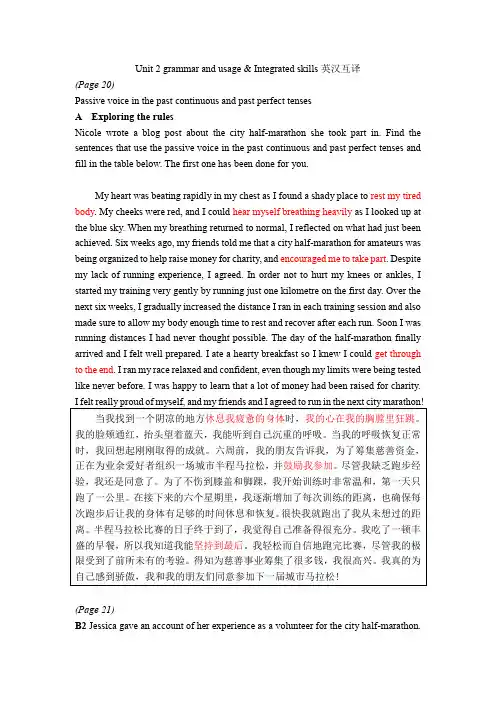
Unit 2 grammar and usage & Integrated skills英汉互译(Page 20)Passive voice in the past continuous and past perfect tensesA Exploring the rulesNicole wrote a blog post about the city half-marathon she took part in. Find the sentences that use the passive voice in the past continuous and past perfect tenses and fill in the table below. The first one has been done for you.My heart was beating rapidly in my chest as I found a shady place to rest my tired body. My cheeks were red, and I could hear myself breathing heavily as I looked up at the blue sky. When my breathing returned to normal, I reflected on what had just been achieved. Six weeks ago, my friends told me that a city half-marathon for amateurs was being organized to help raise money for charity, and encouraged me to take part. Despite my lack of running experience, I agreed. In order not to hurt my knees or ankles, I started my training very gently by running just one kilometre on the first day. Over the next six weeks, I gradually increased the distance I ran in each training session and also made sure to allow my body enough time to rest and recover after each run. Soon I was running distances I had never thought possible. The day of the half-marathon finally arrived and I felt well prepared. I ate a hearty breakfast so I knew I could get through to the end. I ran my race relaxed and confident, even though my limits were being tested like never before. I was happy to learn that a lot of money had been raised for charity.(Page 21)B2 Jessica gave an account of her experience as a volunteer for the city half-marathon.Complete the passage with the correct forms of the verbs in the box below.By the time Cathy and I, together with other volunteers for the city half-marathon, arrived at 4:30 a.m., tables (1)had been placed on both sides of the road. Bottles of water and paper cups (2)were being carried to different tables, so Cathy and I immediately went to help. Then, we took our place at the table and quickly started to arrange the bottles and cups so that they looked like an army of soldiers standing in line for inspection. I took a step back, and looked at the scene with satisfaction. For the previous couple of weeks, I (3)had (been) trained on how to be a volunteer for the half-marathon. I decided to volunteer for this year’s half-marathon after the chairman of the organizing committee visited my school. We were told that the competitors would be raising money for charity, and while I didn’t feel that I had a strong constitution to run that far, I thought the next best thing would be to help those who could. After all the preparations (4)had been made/were made, the exciting half-marathon began. Cathy and I waited patiently until word spread that the first runners would be arriving soon. As the tired, thirsty runners ran along, they (5)were being cheered by the crowds. Cathy and I quickly poured water into the cups for them. After the last runner passed, I found paper cups and plastic bottles everywhere. The litter (6)was being blown around by the wind as I bent over to pick up a plastic bottle. Cathy and I started clearing up. We were tired and wet with sweat but it felt really good to know that we had been able to help(Page 23)Integrated skillsSharing your understanding of sportsmanshipB Daniel has found a website article about fair play. Read the article below and answer the following questions.Winning isn’t everythingWe all know what it is like to want to win and most of us know what it is like to lose. More often than not, winning has the victor walking on air, lost in the glory of the moment, while the loser is left with a bitter taste and a feeling of failure. Almost nobody likes to come second, and sometimes it is difficult to keep everything in perspective. Modern society honours winners and successful sportspeople quickly become celebrities, admired by all. However, there are ways to win and ways to lose. Whether you come first or last, it is important to remember that at any sporting event, you face two opponents: your fellow competitors and yourself. At the finish, your competitors will walk away but you will have to live with your decisions. A true sportsperson will make the right decisions for the right reasons and not worry about failure. There is an old and very wise saying, repeated many times, “Win with humility, lose with grace,In praise of such acts of sportsmanship, the International Fair Play Committee decided to award the Pierre de Coubertin Fair Play Trophy, in 1964. The first athlete to receive the award was an Italian bobsleigh competitor named Eugenio Monti. During the two-man bobsleigh final at the 1964 Winter Olympic Games, he produced an excellent time for his downhill run. One of the British competitors, Tony Nash, had broken a part of his bobsleigh and was unable to compete. Monti became aware of this, and without hesitation, he removed the same part of his own bobsleigh and lent it to his opponent. Nash and his partner went on to achieve a record time and won the goldmedal. Monti’s remarkable, unselfish decision to help a fellow competitor, in the final stage of an Olympic event, is an example to us all. He did not come first but he walked。
牛津英语高一Module1Unit2GrammarandUsageTheattributive
Module 1 Unit 2 Grammar and Usage The attributive clause(2) 教学案2.介词+关系代词1)根据动词选择介词。
I don’t know the foreigner with whom my teacher shook hands.(或I don’t know the foreigner whom my teacher shook hands with.)Note: who和that不能直接位于介词后作宾语;有的短语动词是不能拆开的,常见的这类短语有:look for,look after等。
This is the pencil that Ma Lili is looking for. (R)This is the pencil for which Ma Lili is looking. (W)2)根据先行词选择介词。
介词和先行词之间构成习惯搭配,介词一般位于关系代词之前,和从句中的动词不存在逻辑或意义上的关系。
He stood by the window,through which he could see what was happening outside. (the window是介词through的逻辑宾语)3)介词+关系代词有时可转换为关系副词when,why,where等。
This is the house in which /where Chairman Mao once lived.Everyone knows the reason for which/why the High Dam was built.I still remember the day on which/when we visited the temple.三、关系副词引导的定语从句1.when指时间,在定语从句中作时间状语。
Do you know the date when Lincoln was born?The time when my father worked was a hard time.There were times when I didn’t know what to do.2.where指地点,在定语从句中作地点状语。
牛津译林版英语必修一Unit2Grammarandusage1教案
牛津高中英语教学设计单元:Unit 2 Growing pains板块:Grammar and usageThoughts on the design:本节课是以读、写为主的语法教学课。
语法教学的方法各有不同,本节课的设计除了语言知识的传输外,还着眼于培养学生对于学习策略的掌握。
本节课按照“呈现—思考—归纳—巩固”的模式,在语言知识的传授过程中,强调让学生独立思考并归纳语言规则,从而掌握独立的学习策略。
此外,本节课在内容的选择上参考了05-08年各地高考题,对教学内容作了适当增补。
Teaching aims:After learning this session, the students will be able to grasp the basic rules for attributive clauses —“prep.+which/whom”used to begin attributive clauses. Besides, the students will be able to learn the studying strategy for language learning.Teaching procedures:Step 1Review what the students have learned in the previous unit —relative pronouns —with a blank-filling exercise.Fill in the blanks with relative pronouns.1. This is the story __________ we wrote for our storytelling contest. (which/that)2. The book __________ I borrowed from the library is very interesting. (which/that)3. He likes the birthday gifts _________ his friends gave him. (which/that)4. The girl _________ you have just seen is very good at English. (who/whom/that)5. I don’t know the name of the teacher _________ I met in the computer room. (who/whom/that) After finishing the exercise, ask the students to think about the grammatical principles in the sentences, and then make a conclusion as follows: The relative pronouns serve as the objects of the __________. (verbs)[Explanation]第一和第二步是对第一单元中学习的关系代词引导定语从句的复习。
Unit2TheUniversalLanguageGrammarandusage说课课件-高中英语牛
Cooperative learning method Situational teaching
aids
Textbook Worksheets Blackboard Multimedia projector
07 Teaching Process
Purpose: To summarize and integrate the rules.
07 Teaching Process
1.To help students better understand the basic function of music; Purpose: 2. To provide students with a creative context based on the theme and
functions of target grammar in given discourse.
07 Teaching Process
1.To relate to the reading part and help students get the bigger picture
Purpose:
of the integral unit; 2.To enhance their application of Verb-ing forms;
Key points Difficult
points
• Guide students to generalize the rules and apply them in oral and written expressions.
06 Teaching methods and aids
高中英语牛津译林必修一unit2Grammarandusage教案
高中英语牛津译林必修一unit2Grammarandusage教案《英语》(必修·第一册)Unit 2 Let’s talk teensGrammar and usage江苏省平潮高级中学I. Learning objectivesBy the end of the lesson, students will be able to:1. know the characteristics of a simple sentence, a compound sentence and a complex sentence;2. make a distinction between simple sentences and compound/complex sentences;3. ease parent-child tensions and improve their relationship with parents.II. Key competence focus1. Learn about the characteristics of a simple sentence, a compound sentence and a complex sentence.2. Grasp the ways to ease parent-child tensions.III. Predicted area of difficulty1. How to distinguish between simple sentences and compound/complex sentences correctly.2. How to improve parent-child relationship efficiently.IV. Teaching proceduresStep 1 Lead-in1.Appreciation of two sentences about “family”·Family is the kingdom of father, the world of mother and the paradise of children.·Family should be the palace of love, joy and laughter.2.Raising questionsT: What is a happy family like? In a happy family, parents andthe child love each other. In other words, the parent-child relationship is good and harmonious.T: What’s your relat ionship between you and your parents?T: What causes the tension between you and your parents?T: You experience physical and mental changes as you become a teenager. These physical changes may result in such family tensions. What’s more, it can be a heada che to balance your developing mental needs too. You enter a strange middle ground—no longer a small child but not quite an adult. In general, the physical changes and the developing mental needs will cause family tensions.T: What’s the consequence once you and your parents’ relationship become tense?T: Yes. Heated arguments and cold silences are common between teenagers and their parents.T: What’s your suggestions on helping the teenagers solve their problem?T: With the development of science and technology, webs designed for the teenagers to improve their well-being have sprung up. Not only can they seek practical advice for themselves but also they can help others in these webs. Besides visiting these webs, the teenagers can talk to theirfriends to get some advice. Last but not least, communication with parents is of great importance to parent-child relationship.【设计意图:欣赏“家”的美句,引导学生探讨家庭亲子关系,挖掘亲子关系紧张的原因,并鼓励学生分享改善亲子关系的方法。