
七年级英语上册unit 6教案3
Unit 6案3一、教学目标1、学会询问对方喜欢与不喜欢的食物。
2、学会了解别人喜欢与不喜欢的食物。
3、学会谈论自己与他人早、中、晚餐喜爱吃的食物。
4、学会营养配餐。
二、语言目标1、Do you like …? Yes, I do. No, I don’t. Do they like…? Yes, they do.2. I like… I don’t like…. He likes … He doesn’t like…They like… They don’t like…3. 重点词汇:hamburgers. Tomatoes, broccoli, French fries, oranges, ice cream, carrots, apples, chicken, breakfast, lunch, dinner, fruit, vegetable, salad,Period 1教学内容:Section A(1a ——1c)Task One: What food do you know?1. Ask: What foods do you know? Write food on the blackboard and explain the words by giving example words.2. What kind of food do you see?They are hamburgers, tomatoes, broccoli, French fries, orange, ice cream, salad, bananas, strawberries.Explain the spelling of these words: ham + bur + ger, to + ma + to +es, …(Note: 1. the “F” in “French” must be big letter. 2. the plural form of “tomato” is “tomatoes” as well as “potato”, but different from “photos”. 3. the plural form of “strawberry” is “strawberries”. )3. Say the words on the list. Have the students repeat.4. Match the words and pictures. Then check the answers.Task Two. Do you like bananas?1. Ask: I like hamburgers very much. I like apples. I like oranges. Do you like apples?(Help to answer: Yes, I do. Or: No, I don’t. )Ask more students: Do you like…?Write the answer down in the form on the blackboard:name Apples hamburgers salad Ice cream BroccoliJim Yes Yes No Yes NoDave No Yes Yes Yes NoPeter Yes No, No Yes NoJay No No, Yes yes YesAnna No Yes yes yes NoSay: Jim likes apples, hamburgers and ice cream.Ask: Does Jim like apples? Does Jim like salad? Go on asking the same questions.Say: Jay and Anna don’t like apples.Ask: Do Jay and Anna like apples? Do they like salad? Do they like ice cream? (help to answer)Task Three: ListeningPlay the recording for the first time. Students only listen.Play the recording a second time. Students number the boxes 1-3.Check the answers. 2, 1, 3Task Four: Do you like bananas?Get the students to make a form like the one on the blackboard. Fill in some foods and ask the classmates aroun d: “Do you like apples?” “Yes, I do.”Then give a report in front of the class.e.g. Jim likes apples, hamburgers and ice cream. He doesn’t like salad and broccoli.Dave and Anna like hamburgers, salad and ice cream. They don’t like apples a nd broccoli.Peter likes apples and ice cream. He doesn’t like hamburgers, salad or broccoli.Jay likes salad, broccoli and ice cream, but he doesn’t like apples, hamburgers.name Apples hamburgers salad Ice cream BroccoliJim Yes Yes No Yes NoDave No Yes Yes Yes NoPeter Yes No, No Yes NoJay No No, Yes yes YesAnna No Yes yes yes NoPeriod 2教学内容:Section A(2a ——2c)Task One. Review1. Ask some students individually: Do you like…? How do you spell …?2. Ask: Does Jay like…? Do Peter and Anna like…?Task Two. Listening1. Point to the and read the word aloud. Students only listen.2. Read the words again, pausing for students to repeat each one.3. play the recording for the first time. Students only listen.4. Say, circle the words you hear. Play the recording again. Students circle the items they hear.5. Check the answers. (hamburgers, broccoli, ice cream)Task Three. Listen and fill in the blanks.1. Read to the class the words in each box or ask volunteers to do this. Say the word “blank” for each blank.2. Play the recording. Students listen and fill in the missing words.3. Check the answers.Task Four. Pairwork1. Teacher asks: What’s your favorite food, Jay?They may think of many words of food that don’t appear in the book. For example: beans, rice, bread, hot dog, fish, chicken, green beans, carrots, cabbages, …2. When one student say “My favorite food is hot dog.” Ask another students: “Do you like…?”3. See “How many of you like hot dog?” Raise up your hands!4. Say: “7 students like hot dogs.”5. Do the same with several students and then get the students to practice in pairs.Homework:Write something about your family. For example: There are three people in my family. Theyare my father, my mother and I. My father likes …. My mother likes…. I like …Period 3教学内容:Section A(3 ——4)Task One: Review the food words1. Revise the food words we learnt in this unit by asking questions like:Do you like carrots? Does he like carrots?Do you like hamburgers? Does he like hamburgers?2. Look at the picture on page 31 and say the food words.What is this? What are these?Task Two: Pairwork1. Have the students in Line 1, 3, 5 turn to page 95 and the left students look at page 33.2. Say: What are these in picture 1/2? What is this in picture 3/4?3. Draw a happy face and a sad face on the blackboard and ask students: Which one means likes and which one means doesn’t like?4. Now work in pairs. Now each of you have only half of the information. Your job is to get the rest of the information from your partner.5. As the students are working together, move around the room making sure that they understand the instructions and helping them get started.6. As the students complete the task, make a simple copy of the chart on the board. When they are finished, ask students to fill in their answers on this chart.Task Three: an activity1. Get the students to make up their own charts similar to the pairwork chart in pairs. Ask them to use different food items, to tell the truth, and to leave out half of the information on each copy of the chart.2. Then ask each pair to exchange charts with another pair and complete the activity as before. Encourage pairs to present their completed charts to the class.Task Four: Food survey1. Look at the chart below. What are these foods?They are …2. Ask one student: Dave, do you like hamburgers?Have the students write down Dave in the form which “likes it” if he likes it and in the form which “doesn’t like it” if he doesn’t like it.3. Get the students to ask the students around him or her the same question: Do you like…?Find out what they like and don’t like.4. Give a report about the chart.5. Ask: Does Mark like hamburgers? Who knows?The student who interviewed Mark should stand up and answer: Yes, he likes. Or, No, he doesn’t like hamburgers.Period 4教学内容:Section B(1a ——2c)教学目标:1、复习在Section A里学过的新单词, 同时学一些新的关于食物的单词。
七年级英语上册人教版Unit6Do you like bananas?单元教案

单元教案Do you like bananas?教材依据:新目标英语七年级上册第六单元教学目标(一)语言知识1、词汇:本单元所要求掌握的所有词汇2、日常交际用语:Do you like …? Yes,I do./No, I don’t.I /They like oranges. I/They don’t like bananas.She likes salad. She doesn’t like salad.3、教学重点:1、掌握各种不同的有关食物方面的名词;2、实义动词like 一般现在时的否定式、疑问式及其答语;3、助动词do /does和don’t/doesn’t的用法;4、一日三餐的营养搭配5、小短文的写作4、教学难点:1、Affirmative and negative statements2、Countable nouns and uncountable nouns3、How to talk about likes and dislikes(二)语言技能学生能认识及听懂各种不同的食物名称,区分可数名词和不可数名词,并能自由表达出自己喜欢和不喜欢的食物;能根据单元所学句型自编对话,讨论自己及他人喜欢和不喜欢的食物并扩展到其他方面(如sports),能进行小组讨论并用英语进行简单的陈述(I like…, I don’t like …,he likes…,he doesn’t like….),能进行一日三餐的营养搭配,能根据课前任务收集和整理资料,并对所得资料进行加工和处理,在课堂中合理地加以运用。
(三)学习策略通过学习课文,掌握有关饮食方面的词汇,并结合所学单词,自由讨论喜好。
通过在课文中交流彼此的特长和爱好,培养群体意识,并在小组讨论及合作中,学会合作学习与研究性学习,完成所给任务,努力开拓课程资源。
(四)情感态度激发学生英语学习的欲望和兴趣,敢于用英语进行交流和表达; 营造情感交融的良好氛围,努力提高学生的学习兴趣,学生自主学习、主动合作;认真完成课前任务,在调查中充分发挥自身潜力,培养思维能力、动手能力、开展研究性学习;(五)文化意识能了解东西方不同的饮食文化。
七年级英语上册(人教版)Unit6单元整体教学设计

1.词汇量有限,对一些描述个人兴趣和日常生活的词汇掌握不足,需要通过本单元的学习进行拓展。
2.时态运用不够熟练,对一般现在时和现在进行时的运用容易混淆,需要通过实例和练习加强巩固。
5.实践活动:
-加入学校的英语角或参加线上英语交流活动,与真实的外国朋友进行交流,体验交笔友的乐趣。
-尝试与班级内的同学建立笔友关系,定期用英语写信交流,分享生活和学习心得。
-根据课堂学习,尝试独立撰写一篇介绍自己和一个好朋友的书信,要求格式正确,内容丰富,不少于50词。
-收集并整理本单元所学的词汇和短语,制作成词汇卡片,方便日常复习。
2.口语作业:
-与同学结成对子,模拟交笔友的场景,用英语进行自我介绍和相互了解,录制一段对话视频。
-尝试用英语向家人介绍本单元学习的主题,分享自己与笔友交流的趣事。
2.使学生掌握一般现在时和现在进行时的用法,并能运用这两种时态描述自己的日常生活。
3.培养学生运用英语进行自我介绍、描述兴趣爱好、谈论日常生活等交际能力。
4.提高学生的阅读理解能力,能够理解并获取文章中的关键信息。
5.培养学生的写作能力,能够独立完成一篇关于介绍自己和朋友的书信。
(二)过程与方法
1.通过小组合作、讨论、分享等方式,激发学生的学习兴趣,培养合作意识和团队精神。
2.强调本单元的重点和难点,提醒学生在课后加强巩固。
3.鼓励学生积极参与英语学习,保持对英语的热情,并期待在下一节课中继续探讨交笔友的乐趣。
4.最后,布置课后作业,让学生练习书写英文书信,巩固所学知识。
五、作业布置
七年级英语上册-Unit-6-Lesson-33-Let’s-Go-to-the-Zoo教案冀教版

七年级英语上册Unit 6 Lesson 33 Let’s Go to the Zoo教案冀教版’s Go to the Zoo教案冀教版’s Go to theZoo教案冀教版一、教材分析1..课文分析:本课内容是关于动物园里的动物以及它们的生活,因此,要求学生对于多见的动物名称应该了解和掌握;另外,在倡导保护环境、保护大自然这个时代主题下,应让同学们体会到“动物是人类的朋友”,因此,可以在学习课文的基础上,开展“动物是否有情感”的讨论,进行一定的拓展教学。
2..教学重点:本课需要掌握的词汇、短语及句型。
3..教学难点:掌握描述情感或状态的主系表结构的句子。
●知识目标:(1)掌握词汇:dream,noise,lion,lonely, miss, forest,course(2)掌握短语及句型:go to the zoo, make noises, of course●能力目标:能用已经学习的词汇,谈论自己喜爱的动物。
●情感目标:动物是人类的朋友,倡导“保护动物,就是保护人类自己!”●学习策略:预设和对话有关的问题,让学生带着问题去学习、去体验。
二、教学准备1.. CAI课件;2.. pictures of animals三、教学步骤Step Ⅰ.. Class Opening (3 minutes)T:Boys and girls, do you know a saying like this:Whenthe cat is away, mice will play.. Who can translate it intoChinese? Yes,“山中无老虎,猴子称霸王。
”Where can you findthem? Yes, let’s go to the zoo! Then show thetitle“Lesson33:Let’s Go to the Zoo!”on the screen..再采用超链接播放一段关于动物园内各种动物活动的视频。
Unit6Myclothes,mystyle(教学设计)2024-2025学年译林版英语七年级上册
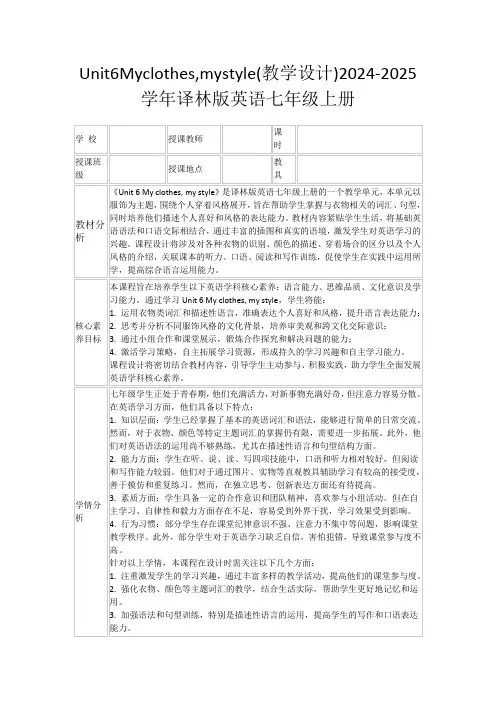
1.拓展内容:
-阅读材料:提供一些关于不同文化背景下服饰风格的文章,让学生了解世界各地的穿着习惯和时尚潮流。
-视频资源:选择一些时尚秀或服饰搭配的视频,让学生感受时尚的魅力,学习如何根据场合和个性选择合适的服饰。
2.拓展要求:
-鼓励学生利用课后时间阅读相关文章,观看视频,拓展对服饰文化的了解。
在小组讨论和角色扮演活动中,学生的合作能力和口语表达能力得到了锻炼。然而,我也注意到一些学生在讨论时过于依赖母语,这影响了他们的英语交流能力。因此,我计划在未来的教学中加强英语讨论的指导,鼓励学生更多使用英语进行交流。
在教学管理方面,我注意到课堂纪律需要进一步加强。部分学生在课堂上的注意力不集中,影响了教学效果。我计划通过增加课堂互动和趣味性活动,提高学生的课堂参与度和纪律性。
- beautiful, ugly, comfortable, stylish, casual, formal, bright, colorful, etc.
-右侧:句型与语法
- This is a... It's.../ The... is...
- I like.../ I don't like.../ My favorite...
-其他相关词汇:fashion, style, clothes, material, pattern, occasion, etc.
2.句型与语法:
-描述衣物和颜色的句型:This is a... It's.../ The... is...
-表达喜好的句型:I like.../ I don't like.../ My favorite...
-图表:制作衣物类词汇的分类图表,帮助学生系统记忆和复习。
2024年秋外研版七年级英语上册Unit 6 The power of plants(教案)

Unit 6 The power of plants单元教学目标单元教材分析本单元的主题是“人与自然”下的“自然生态”,归属于“热爱与敬畏自然,与自然和谐共生”这一子主题内容。
本单元教材围绕奇妙的植物展开,内容包括:描述有关植物的事实;谈论有关植物的好处;阐述植物的重要性。
第一课时Starting out&ReadingTeaching Objects【教学目标】1.Know some facts about plants.2.Learn about photosynthesis in plants.3.Talk about the benefits of plants.Teaching Aids【教学工具】an English book,a tape recorder and CAITeaching Steps【教学步骤】★Step 1Lead in【导入】Show some pictures about different plants to the Ss, such as bamboos, trees and flowers, and then ask them to say the facts about these plants.Starting outPage 95,11.Ask the Ss to look at the picture on page 95 and answer the following question.Do you think plants are amazing? Why or why not?2.Give the Ss some prompts.3.Let some Ss say their answers.Page 95,21.Ask the Ss to look at the pictures and answer the questions.(1)What are the people doing?(2)What can plants do for us?2.Let some Ss say their answers.3.Check the answers with the class.Understanding ideas(1—4)★Step 2 Pre-task【准备任务】1.Show the picture of a plant on page 96 to the Ss, and then ask them to guess what may be filled in the blanks.★Step 3 While-task【过程任务】Page 97,21.Ask the Ss to read the passage on page 97 and fill in the blanks on page 96.2.Ask some Ss to say their answers.3.Check the answers with the class.Page 98,31.Show the four titles to the Ss, and make sure they understand the meanings.2.Ask the Ss to choose another suitable title and give their reasons.3.Let some students say their answers.4.Check the answer with the class.Page 98,41.Show the texts on page 98 to the Ss, and then ask them to guess what may be filled in the blanks.2.Let the Ss complete the texts with the words and expressions from the passage.3.Ask some Ss to say their answers.4.Check the answers with the class.★Step 4Post-task【后续任务】Page 98, Think and share1.Ask the Ss to read the passage and answer the following questions.(1)What does “plant” mean in the title?(2)In what other ways do plants help the world?2.Give the Ss some prompts.3.Let some Ss say their answers.4.Check the answers with the class.★Step 5Language points【语言要点】1.send 的用法作动词,意为“寄,发送;传达;派遣”。
英语七年级上-Unit6教案(阅读)

拓展
for example 也表示“例如”,但是for example用于列举整 体中的一个例子,其后有逗号。 There is much happiness in our daily life. For example, we have friends to play with us. 生活中有很多快乐,比如我们有很多 朋友可以一起玩。
Sheraton Hong Kong Hotel (¥1,781 a night) 20 Nathan Road, Tsim Sha Tsui, Kowloon. This hotel is near Victoria Harbor and is only 300 metres from Hong Kong Museum of Art.
Victoria Harbor?
A. Regal Kowloon Hotel.
B. Mira Hong Kong Hotel.
C. Sheraton Hong Kong Hotel. D. Hotel LKF by Rhombus.
( D )4. Which of the following is TRUE? A. All the four hotels are 5-star hotels. B. Hotel LKF by Rhombus is on 20 Nathan Road. C. Regal Kowloon Hotel is near Hong Kong's shopping centre. D. Among the hotels, Sheraton Hong Kong Hotel is the most expensive one.
用法 (1)around 在此作介词,意为“在……的周围”。 The girls around the teacher seemed excited. 围着老师的那些女生 看起来很兴奋。
人教版七年级英语上册教案Unit 6第3课时Section A (Grammar Focus-3c)
第三课时SectionA (GrammarFocus-3c)Step1 情景导入【参考案例】T:Doyouliketomatoes/oranges/salad…?S1:Yes,Ido./No,Idon't,butIlike…T:Doesshe/heliketomatoes/oranges/salad…?S2:Yes,she/hedoes./No,she/hedoesn't,butshe/helikes…设计意图:通过师生互动问答复习上节课内容,在问答中提醒学生注意一般现在时态第三人称单数的使用。
Step2 畅通GrammarFocus回顾语法重点【操作案例】1.学生阅读GrammarFocus中的句子,总结含有实义动词的一般现在时的句型规律。
2.阅读方框中可数名词和不可数名词,并对所学过的部分词汇按此分类进行归纳总结。
设计意图:学生通过阅读感知句型规律,并做出总结。
通过阅读方框中可数名词和不可数名词,进一步加深理解。
Step3 完成教材3a-3c的任务【操作案例】1.认真阅读3a的5个句子,并在括号内正确的单词下面画线,使句子正确完整。
2.学生说出答案,老师核对,然后让学生大声朗读这些句子,并背诵。
3.认真阅读3b的几个句子,将其编号,组成对话,然后读背。
4.做食物调查。
用“Doyoulike…?”句型就3c表格中的食物向小组成员提问。
找出他们喜欢和不喜欢的食物,并把结果登记在表格中。
设计意图:学生通过参加活动和练习,更好地掌握本课知识。
知识▲可数名词与不可数名词的含义与特点Step4 随堂练习 根据图示,完成句子。
1.Paullikestomatoesand__icecream __.2.Pauldoesn'tlikehamburgersor__strawberries__. 3.Emmalikes__hamburgers__andstrawberries. 4.Emma__doesn't__like__tomatoes__or__icecream. 5.Paullikestomatoes ,butEmma__doesn't__like__them. Step5 板书设计SectionA (GrammarFocus -3c)Importantwords :egg ,carrot ,rice ,chicken ,so Importantphrase :asksb.aboutsth. Importantsentences :1.Ilikefruit ,butIdon'tlikevegetables. 2.Helikesbananas ,buthedoesn'tlikeoranges.Step6 完成学生用书。
人教版英语七年级上册Unit6SectionB(3a~SelfCheck)教学设计
鼓励学生利用网络、书籍等资源,了解不同国家和地区的作息时间差异,并整理成一份简短的报告。此作业旨在激发学生的探究兴趣,提高他们的信息整理能力。
(7)拓展活动:组织学生编写关于日常作息时间的对话或小故事,并进行展示,提高学生的写作能力和创造力。
(8)总结反馈:教师针对学生的课堂表现进行评价,给予鼓励和指导,帮助学生明确学习目标,提高学习效果。
四、教学内容与过程
(一)导入新课
1.教学活动设计
在课程开始时,我将以一首轻松愉快的英文歌曲《My Day》作为导入,让学生在欣赏歌曲的同时,关注歌词中提到的日常作息时间。通过歌曲,学生可以初步感知本节课的主题。
4.课后练习:
完成本节课所提供的课后练习题,包括词汇填空、句子改写、阅读理解等。要求学生在完成练习的过程中,注意检查自己的答案,对错误进行反思和总结。
5.视频观后感:
观看一段关于外国人日常作息时间的视频,并撰写观后感。要求学生描述视频中的主要内容和自己的感受,以及与自己的作息时间进行对比。此作业有助于培养学生的跨文化交际意识。
在本章节的学习中,学生可能面临以下挑战:
1.对于时间的描述,部分学生可能难以准确把握词汇和句型的运用。
2.一般现在时态的运用中,学生可能对动词变化形式掌握不够熟练。
3.在听力训练中,学生可能对快速、真实的英语口语表达感到困难。
4.阅读过程中,学生可能在理解长句、复杂句以及进行推理判断方面存在困难。
因此,在教学过程中,教师应关注学生的个体差异,针对不同学生的需求进行分层教学,充分调动学生的积极性,提高他们的英语综合运用能力。同时,注重培养学生的学习策略,帮助他们养成良好的学习习惯,为今后的英语学习奠定坚实基础。
1.培养学生热爱生活、珍惜时间的生活态度,认识到合理安排作息时间的重要性。
人教版英语七年级上册Unit6单元整体教学设计
-定期进行英语角、英语剧等活动,为学生提供展示英语能力的平台,增强学习自信。
四、教学内容与过程
(一)导入新课
1.教师通过向学生展示一个神秘的盒子,引发学生的好奇心,询问学生:“What's in the box? Do you want to know?”从而导入新课。
2.小组内成员相互提问,练习一般疑问句和肯定回答,如:“Is this your book? Yes, it's mine.”
3.教师巡回指导,关注学生的讨论过程,及时纠正发音、语法错误。
(四)课堂练习
1.教师设计填空、选择、匹配等练习题,让学生巩固所学词汇、句型和语法。
2.学生完成练习题后,教师及时批改并反馈,针对共性问题进行讲解。
人教版英语七年级上册Unit6单元整体教学设计
一、教学目标
(一)知识与技能
在本章节的学习中,学生将掌握以下知识与技能:
1.掌握本单元的词汇:能够在具体语境中正确运用新学的词汇,如:pen, pencil, ruler, eraser, schoolbag, book, sharpener, tape, dictionary等。
-设计词汇填空、匹配等练习,让学生在实际语境中运用词汇,巩固记忆。
2.句型和语法教学:
-通过角色扮演、情景对话等活动,让学生在实际交流中练习句型的使用。
-采用图表、示例等方法,直观展示名词所有格的构成和用法,帮助学生理解和记忆。
-设计形式多样的语法练习,如填空、改错、造句等,让学生在实践中掌握语法规则。
1.培养学生的集体荣誉感,让他们学会为团队和伙伴的成功而努力。
2.培养学生的环保意识,让他们关注身边的事物,珍惜资源。
人教版七年级英语上册教案(RJ) Unit 6 Do you like bananas
Unit 6Do you like bananas?第一课时Section A(1a-1c)1.重点单词:banana,hamburger,tomato,icecream,salad,strawberry,pear,milk,bread2.重点句式:—Do you like bananas?—Yes,I do.—Do you like salad?—No,I don't.1.用like来谈论喜好2.可数名词的单复数1.用like来谈论喜好2.可数名词的单复数一、预习课本P31新单词并背诵,完成下面的汉译英。
1.香蕉____________ 2.汉堡____________3.西红柿____________ 4.冰激凌__________5.沙拉____________ 6.草莓____________7.梨____________ 8.牛奶____________9.面包____________二、认真预习1a,1b,1c,找出下列句型。
1.—你喜欢香蕉吗?—是的,我喜欢。
________________________________________________________________________ 2.—你喜欢沙拉吗?—不,我不喜欢。
________________________________________________________________________Step 1情景导入Teacher:There are many different kinds of fruits and vegetables in the world,and different people like different food.Everyone has its own taste.What kind of food do you like?What kind of food do you dislike?Today let's talk about the food we like and we dislike in Unit 6.环节说明:由学生感兴趣的话题导入新课,简洁明了,激起学生的学习兴趣。