
人教版新目标英语七年级下册语法知识讲解和 习题汇编(含答案 )
人教版新目标英语七年级下册语法知识讲解与经典习题汇编(含答案,原创)一、情态动词(Modal Verbs)1、定义:情态动词表示说话人对所说动作的观点,如:需要、可能、意愿、怀疑等;情态动词没有人称、单复数的变化;情态动词后加动词原型;2、类型及用法:(1)can的用法:can的过去式could,肯定式:S.+can/could+do 否定式:S.+can`t/cannot/couldn`t+do疑问式:Can/Could +S.+do...? 回答:Yes, S+can/could. No, S.+can`t/couldn`t.A:表示能力: e.g. We can speak English and Chinese.B:表示许可:e.g. You can`t fight in the hallways.C:表示请求:e.g.Can you pass me my book ?【注意】could 也表示请求,但是比can的语气更委婉,回答仍然是can.e.g. Could you please tell me how to get to the museum ? Yes, I can.(2)may的用法:may的过去式might肯定式:S+may/might+do 否定式:S+may/might +not+do疑问式:May/Might+S.+do..? 回答:Yes, S+may/might. No, S+can`t/mustn`t.A:表示许可,意思是“可以”语气比can 更正式及委婉e.g. May I come in ?B:表示可能性,意思是:也许、可能,但是不确定e.g. That may be true, I am not sure.【区别】maybe adv.=perhaps “也许”位于句首may be “也许是”位于句中,作谓语e.g. It may be his book.Maybe it is his book.(3)must的用法:肯定式:S+must+do 否定式:S+mustn`t +do疑问式:Must+S+do...? 回答:Yes, S.+must. No, S.+needn`t.A:表示“必须、一定”e.g. You must do your homework in the evening.B:与have to的区别:(A)have to do 表示“不得不”,e.g. I have to study at home because of COVID-19.(B)Must 表示说话人的主观看法,have to往往表示说话人的客观需要:e.g. I have to go home because it is too late.I must study hard at English.(C)否定式含义不同:mustn`t “不准、禁止”don`t have to “不必要”e.g.You mustn`t play soccer on the street. It is too dangerous.You don`t have to come because it is too late.(D)must只表示现在,没有人称和数的变化,have to有不同时态、人称及数的变化:e.g. She has to do her homework at school.He must come back home today.3、经典习题:(1)---.May I go shopping with you , Mum ?--No, you .You do your homework now.A.mayn`t, mustB. can`t, mustC. mustn`t, canD.mayn`t, have to(2)--.Must I clean the classroom now, Miss Green ?--- No, you . You clean it after school.A.mustn`t, mayB.can`t, mayC.needn`t, mayD.don`t have to, must(3).--Could you please help me with my homework, Jack ?---Sorry, I . You think about it by yourself.A.can`t, mustB.couldn`t, mustC.can`t, couldD.could, must(4).Mr.Green at home. But I am not sure.A.maybeB. can beC.must beD.may be(5).You make breakfast every morning. We have it at school.A.don`t have to, canB.mustn`t, mustC.can`t, canD.mayn`t, may(答案:BCADA)二、现在进行时(Present Progressive Tense)1、定义:表示现在(说话瞬间)、当前一段时间的活动或现阶段正在进行或发生的动作;2、.肯定式:S.+am/is/are+doing 否定式:S+am/is/are+not+doing疑问式:Am/Is/Are +S.+doing...? 回答:Yes, S+am/is/are. No, S+am not/isn`t/aren`t.3、现在分词(doing)的变化规则:A:一般的情况,直接在动词末尾加ing, e.g. say--saying, talk--talkingB:以不发音字母e结尾的情况,去掉e,再加ing, e.g. make---making【注意】see--seeing be--beingC:如果动词的最后一个音节是重读闭音节及末尾三个字母是“辅音字母+元音字母+辅音字母”,先双写最后一个辅音字母,再加ing, e.g. shop---shoppingget--getting sit--sitting run--running put--putting【思考】listen--wait---open--eat--4、时间状语或标志词/组:now/listen/look/at this time/It is ...o`clock./上下文e.g.Look! The boy is reading English.【注意】现在进行时也表示现在经常反复发生的动作:e.g.The boy`s mother is always saying , “Don`t be late for school.”某些动词的进行时的形式也可以表示将来时,如:go/come/leave等e.g. Be quick ! The bus is coming.5、经典习题:(1)Who . to the radio ? Some old men are.A. are listeningB.is listeningC.listenD.listens(2) Peter`s and milk at the table now.A. siting, drinkingB.sitting, drinksC.sitting, drinkingD.sit, drink(3)---Where is your mother?-- She with my math teacher in the classroom.A.talksB.is talkingC.talkingD.is talks(4)It is six o`clock in the evening. The Greens dinner.A. is havingB.are havingC.hasD.have(5)Tom , but his brother . .A.is drawing,isB.isn`t drawing, isC.is drawing, doesD.isn`t drawing, doesn`t(答案:BCBBB)三、一般过去时(Simple Past Tense)1、定义:表示过去某个时间或一段时间内发生的动作或存在的状态,也表示过去经常或反复发生的动作,常和often/always等频度副词连用;2、动词be的句型:肯定式:S.+ was/were+... 否定式:S.+wasn`t/weren`t+...疑问式:Was/Were+ S. +...? 回答:Yes, S.+was/were. No, S.+wasn`t/weren`t.3、行为动词的句型:肯定式:S.+did+... 否定式:S.+didn`t+do...疑问式;Did+S.+do...? 回答:Yes, S. +did. No, S.+didn`t.4.规则动词的过去式构成:A:一般的情况:在动词末尾加ed, e.g. look--looked, talk--talkedB:以e结尾的动词,加d, e.g. live--lived, hope--hopedC:如果动词的最后一个音节是重读闭音节及末尾三个字母是“辅音字母+元音字母+辅音字母”,先双写最后一个辅音字母,再加ed, e.g. shop--shoppedD:以辅音字母+y结尾的动词,改y为i,加ed, e.g. study--studied【注意】不规则动词的过去式构成见课本后面P141,过去式的读音规则见课本P114.的表格。
5、时间状语或标志词/组/句子:yesterday(morning/afternoon/evening), last night/week/month, in 2019, three days ago, just now/a moment ago, the other day, 上下文等6、经典习题:(1)Tom his homework just now. He the piano.A.didn`t, playedB. doesn`t do, playsC.didn`t do, playedD.doesn`t, plays(2)--Who the bed for you ?-- My sister did.A. makesB.is makingC.makeD.made(3)--When you to study online ?--On February 20,2020.A. do, startB.did, startC.did, startedD.do, started(4)Bob a new bike for his son two days ago.A.broughtB.boughtC.bringsD.buys(5)Mary to London the other day.A. fliedB.fliesC.flewD.is flying(答案:CDBBC)四、There be 结构: 表示“某地或某时有某物或某人”,1、句型:There + be (is/are/was/were)+sb./sth.+somewhere/some time否定句:There +isn`t/aren`t/wasn`t/weren`t+sb./sth.+somewhere/some time疑问句:Is/Are/Was/Were+there+sb./sth.+somewhere/some time?回答; Yes, there is/are/was/were. No, there isn`t/aren`t/wasn`t/weren`t.e.g.There is a book and two pens on the desk.There are two pens and a book on the desk.Are there any books on the desk ? Yes, there are some.2、【注意】动词be和后面所跟的名词在数方面必须一致,即“就近原则”;回答时用there,不可以用it/they/this/that; some用于肯定句、肯定回答,但是在句型:Would/Could.....?中也可以用some;any用于否定句、疑问句、否定回答中,但是在句型if(如果)表示条件的从句中,可以用any,表示“任何,任一”3、对数量提问用how many/much:e.g. There are some people in the room.(对划线部分提问)How many people are there in the room ?There is a little meat in the bowl.(对划线部分提问)How much meat is there in the bowl ?对内容提问用what:e.g.-- What is in the bag ?-- There are some books in it.表示有某人在做某事:There +be+sb. +doing sth.e.g.There are some boys playing basketball on the playground.4、【区别】:表示“某人拥有。
最新人教新目标版中考英语语法聚焦和练习七年级下册Unit7_12含答案
2019中考英语人教七下U7—12语法聚焦和练习及答案一、阅读理解。
阅读下列短文,从每小题所给的A、B、C、D四个选项中选出最佳选项。
Ask someone what they have done to help the environment recently and they will almost mention recycling. Recycling in the homes is very important. However, having to recycle often means we already have more products than we need. We are just dealing with the results of that over-consumption in the greenest way, but it would be much better if we did not bring so many goods home.The total amount of packaging(外包装) has increased by 12% between 2001 and 2007. It is 1/3 of a home’s waste in the UK. In many supermarkets, food products are packaged twice with plastic and paper. Too much packaging is doing serious damage to the environment. The UK, for example, is running out of land because of this unnecessary waste. If such packaging is burnt, it gives off greenhouse gases which go on to cause the greenhouse effect(温室效应). Besides, the plastic from the package puts some creatures(生物) in danger, especially birds and fish.Recycling helps, but the recycling itself uses energy. The solution is not to produce such waste in the first place. Too many supermarkets encourage customers to buy more than they need. However, few of them have the idea that this cannot continue. But this is not just about supermarkets. It is about all of us. We have been used to the idea that packaging means excellence while anything unpackaged is of poor condition. This is especially true of food. But this idea has spread to other products, which often have far more packaging than necessary.There are signs of hope. As more of us recycle, we are beginning to realize just how many unnecessary goods are collected. We need to face the waste of our consumer culture(消费文化), but we have a mountain to climb.( )1. What does the underlined word “over-consumption”in Paragraph 1 refer to?A. 过度包装B. 回收废物C. 过度消费D. 过度生产( )2. Which of the following damage of over packaging is NOT mentioned?A. It may waste land.B. It may pollute the food.C. It may do harm to the living things, like birds and fish.D. It may make the greenhouse effect worse.( )3. According to Paragraph 3, what is in the first place to help protect the environment?A. Recycling.B. Not to produce waste.C. Not to buy products in the supermarkets.D. Not to use energy.( )4. What do people think of packaged products?A. Supermarkets encourage them to buy those products.B. Packaged products are much cheaper.C. It is unnecessary for food to have packaging.D. People think packaged products are better than unpackaged ones. ( )5. What does the writer tell us in the last paragraph?A. Fighting waste is difficult.B. People don’t waste any more.C. Doing exercise is good, like climbing the mountain.D. We should continue our consumer culture.参考答案CBBDA二、教材语法聚焦1. 现在进行时(II)(七下Unit 7)【基本用法】表示现在(说话瞬间)正在进行或发生的动作。
人教版七年纪下unit 3教案详解语法重点及课后练习附答案汇编

Unit 3 How do you get to school?本讲知识清单:Important words & phrasesImportant sentencesGrammar本讲重点:Important sentences & Grammar教学建议1. 课时:2小时2. 上课安排:本讲内容包含3个小章节:重点单词和词组;重点句子和语法。
老师在上课时,可以根据学生情况调换章节顺序来讲解教学建议单元重点单词:Take, need,live,hundred,minute,stop, cross, between,afraid,等单元重点短语:how about,leave for,how far,get to,think of 等1. 本章节涵盖了3个板块:单词,重点词组和课文重点词组。
2. 单词板块:讲解时主要以单词拆分记忆法&词的前后缀等方面来帮助学生记忆,同时,注重词性、词形的变化、词义的延伸和拓展、近义词汇的辨析、相关的固定搭配等。
3. 重点词组板块:挑出本单元重点短语进行精讲。
4. 课文重点词组板块:建议老师以抽查的形式,检验学生的背诵情况和掌握情况,同时,可以将不会的词组打钩,课后让学生继续巩固加强。
单词·巧记·典句·考点1. take [teik] v.乘坐;花费;买,拿走;带去【巧记提示】ta+ke【经典例句】1)you can take the bus to the hospital.你可以做公交车去医院2)How long does it take you to get home? 你到达家里要花多长时间?3)It’s cheap,I will take it. 它很便宜,我要买了。
4)Take your book to school tomorrow.明天把你的书带去学校【考点聚焦】take作“乘坐”时,常构成结构:take the bus/subway/train/boat/bike/taxi to+地点。
新目标人教版七年级英语下册第一单元语法及练习题带答案
新目标人教版七年级英语下册第一单元语法及练习题带答案情态动词can的用法一、基本用法1. 表示能力(如体力和脑力方面),意为“能;会”等。
例如:Canyou speak English? 你会讲英语吗?Canyou play the piano? 你会弹钢琴吗?2.表示请求或允许,多用在口语中,意为“可以;能”等。
用于疑问句中用来提出要求,用于否定句表示不允许。
例如:CanI help you? 我能帮助你吗?Youcan’t play basketball.你不能玩篮球。
Canyou...?“请你……好吗?”表示说话人的请求;CanI...?“我可以……吗?”用来征求对方是否允许自己做某事。
如在句末加上please一词就显得更有礼貌了。
例如:Canyou help me, please? 请你帮助我好吗?3. 表示可能。
例如:Hecan be at home now. 他现在可能在家。
Themoon can’t always be full. 月亮不可能常圆。
4. 表示怀疑。
在表达此意时,只能用于一般疑问句中,带有感情色彩。
例如:Canit be true? 那会是真的吗?二、句式变化如下:1.在变否定句时,直接在can后加上“not”,可缩写成can’t或cannot,但不能写成cann’t。
例如:Hecan swim. →He can’t swim.Tonycan see the pen on the desk.→Tony cannot see the pen on the desk.在变一般疑问句时,直接移到主语前(原主语的首字母改成小写,第一人称应变为第二人称)即可。
例如:Ican see an orange on the table. →Canyou see an orange on the table?其回答可用Yes,OK或Certainly等作肯定回答;用No或Sorry 等作否定回答。
人教新目标七年级全册核心语法归纳(附中考真题及答案)
人教新目标七年级全册核心语法归纳(附中考真题及答案)七年级上册 Unit 1-2考点一:b e动词(a m/i s/a r e)的用法总结:除特殊情况外,单数名词全用i s;复数名词全用a r e。
考点二:含有b e动词的一般疑问句含有b e动词的陈述句变一般疑问句时一般将b e动词提前至句首,如果主语是I或者w e时,在变为一般疑问句后要相应地改为y o u。
其肯定回答形式为Y e s,主语+b e动词;否定回答形式为N o,主语+b e动词+ n o t。
考点三:疑问代词w h ow h o意为“谁”,一般用来引导特殊疑问句,用于询问别人的身份。
考点四:指示代词指示代词分单数(t h i s/t h a t)和复数(t h e s e/t h o s e)两种形式,t h i s和t h e s e指距离较近的人或事,t h a t和t h o s e指距离较远的人或事。
其组合形式为t h i s / t h a t i s ...或t h e s e / t h o s ea r e ...。
练一练1.【2019 黑龙江省大庆市】we all think ( ) quite necessary to stop school bullying.A.itB.herC.thatD.this2.【2019 四川省广元市】Welcome you all to Guangyuan and enjoy ( ) here.A.youB.yourC.yourselves(答案见文末)七年级上册 Unit 3-4考点一:物主代词物主代词主要分为形容词性物主代词和名词性物主代词,均表示所有关系。
形容词性物主代词相当于形容词,一般在句中充当定语,起修饰作用。
名词性物主代词在句中可充当主语、宾语、表语等,相当于形容词性物主代词加上一个名词。
考点二:方位介词i n,o n,u n d e ri n意为“在……里面”;o n意为“在……之上”,一般指物体的表面接触;u n d e r意为“在……之下”。
人教新目标七年级下册核心语法归纳(附中考真题及答案)
人教新目标七年级下册核心语法归纳七年级下册Unit1-3考点一:情态动词can情态动词can意为“能,会”;表示有能力或能够发生,没有人称和数的变化,其后跟动词原形。
考点二:询问时间what time和when都可以询问时间,但两者的侧重点各有不同。
1.what time意为“什么时候;几点”,一般对具体时刻(即时间点)进行提问。
when除了可以对具体时刻提问外,还可以用来询问时间段(如上午、星期、月份、年份及具体日期等)。
2.询问钟表所表示的具体时间时,只能用what time而不能用when。
考点三:频度副词频度副词(never,sometimes,often,usually,always等)用来表示动作频率。
频度副词一般位于系动词、助动词、情态动词之后实义动词之前。
考点四:how,how long和how farhow意为“怎样、怎么”,常用于对方式提问。
how long意为“多久、多长时间”,用于对一段时间进行提问,答语通常是“for+一段时间”或“since+时间点”。
how far意为“多远”,常用于对距离提问。
练一练8.【2016山东济南】Helen,who()fix up the computer in our class?I think Jeff canA.shouldB.wouldC.mustD.can(答案见文末)七年级下册Unit4-6考点一:祈使句祈使句常用来表示命令、请求、要求、建议等。
其肯定形式通常以动词原形开头,否定形式是在动词原形前加don’t。
考点二:情态动词can表示许可。
例如:You can go to the cinema this evening.考点三:why引导的特殊疑问句由why引导的特殊疑问句用于询问“原因”,其答语通常用because开头。
考点四:现在进行时现在进行时有以下两种用法:(1)表示现在正在发生的动作。
(2)表示当前一段时间内的活动或现阶段正在进行的动作。
初中英语人教新目标七年级下册Unit5 语法练习(why 引导的特殊疑问)(附参考答案)
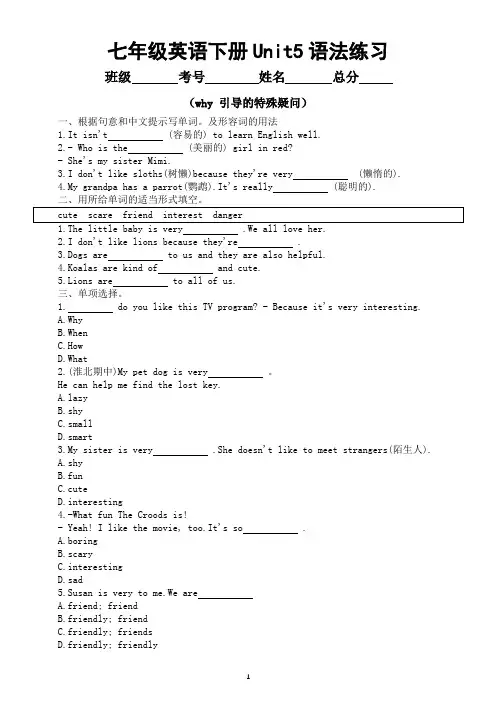
七年级英语下册Unit5语法练习班级考号姓名总分(why 引导的特殊疑问)一、根据句意和中文提示写单词。
及形容词的用法1.It isn't (容易的) to learn English well.2.- Who is the (美丽的) girl in red?- She's my sister Mimi.3.I don't like sloths(树懒)because they're very (懒惰的).4.My grandpa has a parrot(鹦鹉).It's really (聪明的).1.The little baby is very .We all love her.2.I don't like lions because they're .3.Dogs are to us and they are also helpful.4.Koalas are kind of and cute.5.Lions are to all of us.三、单项选择。
1. do you like this TV program? - Because it's very interesting.A.WhyB.WhenC.HowD.What2.(淮北期中)My pet dog is very 。
He can help me find the lost key.zyB.shyC.smallD.smart3.My sister is very .She doesn't like to meet strangers(陌生人).A.shyB.funC.cuteD.interesting4.-What fun The Croods is!- Yeah! I like the movie, too.It's so .A.boringB.scaryC.interestingD.sad5.Susan is very to me.We areA.friend; friendB.friendly; friendC.friendly; friendsD.friendly; friendly四、根据所给汉语提示完成句子,每空一词。
人教新目标七年级英语下册Unit4知识点总结和同步练习(含答案)
⼈教新⽬标七年级英语下册Unit4知识点总结和同步练习(含答案)Unit 4 Don’t eat in class.⼀、词汇拓展1.rule(复数)rules2. hallway(复数)hallways3. listen(现在分词)listening4.fight(现在分词)fighting5. outside(反义词)inside6. wear(同⾳词)where7.important(反义词)unimportant8. bring to(反义词)take to9.uniform(复数)uniforms 10.out(反义词)in 11. before(反义词)after 12.dirty (反义词)clean 13. noisy(反义词)quiet 14.relax(形容词)relaxing/relaxed15.terrible(副词)terribly 16. luck(形容词)lucky⼆、重点短语与句型1. dining hall 餐厅listen to 听in class 上课in the dining hall在餐厅don't arrive late for…=be not late for... 不要到……迟到G7BU4p192.a lot of 许多,⼤量be quiet=keep quiet安静wear a hat /the school uniform 穿着帽⼦/穿着校服bring …to… 带……到(给)……3.be on time for……准时(按时)做……4.have to,has to 不得不don't(doesn’t) have to do …=needn’t....不必做……go out 外出(娱乐) do the dishes=wash thedishes(U5)清洗餐具G7BU4p215.practice the guitar=practice playing the guitar练习弹吉它help sb. (to) do sth. 帮助某⼈做某事on school nights在夜⾃习,在晚上上课before dinner 晚饭前every Saturday /morning 每周六/每天上午G7BU4p226. make (one's) bed 铺床make breakfast 做早餐follow the rules 遵守规则be strict with+⼈对某⼈要求严格be strict in+事情对某事要求严格too many+可数名词(复数)⼤多的……leave +物品+in the kitchen 把某东西忘放在厨房be noisy 吵闹,发出噪⾳What can I do? 我该怎么办呢?think about 考虑,思考read a book 看书make rules to d o…制定规章来做…… good luck!祝你好运!G7BU4p23 7.at home 在家learn to do... 学习做…… have fun 过得⾼兴,玩得愉快keep + 宾语+形容词使……保持某种状态keep one’s hair short 某⼈留短发get sth.for sb. 替某⼈拿某物want sb. to do…想某⼈做……It's best to do…做……是最好的。
最新人教新目标版中考英语语法聚焦和练习七年级下册Unit1_6含答案
2019中考英语人教七下U1—6语法聚焦和练习及答案一、阅读理解。
A. hotel .B. supermarketC. bookshopD. bank.( )2. Aguest who forgets to bring a toothbrush with him__________.A. must buy one from the hotel.B. should get one ready by himselfC. can get one from the hotel for freeD. may ask someone to buy one for him ( )3. If guests want to get their towels changed, they should leave them______.A. on the rack.B. on the floorC. under the bedD. on the desk ( )4. The third card tells guests______.A. how to get the towels changedB. where to get the towels changedC. where to get the badcloths changedD. how to get the bedclothes changed ( )5. The purpose of the passage is to tell guests how to______________.A. follow the rules of the hotelB. get good serviceC. protect our environmentD. All above参考答案1--5 ACBDD二、教材语法聚焦1. 情态动词can, must, have to的用法(七下Unit 1, Unit 4)【基本用法】can表“能力,许可,请求”, must主观上“必须”,have to客观上“必须”。
人教版英语七年级下册语法归纳习题及答案.docx
七年下册法(一)情一、 Can情 can 有一定的,但不能独立存在,它必与原形一起构成。
情can 没有人称和数的化。
其具体用法如下:1.表示 " 能、会 ",指力或体力方面的" 能力 " 。
例如 : Jim can swim, but I can吉’姆t会.游泳,但我不会。
2.表示 " 可能 ",常用于否定句或疑句中,指某种可能性。
例如 : Han Mei can't be in the classroom. 梅不可能在教室里。
Can he come here today, please 他今天能到里来3.表示 " 可以 ",常用于口中,指可或求做某事。
例如 : Can I have a cup of tea, please 我可以喝一杯茶You can go out.你可以出去了情can 的基本句型1.肯定句型 :主 +can+原形 +其它。
例如 : They can play basketball. 他能打球。
2.否定句型 :主 +can not(can't/cannot)+ 原形 +其它。
表示 "某人不能 (不会。
不可能 )做⋯⋯"。
其中 can't 是 can not 的略式 ,英国多写成 cannot 。
3.疑句句型分 :一般疑句句型和特殊疑句句型两种型。
⑴一般疑句句型 :Can+主 +原形 +其它。
表示 " 某人会 (能。
可以 )做⋯⋯ ".其肯定答用 ""Yes,主 +can."作答 ;否定答用 "No, 主 +can't." 作答。
(注意 :答中作主的人称代,根据句中的主作相的化。
其化:第一人称 ,第二人称答 ;第二人称 ,第一人称答;第三人称 ,第三人称答。
)例如 : ①-Can you sing an English song for us 你可以我大家唱一首英歌-Yes.行。
人教新目标版2020中考英语七年级下册教材知识点梳理与练习含答案
重点单词蹈5.draw(v.)画6.speak(v.)说(某种语言);说话★7.join(v.)参加;加入8.club(n.)俱乐部;社团9.tell(v.)讲述;告诉★10.story(n.)故事;小说11.write(v.)写作;写字★12.show (n.)演出;节目(v.)给……看;展示34.work(n.& v.)工作35.funny (adj.)奇怪的;滑稽好笑的36.exercise(v.& n.)锻炼;练习★37.best(adj.)最好的(adv.)最好地;最★38.half(n.& pron.)一半;半数★39.past(prep.)晚于;过(时间)(adj.)过去的61.boat(n.)小船62.afraid(adj.)害怕;畏惧★63.leave(v.)离开;留下★64.dream(n.)梦想;睡梦(v.)做梦65.true(adj.)真的;符合事实的66.rule(n.)规则;规章67.arrive(v.)到达68.fight(v.& n.)打架;25.brush(v.)刷;刷净(n.)刷子26.tooth(n.)牙齿★27.shower(v.)淋浴 (n.)淋浴器(间)ually(adv.)通常地;一般地29.forty(num.)四十30.never(adv.)从不;绝不★49.ride(v.)骑(n.)旅程50.ninety(num.)九十51.hundred (num.)一百★52.minute(n.)分钟53.far(adv.& adj.)远;远的54.drive(v.)开车★55.live(v.)居住;生活56.stop(n.)车站;停81.feel(v.)感受;觉得★82.strict(adj.)严格的;严厉的★83.remember (v.)记住;记起84.follow(v.)遵循;跟随85.luck(n.)幸运;运气★86.learn(v.)学习;学会★→teeth(复数)5.life(n.)生活;生命→lives(复数)6.far(adj.& adv.)远;远的→farther/further(比较级)→farthest/furthest(最高级)7.cross(v.)穿过→across(prep.)穿过→crossing(n.)十字路口12.fun(adj.& n.)有趣的;乐趣→funny(adj.)有趣的;滑稽好笑的ual(adj.)寻常的→usually(adv.)通常地→unusual(形容词的反义词)不寻常的;与众不同的19.ride(v.)骑→rode(过去式)→ridden(过去分词)20.draw(v.)画画→drew(过去式)→drawn(过去分词)21.speak(v.)说(某种语言);说话→spoke(过去式)→spoken(过去分词)→speaker(n.)发言人重点短语chess2.说英语speakEnglish3.擅长于……be goodat…4.跟……说talk to…5.敲鼓play the drums6.拉小提琴play theviolin7.弹钢琴play thepiano8.弹吉他play thehelp(sb.) with sth.14.(在)周末on theweekend15.起床get up16.穿上衣服getdressed17.洗淋浴take ashower18.听……listen to…19.广播电台radiostation20.(在)周末onsubway26.骑自行车ride abike27.每天every day28.骑自行车by bike29.认为think of30.在……和……之间between…and…31.实现;成为现实cometrue32.准时(be) on time33.餐厅dining hall重点句子—I want to join the chessclub.我想参加象棋俱乐部.3.You are very __good__at__telling stories.你非常擅长讲故事。