
2012年英语六级模拟试卷
大学英语六级考试预测卷(一)Part ⅠWriting (30 minutes)Directions: For this part, you are allowed 30 minutes to write a short essay entitled Is It Appropriate for College Students to Rent Apartments Outside Campus? You should write at least 150 words following the outline given below:1. 简单说明目前大学生在外租房情况2. 对这种情况进行利弊分析3. 根据利弊分析得出结论,表明观点Part ⅡReading Comprehension (15 minutes)Directions:In this part,you will have 15 minutes to go over the passage quickly and answer the questions on Answer Sheet 1.For questions 1-4,markY(for YES)if the statement agrees with the information given in the passage;N(for NO)if the statement contradicts the information given in the passage;NG(for NOT GIVEN)if the information is not given in the passage.For questions 5-10,complete the sentences with the information given in the passage.Reading for LifeToday is the first day of the rest of your life. How can reading fill it to overflowing with adventure, richness, and fullness?Your Pleasure-giving SkillSkills are skills. Pleasures are pleasures. But some skills are lasting pleasures. Such is reading. Listen to Hazilitt—“The greatest pleasure in life is that of reading.” Or Macauly—“I would rather be a poor man in a garret with plenty of books than a king who did not love reading.” To them and countl ess others allover the world, reading is a source of the deepest and fullest enjoyment. That’s true from early school days to days of leisure and retirement.Your Fountain of YouthReading is more than that. It can be your fountain of youth. Virginia Woolf said, “The true reader is essentially young.” One of your major problems is how to stay alive as long as you live. Some die at 30 but are not buried until they’re 70. With some, youth slips away before being properly savored. Reading provides a spring of living water, refreshing and life-giving. Stay young for life with reading.Your Dream-fulfillment AidPart of youth lies in dreaming—dreaming impossible dreams that you can sometimes make possible. Robert F. Kennedy said this,“Some men see things as they are and say ‘Why?’ I dream things that never were and say ‘Why not?’” Certain books push the boundaries of the human mind out beyond belief. After all, a little bit of greatness hides in everyone. Let books bring it into full bloom.Your Know-thyself AidWhat’s your most important quest? Finding yourself. Finding your own identity. The Greeks epitomized that problem in two words: Know thyself. Well, articles and books help in that all important search. They supply assurance of the power and worth of your own life, a measure of your possibilities.To see yourself in proper perspective, you need detailed picture of real people in real situations. We need to see three-dimensional characters, with all the typical human fears and limitations. Then, and only then, can you begin to see and know yourself as you should.Your Vocational Counselor and ConsultantWhat about practical questions, such as those about your vocation? Will reading help you decide more intelligently what to do, how to prepare yourself and how to succeed on the job?To answer the first question, you have to know your own talents, abilities, and interests well.You must also, however, know the opportunities in the world aroundyou. Some Bureau of Labor Statistics, for example, predicted a surplus of approximately two million school teachers. Still another source indicated that right now “the health fields are the only fields in which we have shortages.” Balance such information with self-knowledge and you have some of the ingredients needed to make intelligent, perceptive choices.Second, you’ve decided on a career. How and where do you get the required preparation? Again, turn to reading. You’ll probably find a listing of school programs to choose from. You may e ven find them rated. If so, you’ll know exactly where to go for the best possible preparation.Third, don’t stop yet. You’ve selected a career and trained yourself. Learn on reading now to help you succeed on the job. A variety of magazines and books will provide guidance and help.But that’s not all. The day of only one lifetime career may be almost over. All too often, change throws hundreds out of work. Change hits the aircraft industry, for example. Result? Hundreds of well-qualified engineers suddenly out on the street.If you manage things well, keeping a close eye on changing conditions. You can avoid the pain of waking up to find yourself out of a job. Through reading develop some new skills and interests. Then if conditions change, you can slip with comparative ease from one field into another, hardly breaking stride.Most of the things taught in school—typing, shorthand, key punching, language, farming, business management—are readily available in interesting self-help articles and books. Let them smooth your path in any new direction you decide to take.Your Experience ExtenderWhat’s the best teacher? Experience, of course! It’s priceless. It comes from what you yourself have seen, heard, tasted, smelled, and felt — what you yourself have lived through.Take a closer look. Look at our limitations. No wonder experience is so precious. We can’t begin to get enough of it. We can’t even experience again what we justlived through. We’re not born with instant replay. We can’t actually relive any moment. And, obviously, we’re limited to one lifetime.Space and time! How they limit us. Who has a time machine to carry him back into history? No one. It’s the same with space. We can’t literally be in two places at the same time. Right now you can’t be sitting where you are and at the same time be strolling down the famed Champs Elysees in Paris.Here’s where reading fits. It can bring us almost unlimited additional experience. To be sure, it’s secondhand experience. But it’s often so vivid that it seems firsthand, just as if we’re living through it ourselves, being moved to tears, laughter, or suspense. That rich range of experience provides the ideal supplement to our own limited experience. In this way, reading becomes one of our most profound mind-shaping activities.Furthermore, all this experience is available when we want it. Books never impose on us. When we want them, we reach out and pull them off the shelf or table. At our convenience we invite them to share their unbelievable wealth with us.Carlyle sums this all up nicely,“All that mankind has done, thought, gained, or been; it is lying as in magic preservation in the pages of books.” Help yourself! Make reading your experience-extender for the rest of your life.1. According to the passage, reading is the lasting pleasure.2. Reading provides all the people in the world with a source of deepest and fullest enjoyment.3. Reading is a fountain of youth in that one can always learn something new from books and never cease to be young in spirit.4. The passage explains how books help fulfill your long-cherished dreams.5. To find your own identity simply means .6. To make an intelligent decision on what to do, you should have an adequate knowledge of your own .7. According to the author, reading is even after you have selected a career and trained yourself.8. You should develop some new skills and interests with the help of books in order to prepare for .9. Though our experience is limited by , reading can bring us unlimited additional secondhand experience.10. Carlyle calls on people to make reading their for the rest of their life.Part ⅢListening Comprehension(35 minutes)Section ADirections: In this section,you will hear 8 short conversations and 2 long conversations.At the end of each conversation,one or more questions will be asked about what was said.Both the conversation and the questions will be spoken only once.After each question there will be a pause. During the pause,you must read the four choices marked A),B),C)and D),and decide which is the best answer.Then mark the corresponding letter on Answer Sheet 2 with a single line through the centre.11. A) He feels very excited. B) He feels very happy.C) He feels very angry. D) He feels very sorry.12. A) Reading newspaper. B) Watching television.C) Discussing a sports program. D) Listening to the music.13. A) At a railway station. B) At an airport.C) On an airplane. D) At a bus stop.14. A) To go to study. B) To play computer games.C) To ask for his father’s permission. D) To be quiet and not to disturb his father.15. A) A film. B) A book. C) A fencing match. D) A popular singer.16. A) The woman is sati sfied with the man’s apologies.B) The woman forgives the man’s negligence.C) The woman is not at all pleased with the man’s apologies.D) The woman doesn’t need the man’s apologies.17. A) The students will take an English exam tomorrow morning.B) The students will attend a meeting.C) The teacher postponed the meeting.D) There won’t be an exam this afternoon.18. A) The man doesn’t want to pay for the room.B) The man likes smoking.C) The man wants to have a non-smoking room.D) There’s no more room in the hotel.Conversation One19. A) A giant ocean wave. B) A kind of food.C) A bus. D) A Japanese person.20. A) There will be an eastward ocean current.B) There will be a westward ocean current.C) They would be swallowed up by the ocean waves.D) They would be able to eat fish.21. A) Cool. B) Calm. C) Dangerous. D) Frightening.22. A) An earthquake. B) A volcano.C) A landside. D) A warm current.Conversation Two23. A) He never took illegal commissions.B) He sold the company’s products at higher prices.C) He sold more of the company’s products than other salespeople.D) He is getting along well with his colleagues.24. A) He knows more customers than any other employees.B) Only he knows how to get a certain large contract.C) He used to be a manager of a large company.D) A relative of his is the manager of a large company.25. A) She mistook the man for Carl Smith.B) She raised the man’s pay by mistake.C) She praised the wrong person.D) She almost fired the wrong person.Section BDirections:In this section,you will hear 3 short passages.At the end of each passage,you will hear some questions.Both the passage and the questions will be spoken only once.After you hear a question,you must choose the best answer from the four choices marked A),B),C)and D).Then mark the corresponding letter on Answer Sheet 2 with a single line through the centre.Passage OneQuestions 26 to 29 are based on the passage you have just heard.26. A) The Federal agencies. B) The religious groups.C) The state and local governments. D) The school board of trustees.27. A) 12. B) 16. C) 18. D) 20.28. A) Most of them are operated by religious groups.B) Most of them do not receive government money.C) They must be approved by the local government.D) They can be found in all states and territories.29. A) One million. B) Four million.C) Six million. D) Forty-six million.Passage TwoQuestions 30 to 32 are based on the passage you have just heard.30. A) Aggressive behaviour exhibited by birds and mammals.B) The control of the larger animals over the small ones.C) A geographical area that an animal claims dominance.D) A place with a centre and extending over its outer limits.31. A) The larger dog has left the territory.B) The larger dog has calmed down.C) He realizes that the larger dog is stronger.D) He is not supposed to exceed the limits.32. A) They grow larger and stronger.B) They exhibit greater stress and anxiety.C) They begin to establish their own territories.D) They exert dominance over others’ territories.Passage ThreeQuestions 33 to 35 are based on the passage you have just heard.33. A) More than 500. B) More than 250.C) 193. D) One-third of Chinese cities.34. A) Making reasonable development plans.B) Building effective operated infrastructure.C) Continuing the improvement of the city environment.D) Treating industrial waste.35. A) More and more cities appear.B) There are increasing complaints about environmental problems.C) More and more people pour into cities.D) One-third of industrial sewage in the cities went untreated.Section CDirections:In this section,you will hear a passage three times.When the passage is read for the first time,you should listen carefully for its general idea.When the passage is read for the second time,you are required to fill in the blanks numbered from 36 to 43 with the exact words you have just heard.For blanks numbered from 44 to 46 you are required to fill in the missing information.For these blanks,you can either use the exact words you have just heard or write down the main points in your own words.Finally,when the passage is read for the third time,you should check what you have written.Over a century after it ended, the Civil War remains the (36) turning point in American history. It produced a loss of life (37) in the American experience. The 620,000 combatants who (38) in the conflict nearly outnumber those who died in all other American wars (39) .The conflict also (40) affected the future course of national development. In the physical (41) it brought to the South, the economic changes it producedthroughout the nation, the new technologies it (42) , and the new ideas it spawned, the war (43) the lives of several generations of Americans.Slavery lay at the root of the crisis that produced the Civil War. During the first half of the nineteenth century, (44) . As the South united in defense of a way of life based on slavery, the North increasingly celebrated the superiority of free labor.(45)The North went to war to preserve the Union after eleven Southern states seceded in 1860 and 1861. In time, the conflict became a struggle to destroy slavery and emancipate African Americans in bondage.(46) .Yet the war left it to the future generations to confront the legacies of slavery and to embark on the still unfinished struggle for racial justice.Part ⅣReading Comprehension(Reading in Depth)(25 minutes)Section ADirections:In this section,there is a short passage with 5 questions or incomplete statements.Read the passage carefully.Then answer the questions or complete the statements in the fewest possible words on Answer Sheet 2.Questions 47 to 51 are based on the following passage.For most people, shopping is still a matter of wandering down the high street or loading a cart in a shopping mall. Soon, that will change. Electronic commerce is growing fast and will soon bring people more choice. There will, however, be a cost:Protecting the consumer from fraud will be harder. Many governments therefore want to extend highstreet regulations to the electronic world. But politicians would be wiser to see cyberspace as a basis for a new era of corporate self-regulation.Consumers in rich countries have grown used to the idea that the government takes responsibility for everything from the stability of the banks to the safety of the drugs, or their rights to refund(退款) when goods are faulty. But governments cannot enforce national laws on businesses whose only presence in their country is on the screen. Other countries have regulators, but the rules of consumer protection differ, as does enforcement. Even where a clear right to compensation exists, the onlinecatalogue customer in Tokyo, say, can hardly go to New York to extract a refund for a dud purchase.One answer is for governments to cooperate more: to recognize each other’s ru les. But that requires years of work and volumes of detailed rules. And plenty of countries have rules too fanciful for sober states to accept. There is, however, an alternative. Let the electronic businesses do the “regulation” themselves. They do, after all, have a self-interest in doing so.In electronic commerce, a reputation for honest dealing will be a valuable competitive asset. Governments, too, may compete to be trusted. For instance, customers ordering medicines online may prefer to buy from the United States because they trust the rigorous screening of the Food and Drug Administration; or they may decide that the FDA’s rules are too strict, and buy from Switzerland instead.Consumers will need to use their judgment. But precisely because the technology is new, electronic shoppers are likely for a while to be a lot more cautious than consumers of the normal sort—and the new technology will also make it easier for them to complain noisily when a company lets them down. In this way, at least, the advent of cyberspace may argue for fewer consumer protection laws, not more.47. What can people benefit from the fast-growing development of electronic commerce?48. When goods are faulty, consumers in rich countries tend to think that it is who takes responsibility for everything.49. In the author’s view, why do businesses place a high premium on honest dealing in the electronic world?50. We can infer from the passage that in licensing new drugs the FDA in the United States is .51. We can learn from the passage that are probably more cautious than consumers of the normal sort when buying things.Section BDirections:There are 2 passages in this section.Each passage is followed by some questions or unfinished statements.For each of them there are four choices marked A),B),C)and D).You should decide on the best choice and mark the corresponding letter on Answer Sheet 2 with a single line through the centre.Passage OneQuestions 52 to 56 are based on the following passage.Some people say that the study of liberal arts is a useless luxury we can not afford in hard times. Students, they argue, who do not develop salable skills will find it difficult to land a job upon graduation. But there is a problem in speaking of “salable skills”. What skills are salable? Right now, skills for making automobiles are not highly salable, but they have been for decades and might be again. Skills are another example of varying salability, as the job market fluctuates. What’s more, if one wants to build a curriculum exclusively on what is salable, one will have to make the courses very short and change them very often, in order to keep up with the rapid changes in the job market. But will not the effort be in vain? In very few things can we be sure of future salability, and in a society where people are free to study what they want, and work where they want, and invest as they want, there is no way to keep supply and demand in labor in perfect accord.A school that devotes itself totally to salable skills, especially in a time of high unemployment, sending young men and women into the world armed with only a narrow range o f skills, is also sending lambs into the lion’s den. If those people gain nothing more from their studies than supposedly salable skills, and can’t make the sale because of changes in the job market, they have been cheated. But if those skills were more than salable, if study gave them a better understanding of the world around them and greater adaptability in a changing world, they have not been cheated. They will find some kind of job soon enough. Flexibility, and ability to change and learn new things, is a valuable skill. People who have learned how to learn can learn outside of school. That is where most of us have learned to do what we do, not in school. Learning to learn is one of the highest liberal skills.52. From the passage, we can learn that the author is in favor of .A) teaching practical skills that can be sold in the current job marketB) a flexible curriculum that changes with the timesC) a liberal educationD) keeping a balance between the supply and demand in the labor market53. The word “fluctuate”(Line 5,Para.1) most probably means .A) remain steady B) change in an irregular wayC) follow a set pattern D) become worse and worse54. According to the author, who of the following is more likely to get a job in times of high unemployment?A) A person with the ability to learn by himself.B) A construction worker.C) A car repairman.D) A person with quite a few salable skills.55. According to the author, in developing a curriculum school should .A) predict the salability of skills in the future job marketB) take the current job market into considerationC) consider what skills are salableD) focus on the ability to adapt to changes56. We can learn from the passage that .A) liberal arts education is being challenged nowB) schools that teach practical skills fare better during hard timesC) extracurricular activities are more important than classroom learningD) many students feel cheated by the educational systemPassage TwoQuestions 57 to 61 are based on the following passage.Over the past decade, American companies have tried hard to find ways to discourage senior from feathering their own nests at the expense of their shareholders. The three most popular reforms have been recruiting more outside directors in order to make boards more independent, linking bosses’pay to various performance measures, and giving bosses share options, so that they have the same long-term interests as their shareholders.These reforms have been widely adopted by American’s larger companies, and surveys suggest that many more companies are thinking of following their lead. But have they done any good? Three papers presented at the annual meeting of the Academy of Management in Boston this week suggest not. As is usually the case with boardroom tinkering, the consequences have differed from those intended.Start with those independent boards. On the face of it, dismissing the boss’s friends from the board and replacing them with outsiders looks a perfect way to make senior managers more accountable. But that is not the conclusion of a study by Professor James Westphal. Instead, he found that bosses with a boardroom full of outsides spend much of their time building alliances, doing personal favors and generally pleasing the outsiders.All too often, these seductions succeed. Mr.Westphal found that, to a remarkable degree, “independent” boards pursue strategies that are likely to favor senior managers rather than shareholders. Such companies diversify their business, increase the pay of executives and weaken the link between pay and performance.To assess the impact of performance related pay, Mr.Westphal asked the bosses of 103 companies with sales of over $1 billion what measurements were used to determine their pay. The measurements varied widely, ranging from sales to earnings per share. But the researcher’s big discovery was that bosses attend to measures that affect their own incomes and ignore or play down other factors that affect a c ompany’s overall success.In short, bosses are quick to turn every imaginable system of corporate government to their advantage—which is probably why they are the people who areput in charge of things. Here is a paradox for the management theorists: any boss who cannot beat a system designed to keep him under control is probably not worth having.57. What is the purpose of the large companies in recruiting outsiders and putting them on the board of directors?A) To diversify the business of the corporation.B) To enhance the cooperation between the senior managers and the board directors.C) To introduce effective reforms in business management.D) To protect the interests of the shareholders.58. What does Professor James Westphal’s study sug gest?A) Boardroom reforms have failed to achieve the desired result.B) Outside board directors tend to be more independent.C) With a boardroom full of outsiders, senior managers work more conscientiously.D) Cooperation between senior managers and board directors suffered from the reforms.59. The word “seduction”(Line 1,Para.4) probably means “ ”.A) efforts to conquerB) attempts to win overC) endeavors to increase profitsD) exertions to understand60. Which of the following statements is true?A) Corporate executives in general are worth the high pay they receive.B) The income of corporate executives is proportional to the growth of corporate profits.C) Corporate executives tend to take advantage of their position to enrich themselves.D) The performance of corporate executives affects their own interests more than those of the shareholders.61. How does the author feel about the efforts to control senior executives?A) Doubtful. B) Optimistic. C) Positive. D) Approving.Part ⅤError Correction(15 minutes)Directions:This part consists of a short passage.In this passage,there are altogether 10 mistakes,one in each numbered line.You may have to change a word,add a word or delete a word.Mark out the mistakes and put the corrections in the blanks provided.If you change a word,cross it out and write the correct word in the corresponding blank.If you add a word,put an insertion mark(∧)in the right place and write the missing word in the blank.If you delete a word,cross it out and put a slash(/)in the blank.Conflict is a necessary element in fiction. Indeed, it isthe backbone of a story; it is conflict that gives us the senseof a story going somewhere.The conflict in a story must first be obvious importance 62to the characters involved. We can illustrate this byreference to experience. All of us face constant conflicts ourdaily lives—whenever we cross a street, for example, orwhenever the alarm goes off and we have to get up for aclass. Most of our conflicts are easily resolved—we wait fortraffic and then cross the street without fear, or we shut off the alarm, get up, and after two cups of coffee forget our pain. Furthermore, we also experience conflicts that are not 63 easily resolved. All of us, for example, are faced almostdaily with conflicts which have some kind of a permanenteffect to us—which alter our basic values or our conception 64 of human nature. Should we report the fellow student whomwe look cheating on an examination? Should we pad (虚报) 65our accounts for books and supplies in that letter home—particularly since we know that father cheats a little here and there on his income-tax returns? None of us have 66 witnessed teachers or ministers or high public officials preach one thing and practice other. All of us have found 67 ourselves in that most common of all dilemmas—the choice between holding to a set of moral and ethical convictionsand violate them in order to be accepted by our group. 68 These are the kinds of conflicts which we find fiction; and 69 because they are of this nature, we call fictional conflicts crisis situations. We mean by this that as a result of a given conflict, the character or characters involving will never 70 again be quite the same people that they are before the 71incident occurred.Part ⅥTranslation(5 mi nutes)Directions:Complete the following sentences on Answer Sheet 2 by translating into English the Chinese given in brackets.72. If I had (足够的钱,我会毫不犹豫地买一辆名牌车).73. With tears in her eyes, the mother (看着吸毒成瘾的女儿被带上了警车).74. After the outbreak of the infectious disease, all the citizens (被警告暂时取消任何旅行计划).75. Nowadays, the young people prefer to correspond with each other (通过发电子邮件而不是写信).76. It must be kept in mind that (你只有通过终身学习才能在这个竞争激烈的社会中生存).。
2012年6月大学英语六级考试CET6真题及答案解析word版本
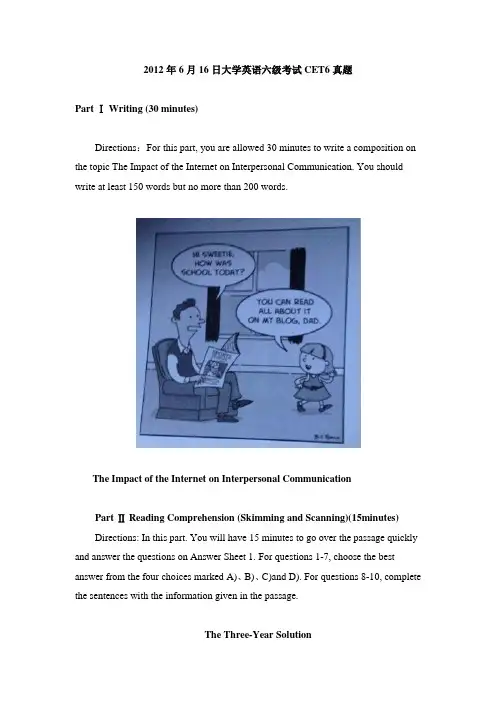
2012年6月16日大学英语六级考试CET6真题Part Ⅰ Writing (30 minutes)Directions:For this part, you are allowed 30 minutes to write a composition on the topic The Impact of the Internet on Interpersonal Communication. You should write at least 150 words but no more than 200 words.The Impact of the Internet on Interpersonal CommunicationPart Ⅱ Reading Comprehension (Skimming and Scanning)(15minutes)Directions: In this part. You will have 15 minutes to go over the passage quickly and answer the questions on Answer Sheet 1. For questions 1-7, choose the best answer from the four choices marked A)、B)、C)and D). For questions 8-10, complete the sentences with the information given in the passage.The Three-Year SolutionHartwick College, a small liberal-arts school in upstate New York, makes New York, makes this offer to well prepared students: earn your undergraduate degree in three years instead of four, and save about 543,000—the amount of one year’s tuition and fees. A number of innovative colleges are making the same offer to students anxious about saving time and money. That’s both an opportunity and a warning for the best higher-education system in the world.The United States has almost all of the world’s best universities. A recent Chinese survey ranks 35 American universities among the top 50, eight among the top 10. Our research universities have been the key to developing the competitiveadvan tages that help Americans produce 25% of all the world’s wealth. In 2007, 623,805 of the world’s brightest students were attracted to American universities.Yet, there are signs of peril (危险)within American higher education. U.S. colleges have to compete in the marketplace. Students may choose among 6,000 public, private, nonprofit, for profit, or religious institutions of higher learning. In addition, almost all of the 532 billion the federal government provides for university research is awarded competitively.But many colleges and universities are stuck in the past. For instance, the idea of the fall-to-spring“school year”hasn’t changed much since before the American Revolution, when we were a summer stretch no longer makes sense. Former George Washington University president Stephen Trachtenberg estimates that a typical college uses its facilities for academic purposes a little more than half the calendar year.“While college facilities sit idle, they continue to generate maintenance expenses that cont ribute to the high cost of running a college,” he has written.Within academic departments, tenure(终身职位),combined withage-discrimination laws, makes faculty turnover—critical for a university to remain current in changing times—difficult. Instead of protecting speech and encouraging diversity and innovative thinking, the tenure system often stifles(压制)them: younger professors must win the approval of established colleagues for tenure, encouraging like-mindedness and sometimes inhibiting the free flow of ideas.Meanwhile, tuition has soared, leaving graduating students with unprecedented loan debt. Strong campus presidents to manage these problems are becoming harder to find, and to keep. In fact, students now stay on campus almost as long as their presidents. The average amount of time students now take to complete an undergraduate degree has stretched to six years and seven months as students interrupted by work, inconvenienced by unavailable classes, or lured by one more football season find it hard to graduate.Congress has tried to help students with college costs through Pell Grants and other forms of tuition support. But some of their fixes have made the problem worse. The stack of congressional regulations governing federal student grants and loans now stands twice as tall as I do. Filling out these forms consumes 7% of every tuition dollar.For all of these reasons, some colleges like Hartwick are rethinking the old way of doing things and questioning decades-old assumptions about what a college degree means. For instance, why does it have to take four years to earn a diploma? This fall, 16 first-year students and four second-year students at Hartwick enrolled in the school’s new three year degree program. According to the college, the plan is designed for high-ability, highly motivated student who wish to save money or to move along more rapidly toward advanced degrees.By eliminating that extra year, there year degree students save 25% in costs. Instead of taking 30 credits a year, these students take 40. During January, Hartwick runs a four week course during which students may earn three to four credits on or off campus, including a number of international sites. Summer courses are not required, but a student may enroll in them—and pay extra. Three year students get first crack at course registration. There are no changes in the number of courses professors teach or in their pay.The three-year degree isn’t a new idea. Geniuses have always breezed through. Judson College, a 350-student institution in Alabama, has offered students athree-year option for 40 years. Students attend “short terms” in May and June to earnthe credits required for graduation. Bates College in Maine and Ball State University in Indiana are among other colleges offering three-year options.Changes at the high-school level are also helping to make it easier for many students to earn their undergraduate degrees in less time. One of five students arrives at college today with Advanced Placement (AP) credits amounting to a semester or more of college level work. Many universities, including large schools like the University of Texas, make it easy for these AP students to graduate faster.For students who don’t plan to stop with an undergraduate degree, the three-year plan may have an even greater appeal. Dr. John Sergent, head of Vanderbilt University Medical School’s residency (住院医生) program, enrolled in Vanderbilt’s undergraduate college in 1959. He entered medical school after only three years as did four or five of his classmates.” My first year of medical school counted as my senior year, which meant I had to take three to four labs a week to get all my sciences in. I basically skipped my senior year,” says Sergent. He still had time to be a student senator and meet his wife.There are, however, drawbacks to moving through school at such a brisk pace. For one, it deprives students of the luxury of time to roam (遨游) intellectually. Compressing everything into three years also leaves less time for growing up, engaging in extracurricular activities, and studying abroad. On crowded campuses it could mean fewer opportunities to get into a prized professor’s class. Iowa’s Waldorf College has graduated several hundred students in its three-year degree program, but it now phasing out the option. Most Waldorf students wanted the full four-year experience—academically, socially, and athletically. And faculty members will be wary of any change that threatens the core curriculum in the name of moving students into the workforce.“Most high governmental officials seem to conceive of education in this light—as a way to ensure economic competitiveness and continued economic growth,” Derek Bok, former president of Harvard, told The Washington Post. “I strongly disagree with this ap proach.” Another risk: the new campus schedules mighteventually produce less revenue for the institution and longer working hours for faculty members.Adopting a three-year option will not come easily to most school. Those that wish to tackle tradition and make American campus more cost-conscious may find it easier to take Trachtenberg’s advice: open campuses year-round.“You could run two complete colleges, with two complete faculties,”he says.“That’s without cutting the length of students’ vacations, in creasing class sizes, or requiring faculty to teach more.”Whether they experiment with three-year degrees, offer year-round classes, challenge the tenure system—or all of the above—universities are slowly realizing that to stay competitive and relevant they must adapt to a rapidly changing world.Expanding the three-year option may be difficult, but it may be less difficult than asking Congress for additional financial help, asking legislators for more state support, or asking students even higher tuition payments. Campuses willing to adopt convenient schedules along with more focused, less-expensive degrees may find that they have a competitive advantage in attracting bright, motivated students. These sorts of innovations can help American universities avoid the perils of success.注意:此部分试题请在答题卡1上作答。
2012六级模拟测试卷(三)

大学英语六级模拟测试卷(三)Part I Writing (30 minutes)Directions: For this part, you are allowed 30 minutes to write a composition on the topic: Overseas Study at an Early Age. You should write at least 150 words following the outline given below:1. 目前很多父母在子女高中毕业前就送他们出国学习2. 形成这种趋势的原因3. 我对此的看法Overseas Study at an Early Age_____________________________________________________________________ _____________________________________________________________________ _____________________________________________________________________ _____________________________________________________________________ _____________________________________________________________________ _____________________________________________________________________ _____________________________________________________________________ _____________________________________________________________________ _____________________________________________________________________ _____________________________________________________________________ _____________________________________________________________________ _____________________________________________________________________ _____________________________________________________________________ _____________________________________________________________________ _____________________________________________________________________ _____________________________________________________________________ _____________________________________________________________________ _____________________________________________________________________ _____________________________________________________________________Part II Reading Comprehension (Skimming and Scanning) (15 minutes) Directions: In this part, you will have 15 minutes to go over the passage quickly and answer the questions on Answer Sheet1.Seven way to Save the World(1)Forget the old idea that conserving energy is a form of self-denial—riding bicycles, dimming the lights, and taking fewer showers. These days conservation is all about efficiency: getting the same — or better — results from just a fraction of the energy. When a slump in business travel forced Ulrich Ramer to cut costs at his family—owned hotel in Germany, he replaced hundreds of the hotel’s wasteful light bulbs, getting the same light for 80 percent less power. He bought a new water boiler with a digitally controlled pump, and wrapped insulation around the pipes. Spending about £100,000 on these and other improvements, he slashed his £90,000 fuel and power bill by £60,000. As a bonus, the hotel’s lower energy needs have reduced its annual carbon emissions by more than 200 metric tons. “For us, saving energy has been very, very pr ofitable,” he says. “And most importantly, we’re not giving up a single comfort for our guests.”(2)Efficiency is also a great way to lower carbon emissions and help slow global warming. But the best argument for efficiency is its cost—or, more precisely, its profitability. That’s because quickly growing energy demand requires immense investment in new supply, not to mention the drain of rising energy prices.(3)No wonder efficiency has moved to the top of the political agenda. On Jan. 10, the European Union unveiled a plan to cut energy use across the continent by 20 percent by 2020. Last March, China imposed a 20 percent increase in energy efficiency by 2020. Even George W. Bush, the Texas oilman, is expected to talk about energy conservation in his State of the Union speech this week.(4)The good news is that the world is full of proven, cheap ways to save energy. Here are the seven that could have the biggest impact.Insulate(5)Space heating and cooling eats up 36 percent of all the world’s energy. There’s virtually no limit to ho w much of that can be saved, as prototype “zero-energy homes” in Switzerland and Germany have shown. There’s been a surge in new ways of keeping heat in and cold out (or vice versa). The most advanced insulation follows the law of increasing returns: if you add enough you can scale down or even eliminate heating and air-conditioning equipment, lowering costs even before you start saving on utility bills. Studies have shown that green workplaces (ones that don’t constantly need to have the heat or air-conditioner running) have higher worker productivity and lower sick rates.Change Bulbs(6)Lighting eats up 20 percent of the world’s electricity, or the equivalent of roughly 600,000 tons of coal a day. Forty percent of that powers old-fashionedincandescent light bulbs — a 19th-century technology that wastes most of the power it consumes on unwanted heat.(7)Compact fluorescent lamps, or CFLS, not only use 75 to 80 percent less electricity than incandescent bulbs to generate the same amount of light, but they also last 10 times longer. Phasing old bulbs out by 2030 would save the output of 650 power plants and avoid the release of 700 million tons of carbon into the atmosphere each year.Comfort Zone(8)Water boilers, space heaters and air conditioners have been notoriously inefficient. The heat pump has altered that equation. It removes heat from the air outside or the ground below and uses it to supply heat to a building or its water supply. In the summer, the system can be reversed to cool buildings as well.(9)Most new residential buildings in Sweden are already heated with ground-source heat pumps. Such systems consume almost no conventional fuel at all. Several countries have used subsidies to jump-start the market, including Japan, where almost 1 million heat pumps have been installed in the past two years to heat water for showers and hot tubs.Remake Factories(10)From steel mills to paper factories, industry eats up about a third of the world’s energy. The opportunities to save are vast. In Ludwigsha fen, German chemicals giant BASF runs an interconnected complex of more than 200 chemical factories, where heat produced by one chemical process is used to power the next. At the Ludwigshafen site alone, such recycling of heat and energy saves the company £200 million a year and almost half its CO2 emissions. Now BASF is doing the same for new plants in China. “Optimizing (优化) energy efficiency is a decisive competitive advantage,” says BASF CEO Jurgen Hambrecht.Green Driving(11)A quarter of the world’s energy---including two thirds of the annual production of oil—is used for transportation. Some savings come free of charge: you can boost fuel efficiency by 6 percent simply by keeping your car’s tires properly inflated (充气). Gasoline-electric hybrid(混合型的) models like the Toyota Prius improve mileage by a further 20 percent over conventional models.A Better Fridge(12)More than half of all residential power goes into running household appliances, producing a fifth of the world’s carbon emissions. And that’s true even though manufacturers have already hiked the efficiency of refrigerators and other white goods by as much as 70 percent since the 1980s. According to an InternationalEnergy Agency study, if consumers chose those models that would save them the most money over the life of the appliance, they’d cut global residential power consumption (and their utility bills) by 43 percent.Flexible Payment(13)Who says you have to pay for all your conservation investments? “Energy service contractors” will pay for retrofitting(翻新改造)in return for a share of the client’s annual utility-bill savings. In Beijing, Shenwu Thermal Energy Technology Co. specialize s in retrofitting China’s steel furnaces. Shenwu puts up the initial investment to install a heat exchanger that preheats the air going into the furnace, slashing the client’s fuel costs. Shenwu pockets a cut of those savings, so both Shenwu and the client profit.(14)If saving energy is so easy and profitable, why isn’t everyone doing it? It has do with psychology and a lack of information. Most of us tend to look at today’s price tag more than tomorrow’s potential saving. That holds double for the landlord or de veloper, who won’t actually see a penny of the savings his investment in better insulation or a better heating system might generate. In many people’s minds, conservation is still associated with self-denial. Many environmentalists still push that view.(15)Smart governments can help push the market in the right direction. The EU’s 1994 law on labeling was such a success that it extended the same idea to entire buildings last year. To boost the market value of efficiency, all new buildings are required to have an “energy pass” detailing power and heating consumption. Countries like Japan and Germany have successively tightened building codes, requiring an increase in insulation levels but leaving it up to builders to decide how to meet them.(16)The most powerful incentives, of course, will come from the market itself. Over the past year, sky-high fuel prices have focused minds on efficiency like never before. Ever-increasing pressure to cut costs has finally forced more companies to do some math on their energy use.(17)Will it be enough? With global demand and emissions rising so fast, we may not have any choice but to try. Efficient technology is here now, proven and cheap. Compared with all other options, it’s the biggest, easiest and most profitable bang for the buck.1. What is said to be best way to conserve energy nowadays?A) Raising efficiency.B) Cutting unnecessary costs..C) Finding alternative resources.D) Sacrificing some personal comforts.2. What does the European Union plan to do?A) Diversify energy supply.B) Cut energy consumption.C) Reduce carbon emissions.D) Raise production Raise production efficiency.3. If you add enough insulation to your house, you may be able to __________.A) improve your work environmentB) cut your utility bills by halfC) get rid of air-conditionersD) enjoy much better health4. How much of the power consumed by incandescent bulbs is converted into light?A) A small portion.B) Some 40 percent.C) Almost half.D) 75 to 80 percent.5. Some countries have tried to jump-start the market of heat pumps by ________.A) upgrading the equipmentB) encouraging investmentsC) implementing high-techD) providing subsidies6. German chemicals giant BASF saves £200 million a year by ___________.A) recycling heat and energyB) setting up factories in ChinaC) using the newest technologyD) reducing the CO2 emissions of its plants7. Global residential power consumption can be cut by 43 percent if ________.A) we increase the insulation of walls and water pipesB) We choose simpler models of electrical appliancesC) We cut down on the use of refrigerators and other white goodsD) We choose the most efficient models of refrigerators and other white goods8. Energy service contractors profit by taking a part of clients’____________.9. Many environmentalists maintain the view that conservation has much to do with _.10. The strongest incentives for energy conservation will derive from ________.Part Ⅲ Listening Comprehension (35 minutes)Section ADirections: In this section, you will hear 8 short conversations and 2 long conversations. At the end of each conversation, one or more questions will be asked about what was said. Both the conversation and the questions will be spoken only once. After each question there will be a pause. During the pause, you must read the four choices marked A), B), C) and D), and decide which is the best answer. Then mark the corresponding letter on Answer Sheet 2 with a single line through the centre.11. A) They would rather travel around than stay at home.B) They prefer to carry cash when traveling abroad.C) They usually carry many things around with them.D) They don’t like to spend much money on traveling.12. A) The selection process was a little unfair.B) He had long dreamed of the dean’s position.C) Rod was eliminated in the selection process.D) Rod was in charge of the admissions office.13. A) Applause encourages the singer.B) She regrets paying for the concert.C) Almost everyone loves pop music.D) The concert is very impressive.14. A) They have known each other since their schooldays.B) They were both chairpersons of the Students’ Union.C) They have been in close touch by email.D) They are going to hold a reunion party.15. A) Cook their dinner.B) Rest for a while.C) Get their car fixed.D) Stop for the night.16. A) Newly-launched products.B) Consumer preferences.C) Survey results.D) Survey methods.17. A) He would rather the woman didn’t buy the blouse.B) The woman needs blouses in the colors of a rainbow.C) The information in the catalog is not always reliable.D) He thinks the blue blouse is better than the red one.18. A) The course is open to all next semester.B) The notice may not be reliable.C) The woman has not told the truth.D) He will drop his course in marketing.Questions 19 to 22 are based on the conversation you have just heard.19. A) A director of a sales department.B) A manager at a computer store.C) A sales clerk at a shopping center.D) An accountant of a computer firm.20. A) Handling customer complaints.B) Recruiting and training new staff.C) Dispatching ordered goods on time.D) Developing computer programs.21. A) She likes something more challenging.B) She likes to be nearer to her parents.C) She wants to have a better-paid job.D) She wants to be with her husband.22. A) Right away.B) In two months.C) Early next month.D) In a couple of days.Questions 23 to 25 are based on the conversation you have just heard.23. A) It will face challenges unprecedented in its history.B) It is a resolute advocate of the anti-global movement.C) It is bound to regain its full glory of a hundred years ago.D) It will be a major economic power by the mid-21st century.24. A) The lack of overall urban planning.B) The huge gap between the haves and have-nots.C) The inadequate supply of water and electricity.D) The shortage of hi-tech personnel.25. A) They attach great importance to education.B) They are able to grasp growth opportunities.C) They are good at learning from other nations.D) They have made use of advanced technologies.Section BDirections: In this section, you will hear 3 short passages. At the end of each passage, you will hear some questions. Both the passage and the questions will be spoken only once. After you hear a question, you must choose the best answer from the four choices marked A), B), C) and D). Then mark the corresponding letter on Answer Sheet 2 with a single line through the centre.Passage OneQuestions 26 to 29 are based on the passage you have just heard.26. A) She taught chemistry and microbiology courses in a college.B) She gave lectures on how to become a public speaker.C) She helped families move away from industrial polluters.D) She engaged in field research on environmental pollution.27. A) The job restricted her from revealing her findings.B) The job posed a potential threat to her health.C) She found the working conditions frustrating.D) She was offered a better job in a minority community.28. A) Some giant industrial polluters have gone out of business.B) More environmental organizations have appeared.C) Many toxic sites in America have been cleaned up.D) More branches of her company have been set up.29. A) Her widespread influence among members of Congress.B) Her ability to communicate through public speaking.C) Her rigorous training in delivering eloquent speeches.D) Her lifelong commitment to domestic and global issues.Passage TwoQuestions 30 to 32 are based on the passage you have just heard.30. A) The fierce competition in the market.B) The growing necessity of staff training.C) The accelerated pace of globalisation.D) The urgent need of a diverse workforce.31. A) Gain a deep understanding of their own culture.B) Take courses of foreign languages and cultures.C) Share the experiences of people from other cultures.D) Participate in international exchange programmes.32. A) Reflective thinking is becoming critical.B) Labor market is getting globalised.C) Knowing a foreign language is essential.D) Globalisation will eliminate many jobs.Passage ThreeQuestions 33 to 35 are based on the passage you have just heard.33. A) Red-haired women were regarded as more reliable.B) Brown-haired women were rated as more capable.C) Golden-haired women were considered attractive.D) Black-haired women were judged to be intelligent.34. A) They are smart and eloquent.B) They are ambitious and arrogant.C) They are shrewd and dishonest.D) They are wealthy and industrious.35. A) They force people to follow the cultural mainstream.B) They exaggerate the roles of certain groups of people.C) They emphasize diversity at the expense of uniformity.D) They hinder our perception of individual differences.Section CDirections: In this section, you will hear a passage three times. When the passage is read for the first time, you should listen carefully for its general idea. When the passage is read for the second time, you are required to fill in the blanks numbered from 36 to 43 with the exact words you have just heard. For blanks numbered from 44 to 46 you are required to fill in the missing information. For these blanks, you can either use the exact words you have just heard or write down the main points in your own words. Finally, when the passage is read for the third time, you should check what you have written.The ancient Greeks developed basic memory systems called mnemonics. The name is (36)_________ from their Goddess of memory “Mnemosyne”. In the ancient world, a trained memory was an (37)_________ asset, particularly in public life. There were no (38)_________ devices for taking notes, and early Greek orators(演说家) delivered long speeches with great (39)_________ because they learned the speeches using mnemonic systems.The Greeks discovered that human memory is (40)_________ an associative process—that it works by linking things together. For example, think of an apple. The (41)_________ your brain registers the word “apple”, it (42)_________ the shape, color, taste, smell and (43)_________ of that fruit. All these things are associated inyour memory with the word “apple”.(44)_____________________________________________________________. An example could be when you think about a lecture you have had. This could trigger a memory about what yo u’re talking about through that lecture, which can then trigger another memory.(45)_____________________________________________________________. An example given on a website I was looking at follows: Do you remember the shape of Austria, Canada, Belgium, or Germany? Probably not. What about Italy, though?(46)_________________________________________________________________. You made an association with something already known, the shape of a boot, and Italy’s shape could not be forgotten once you had ma de the association.Part IV Reading Comprehension (Reading in Depth) (25 minutes)Section ADirections: In this section, there is a short passage with 5 questions or incomplete statements. Read the passage carefully. Then answer the questions or complete statements in the fewest possible words. Please write your answers on Answer Sheet 2.By the mind-nineteenth century, the term "icebox" had entered the American language, but ice was still only beginning to affect the diet of ordinary citizens in the United States. The ice trade grew with the growth of cities. Ice was used in hotels, taverns(酒馆), and hospitals, and by some forward-looking city dealers in fresh meat, fresh fish, and butter. After the Civil War (1861-1865), as ice was used to refrigerate freight cars, it also came into household use. Even before 1880, half of the ice sold in New York, Philadelphia, and Baltimore, and one-third of that sold in Boston and Chicago, went to families for their own use. This had become possible because a new household convenience, the icebox, a precursor of the modern fridge, had been invented.Making an efficient icebox as not as easy as we might now suppose. In the early nineteenth century, the knowledge of the physics of heat, which was essential to a science of refrigeration, was rudimentary(未发展的). The commonsense notion that the best icebox was one that prevented the ice from melting was of course mistaken, for it was the melting of the ice that performed the cooling. Nevertheless, early efforts to economize ice included wrapping up the ice in blankets, which kept the ice from doing its job. Not until near the end of the nineteenth century did inventors achieve the delicate balance of insulation and circulation needed for an efficient icebox.But as early as 1803, and ingenious Maryland farmer, Thomas Moore, had beenon the right track. He owned a farm about twenty miles outside the city of Washington, for which the village of Georgetown was the market center. When he used an icebox of his own design to transport his butter to market, he found that customers would pass up the rapidly melting stuff in the tubs of his competitors to pay a premium price for his butter, still fresh and hard in neat, one-pound bricks. One advantage of his icebox, Moore explained, was that farmers would no longer have to travel to market at night in order to keep their produce cool.47. What is the topic of the passage?_____________________________________________________________________ 48. Where was ice used after the Civil War?_____________________________________________________________________ 49. What was essential to a science of refrigeration according to the passage?_____________________________________________________________________ 50. It can be inferred from the passage that the theoretical foundation of ice box should be that ________.51. Without an ice box, farmers had to go to the market at night because ________.Section BDirections: There are 2 passages in this section. Each passage is followed by some questions or unfinished statements. For each of them there are four choices marked A), B), C) and D). You should decide on the best choice and mark the corresponding letter on Answer Sheet 2 with a single line through the center.Passage OneQuestions 52 to 66 are based on the following passage.Racket, din clamor, noise. Whatever you want to call it, unwanted sound is America's most widespread nuisance. But noise is more than just a nuisance. It constitutes a real and present danger to people's health. Day and night, at home, at work, and at play, noise can produce serious physical and psychological stress. No one is immune to this stress. Though we seem to adjust to noise by ignoring it, the ear, in fact, never closes and the body still responds—sometimes with extreme tension, as to a strange sound in the night.The annoyance we feel when faced with noise is the most common outward symptom of the stress building up inside us. Indeed, because irritability is so apparent, legislators have made public annoyance the basis of many noise abatement(消除) programs. The more subtle and more serious health hazards associated with stresscaused by noise traditionally have been given much less attention. Nevertheless, when we are annoyed or made irritable by noise, we should consider these symptoms fair warning that other things may be happening to us, some of which may be damaging to our health.Of the many health hazards related to noise, hearing loss is the most clearly observable and measurable by health professionals. The other hazards are harder to pin down. For many of us, there may be a risk that exposure to the stress of noise increases susceptibility to disease and infection. The more susceptible among us may experience noise as a complicating factor in heart problems and other diseases. Noise that causes annoyance and irritability in healthy persons may have serious consequences for those already ill in mind or body.Noise affects us throughout our lives. For example, there are indications of effects on the unborn child when mothers are exposed to industrial and environmental noise. During infancy and childhood, youngsters exposed to high noise levels may have trouble falling asleep and obtaining necessary amounts of rest.Why, then, is there not greater alarm about these dangers? Perhaps it is because the link between noise and many disabilities or diseases has not vet been conclusively demonstrated. Perhaps it is because we tend to dismiss annoyance as a price to pay for living in the modern world. It may also be because we still think of hearing loss as only an occupational hazard.52. The phrase "immune to" (Line 3, Para. 1) are used to mean ________.A) unaffected by B) hurt byC) unlikely to be seen by D) unknown by53. The author's attitude toward noise would best be described as ________.A) unrealistic B) traditional C) concerned D) hysterical54. Which of the following best states the main idea of the passage?A) Noise is a major problem; most people recognize its importance.B) Although noise can be annoying, it is not a major problem.C) Noise is a major problem and has not yet been recognized as such.D) Noise is a major problem about which nothing can be done.55. The author condemns noise essentially because it ________.A) is against the law B) can make some people irritableC) is a nuisance D) is a danger to people's health56. The author would probably consider research about the effects noise has on people to be ________.A) unimportant B) impossibleC) a waste of money D) essentialPassage TwoQuestions 57 to 61 are based on the following passage.Freshwater life itself has never come easy in the Middle East. Ever since The Old Testament(旧约全书), God punished man with 40 days and 40 nights of rain. Water supplies here have been dwindling. The rainfall only comes in winter and drains quickly through the semiarid land, leaving the soil to bake and to thirst for next November.The region's accelerating population, expanding agriculture, industrialization, and higher living standards demand more freshwater. Drought and pollution limit its a availability. War and mismanagement waste it. Said Joyce Starr of the Global Water Summit Initiative, based in Washington, D.C. "Nations like Israel and Jordan are swiftly sliding into that zone where they are suing all the water resources available to them. They have only 15 to 20 years left before their agriculture, and ultimately their food security, is threatened."I came here to examine this crisis in the making, to investigate fears that "water wars" are imminent, that water has replaced oil as the region's most contentious commodity. For more than two months I traveled through three river valleys and seven nations—from southern Turkey down the Euphrates River to Syria, Iraq, and on to Kuwait; to Israel and Jordan, neighbors across the valley of the Jordan; to the timeless Egyptian Nile.Even amid the scarcity there are haves and have-nots. compared with the United States, which in 1990 had freshwater potential of 10,000 cubic meters (2.6 million gallons) a year for each citizen, Iraq had 5,500, Turkey had 4,000, and Syria had more than 2,800. Egypt's potential was only 1,100. Israel had 460. Jordan had a meager 260. But these are not firm figures, because upstream use of river water can dramatically alter the potential downstream.Scarcity is only one element of the crisis. Inefficiency is another, as is the reluctance of some water-poor nations to change priorities from agriculture to less water-intensive enterprises. Some experts suggest that if nations would share both water technology and resources, they could satisfy the region's population, currently 159 million. But in this patchwork of ethnic and religious rivalries, water seldom stands alone as an issue. It is entangled in the politics that keep people from trusting and seeking help from one another. Here, where water, like truth, is precious, each nation tends to find its own water and supply its own truth.As Israeli hydrology professor Uri Shamir told me:" If there is political will for。
[整理]2012年大学英语六级考试模拟试题及答案解析完整版.
![[整理]2012年大学英语六级考试模拟试题及答案解析完整版.](https://360docs-1393072327.cos.ap-beijing.myqcloud.com/b4368ed5fd0a79563d1e7266.webp)
2012年大学英语六级考试模拟试题及答案解析(完整版)Part Ⅰ Writing (30 minutes)Directions: For this part, you are allowed 30 minutes to write a short essay entitled College Students on the Job Market. You should write at least 150 words following the outline given below.1.当今大学生面临着严重的就业压力2.这一现象的产生有多方面的原因3.解决的办法College Students on the Job Market_____________________________________________________________________________ Part I Writing【写作思路】本文是关于对某种社会现象的讨论,探讨其原因,并提供解决问题的方案。
毕业生就业压力大,是目前比较热门的话题,媒体、社会以及学生本人都会时不时的讨论,所以文章难度不是很大。
文章开篇提出就业压力大的问题,毕业生越来越多,而就业市场却保持稳定,两者之间的不平衡,导致毕业生面临越来越大的就业压力。
第二段讨论出现这种问题的原因。
第一方面,从宏观上来看,整个世界的经济危机影响了就业市场;第二方面,从学校招生来看,热门专业人数过多,结果供过于求,而冷门专业学生很少,结果供不应求。
第三段针对第二段的原因,探讨相应的解决方案。
从政府的角度出发,要尽可能的采取各种手段帮助经济恢复,帮助学生就业;从个人角度出发,要学会自主选择,不追潮流,学习自己感兴趣的,努力提高自身素质,增强竞争能力。
【参考范文】More and more graduates are going out of universities and entering into the society every year while the demand on the job market remains stable. The college students are facing greater and greater pressure in job-hunting.There are many reasons behind the current phenomenon. To begin with, the economy has been confronted with depression in recent years on a global level, and it takes time for the worldwide economy to recover. What's more, there is an element of irrationality in the enrollment of the campuses. Some hot majors have enrolled too many students, and many people compete for one position after graduation, whereas the majors with little attention have few students, and more graduates are needed than the campus can supply.The solution to this problem lies with both the government as a whole and the individual in specific. The government takes whatever measures possible to help the economy recover and to create more job opportunities for the applicants. And for the individual students, it is better to study what they are interested in and to gain experience through practice, thus better prepared for the society.Part ⅡReading Comprehension (Skimming and Scanning) (15 minutes) Directions: In this part, you will have 15 minutes to go over the passage quickly and answer the questions on Answer Sheet 1. For questions 1-7, choose the best answerfrom the four choices marked A), B), C) and D). For questions 8-10, complete the sentences with the information given in the passage.Will Electronic Medical Records Improve Health Care?Electronic health records (EHRs) have received a lot of attention since the Obama administration committed $19 billion in stimulus funds earlier this year to encourage hospitals and health care facilities to digitize patient data and make better use of information technology. The healthcare industry as a whole, however, has been slow to adopt information technology and integrate computer systems, raising the question of whether the push to digitize will result in information that empowers doctors to make better-informed decisions or a morass of disconnected data.The University of Pittsburgh Medical Center (UPMC) knows firsthand how difficult it is to achieve the former, and how easily an EHR plan can fall into the latter. UPMC has spent five years and more than $1 billion on information technology systems to get ahead of the EHR issue. While that is more than five times as much as recent estimates say it should cost a hospital system, UPMC is a mammoth network consisting of 20 hospitals as well as 400 doctors' offices, outpatient sites and long-term care facilities employing about 50,000 people.UPMC's early attempts to create a universal EHR system, such as its ambulatory electronic medical records rolled out between 2000 and 2005, were met with resistance as doctors, staff and other users either avoided using the new technology altogether or clung to individual, disconnected software and systems that UPMC's IT department had implemented over the years.On the mendAlthough UPMC began digitizing some of its records in 1996, the turning point in its efforts came in 2004 with the rollout of its eRecord system across the entire health care network. eRecord now contains more than 3.6 million electronic patient records, including images and CT scans, clinical laboratory information, radiology data, and a picture archival and communication system that digitizes images and makes them available on PCs. The EHR system has 29,000 users, including more than 5,000 physicians employed by or affiliated with UPMC.If UPMC makes EHR systems look easy, don't be fooled, cautions UPMC chief medical information officer Dan Martich, who says the health care network's IT systems require a "huge, ongoing effort" to ensure that those systems can communicate with one another. One of the main reasons is that UPMC, like many other health care organizations, uses a number of different vendors for its medical and IT systems, leaving the integration largely up to the IT staff.Since doctors typically do not want to change the way they work for the sake of a computer system, the success of an EHR program is dictated not only by the presence of the technology but also by how well the doctors are trained on, and use, the technology. Physicians need to see the benefits of using EHR systems both persistently and consistently, says Louis Baverso, chief information officer at UPMC's Magee-Women's Hospital. But these benefits might not be obvious at first, he says, adding, "What doctors see in the beginning is that they're losing their ability to work with paper documents, which has been so valuable to them up untilnow."Opportunities and costsGiven the lack of EHR adoption throughout the health care world, there are a lot of opportunities to get this right (or wrong). Less than 10 percent of U.S. hospitals have adopted electronic medical records even in the most basic way, according to a study authored by Ashish Jha, associate professor of health policy and management at Harvard School of Public Health. Only 1.5 percent have adopted a comprehensive system of electronic records that includes physicians' notes and orders and decision support systems that alert doctors of potential drug interactions or other problems that might result from their intended orders.Cost is the primary factor stalling EHR systems, followed by resistance from physicians unwilling to adopt new technologies and a lack of staff with adequate IT expertise, according to Jha. He indicated that a hospital could spend from $20 million to $200 million to implement an electronic record system over several years, depending on the size of the hospital. A typical doctor's office would cost an estimated $50,000 to outfit with an EHR system.The upside of EHR systems is more difficult to quantify. Although some estimates say that hospitals and doctor's offices could save as much as $100 million annually by moving to EHRs, the mere act of implementing the technology guarantees neither cost savings nor improvements in care, Jha said during a Harvard School of Public Health community forum on September 17. Another Harvard study of hospital computerization likewise determined that cutting costs and improving care through health IT as it exists today is "wishful thinking". This study was led by David Himmelstein, associate professor at Harvard Medical School.The cost of getting it wrongThe difference between the projected cost savings and the reality of the situation stems from the fact that the EHR technologies implemented to date have not been designed to save money or improve patient care, says Leonard D'Avolio, associate center director of Biomedical Informatics at the Massachusetts Veterans Epidemiology Research and Information Center (MAVERIC). Instead, EHRs are used to document individual patients' conditions, pass this information among clinicians treating those patients, justify financial reimbursement and serve as the legal records of events.This is because, if a health care facility has $1 million to spend, its managers are more likely to spend it on an expensive piece of lab equipment than on information technology, D'Avolio says, adding that the investment on lab equipment can be made up by charging patients access to it as a billable service. This is not the case for IT. Also, computers and networks used throughout hospitals and health care facilities are disconnected and often manufactured by different vendors without a standardized way of communicating. "Medical data is difficult to standardize because caring for patients is a complex process," he says. "We need to find some way of reaching across not just departments but entire hospitals. If you can't measure something, you can't improve it, and without access to this data, you can't measure it."To qualify for a piece of the $19 billion being offered through the American Recovery and Reinvestment Act (ARRA), healthcare facilities will have to justify the significance of their IT investments to ensure they are "meaningful users" of EHRs. The Department of Health and Human Services has yet to define what it considers meaningful useAggregating info to create knowledgeIdeally, in addition to providing doctors with basic information about their patients, databases of vital signs, images, laboratory values, medications, diseases, interventions, and patient demographic information could be mined for new knowledge, D'Avolio says. "With just a few of these databases networked together, the power to improve health care increases exponentially," D'Avolio suggested. "All that is missing is the collective realization that better health care requires access to better information—not automation of the status quo." Down the road, the addition of genomic information, environmental factors and family history to these databases will enable clinicians to begin to realize the potential of personalized medicine, he added.1. In America, it is slow to adopt information technology because —————.A) the funds invested by the government is not enough in the pastB) EHRs have received less attention of the public in the pastC) whether it will be useful to doctors or not is doubtfulD) UPMC knows how difficult it is to digitize the hospital2. The University of Pittsburgh Medical Center (UPMC) —————.A) is the first medical center to adopt information technologyB) satisfy the requirement of the government on information technologyC) spent less money on information technology than it was estimatedD) attempted to created a universal EHR system, but met some difficulties3. The health care network’s IT systems require a lot of effort to ensure it can communicate with one another mainly because —————..A) the integration among different system is largely up to the IT staffB) UPMC is like many other health care organizations in the United StatesC) UPMC makes EHR systems look easyD) UMPC began digitizing some of its records in 19964. The success of the EHR program is decided by —————..A) the fact whether the information technology is available or notB) the fact how well the doctors are trained to use the information technologyC) not only the presence of the technology but the doctor’s training on technologyD) the fact whether physicians can see the benefits of using EHR systems5. The most important reason of most hospitals being reluctant to adopt EHR system is that —————.A) the cost is too high for the hospital to affordB) physicians are unwilling to adopt itC) there is a lack of staff with adequate IT expertiseD) doctor worry about its negative influence on patients6. According to the study led by David Himmelstein through health IT —————.A) it is possible to cut the costs of the hospitalB) it is possible to improve the health careC) it ensure neither cost saving nor improvement in careD) it could save as much as $100 million annually7. The hospital’s managers prefer to —————.A) spend money on an expensive piece of equipment than on information technologyB) charge patients access to the information technology as a billable serviceC) purchase the information technology to improve the health care of the hospitalD) invest more money on the training of the physicians to charge patients more money8. Jha said the mere act of implementing the technology guarantees ______________________.9. D'Avolio says the investment on lab equipment can be made up by_____________________.10. Databases of vital signs, images, laboratory values, medications, diseases, interventions, and patient demographic information could be ____________________. Part II Reading Comprehension (Skimming and Scanning)原文精译【1】给自己的事业买最好的保险消防队无意之中淹没了Mad Gab's的总部,Mad Gab's是Gabrielle Melchionda二十多年前建立的美容公司。
2012年6月英语六级考试(CET6)全真预测试卷(8)-中大网校
2012年6月英语六级考试(CET6)全真预测试卷(8)总分:710分及格:426分考试时间:140分Part I Writing(1)Directions:For this part,you are allowed 30 minutes to write a composition entitled <STRONG>On the Restraint of Spending</STRONG>. You should write at least 150 words following the outline given below:1.现在许多大学生花钱大手大脚;2.有人认为社会整体生活水平提高了,大学生花钱多一些无可厚非;3.我的观点。
Part II Reading Comprehension快速阅读 单选题(1)Directions:In this part,you will have 15 minutes to go over the passage quickly and answer the questions on Answer Sheet 1.For questions 1-7,choose the best answer from the four choices marked A),B),C)and D)。
For questions 8-10,complete the sentences with the information given in the passage.<strong>Happy Earth Day</strong><strong>The Good News</strong>Here’s the good news: our air is cleaner, our lakes are purer, our forests are healthier, endangered species are recovering, toxic emissions are down, and acid rain has diminished dramatically. And yet, if you’ve looked at a newspaper or watched the evening news lately, you might think our environment is under siege (围攻). Media Coverage of the environment is heavy on doomsday, but the truth is not at all bleak: nearly all environmental trends in the United States are positive and have been for years—if not decades.Eco-legislation, green organizations, corporate cooperation and new inventions have all quietly steered our environment in a positive direction. We can’t afford to be complacent (自满的), though—especially when it comes to greenhouse gases, since global warming is the one huge problem we haven’t really tackled. But almost every measure taken by government agencies and grass-roots efforts to improve the environment has shown encouraging results—usually faster than expected end at a lower cost. Now that’s good news.Scientists and environmentalists think that even the worrisome fact of global Warming can be ameliorated (改善). There is a strong scientific consensus that the global warming threat requires action, but if current environmental trends persist and the reduction of most pollutants continues to be accomplished faster and more cheaply than expected, we may be able to control and reduce greenhouse gases in both affordable and practical ways.Consider some of the environmental improvements the United States has witnessed over the last three decades.<strong>Improved Air Quality</strong>Take a nice, big cleansing breath. According to the Environmental Protection Agency, emissions of. the primary smog-causing chemicals from cars and trucks have declined 54 percent since 1970, even though the number of registered cars and trucks has more than doubled, from 108,407,000 to 230,428,000, and they are now driven one and a half times as far annually.Keep breathing, because the fine particulates linked to respiratory disease, including those sometimes seen as soot(煤烟), are down by about one-third since 1979 (though fewer cities were surveyed back then). The level of carbon monoxide, a dangerous odorless gas, is down53 percent since 1970. And emissions of sulfur dioxide, often the major culprit behind acid rain, are down 49 percent since 1970, despite the fact that the United States now bums far more coal, the main source of this pollutant.These improvements have translated into better air quality for millions of Americans. Between 1976 and 1990, the Los Angeles area averaged some 150 days per year in violation of federal smog standards; in 2004, that figure dropped to just 27 violation days, the fewest ever for that city.And, in case you are wondering, federal standards have become stricter, not weaker, during this period. Of course, there is more to be done—27 smog days in Los Angeles are still 27 too many, and Atlanta, Houston and other cities continue to experience air-pollution problems. But overall, air-quality trends are strongly positive. Now, exhale.<strong>Better Water Quality</strong>Other environmental trends are equally encouraging. Water quality has improved, too, and rates of waterborne disease are also in decline. It’s hard to believe, but just a generation ago, factories and municipal plants actually discharged untreated wastewater directly into rivers; today, though some raw sewage often makes it to waterways, almost all wastewater in the United States is treated before discharge.Even our largest metropolises have seen dramatic changes in their waterways. Remember when the filthy condition of Boston Harbor became a contentious issue in the 1988 presidential campaign Today, Boston Harbor is sparkling again. The Potomac River, which in the 1960s literally gave off a stench (恶臭), now boasts a thriving waterfront restaurant scene. And the Chicago River, a virtual open sewer in the 1960s, now hosts charming dinner cruises.<answer><span></span></answer><strong>Innovation Goes Green</strong>Invention has always been an important force in American history. When major reductions in automobile pollution were first mandated by the Clean Air Act of 1970, automakers either called the goals impossible or claimed that cars would become ruinously expensive. Then the catalytic converter was invented. This device reduces the level of many pollutants from automobile exhaust both cheaply and reliably.Today, it is estimated that new cars and light trucks emit just 3 to 4 percent of the amount of pollution that a new car would have emitted in 1968, before regulation; soon cars emitting less than 1 percent could be seen driving around your neighborhood.Other inventions, such as an enormous device known as the electrostatic precipitator, have reduced severe emissions from power-plant smokestacks, eliminated toxic substances from manufacturing processes, and replaced CFCs. the chemicals that cause ozone-layer depletion, with other more benign compounds. And by the way, the ozone layer appears to be restoring itself.<strong>Legislation in Action</strong>Government regulation has also been an important force in the drive to protect the environment. The mason the catalytic converter and other antipollution devices were invented in the first place is because the government required big reductions in pollution, via the Clean Air Act, Clean Water Act and other legislation. Some environmental regulation may be too cumbersome (麻烦的)and needs to be streamlined-standards can vary wildly between regions —but there isn’t any doubt that environmental regulation actually works.<strong>Citizens for Change</strong>Individual activism has been another important factor in the amazing progress we have seen in our natural world Without the continued pressure from environmentalists, antipollution legislation would not have been enacted, and many pollution-reducing devices would not have been invented. Grass-routs organizations have been particularly essential to the ongoing creation and maintenance of new parks, wildlife refuges and protected forests.<strong>Corporations Clean Up</strong>Businesses that once resisted environmental rules now generally comply. When companies started losing lawsuits regarding their chemicalemissions, the idea of toxic reduction became rather popular in corporate boardrooms. But many corporations today seem to have genuinely come to believe that environmental protection is good for the country, good for the economy and, therefore, good for business. Getting a head start on the future, several big manufacturers, such as Alcoa, Boeing and Whirlpool, have already taken steps to reduce their companies’ greenhouse gas emissions.Alcoa, for example, has initiated a plan to use improved technology to reduce its greenhouse gas emissions 25 percent by 2010. The company also has extensive tree-planting programs near many of its operations and service areas, and Alcoa helps fund environmental nonprofits. Boeing and Whirlpool, meanwhile, are working to meet emissions reduction targets even though no federal law yet requires this.Business leaders, environmentalists, regulators and inventors are working toward the same goal. That’s certainly an odd mix-not clearly Republican or Democratic, nut clearly left-wing or right-wing. And maybe that’s the biggest reason you rarely hear about environmental progress. Current trends do not fit any preconceived (预想的)ideological notions. The political left wants to believe that industry is destroying the planet, and refuses to consider the evidence that business and the environment are making peace. The political right wants to believe that regulations are destroying the country, and refuses to consider the evidence that the longest period of economic expansion in American history occurred during the very period when pollution was in the midst Of its big decline. However, today’s reality—an improving environment without economic harm— does not fit with anyone’s scare-tactic fund-raising or cheap-shot political campaigns.<strong>Miles to Go</strong>Do the positive trends mean that environmental protection is no longer a concern Absolutely not. Many problems remain, among them the loss of wildlife habitat in suburban expansion areas, chemical runoff from nearly unrestricted agriculture, and low miles-per-gallon SUVs, which cause waste by burning excessive gas. Beyond these setbacks stands the specter (幽灵)of artificially triggered climate change. Global warming may be the Super Bowl of environmental problems, since it could impact all of Earth.But just bear this in mind: in every place where nations have imposed strict environmental standards, negative trends turned to positive very quickly. Earth, after all, has proved throughout the eons (万古)to be nothing if not resilient (能复原的). This gives us good reason to hope that if we act to solve the environmental problems that still remain, we will achieve rapid progress against them too. Now that’s a reason to say Happy Earth Day!注意:此部分试题请在答题卡1上作答,8—10题在答题卡1上.阅读以上短文,回答下列问题{TS}What is the one huge problem that we haven't really solved?[A]Global warming.[B]Acid rain.[C]Toxic emission.[D]Environment.(2)Scientists and environmentalists think that global wanning call be_____________.A. continuedB. improvedC. controlledD. reduced(3)Which year is the fewest in violation of federal smog standards in Los Angeles?A. 1976B. 1979C. 1990D. 2004(4)Which of the following provides dinner cruises now?A. The Potomac RiverB. Boston HarborC. The Chicago RiverD. The Mississippi River(5)The electrostatic precipitator has got rid of___________from manufacturing processes.A. severe emissionsB. ozone-layer depletionC. many pollutantsD. toxic substances(6)There is no doubt that enviromental regulation_______________.(7)Antipollution legislations have been enacted thanks to the continued pressure from________________________.A. grass-roots organizationsB. individual activismC. environmentalistsD. environmental regulation快速阅读填空题(1)When companies started losing lawsuits regarding their chemical emissions,the idea of toxic reduction became rather popular in_________________________.(2)Boeing and Whirlpool,meanwhile,are working to meet emissions reduction targets even though_________________________.(3)This gives us good reason to hope that if we act to solve the environmental problems that still remain,we will___________________________.Part III Listening Comprehension (35 minutes)听力选择题(1)点击按钮开始播放听力音频>>{MP3:/examfiles/2012/listenfiles/201206cet6/8.mp3}Directions:In this section,you will hear 8 short conversations and 2 long conversations.At the end of each conversation,one or more questions will be asked about what was said.Both the conversation and the questions will be spoken only once;After each question there will be a pause.During the pause,you must read the four choices marked[A],[B],[C]and [D],and decide which is the best answer Then mark the corresponding letter on Answer Sheet 2 with a single line through the centen注意:此部分试题请在答题卡2上作答。
2012年6月英语CET6真题及答案

2012年6月全国大学英语六级考试试卷PartⅣReading Comprehension(Reading in Depth) (25minutes)Section ADirections: In this section, there is a short passage with 5 questions or incomplete statements. Read the passage carefully. Then answer the questions or complete the statements in the fewest possible words. Please write your answers on Answer Sheet 2Questions 47 to 51 are based on the following passage.In face of global warming, much effort has been focused on reducing greenhouse gas emissions through a variety of strategies. But while much of the research and innovation has concentrated on finding less-polluting energy alternatives, it may be decades before clean technologies like wind and solar meet a significant portion of our energy needs.In the meantime, the amount of CO2 in the air is rapidly approaching the limits proposed by the Intergovernmental Panel on Climate Change (IPCC). “As long as we’re consuming fossil fuels, we’re putting out CO2,”says Klaus Lackner, a geophysicist at Colu mbia, University” We cannot let the CO2 in the atmosphere rise indefinitely.”That sense of urgency has increased interest in capturing and storing CO2, which the IPCC says could provide the more than 50% reduction in emissions thought needed to reduce global warming.“We see the potential for capture and storage to play an integral role in reducing emissions,” says Kim Corley, Shell’s senior advisor of CO2 and environmental affairs. That forward thinking strategy is gaining support. The U.S. Department of Energy recently proposed putting $1 billion into a new $2.4 billion coal-burning energy plant. The plant’s carbon-capture technologies would serve as a pilot project for other new coal-burning plants.But what do you do with the gas once you’ve captured it? One option is to put it to new uses. Dakota Gasification of North Dakota captures CO2 at a plant that converts coal into synthetic natural gas. It then ships the gas 200 miles by pipeline to Canada, where it is pumped underground in oil recovery operations. In the Netherlands, Shell delivers CO2 to farmers who pipe it into their greenhouses, increasing their yield of fruits and vegetables.However, scientists say that the scale of CO2 emissions will require vast amounts of long-term storage. Some propose storing the CO2 in coal mines or liquid storage in the ocean, Shell favors storing CO2 in deep geological structures such as saline(盐的) formations and exhausted oil and gas fields that exist throughout the world.注意:此部分试题请在答题卡2上作答。
2012年6月大学英语六级考试CET6真题及答案解析word版本
2012年6月16日大学英语六级考试CET6真题Part Ⅰ Writing (30 minutes)Directions:For this part, you are allowed 30 minutes to write a composition on the topic The Impact of the Internet on Interpersonal Communication. You should write at least 150 words but no more than 200 words.The Impact of the Internet on Interpersonal CommunicationPart Ⅱ Reading Comprehension (Skimming and Scanning)(15minutes)Directions: In this part. You will have 15 minutes to go over the passage quickly and answer the questions on Answer Sheet 1. For questions 1-7, choose the best answer from the four choices marked A)、B)、C)and D). For questions 8-10, complete the sentences with the information given in the passage.The Three-Year SolutionHartwick College, a small liberal-arts school in upstate New York, makes New York, makes this offer to well prepared students: earn your undergraduate degree in three years instead of four, and save about 543,000—the amount of one year’s tuition and fees. A number of innovative colleges are making the same offer to students anxious about saving time and money. That’s both an opportunity and a warning for the best higher-education system in the world.The United States has almost all of the world’s best universities. A recent Chinese survey ranks 35 American universities among the top 50, eight among the top 10. Our research universities have been the key to developing the competitive advantages that help Americans produce 25% of all the world’s wealth. In 2007, 623,805 of the world’s brightest students were attracted to American universities.Yet, there are signs of peril (危险)within American higher education. U.S. colleges have to compete in the marketplace. Students may choose among 6,000 public, private, nonprofit, for profit, or religious institutions of higher learning. In addition, almost all of the 532 billion the federal government provides for university research is awarded competitively.But many colleges and universities are stuck in the past. For instance, the idea of the fall-to-spring“school year”hasn’t changed much since before the American Revolution, when we were a summer stretch no longer makes sense. Former George Washington University president Stephen Trachtenberg estimates that a typical college uses its facilities for academic purposes a little more than half the calendar year.“While college facilities sit idle, they continue to generate maintenance expenses that contribute to t he high cost of running a college,” he has written.Within academic departments, tenure(终身职位),combined withage-discrimination laws, makes faculty turnover—critical for a university to remain current in changing times—difficult. Instead of protecting speech and encouraging diversity and innovative thinking, the tenure system often stifles(压制)them: younger professors must win the approval of established colleagues for tenure, encouraging like-mindedness and sometimes inhibiting the free flow of ideas.Meanwhile, tuition has soared, leaving graduating students with unprecedented loan debt. Strong campus presidents to manage these problems are becoming harder to find, and to keep. In fact, students now stay on campus almost as long as their presidents. The average amount of time students now take to complete an undergraduate degree has stretched to six years and seven months as students interrupted by work, inconvenienced by unavailable classes, or lured by one more football season find it hard to graduate.Congress has tried to help students with college costs through Pell Grants and other forms of tuition support. But some of their fixes have made the problem worse. The stack of congressional regulations governing federal student grants and loans now stands twice as tall as I do. Filling out these forms consumes 7% of every tuition dollar.For all of these reasons, some colleges like Hartwick are rethinking the old way of doing things and questioning decades-old assumptions about what a college degree means. For instance, why does it have to take four years to earn a diploma? This fall, 16 first-year students and four second-year students at Hartwick enrolled in the school’s new three year degree program. According to the college, the plan is designed for high-ability, highly motivated student who wish to save money or to move along more rapidly toward advanced degrees.By eliminating that extra year, there year degree students save 25% in costs. Instead of taking 30 credits a year, these students take 40. During January, Hartwick runs a four week course during which students may earn three to four credits on or off campus, including a number of international sites. Summer courses are not required, but a student may enroll in them—and pay extra. Three year students get first crack at course registration. There are no changes in the number of courses professors teach or in their pay.The three-year degree isn’t a new idea. Geniuses have always breezed through. Judson College, a 350-student institution in Alabama, has offered students athree-year option for 40 years. Students attend “short terms” in May and June to earnthe credits required for graduation. Bates College in Maine and Ball State University in Indiana are among other colleges offering three-year options.Changes at the high-school level are also helping to make it easier for many students to earn their undergraduate degrees in less time. One of five students arrives at college today with Advanced Placement (AP) credits amounting to a semester or more of college level work. Many universities, including large schools like the University of Texas, make it easy for these AP students to graduate faster.For students who don’t plan to stop with an undergraduate degree, the three-year plan may have an even greater appeal. Dr. John Sergent, head of Vanderbilt University Medical School’s residency (住院医生) program, enrolled in Vanderbilt’s undergraduate college in 1959. He entered medical school after only three years as did four or five of his classmates.” My first year of medical school counted as my senior year, which meant I had to take three to four labs a week to get all my sciences in. I basically skipp ed my senior year,” says Sergent. He still had time to be a student senator and meet his wife.There are, however, drawbacks to moving through school at such a brisk pace. For one, it deprives students of the luxury of time to roam (遨游) intellectually. Compressing everything into three years also leaves less time for growing up, engaging in extracurricular activities, and studying abroad. On crowded campuses it could mean fewer opportunities to get into a prized professor’s class. Iowa’s Waldorf College has graduated several hundred students in its three-year degree program, but it now phasing out the option. Most Waldorf students wanted the full four-year experience—academically, socially, and athletically. And faculty members will be wary of any change that threatens the core curriculum in the name of moving students into the workforce.“Most high governmental officials seem to conceive of education in this light—as a way to ensure economic competitiveness and continued economic growth,” Derek Bok, former president of Harvard, told The Washington Post. “I strongly disagree with this app roach.” Another risk: the new campus schedules mighteventually produce less revenue for the institution and longer working hours for faculty members.Adopting a three-year option will not come easily to most school. Those that wish to tackle tradition and make American campus more cost-conscious may find it easier to take Trachtenberg’s advice: open campuses year-round.“You could run two complete colleges, with two complete faculties,”he says.“That’s without cutting the length of students’ vacations, inc reasing class sizes, or requiring faculty to teach more.”Whether they experiment with three-year degrees, offer year-round classes, challenge the tenure system—or all of the above—universities are slowly realizing that to stay competitive and relevant they must adapt to a rapidly changing world.Expanding the three-year option may be difficult, but it may be less difficult than asking Congress for additional financial help, asking legislators for more state support, or asking students even higher tuition payments. Campuses willing to adopt convenient schedules along with more focused, less-expensive degrees may find that they have a competitive advantage in attracting bright, motivated students. These sorts of innovations can help American universities avoid the perils of success.注意:此部分试题请在答题卡1上作答。
2012英语等级考试六级测试题
2012——2013年英语等级考试六级测试题听力部分一、听音,选出你所听到的单词。
( )1、A: 120 B: 122 C: 212 D: 102( )2、A: 4765398 B: 4567893 C: 5674983 D: 3768945( )3、A: pupil B: people C: purple D: apple( )4、A: map B: mug C: mad D: mop( )5、A: fine B: mine C: find D: nine二、听音,根据所听对话和问题,选出正确的答案。
()6、A:5:15 B: 5:05 C: 4:45 D: 5:45()7、A: a cup of tea B: a cup of water C: a cup of coffeeD: a glass of water( ) 8、A:Yes , he knows B: No ,he can’t C: Y es, h e is.D: No, he doesn’t know.( ) 9、A: It’s behind the Bank of China.B: It’s on the left side of the Bank of China.C: It’s on the right side of the Bank of China.D: It’s in front of the Bank of China.( )10、A: Y es, he does B: No, she do esn’t C: Y es , she is D: No she isn’t.三、根据你所听到的内容,将I II III栏中的相关内容连起来,只写标号。
11、Marry 1. Japanese a. 13 A: banana12、Wang Fee 2. France b. 12 B: apple13、Jack 3. China c: 14 C: orange14、Tom 4. England d: 13 D: pear四、听音,选出你听到的单词。
2012年12月英语四六级真题答案及详解(完整版)
2012年12月英语六级试题答案(完整版)Part ⅠWritingMy View on University RankingIn recent years, all kinds of University Ranking Lists can be found on some educational websites, or newspapers. The ranking standards also vary. These lists have great influence on students. They are even becoming the only scale to evaluate the colleges and universities.People hold different views toward this phenomenon. Some believe that these lists help the students a lot, especially for those who will choose their university. While some other protest vigorously. In their points, the list is really ridiculous and harmful. In my view, the university ranking may have its own reference values, but its disadvantages overweigh its values.For those university-students-to-be, they are supposed to choose the school according to his or her own situation, but not the so-called Ranking List. What’s more, how about the university students? How do they feel about themselves when they see the ranking? The list may become some intangible shackles for them if their own school ranks poorly.In a nutshell, there is no easy method to rank these universities, but the Ranking, only helps students ignore the essentials, namely, their ninety-nine percent perspiration.此次六级作文的自由度很大,看似给出了提纲,实际上具体的观点全靠个人发挥。
2012年6级模拟题1
Section ADirections: In this section, you will hear 8 short conversations and2 long conversations. At the end of each conversation, one or more questions will be asked about what was said. Both the conversation and the questions will be spoken only once. After each question there will be a pause. During the pause, you must read the four choices marked A), B), C) and D), and decide which is the best answer. Then mark the corresponding letter on Answer Sheet 2 with a single line through the centre.11.M: I don’t know what to do. I have to drive to Chicago next Friday for my cousin’s wedding, but I have got a Psychology test to prepare for.W: Why don’t you record your notes so you can study on the way?Q: What does the woman suggest the man do?12.M: Professor Wright, you may have to find another student to play this role, the lines are so long and I simply can’t remember them all.W: Look, Tony. It is still a long time before the first show. I don’t expect you to know all the lines yet. Just keep practicing.Q: What do we learn from the conversation?13.M: Hello, this is Dr. Martin from the Emergency Department. I have a male patient with a fractured ankle.W: Oh, we have one bed available in ward 3, send him here and I will take care of him.Q: What are the speakers talking about?14.W: Since Simon will graduate this May, the school paper needs a new editor. So if you are interested, I will be happy to nominate you.M: Thanks for considering me. But the baseball team is starting up a new season. And I’m afraid I have a lot on my hands.Q: What does the man mean?15. W: Have you heard the news that Jame Smeil has resigned his post as prime minister?M: Well, I got it from the headlines this morning. It’s reported that he made public at this decision at the last cabinet meeting.Q: what do we learn about Jame Smeil?16. W: The morning paper says the space shuttle is taking off at 10 a.m. tomorrow.M: Yeah, it’s just another one of this year’s routine missions. The first mission was undertaken a decade ago and broadcast live then worldwide.Q: what can we infer from this conversation?17. M: We do a lot of camping in the mountains. What would you recommend for two people? W: You’d probably be better off with the four real drive vehicle. We have several off-road trucks in stock, both new and used.Q: Where does the conversation most probably take place?18. W: I hear you did some serious shopping this past weekend.M: Yeah, the speakers of my old stereo finally gave out and there was no way to repair them.Q: What did the man do over the weekend?Conversation OneW: Now, could you tell me where the idea for the business first came from?M: Well, the original shop was opened by a retired printer by the name of Gruby. Mr Gruby being left-handed himself, thought of the idea to try to promote a few products for left-handers.W: And how did he then go about actually setting up the business?M: Well, he looked for any left-handed products that might already be on the market which were very few. And then contacted the manufactures with the idea of having products produced for him, mainly in the scissors range to start with.W: Right. So you do commission some part of your stock.M: Yes, very much so. About 75 percent of our stock is specially made for us.W: And the rest of it?M: Hmm, the rest of it now, some 25, 30 years after Mr. Gruby’s initial efforts, there are more left-handed product actually on the market. Manufactures are now beginning to see that there is a market for left-handed products.W: And what’s the range of your stock?M: The range consists of a variety of scissors from children scissors to scissors for tailors, hairdressers etc. We also have a large range of kitchen ware.W: What’s the competition like? Do you have quite a lot of competition?M: There are other people in the business now in specialists, but only as mail-order outlets. But we have a shop here in central London plus a mail-order outlet. And we are without any doubt the largest supplier of the left-handed items.Q19: What kind of business does the man engaged in?Q20: What does the man say about his stock of products?Q21: What does the man say about other people in his line of business?Conversation TwoM: Can we make you an offer? We would like to run the campaign for four extra weeks.W: well, can we summarize the problem from my point of view? First of all, the campaign was late. It missed two important trade affairs. The ads also did not appear into key magazines. As a result, the campaign failed. Do you accept that summary of what happened?M: well, the delay wasn’t entirely our fault. You did in fact make late changes to the specifications of the advertisements.W: Uh, actually, you were late with the initial proposals so you have very little time and in fact,we only asked for small changes.M: Well whatever, can we repeat our offer to run the campaign for 4 extra weeks?W: That’s not really the point. The campaign missed two key trade affairs. Because of this, we are asking you either to repeat the campaign next year for free, or we only pay 50% of the fee for this year.M: Could we suggest a 20% reduction to the fee together with the four week sustention to the campaign.W: We are not happy. We lost business.M: I think we both made mistakes. The responsibility is on both sides.W: Ok, let’s suggest a new solution. How about a 40% cut in fee, or a free repeat campaign? M: Well, let’s take a break, we’re not getting very far. Perhaps we should think about this.22: What do we learn about the man’s company?23: Why was the campaign delayed according to the man?24: What does the woman propose as a solution to the problem?25: What does the man suggest they do at the end of the conversation?Section BPassage OneThe University of Tennessee’s Walters Life Sciences building, is a model animal facility, spotlessly clean, careful in obtaining prior approval for experiments from an animal care committee. Of the 15,000 mice house there in a typical year, most give their lives for humanity. These are good mice and as such won the protection of the animal care committee. At any given time however some mice escape and run free. These mice are pests. They can disrupt experiments with the bacteria organisms they carry. They are bad mice and must be captured and destroyed. Usually, this is accomplished by means of sticky traps, a kind of fly paper on which they become increasingly stuck. But the real point of the cautionary tale, says animal behaviorist Herzau, is that the labels we put on things can affect our moral responses to them. Using stick traps or the more deadly snap traps would be deemed unacceptable for good mice. Yet the killing of bad mice requires no prior approval. Once the research animal hits the floor and becomes an escapee, says Herza, its moral standard is instantly diminished. In Herzau’s own home, there was more ironic example when his young son’s pet mouse Willy died recently, it was accorded a tearful ceremonial burial in garden. Yet even as they mourned Willy, says Herzau, he and his wife were setting snap traps to kill the pest mice in their kitchen with the bare change in labels from pet to pest, the kitchen mice obtained totally different moral standardsQuestions:26, What does the passage say about most of the mice used for experiments?27, Why did the so-called bad mice have to be captured and destroyed?28, When are mice killed without prior approval?29, Why does the speaker say what the Herzau’s did at home is ironical?Passage TwoThere are roughly three New Yorks. There is, first, the New York of the man or woman who wasborn here, who takes the city for granted and accepts its size and its turbulence as natural and inevitable. Second, there is the New York of the commuter —the city that is swallowed up by locusts each day and spat out each night. Third, there is the New York of the person who was born somewhere else and came to New York in quest of something. Of these three trembling cities the greatest is the last, the city of final destination, the city that has a goal. It is this third city that accounts for New York's high-strung disposition, its poetical deportment, its dedication to the arts, and its incomparable achievements. Commuters give the city its tidal restlessness; natives give it solidity and continuity; but the settlers give it passion. And whether it is a farmer arriving from Italy to set up a small grocery store in a slum, or a young girl arriving from a small town in Mississippi to escape the indignity of being observed by her neighbors, or a boy arriving from the Corn Belt with a manuscript in his suitcase and a pain in his heart, it makes no difference: each embraces New York with the intense excitement of first love, each absorbs New York with the fresh eyes of an adventurer, each generates heat and light to dwarf the Consolidated Edison Company.Questions 30 to 32 are based on the passage you have just heard.30. What does the speaker say about the natives of New York?31. What does the speaker say commuters give to New York?32. What do we learn about the settlers of New York?Passage Three“If you asked me television is unhealthy”, I said to my roommate Walter, as I walked into the living room.“While you are sitting passively in front of the TV set, your muscles are turning to fat, your complexion is fading, and your eyesight is being ruined.”“Shh~”Walter put his finger to his lips, “This is an intriguing murder mystery.”“Really?”I replied.“But you know, the brain is destroyed by TV viewing. Creativity is killed by that box. And people are kept from communicating with one another. From my point of view, TV is the cause of the declining interest in school and the failure of our entire educational system.”“Ah ha, I can’t see your point.”Walter said softly. “But see? The woman on the witness stand in this story is being questioned about the murder that was committed one hundred years ago.”Ignoring his enthusiastic description of the plot, I went on with my argument.“As I see it,”I explained, “not only are most TV programs badly written and produced, but viewers are also manipulated by the mass media. As far as I am concerned, TV watchers are cut off from reality from nature, from the other people, from life itself! I was confident in my ability to persuade.After a short silence, my roommate said, “Anyway, I’ve been planning to watch the football game. I am going to change the channel.”“Don’t touch that dial!”I shouted, “I wanted to find out how the mystery turns out!”I am not sure I got my point to cross.Questions 33- 35 are based on the passage you have just heard.33. As the speaker walked into the living room, what was being shown on TV?34. What does the speaker say about watching television?35. What can we say about the speaker?Section C Compound DictationIn the past, one of the biggest disadvantages of machines has been their inability to work on a micro scale. For example, doctors did not have devices allowing them to go inside the human body to detect health problems or to perform delicate surgery. Repair crews did not have a way of identifying broken pipes located deep within a high-rise apartment building. However, that’s about to change. Advances in computers and biophysics have started a micro miniature revolution that allows scientists to envision and in some cases actually build microscopic machines. These devices promise to dramatically change the way we live and work.Micromachines already are making an impact. At Case Western Reserve University in Cleveland, Ohio, research scientists have designed a 4-inch silicon chip that holds 700 tiny primitive motors. At Lucas Nova Sensor in Fremont, California, scientists have perfected the world’s first microscopic blood-pressure sensor. Threaded through a person’s blood vessels, the sensor can provide blood pressure readings at the valve of the heart itself.Although simple versions of miniature devices have had an impact, advanced versions are still several years away.Auto manufacturers, for example, are trying to use tiny devices that can sense when to release an airbag and how to keep engines and breaks operating efficiently. Some futurists envision nanotechnology also being used to explore the deep sea in small submarine, or even to launch finger-sized rockets packed with micro miniature instruments.“There is an explosion of new ideas and applications,”So, when scientists now think about future machines doing large and complex tasks, they’re thinking smaller than ever before.Section A11.【答案】A) Listen to the recorded notes while driving.12.【答案】C) The man lacks confidence in playing the part.13.【答案】A) Arranging a bed for a patient14.【答案】A) He is too busy to accept more responsibility.15. 【答案】C) He has left his position in the government.16. 【答案】D) The man is well informed about the space shuttle missions.17. 【答案】A) At a car renting company26 What does the passage say about most of the mice used for experiments?【答案】D)They sacrifice their lives for the benefit of humans.27 Why did the so-called bad mice have to be captured and destroyed?【答案】C) They may affect the results of experiments.28 When are mice killed without prior approval?【答案】C) When they become escapees.29 Why does the speaker say what the Herzau’s did at home is ironical?【答案】A)While holding a burial ceremony for a pet mouse, they were killing pest mice.30. What does the speaker say about the natives of New York?【答案】D) They take it for granted.31. What does the speaker say commuters give to New York?【答案】A) Tidal restlessness.32. What do we learn about the settlers of New York?【答案】B) They are adventurers from all over the world.33. As the speaker walked into the living room, what was being shown on TV?【答案】D)A murder mystery34. What does the speaker say about watching television?【答案】C)It is unhealthy for the viewers.35. What can we say about the speaker?【答案】B) He can’t resist the temptation of T.V. either.36. detect37. delicate38. identifying39. apartment40. revolution41. dramatically42.primitive43.vessels44. Although simple versions of miniature devices have had an impact, advanced versions are still several years away45.that can sense when to release an airbag and how to keep engines and breaks operating efficiently46. when scientists now think about future machines doing large and complex tasks, they’re thinking smaller than ever before。
2012年12月英语六级真题及答案汇总(完整版
Part I Writing A 【标准版】 Man and Computer Ever since the birth of it, the computer has largely changed human being’s life and there has been a hot debate about its effects on humans. Undeniably, computers have taken the place of humans in many areas and it seems that computers begin to think like man, but this does not necessarily lead to the danger that man will think like computers. The reasons, in my opinion, are as follows. Firstly, when computers release human from repetitive tasks, humans themselves can spend more time on creative works, such as scientific research, which require imagination and cannot be completed by computers. Meanwhile, thanks to computers, humans get more spare time with their friends and family, which enhances their happiness. Moreover, even though computers can work automatically, the premise is that the program, which is written by humans, has been installed in it. In conclusion, humans, unlike computers, have creative ability, emotional desires and social bounds. Thus, I don’t think that there will be the danger that man will begin to think like the computer. 【高分版】 Man and Computer It is believed that the computer is bringing the world into a brand new era. At the time the computer was invented, scientists, marveling at its calculating speed, felt that they had created a miracle. Nowadays, the function of the computer is no longer confined to calculation; it permeate s people’s daily lives and has become an inseparable part of human society. People become so heavily dependent on computers that it is hard to imagine the life without computers. Therefore, some people are worried that “The real danger is not that the computer will think like man, but man will think like the computer.” Their concern does make sense. Indeed, some people spend such a long time working on computers that they have few interactions with people in real life. According to a research, too many hours in front of a computer may lead to a poker face and interpersonal isolation. This fact should arouse our attention, because unlike computers, human beings are social creatures that need emotional connections with others. Yet, it is also unnecessary for us to be overwhelmed by the negative impacts of computers. After all, we humans are intelligent and will be able to f igure out better ways to make improvements. 本次六级作文的题目是人与电脑,对“真正的危险不是电脑开始像人一样思考,而是人开始像电脑一样思考。