
八年级英语教案8AUnit8Naturaldisasters
八年级英语教案 1课题:8A Unit 8 Natural disasters, Integrated skills一、教学重点:Learn to how to deal with the danger.二、教学难点:Different ways to protect ourselves.三、教学过程:【预习检查】1. 根据句意,首字母或中文提示写出单词。
1. I need a __________ (毛巾) to wash my face.2. Our school __________ (规则) are very strick.3. He is afraid of __________ (go) out at night.4. All the people ran away quickly __________ (protect) from the fire.5. He gave me some __________ (advice) on how __________ (learn) English6. How can we protect __________ (we) from thick smoke?7. They’re singing and dancing __________ (happy) in the playground.8. ___________ (remember) to take your homework, Jack.9. He ran out of the __________ (burn) house.10. He asked when __________ (meet) at the gate.【目标展示】1. Tell students which telephone number they should dial in different situations.2. Listen to the tapes, try to finish the table:When they meet fire, they should…When they meet flood, they should…When they meet earthquakes, they should…When they meet traffic accidents, they should…3. Listen to the tape, finish part A3What should we do first4. Try to make a new dialogue about how to deal with the danger【新知研习】( ) 1. If there is someone hurt, we call __________.A. 110B. 119C. 120D. 122 ( ) 2. Look first left and then right when you __________ the road.A. acrossB. crossingC. crossD. pass ( ) 3. --- What was Jim wearing in the party?--- Nothing ________. He was in his usual shirt and jeans.A. specialB. simpleC. importantD. interesting ( ) 4. What happened __________ August 9?A. inB. onC. toD. for( ) 5. I don’t know if it ________ tomorrow. If it __________ tomorrow, won’t go out/A. rains, rainsB. will rain, rainsC. rains, will rainD. will rain, will rain ( ) 6. The doctor asked him ___________.A. not smokeB. not to smokeC. don’t smokeD. should not smoke ( ) 7. Bad weather sometimes natural disasters.A. makesB. startsC. causesD. gets( ) 8. The cat is so clever that it can wash ________.A. itB. itsC. itselfD. it’s【归纳总结】1. 尽你所能尽快从屋子里出来。
Try your best _________________ the house _____________________.2. 火车站着火了。
______________________ is ________________________.3.你知道当我们烧伤自己时我们该做什么?Do you know __________________ when we _______________________?4. 我们必须遵守交通规则,否则就会有交通事故。
We must _______________________, or there will be some _____________________.【巩固拓展】1. 我们应该做什么来保护孩子远离网络的伤害。
What should we do _______________________________ the Internet.2. 家长们告诉孩子们应该远离火。
The parents should tell the children ________________________ the fire.3. 我不知道怎样处理这个问题。
I don’t know _________________________ the problem.4. 当遇到浓烟时用湿毛巾盖住你的鼻子和嘴巴。
_______________________ with _________________ when there is __________________. 【预习指导】根据汉语意思写出下列单词。
女儿孙女黑板布告栏周末工作日头疼牙疼四、板书设计五、教学反思八年级英语教案2课题:8A Unit 8 Natural disasters, Study skills一、教学重点:合成词二、教学难点:合成词的词义和用法三、教学过程:【预习检查】1. Can you notice the __________ (板) on the wall/2. I’ve got a __________ (头痛) and a cough.3. I couldn’t sleep well with my __________ (牙疼).4. I burnt my hand when I making __________ (烙饼) at home.5. My mother do a lot of __________ (housework) in my family.6. What is your __________ (女儿) going to do when she grow up?【目标展示】We can put two words together to create new words.Eg. rail + way = railway earth + quake = earthquakePan +cake = pancake snow + ball = snowball【新知研习】研习1: How to put two words into one研习2: Know the meanings of the new words.grandmother grandfather grandson granddaughter grandparentsat the weekend on the weekdaysget/have a toothache/ headache【归纳总结】bookshop = __________ + __________ housework = __________ + __________ classroom = __________ + __________ newspaper = __________ + __________ countryside = __________ + __________ pancake = __________ + __________ gentleman = __________ + __________ supermarket = __________ + __________ 【巩固拓展】Ⅰ.根据中文意思或英文单词完成单词。
1. Can you notice the __________ (板) on the wall/2. I’ve got a __________ (头痛) and a cough.3. I couldn’t sleep well with my __________ (牙疼).4. I burnt my hand when I making __________ (烙饼) at home.5. My mother do a lot of __________ (housework) in my family.6. What is your __________ (女儿) going to do when she grow up?7. Do you like the basketball player __________ (name) Kobe?8. She always enjoys ___________ (cover) my face with her hands.9. The boys want to be __________ (fireman). They’d like to help people.10. The house __________ (catch) a fire just now.Ⅱ.翻译下列词组。
1. 同时_____________________________2. 摔倒_____________________________3. 远离危险_________________________4. 尽可能快地_______________________5. 保护……远离_____________________6. 遵守交通规则_____________________7. 着火_____________________________8. 浓烟_____________________________9. 用……覆盖_______________________ 10. 处理____________________________ 11. 看黑板__________________________ 12. 在工作日________________________ 13. 许多通知________________________ 14. 把手放在水里十分钟______________ 【预习指导】根据句意,用括号内单词的适当形式填空。
牛津译林版八年级英语上册Unit 8 Natural disasters第2课时示范课教案
Unit 8 Natural disastersReading (1)一、教学目标1. 掌握本课重点词汇及短语:slight, shake, loud, bomb, shake, fear, direction, in all direction…2.掌握本课重点句型:I was sleeping when the earthquake started.I tried my best to run out too, but I could not.Outside, people were running in all directions while pieces of glass and bricks were falling down. Luckily, there was just enough space for me to move.Hours later, as I was trying to find my way out, I suddenly heard some noise above me.3.通过读,获取Timmy在地震灾害中如何获救的信息。
4. 通过讨论,判断Timmy 获救的原因。
5. 当面对灾难时,要学会如何自救。
二、教学重点及难点重点:1. 指导学生在读中获取Timmy在地震灾害中如何获救的信息。
2. 引导学生讨论,判断Timmy 获救的原因。
难点:引导学生讨论,判断Timmy 获救的原因涉及学生深层思维的发展,如何帮助学生将讨论引向深度。
三、教学过程Step 1 Warming-upShow a picture of an earthquake and lead the topic about the earthquake.【设计意图】通过引导学生谈论地震,引入话题。
Step 2 Pre-readingShow the pictures of Taiwan earthquake and get Ss to predict the order.【设计意图】通过将图片排序,引导学生初步了解故事发生的顺序,培养学生逻辑思维能力。
译林版八年级英语上册Unit 8 Natural disaster (全章教案)
译林版八年级英语上册Unit 8 Natural disaster 全章教案第1课时Comic strip and Welcome to the unit一、教学目标1、能听懂并掌握一些关于自然灾害的词汇。
2、学会简单谈论常见的自然灾害及其导致的后果。
3、能谈论自然灾害的浅显对话。
二、教学重点能通过灾害特点谈论自然灾害,并编出有关的浅显对话。
三、教学难点能通过灾害特点谈论自然灾害,并编出有关的浅显对话。
四、教学过程(一)Lead-in(师)1.Ask: What’s the weather like today ? Is there any bad weather in our city?2. Revise the vocabularies about the weather, such as cloudy, foggy, rainy,snowy, windy.(生)Answer thequestions about theweather. Then revise the weathers likecloudy, foggy, rainy,snowy, windy.(二)Presentation and Practice(师)1.Teacher says:Hobo has some trouble. What happened to him?2. Let students listen thetape, then answerquestions.(1)What’ s the weatherlike ?(2)What was Hobo doing when it started to rain?(3)What did Hobo seeWhen he woke up?(4)Why doesn’t he wantto go home alone?3. Let students repeat the tape.4.Explanation.教师简单解释was sleeping的用法,引入过去进行时概念。
牛津译林版八年级英语上册Unit 8 Natural disasters第1课时示范课教案
Unit 8 Natural disastersComic strip &Welcome to the unit一、教学目标1.掌握本课重点词汇:disaster, mop, up, earthquake, thousands of, accident, coach, crash, flood, wash away, village, lightning, storm, thunder, catch fire2. 掌握本课重点句型:I was sleeping when it started to rain.3. 通过听,获取Eddie和Hobo雨天的对话信息以及Sandy和Millie谈论自然灾害的信息。
4. 介绍自然灾害的种类以及相关信息。
5. 热爱自然,热爱环境,保护自己。
二、教学重点及难点重点:1. 指导学生在听中获取Eddie和Hobo雨天的对话信息以及Sandy和Millie谈论自然灾害的信息。
2. 提供支架指导学生谈论自然灾害的种类以及相关信息。
难点:指导学生能够谈论自然灾害的种类以及相关信息。
三、教学过程Task 1Step 1 Warming-up1. Show Hobo’s picture and ask Ss to guess the answer to the question.2. Show the weather report to help Ss check their answers.【设计意图】通过出示Hobo淋雨的照片和天气预报的相关信息,激发学生的新课学习兴趣,使学生能快速进入角色,为后面的学习做铺垫。
Step 2 Presentation1. Listen to the dialogue and answer the questions.2. Listen again and read the dialogue. Then learn the language point.【设计意图】通过设置问题,检测学生听前预测内容,通过听读并学习相关语言点,帮助学生获取相关核心信息。
牛津译林版八年级上册Unit8《Naturaldisasters》(Grammar)说课稿
牛津译林版八年级上册Unit 8《Natural disasters》(Grammar)说课稿一. 教材分析《Natural disasters》是人教版牛津译林八年级上册的一篇课文,主要介绍了一些自然灾害的成因及应对方法。
通过本节课的学习,学生能够掌握一般现在时的被动语态,提高阅读理解能力,同时增强对自然灾害的防范意识。
二. 学情分析八年级的学生已经具备了一定的英语基础,对一般现在时态和被动语态有所了解。
但部分学生对英语阅读兴趣不高,且对于自然灾害相关知识了解有限。
因此,在教学过程中,需要关注学生的兴趣,引导学生主动参与课堂活动,提高他们的阅读理解能力。
三. 说教学目标1.知识目标:学生能够掌握一般现在时的被动语态,正确运用动词的过去式和被动式。
2.能力目标:学生能够阅读并理解关于自然灾害的英语文章,提高阅读理解能力。
3.情感目标:学生能够增强对自然灾害的防范意识,学会保护自己和他人。
四. 说教学重难点1.重点:学生能够掌握一般现在时的被动语态。
2.难点:学生能够运用一般现在时的被动语态描述自然灾害。
五. 说教学方法与手段1.教学方法:采用任务型教学法,让学生在完成任务的过程中,自然而然地掌握语言知识。
2.教学手段:利用多媒体课件、图片、视频等,激发学生的学习兴趣,提高课堂效果。
六. 说教学过程1.导入:展示一些自然灾害的图片,如地震、洪水等,引导学生谈论对这些灾害的了解和感受。
2.阅读理解:让学生阅读课文《Natural disasters》,回答相关问题,检测学生对文章内容的理解。
3.语法讲解:讲解一般现在时的被动语态,让学生通过例句和实践,掌握这一语法知识。
4.小组讨论:学生分成小组,讨论如何用英语描述一种自然灾害,以及如何防范。
5.展示与评价:每个小组选择一名代表,展示他们的讨论成果,其他同学和老师进行评价。
6.总结与反思:教师引导学生总结课堂所学,让学生反思自己在课堂上的表现,以及如何提高。
牛津译林版八年级英语上册Unit 8 Natural disasters第3课时示范课教案
Unit 8 Natural disastersReading (2)一、教学目标1. 进一步巩固重点词汇、短语以及句型。
2. 读懂文章,了解1999年台湾地震的基本情况。
3. 培养学生根据关键词和语境猜测大意的能力。
4. 教育学生学会在自然灾害中自我保护。
二、教学重点及难点重点:1. 读懂文章,了解1999年台湾地震的基本情况。
2. 培养学生根据关键词和语境猜测大意的能力。
难点:培养学生根据关键词和语境猜测大意的能力。
三、教学过程Step 1 RevisionRetell the story according to the pictures.【设计意图】通过提供图片复述,引导学生回忆上节课所学,为下边的输出活动做准备。
Step 2 Pre-readingDo the True or False activity.【设计意图】通过判断正误,帮助学生回忆文章信息。
Step 3 While-reading1. Read the passage and match the words on the left with the meanings on the right.【设计意图】培养学生根据关键词和语境猜测大意的能力。
2. Read again and find out how Timmy felt during the earthquake and describe the changes of his feelings.【设计意图】通过寻找并描述Timmy的情感变化,帮助学生理解Timmy获救的原因,体会他的智慧。
Step 4 Post-reading1. Learn some language points.(1)People screamed in fear.(2)…, but I told myself to calm down since I was still alive.【设计意图】通过创设语境,讲解与操练重点语言点。
新牛津译林版八年级英语上册 Unit 8 Natural disasters. Reading 教案
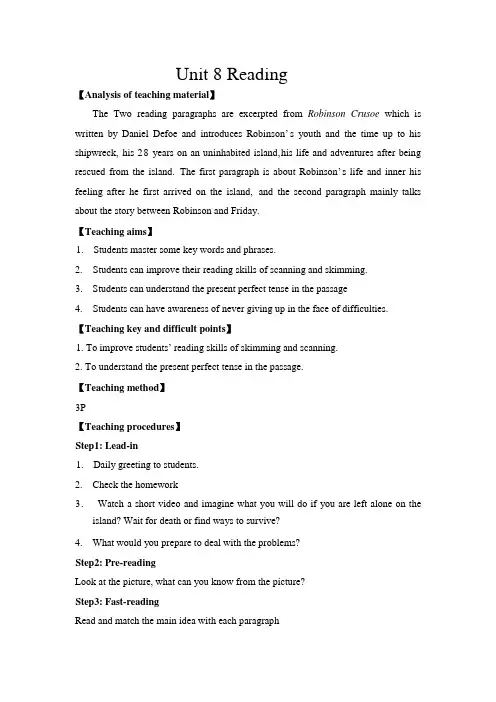
Unit 8 Readingof teachingThe Two reading paragraphs are excerpted from Robinson Crusoe which is written by Daniel Defoe and introduces Robinson’s youth and the time up to his shipwreck, his 28 years on an uninhabited island,his life and adventures after being rescued from the island.The first paragraph is about Robinson’s life and inner his feeling after he first arrived on the island,and the second paragraph mainly talks about the story between Robinson and Friday.1. Students master some key words and phrases.2. Students can improve their reading skills of scanning and skimming.3. Students can understand the present perfect tense in the passage4. Students can have awareness of never giving up in the face of difficulties.key and difficult1. To improve students’ reading skills of skimming and scanning.2. To understand the present perfect tense in the passage.3PStep1:Lead-in1. Daily greeting to students.2. Check the homework3. Watch a short video and imagine what you will do if you are left alone on theisland? Wait for death or find ways to survive?4. What would you prepare to deal with the problems?Step2:Pre-readingLook at the picture, what can you know from the picture?Step3:Fast-readingRead and match the main idea with each paragraphPara. 1 Robinson saved Friday and they helped each other.Para.2 Robinson ’s life on the islandStep3: Careful reading1. Imagine what problems you may have if you were left alone on the island just like Robinson?2. Read para. 1 and find what Robinson has done to deal with the problems?3. Read Para. 2 and complete the timelinea few weeks ago:Step 4: After reading1. What do you think of Robinson Crusoe?Robonsin is brave, creative, clever, optimistic and he is a ma full of wisdom and courage.2. What can we learn from Robinson Crusoe?Never give up trying in the face of difficulties.There are more ways than difficulties.Learn the importance of life skillsLife is fine, and learn to enjoy it.3. Is there anyone who has the same spirit as Robinson?4. Robinson and Friday lived on the island for 28 years. Finally, they were saved by a ship passing by. Can you make up your end to the story?Level 1:Tell the story of Robinson Crusoe to your friends after class.Level 2: Try to go on writing your own story of Robinson and share your story with us next class.designIn this reading class,individual learning and group cooperation are combined to promote to improve students’reading skills,and in some ways stimulate learning motivation of students. However, as the reading passages in grade 8 are becoming more and more difficult,some students still don’t have the habit of previewing, so they can’t finish the reading tasks within limited time. Besides, some students are not able to understand the present perfect tense in the st but not least,the text analysis is not enough.。
牛津译林版八年级上册Unit8《Naturaldisasters》(Studyskills)说课稿
牛津译林版八年级上册Unit 8《Natural disasters》(Study skills)说课稿一. 教材分析《牛津译林版八年级上册Unit 8 Natural disasters》是一篇关于自然灾害的文章,通过介绍地震、台风、洪水等自然灾害,让学生了解自然灾害的特点以及如何应对。
本课内容与学生的生活息息相关,能够激发学生的学习兴趣。
文章语言简练,图文并茂,有助于学生理解和掌握知识。
二. 学情分析八年级的学生已经具备了一定的英语基础,能够进行简单的阅读和交流。
但学生在阅读长篇文章时,可能会遇到生词和语法障碍,影响阅读理解。
因此,在教学过程中,教师需要帮助学生克服这些困难,提高阅读理解能力。
三. 说教学目标1.知识目标:让学生掌握与自然灾害相关的词汇和表达方式,如earthquake、typhoon、flood等。
2.能力目标:培养学生阅读长篇文章的能力,提高学生的阅读理解水平。
3.情感目标:培养学生关爱生命,关注自然的意识,增强学生应对自然灾害的能力。
四. 说教学重难点1.重点:让学生掌握与自然灾害相关的词汇和表达方式。
2.难点:理解文章中涉及的复杂句子结构和语法现象。
五. 说教学方法与手段1.教学方法:采用任务型教学法,让学生在完成任务的过程中,掌握知识,提高能力。
2.教学手段:利用多媒体课件、图片、视频等辅助教学,增强学生的学习兴趣。
六. 说教学过程1.导入:通过展示自然灾害的图片,引导学生谈论自然灾害,激发学生的学习兴趣。
2.阅读理解:让学生阅读文章,回答相关问题,提高学生的阅读理解能力。
3.词汇学习:讲解文章中出现的生词和短语,让学生掌握与自然灾害相关的词汇。
4.语法讲解:分析文章中的复杂句子结构和语法现象,帮助学生理解。
5.小组讨论:让学生分小组讨论如何应对自然灾害,培养学生的合作意识。
6.总结:对本节课的内容进行总结,强化学生的记忆。
7.作业布置:让学生课后写一篇关于自然灾害的短文,提高学生的写作能力。
牛津译林版八年级上册Unit 8《Natural disasters》(Task)说课稿
牛津译林版八年级上册Unit 8《Natural disasters》(Task)说课稿一. 教材分析《牛津译林版八年级上册Unit 8 Natural disasters》是围绕自然灾害展开的一篇文章。
本节课的主要内容是让学生通过阅读文章,了解自然灾害对人类生活的影响以及如何在自然灾害面前保护自己。
教材内容丰富,插图生动,激发了学生学习兴趣。
同时,本节课还设计了丰富的口语、写作和听力活动,帮助学生全面提高英语能力。
二. 学情分析八年级的学生已经具备了一定的英语基础,对于一些简单的自然灾害词汇和表达方式有所了解。
但他们在阅读长篇文章、理解复杂信息方面还存在一定的困难。
因此,在教学过程中,我需要关注学生的个体差异,调整教学策略,确保每个学生都能参与到课堂活动中来。
三. 说教学目标1.知识目标:学生能够掌握与自然灾害相关的词汇和表达方式,如earthquake、tsunami、hurricane等。
2.能力目标:学生能够通过阅读文章,理解自然灾害对人类生活的影响,提高阅读理解能力。
3.情感目标:培养学生关爱生命、珍惜生命的意识,以及面对自然灾害时的自我保护能力。
四. 说教学重难点1.重点:学生能够掌握与自然灾害相关的词汇和表达方式,理解文章内容。
2.难点:学生能够运用所学知识,就自然灾害话题进行口语交流和写作表达。
五. 说教学方法与手段1.任务型教学法:通过完成各种任务,激发学生的学习兴趣,提高学生的参与度。
2.情境教学法:创设生动的情境,让学生在真实的环境中学习英语。
3.交际式教学法:鼓励学生积极参与课堂交流,提高口语表达能力。
4.利用多媒体教学手段:通过播放视频、图片等,丰富教学内容,提高学生的学习兴趣。
六. 说教学过程1.导入:以一段关于自然灾害的视频导入,激发学生的学习兴趣。
2.阅读理解:学生阅读文章,回答相关问题,了解自然灾害对人类生活的影响。
3.词汇学习:学生通过小组合作,归纳总结文章中出现的自然灾害词汇。
八年级英语上册 Unit 8 Natural disasters教案
Unit8 Natural disasters教学目标1.To learn some natural disasters and accidents2.To talk about some accidents3.To learn to write an article on natural disasters教学重点1.To learn some natural disasters and accidents2.To talk about some accidents教学难点To learn to write an article on natural disasters教具准备 computer, ppt, pictures, tape recorder教学过程(教师)学生活动Welcome to the unitStep1 Lead-in1.T: What natural disasters do you know?2.Ss work i n pairs and have a discussion学生讨论自己所知道的自然灾害Step2 Pr esentation1.Show Ss some pictures and some wordsthunder and lightening flood earthquake2. T: They’re called disasters.3. Show Ss some pictures and phrasesThe flood washed away the vi llagemop up the floor thousands of peoplea train accident coachThe car crashed into a tree storm catch a fire4 Ss read the words and phrases 学生看图片学习单词学生明吧理解disaster 的含义学生看图片学习短语学生读单词和短语Step3 Practice1.T: Sandy is reading some newspaper headli nes.Look at them. Which are abo ut naturaldisasters? Put a tick (√)in the correct boxes.2.Check the answers3.Listen and answerT: Sandy and Millie are chatting on line abo ut natur al disasters and accidents. Listen to their conversation and answer some questions(1) What happened to Vivien’s school?(2)When did it happen?4. Some language pointshear about = hear of with 的用法 cau ght fire5.Ss work in pairs and make up a new dialogue usingthe con versation as a model6. Play the tape and Ss read after it 学生完成Part A 部分学生核对答案学生听对话回答问题学生学习一些短语学生听录音跟读,练习语音语调Comic stripStep1 Presentation1.Listen to the conversation and answer questions(1)What’s the weather like?(2)What happened to Ho bo?(3)What was Hobo doing when it started to rain?(4)Did Hobo hear the rain?(5)Why doesn’t he want to go home alone?(6)What do you think of Hobo?2.Some language pointswake up 醒来wake sb. up 叫醒某人mop up 拖干,把......拖干fall from 从……掉下,落下学生听对话回答问题学生学习相关语言点Step 2 Practice1.Act the comic strip out2. Finish some exercises on the ppt 学生表演对话学生完成ppt上的相关练习Step3 Homework1.Write an article about the natural disaster2.Review the words and phrases and some languagepoints3. Preview reading教学反思。
Unit8 Natural disasters 教案。牛津译林版八年级上册
Unit8 Natural disasters 教案。
牛津译林版八年级上册XXX Aims:1.XXX natural disasters.2.XXX.3.XXX natural disasters.Step 1: XXXXXX。
earthquake。
storm。
lightning。
and fire。
Read the new words aloud and have the students repeat them.Step 2: Vocabulary PracticeHave students complete Part A on page 93 to practice using XXX.Step 3: XXXXXX aid.Step 4: Listening and Speaking PracticeXXX.Step 5: XXXXXX.Step 6: Vocabulary ReviewXXX in class。
such as "mop up" which means to clean up or dry off a surface.1.XXX disasters in the world every day.2.I heard of a car accident here.3.- What was the weather like yesterday?It was sunny but windy.4.XXX Friday.5.XXX his bike just now.6.I XXX.1.The weather will get worse next week.XXX for next week is uncertain.2.Thousands of people died in the XXX.3.Their house XXX.Homework:1.Memorize the XXX.plete the workbook exercises.Reading IXXX Aims:1.XXX.e XXX.3.Practice XXX."Step 1: XXXIntroduce new words with pictures and read them aloud: slightXXXloudfearXXXnin all ns brick come down XXXnot at all nervous XXX XXX XXX calmcalm down sincestillXXXdark shoutat last daylight safeXXXafterfind one's way outStep 2: Match the words on the left with their meanings on the right.plete part B1 on page 95.2.Check your answers.Step 3: XXXLook at some pictures and discuss "What is an XXX?"Step 4: Listening1.Listen to the text and complete part B3.2.Check your answers.Timmy was playing in his house when suddenly there was a loud noise and everything XXX't know what was XXX't move because he was XXX for help but no one could hear him。