
24孝的英文版本
The Twenty-Four Filial ExemplarsbyGUŌ JūjìngIntroductionThe text of The Twenty-Four Filial Exemplars has stood for generations as the prime folk document on what filial piety is all about. The collection is not by any means part of the Confucian canon, and indeed tends to attract little but scorn from Chinese intellectuals. But until the Communist regime campaigned to suppress the text as part of its campaign against tradition, there was probably not a bookstore in China that did not have copies available, and in the course of the 1990s new editions came flowing back into Chinese bookstores once again. The tales are known individually to most Chinese, and the collection has spawned many imitators containing other stories, sometimes overlapping with these.The author of the Twenty-Four Exemplars was GuōJūjìng , a Yuán dynasty (1260-1368) man who lived in Dàtián Xiàn, north of Déhuà, in Fújiàn province. He was apparently much known for his filial piety, and took the occasion of the death of his father to publish the tales we read here, recounting the feats of filial children —nearly all male— towards their parents —mostly aged mothers— from the age of the primordial Emperor Shùn down to his own era.The present translation was made by me in 1973, and first appeared in the 1986 volume cited below. I have made minor editorial changes from time to time in the subsequent years.1The numbering of the tales used here is traditional, but is not observed in all editions. Similarly, the brief summary titles (each four characters in Chinese) are quite traditional.The full Chinese text, in traditional and simplified characters and full Pinyin Romanization, can be found on my web site at /~dkjordan for the benefit of students who are also taking Chinese (or who already know Chinese and prefer to read the original).I have published two articles on filial piety, the first (1986) concentrating on this collection of tales, including an examination of many later imitations that included different ones (a total of 131 all told), and the second (1998) expanding upon the analysis of filial piety itself that I began in the analysis of the Exemplars article. Both articles derive from a 1986 conference on the Psychodynamics of the Confucian family, held in Korea under the auspices and gracious hostmanship of the International Cultural Society of Korea. They are:1 -I am grateful to Mrs. Shiu-kuen Fan Tsung for her criticism of the original translation and for herassistance in interpreting some passages which I found obscure. The responsibility for remaining errors is, of course, my own.1986 Folk filial piety in Taiwan: the twenty-four filial exemplars. IN Walter H.Slote (ed.) The psycho-cultural dynamics of the Confucian family: pastand present. Seoul: International Cultural Society of Korea. Pp. 47-106. 1998 Filial piety in Taiwanese popular thought. IN Walter H. Slote & George A.DeVos (eds) Confucianism and the family. Albany: SUNY Press. Pp. 267-284.Translation1. THE FEELING OF FILIAL PIETY MOVED HEAVENEmperor Shùn of the Yú dynasty was the son of Gŭshŏu (=Blind Old-Man). His nature was most filial. But his father was obstinate and his mother was boorish. His younger brother Xiàng was proud and overbearing. Shùn ploughed on Mount Lì [in Shāndōng province], where the elephants ploughed for him and the birds weeded for him, for his feelings of filial piety were so great [that even the beasts were moved]. Emperor Yáo [of Táng] heard of this; he sent nine of his sons to wait on him and two of his daughters to be his wives and later abdicated the throne in his favor. Verses praise him saying:Herds of elephants plough in the spring;Flocks of birds pull the weeds;He is the heir of Yáo and mounts his throne;The spirit of filial piety moves the heart of Heaven.2. HER SON TASTED SOUPS AND MEDICINEEmperor Wén of the western Hàn was named Héng. He was the third son of [Liú Bāng,] the founder of the dynasty. Before he became emperor he was appointed king of Dài [in Shānxī province]. His mother became Queen-Mother Bó[-jī]. the emperor-to-be respectfully tended her and was not idle. His mother took sick for three years. The emperor did not sleep nor even unfasten the belt of his clothes. And if he had not tasted a medicine, it was not brought to his mother. His benevolence and piety were rumored throughout the kingdom. Verses praise him saying:Benevolence and piety are rumored through the kingdom;Lofty and eminent he excels a hundred kings;The Queen-Mother has been sick for three years,And he always tastes the medicine first3. SHE BIT HER FINGER AND PAINED HIS HEARTZēng Shēn of the Zhōu dynasty was called Zĭ-yú (=Disciple of the Master). He was extremely filial to his mother. Shēn once went to the mountains to gather firewood.A guest came to the house, and his mother had no arrangements [to entertain him]. She longed for Shēn , who did not return. Then she bit her finger, drawing blood. Suddenly Shēn felt a pain in his heart. He shouldered the firewood and returned home. Kneeling, he asked his mother what the matter was. His mother said: “A guest came unexpectedly. I bit my finger to alert you.” Later, verses praised him, saying:His mother has just bitten her finger,When her son's heart aches uncontrollably;He shoulders his wood to return and is not too late;The tie between mother and child [lit.: bones & flesh] is so deep.4. HE OBEYED HIS MOTHER IN SIMPLE CLOTHESMĭn Sŭn of the Zhōu dynasty was called Zĭqiān (=the Master's Inferior). His mother died very early, and his father took another wife, who bore two sons, whom she dressed in raw silk lined with cotton wadding. She was jealous about Sŭn and dressed him in mere rushes. One day his father ordered Sŭn to harness the cart. Sŭn 's body was cold and he dropped the rope. His father looked into the reason, then resolved to divorce his second wife. Sŭn said: “If Mother stays, one child will be poorly dressed. If Mother leaves, three children will be cold.” The stepmother heard this, and she repented and changed. Verses praise him, saying:The Mĭn family has a saintly son,Who never resents his stepmother;Before the cart he [has begged his father to] let his [step-] mother stay;Three children are saved from wind and frost.5. HE SHOULDERED RICE TO NOURISH HIS PARENTSZhòng Yóu of the Zhōu dynasty was called Zĭlù (=Way of the Master). He was of a poor family, and they ate only brambles [Lit: chenopodium]. For his parents he often carried [sacks of] rice more than a hundred lĭ. After his parents died, he traveled south to the state of Chŭ, where he became an official and had a hundred chariots to follow him when he went out and a large store of grain. He sat upon many layers of cloth before rows of tripods [of food]. But he sighed and said: “I would rather be back eating brambles and carrying rice more than a hundred lĭ for my parents, but that is impossible.”A verse says of him:He carried rice to provide good food,And willingly traveled a hundred lĭ away;He has become prosperous, but his parents are already dead;He still thinks on their “grievous toil.”26. HE SOLD HIMSELF TO BURY HIS FATHERIn the Hàn dynasty the family of Dŏng Yŏng was very poor. When his father died, he promised himself as security to borrow money to bury him. Then he went to work [for the lender to pay back the debt]. On the way he met a woman, who asked to become Yŏng's wife, and she went with him to his master's house. The master ordered them to weave 300 bolts of silk, and then they could return [home]. His wife wove for a month and then was finished. They returned as far as the locust tree where they had met, when she bade Yŏng good-bye and vanished. There is a poem praising him, saying:To bury his father he has to borrow money;A fairy concubine appears upon the road andWeaves the silk to repay his debt;Filial feeling moves the heavens.2 -Cf. Book of Songs: “Pity my parents who bore me with grievous toil.”7. HE FED HIS PARENTS DEER'S MILKIn the Zhōu dynasty lived a man named Tán whose nature was very filial. His parents were old, and both suffered from a malady of the eyes [for the cure of which] they desired to drink deer's milk. Tán therefore [disguised himself in] a deerskin and went to a herd of deer deep in the mountains to obtain deer's milk to give his parents. Some hunters saw him and were about to shoot him, when Tán revealed himself to them to avoid [being shot]. There is a poem which praises him, saying:His elderly parents want deer's milk,So he wears a coarse fur garment;If he had not spoken out loud,He would have borne back arrows.8. HE HIRED OUT TO SUPPORT HIS MOTHERJiāng Gé lived in the later Hàn dynasty. His father died when he was young, and he lived alone with his mother. The times were troubled and chaotic, so, carrying his mother on his back, he fled. Again and again they encountered bandits who wanted to force him to join them. But Gé burst into tears and told them that he bore his mother with him [whom he had to support]. The bandits could not bring themselves to kill him, and at length he reached Xià Péi [in Jiāngsū province]. Impoverished, naked, and barefoot, he hired himself out as a laborer to support his mother. His mother was able to have all she desired, and there was no end to what he gave her. A verse praises him thus:He carries his mother out of danger;When destitute brigands assault him many times,He tells them his grief and is able to avoid them;By his labors he supports his mother.9. HE CONCEALED ORANGES TO PRESENT TO HIS MOTHERIn the later Hàn dynasty there lived a certain Lù Jī, also called Gōngjì. When he was six, he went to Jiùjiāng (=Nine Rivers) [in Jiāngxī province], where he met [General] Yuán Shù. Shù brought out some oranges and presented them to him [as a guest]. Jīconcealed two oranges in his sleeves. But when he thanked [the general] upon leaving, they fell out on the ground. Shù said: “Master Lù, you are my guest, and yet you conceal oranges?” Jī knelt and answered: “My mother has a fondness for them, and I wanted to present them to her when I returned.” Shù was greatly amazed. A poem praises him in these words:Filial duty is an inborn quality, thusAmong men a six-year-old childConceals oranges in his sleeve toPresent them to his mother and repay her deep benevolence.10. SHE SUCKLED HER MOTHER-IN-LAWCuī Nánshān of the Táng dynasty had a great grandmother known as Madame Zhăngsūn. She was very old and no longer had teeth. Each day his grandmother, MadameTáng, combed the old lady's hair, washed her face, and brought her into the main hall, where she fed her mother-in-law with her own milk. Although the old lady ate not a crumb, nevertheless she passed many years in good health. One day she fell sick, and young and old gathered about her as she announced: “There is no way that I can repay my daughter-in-law's favors. I want all the sons and grandsons and their wives to be as filial and respectful as this daughter-in-law has been.” She is praised in verse thus: The filial daughter-in-law of the Cuī familyGives milk to her mother-in-law after combing her hair and washingher each morning;This favor cannot be returned, butIt is wished that she receive the same treatment from her sons andgrandsons.11. HE LET MOSQUITOES CONSUME HIS BLOODWhen Wú Mĕng of the Jìn dynasty was eight years old, he was very filial towards his parents. The family was poor, and the bed had no mosquito net. Every night in summer mosquitoes in droves nibbled at their skin and sucked their blood without restraint. Although there were many, Mĕng did not drive them away, lest in leaving him they bite his parents. So great was his love of his parents! A poem praises him: On summer nights without a mosquito net,When mosquitoes are many he dares not wave them off;They gorge themselves on his flesh and blood,And thus he avoids their bothering his parents.12. HE LAY ON ICE IN SEARCH OF CARPWáng Xiáng of the Jìn dynasty lost his mother early. His stepmother, named Zhū, was unloving toward him and unceasingly spoke ill of him before his father. Because of this he lost the love of his father also. His stepmother often liked to eat fresh fish, but one winter the cold froze [the river] to ice. Xiáng loosened his clothes and lay on the ice to [melt it so he could] procure them. Suddenly the ice opened of itself and a pair of carp leapt out. He took them and returned to serve them to his stepmother. A verse speaks of this:We have seen stepmothers before,But never a Wáng Xiáng,Until today upon the river, whenHe left us a model by lying on the ice.13. HE BURIED HIS SON FOR HIS MOTHERIn the Hàn dynasty the family of Guō Jù was poor. He had a three-year-old son. His mother sometimes divided her food with the child. Jù said to his wife: “[Because we are] very poor, we cannot provide for Mother. Our son is sharing Mother's food. Why not bury this son?” He was digging the pit three feet deep when he struck a caldron of gold. On it [an inscription] read: “No official may take this nor may any other person seize it.”A verse says of him:Guō Jù wishes to serve his mother, andBuries his son that his mother may survive;Yellow gold is bestowed by heaven, andBrilliant fortune brightens their poor threshold.14. HE STRANGLED A TIGER TO SAVE HIS FATHERWhen Yáng Xiāng3 of the Jìn dynasty was fourteen, he often followed his father Fēng into the fields to reap grain. His father [on one occasion] was dragged away by a tiger. Although at the time Yáng Xiāng had no weapon at hand,she thought only of his father and not of himself as he leapt quickly forward and grabbed tightly at the tiger's neck. The tiger left in defeat, and his father was able to escape injury. A verse praises him saying:In the deep mountains a white forehead4 reared, andWhen it moved the wind was filled with the smell [of its dead prey];The father and child have suffered no injury, [for he]Has rescued his [father's] body from the greedy mouth.15. HE ABANDONED A MANDARINATE TO SEEK HIS MOTHERWhen Zhū Shòuchāng of the Sòng dynasty was seven years old, his mother, [a concubine] named Liú, because of the envy of the first wife, was married out again [to another family]. For fifty years the mother and son did not see each other. In the reign called Shén Zōng [1068-1085] he gave up his office and went to Chín [in Shaănxī], to find his mother, vowing not to return until he did so. He journeyed to Tóngzhōu [ in Shānxī] and reached her. At that time his mother was already seventy. A verse praises him thus:At seven he was separated from his mother,And fifty years have passed;One morning they meet again,And the joy of it moves Heaven.16. HE TASTED DUNG WITH AN ANXIOUS HEARTYŭ Qiánlóu of the southern Qí dynasty was sent as a magistrate to Chánglíng [south of Gōng'ān in Húbĕi province]. He had been in the district less than ten days when suddenly his heart was alarmed and he perspired. Immediately he gave up his office and returned, [to find] his father had been sick for two days. The doctor said: “To know whether a sickness is improving or very serious, one must taste the [patient's] dung. If it is bitter, then there is hope.” Qiánlóu tasted it, and it was sweet. His heart was very 3 -Because the name Xiāng (“fragrance”) would today be a female one, some writers interpret Yáng Xiāngas female; others, as male. It is more likely that a son than a daughter would accompany a man to work in the fields, so I have considered the name male. Huáng Xiāng, the protagonist of tale 19, has the same Xiāng as a name, but is known from other sources to be male.4 -Some folktales maintain that a tiger who has eaten a hundred humans develops a white forehead.anxious. When night came, he kowtowed to the North Star [of longevity], beseeching it to let him die in his father's place. Verses praise him saying:He was in his post less than ten days, whenHis father suddenly met with serious illness;He wants to substitute himself in death for his father;Facing north, he is weighted down in worry.17. HE AMUSED HIS PARENTS WITH PLAY AND GLAD CLOTHESOld man Lái of the Zhōu dynasty was noted for his filial nature. He respectfully cared for his two parents, preparing them sweet and crispy foods. He was over seventy, but he never mentioned the word “old.” He wore five-colored patterned clothes and played like a child before his parents; often he carried water into the room and would slip and fall, and then he would cry like a baby to amuse his parents. A verse says of him: He plays and dances and pretends delicate nonsense;The spring wind blows his colorful clothes;His two parents throw open their mouths in laughter,And their joy fills the hall..18. HE PICKED MULBERRIES TO SERVE HIS MOTHERCài Shùn of the Hàn dynasty was left fatherless at a young age. He served his mother with utmost filial devotion. They had to endure the tumult of Wáng Măng, and the crops were bad and the land unproductive. He gathered mulberries, which he sorted into different containers until they were full. A [band of] Red-Eyebrow robbers [rebels against Wáng Măng] saw this and asked him about it. Shùn said: “The black, ripe ones I give to my mother. The red, unripe ones I eat myself.” The robbers took compassion because of this filiality and gave him three catties of white rice and an ox leg. A verse says of him:With black mulberries he nourishes his mother;Tears of hunger drench his clothing;The Red-Eyebrows know his filial intent andPresent beef and rice for the filial son to bring home.19. HE FANNED THE PILLOW AND WARMED THE QUILTWhen Huáng Xiāng of the Hàn dynasty was nine years old, he lost his mother. He [continued to] think of her so much and with such love that the neighbors praised his filial devotion. Xiāng did diligent and painful work, and his one thought was to serve his father. In summer, when the weather was hot, he cooled his [father's] pillow and mat with a fan. In winter, when the weather turned cold, he warmed his [father's] quilts and cushions with his body. The prefect Liú Hù publicly honored and recognized him [for his rare filiality]. A verse praises him thus:In winter he warms the quilts, andIn hot weather he fans the pillow to make it cool;The child knows a son's duty;In a thousand ages there can be but one Huáng Xiāng.20. THE FOUNTAIN BUBBLED AND THE CARPS LEAPTJiāng Shī of the Hàn dynasty served his mother filially. His wife was named Páng, and she was even more respectful. The old mother liked to drink water from [a certain] river, and the wife would go to draw it and bring it back to the old lady. His mother also loved eating minced fillet of fish, and Shī and his wife often prepared it. They [even] invited the neighbors' mothers to join her when she ate. Suddenly a fountain sprang up beside the house with a taste like the water from the river, and each day two carp jumped from it, which Shī would take to give to his mother. A verse says of this:Beside the house a sweet fountain flows, andEach morning a pair of fish appears;The son can constantly be filial to his mother;The daughter-in-law can be filial to her husband's mother.21. HE HEARD THUNDER AND WEPT AT THE GRAVEWáng Póu of the state of Wèi [at the time of the Three Kingdoms] served his mother with filiality. When she was alive, she was afraid of thunder. After she died she was buried in a hilly wood. Whenever there was wind and rain and Póu would hear the loud sound of [thunder like the passing of the chariot of the thunder-goddess] Àxiāng, he would hurry to the grave and kneel and pray. He would weep, saying: “Póu is here; Mother must not be afraid.” A poem praises him saying:His loving mother feared hearing thunder;[Now] her chill spirit dwells among the dead, andWhen Àxiāng thunders over and overHe goes to the tomb to walk about it a thousand times.22. HE CARVED WOOD TO SERVE HIS PARENTSThe father and mother of Dīng Lán of the Hàn dynasty died when Lán was young and never received support and service from him. But he thought often of their “grievous toil.”5 He carved wooden statues and served them as though they were alive. His wife began after a time not to revere them. [One day] she took a needle and pricked their fingers in mockery. Blood flowed, and when the wooden statues saw Lán, tears fell from their eyes. Lán inquired about their condition; then he divorced his wife and cast her out.6 There is a verse which says:5 -Cf. Tale 5, verse & note.6 -This is the one story which some modern editors most often rewrite, apparently in order to avoid thedivorce. In a couple of retellings in my collection, the wife, seeing the statues react, is grief-stricken, reforms, and is forgiven rather than divorced by her husband. In one elaborately illustrated, heavy-paper edition designed for younger children, a neighbor's wife, come to borrow something, scoffs at Dīng Lán's wife at her devotions. Dīng Lán's wife, angered, refuses to lend her what she wants. Theneighbor's wife returns home and sends her husband over, who sneers and beats the statues with hisHe carves wooden statues of his mother and father,Giving them the appearance they had in life;And this is to caution every son and nephew,that each must be filial towards his parents.23. HE WEPT TILL THE BAMBOO SPROUTEDMèng Zōng of the Three Kingdoms period was also called Gōngwŭ. His father died when he was small, and his mother was very ill. One winter she longed to eat a soup made with boiled bamboo shoots. Zōng had no means to give her such a thing, and he went out to the bamboo grove where, seizing a bamboo stalk, he wept. His filial piety moved heaven and earth. In a moment, the earth cracked open and many stalks of bamboo shoots appeared. He gathered them and returned home to make soup for his mother. When she had eaten it, she recovered. Verses praise him, saying:Tears drop; the north wind is coldAnd moans through a stand of bamboo;But winter bamboo shoots come forth!The wish of Heaven is to bring harmony.724. HE WASHED HIS MOTHER'S BEDPANHuáng Tíngjiān of the Sòng dynasty was also called Shāngŭ. During the Yuányòu reign period [1086-1093] he was a government compiler. His nature was filial, and although he was very prominent, he served his mother with deep sincerity. Every evening he himself washed out his mother's bedpan. A moment did not pass in which he did not display the responsibility of a son. A verse praises him saying:He is prominent enough to be known throughout the world, butAll his life he is filial toward his mother;He does not decline to wash out her urine;How could he use maids and let himself be spoilt [by prominence]?stick. Dīng Lán returns, sees the weeping statues, hears the tale, and stabs the neighbor to death. The magistrate, rather than punishing him, commends him as a fine example of filial piety.7 -For a discussion of this complex concept in its specialized application to families, see my book, Gods,Ghosts, & Ancestors: The Folk Religion of a Taiwanese Village, page 92 (available on-line at/~dkjordan/scriptorium/gga/ggach05.html#page92).。
二十孝英文版

Twenty-Four Stories of Filial PietyThe book entitled The Twenty-four Paragons of Filial Piety was written by the Yuan Dynasty scholar Guo Jujing. His pen-name was Yizi, and he was a native of Datian County, in Fujian Province, China. Guo was not only a well-known poet, he was also a reknowned filial son in his own right. After his father passed away, Guo personally experienced the truth of the maxim:"The tree would prefer stillness, but the wind continues to blow.The child wishes to practice filial devotion, but his parents are already gone,"And he felt deep grief over his loss. His depth of feeling prompted him to comb the histories in search of true stories of the finest examples of filial respect, as practiced by devoted children throughout the centuries. He selected twenty-four such paragons, and penned a verse to eulogize each authentic account of filial practice. Then he told a story of the events that lead to each son or daughter's examplary conduct. Thebook that resulted from his work was called The Twenty-four Paragons of Filial Devotion.Filial Conduct That Moved the Heart/Mind of Heaven: Shun The Great (孝感动天)Great Yao was an Emperor both humane and virtuous. Under his rule, the citizens of China were both obedient and harmonious. They looked up to their Emperor and treated him as respectfully as they did their own parents. Yao, however, had grown old, and decided to request his military and civilian cabinet ministers to select a wise and worthy successor, so that he couldhand down the duty of ruling all of China to him. The Emperor's advisors told him, "There is a devoted filial son at Li Mountain named Shun. Although his family does not get along, he still treats them with a proper attitude of respect and affection. His father, Gu Sou, is unreasonable, and harsh. His step-mother is petty by nature, and constantly abuses and scolds her son. Shun's step-brother, Xiang, is arrogant and lazy. He is jealous of his older brother and wants to do him in. Living in such a family, Shun manages to not resent them; he behaves as a devoted son and brother should."The ministers told the Emperor, "When his family scolds or beats him, he doesn't bear a grudge or strike back. He simply runs out into the fields where no one can see him and cries to himself. You can find this boy plowing the fields every day, and doing the planting and weeding. His father and brother never lend a hand. Shun's devotion to filial respect does, however, inspire the heavens and the earth to respond. How do we know this is true? The elephants come down from the mountains to plow the furrows for this young man; in the Spring you can see them line up and use their tusksto dig the earth. In the Summer the crows and magpies flock down to pull up the weeds with their beaks. Nature itself approves of his righteous attitude, especially in the face of hardship, as in the case of his impossible family situation."Hearing about Shun's filial conduct inspired Emperor Yao to dispatch nine of his sons to assist Shun with the farming work. He instructed his daughters, named Huang and Ying to serve Shun as his wives. The Emperor put the young man through years of training and testing, and when he felt satisfied with his capabilities, he bestowed the throne of Emperor on him, and retired from the duties of ruling China. Under Shun's guidance, the people of China prospered. Following his virtuous influence, all creatures enjoyed peace and happiness. Such were the manifold benefits of a proper attitude of filial respect.A verse in his honor says,Elephants in file plow the fields in spring. Little birds in flocks come weed the summer grass.Following Emperor Yau, he took the Dragon Throne.His filial conduct touched the hearts of creatures under heaven.He Personally Tested His Mother's Prescriptions: The Learned Emperor Of Han (亲尝汤药)During the Western Han Dynasty in China, after its founding patriarch Liu Bang died, the throne came by succession to his son, "Liu the Constant". He earned the name Han Wendi, "The Learned Emperor of Han". As a ruler, he practiced vigorous, just government, and he loved the citizens, moving and inspiring them to self improvement through education. State business was extremely complex and demanding of time, nonethelesshe still found time to serve his mother with respectful, filial devotion. He was neither careless nor tardy in his treatment of his mother.Once the matron suffered a serious illness and Han Wendi, as soon as he had completed the various governmental matters , would immediately leave the state chambers and return to his mother's bedside to nurse her with tender concern. She was sick for a full three years, and his care was constant and untiring. He waited on her by night and day throughout her convalescence, without relaxing his vigilance in the least. He never grumbled or resented the toil and tedium.The Emperor's care of his mother was thorough to the last detail. He would wait by her bedside without closing his eyes, often forgetting to change his robes for long Periodst afraid that he might be remiss in his nursing care. As soon as the servants had prepared any dose of medicine, the Emperor would first sample the mixture himself, to make sure it was neither too hot nor too weak. As soon as it was fit to drink, he would spoon-feed the mixture himself to his mother.Many years passed, and the Learned Emperor nursed his mother throughout. He earned the praises of all the citizens. An outstanding leader, he was also a most unusual, filially-devoted son, and set the standards of behavior towards parents. The people of China respected him, and accepted his teaching. They were deeply influenced and transformed by his model of virtue. The people in their turn, practiced filial respect towards their parents, and treated them well. The Learned Emperor's name, Han Wendi, has passed down through a thousand ages to the present--people still admire his model of virtuous, selfless conduct.A verse in his honor says,Both filial and humane, he was known throughout the land.Awesome as a leader, he ruled the Hundred Kings. For three long years he nursed his ailing mother, the Empress,Duty-bound, he tasted every medicine she took.His Heart Was Pained When His Mother Bit Her Finger: Zeng Shen (啮指痛心)During the Spring and Autumn Period of Chinese history, there lived a student of Confucius, Zeng Shen, who become well-known for his filial attitude of respect. His father passed away while Shen was still young. He was extremely respectful and obedient to his mother. Every day the young man would go into the mountains to cut firewood; his mother would stay home and weave cloth to sell. Mother and son had to work hard to earn enough to get by.One day Zeng Shen set out early for the mountains.A guest who had traveled a long distance arrived at the Zeng household that very morning. The family being poor, there was nothing with which to entertain the guest, and no way to properly welcome him. As Zeng Shen was not at home, his mother did not know what to do, and she could only hope that her son would return soon from the mountains.The boy did not show up, and Mrs. Zeng grew agitated. Without realizing what she was doing, she put her finger into her mouth and bit it. In her nervousness, she bit her finger so hard that it bled. Zeng Shen, in the mountains, suddenly felt a stinging pain in his heart, and knew there must be something amiss with his mother. He quickly bundled up the brush and kindling and ran back down the mountain.Arriving before his mother, he knelt in the doorway and asked her what was the matter. Relieved and happy, she said, "A guest has come and I was so upset that I bit my finger. You must be a truly respectful child that you can know your mother's thoughts from a distance!"A verse in his praise says,His mother bit her finger, her son's heart felt the pain.He bundled up the firewood And ran home just in time.What age has ever witnessed deeper ties of filial loveThan the depth of shared between this mother and her son?Clad In A Threadbare Jacket, He Tolerated His Cruel Stepmother: Min Ziqian (芦衣顺母)Confucius's disciple, Min Ziqian was foremost in filial respect. His mother died early, and his father remarried, but to a woman who mistreated her stepson. Because he was not her natural child, she gave him only cruel words and harsh treatment. Min Ziqian often went cold and hungry, and suffered from loneliness, as his stepmother gave all her love and attention to her own two sons.When the weather turned cold, the second Mrs. Min made her two sons warm coats padded with warm cotton linings. She gave Min Ziqian a coat stuffed only with dry rushes. From the outside the two coats looked alike, but the one stuffed with reeds was not warm at all. It neither blocked the biting wind, nor kept out the stinging cold. His only jacket being so thin, Min Ziqian was always shivering and miserable in the cold.One icy winter day, Min Ziqian's father had business in town, and told the boy to fetch the horse and cart from the stable. The evening air was frigid, the wind blew hard, and the young boy was so cold that his entire body trembled. His hands and feet were frozen to thepoint of immobility. His numb fingers dropped the cart reins, and his father scolded him for his clumsiness.In his anger the man grabbed Ziqians coat-sleeve and ripped it from the jacket, revealing the dried grass lining. He was shocked at the sight of the flimsy jacket that could not protect his son from the cold. Mr. Min suddenly recognized the pattern of cruel treatment his wife had given his boy. He understood at once the injustice of her harshness, and it infuriated him so that he flew into a rage.He ran back into the house, yelling at the top of his lungs for his wife. She appeared and cowered before him on her knees. He angrily ordered her to leave the house and never return. Min Ziqian knelt beside his stepmother and begged his father to give her another chance. He pleaded for leniency. "When my mother is here only one boy has to suffer the cold. But if she goes, then three sons will have no one to care for them. Please, Father, let her stay!"At this, his stepmother cried piteously in deep shame. She was so deeply touched that her attitudetotally changed. She turned over a new leaf, and ever after treated Min Ziqian as lovingly as she did her own sons.A verse in his honor says,Mr. Min, the widower, has a worthy son;Who never grudged his second mother's hateful, wicked ways."Keep her here at home!", he begged, while kneeling by the cart."Or else three boys will suffer from the biting wind and frost."Confucius's disciple, Zi Lu, was born to the Jung family (百里负米)During the Zhou Dynasty. His given name was You, and he was a most filial, devoted son. His family was poor, and the boy had to dig wild greens and roots from the fields in order to feed himself. Because he wished his parents to have adequate, suitable food, he had to travel long miles, out of the poverty-stricken neighborhood, where so many families were forced to forage for their meals, in order to find a wage-paying job.You would rise long before dawn every week, and lay aside enough dried fruits, roots, and vegetables for his parents' table that week, and then make a lengthy,dangerous trip into the neighboring states, seeking work. He would often travel over one hundred miles, earning what money he could, in order to buy rice and staples for his household. Then shouldering the sack of provisions, he would run back the many miles, arriving in time to cook up a nourishing meal for the Jung elders. When the bag was empty, he would tie up his leggings and set off once more for the market towns. While his parents remained on earth, Zi Lu would spare no effort to treat them with proper filial respect. Everyone considered him an unusually good-hearted example of true filial service.After his parents died, the young man left his native land for the country of Chu in the south. The king of Chu was impressed with Jung You's learning, and with his righteous character, and offered him a post in the civil service. Zi Lu accepted, and soon grew quite wealthy, drawing a handsome salary and rich side benefits for his able leadership of state affairs. Whenever he went riding in his silk-lined carriage, a retinue of one hundred chariots flanked the royal coach on four sides. His personal storehouses of grains,cloth, books, and silver covered an acre of land. Woolen blankets and thick rugs adorned his personal quarters in luxury. His dinner table was set with fine and rare delicacies.Despite the life of affluent comfort, Zi Lu in his heart constantly pined for the days of his youth, when he was able to serve his mother and father. He would often sigh, "This wealth and honor is flavorless, and depressing. How I wish I could return to the old days, when I ate field-greens and carried rice on my back for Mom and Dad. How happy I was in those days!. Now that my parents have left this world I can no longer fulfill my duty as a filial son ...."A verse in his honor says,The rice bag on his back holds a rare treat for his parents;Without a murmur of fatigue he ran those many miles.Glory, wealth, and honor, once his parents had passed on,Meant nothing: he only thought of the happy days gone by.Costumes and Pranks To Amuse His Parents: Lao Laizi (戏彩娱亲)During the Spring and Autumn Period there lived a filial son named Old Master Lai (Lao Laizi). From his youth he had always been most respectful and obedient towards his parents. He obeyed their wishes, and even took special care of their innermost thoughts, so concerned was his heart in serving them as a dutiful son. At age seventy he still earnestly made offerings to the elderly couple, who had reached such a lengthy life span due to his filial devotion. He kept them warm in winter, cool in summer, and fed them soft foods, thatwere easy to digest in their toothless mouths. Old Master Lai, wanting to keep his parents' spirits high, never mentioned the word "old" in their hearing. When he overheard the old friends lamenting one day, "Look at our son, he's already in his dotage! Surely our own days must be drawing to a close!", his heart could not endure the helpless feelings that arose. "I must find a way to lighten their hearts!" he vowed. Determined to keep his parents from lamenting over their increasing years, he hit upon a plan.Old Master Lai dressed up in the costume of a young child at the circus, or imitate the walk and manner of a mischievous boy at play. He would paint on comic opera make-up and carry a flower drum, horse-playing and cutting comic antics in front of his delighted parents' eyes. To tickle their funny-bone he would take a toy in hand and mimic a child's nonsense prattle, singing and dancing, and falling in a heap. Sometimes he would carry a pole into the sitting room that balanced two full buckets of water. Singing a silly tune he would trip up on purpose, sending water showering over the floor and soaking his foolish-looking wig andface-powder. His ridiculous show never failed to send the old folks into gales of laughter. Playing the fool always dispelled his elders' Periods of melancholy, and made them happy for days. Even though he was not a youngster, he was able to dutifully care for the physical health and mental well-being of his seniors. This was his first priority in life.Lao Laizi's filial devotion impressed all who heard of it, and he received unreserved praise as an unusual example of perfect respect and proper affection.A verse in his honor says,He cut a comic caper, and played the merry fool, The Spring breeze fluttered his flower-drum gown.The old folks laughed with toothless glee;The sounds of their delight filled the air with joy.Bringing Deer's Milk To His Ailing Parents: Young Master Tan (鹿乳奉亲)During China's Spring and Autumn Period, there was a filial son in the Tan family whose name has not been recorded. People simply referred to him as Young Master Tan, or Tanzi. While he was quite young, both his parents came down with an eye disease that the doctors said could only be cured by giving them deer's milk to drink. As the family was very poor, and milk was both rare and expensive, the young lad was upset and worried that he would be unable to provide the medicine that could cure his mother and father. Wandering out in the mountains, he pondered the situation, but couldn't come up with a solution. There in the meadow before him, aherd of deer grazed. The does stood patiently while the spring's crop of young fawns frolicked and ran, then returned to their mothers to nurse on milk.'That's it!" exclaimed Master Tan. "I'll get my folks deer's milk!" The next morning, dressed in a deer's skin, with head, tail and fur, Tanzi set off for the mountain meadow, bucket in hand. When the young deer ran, Tanzi ran beside them. When they grazed, he stood and grazed. When they came to the does for milk, Tanzi nursed too, only the milk went into his bucket, not into his stomach.When the day was over, Tanzi carefully walked back down the mountain, carrying a full bucket of milk, delighted with the success of his plan. His parents were overjoyed to have deer's milk to drink, and praised their clever, considerate, and resourceful boy. The next day, Young Master Tan returned to the meadow and again played with the fawns, and again returned home at sunset with a bucket of milk. So it continued for weeks, and his parents began to recover their sight, thanks to their filial son's dutiful sacrifice on the mountainside.One day as Tanzi was playing amid the young deer, the herd leaders suddenly bleated, picked up their white tails, and ran for the trees. The herd followed in fear, leaving Tan Dz alone in the middle of the meadow. He looked towards the path and saw why the deer had fled.A fierce-looking hunter, bow in hand, stood in the shade, prepared to shoot some venison.Arrows began to zip past Tanzi's ears, their deadly whistle much too close for comfort. The boy quickly stood up, threw back his deer-skin cloak and loudly shouted, "I'm a person, not a deer. Don't shoot !" The hunter was shocked. "Hey, Boy, what are you doing here in the woods! I nearly killed you! Why are you dressed up like that?"Tanzi answered, "My parents are sick and need deer's milk to drink in order to recover. I come here to milk the does, disguised as a deer." Deeply impressed, the hunter said softly, "You are certainly a rare child, to go to so much trouble for your parents. But this is dangerous! If you had waited one minute longer to reveal your identity, I would have shot you down. Be more careful in the future!" After this warning, the hunterescorted Young Master Tan safely out of the forest and back home.A verse in his honor says,His parents needed milk, their eyes to cure, He robed his body in a suit of fur.If he had failed to shout aloud, "Don't shoot!" The hunter would have killed him for a deer.Laboring For His Mother: Jiang Ge (行佣供母)During the Later Han Dynasty, a filial son named Jiang Ge supported his widowed mother. As his father had passed on years ago, the son and mother got along as best they could. Bandit gangs roamed the countrysidenearby, and Jiang Ge resolved to take his mother to safety, far from the chaos and trouble of his home. Having no cart or horse, the young man simply carried his mother on his back along the highway, escaping the onslaught of the brigands. As luck would have it they promptly ran into first one, then another group of rebels. When the leaders demanded that Jiang Ge join their number, the young filial son knelt down and pleaded for mercy, crying, "If I run off with you, my old mother will starve. She needs me to take care of her; please let us travel on in peace."Touched by his sincere plea, the bandits would always let them go. Traveling in this way, the two eventually reached the county of Xiabi in Jiangsu province. They had spent all their money, and their clothing had grown tattered and torn beyond repair. Lacking relatives in Jiangsu to support them, mother and son could only fashion a lean-to of grass and camp out with the other refugees from the civil war to the North.Jiang Ge would go out each morning in search of odd jobs. Whatever bits of cash he earned would go tosupporting his mother in the style she was accustomed to before her husband had passed on. Jiang Ge wore ragged clothes and went barefoot, he are wild greens and broken rice himself, but the clothing and food he provided for his mother was the finest he could afford. He was not the least bit remiss in the care of his mother. Their neighbors praised his selflessness in service to his mother, and urged him to relax the ascetic hardship he imposed upon himself. Jiang Ge would only smile, and say, "A son's duty is to care for his parents."At long last he found a secure, salary-paying job that promised a comfortable living for his mother. Peace had returned to their home-land by this time, and his mother wished to return. The ride in a horse-drawn cart would have proved too strenuous for her, so Jiang Ge passed over the good job that could have brought him a luxurious life. Instead he found a sturdy cart, settled his mother comfortably within, and pulled it himself all the way back home. Good people all along the way praised his devotion as a genuine model of filial compliance.A verse in his praise says,Bearing mother on his back, he fled the troubled land.Evil bandits caught them on the road.A plea for mercy saved their lives, as always, He labored hard to treat his mother well.Stealing Oranges To Take Home For His Mother: Lu Ji (怀橘遗亲)In the Later Han Period, a young boy of only six years old showed a deep filial regard for his mother. He traveled with his father to visit the Chief Minister of Nan Yang, named Yuan Shu. Elder Yuan Shu saw howprecocious the young boy was, and ordered his butler to bring a dish of oranges to offer to young Lu Ji. The boy saw the delicious, large fruit, and immediately ate two . He waited until nobody was looking, and secreted three oranges away in the sleeve of his robe. When it was time to say good-bye, along with his father, little Lu Ji raised his hands up in salute. Unexpectedly, the three oranges came rolling out, and fell to the floor in front of Lu Ji.Yuan Shu saw the oranges and laughed: "Little Brother, you're my guest today. How come you stole your host's oranges?" The little boy replied, "Pardon me, my mother likes oranges best of all. Because we don't have any money, it's hard to provide oranges for her. Today I enjoyed two of these ripe, sweet, oranges, and I could not resist taking a few of them back for Mother. She likes them so much."Minister Yuan Shu was impressed by thesix-year-old's concern for his mother's happiness. He told his staff to give the entire plate of fruit to Lu Ji for his family.A verse in his honor says:Filial love and brotherhood made nature "Heaven-True",Most rare in a boy just six years old.He hid three oranges in his sleeve, as a gift for his Mom,Just a token to repay her kindness without end.Never Tiring of Feeding Her Mother-in-law Milk: Lady Tang (乳姑不怠)In the Tang Dynasty, an official named Cui Nanshan, had in his family the Grand Dame Zhang Sun, Mr. Cui's great-grandmother. She was quite elderly, and had lostall her teeth, thus she could not chew even soft rice. Eating was a big problem. Mr. Tswei's grandmother, the Lady Tang, realized the difficulty her mother-in law had in chewing food, and thus hit upon a solution to keep the Grand Dame alive and in good health. The Lady Tang would wake up each morning, perform her daily toilet of washing her face and combing her hair, then she would enter her mother-in-law's chambers and proceed to feed her breast-milk from her own body. The elderly matron had no trouble digesting this nutriment, and thus thanks to her daughter-in-law, even though she could not eat normal food, her body stayed strong and healthy.One day she fell ill, and knowing that her life was about to reach its natural end, she summoned all her generations of descendants into her room and told them, "All these years I have been looked after by my daughter-in-law. She has treated me most kindly, and I am deeply grateful to her. I only hope that the wives of all my children and grandchildren will be as considerate and proper in their filial devotion as she has been towards me."When the family heard her final words, they were deeply impressed, and ever after, used the Grand Dame Jang Sun's advice as the motto of the household. The teaching was passed down and cherished through the many generations of the Tswei family.A verse in her honor says,Out of deep respect for the Tswei Family's matron,After morning toilet she would feed the Grand Dame milk.Kindness such as this is difficult to repay; May every generation of descendants be so kind!Attracting Mosquitoes To Drink His Blood: Wu Meng (恣蚊饱血)In the Jin Dynasty, a filial eight-year-old boy named Wu Meng served his parents with devoted compliance. His family was extremely poor and could not afford mosquito netting. On hot summer nights the mosquitoes would come swarming in as thick as smoke. The little boy would remove his shirt and let the insects land on his bare skin. He would watch then drink their fill of his blood, and fly away; he wouldn't raise a hand to shoo them off, no matter how painfully they stung him. Wu Meng wasn't a fool, so why didn't he brush the bugs away?He knew that his parents had no netting at their bedside. If he drove the mosquitoes away from his body, they would surely fly over and wake up his mother and father with their stinging. So the devoted son simply let the mosquitoes drink his blood instead. So that his parents wouldn't know about his sacrifice and demand that he stop, the boy would wake up earlier than they, slip his shirt over his swollen torso, and return to his own bed. But one morning, being tired from loss of sleep, he forgot to wake up and pull on his shirt. His father arose and found his son asleep by his bed. He looked at the boy' s pathetic, mosquito-bitten skin that was covered with red welts, and understood immediately what Wu Meng had done. Mr. Wu woke up his wife and told her the story. The two parents, deeply moved by their son's unselfish concern for them, began to cry. They were so touched, their sounds of sobbing could be heard by the neighbors. From all sides the neighbors gathered to investigate the matter, and learned about Wu Meng's sacrifice on behalf of hi s parents.Everyone thought that the boy's attitude of filial respect was most remarkable, especially for one only eight years old. Someone reported the incident to the local magistrate, who wrote a memorandum to the Dragon Throne, to inform the imperial court. The matter thus came to the attention of the Emperor, who rewarded Wu Meng with a scholarship to the academy. Further, he gave the family a set of mosquito nets and a stipend, so that they never again lacked the necessities of life.A verse in his honor says,Summer nights and no mosquito netting!Insects by the thousands, yet he wouldn't raise a hand."Let them drink my blood and fill their bellies, Just don't disturb my parents while they sleep!"Lying Down On The Ice to Fetch Carp For His Stepmother: Wang Xiang (卧冰求鲤)。
2024新版(人教版)七年级英语下册单词带音标
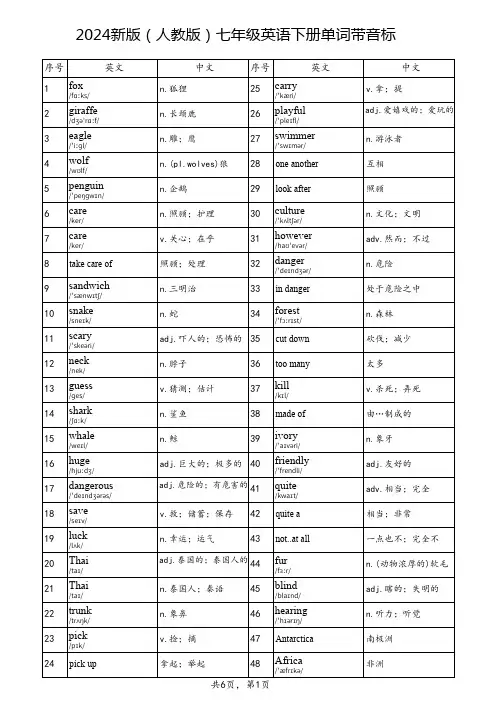
2024新版(人教版)七年级英语下册单词带音标序号 英文 中文序号 英文 中文1fox/fɑːks/n.狐狸25carry/ˈkæri/v.拿;提2giraffe/dʒəˈrɑːf/n.长颈鹿26playful/ˈpleɪfl/adj.爱嬉戏的;爱玩的3eagle/ˈiːɡl/n.雕;鹰27swimmer/ˈswɪmər/n.游泳者4wolf/wʊlf/n.(pl.wolves)狼28one another互相5penguin/ˈpeŋɡwɪn/n.企鹅29look after照顾6care/ker/n.照顾;护理30culture/ˈkʌltʃər/n.文化;文明7care/ker/v.关心;在乎31however/haʊˈevər/adv.然而;不过8take care of照顾;处理32danger/ˈdeɪndʒər/n.危险9sandwich/ˈsænwɪtʃ/n.三明治33in danger处于危险之中10snake/sneɪk/n.蛇34forest/ˈfɔːrɪst/n.森林11scary/ˈskeəri/adj.吓人的;恐怖的35cut down砍伐;减少12neck/nek/n.脖子36too many太多13guess/ɡes/v.猜测;估计37kill/kɪl/v.杀死;弄死14shark/ʃɑːk/n.鲨鱼38made of由…制成的15whale/weɪl/n.鲸39ivory/ˈaɪvəri/n.象牙16huge/hjuːdʒ/adj.巨大的;极多的40friendly/ˈfrendli/adj.友好的17dangerous/ˈdeɪndʒərəs/adj.危险的;有危害的41quite/kwaɪt/adv.相当;完全18save/seɪv/v.救;储蓄;保存42quite a相当;非常19luck/lʌk/n.幸运;运气43not..at all一点也不;完全不20Thai/taɪ/adj.泰国的;泰国人的44fur/fɜːr/n.(动物浓厚的)软毛21Thai/taɪ/n.泰国人;秦语45blind/blaɪnd/adj.瞎的;失明的22trunk/trʌŋk/n.象鼻46hearing/ˈhɪərɪŋ/n.听力;听觉23pick/pɪk/v.捡;摘47Antarctica南极洲24pick up拿起;举起48Africa/ˈæfrɪkə/非洲49Malee/ˈmɑːliː/马莉74of course当然50Thailand/'taɪlənd/泰国75mobile/,mo'bil/adj.可移动的51rule/ruːl/n.规则;规章76mobile phone手机52order/ˈɔːrdər/n.秩序77turn off关掉(水、电或煤气)53order/ˈɔːrdər/v.点菜78queue/kjuː/n.队54follow/ˈfɑːloʊ/v.遵循;跟随79jump the queue插队55be late(for)迟到80wait for等待56arrive/əˈraɪv/v.到达81just/dʒʌst/adv.只是;正好57on time准时82leave/liːv/v.离开;留下58hallway/ˈhɔːlweɪ/n.走廊83absent/ˈæbsənt/adj.缺席的;不在的59uniform/ˈjuːnɪfɔːrm/n.校服;制服84be absent from缺席;不在60litter/ˈlɪtər/v.乱扔85shh(=sh)interj.嘘(用以让别人安静下来)61litter/ˈlɪtər/n.垃圾86quietly/ˈkwaɪətli/adv.轻声地;安静地62polite/pəˈlaɪt/adj.有礼貌的87belt/belt/n.安全带;腰带;皮带63treat/triːt/v.对待;招待;治疗88feed/fiːd/v.喂养;饲养64treat/triːt/n.款待89noise/nɔɪz/n.声音;噪声65respect/rɪˈspekt/n.&v.尊敬90unhappy/ʌnˈhæpi/adj.不快乐的66if/ɪf/conj.如果91Dr(=doctor)博士;医生67jacket/ˈdʒækɪt/n.夹克衫;短上衣92make sb's/the bed整理床铺;铺床68have to不得不93either/ˈiːðər,ˈaɪðər/adv.也(用于否定词组后)69everything/ˈevriθɪŋ/pron.每件事;一切94practise/ˈpræktɪs/v.训练;练习70lend/lend/v.借给;借出95hang/hæŋ/v.悬挂71sweet/swiːt/n.糖果96hang out闲逛;常去某处72sweet/swiːt/adj.甜的97weekday/ˈwiːkdeɪ/n.工作日(星期一至星期五的任何一天)73snack/snæk/n.点心;小吃98awful/ˈɔːfl/adj.槽糕的;讨厌的99become/bɪˈkʌm/v.变成;成为124hardly/ˈhɑːrdli/adv.几乎不:几乎没有100better/ˈbetə(r)/adj.较好125ever/ˈevər/adv.在任何时候;从来;曾经101better/ˈbetə(r)/adv.较好地126hardly ever几乎从不102person/ˈpɜːrsn/n.人127once/wʌns/adv.一次;曾经103focus/ˈfoʊkəs/v.集中(注意力、精力等);聚焦128twice/twaɪs/adv.两次;两倍104focus on集中(注意力、精力等)于129mine/maɪn/pron.我的(所有物)105build/bɪld/v.创建;建造130hers/hɜːz/pron.她的(所有物)106spirit/ˈspɪrɪt/n.精神;情绪131maybe/ˈmeɪbi/adv.也许;大概107think about思考132well-used adj.使用得多的108relax/rɪˈlæks/v.放松;休息133practice/ˈpræktɪs/n.练习;实践109advice/ədˈvaɪs/n.建议;意见134perfect/ˈpɜːrfɪkt/adj.完美的;极好的110understand/ˌʌndərˈstænd/v.理解;领会135seldom/ˈseldəm/adv.很少;不常111untidy/ʌnˈtaɪdi/adj.不整洁的136badminton/ˈbædmɪntən/n.羽毛球运动112Mary/ˈmæri/玛丽137double/ˈdʌbl/n.双打;两倍113Tony/ˈtəʊni/托尼138double/ˈdʌbl/adj.成双的;两倍的114Anne/æn/安妮139sometime/ˈsʌmtaɪm/adv.在某个时候115Eric/'erɪk/埃里克140volleyball/ˈvɒlɪbɔːl/n.排球(运动)116fit/fɪt/adj.健康的;健壮的141theirs/ðeəz/pron.他们的,她们的.它们的(所有物)117fit/fɪt/v.适合142jog/dʒɒɡ/v.慢跑118baseball/ˈbeɪsbɔːl/n.棒球(运动)143few/fjuː/adj.(表示否定的)很少的;几乎没有的119glove/ɡlʌv/n.(手指分开的)手套144 a few少数;几个120mat/mæt/n.(运动用的)垫子145excuse/ɪkˈskjuːs/v.原谅;宽恕121rope/roʊp/n.绳子;粗绳146excuse me劳驾;请原谅122jump rope跳绳用的绳子:跳绳(运动)147over there在那边123racket/ˈrækɪt/n.(网球、羽毛球等的)球拍148T-shirt n.T恤衫149belong/bɪˈlɒŋ/v.应在(某处)174mutton/ˈmʌtn/n.羊肉150belong to属于(某人)175cookie/ˈkʊki/n.曲奇饼151at the start开始;起初176onion/ˈʌnjən/n.洋葱;葱头152still/stɪl/adv.还;仍然177dumpling/ˈdʌmplɪŋ/n.饺子153sleepy/ˈsliːpi/adj.困倦的;想睡的178coffee/ˈkɒfi/n.咖啡154instead/ɪnˈsted/adv.反面;代替179bean/biːn/n.豆155group/ɡruːp/n.组180chip/tʃɪp/n.炸薯条156skateboard/ˈskeɪtbɔːd/n.滑板181fish and chips炸鱼薯条157encourage/ɪnˈkʌrɪdʒ/v.鼓励;激励182salad/ˈsæləd/n.沙拉;色拉158trick/trɪk/n.技巧;戏法183porridge/ˈpɒrɪdʒ/n.粥;麦片粥159succeed/səkˈsiːd/v.成功;达到目标184waiter/ˈweɪtə(r)/n.(男)服务员160skateboarding/ˈskeɪtbɔːdɪŋ/n.滑板运动185What about..?…怎么样?161goal/ɡoʊl/n.目标;目的186taste/teɪst/v.有…味道;尝162sit-up n.仰卧起坐187taste/teɪst/n.味道163work out锻炼188anything/ˈeniθɪŋ/pron.某事物;任何事物164app(=application)n.应用程序189dish/dɪʃ/n.一道菜;盘165progress/ˈprɑːɡres,ˈprɑːɡrəs/n.进步;进展190choice/tʃɔɪs/n.选择166match/mætʃ/n.比赛;竞赛191meal/miːl/n.一餐所吃的食物;早(午、晚)餐167team/tiːm/n.队;组192pork/pɔːrk/n.猪肉168ours/ˈaʊəz/pron.我们的(所有物)193strawberry/ˈstrɔːberi/n.草莓169lose/luːz/v.输掉;丢失194menu/ˈmenjuː/n.菜单170teenager/ˈtiːneɪdʒə(r)/n.青少年(13岁至19岁之间)195customer/ˈkʌstəmər/n.顾客171Steve/stiːv/史蒂夫196serve/sɜːrv/v.提供;服务172watermelon/ˈwɔːtəmelən/n.西瓜197waitress/ˈweɪtrəs/n.女服务员173cabbage/ˈkæbɪdʒ/n.卷心菜198sir/sɜː(r)/n.先生199go with搭配;相配224soft/sɔːft/adj.柔和的;柔软的200pear/per/n.梨225soft drink软饮料(不含酒精)201too much太多226thirsty/ˈθɜːsti/adj.渴的202sugar/ˈʃʊɡər/n.糖227Gongbao chicken宫保鸡丁203improve/ɪmˈpruːv/v.改进;改善228America/əˈmɛrɪkə/美国;美洲204habit/ˈhæbɪt/n.习惯229Dongpo pork东坡肉205fast food快餐230ride/raɪd/v.骑206salt/sɔːlt/n.盐231ride/raɪd/n.旅程207fat/fæt/n.脂肪232moment/ˈmoʊmənt/n.某个时刻;片刻;瞬间208fat/fæt/adj.肥胖的233at the moment现在;此刻209put on增加234work on做;从事210weight/weɪt/n.体重;重量235dragon/ˈdræɡən/n.龙211hamburger/ˈhæmbɜːɡə(r)/n.汉堡包236festival/ˈfestɪvl/n.节日212cause/kɔːz/v.造成;导致237hold/hoʊld/v.拿着;抓住213heart/hɑːrt/n.心脏;中心238hold on别挂断电话;等一等214balanced/ˈbælənst/adj.均衡的;平衡的239voice/vɔɪs/n.噪音;声音215too...to太…以至于不能240race/reɪs/n.比赛;竞赛216energy/ˈenərdʒi/n.能量;精力241darling/ˈdɑːrlɪŋ/n.亲爱的217after all毕竟242somebody/ˈsʌmbədi/pron.某人;有人218away/əˈweɪ/adv.离开;在别处243could/kʊd;kəd/modal v.能;可以219poor/pʊr,pɔːr/adj.不好的;贫穷的;可怜的244message/ˈmesɪdʒ/n.消息;信息220result/rɪˈzʌlt/n.后果;结果245take a message捎令;口信221article/ˈɑːrtɪkl/n.文章;冠词246leave amessage留个口信222common/ˈkɑːmən/adj.共同的;常见的247call back回电话223among/əˈmʌŋ/prep.在……中;……之一248kick/kɪk/v.踢;端249wow/waʊ/interj.哇;呀273painting/ˈpeɪntɪŋ/n.绘画作品;绘画;油画250online/ˌɒnˈlaɪn/adj.在线的274market/ˈmɑːrkɪt/n.市场251shuttlecock/ˈʃʌtlkɒk/n.羽毛球275side/saɪd/n.边;侧252sight/saɪt/n.名胜;风景;视力276side by side并排;并行地253exam(=examination)n.考试277subway/ˈsʌbweɪ/n.地铁254hope/hoʊp/v.&n.希望278bright/braɪt/adj.鲜艳的;明亮的;聪明的255forward/ˈfɔːrwərd/adv.向前279drop/drɑːp/v.把……送至;落下256look forward to希望280drop/drɑːp/n.滴;下降257skate/skeɪt/v.滑冰281drop off(开车)把某人送到某处258happen/ˈhæpən/v.发生282passenger/ˈpæsɪndʒər/n.乘客259zone/zoʊn/n.地区;地带;区域283central/ˈsentrəl/adj.中心的;中央的260time zone时区284take part in参加261around the world世界各地285tour/tʊr/n.&v.旅行;旅游262right now现在;立刻286sunshine/ˈsʌnʃaɪn/n.阳光263rush/rʌʃ/v.&n.冲;奔287drive/draɪv/v.开车;驾驶264in a hurry匆忙288rush hour(上下班时的)交通高峰期265shine/ʃaɪn/v.发光;照耀289Adam/ˈædəm/亚当266shine/ʃaɪn/n.光亮290Dragon Boat Festival端午节267brightly/ˈbraɪtli/adv.明亮地291Beth贝丝268colourful/ˈkʌləf(ə)l/adj.色彩鲜艳的292Nairobi/ˌnaɪəˈrəʊbi/内罗毕(肯尼亚首都)269slowly/ˈsloʊli/adv.缓慢地293New York纽约270such/sʌtʃ/adj.这样的;那样的294Kenya/kenˈyə/肯尼亚271such/sʌtʃ/pron.这样(那样)的人或事物295USA/ˌjuː es ˈeɪ/美国272such as例如296Central Park中央公园2024新版(人教版)七年级英语下册单词带音标序号 英文 中文序号 英文 中文1rain or shine不论是雨或是晴;不管发生什么事25cloud/klaʊd/n.云;云彩2affect/əˈfekt/v.影响26feel like感觉像3dry/draɪ/adj.干的;干早的27magical/ˈmædʒɪkl/adj.魔法的;神奇的4lightning/ˈlaɪtnɪŋ/n.闪电28rock/rɑːk/n.岩石5stormy/ˈstɔːrmi/adj.有暴风雨(或暴风雪)的29rest/rest/n.休息;剩余部分6north/nɔːrθ/n.北部;北;北方30area/ˈeriə/n.场地;地区7west/west/n.西部;西;西方31rest area休息区8south/saʊθ/n.南部;南;南方32make progress取得进展9east/iːst/n.东部;东;东方33although/ɔːlˈðoʊ/conj.虽然;尽管10centre/ˈsentə(r)/n.中间;中心点34in high spirits情绪高涨;兴高采烈11stay in待在家里;没在外出35experience/ɪkˈspɪriəns/n.经历;经验12lucky/ˈlʌki/adj.运气好的;带来好运的36experience/ɪkˈspɪriəns/v.经历13lucky you你真幸运37through/θruː/prep.穿过;凭借14sunbathe/ˈsʌnbeɪð/v.沐日光浴;晒太阳38glad/ɡlæd/adj.高兴的15some day将来;有朝一日39peak/piːk/n.山顶;顶点16temperature/ˈtemprətʃər,ˈtemprətʃʊr/n.温度40grey/ɡreɪ/adj.灰色的17snowman/ˈsnəʊmæn/n.雪人41because/bɪˈkəz,bɪˈkɔːz/of因为18heavily/ˈhevɪli/adv.大量地;沉重地42fog/fɑːɡ/n.雾19snowy/ˈsnoʊi/adj.下雪的;雪白的43ground/ɡraʊnd/n.地面20beach volleyball沙滩排球44wet/wet/adj.湿的21high/haɪ/adv.&adj.高45tiring/ˈtaɪərɪŋ/adj.令人疲倦的;累人的22freezing/ˈfriːzɪŋ/adj.极冷的;冰冻的46seem/siːm/v.似乎;好像23tourist/ˈtʊrɪst/n.旅行者;观光客47sunlight/ˈsʌnlaɪt/n.阳光,日光24mount/maʊnt/n.(在现代英语里仅用于地名)山;山峰48at the top在顶部;在顶端49thought/θɔːt/n.想法74waste/weɪst/n.废弃物50mountain/ˈmaʊntn/n.山;高山75waste/weɪst/v.浪费51end/end/n.末尾;结束76machine/məˈʃiːn/n.机器52at the end最后;在末尾77germ/dʒɜːrm/n.微生物;细菌53storm/stɔːrm/n.暴风雨;暴风雪78step/step/n.步骤;脚步54pour/pɔː(r)/v.倾倒;倒出79used to过去常常(做)55wind/wɪnd; waɪnd/n.风80realize/ˈriːəlaɪz/v.认识到;实现56shout/ʃaʊt/v.&n.喊叫;呼唤81inside/ˌɪnˈsaɪd/prep.在……里面57run after追逐82inside/ˌɪnˈsaɪd/adv.在里面58Anna/ˈʌnə/安娜83go on a trip去旅行59John/dʒɒn/约翰84process/proˈsɛs;(for n.)prɑsɛs/n.过程60Stockholm/ˈstɒkhəʊm/斯德哥尔摩(瑞典首都)85theatre/ˈθɪətə(r)/n.戏院;剧场;电影院61Mount Huangshan黄山86factory/ˈfæktri,ˈfæktəri/n.工厂62Bright Peak光明顶87actor/ˈæktər/n.演员63meet up碰头;相聚88gun/ɡʌn/n.枪64museum/mjuˈziːəm/n.博物馆89try on试穿65exhibition/ˌeksɪˈbɪʃn/n.展览90along/əˈlɔːŋ/prep.沿着;顺着66direction/dəˈrekʃn,daɪˈrekʃn/n.方向91road/roʊd/n.道路67terrible/ˈterəbl/adj.糟糕的92create/kriˈeɪt/v.创造68trip/trɪp/n.旅行93record/ˈrekərd/v.记录69wastewater/ˈweɪstwɔːtə(r)/n.废水94record/ˈrekərd/n.记录70plant/plænt/n.工厂95skill/skɪl/n.技能71into/ˈɪntə,ˈɪntu,ˈɪntuː/prep.到……里面;进入96write down写下;记下72remove/rɪˈmuːv/v.移开;拿走97explore/ɪkˈsplɔːr/v.探索73piece/piːs/n.片;块98tent/tent/n.帐篷99cucumber/ˈkjuːkʌmbər/n.黄瓜124promise/ˈprɑːmɪs/n.承诺;诺言100from...to...从……到……125long ago很久以前101straight/streɪt/adv.直接;立即;笔直地126war/wɔːr/n.战争102straight/streɪt/adj.直的127neighbour/ˈneɪbə(r)/n.邻居103fill/fɪl/v.装满;盛满128wise/waɪz/adj.明智的;高明的104basket/ˈbæskɪt/n.篮子;筐129emperor/ˈempərər/n.皇帝105teach/tiːtʃ/v.教130lie/laɪ/v.撒谎106branch/bræntʃ/n.分支;树枝131lie/laɪ/n.谎言107leaf/liːf/n.树叶132pretend/prɪˈtend/v.假装;伪装108finally/ˈfaɪnəli/adj.终于133official/əˈfɪʃl/n.官员;高级职员109think of考虑;想起134silly/ˈsɪli/adj.愚套的;傻的110grain/ɡreɪn/n.谷物:谷粒135decide/dɪˈsaɪd/v.决资111fresh/freʃ/adj.新鲜的136praise/preɪz/v.&n.赞美;表扬112certainly/ˈsɜːt(ə)nli/adv.肯定地137afraid/əˈfreɪd/adj.害怕的;担心的113diary/ˈdaɪəri/n.日记;日记本138suddenly/ˈsʌdənli/adv.突然地;出乎意料地114entry/ˈentri/n.(日记的)一则;入口139at first起初;最初115agree/əˈɡriː/v.赞成;同意140truth/truːθ/n.真相;事实116agree with赞成;同意141tell the truth说实话117upon/əˈpɑːn/prep.在……上142make money赚钱118once upon a time从前;很久以前143true/truː/adj.符合事实的;真正的119bite/baɪt/v.咬;咬伤144hate/heɪt/v.不喜欢;厌恶;讨厌120bite through咬穿145get out逃脱;离开121net/net/n.网;网状物146king/kɪŋ/n.君主;国王122hunter/ˈhʌntər/n.猎人:搜寻者147artist/ˈɑːrtɪst/n.美术家;艺术家123promise/ˈprɑːmɪs/v.承诺;保证148quickly/ˈkwɪkli/adv.快速地;很快149smile/smaɪl/v.微笑168dislike/dɪsˈlaɪk/n.不喜欢(的事物);反感150smile/smaɪl/n.微笑;笑容169only if只有151all over到处;遍及170fisherman/ˈfɪʃərmən/n.渔夫152ugly/ˈʌɡli/adj.丑陋的;难看的171fishing/ˈfɪʃɪŋ/n.钓鱼;捕鱼153duckling/ˈdʌklɪŋ/n.小鸭子172come out出现;盛开154real/ˈriːəl/adj.真的;真正的173genie/ˈdʒiːni/妖怪;鬼155laugh at嘲笑174die/daɪ/v.死亡;消失156go away走开175make a promise许下诺言157search/sɜːrtʃ/v.寻找;搜寻176someone/ˈsʌmwʌn/pron.某人;有人158search for寻找177set/set/v.使处于某种状况;使开始159hen/hen/n.母鸡178set...free释放160hopefully/ˈhəʊpfəli/adv.有希望地179rich/rɪtʃ/adj.富有的;富含……的161purr/pɜː(r)/v.(猫愉快时)发出呜鸣声180powerful/ˈpaʊəf(ə)l/adj.强大的;有影响力的162lay/leɪ/v.下(蛋);放置;搁181anyone/ˈeniwʌn/pron.任何人;某个人163swan/swɒn/n.天鹅182instead of而不是;代替164feather/ˈfeðər/n.羽毛183succeed in doing sth成功做成某事165to sb's surprise出乎某人的意料184himself/hɪmˈself/pron.他自己;他本人166size/saɪz/n.大小尺寸185in the end最后;终究167dislike/dɪsˈlaɪk/v.不喜欢;厌恶186Hans Christian Andersen 汉斯·克里斯蒂安·安徒生。
新人教版PEP英语单词表三年级至六年

green [griːn]绿色
yellow ['jeləʊ]黄色
blue [bluː]蓝色
black [blæk]黑色
brown [braʊn]棕色
white [hwaɪt]白色
orange ['ɔːrɪndʒ]橙色
OK [əʊˈkeɪ]好;行
mum [mʌm]妈妈
Unit 3
music room音乐教室
next to ['neksttə]紧邻
homework ['həʊmwɜːk]作doctor [ˈdɒktə]医生cook [kʊk]厨师driver ['draɪvə]司机farmer ['fɑːmə]农民nurse [nɜːs]护士people ['piːpl]人们but [bʌt]但是little ['lɪtl]小的puppy ['pʌpi]小狗football player足球运动员
fifteen ['fɪf'tiːn]十五
sixteen [ˈsɪksti]十六
seventeen [sevənˈtiːn]十
四年级上册
clean [kliːn]打扫
help [help]帮助
Unit 2
schoolbag ['skuːlˌbæg]书
包
maths book数学书
English book英语书
them [ðem]他(她、它)们
Unit 5
beef [biːf]牛肉
chicken [ˈtʃɪkɪn]鸡肉
noodles面条
soup [suːp]汤
vegetable ['vedʒɪtəbl]蔬菜
【读书】弟子规英文对照版

【关键字】读书《弟子规》英文对照版弟子规(STANDARDS FOR STUDENTS)(清)李毓秀撰《弟子规》,清代康熙时山西绛州人李毓秀所作。
李毓秀,字子潜,主要活动是教书。
根据传统对童蒙的要求,也结合他自己的教书实践,写成了《弟子规》。
全书以《论语·学而》中的“弟子入则孝,出则弟,谨而信,泛爱众,而亲仁。
行有余力,则以学文”开篇,对儿童言语行动提出要求,教以应该怎样待人处世,通常的核心思想是孝悌仁爱。
<总叙> Preface Outline弟子规圣人训首孝悌次谨信These standards for students are guidelines, handed down to us by Ancient Stages.First, obey and care for your parents, and then practice true brotherhood.泛爱众而亲仁有余力则学文Learn to be careful and honest, and cherish all living beings.Draw near to good-hearted people, and study whenever you can.解:首先,在日常生活中要做到孝敬父母,友爱兄弟姐妹,其次一切言行中,要谨慎,要讲信用;和大众交往时要平等仁和,要时常亲近有仁德的人,向他学习。
以上这些事是学习的根本,非做不可。
如果做了还有余暇,更应努力地学习礼、乐、射、御、书、术等六艺,各种经典,以及其他有益的学问。
第一章孝(On Being Filial At Home)父母呼应勿缓父母命行勿懒When mother and father are calling, answer them right away.When they give you instructions, obey them without hesitation.解:父母呼唤的时候,要立刻答应;父母要你做事的时候,要马上去做,不要偷懒。
英语作文二十四孝

英语作文二十四孝**English Content:**The 24 Paragons of Filial Piety is a traditional Chinese storybook that highlights the virtues of filial piety towards one's parents. This collection of stories, dating back to ancient times, serves as a moral guide for the younger generation, teaching them the importance of respecting, caring for, and honoring their parents. Each story tells of a son or daughter who goes above and beyond to fulfill their filial duties, exhibiting unwavering devotion and dedication towards their parents.The first story, "Filial Piety of Dong Yong," tells of a man who sold himself into slavery to provide for his mother's needs. Dong Yong's act of sacrifice and love for his mother set the tone for the remaining stories, each one illustrating a different aspect of filial piety."Yang Hui's Loyalty to His Parents" highlights the importance of staying by one's parents' side, even in times of adversity. Yang Hui, despite facing financialdifficulties, refused to leave his blind father alone, choosing to care for him instead.The story of "Lao莱衣顺母" emphasizes patience and understanding towards one's aging parents. Lao莱衣,despite being mocked for his actions, remained unperturbed, knowing that his mother needed his companionship and care. These stories, along with the other seventeen paragons, are not just tales of the past but serve as timeless reminders of the value of filial piety. They teach us that our parents are not just our caretakers but our teachers, mentors, and role models. Their love,牺牲, and guidance shape us into the individuals we become.In today's fast-paced world, where technology and material possessions often overshadow human values, the 24 Paragons of Filial Piety reminds us to cherish and appreciate our parents. It encourages us to prioritize our relationships with them, to spend quality time with them, and to fulfill our filial duties with love and respect.The lessons learned from these paragons are not limited to the Chinese culture but are universally applicable.Filial piety is a universal virtue that transcends culturaland geographical boundaries, teaching us to value and respect our elders, regardless of their background or circumstances.In conclusion, the 24 Paragons of Filial Piety is a timeless collection of stories that serve as a powerful reminder of the importance of filial piety. These stories, with their deep-rooted moral values, continue to inspire and guide individuals of all ages, reminding us of the fundamental role our parents play in shaping our lives and the crucial need to cherish them always.**Chinese Content:**《二十四孝》是一部传统的中国故事集,强调了子女对父母尽孝的重要性。
讲好中国故事,铸魂育人——以综合英语教学改革为例

摘 要:专业课程与思想政治理论课同向同行。
本文从教学内容、教学实施过程、教学评价、思政教学课例四个方面,展开了课程思政教学改革实践,充分发挥综合英语课程隐性思政育人的功能,以期帮助大学生树立正确的世界观、人生观、价值观。
关键词:课程思政;综合英语;教学改革中图分类号:G71 文献标识码:A 文章编号:2095-9214(2020)17-0160-02 DOI:10.12240/j.issn.2095-9214.2020.17.075古语有云:“德者,本也。
”教书育人乃学校教育之根本。
《教育部高等教育司2020年工作要点》指出,各高校要充分发挥育人功能,以学科相融、协同创新为抓手,“深入挖掘各门课程的思想政治教育内容,促进专业课程与思想政治理论课同向同行”,要求各高校强化思想理论教育和价值引领,加强对课堂教学和各类思想文化阵地的建设管理。
国际社会形势错综复杂,多元化思潮泛滥于网络。
作为涉外专业,应将技能的传承和育人无痕的思政教育理念融为一体,培养学生树立正确的社会主义“三观”,传播正能量,勇于担当,积极实践。
现以我校综合英语课程的教学改革实践为切入点,以讲好中国故事为载体,阐述思政教育在高职综合英语教学中的实践及应用。
一、教学内容结合古今,养心育人综合英语推出了思政智慧版教材《新视野大学英语读写教程(第三版)》,并配套上线“新视野大学英语(第三版)读写思政”数字课程,新增Moral education(思政数字课程)。
结合每个单元的主题,从中国视角、中国故事、中国声音三个维度切入,以图文描述、视频鉴赏、语言实训三种形式,发掘思政亮点、展开思政教学活动、确定思政教学目标。
本文以“新视野”(第三版)读写课程第1册为例,基于外研社提供的课程思政数字资源,授课教师现将第一册八个单元的思政课程模块总结如下:Unit 1 Fresh start思政亮点:社会责任、21世纪的后浪。
思政教学目标:学生能够理解社会主义接班人所肩负的社会责任,并能用英语具体表达自己对人生、对家庭、对社会、对未来分别负有什么样的责任。
林克妈妈英文三字经(背诵版)
我家dad(爸爸),脾气bad(坏的),让我sad(伤心的)。
有只cat(猫),非常fat(胖),专吃rat(老鼠)。
放下plate(盘子),赶到gate(大门),已经late(迟到)。
清晨wake(醒来),来到lake(湖),钓上snake(蛇)。
撒下net(网),鱼没get(得到),衣服wet(弄湿)。
为捉pest(害虫),从不rest(休息),本领best(最棒的)。
一只pig(猪),非常big(大),把洞dig(挖)。
没给tip(小费),把我lip(嘴唇),装上zip(拉链)。
一只kite(风筝),颜色white(白色),被狗bite(咬)。
学会ride(骑),妈妈pride(骄傲)。
清晨jog(慢跑),带上dog(狗),踩到frog(青蛙)。
轻轻hop(跳),跳上top(顶,最高处),唱起pop(流行歌曲)。
把眼close(闭上,关上),用我nose(鼻子),去闻rose(玫瑰)。
喝着coke(可乐),听着joke(笑话),把腰broke(折断)。
举着gun(枪),瞄准sun(太阳),不停run(跑)。
小小bug(虫),把我hug(拥抱)。
找个excuse(借口),借车use(使用),遭到refuse(拒绝)。
假装mute(哑巴的),真是cute(可爱的)。
开着car(汽车),向着star(星星),路途far(遥远的)。
想变smart(聪明的),必须start(开始),学习art(艺术)。
一个driver(司机),掉进river(河),生命over(结束,完了)。
一个robber(强盗),专抢rubber(橡皮)。
穿上shirt(衬衫),脱下skirt(裙子),扔进dirt(泥土,尘土)。
这只bird(鸟),总跑third(第三)。
个子short(矮个的),喜欢sport(运动),跑到airport(机场)。
拿着fork(叉子),吃着pork(猪肉)。
一个nurse(护士),丢了purse(钱包)。
古代24孝的英文版本
24孝的英文版本The Twenty-Four Filial Exemplars by GUŌ Jūjìng IntroductionThe text of The Twenty-Four Filial Exemplars has stood for generations as the prime folk document on what filial piety is all about. The collection is not by any means part of the Confucian canon, and indeed tends to attract little but scorn from Chinese intellectuals. But until the Communist regime campaigned to suppress the text as part of its campaign against tradition, there was probably not a bookstore in China that did not have copies available, and in the course of the 1990s new editions came flowing back into Chinese bookstores once again. The tales are known individually to most Chinese, and the collection has spawned many imitators containing other stories, sometimes overlapping with these.The author of the Twenty-Four Exemplars was GuōJūjìng , a Yuán dynasty (1260-1368) man who lived in Dàtián Xiàn, north of Déhuà, in Fújiàn province. He was apparently much known for his filial piety, and took the occasion of the death of his father to publish the tales we read here, recounting the feats of filial children —nearly all male—towards their parents —mostly aged mothers—from the age of the primordial Emperor Shùn down to his own era.The present translation was made by me in 1973, and first appeared in the 1986 volume cited below. I have made minor editorial changes from time to time in the 1subsequent years.The numbering of the tales used here is traditional, but is not observed in all editions. Similarly, the brief summary titles (each four characters in Chinese) are quite traditional.The full Chinese text, in traditional and simplified characters and full Pinyin Romanization, can be found on my web site at /~dkjordan for the benefit of students who are also taking Chinese (or who already know Chinese and prefer to read the original).I have published two articles on filial piety, the first (1986) concentrating on this collection of tales, including an examination of many later imitations that included different ones (a total of 131 all told), and the second (1998) expanding upon the analysis of filial piety itself that I began in the analysis of the Exemplars article. Both articles derive from a 1986 conference on the Psychodynamics of the Confucian family, held in Korea under the auspices and gracious hostmanship of the International Cultural Society of Korea. They are:1-I am grateful to Mrs. Shiu-kuen Fan Tsung for her criticism of the original translation and for her assistance in interpreting some passages which I found obscure. The responsibility for remaining errors is, of course, my own.1986 Folk filial piety in Taiwan: the twenty-four filial exemplars. IN Walter H. Slote (ed.) The psycho-cultural dynamics of the Confucian family: past and present. Seoul: International Cultural Society of Korea. Pp. 47-106.1998 Filial piety in Taiwanese popular thought. IN Walter H. Slote & George A.DeVos (eds) Confucianism and the family. Albany: SUNY Press. Pp.267-284. Translation1. THE FEELING OF FILIAL PIETY MOVED HEAVENEmperor Shùn of the Yú dynasty was the son of Gŭshŏu (=Blind Old-Man). His nature was most filial. But his father was obstinate and his mother was boorish. His younger brother Xiàng was proud and overbearing. Shùn ploughed on Mount Lì[in Shāndōng province], where the elephants ploughed for him and the birds weeded for him, for his feelings of filial piety were so great [that even the beasts were moved]. Emperor Yáo [of Táng] heard of this; he sent nine of his sons to wait on him and two of his daughters to be his wives and later abdicated the throne in his favor. Verses praise him saying:Herds of elephants plough in the spring; Flocks of birds pull the weeds;He is the heir of Yáo and mounts his throne; The spirit of filial pietymoves the heart of Heaven.2. HER SON TASTED SOUPS AND MEDICINEEmperor Wén of the western Hàn was named Héng. He was the third son of [LiúBāng,] the founder of the dynasty. Before he became emperor he was appointed king of Dài [in Shānxīprovince]. His mother became Queen-Mother Bó[-jī]. the emperor-to-be respectfully tended her and was not idle. His mother took sick for three years. The emperor did not sleep nor even unfasten the belt of his clothes. And if he had not tasted a medicine, it was not brought to his mother. His benevolence and piety were rumored throughout the kingdom. Verses praise him saying:Benevolence and piety are rumored through the kingdom; Lofty andeminent he excels a hundred kings; The Queen-Mother has been sickfor three years, And he always tastes the medicine first3. SHE BIT HER FINGER AND PAINED HIS HEARTZēng Shēn of the Zhōu dynasty was called Zĭ-yú (=Disciple of the Master). He was extremely filial to his mother. Shēn once went to the mountains to gather firewood. A guest came to the house, and his mother had no arrangements [to entertain him]. She longed for Shēn , who did not return. Then she bit her finger, drawing blood. SuddenlyShēn felt a pain in his heart. He shouldered the firewood and returned home. Kneeling, he asked his mother what the matter was. His mother said: “A guest came unexpectedly. I bit my finger to alert you.” Later, verses praised him, saying:His mother has just bitten her finger, When her son's heart achesuncontrollably; He shoulders his wood to return and is not too late;The tie between mother and child [lit.: bones & flesh] is so deep.4. HE OBEYED HIS MOTHER IN SIMPLE CLOTHESMĭn Sŭn of the Zhōu dynasty was called Zĭqiān (=the Master's Inferior). His mother died very early, and his father took another wife, who bore two sons, whom she dressed in raw silk lined with cotton wadding. She was jealous about Sŭn and dressed him in mere rushes. One day his father ordered Sŭn to harness the cart. Sŭn 's body was cold and he dropped the rope. His father looked into the reason, then resolved to divorce his second wife. Sŭn said: “If Mother stays, one child will be poorly dressed. If Mother leaves, three children will be cold.”The stepmother heard this, and she repented and changed. Verses praise him, saying:The Mĭn family has a saintly son, Who never resents his stepmother;Before the cart he [has begged his father to] let his [step-] mother stay;Three children are saved from wind and frost.5. HE SHOULDERED RICE TO NOURISH HIS PARENTSZhòng Yóu of the Zhōu dynasty was called Zĭlù (=Way of the Master). He was of a poor family, and they ate only brambles [Lit: chenopodium]. For his parents he often carried [sacks of] rice more than a hundred lĭ. After his parents died, he traveled south to the state of Chŭ, where he became an official and had a hundred chariots to follow him when he went out and a large store of grain. He sat upon many layers of cloth before rows of tripods [of food]. But he sighed and said: “I would rather be back eating brambles and carrying rice more than a hundred lĭfor my parents, but that is impossible.” A verse says of him:He carried rice to provide good food, And willingly traveled a hundredlĭaway; He has become prosperous, but his parents are already dead;2He still thinks on their “grievous toil.”6. HE SOLD HIMSELF TO BURY HIS FATHERIn the Hàn dynasty the family of Dŏng Yŏng was very poor. When his father died, he promised himself as security to borrow money to bury him. Then he went to work [for the lender to pay back the debt]. On the way he met a woman, who asked to become Yŏng's wife, and she went with him to his master's house. The master ordered them to weave 300 bolts of silk, and then they could return [home]. His wife wove for a month and then was finished. They returned as far as the locust tree where they had met, when she bade Yŏng good-bye and vanished. There is a poem praising him, saying:To bury his father he has to borrow money; A fairy concubine appearsupon the road and Weaves the silk to repay his debt; Filial feelingmoves the heavens.2-Cf. Book of Songs: “Pity my parents who bore me with grievoustoil.”7. HE FED HIS PARENTS DEER'S MILKIn the Zhōu dynasty lived a man named Tán whose nature was very filial. His parents were old, and both suffered from a malady of the eyes [for the cure of which] they desired to drink deer's milk. Tán therefore [disguised himself in] a deerskin and went to a herd of deer deep in the mountains to obtain deer's milk to give his parents. Some hunters saw him and were about to shoot him, when Tán revealed himself to them to avoid [being shot]. There is a poem which praises him, saying:His elderly parents want deer's milk, So he wears a coarse fur garment;If he had not spoken out loud, He would have borne back arrows.8. HE HIRED OUT TO SUPPORT HIS MOTHERJiāng Gé lived in the later Hàn dynasty. His father died when he was young, and he lived alone with his mother. The times were troubled and chaotic, so, carrying his mother on his back, he fled. Again and again they encountered bandits who wanted to force him to join them. But Gé burst into tears and told them that he bore his mother with him [whom he had to support]. The bandits could not bring themselves to kill him, and at length he reached XiàPéi [in Jiāngsūprovince]. Impoverished, naked, and barefoot, he hired himself out as a laborer to support his mother. His mother was able to have all she desired, and there was no end to what he gave her. A verse praises him thus:He carries his mother out of danger; When destitute brigands assaulthim many times, He tells them his grief and is able to avoid them; Byhis labors he supports his mother.9. HE CONCEALED ORANGES TO PRESENT TO HIS MOTHERIn the later Hàn dynasty there lived a certain Lù Jī, also called Gōngjì. When he was six, he went to Jiùjiāng (=Nine Rivers) [in Jiāngxīprovince], where he met [General] Yuán Shù. Shùbrought out some oranges and presented them to him [as a guest]. Jīconcealed two oranges in his sleeves. But when he thanked [the general] upon leaving, they fell out on the ground. Shù said: “Master Lù, you are my guest, and yet you conceal oranges?” Jīknelt and answered: “My mother has a fondness for them, and I wanted to present them to her when I returned.” Shù was greatly amazed. A poem praises him in these words:Filial duty is an inborn quality, thus Among men a six-year-old childConceals oranges in his sleeve to Present them to his mother and repayher deep benevolence.10. SHE SUCKLED HER MOTHER-IN-LAWCuīNánshān of the Táng dynasty had a great grandmother known as Madame Zhăngsūn. She was very old and no longer had teeth. Each day his grandmother, MadameTáng, combed the old lady's hair, washed her face, and brought her into the main hall, where she fed her mother-in-law with her own milk. Although the old lady ate not a crumb, nevertheless she passed many years in good health. One day she fell sick, and young and old gathered about her as she announced: “There is no way that I can repay my daughter-in-law's favors. I want all the sons and grandsons and their wives to be as filial and respectful as this daughter-in-law has been.” She is praised in verse thus:The filial daughter-in-law of the Cuīfamily Gives milk to hermother-in-law after combing her hair and washing her each morning;This favor cannot be returned, but It is wished that she receive thesame treatment from her sons and grandsons.11. HE LET MOSQUITOES CONSUME HIS BLOODWhen Wú Mĕng of the Jìn dynasty was eight years old, he was very filial towards his parents. The family was poor, and the bed had no mosquito net. Every night in summer mosquitoes in droves nibbled at their skin and sucked their blood without restraint. Although there were many, Mĕng did not drive them away, lest in leaving him they bite his parents. So great was his love of his parents! A poem praises him:On summer nights without a mosquito net, When mosquitoes are manyhe dares not wave them off; They gorge themselves on his flesh andblood, And thus he avoids their bothering his parents.12. HE LAY ON ICE IN SEARCH OF CARPWáng Xiáng of the Jìn dynasty lost his mother early. His stepmother, named Zhū, was unloving toward him and unceasingly spoke ill of him before his father. Because of this he lost the love of his father also. His stepmother often liked to eat fresh fish, but one winter the cold froze [the river] to ice. Xiáng loosened his clothes and lay on the ice to [melt it so he could] procure them. Suddenly the ice opened of itself and a pair of carp leapt out. He took them and returned to serve them to his stepmother. A verse speaks of this:We have seen stepmothers before, But never a Wáng Xiáng, Untiltoday upon the river, when He left us a model by lying on the ice.13. HE BURIED HIS SON FOR HIS MOTHERIn the Hàn dynasty the family of GuōJù was poor. He had a three-year-old son. His mother sometimes divided her food with the child. Jù said to his wife: “[Because we are] very poor, we cannot provide for Mother. Our son is sharing Mother's food. Why not bury this son?” He was digging the pit three feet deep when he struck a caldron of gold. On it [an inscription] read: “No official may take this nor may any other person seize it.”A verse says of him:Gu ōJù wishes to serve his mother, and Buries his son that his mothermay survive; Yellow gold is bestowed by heaven, and Brilliant fortunebrightens their poor threshold.14. HE STRANGLED A TIGER TO SAVE HIS FATHERWhen Yáng Xi āng 3 of the Jìn dynasty was fourteen, he often followed his father F ēng into the fields to reap grain. His father [on one occasion] was dragged away by a tiger. Although at the time Yáng Xi āng had no weapon at hand,she thought only of his father and not of himself as he leapt quickly forward and grabbed tightly at the tiger's neck. The tiger left in defeat, and his father was able to escape injury. A verse praises him saying:In the deep mountains a white forehead 4 reared, and When it moved thewind was filled with the smell [of its dead prey]; The father and childhave suffered no injury, [for he] Has rescued his [father's] body fromthe greedy mouth.15. HE ABANDONED A MANDARINATE TO SEEK HIS MOTHERWhen Zh ūShòuch āng of the Sòng dynasty was seven years old, his mother, [a concubine] named Liú, because of the envy of the first wife, was married out again [to another family]. For fifty years the mother and son did not see each other. In the reign called Shén Z ōng [1068-1085] he gave up his office and went to Chín [in Sha ănx ī], to find his mother, vowing not to return until he did so. He journeyed to Tóngzh ōu [ in Sh ānx ī] and reached her. At that time his mother was already seventy. A verse praises him thus:At seven he was separated from his mother, And fifty years havepassed; One morning they meet again, And the joy of it movesHeaven.16. HE TASTED DUNG WITH AN ANXIOUS HEARTY ŭQiánlóu of the southern Qí dynasty was sent as a magistrate to Chánglíng[south of G ōng'ān in Húb ĕi province]. He had been in the district less than ten days when suddenly his heart was alarmed and he perspired. Immediately he gave up his office and returned, [to find] his father had been sick for two days. The doctor said: “To know whether a sickness is improving or very serious, one must taste the [patient's] dung. If it is bitter, then there is hope.” Qiánlóu tasted it, and it was sweet. His heart was very3 -Because the name Xi āng (“fragrance ”) would today be a female one, some writers interpret Yáng Xi āng as female; others, as male. It is more likely that a son than a daughter would accompany a man to work in the fields, so I have considered the name male. Huáng Xi āng, the protagonist of tale 19, has the same Xi āng as aname, but is known from other sources to be male.4-Some folktales maintain that a tiger who has eaten a hundred humans develops a white forehead.anxious. When night came, he kowtowed to the North Star [of longevity], beseeching it to let him die in his father's place. Verses praise him saying:He was in his post less than ten days, when His father suddenly metwith serious illness; He wants to substitute himself in death for hisfather; Facing north, he is weighted down in worry.17. HE AMUSED HIS PARENTS WITH PLAY AND GLAD CLOTHESOld man Lái of the Zhōu dynasty was noted for his filial nature. He respectfully cared for his two parents, preparing them sweet and crispy foods. He was over seventy, but he never mentioned the word “old.”He wore five-colored patterned clothes and played like a child before his parents; often he carried water into the room and would slip and fall, and then he would cry like a baby to amuse his parents. A verse says of him:He plays and dances and pretends delicate nonsense; The spring windblows his colorful clothes; His two parents throw open their mouths inlaughter, And their joy fills the hall..18. HE PICKED MULBERRIES TO SERVE HIS MOTHERCài Shùn of the Hàn dynasty was left fatherless at a young age. He served his mother with utmost filial devotion. They had to endure the tumult of Wáng Măng, and the crops were bad and the land unproductive. He gathered mulberries, which he sorted into different containers until they were full. A [band of] Red-Eyebrow robbers [rebels against Wáng Măng] saw this and asked him about it. Shùn said: “The black, ripe ones I give to my mother. The red, unripe ones I eat myself.” The robbers took compassion because of this filiality and gave him three catties of white rice and an ox leg. A verse says of him:With black mulberries he nourishes his mother; Tears of hunger drenchhis clothing; The Red-Eyebrows know his filial intent and Present beefand rice for the filial son to bring home.19. HE FANNED THE PILLOW AND WARMED THE QUILTWhen Huáng Xiāng of the Hàn dynasty was nine years old, he lost his mother. He [continued to] think of her so much and with such love that the neighbors praised his filial devotion. Xiāng did diligent and painful work, and his one thought was to serve his father. In summer, when the weather was hot, he cooled his [father's] pillow and mat with a fan. In winter, when the weather turned cold, he warmed his [father's] quilts and cushions with his body. The prefect Liú Hù publicly honored and recognized him [for his rare filiality].A verse praises him thus:In winter he warms the quilts, and In hot weather he fans the pillow tomake it cool;The child knows a son's duty; In a thousand ages there can be but oneHuáng Xiāng.20. THE FOUNTAIN BUBBLED AND THE CARPS LEAPTJiāng Shīof the Hàn dynasty served his mother filially. His wife was named Páng, and she was even more respectful. The old mother liked to drink water from [a certain] river, and the wife would go to draw it and bring it back to the old lady. His mother also loved eating minced fillet of fish, and Shīand his wife often prepared it. They [even] invited the neighbors' mothers to join her when she ate. Suddenly a fountain sprang up beside the house with a taste like the water from the river, and each day two carp jumped from it, which Shīwould take to give to his mother. A verse says of this:Beside the house a sweet fountain flows, and Each morning a pair offish appears; The son can constantly be filial to his mother; Thedaughter-in-law can be filial to her husband's mother.21. HE HEARD THUNDER AND WEPT AT THE GRAVEWáng Póu of the state of Wèi [at the time of the Three Kingdoms] served his mother with filiality. When she was alive, she was afraid of thunder. After she died she was buried in a hilly wood. Whenever there was wind and rain and Póu would hear the loud sound of [thunder like the passing of the chariot of the thunder-goddess] Àxiāng, he would hurry to the grave and kneel and pray. He would weep, saying: “Póu is here; Mother must not be afraid.” A poem praises him saying:His loving mother feared hearing thunder; [Now] her chill spirit dwellsamong the dead, and When Àxiāng thunders over and over He goes tothe tomb to walk about it a thousand times.22. HE CARVED WOOD TO SERVE HIS PARENTSThe father and mother of Dīng Lán of the Hàn dynasty died when Lán was young and never received support and service from him. But he thought often of their “grievoustoil.”5He carved wooden statues and served them as though they were alive. His wifebegan after a time not to revere them. [One day] she took a needle and pricked their fingers in mockery. Blood flowed, and when the wooden statues saw Lán, tears fell fromtheir eyes. Lán inquired about their condition; then he divorced his wife and cast her out.6 There is a verse which says:5-Cf. Tale 5, verse & note.6-This is the one story which some modern editors most often rewrite, apparently in order to avoid the divorce. In a couple of retellings in my collection, the wife, seeing the statues react, is grief-stricken, reforms, and is forgiven rather thandivorced by her husband. In one elaborately illustrated, heavy-paper edition designed for younger children, a neighbor's wife, come to borrow something, scoffs at Dīng Lán's wife at her devotions. Dīng Lán's wife, angered, refuses to lend her what she wants. The neighbor's wife returns home and sends her husband over, who sneers and beats the statues with hisstick. Dīng Lán returns, sees the weeping statues, hears the tale, and stabs the neighbor to death. The magistrate, rather than punishing him, commends him as a fine example of filial piety.He carves wooden statues of his mother and father, Giving them theappearance they had in life; And this is to caution every son andnephew, that each must be filial towards his parents.23. HE WEPT TILL THE BAMBOO SPROUTEDMèng Zōng of the Three Kingdoms period was also called Gōngwŭ. His father died when he was small, and his mother was very ill. One winter she longed to eat a soup made with boiled bamboo shoots. Zōng had no means to give her such a thing, and he went out to the bamboo grove where, seizing a bamboo stalk, he wept. His filial piety moved heaven and earth. In a moment, the earth cracked open and many stalks of bamboo shoots appeared. He gathered them and returned home to make soup for his mother. When she had eaten it, she recovered. Verses praise him, saying:Tears drop; the north wind is cold And moans through a stand ofbamboo; But winter bamboo shoots come forth! The wish of Heaven is7to bring harmony.24. HE WASHED HIS MOTHER'S BEDPANHuáng Tíngjiān of the Sòng dynasty was also called Shāngŭ. During the Yuányòu reign period [1086-1093] he was a government compiler. His nature was filial, and although he was very prominent, he served his mother with deep sincerity. Every evening he himself washed out his mother's bedpan. A moment did not pass in which he did not display the responsibility of a son. A verse praises him saying:He is prominent enough to be known throughout the world, but All hislife he is filial toward his mother; He does not decline to wash out herurine; How could he use maids and let himself be spoilt [byprominence]?7-For a discussion of this complex concept in its specialized application to families, see my book,Gods, Ghosts, & Ancestors: The Folk Religion of a Taiwanese Village, page 92 (available on-line at /~dkjordan/scriptorium/gga/ggach05.html#page92).。
【2024秋季】最新人教版七年级上册英语第二单元Unit2《We’re Family!》课文翻译
【2024秋季】最新人教版七年级上册英语第二单元Unit2《We’re Family!》课文翻译UNIT 2第二单元We’re Family!我们是家庭!BIG Question What does family mean to you?大问题:家庭对你来说意味着什么?In this unit, you will:在本单元中,你将:1.1.2. identify ownership using -'s.使用-'s来表示所有权。
3. describe family members in a photo.描述照片中的家庭成员。
4. explore the meaning of being a family.探讨构建家庭的意义。
Look and share看并分享1. What is the relationship of the people in the photo?照片中的人是什么关系?2. What do you think of the family?你怎么看这个家庭?3. Who are the people in your family?你家里有谁?SECTION AA节What is your family like?你的家庭是怎样的?1a. Match the definitions with members of the family. 1a. 将定义与家庭成员匹配。
1. your mum's or dad's mother你妈妈或爸爸的母亲grandmother奶奶2. your aunt and uncle's child你姑姑和叔叔的孩子cousin表兄弟姐妹3. your mum's or dad's sister你妈妈或爸爸的姐妹aunt姑姑4. your grandmother's husband你奶奶的丈夫grandfather爷爷5. your mum's or dad's brother你妈妈或爸爸的兄弟uncle。
Unit+2+背诵版++2024-2025学年人教版(2024)七年级英语上册++
七年级上英语背诵版Unit 2 We’re Family!年级:班级:姓名:一、词汇1. or conj.或者;也不(用于否定句)2. mother n.母亲3. child(pl.children) n.儿童;小孩4. sister n.姐;妹5. brother n.兄;弟6. cousin n.堂兄(弟、姊、妹);表兄(弟、姊、妹)7. aunt n.姑(姨、伯、婶、舅)母8. grandmother(=grandma)n.奶奶;外婆9. come v.来;来到10. ping-pong n.乒乓球运动11. whose pron.谁的12. well interj.嗯;好吧adv.好;令人满意地adj.健康的13. every adj.每一;每个14. day n.一天;白天15. week n.周16. fish v.钓鱼n.鱼;鱼肉17. father n.父亲;爸爸18. piano n.钢琴19. basketball n.篮球20. read v.读;阅读21. garden v.做园艺工作;种植花木n.园圃;庭园22. classroom n.教室23. their pron.他(她、它)们的24. clean adj.干净的v.使…干净;打扫25. little adj.小的;年幼的26. ball n.球27. playground n.游乐场;操场28. wear v.穿;戴29. talk v.&n.说话;交谈30. tall adj.高的31. short adj.短的;矮的32. hair n.头发33. long adj.长的34. quiet adj.安静的35. girl n.女孩36. but conj.但是37. any adj.&pron.任何(的);任一(的)38. photo n.照片39. pink adj.&n.粉红色(的)40. left n.左边adv. 向左边41. right n.右边adv. 向右边adj.正确的;适当的42. always adv.总是43. story n.故事44. night n.夜晚45. middle n. 中间adj. 中间的46. think v.思考47. football n.足球48. happy adj.快乐的49. eye n. 眼睛50. clever adj.聪明的51. next adj.&pron.下一个(的) 52. him pron.(he 的宾格)他53. help v.&n.帮助54. mean v. 意思是;打算55. husband n. 丈夫56. bat n. 球棒;球拍57. ping-pong bat 乒乓球拍58. play ping-pong 打乒乓球59. every day 每天60. together adv. 在一起;共同61. fishing rod 钓竿62. spend v. 花(时间、钱等)63. a lot of / lots of 大量;许多64. really adv. 非常;确实;真正地65. activity n. 活动66. chess n. 国际象棋67. Chinese chess 中国象棋68. funny adj. 好笑的;奇怪的69. laugh v. 笑;发笑n. 笑声70. different adj. 不同的71. violin n. 小提琴72. have fun 玩得高兴73. pink adj. & n. 粉红色(的)74. hat n. 帽子75. handsome [ adj. 英俊的76. knee n. 膝;膝盖77. at night 在夜晚78. in the middle 中间;中部79. grandchild n. (pl. grandchildren)(外)孙子;(外)孙女80. son n. 儿子81. next to 紧邻;在……近旁82. hike v. & n. 远足;徒步旅行83. go hiking 远足;徒步旅行84. David 戴维85. Jim 吉姆86. Kate 凯特87. Lily 莉莉88. Ireland 爱尔兰89. Fred 弗雷德90. Sam 萨姆91. Jane 简92. Jack 杰克93. Sarah 萨拉94. Oscar 奥斯卡95. Lucy 露西二、重点短语1. the meaning of ….…… 的意思是2. ping-pong bat乒乓球拍3. play ping-pong 打乒乓球4. every day 每天5. fishing rod 钓竿6. a lot of/lots of大量;许多7. have fun 玩得高兴8. spend time fishing 花时间钓鱼9. play the piano 弹钢琴10. play the erhu 拉二胡11. play the violin 拉小提琴12. make us laugh 让我们大笑13. on the left 在左边14. on the right 在右边15. at night 在夜晚16. in the middle 中间;中部17. next to紧邻;在……近旁18. go hiking 远足;徒步旅行19. help each other 彼此帮助三、重点句型1. Whose are they? 它们是谁的?2. Do you often play ping-pong together?你们经常一起打乒乓球吗?3.He spends a lot of time fishing.他花大量时间钓鱼。