
七年级英语上册 unit6 复习课件 人教新目标版.ppt
名词复数的变化规则
句型转换
1. I have a soccer ball. (改为一般疑问句) Do you have a soccer ball?
2. Does your father have a computer?(作否定回答) No, he doesn’t.
3. Does she have a tennis ball? (作肯定回答) Yes, she does.
Thank you for your listening!
Goodbye!
• 9、春去春又回,新桃换旧符。在那桃花盛开的地方,在这醉人芬芳的季节,愿你生活像春天一样阳光,心情像桃花一样美丽,日子像桃子一样甜蜜。 2020/6/262020/6/26Friday, June 26, 2020
• 10、人的志向通常和他们的能力成正比例。2020/6/262020/6/262020/6/266/26/2020 11:16:23 AM
10. There are
in that room.
A. three bag of rices B. three bags of rice
C. three bags of rices D. three bag of rice
C【解析】rice“大米”是不可数名词,排除BD;three后要 跟名词复数,故选C,表示“三袋大米”。
6. I have a cat. It likes fish. It eats _______ every day. A. a lot B. many C. lots of D. very much
A【解析】fish是不可数名词,四个选项中,a lot可以代指 不可数名词,故选A。BC后跟可数名词复数;D修饰副词。
句型转换
4. They like broccoli. (改为否定句) They don’t like broccoli.
5. Do you have a red pencil? (作否定回答) No, I don’t.
连词成句
1. you, do, basket, have, ball, a Do you have a basket ball?
• 17、一个人如果不到最高峰,他就没有片刻的安宁,他也就不会感到生命的恬静和光荣。2020/6/262020/6/262020/6/262020/6/26
谢谢观看
C 【解析】Tom是第三人称单数,用1:助动词do的用法
助动词do讲解
助动词do的原形为do,否定式为don not,缩略为don’t;第三人称 单数为does,否定为does not,缩略为doesn’t。
具体用法:do用来构成否定句和疑问句,其中,does用于第三人称 单数,其余人称都用do。
D 【解析】对于上述问句的回答有两种,肯定回答是Yes, she does.否定回答是No, she doesn’t.故选D。
5. What _____ _ Tom like _______ for breakfast?
A. does; eat
B. do; eat
C. does; to eat
D. do; to eat
。2020年6月26日星期五2020/6/262020/6/262020/6/26
• •
THE END 15、会当凌绝顶,一览众山小。2020年6月2020/6/262020/6/262020/6/266/26/2020
16、如果一个人不知道他要驶向哪头,那么任何风都不是顺风。2020/6/262020/6/26June 26, 2020
2. I
like French fries.
A. don’t B. doesn’t C. isn’t D. am not
A 【解析】I 是主语,排除B、C;又因like是实义动词,所以用 don’t,故选A。
3. Does he
six red pencils?
A. have B. has C. had D. haves.
A 【解析】does已经构成时态,故之后的动词用原形,故选A。
4. –-Does your friend like ice cream?
---_________.
A. Yes, she likes.
B. No, she does.
C. Yes, she doesn’t D. No, she doesn’t.
C【解析】根据第一句“我渴了”可知后面说的应是“想喝 一些……”,只有C“橘汁”符合题意。
9. Oranges are a kind of ________. A. vegetables B. vegetable C. fruits D. fruit
A【解析】根据常识,橘子是一种水果,排除AB;of后跟名 词复数,故选C。
Answers:F T F F T
写作练习
Breakfast
Mary
Milk bread
Lunch
Rice Pears
Dinner Porridge
Tom
An egg Milk
Noodles Tomatoes
根据表格内容写一篇短文,介绍两人的饮食习惯。
范文一
Mary has milk and bread for breakfast. For lunch, she has rice and pears. And she has porridge for dinner. As for Tom, he has an egg and milk for breakfast. He has noodles for lunch. And for lunch, he has tomatoes.
• 14、Thank you very much for taking me with you on that splendid outing to London. It was the first time that I had seen the Tower or any of the other famous sights. If I'd gone alone, I couldn't have seen nearly as much, because I wouldn't have known my way about.
人
people
空白
blank
谈话
conversation
另外的人 other
也
also
Grammar
1. ________ you like salad? A. Are B. Am C. Does D. Do
D 【解析】like是实义动词,构成疑问句要用do的相应形式, 排除A、B;又因为you是第二人称,故选D。
• 11、夫学须志也,才须学也,非学无以广才,非志无以成学。2020/6/262020/6/262020/6/26Jun-2026-Jun-20
• 12、越是无能的人,越喜欢挑剔别人的错儿。2020/6/262020/6/262020/6/26Friday, June 26, 2020
• 13、志不立,天下无可成之事。2020/6/262020/6/262020/6/262020/6/266/26/2020
4. often, rice, lunch, for, she, has She often has rice for lunch.
5. not, for, he, like, breakfast, does, eggs He does not like eggs for breakfast.
6. bike, a, green, have, I I have a green bike.
举例:He doesn’t like apples. Does he like apples? Yes, he does. /No, he doesn’t. I don’t like red. You don’t look well. We like Sundays. They like apples. Do you like apples? Yes, I do. / No, I don’t. Do they like apples? Yes, they do. / No, they don’t.
喜欢 香蕉 汉堡包 西红柿 花椰菜 炸薯条 橙子 冰 奶油 冰激凌 沙拉 草莓
like banana hamburger tomato broccoli French fries orange ice cream ice cream salad strawberry
Unit Six
Words
梨
pear
阅读理解
Jerry is a lovely boy. He is 8. He loves football very much. He has a new football. For breakfast, he has an egg and a bottle of milk. For lunch, he has two bowels of rice. And he has an apple after lunch. And for dinner, he has porridge and bread.
重点语法2:名词的数
名词的数讲解
名词按其所表示的事物的性质分为可数名词和不可数名词。 可数名词有复数形式,如:an apple,two apples,bag,some bags。 不可数名词只有单数形式,如:broccoli。 一些词即可当可数名词,又可当不可数名词,但词义不同,如: chicken(鸡肉,不可数),chickens(小鸡,可数)。
范文二
For breakfast, Mary has milk and bread, and Tom has an egg and milk. For lunch, Mary has rice and pears, and Tom has noodles. And for dinner, Mary has porridge and Tom has tomatoes.
山西省2024七年级英语上册Unit6课时4sectionB(1a_2b)课件新版人教新目标版
years old.
3. Let’s have a break (休息)after a long walk. 点拨:break为可数名词;have/take a break表示“休息一
会儿”。
一二三四五六
4. He wears daily (日常的)clothes today. 5. Cindy often helps her classmates (to) finish (完成)the work. 6. Don’t go to play football because it’s raining hard
一二三四五六
The school is not very big, 26 it looks very nice. Anita is very happy. She goes into her classroom. In the first class, the
teacher tells a 27 story. It makes all the students laugh. After that, the teacher tells them about class rules(规则).
gets up early and 25 her things for school. After breakfast,
she says goodbye to her parents and then goes to school.
( C ) 25. A. brushes
B. rises
C. prepares
students. 10. Little Bill sometimes breaks (break) his cups. 11. It’s time to have (have) lunch. It’s already 12:30 pm. 12. How many hobbies (hobby) do you have? 13. The jobs attract(吸引)people from all parts (part) of the
七年级英语上册 Unit6 Do you like bananas Section A 2课件 人教新目标版
3. I like bananas. 我喜欢香蕉。 (1) like表示“喜欢”, 是动词。如果主语 是 第三人称单数, 后要加“s”。例如: He likes apples. 他喜欢苹果。 (2) 否定形式要在like前加don’t或在likes 前加doesn’t, 同时把likes改为like。 I don’t like bananas. 我不喜欢香蕉。 He doesn’t like apples. 他不喜欢苹果。
IV. Exercise
一. 按要求写出下列单词 1. watch(复数)________ watches 2. carrot(复数)________ carrots 3. sound(第三人称单数)_______ sounds 4. tomato(复数)________ tomatoes 5. I(宾格)____ me 6. it is(缩写)_____ it's
2. Do you like oranges? orange n. 既可以是可数名词, 也可以 做不可数名词。当可数名词时, 意思是 “橘子”;当不可数名词时,意思是橘汁。 如:Can I have an orange juice, please? 我可以要一杯橘汁吗? I like oranges better than tomatoes. 与西红柿比,我比较喜欢橘子。
二.词汇 1. We have __________ (蔬菜)for dinner vegetables every day. 2. We have _____ (许多)clubs. Join us soon. many 3. Edle doesn't like ________ (西红杮). tomatoes 4. —Let's eat ice cream. —That sounds (听起来)good. ______ 5. I like ____________(草莓)very much. strawberries
七年级英语上册 Unit 6 Do you like bananas(第5课时)Section B(2a-3b)课件 (新版)人教新目标版

二、根据句意及汉语提示写单词。
6.Dale's brother _w_a_n__ts_(想要) an apple. 7.My son has good eating _h_a_b_i_t_s (习惯). 8.Fruit and vegetables are __h_e_a_lt_h_y_(健康的) food. 9.You can ask me some __q_u_e_s_ti_o_n_s_(问题). 10.The picture is __r_e_a_ll_y__(真正地) nice.
Unit 6 Do you like bananas?
第五课时 Section B(2a~3b)
1.Sports star eats well.体育明星吃得好。 (1)sports star体育明星。 (2)eats是eat的第三人称单数形式。在一般现在时中,当主语是 第三人称单数,就用动词的第三人称单数形式。 (3)well adv.好,主要用于修饰动词。 2.ask sb. about sth.向某人询问某事 3.her eating habits她的饮食习惯 此处eating作定语。eg: I have good eating habits.我有好的饮食习惯。
4.healthy 形容词,意为“健康的”,其名词形式为health,其反义词为 unhealthy。 5.I don't want to be fat.我不想长胖。 want“要,想要”,常用结构有:want sth.“想要某物”;want to do sth.“想做某事”,want sb. to do sth.“想要某人做某事”。 6.What do you like for breakfast?你早餐喜欢什么? (1)for 介词,意为“为了,给”,在句型“have…for breakfast/lunch/dinner”中表示“某人吃什么。” (2)breakfast前面不能用冠词,一日三餐前一般不加冠词。
人教版2020年七年级英语上册Unit6Doyoulikebananas讲义(新版)人教新目标版
Unit 6 Do you like bananas?Part 1 Words and Expressionsbanana /bə'nɑːnə/ n. 香蕉hamburger /'hæmbɜː(r)gə(r)/ n. 汉堡包tomato /tə'mɑːtəʊ/ /tə'meɪtəʊ/n. 西红柿ice-cream /,aɪs'kri:m/ n. 冰激凌salad /'sæləd/ n. 沙拉strawberry /'strɔːbəri/ n. 草莓pear/peə(r)/ n. 梨milk /mɪlk/ n. 牛奶bread /bred/ n. 面包birthday /'bɜː(r)θdeɪ/ n. 生日dinner /'dɪnə(r)/ n.(中午或晚上吃的)正餐week /wiːk/ n. 周;星期think about 思考;思索food /fuːd/ n. 食物sure /ʃʊə(r)/ adv. 当然;肯定;一定How about…?(提出建议)……怎么样?burger /'bɜː(r)gə(r)/ n. (= hamburger) 汉堡包vegetable /'vedʒtəbl/ n. 蔬菜fruit /fruːt/ n. 水果right /raɪt/ adj. 正确的;适当的apple /'æpl/n. 苹果then /ðen/adv. 那么egg /eg/ n. 蛋;鸡蛋carrot /'kærət/ n. 胡萝卜rice /raɪs/ n. 大米;米饭chicken /'tʃɪkɪn/ n. 鸡肉so /səʊ/ conj.(引出评论或问题)那么breakfast /'brekfəst/ n. 早餐;早饭lunch /lʌntʃ/ n. 午餐star /stɑː(r)/ n. 明星;星星eat /iːt/ v. 吃well /wel/ adv. 好;令人满意地habit /'hæbɪt/ n. 习惯1healthy /'helθi/adj. 健康的really /'riːəli/ adv. 真正地question /'kwestʃən/ n. 问题want /wɒnt/ v. 需要;想要be /biː/ v. 变成fat /fæt/adj. 肥的;肥胖的Part 2:Texts课文(一)Jack: Hey, John’s birthday dinner is next week. Let’s think about the food.Tom: Sure. How about burgers, vegetable salad, and some fruit? Bill: Sounds good. John likes hamburgers.Jack: Oh, I don’t like salad.Bill: But John likes salad, and it’s his birthday.Jack: Yes, you’re right. What about the fruit?Tom: I think John likes strawberries and apples.Jack: OK. Let’s have strawberries and applesthen.Structure——谈论好恶1.Do you like salad? Yes, I do./No, I don’t.2.Do they like pears? Yes, they do./ No, they don’t.3.Does she like tomatoes? Yes, she does./ No, she doesn’t.4.I like oranges. I don’t like bananas.5.We like rice. We don’t like hamburgers.6.He likes ice-cream. He doesn’t like vegetables.重点句型:—Do / Does sb. like…?—Yes, sb. do / does.—No, sb. don’t / doesn’t.sb. like/likes ….sb. don’t/doesn’t like ….Underline the correct words in the brackets.在括号内正确的单词下画线。
七年级英语上册-Unit6-Do-you-like-bananas课件-人教新目标版
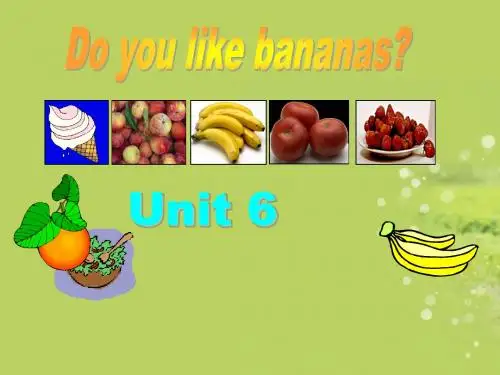
a banana s
a hamburger s
a tomatoes
broccoli
French fries
an orange s
ice cream
a strawberry ies
a pears
salad
Let’s have a big meal.(让我们大吃一顿.)
Explanation
1. Running star Sandra Clark eats lots of healthy food. some , many , lots of , a lot of 的区别 (1) some 意思是 “一些”, 可以修饰 可 数名词,也可以修饰不可数名词。 如:some friends 一些朋友 some water 一些水
Sandra: No, I don’t like vegetables.
Well, only salad. I like
salad. But I like fruit. I like
bananas, oranges…
Tom: How about apples? I don’t like apples!
hamburgers
French fries
ice cream
tomatoes
broccoli
strawberry strawberries salad
/e/ e
pears
bananas
oranges
/ e/
1a Match the words
1. hamburgers 2. tomatoes 3. broccoli 4. French fries 5. orange 6. ice cream 7. salad 8. bananas 9. strawberries 10.pears d g a h e f c b i j
Units4-6复习课件课件(人教新目标七年级上)

_______i_sn_'t___otnhe watch?
2.Her hat is on the chair. (改为否定句)
Are these
Her hat ________ ____ the chair.
3. These are my books.(改为一般疑问句)
___I_s___ ________o_n_ your books?
Unit 5┃ 基础知识梳理
we
9. 我们 _la_te______ 10. 迟到 网__球___w_a_tc_h___ 11. 注视;观乒看乓球_____________ 12. tenni班s 级_;__(一__节__)课____
相同的
13. ping-p爱o;ng喜爱______________ 14. class允_许__;_让__________________ 15.sam有e趣的______________ 16.love玩;__打_(_球_)_________ 17.let __________________
Unit 4┃ 基础知识梳理
3. “你的书在哪儿?” “它W们her在e o椅n 子ar上e 。” —___________ _______ your books? —They araere___in_ the chair. 4. 钥匙在书架上。 The keys ______ ____ the bookcase.
Unit 4 Where‘s my schoolbag? Unit 5 Do you have a soccer ball? Unit 6 Do you like bananas?
Unit 4 My name's Gina
Unit 4┃ 基础知识梳理
Unit 6 (单元复习课件)-七年级英语上册(人教新目标Go for it!)
➢ 三单:Does+主语+like+宾语? Yes,主语代词 does./No,主语代词
doesn’t. John喜欢他们吗?不,他不喜欢。 _D_o_es_ _J_o_h_n_li_k_e_t_h_em_ _?_ N_ _o_,_h_e_ d_o_e_s_n_’_t._ _ _ _ _ _ _ _ _ _ _ _ _
那么;所以,如此的____s_o________ 早餐___b__re__a_k_fa__st______ 作为早餐__fo__r_b__r_e_a__k_f_a_st 午餐___lu_n__c_h______ 午餐后_a_f_t_e_r_l_u_n_c_h____ 明星;星星 ___s_t_a_r_______
11. 晚餐后
____a_ft_e_r_d_i_n_n_e_r___
12. 我不想变胖。_I_d__o_n_’t_w__a_n_t_t_o_b_e__fa_t_._
03 Sentences
Sentences
Jack: Hey, John’s birthday dinner is next week. Let’s think about the food.
Cindy: I love fruit. I think it's healthy.
某人某餐喜欢吃什么?
David: OK. So what fruit do you like? Do you like bananas? 你喜欢吃什么水果?
Cindy: Well, I don't like bananas. But I like oranges and apples.
新目标英语七年级上册unit6Period1公开课课件
02
实施
03
04
安排5-10分钟时间,让学生 提问。
教师解答学生的疑问,并引导 其他学生参与讨论。
Teacher's Q&A session
目的: 教师解答学生疑惑,提供个性化指导。 教师收集学生的问题,挑选有代表性的进行解答。
实施
对于共性问题,教师可组织小组讨论或邀请学生分享经 验。
Classroom interactive games
Try to understand the cultural background and context of the text.
Practice listening, speaking, writing and translation to
improve English proficiency.
深入解析语法规则
通过讲解、演示和练习,使学生深入理解Unit6涉及的语法知识点,如现在进行时、一般将来时等,并能在实际语境中运用。
Text Analysis
培养阅读理解能力
通过对Unit6的课文进行深入分析,引导学生理解文章的主题、结构和语言特点,同时提高学生的阅 读速度和理解能力。
03 teaching method
培养批判性思维
学生在讨论中学会倾听、思考、表 达自己的观点,培养批判性思维能 力。
增强沟通技巧
小组讨论让学生学会与人沟通、协 商、达成共识,提高沟通技巧。
04 Teaching interaction
Student questioning session
01
目的: 鼓励学生主动提问,促 进知识内化。
Reading and Understanding: A Trip to New York City
Unit 6 Section A Grammar Focus-3c 课件 人教版英语七年级上册
Grammar Focus
Do you like salad?
Do they like pears? Does she like tomatoes? I like oranges. We like rice. He likes ice-cream.
Yes, I do./No, I don't.
Yes, they do./No, they don't. Yes, she does./No, she doesn't. I don't like bananas. We don't like hamburgers. He doesn't like vegetables.
Complete the chart!
Food
Likes Doesn’t like
Ⅰ. 用所给单词的适当形式填空。
1. I like __t_o_m__a_to_e_s___(tomato) very much. 2. Nick ____l_ik_e_s_____(like) hamburgers and salad. 3. Let’s ___t_h_i_n_k_____(think) about the birthday dinner. 4. Ms. Smith has ten _s_t_r_a_w_b_e_r_r_ie_s_(strawberry)? 5. Hamburgers? That ___s_o_u_n_d_s____(sound) good. 6. My brother __d_o_e_s_n_’t_l_i_k_e_(not like) eggs. 7. His cousins ___d_o_n_’t__li_k_e__(not like) ice-cream.
宁夏2024七年级英语上册Unit6ADayintheLife易错考点专练课件新版人教新目标版
用raise或rise的适当形式填空。 1. We like to watch the sun rise over the bridge(桥). 2. Let’s raise some money for children in Hope School.
8. —When is Linda’s birthday party? —It’s at three o’clock on the afternoon of July 8 th.
辨析when 与what time 易错点津:当询问某事发生的具体时间点时, what time与
when可互换使用;当询问某事发生的年份、月份、日期 或上午、下午、晚上时,用when;但当询问钟表上的具 体时间时,一般用what time,意为 “几点”。
Let’s prepare for the party.
一、用when 或what time填空。 1. — When does Lisa play the piano?
—She usually plays the piano on weekends. 2. — What time/When do you have dinner every day?
—At about 6:00 p.m. 3. — When does your cousin David play basketball?
—He often plays basketball on Sunday afternoon.
二、补全对话拆解练。(每空一词) 4. Jim usually watches TV at eight in the evening.(对画