
译林版九年级英语下册教案Unit 4 Integrated skills
Integrated skillsTeaching aims:To listen to the dialogue and do some exercises.To complete a report from the TV program.Talk advantages and disadvantages about Mars and express own ideas. Teaching steps:Step 1 RevisionComplete the sentences.1.Earth is becoming more and more ________ (crowd).2.Every year, large numbers of tourists ______ (come) to visit Beijing.3.There will be no _________ (pollute)on Mars.4.The news made her ____ (feel) sad.5._______ (science)are working hard to make the dream become true.Keys: crowded, come, pollution, feel, ScientistsStep 2 Presentation1. carry out 开展,执行e.g. No matter what difficulty you will meet with, carry out your plan.不管你遇到什么困难,都要执行计划。
2. percentage n. 百分率,百分数e.g. Percentage of students who would like to move away from the earth is 50%.想要搬离地球的学生数的百分比是50%。
3. disadvantage n. 缺点,不利条件e.g. The disadvantage of living on Mars。
住在火星的缺点。
4. risk n. 风险e.g. I’m not sure if it’s worth the risk.我不确信是否它值得这个风险。
5. after all 毕竟e.g. After all, people have already been to the Moon. 毕竟,人们已经去过月球。
Step 3 Practice1. Daniel wants to live on Mars in the future. However, Sandy is still not sure if she would like to. This week, there is a TV programme on this topic. Listen to the preview. Help Sandy make notes of it.Survey carried out in: Schools in Sunshine TownDay:Channel:Name of programme:Time:Percentage of students who would like to move away from the Earth:Keys: Friday evening, Sunshine TV, Move in Mars, 7:30 to 9:00 p.m. 50%2. Sandy is watching the TV programme. She wants to write down the important points. Listen to the discussion and help her complete her lists.Advantages1. It would be very interesting.2. We could study at ____________.3. It is not so crowded, with much more _____.4. Travelling in space would be ____.Keys: online schools, space, funDisadvantages1. We do not know if it is really safe.2. We might ______ from living there.3. It is ___________ from the Earth.4. There is not enough food, ______ or oxygen.5. There might be __________ aliens.Keys: get ill, so far away, water, dangerousStep 4 DebateHave a discussion in groups of four, and hold a debate.Advantages of living on Mars:Disadvantages of living on Mars:Step 5 Daniel and Sandy are talking about the TV programme. Complete theirconversation with the information in Parts A 1 and A 2.Sandy: Did you watch the programme called (1) ____________ on (2) ________ TV last (3) ______ evening?Daniel: Yes, I did. but I missed the first part of it. When did the programme begin? Sandy: It began at ________. It started with a discussion about a ______. It showed that (6) _____ of the students would like to (7) ______________ the Earth and live on (8) _____.Daniel: Oh, yes. Some students said living on another planet such as Mars would be very (9) _________. They could study at (10) ____________, and travelingin (11) ______ would be fun.Sand y: There might also be much more (12) ______ for everyone on Mars. It’s too crowded here.Daniel: However, some other students were worried about living there. They said they didn’t know if it would be (13) _________. They thought they might (14)_____ bec ause there’s not enough food, (15) _____ or oxygen on Mars. Sandy: They were even afraid of aliens there. They thought aliens were (16) _________ and would harm people.Keys: Move in Mars, Sunshine, Friday, 7:30 p.m., survey, 50%, move away from, Mars, interesting, online schools, space, space, really safe, get ill, water,dangerousStep 6 DiscussionHow do we protect the Earth?We should reduce pollution;We should control population;We should save energy;We should…Step 7 Speak up1. Daniel and Sandy are talking about living on Mars. Work in pairs and discusswhether you would like to live on Mars. Use the conversation below as a model. Daniel: Would you like to live on Mars, Sandy?Sandy: I’m not sure if it’s worth the risk. It worries me.Daniel: Why? It would be quite safe. After all, humans have already been to the Moon.Sandy: Maybe you are right, but we might get ill from living there.Daniel: I don’t think so, Sandy. It’s just a different kind of life. It would be great to live on another planet.Sandy: What about all your friends here on the earth if you go to Mars?Daniel: I want you all to come too.Sandy: OK. If you all go together, it should be fun.2. Listen to the conversation and answer the questions.1. Would Sandy like to live on Mars? Why?2. Would Daniel like to live on Mars? Why?Keys: He is not sure because she is not sure if it’s worth the risk it worries her.Yes, he would like to. Because it’ll be great to live on another planet. Step 8 Work in pairs.Where do you prefer to live, Mars or Earth?Why?Useful information:online schoolsmuch more spacetravelling in spacesome dangerous aliensso far away from the Earthno food, water or oxygenStep 9 Exercises1. Translate the following phrases.1. 开展,执行2. 在太空中旅游3. 对…… 有伤害4. 害怕见到外星人5. 离地球如此遥远6. 生活在火星上的缺点7. 与地球上的情形不同8. 毕竟9. 住在另一个行星上非常棒2. Complete the following sentences.1. Some of the students are afraid of ______ (see) aliens there.2. They are not sure whether it is much _____ (safe) to live there.3. The questions she asked last week is still under _________ (discuss).4. Reading in the sun is _______ (harm) to our eyes.5. Don’t have the baby ____ (cry) all the time.Keys: seeing, safer, discussion, harmful, cry3. Translate the following sentences.1. 我们的班会以一个特别的讨论开始。
译林版英语九年级下册教学教案Unit 4 Integrated skills
Unit 4 Life on MarsIntegrated skillsI. Teaching aims and learning objectivesBy the end of the lesson, students should be able to:1.understand the programme and get useful information from it;2.talk about whether they would like to live on Mars.II. Teaching contents1.New words and phrases: risk, percentage, disadvantage, carry out, get ill from, after all2.New structures: However, some other students were worried about living there.They were even afraid of aliens there.They thought aliens were dangerous and would harm people.I’m not sure if it’s worth the risk.After all, humans have already been to the Moon.III. Focus of the lesson and predicted area of difficultyListening and speaking.IV. Teaching proceduresA Living on MarsStep 1 Before listeningMake a surveyT: Do you want to live on Mars in the future? Why or why not?Our friend Daniel wants to live on Mars, while Sandy is not sure if she would like to. Would you like to share your ideas with Sandy to help her make a decision?Step 2 While listening[1.Listen to the previewT: There is going to be a TV programme on living on Mars. Listen to the preview and make notes with Sandy please.Survey carried out in: _____________________Day: _____________________Channel: _____________________Name of programme: _____________________Time: _____________________Percentage of students who would]like to move away from the Earth ________2. Listen to the TV programme(1) Understand the main idea]T: Now let’s listen to the programme together and try to understand what it is about.(2) Fill in the blanksT: Listen to the programme again and write down the advantages and the disadvantages of living on Mars.T: Complete the conversation with the information you’ve got.(3) Listen and discussT: Listen to the programme for the third time. Think over how Daniel and Sandy feel about the programme.B Speak up: Earth or Mars?Step 1 After listeningShare your ideasT: After watching the TV programme, how do you feel about living on Mars? Would you like to go there? S: I’d love to live on Mars, because …I’m not sure if it’s worth the risk …Step 2 Practice1.Listen and answerT: Listen to the dialogue between Daniel and Sandy, and answer the following questions.(1) Who would like to live on Mars, Simon or Daniel?(2) Would Sandy like to live on Mars? Why or why not?2.Make a similar dialogueV. Homework1. Recite Part B.2. Talk more about living on Mars after class.。
Unit4IntegratedskillsStudyskills学案牛津译林版英语九年级下册

Unit 4 Integrated skills & Study skills【学习目标】1.能记住并能正确运用本节课词汇carry out, percentage, disadvantage, risk, after all。
2.能从听力材料中获取信息,会用英语谈论火星生活,并总结其优劣处。
3.学会自我评价,制定学习计划。
【预习导学】一、词汇记忆1.风险2.百分数3.劣势,不利条件4.开展5.毕竟6.频道7.语法规则8.提高,改善二、想一想。
将你常用的英语学习方法写下来,与同伴交流,完成下表。
Ways of studying EnglishYou Your partner【答案】一、词汇记忆1.risk2.percentage3.disadvantage4.carry out5.after all6.channel7.grammar rules8.improve二、想一想。
将你常用的英语学习方法写下来,与同伴交流,完成下表。
Listen to tapes Work in pairs Sing English songs Join an English club Learn grammar【合作探究】任务驱动一听力训练1.听教材Integrated skills中A1部分录音,填空。
The host of Sunshine TV did a in schools in Sunshine Town by asking three questions. The questions are:Is there on Mars? Should we there? What would be like there? The survey showed that 50% of the students would like to move to .2.听教材Integrated skills中A2部分录音,连线将人物和观点匹配。
英语:unit 4《great people》integrated skills教案(2)(译林牛津九年级下).doc
英语:Unit 4《Great people》Integrated skills教案(2)(译林牛津九年级下)Teaching & Studying PlanUnit 4Great people学案(Integrated skills) 【学习目标】语言知识:1. 掌握相关的词汇和短语。
2. 学会从人物简介中提取信息。
3. 学会补全笔记。
语言技能:能用所学结构谈论名人以及我们钦佩他们的原因。
情感态度:以名人为榜样,现在努力学习将来为社会多作贡献。
【学习重难点】1. 如何谈论名人以及我们钦佩他们的原因。
2. 完成一篇介绍人物的文章。
课前延伸课前导学练习一、根据中文、首字母提示及句意写出单词。
1. Do you know who invented (X光) machines?2. The future is always (未知的) to us.3. A c only have one child in most cities in china.4. My friend is a F , and he comes from Paris.5. Maths is short for .Keys: 1.X-ray; 2.unknown; 3.couple; 4.Frenchman; 5.mathematics二、收集有关居里夫人的信息,并能通过、文字、图片等进行描述。
课内探究课中训练Ⅰ.Read the following information and then answer some questions.Marie Curie was born in the city of Warsaw in Poland. When she was 24, she moved to France and studied mathematics and physics .She married a Frenchman called Pierre Curie there. In 1898, they discovered radium. Marie Curie received the Nobel Prize twice during her lifetime. She died at the age of 67.1.Where was Marie Curie born?2.What did she study in France?3.What were she and her husband famous for?4.How many times did she receive the Nobel Prize?Keys:In the city of Warsaw in PolandMathematics and physicsThe discovery of radiumTwiceⅡ. Finish some of PartA1 with as much information as you can.Keys: 1.1867; 2.Warsaw; 9.mathematics; 10.physics; 11.Frenchman12. discovering; 18.67Ⅲ.Complete the rest of PartA1 after listening.Keys: 3. the youngest; 4. Science; 5.music; 6.16; 7.teacher; 8.Paris; 13.190314. traffic accident; 15.1905; 16.1911; 17.4th JulyⅣ. Use the information in PartA1 to finish PartA3.. Keys: 1.Warsaw in Poland; 2.Paris; 3.mathematics; 4.physics; 5.husband6. Frenchman;7.Nobel Prize;8.radium;9.Second Nobel Prize10.1905Ⅴ. Complete the following dialogue.Millie: Who do you think is the g 1 person that has ever lived?Simon: Neil Armstrong! I a 2 him the most.Millie: What did Neil Armstrong do?Simon: He was the f 3 man that walked on the moon.Millie: Why do you admire him?Simon: Because he was a b 4 man to go to a place that was u 5to humans at that time. What a 6 you? Do you admire anybody?Millie: Yes. I admire Marie Curie. She d 7 radium and i 8X-ray machines.Simon: Why do you admire her?Millie: Because X-ray machines are now u 9 all over the world to help doctors s lives.Keys: 1.greatest; 2.admire; 3.first; 4.brave: 5.unknown6.about;7.discovered;8.invented;ed; 10.saveⅥ. WritingMarie Curie is one of the world’s most famous women.She was bornWe should learn from her..Marie Curie is one of the wor ld’s most famous women.She was born on 7th November 1867. She was born in Warsaw, a city in Poland. She was the fifth and the youngest child of her family. When she was 24, she left Poland and went to Paris to study at a university there. She studied maths and physics. She married a Frenchman called Pierre Curie. The couple won a Nobel Prize for the discovery of radium in 1903. In 1911, she was awarded her second Nobel Prize. She died at the age of 67.We should learn from her. We should study hard today so that we can do more for the society.课后提升课后提升一、句型转换。
新牛津译林版英语九年级下册《unit 4 great people》integrated skills优秀教案(重点资料).doc
Step1P resentation
1 Get students to read Part A1 and then do the execis es
2 Invite students to talk about Marie Curie.
3 Play the recording. Students listen carefully and complete the sentenes with correct words in Part A3.
Step2Presentation
1.Close the books and listen to me while I read the conversation.Ask stude nts to repeat the sentences as they hear them.
2 Ask students to practice the conversation in pairs and then change roles.
Unit 4 Great people
In tegrated skills
Teach ing Aims:
To extract information from a profile
To complete notes[网]
To extract information from a recording about Marie Curie
To complete a presentation
Teaching Important Point:
To extract information from a profile
To extract information from a recording about Marie Curie
英语:unit 4《great people》integrated skills教案(1)(译林牛津九年级下)
learn Integrated skills which will introduceus a famous woman scientist—Marie Curie. T: Have you previewed it? S: Yes. T: Great! Please take out your paper. Part1,Check your answers in your group. If you have any questions, you can ask mefor help. S: (学生讨论) T: OK. Let’s check the keys together. Please read thewhole sentence, then spell the word you fill in. No1, Group 1. S: Do you know who invented T: No2, Group 2. S: Thefutureis always T: Next one. S:A c only have one child in most cities in china. C-o-u-p-l-e, couple (未知的) to us. U-n-k-n-o-w-n, unknown. (X 光) machines?X-r-a-y, X-ray.
No.14. traffic accident; No.15.1905; No.16.1911; No.17.4 th July T: Very good!A flag for you. T: So far wehaveknown a lot about her. So it is easy for us to complete PartA3. Have a try. S: (Practice) T: Check theanswers and read them together. S: No.1.Warsaw in Poland; No.2.Paris; No.3.mathematics; No.4.physics; No.5.husband No.6. Frenchman; No.7.NobelPrize; No.8.radium; No.9.Second Nobel Prize No.10.1905 S: (Reading) T: Now, let’s do morepractice. Complete the following dialogue. Take out your papers. S: (Practice) T: Please check theanswers.
初中英语译林版九年级下册同步Integrated skills (4)精品教案
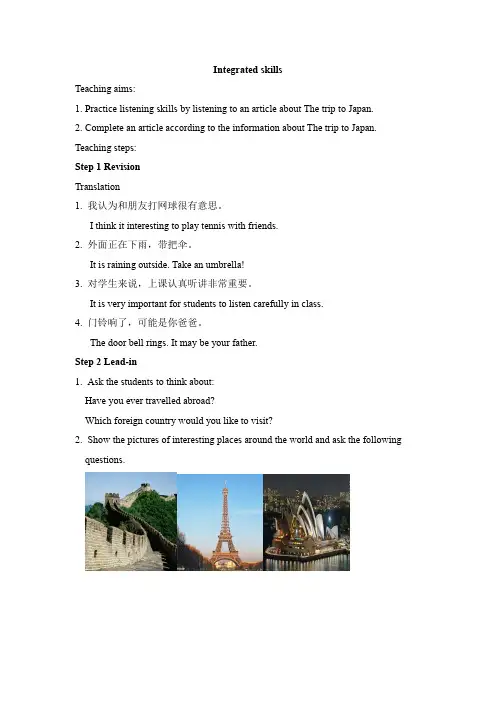
Integrated skillsTeaching aims:1. Practice listening skills by listening to an article about The trip to Japan.2. Complete an article according to the information about The trip to Japan. Teaching steps:Step 1 RevisionTranslation1. 我认为和朋友打网球很有意思。
I think it interesting to play tennis with friends.2. 外面正在下雨,带把伞。
It is raining outside. Take an umbrella!3. 对学生来说,上课认真听讲非常重要。
It is very important for students to listen carefully in class.4. 门铃响了,可能是你爸爸。
The door bell rings. It may be your father.Step 2 Lead-in1. Ask the students to think about:Have you ever travelled abroad?Which foreign country would you like to visit?2. Show the pictures of interesting places around the world and ask the following questions.(1). Have you ever been to Japan?(2). What would you like to see in Japan?(3). What would you like to eat in Japan?Step 3 Listen and complete1. The exchange students are going to Japan after visiting Shanghai. Listen to Millie introducing their itinerary. Match the days on the left with their activities on the right.A tour of JapanDay 1 leave Japan for another Asian countryDay 2 visit Kyoto, an ancient city of cultureDay 3 take a tour of Tokyo, the capital cityDay 4 visit Mount Fuji, Japan’s highest mountain2. Check the answers.Day 1 take a tour of Tokyo, the capital cityDay 2 visit Mount Fuji, Japan’s highest mountainDay 3 visit Kyoto, an ancient city of cultureDay 42. Miss Thompson is telling the exchange students about their trip to Japan. Kevin ismaking notes. Listen carefully and help Kevin complete his notes.• leave Shanghai at __________________ on ________________• arrive in _________ aro und ________• see the main _______ and go ________ visit the Tokyo _______________ to see some Japanese ________________• travel to ___________ by ______ on the second day; can go _______ there• visit the ancient city Kyoto on the third day and learn about Japanese__________• try all kinds of Japanese _______ during our stay in Japan3. Check the answers.9:00 in the morning, 25th, February, Tokyo, noon, sites, shopping, National museum, works of art, Mount Fuji, coach, skiing, culture, food.4. Kevin is writing about the exchange students' trip to Japan. Help him complete it. Use the information in Parts A1 and A2 to help you.We are leaving for Japan soon. Japan is the second country we are going to visit in Asia. Our flight will be (1) ________ on 25 February, and we plan to stay there for (2) ______________.First, we are going to visit (3) _______. It is Japan‘s capital city. We can see the main (4) ___________ and go (5) _________ there. Our teacher, Miss Thompson, is also going to take us to the (6) _____________________ to see some Japanese (7) _______________.On the second day, we are going to take a (8) __________ to (9) ___________. It is Japan’s (10) ________ mountain. We can go (11) ___________ there.On the third day, we are going to visit an ancient city called (12) ________ and learn about Japanese (13) ________.During our stay in Japan, we can also try all kinds of Japanese (14) _______.I hope we will have a very nice trip.5. Check the answers.Leaving, four days, Tokyo, sites, shopping, Tokyo National museum, works of art, coach, Mount Fuji, highest, skiing, Kyoto, culture, foodStep 4 Language points1. leave Japan for another Asian country离开日本去另一个亚洲国家leave sp. for sp. 离开(出发地)去(目的地)leave for sp. 离开去(目的地)e.g. 他昨天离开上海去北京了。
牛津译林版英语九年级下册Unit4Integratedskills教学设计
难点:如何帮助学生克服听力过程中的焦虑情绪,提高听力理解水平,特别是在长对话和复杂语境中。
3.重点:通过口语交流,培养学生的英语思维和表达能力。
难点:如何引导学生进行高质量的口语互动,提高口语表达的准确性和流利性。
4.重点:通过写作训练,提升学生的篇章组织能力和句子构建技巧。
接着,我会解释这两个时态的用法,并结合实际语境,让学生进行例句仿写。此外,针对本节课的重点词汇和短语,如“achieve one's goal”, “set an example”, “make a difference”等,我会通过图片、例句和语境,帮助学生理解和记忆。
(三)学生小组讨论
在学生掌握了新知识后,我会组织他们进行小组讨论。将学生分成若干小组,每组选择一个成功人士的案例,讨论以下问题:
2.学生能够掌握一般过去时和现在完成时的用法,运用这两种时态描述过去发生的事情以及对现在造成的影响。
3.学生能够在听力活动中,抓住关键信息,提高听力技巧,如:预测、关键词识别等。
4.学生能够在口语交流中,用英语表达自己的目标和计划,以及为实现目标所采取的行动。
5.学生能够在写作中,运用所学知识,描述一个成功的案例,并表达自己的观点和感悟。
1.写作作业:请学生结合课堂讨论的成功人士案例,运用一般过去时和现在完成时,写一篇关于自己目标的英语短文。要求短文结构清晰,观点明确,不少于80词。
2.口语作业:学生与家长或朋友合作,进行一次关于“achieve one's goal”的英语对话。要求双方分别扮演成功人士和采访者,用英语进行提问和回答,录音后提交。
3.针对听力训练,设计不同难度的听力任务,逐步提高学生的听力水平。在听力过程中,引导学生运用预测、关键词识别等听力策略,提高听力效果。
【优选整合】牛津译林版九年级下册英语 Unit 4 Life on Mars-Integrated skills 教案
1. Remember the words and phrases.
2.完成《课课练》第六课时
3.完成9B《初中英语读本》阅读一篇
T: Daniel and Simon are talking about the TV programme. Complete their conversation by using the information in Part A1 and A2.
Ss finish the conversation in Part A3, and then check the answers.
If Ss are not sure, listen again. Then check the answers together.
Advantages of living on Mars Disadvantages of living on Mars
1. It isinteresting.
1. We do not know if it isreally safe.
2、难点
Help the students to recognize key expressions used to describe the life on Mars in the future.
教学
方法
task-based approach
教学
用具
Tape recorder, Pictures and Multi-media
Discuss the answers in pairs. Then ask five students to present their answers to the whole class for them to point out the mistakes if there is any.
unit4 Integrated Skills课时教案牛津译林版九年级英语下册
Contents of the three sessions: vocabulary: conduct percentage
Skill objectives: 1. Listen to a TV program advertisement, obtain information from it, and complete notes. 2. Obtain information from a TV discussion program. 3. Complete a conversation. 4. Discuss the pros and cons of life on Mars and express personal opinions.
Earth is too …
Talking about disadvantages
A disadvantage of living on Mars is …
Life on Mars would be worse because …
I wouldn’t like to live on Mars because …
Divide the class into groups of four and ask each group to make answers and write them on a piece of paper. After completion, the groups exchange answers and check each other.
Talking about advantages:
生活在火星上的一个优势是……
火星上的生活会更好,因为……
我想住在火星上,因为……
初中英语九年级下册(牛津译林版)Unit4lntegratedskills教学设计
3.能够运用阅读策略(如略读、寻读、精读)来获取、整理和归纳文章中的信息。
4.能够根据实际情况,设计并介绍自己的旅行计划,包括行程安排、预算、住宿和交通等方面。
5.能够在小组合作中,用英语进行有效沟通,展示自己的观点和倾听他人的意见。
2.在小组讨论过程中,教师巡回指导,观察学生的讨论情况,适时给予建议和反馈。
3.各小组展示并介绍自己的旅行计划,要求运用一般过去时描述旅行经历,其他小组给予评价和建议。
(四)课堂练习(500字)
1.设计一般过去时的写作练习,让学生撰写一篇关于自己旅行经历的文章,巩固所学语法知识。
2.进行阅读练习,选择一篇旅行相关的文章,让学生运用所学阅读策略,完成相应的任务,如填空、问答、归纳总结等。
(二)过程与方法
在本章节的教学过程中,学生将通过以下方法提高英语综合运用能力:
1.通过小组讨论、分享和角色扮演等活动,提高学生的听说能力和团队合作精神。
2.通过阅读旅行相关的文章,培养学生获取、整理和归纳信息的阅读策略。
3.通过写作练习,提高学生的书பைடு நூலகம்表达能力,巩固一般过去时的用法。
4.通过设计旅行计划,培养学生的创新思维和解决问题的能力。
-通过写作练习,让学生撰写自己的旅行经历,巩固一般过去时的用法。
2.针对旅行相关词汇和表达的教学,设想如下:
-制作旅行词汇卡片,让学生通过游戏、竞赛等形式学习和记忆词汇。
-结合实际旅行经历,让学生用英语介绍旅行中的住宿、交通、景点等,提高他们的语言表达能力。
3.针对阅读策略的培养,设想如下:
-选择旅行相关的文章,引导学生运用略读、寻读和精读等策略,获取、整理和归纳文章信息。