
人教版七年级下册英语 Unit 3教案 unit3教案
课
型
New Teaching
教学准备
1.A tape recorder. 2.A computer for multimedia use.
预计授课时间
第3周
教学设计
主
案
副
案
1. T: Hi! Everyone. Nice to see you again. How are you today? 2. T: Do you want to listen to an English song? 3. T: Ok. Let's listen to a song "Lemon Tree". T: Let's learn the new words(. 让我们来学习新
5. Then play the recording for the first time. Ss only listen.(放一遍录音,同学们只是听)
6. Play the recording a second time. This time ask the Ss to write the number of the name next to the correct Ss.(放第二遍录音,这次让同学们在学生下写出正确的名字)
T: Hey, Dave. How do you get to school?
Then let Ss say how other Ss in the picture get to school. Give them some help if necessary. 然后让学生说在图画中别的学生是怎样去上学的,如果需要帮助就给予帮助。
学 过程与方法 Listen, pair work and discuss.
目
标
情感态度 与价值观
通过对情态动词的学习,能够对现实生活中的事情进行推理。
教
1. Listening and writing practice using the target language.
材
重点
2. Make inferences using the target language.
Then read the phrases to them and ask them to repeat. Then ask them to write them in the box and add other ways to get to school.
1. First ask Ss to say what each person is doing. Write the phrases on the board. (首先让学 生说每个人都在做什么。然后把句子写到黑板上)
分
析
难点
Make inferences using the target language.
课 型 New Teaching
教学准备
1.A tape recorder 2.A computer for multimedia use
教学设计
主
案
Ⅵ. Teaching Procedures:
Step I Revision
2. 学习完成任务所需要的语言:1) 词汇:take, subway, hay, walk, train, forty, fifty, sixty, seventy, eighty, ninety, hundred, minute.
知识与能力
2) 句子:How do you get to school? I get to school by bus.
单元名称或题目 单元教学内容分析
单元教学目标
序号
课题
单元教材分析及教学形式安排 Unit 3 How do you get to school?
本单元主要是学习能够正确表达如何去到一个地方
(1) Train students' listening skill. (2) Train students' writing skill. (3) Train students' ability to deduce.
课
题
Section B(1a-2c)
知识与能力 (1) Train students' reading skill.
教
(2) Train students' communicative competence using the target language.
学
过程与方法 1. Practice method. 2. Pairwork.3. A game.
单元教学内容及教学形式安排
教学形式及课时安排
任务设计
1
Section A(1a-2b)
2
Section A(2c-3c)
3
Section B(1a-2c)
New Teaching(1) New Teaching(1) New Teaching(1)
Task-based Language Teaching Saying and pair work Listening, pair work
magazines very much.
预计授课时间 副
第5 周 案
Step Ⅵ 2c This activity provides writing practice using vocabulary introduced in the unit. Step Ⅴ Grammar Focus Ask students to say the questions and answers in pairs. At the same time, write them on the blackboard. Ask students, what does it mean when you say something must be true How sure are you that it is true 100 percent 50 percent 10 percent Repeat the process with the words might, could and can't. Optional activity Play the game like this: T: (Holding up a pen) Whose pen is this S1:It could be Li Lei's. T: Li Lei, is this your pen L: No, it isn't. T: It can't be Li Lei's. He says it's not his. S2:It might be Wu Jun's. T: Wu Jun, is this your pen W: Yes, it is. T: He says it's his. The pen must be Wu Jun's. (Holding up a notebook)Whose notebook is this S3: It must be Li Na's. I gave it to her as a birthday present. Repeat the process with the other items. Step Ⅵ Summary Say, In this class, we've clone some listening and writing practice using' the target language. And we've learned how to make inferences using the words must, might, could and can't. Step Ⅶ Homework Make two sentences each using the words must, could, might and can't.
7. Ask Ss to complete the activity individually.
8. Then check the answers.
课
题
Section A(3a-4)
教skill.(2) Train students' ability to deduce.
walking riding taking the train taking the subway taking the bus
课本
Step 2:
图画
2. Then tell Ss to listen to a recording. Two people are talking about some Ss get to school(. 然 后让同学们听录音)
Revise the conversations in lb. Get different pairs of students to talk about who each thing might
belong to and give a reason. Step Ⅱ 2a
This activity provides listening practice using the target language. Using a hair band, teach
的单词) subway take the subway train take the train Section A 1a
First ask students to look at the picture. And read the sample sentences to them. Ask them to repeat.
students to practice the words hair band, Point to the numbered list with blank lines after each number. Step Ⅲ 2b This activity provides listening and writing practice using the target language. And then have different students explain in his/her own words what each word means.
新人教版七年级下册英语 Unit 3 第3课时 教案(教学设计)
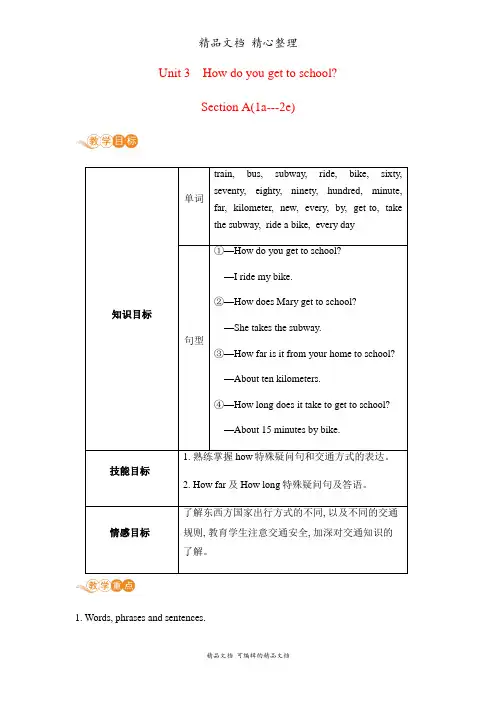
—About 15 minutes by bike.
技能目标
1.熟练掌握how特殊疑问句和交通方式的表达。
2. How far及How long特殊疑问句及答语。
情感目标
了解东西方国家出行方式的不同,以及不同的交通规则,教育学生注意交通安全,加深对交通知识的了解。
2. Play the tape of 2a.
3. Let Ss look at the chart of 2b carefully.
4. Play the tape of 2b.
1. Ss listen and repeat. Then write the correct numbers next to the word.
Unit 3How do you get to school?
Section A(1a---2e)
知识目标
单词
train, bus, subway, ride, bike, sixty, seventy, eighty, ninety, hundred, minute, far, kilometer, new, every, by, get to, take the subway, ride a bike, every day
About 15 minutes by bike.
2. Let Ss read theconversation together after the tape.
3. Explain the difficulties.
4. Let Ss read in pairs.
5. Let several pairs of students role-play the conversation in front of the class.
2019——2020学年人教版英语七年级下册Unit3教案

a.教师可以通过设置具体情境,帮助学生理解频率副词的层次,如通过图表展示不同活动发生的频率,让学生选择合适的副词进行描述。
b.在语法教学环节,教师应明确指出一般现在时态用于描述习惯性动作或普遍真理,并通过例句展示其用法,如:"He always eats breakfast at 7:00 a.m."
在反思今天的课堂时,我也意识到教学难点和重点的讲解需要更加具体和细致。尤其是对于一些理解上存在困难的学生,我需要设计更多的例句和练习,以确保他们能够彻底掌握这些语言点。
-句型:掌握"How often do you...?"句型的用法,并能用一般现在时态回答相关问题。
-语法:理解和运用一般现在时态描述日常习惯,特别是频率副词的使用规则。
举例:在课堂活动中,教师应重点强调如何将频率副词与动词结合起来,形成完整的句子,如:"I usually exercise every morning."
4.学习能力:通过小组合作、互动交流等形式,激发学生的学习兴趣,培养其自主学习、合作学习和探究学习的能力,为终身学习奠定基础。
三、教学难点与重点
1.教学重点
-词汇:本节课的核心词汇包括always, usually, often, sometimes, never等频率副词,以及与日常活动相关的动词(如:exercise, watch TV, play computer games等)。
2. Section B:通过对话和短文,运用目标词汇和句型谈论日常锻炼习惯。
3. Grammar Focus:学习一般现在时态的用法,特别是频率副词的使用。
4. Fun Time:创编小对话,让学生运用所学语言进行实际交流,巩固课堂所学。
人教版七年级英语下册Unit3大单元教学设计
3.阅读理解:阅读与本单元主题相关的文章,完成相应的阅读理解题目,锻炼学生的阅读技巧和信息提取能力。
4.口语作业:准备一段关于自己家庭成员和职业的介绍,下节课进行课堂展示,要求使用本单元所学的句型和词汇,提高学生的口语表达能力。
5.合作意识:七年级学生正处于青春期,个性鲜明,合作意识相对较弱。教师应通过小组活动、角色扮演等形式,培养学生的团队协作能力和沟通技巧。
6.个体差异:学生在英语学习上存在一定的个体差异,教师需关注每个学生的学习状况,因材施教,使每个学生都能在原有基础上得到提高。
三、教学重难点和教学设想
(一)教学重难点
2.分步教学,逐步突破语法难点:
-通过对比一般现在时的肯定句、否定句和一般疑问句的结构,让学生观察、总结语法规则。
-利用图表、例句、练习等多种形式,帮助学生掌握一般现在时的用法,并通过小组合作、角色扮演等活动进行巩固。
3.互动交流,提升口语能力:
-采用问答、讨论等形式,鼓励学生用英语进行交流,提高口语表达能力。
1.重点:本单元的重点在于掌握一般现在时的用法,包括肯定句、否定句、一般疑问句及其回答,以及熟练运用与家庭成员和职业相关的词汇、句型进行交流。
2.难点:
-一般现在时的肯定句、否定句转换,以及一般疑问句的构成和回答。
-不同职业词汇的正确拼写和发音。
-口语表达中,正确使用本单元所学的句型和词汇描述家庭成员及其职业。
2.教师提出问题:“What does your father/mother do?”,让学生用英语回答,活跃课堂氛围,为新课的学习做好铺垫。
3.引入本节课的主题:“Let's talk about our family members and their jobs.”,让学生明确学习目标。
人教版七年级英语下册《Unit 3 How do you get to school单元教案
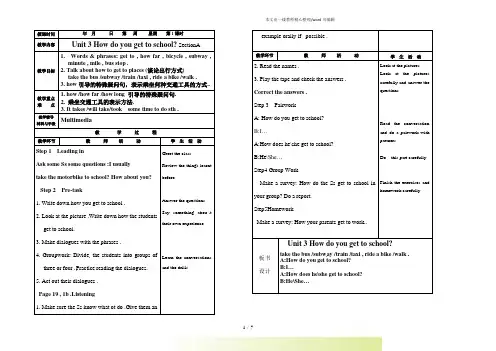
授课时间年月日第周星期第1课时教学内容Unit 3 How do you get to school? SectionA教学目标1. Words & phrases: get to , how far , bicycle , subway ,minute , mile , bus stop .2. Talk about how to get to places (谈论出行方式)take the bus /subway /train /taxi , ride a bike /walk .3. how引导的特殊疑问句,表示乘坐何种交通工具的方式..教学重点难点1. how /how far /how long 引导的特殊疑问句.2. 乘坐交通工具的表示方法.3. It takes /will take/took some time to do sth .教学辅导材料与手段Multimedia教学过程教学环节教师活动学生活动Step 1 Leading inAsk some Ss some questions :I usuallytake the motorbike to school? How about you? Step 2 Pre-task1. Write down how you get to school .2. Look at the picture .Write down how the studentsget to school.3. Make dialogues with the phrases .4. Groupwork: Divide the students into groups ofthree or four .Practice reading the dialogues. 5. Act out their dialogues .Page 19 , 1b .Listening1. Make sure the Ss know what ot do .Give them an Greet the classReview the things learntbefore.Answer the questions.Say something abou ttheir own experience.Learn the conversationsand the drills.example orally if possible .教学环节教师活动学生活动2. Read the names .3. Play the tape and check the answers .Correct the answers .Step 3 PairworkA: How do you get to school?B:I…A:How does he\she get to school?B:He\She…Step4 Group WorkMake a survey: How do the Ss get to school inyour group? Do a report.Step5HomeworkMake a survey: How your parents get to work..Look at the pictures.Look at the picturescarefully and answer thequestions.Read the conversationand do a pairwork withpartners.Do this part carefullyFinish the exercises andhomework carefully.板书设计Unit 3 How do you get to school?take the bus /subway /train /taxi , ride a bike /walk .A:How do you get to school?B:I…A:How does he\she get to school?B:He\She…教学反思授课时间年月日第周星期第2课时教学内容Unit 3 How do you get to school? SectionA 教学目标1.复习基数词及时间的表示方法.2.了解中外文化的差异.教学重点难点1.It takes /will take/took some time to do sth .2. Target language. The use of the drill.教学辅导材料与手段Multimedia教学过程教学环节教师活动学生活动Step 1 Leading in1. Greetings .2. Check the homework .Step 2 Pre –taskPage 20 , 2a.2b&2c .1. Revise the numbers .2. Teach the new word :minute .3. Play the tape for the students to finish Greet the classReview the things learntbefore.Revise the numbers .Listen to the recordingcarefully.2a&2c .Then play again and check theanswers ..4. Go over the dialogue in Page20 ,2d.Step 3 Pre-taskCheck the answer.教学环节教师活动学生活动Page 20 ,Grammar focus .1. Review the grammar box .Ask students to saythe statements and responses .2. Practice reading .Explain the usage of “take” in “take the train”and “take some time to do sth” .activityStep 4 PairworkMake a conversation about how you get toschool. Then practice in pairs.Step5 HomeworkRemember the Grammar Focus .Read the conversationand do a pairwork withpartners.Do this part carefullyFinish the exercises andhomework carefully.板书设计Unit 3 How do you get to school? Numbers: 32 40 41 50 60 70 80 90 100 Phrases:It takes /will take/took some time to do sth .教学反思授课时间年月日第周星期第3课时教学内容Unit 3 How do you get to school? SectionA教学目标1. 复习how far ,how long 引导的特殊疑问句.2. Reading practice.3. Writing practice.4.New words and phrases: town ill worry so much教学重点难点1. Key vocabulary, key phrases2. Target language. The use of the drill.教学辅导材料与手段Multimedia教学过程教学环节教师活动学生活动Step 1 Leading in1.Have Ss make sentences with “take to” .Explain the usage of “take” in “take the train”and “take some time to do sth” .Step 2 While-taskPage 21,3a .1. Pay attention to the speech bubbles .Read thequestions .2. Read the passage by the Ss. Find the answersto the questions and write the answers on thelines .Correct the answers .Step 3 Page 21, 3b .Greet the classReview the things learntbefore.Answer the questions.Say something abouttheir own experience.Learn the conversationsand the drills.教学环节教师活动学生活动1. Show Ss the example in the box .Two studentsread it to the class .2. Pairwork: Make your own conversations usingthe information in the left box.3. Ask some pairs to present the conversations tothe classStep 4 Post-taskPage 21 ,Part 4 .Groupwork.Divide the Ss into groups of three .In each group ,one is A,who look at Page 21.One is B,who look at Page 85,the other is C,who look at Page 86 .Fill in the blanks .The group who fill in the blanks first wins .Step 5 HomeworkWrite the sentences in Part 4 on the exercise books .Look at the pictures. Look at the pictures carefully and answer the questions.Read the conversation and do a pairwork with partners.Read this part carefullyFinish the exercises and homework carefully.板书设计Unit 3 How do you get to school?A:How far is it from your home to school?B:It’s…It takes/took sometime to do something.教学反思时间年月日第周星期第4课时教学内容Unit 3 How do you get to school?. SectionB教学目标1. vocabulary :bus stop bus station train station subwaystation .2. 能力目标:谈论上学的全过程。
有课后反思的七年级人教版英语下册第三单元教案
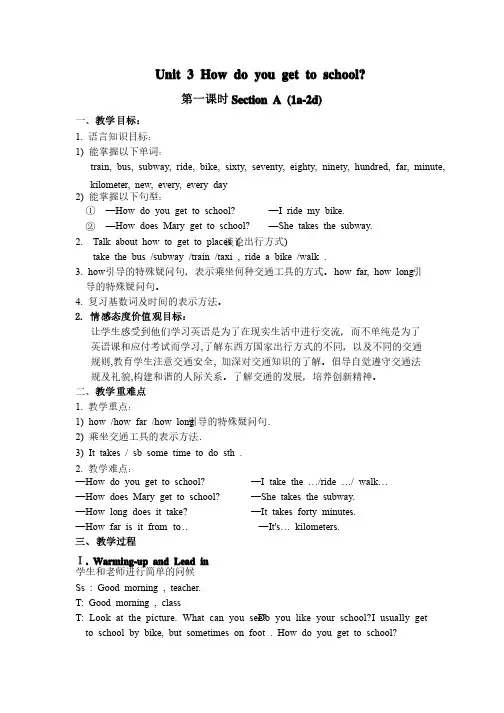
Unit 3 How do you get to school?第一课时Section A (1a-2d)一、教学目标:1. 语言知识目标:语言知识目标:1) 能掌握以下单词:能掌握以下单词:train, bus, subway, ride, bike, sixty, seventy, eighty, ninety, hundred, far, minute, kilometer, new, every, every day 2) 能掌握以下句型:能掌握以下句型:① —How do you get to school? —I ride my bike. ② —How does Mary get to school? —She takes the subway. 2. Talk about how to get to places (谈论出行方式) take the bus /subway /train /taxi , ride a bike /walk . 3. how 引导的特殊疑问句,表示乘坐何种交通工具的方式。
how far, how long 引导的特殊疑问句。
导的特殊疑问句。
4. 复习基数词及时间的表示方法。
复习基数词及时间的表示方法。
2. 情感态度价值观目标:让学生感受到他们学习英语是为了在现实生活中进行交流,而不单纯是为了英语课和应付考试而学习,了解东西方国家出行方式的不同,了解东西方国家出行方式的不同,以及不同的交通以及不同的交通规则,教育学生注意交通安全, 加深对交通知识的了解。
倡导自觉遵守交通法规及礼貌,构建和谐的人际关系。
了解交通的发展,培养创新精神。
二、教学重难点1. 教学重点:教学重点:1) how /how far /how long 引导的特殊疑问句. 2) 乘坐交通工具的表示方法. 3) It takes / sb some time to do sth . 2. 教学难点:教学难点:—How do you get to school? —I take the …/ride …/ walk… —How does Mary get to school? —She takes the subway. —How long does it take? —It takes forty minutes. —How far is it from … to … —It's It's…… kilometers. 三、教学过程Ⅰ. Warming-up and Lead in 学生和老师进行简单的问候学生和老师进行简单的问候Ss : Good morning , teacher. T: Good morning , class T: Look at the picture. What can you see? Do you like your school? I usually get to school by bike, but sometimes on foot . How do you get to school? Ss 按实际情况作答按实际情况作答S1: I ride my bike. S2: I go by bus. S3: ………T: V ery good. You’re clever. Let’s learn Unit 4 Section A. 之后板书:之后板书:“Unit 4 How do you get to school?”Ⅱ. Presentation 1. T: If you are here, but your school is in Shanghai. How do you get to school? Ss: I take the bus /plane/ boat / ship / car / taxi I ride a bike / motorbike T: Do you know any other way? 2. Teacher shows pictures on the big screen .归纳出行方式和常用短语. Ask some questions about how you get to…? (让学生积极主动的思考想象总结,多媒体增加趣味性,加强直观性,效果事半功倍) 3. Show a picture about Part 1, on the screen. Point at girls or boys in the picture. Ask students to answer and write in the blanks. S1 : How does he / she go to school? S2 : He / She … …Ⅲ. 1a T: Look at the picture on your book. Match the words with the picture. (学生们完成1a 的学习任务,然后校对答案) Ⅳ. Listening 1. Make sure the Ss know what to do. Give them an example orally if possible. 2. Read the names in the box. 3. Play the tape and check the answers. Ⅴ. Pair work Ask two students to read the dialogue in the speech bubbles to the class. Then ask students students to to to work work work in in in pairs. pairs. pairs. Ask Ask Ask and and and answer answer answer how how how students students students get get get to to to school school school in in in the the picture. Finally ask some pairs of students to present their conversations to the class. Ⅵ. Listening 1. 1. Revise Revise Revise the the the numbers, numbers, numbers, first, first, first, zero~nine, zero~nine, zero~nine, next, next, next, ten~nineteen, ten~nineteen, ten~nineteen, then, then, then, twenty, twenty, thirty, forty forty……finally, twenty-one, twenty-two… Teach the new word "hundred". 2. Play the tape for the students to finish 2a. Then play again and check the answers Ⅶ. Presentation Section A (1a-2d) 1. —How do you get to school? —I ride my bike? —How does Mary get to school? —She takes the subway. 2. 表达“几十” 个位数字+ty twenty, thirty, 一定要用连字符 twenty-five, sixty-nine 表达“几十几” 一定要用连字符hundred one hundred, two hundred 3. ① How does Jane get to school? ② How far is it from home to school? ③ How long does it take to get to school from her home? 课后反思:引入环节可以先让学生以小组活动为主要练习方式,引入环节可以先让学生以小组活动为主要练习方式,让学生讨论他们让学生讨论他们所知道的交通工具,所知道的交通工具,并把它们画出来,并把它们画出来,并把它们画出来,由小组长汇总,由小组长汇总,由小组长汇总,并填表向全班同学展示讨并填表向全班同学展示讨论结果,论结果,全班评选出哪一组知道的交通工具多,全班评选出哪一组知道的交通工具多,全班评选出哪一组知道的交通工具多,并看谁画得棒。
人教版七年级英语下册Unit 3教案
Unit 3 How do you get to school?Section A (1a-2d)一、教学目标:1. 语言知识目标:1) 能掌握以下单词:train, bus, subway, ride, bike, sixty, seventy, eighty, ninety, hundred, far, minute, kilometer, new, every, every day2) 能掌握以下句型:①—How do you get to school? —I ride my bike.②—How does Mary get to school? —She takes the subway.2. Talk about how to get to places (谈论出行方式)take the bus /subway /train /taxi , ride a bike /walk .3. how引导的特殊疑问句,表示乘坐何种交通工具的方式。
how far, how long 引导的特殊疑问句。
4. 复习基数词及时间的表示方法。
2. 情感态度价值观目标:让学生感受到他们学习英语是为了在现实生活中进行交流,而不单纯是为了英语课和应付考试而学习,了解东西方国家出行方式的不同,以及不同的交通规则,教育学生注意交通安全, 加深对交通知识的了解。
倡导自觉遵守交通法规及礼貌,构建和谐的人际关系。
了解交通的发展,培养创新精神。
二、教学重难点1. 教学重点:1) how /how far /how long 引导的特殊疑问句.2) 乘坐交通工具的表示方法.3) It takes / sb some time to do sth .2. 教学难点:—How do you get to school? —I take the …/ride …/ walk…—How does Mary get to school? —She takes the subway.—How long does it take? —It takes forty minutes.—How far is it from… to…—It's… kilometers.三、教学过程Ⅰ. Warming-up and Lead in学生和老师进行简单的问候Ss : Good morning , teacher.T: Good morning , classT: Look at the picture. What can you see? Do you like your school? I usually get to school by bike, but sometimes on foot . How do you get to school?Ss 按实际情况作答S1: I ride my bike.S2: I go by bus.S3: ………T: Very good. You’re clever. Let’s learn Unit 4 Section A.之后板书:“Unit 4 How do you get to school?”Ⅱ. Presentation1. T: If you are here, but your school is in Shanghai. How do you get to school?Ss: I take the bus /plane/ boat / ship / car / taxiI ride a bike / motorbikeT: Do you know any other way?2. Teacher shows pictures on the big screen .归纳出行方式和常用短语.Ask some questions about how you get to…?(让学生积极主动的思考想象总结,多媒体增加趣味性,加强直观性,效果事半功倍)3. Show a picture about Part 1, on the screen.Point at girls or boys in the picture.Ask students to answer and write in the blanks.S1 : How does he / she go to school?S2 : He / She … …Ⅲ. 1aT: Look at the picture on your book. Match the words with the picture.(学生们完成1a的学习任务,然后校对答案)Ⅳ. Listening1. Make sure the Ss know what to do. Give them an example orally if possible.2. Read the names in the box.3. Play the tape and check the answers.Ⅴ. Pair workAsk two students to read the dialogue in the speech bubbles to the class. Then ask students to work in pairs. Ask and answer how students get to school in the picture.Finally ask some pairs of students to present their conversations to the class.Ⅵ. Listening1. Revise the numbers, first, zero~nine, next, ten~nineteen, then, twenty, thirty,forty…finally, twenty-one, twenty-two…Teach the new word "hundred".2. Play the tape for the students to finish 2a. Then play again and check the answers Ⅶ. PresentationShow a picture on the TV and explain these are your home and school.Teach: home----school How long 10 minutes How far two kilometersThen make up a dialogue to practice.A: How do you get to school?B: I usually take the bus.A: How far is it from your home to school?B: It's about two kilometers.A: How long does it take?B: It takes 30 minutes by busⅧ. Listening1. Tell Ss the following recording is about how Tom and Jane go to school.2. First, listen to the recording fill in the first column.3. Then, play the recording for the Ss again. Ss listen and complete the rest of thechart.4. Check the answers.Ⅸ. Role-play1. Read the dialogue and find the answer to these questions:①How does Jane get to school?②How far is it from home to school?③How long does it take to get to school from her home?2. Ss read the conversations and then find the answers to the questions.3. Check the answers with the class.4. Play the recording for the Ss to listen and repeat.5. Ss read the conversation then role-play the conversation.6. Let some pairs act out the conversation.Homework1. Remember the new words and expressions in this period.2. Role-play the conversation after class.板书设计:Section A (Grammar Focus-3c)一、教学目标:1. 语言知识目标:1) 继续练习谈论出行方式take the bus /subway /train /taxi, ride a bike /walk .2)用不同方式练习how引导的特殊疑问句,表示乘坐何种交通工具的方式。
人教版初中七年级英语下册第三单元Unit3教案含教学反思
第3单元How do you get to school?本单兀教学计划弋,本单元知识梳理类别课程标准要求掌握的内容话题Transportation交通方式Section A 单词train n.火车bus n.公共汽车subway n.地铁ride v.骑n.旅程bike n.自行车sixty num.六十seventy num.七十eighty num.八十ninety num.九十hundred num.一百minute n.分钟far adv.&adj.远;远的kilometer(-kilometre)(abbr.km)n.千米;公里new adj.新的;刚出现的every adj.每一;每个by prep.(表小方式)乘(交通工具)drive v.开车earn.小汽车;轿车live v.居住;生活短语get to到达take the subway乘地铁ride a bike骑自行车every day每天by bike骑自行车from home to school从家到学校how far多远句型1.—How do you get to school?你怎样去上学?一I ride my bike.我骑自行车。
2.一How long does it take to get to school?去学校要多长时间?—It takes about15minutes.大约15分钟。
3.—How far is it from your home to school?从你家到学校有多远?一Ifs only about two kilometers.大约只有2千米。
4.H ave a good day at school.祝你在校过得愉快。
5.D oes Jane walk to school?简步行去学校吗?Section B 单词stop n.车站;停止cross v.横过;越过river n.河;江many adj.&pron.许多villagen.村庄;村镇between prep.介于....之间bridge n.桥boat n.小船year n.年;岁afraid adj.害怕;畏惧like prep.像;怎么样villager n.村民leave v.离开;留下dream n.梦想;睡梦v.做梦true adj.真的;符合事实的ropeway n.索道短语think of认为;想起between...and...在....和....之间come true实现;成为现实have to不得不;必须句型1.Mary wants to know what he thinks of the trip.玛丽想知道他认为这次旅行怎么样。
人教版新目标七年级英语下册 Unit 3 教学设计
人教版新目标七年级英语下册 Unit 3 教学设计一. 教材分析人教版新目标七年级英语下册Unit 3主要围绕着日常生活中的活动展开,包括起床、吃早餐、上学等。
本节课的主要话题是描述日常活动的时间,学会用一般现在时来描述规律性的动作,用一般过去时来描述过去发生的事情。
教材通过丰富的图片、对话和练习,帮助学生掌握日常英语口语交流的能力,同时培养学生的观察力、思维力和创造力。
二. 学情分析七年级的学生已经掌握了基本的英语语音、词汇和语法知识,具备一定的英语听说读写能力。
但部分学生对英语学习仍存在恐惧心理,缺乏自信心。
针对这一情况,教师应关注学生的个体差异,鼓励他们大胆开口说英语,并在课堂上给予及时的反馈和鼓励。
三. 教学目标1.知识目标:–学会描述日常活动的时间。
–掌握一般现在时和一般过去时的基本用法。
–增加相关词汇:wake up, get up, have breakfast, go to school 等。
2.能力目标:–能够用英语简单描述自己的日常活动。
–提高学生的英语听说能力和团队协作能力。
3.情感目标:–激发学生学习英语的兴趣,培养积极的学习态度。
–增强学生之间的友谊,培养团队精神。
四. 教学重难点•描述日常活动的时间。
•运用一般现在时和一般过去时进行口语交流。
•正确运用一般现在时和一般过去时描述自己的日常活动。
•学会在适当的情境下使用一般现在时和一般过去时。
五. 教学方法1.情境教学法:通过设定生活情境,让学生在实际语境中学习、运用英语。
2.任务型教学法:引导学生参与各种小组活动,提高学生的团队协作能力和口语表达能力。
3.激励评价法:及时给予学生反馈,关注学生的点滴进步,激发学生的学习兴趣。
六. 教学准备1.教学素材:教材、多媒体课件、录音机、磁带、相关图片等。
2.教学工具:黑板、粉笔、投影仪等。
七. 教学过程1.导入(5分钟)–教师与学生用英语进行自由谈话,引导学生谈论日常活动。
–提问:What time do you get up? What do you have for breakfast? 让学生用英语回答。
人教版七年级下册unit3-How-do-you-get-to-school-单元教案
Unit 3 How do you get to schoolPeriod 1教学内容与分析教学内容:Make a list ; Listen and write ; Pairkwork教学目标:1) 能够谈论:How do you get to school? 掌握各种交通工具的英语表达法。
2) 能够听、说、认读句子:A:How does Bob get to school? B:He takes the train.3) 能用熟练地运用这些句型对不同交通工具的使用进行谈论和比较。
教学重点、难点分析教学重点:能够听、说、读、写各类交通工具并在实际情景中会运用How do you get to school?句型进行交际活动。
教学难点:take ride the/ a …to + 地点= go to + 地点+ by…walk to +地点= go to + on foot教学设计Teaching proceduresStep ⅠWarming-up and Revision1.Greetings and free talk.2.RevisionStep ⅡLead in1. Listen and guess what it is.Listen and guess what it is. Revise the old words and teach the new words.2. Guessing gameThe teacher say a sentence ask the students to guess what kind of transportation it is.---It is like a bike but goes much faster. ---A motorbike.---It is like a train but goes under the ground. ---A subway.---It goes in the water. ---A ship or a boat.---It takes you about three hours to go to Beijing from Shenzhen by it. ---A plane.---It can take people to the moon. ---A spaceship.---It is very useful, you may ride it to school. ---A bike3. There are so many transportations around the world. What kind of transportation do you like to choose ?Ask how do you get to school/Shanghai/ Hangzhou/ Luqiao /Paris….?Help the students answer:I take the subway./take the bustake a minibus /take a taxitake the train / take the planetake the ship/take the carride my/a bikeride a motorbike/walkStep ⅢTo work in pairs, ask and answerAsk the students to work in pairs.A: How do you get to school?B: I walk to school. I ride a bike to school.I take a bus to school. I take a car to school.I take the subway to school. I take the train to school.Step ⅣPresentation1. First ask two students to ask and answer in pair.Then ask the other students “how does he/she get to school?”He/She takes the subway. /……rides his/her bike……walks.Step ⅤGroup workAsk the students to do group work.A: How do you get to school?B: I take the bus. / ride my bike/ bicycle./ walk.C: How does he /she get to school?He/She takes the bus/… rides his/her bike/bicyc le ./ walks.Step ⅥWork on 1a and 1b.1. To do Section A 1a look at the picture and write down the way of transportation.2. To listen to the tape and finish1b.Step ⅦPresentationAsk “h ow does Bob get to school?’ Help them answer he takes the train.Then ask “how does Paul get to school?” "He walks."Say Paul usually walks to school. He goes to school on foot.Show some pictures to students. Ask them to say like this.My father rides a bike to work every day. =My father goes to work by bike every day. Step ⅧTo work in pairs, ask and answerShow some pictures to the students then ask then to work in pairs.A: How do you get to......? B: I take/ride/walk......I get to school...by.../on...Step ⅨSummaryTake/ride the/a ...to+地点=go to +地点+by....Walk to+地点=go to +on foote.g. He often takes the subway to work.=He often goes to work by subway.注意:当home, here, there 作地点时to 不要。
人教版七年级下册英语Unit 3 教学设计
人教版七年级下册英语Unit 3 教学设计一. 教材分析人教版七年级下册英语Unit 3以“日常活动”为主题,通过介绍日常生活中的活动,让学生学会描述自己的日常安排和兴趣爱好。
本单元的核心词汇有play, watch, read, write, listen to, cook等,核心句型为“What do you do on…? I usually…”和“Do you like…? Yes, I do./ No, I don’t.”。
本单元旨在培养学生用英语进行简单交流的能力,提高他们的语言运用能力。
二. 学情分析七年级的学生已经掌握了基本的英语语法和一定数量的词汇,具备了一定的听说读写能力。
但部分学生在语言运用方面还存在一定的困难,特别是在口语表达和听力理解方面。
因此,在教学过程中,教师需要关注学生的个体差异,调动他们的学习积极性,引导他们主动参与课堂活动。
三. 教学目标1.知识目标:学生能够掌握本单元的核心词汇和句型,正确运用“Whatdo you do on…? I usually…”和“Do you like…? Yes, I do./ No, I don’t.”进行日常交流。
2.能力目标:学生能够在真实情境中运用英语描述自己的日常活动和兴趣爱好,提高他们的语言运用能力。
3.情感目标:培养学生对英语学习的兴趣,增强他们的自信心,使他们更加积极主动地参与课堂活动。
四. 教学重难点1.重点:学生能够熟练掌握并运用本单元的核心词汇和句型进行日常交流。
2.难点:学生能够在真实情境中运用英语描述自己的日常活动和兴趣爱好。
五. 教学方法1.任务型教学法:通过设计各种真实的任务,让学生在完成任务的过程中运用英语,提高他们的语言运用能力。
2.情境教学法:创设各种日常活动的情境,让学生在真实的情境中学习英语,增强他们的学习兴趣。
3.小组合作学习:学生进行小组讨论和合作,培养他们的团队精神和沟通能力。
六. 教学准备1.教材:人教版七年级下册英语教材。