
标准肝体积公式评估-中国人正常肝脏体积预测公式的评估
Zheng-Rong Shi, Lu-Nan Yan, Bo Li, Tian-Fu Wen, Liver Transplantation Division, Department of Surgery, West China Hospital, Sichuan University, Chengdu 610041, Sichuan Province, ChinaAuthor contributions: Shi ZR, Yan LN participated in the research design and writing of the paper; all authors participated in the performance of the research; Shi ZR contributed analytic tools and data analysis.Correspondence to: Lu-Nan Yan, MD, PhD, Liver Trans-plantation Division, Department of Surgery, West China Hospital, Sichuan University, Chengdu 610041, Sichuan Province, China. yanlunan2009@ Telephone: +86-28-85422867 Fax: +86-28-85422867 Received: May 31, 2009Revised: July 16, 2009 Accepted: July 23, 2009Published online: August 28, 2009AbstractAIM: To evaluate different standard liver volume (SLV) formula and verify the applicability of the formulae for Chinese adults.METHODS:Data from 70 cases of living donor liver transplantation (LDLT) performed at our transplanta-tion centers between January 2008 and April 2009 were analyzed. SLV was estimated using our recently reported formula [the Chengdu formula: SLV (mL) = 11.5 × body weight (kg) + 334] and other reported formulae used for Chinese adults. Actual intraoperative liver volumes were obtained from a review of the patients’ medical records. RESULTS:The actual right liver volume was not signifi -cantly different from the estimated right liver volume de-termined by the Chengdu formula, but was signifi cantly smaller than estimates using the Heinemann, Urata, Vauthey, and Lee formulae (P < 0.01), and signifi cantly larger than estimates using the Fan formula (P < 0.05). CONCLUSION: The Chengdu formula was demon-strated to be reliable by its application in LDLT.© 2009 The WJG Press and Baishideng. All rights reserved.Key words: Standard liver volume; Living donor liver transplantation; Chinese adult; Liver volume formulaPeer reviewers: Silvio Nadalin, MD, PhD, Director of Transplant Program, Department of General, Visceral and Transplant Surgery, University Hospital Tübingen, Hoppe Seyler Strasse 3, 72076 Tübingen, Germany; Salvatore Gruttadauria, MD, Assistant Professor, Abdominal Transplant Surgery, ISMETT, Via E. Tricomi, 190127 Palermo, ItalyShi ZR, Yan LN, Li B, Wen TF. Evaluation of standard liver volume formulae for Chinese adults. World J Gastroenterol 2009; 15(32): 4062-4066 Available from: URL: http://www. /1007-9327/15/4062.asp DOI: http://dx.doi. org/10.3748/wjg.15.4062INTRODUCTIONLiving donor liver transplantation (LDLT) has been used to alleviate the shortage of available liver donors. Accurate estimation of the standard liver volume (SLV) of the living donor and recipient is crucial. Overestimation of the donor’s SLV may result in excessive hepatic resection leading to liver failure, while underestimation of the recipient’s SLV may result in small-for-size graft syndrome[1-5]. Since 2001, our transplant centers have carried out 212 LDLTs. We estimated the SLV using computed tomography (CT) or reported formulae. However, there was a difference between these estimates and the actual liver volumes (ALVs) for Chinese adults. Recently, we developed a new formula (named the Chengdu formula) to estimate SLV using data from 115 LDLTs[6]. The formula is: SLV (mL) = 11.5 × body weight (kg) + 334. Using this formula, the SLVs were evaluated in 76 cases of LDLT performed from January 2008 to April 2009. Its accuracy was compared to that of other internationally reported formulae[7-10] to assess which formula is the most accurate for Chinese adults. MATERIALS AND METHODSPatient selectionThe data from 76 living donors were analyzed. Inclusion criteria were: (1) a healthy adult donor, aged 19-59 years;(2) right liver graft without middle hepatic vein; (3) adult-to-adult LDLT; (4) single donor; (5) no history of long term drinking. Exclusion criteria: (1) donor age < 18 or > 60 years; (2) left hepatic graft or left lateral lobe graft;(3) double donor grafts; (4) adult-to-child transplant; (5) donors who were hepatitis B or C carriers[11-14].Clinical dataData of preoperative donors included age, sex, heightOnline Submissions: World J Gastroenterol 2009 August 28; 15(32): 4062-4066 wjg@ World Journal of Gastroenterology ISSN 1007-9327doi:10.3748/wjg.15.4062 © 2009 The WJG Press and Baishideng. All rights reserved.Evaluation of standard liver volume formulae for Chinese adultsZheng-Rong Shi, Lu-Nan Yan, Bo Li, Tian-Fu WenBRIEF ARTICLES(BH, measured to the nearest 1 cm), body weight (BW , measured to the nearest 0.5 kg), and body surface area (BSA) calculated using the DuBois formula: BSA (m 2) = BW (kg) 0.425 × BH (cm) 0.725 × 0.007184 or the Mosteller formula: BSA (m 2) = square root BH (cm) × BW (kg)/3600. From the diaphragm to the superior mesenteric artery plane, the entire liver image was scanned using a 7 mm thick layer. In the Leonardo workstation, the LV was measured by venous phase images [15,16]. All preoperative CT examinations of donors were performed by a single radiologist and all donor procedures were performed by the same surgical unit. The volume of the grafts was measured by a 3 L beaker using a drainage method intraoperatively and the error was less than 10 mL [17,18].Right liver graft without middle hepatic vein reconstruction from a living donor was performed as described, with temporary occlusion of the right portal vein (PV) and right hepatic artery and use of ultrasonography to guide parenchymal transection. The right hepatic duct, right hepatic artery, right portal vein branch, and right hepatic vein were transected approximately 2-3 mm from the con fl uence [19,20], leaving the donor’s main PV and confluence intact. The graft was flushed with University of Wisconsin solution through the PV and hepatic artery [21,22].The volume of 70 livers was calculated using the Chengdu standard LV formula [6] as described above. The estimated right LV (ERLV) was obtained by multiplying the SLV by the proportion of the LV contributed by the right lobe on CT. The actual right LV (ARLV) was obtained by intraoperative measurement. The differencebetween the ERLV and ARLV was statistically evaluated. The formulae of Heinemann et al [8], Urata et al [7], Vauthey et al [9], Lee et al [5], and Fan et al [4] in addition to our own formula [6] were used to determine the estimated SLV (ESLV) of our donor livers. The previously reported formulae are shown in Table 1. For each liver, we calculated the difference between the ALV and volume estimated by each formula (ELV).Statistical analysisAfter testing for normal distribution (kurtosis and skewness tests), descriptive statistics were calculated and data were expressed as means ± SD for age (year), BW (kg), BH (cm), body mass index (BMI), and BSA. The ERLV-ARLV and the ELV-ALV were compared by the 2-sided paired-samples t -test. P < 0.05 was considered statistically significant. All statistical analyses were performed using the SPSS (version 13.0) program.RESULTSSeventy donors (all Chinese; 53 men and 17 women; mean age, 32.21 ± 10.07; range, 19-57 years) met the selection criteria. All donors were related to the recipients.The characteristics of donors are shown in Table 2. All donors were considered healthy on the basis of BMI. All but one donor with a BMI of 17 kg/m 2 had a BMI of 18-28 kg/m 2. The mean volume of the right lobe on CT was 658.98 ± 81.14 mL and represented 55.4% ± 3.7% of the whole liver on CT.The mean ELV and mean ERLV using the Chengdu standard formula were 1058.70 ± 96.74 mL and 586.15 ± 67.17 mL, respectively. The mean ARLV was 578.58 ± 72.33 mL. Differences for individual donors between ERLV and ARLV were not signi fi cant (t = -1.882, P = 0.064). A plot of the relationship of ARLV to the ERLV calculated using the Chengdu formula is shown in Figure 1. The mean total LV determined preoperatively on CT was 1189.53 ± 114.75 mL. The mean RLV on CT without the middle hepatic vein was 658.98 ± 81.14 mL, and 55.4% ± 3.7% of the total LV . The ALV calculated from the volume of the graft and the ratio of the RLV to the total LV on CT (%) was 1050.10 ± 107.41 mL. The Heinemann, Urata, Vauthey, and Lee formulae signi fi cantly overestimated the LV (P < 0.01), while the Fan formula significantly underestimated the LV (P <Shi ZR et al . Liver volume formulae for Chinese adults 4063ESLV: Estimated standard liver volume; BSA: Body surface area; BW: Body weight; CT: Computed tomography; LDLT: Living donor liver transplantation.Table 2 Donor characteristicsMHV: Middle hepatic vein.0.05). There was no signi fi cant difference between ALV and ELV using the Chengdu formula (Figure 2).DISCUSSIONCT has become a standard method for assessing livergraft volume in living donors. Estimation of LV by CT (compared to actual volume) has a margin of error of 5%-25%[23,24]. In the present study, all donors had preoperative CT assessment of LV (mean total LV , 1189.53 ± 114.75 mL and mean volume of right lobe graft without middle hepatic vein, 658.98 ± 81.14 mL). The actual volume of the right liver was 578.58 ± 72.33 mL. In the present study, the LV on CT was 10%-20% higher than the ALV [25-27]. The reasons may be as follows: (1) Preoperative CT measurement is carried out under normal blood fl ow conditions. Perioperatively, liver resection interrupts the blood supply causing a loss of liquid volume, collapse of supporting structures, and thereby reduction in the volumeof the liver. (2) Sources of error (partial volume effect, inter-observer variation, and respiratory movements) may account for this difference [28].The difference between the ERLV (using our formula) and ARLV was compared to the difference between ERLV, calculated using the formulae of Heinemann, Urata, Vauthey, Lee, and Fan, and ARLV in our 70 donors. The Heinemann, Urata, Vauthey, and Lee formulae overestimated LV (P < 0.01)[29]. The reasons may include: ethnic differences (patients in Europe and the United States were Caucasian). All except the Sheung Tat Fan and Chengdu formulae were used to estimate LV from CT LV or autopsy LV. Estimates of LV by CT were 5%-25% higher than the ALV [30].Statistical analysis showed that the Fan formula tends to underestimate LV. The weight and height of the donors in our study were higher than of those in the Hong Kong group. This may be one of the reasons both results are very close (Table 3). Above all, we believe thatALV: Actual liver volume; ND: Not determined.Figure 1 Correlation between actual right liver volume (ARLV) and estimated right liver volume (ERLV) by the Chengdu formula. When both were the same, a dot would be on the linear line.500 600 700Graft ARLV700600500E R L VFigure 2 Correlation between actual liver volume (ALV) and estimated liver volume (ELV) by each formula. When both were the same, a dot would be on the linear line. Formulae of Urata, Heinemann, Vauthey, and Lee overestimated LV with respect to ALV. The Fan formula underestimated LV and the Chengdu formula gave a good estimate of ALV.4064 ISSN 1007-9327 CN 14-1219/R World J Gastroenterol August 28, 2009 Volume 15 Number 32700 900 1100 1300 1500ALV150013001100900700U r a t a700 1000 13001600ALV160013001000700H e i n e m a n n700 900 1100 1300 1500ALV150013001100900700L e e700 1000 1300 1600ALV160013001000700V a u t h e y700 900 1100 1300 1500ALV150013001100900700F a n700 800 900 1000 1100 1200 1300ALV14001300120011001000900800700C h e n g d uthe Chengdu formula was demonstrated to be reliable by its application in LDLT. We were limited to use of single center data in the present study, but we hope to improve the formula by using national multicenter data in the future[31].With development of living donor liver transplantation (LDLT), especially improvement of right graft adult-to-adult LDLT, the danger of donating has been paid more and more attention. The exact liver volume is not only relevant for the recipient, but also for the donor to avoid dangerous life-threatening residual liver volumes.Research frontiersScholars of different countries established several standard liver volume (SLV) formulae from clinical data. The authors estimated the SLV using computed tomography or reported formulae. However, there was a gap between these estimates and the actual liver volumes for Chinese adults. Recently, they developed a new formula (named the Chengdu formula) to estimate SLV using data from 115 LDLTs.Innovations and breakthroughsWith the Chengdu formula, the SLVs were evaluated in 76 cases of LDLT performed from January 2008 to April 2009. Its accuracy was compared to that of other internationally reported formulae to assess which formula is the most accurate for Chinese adults.ApplicationsWith national multicenter data in the future, the Chengdu formula for SLV can be improved. It may then be applied to the evaluation of donors for LDLT. TerminologyStandard liver volume: normal liver volume without disease affecting the volume of liver.Peer reviewVery interesting manuscript dealing with a very hot topic: determination of optimal size matching between graft and recipient in LDLT by means of race-adapted calculation of liver volumes. The recently published liver volume formula for Chinese people (Chengdu formula) has been demonstrated to be more reliable than others and therefore it should be adopted especially in this particular form of LT.REFERENCES1 Khalaf H, Shoukri M, Al-Kadhi Y, Neimatallah M, Al-Sebayel M. Accurate method for preoperative estimation of the right graft volume in adult-to-adult living donor liver transplantation. Transplant Proc 2007; 39: 1491-14952 Avolio AW, Siciliano M, Barbarino R, Nure E, AnnicchiaricoBE, Gasbarrini A, Agnes S, Castagneto M. Donor risk index and organ patient index as predictors of graft survival after liver transplantation. Transplant Proc 2008; 40: 1899-19023 Gruttadauria S, Marsh JW, Vizzini GB, di Francesco F,Luca A, Volpes R, Marcos A, Gridelli B. Analysis of surgical and perioperative complications in seventy-five right hepatectomies for living donor liver transplantation. World J Gastroenterol 2008; 14: 3159-31644 Fan ST, Lo CM, Liu CL, Yong BH, Chan JK, Ng IO. Safety ofdonors in live donor liver transplantation using right lobe grafts. Arch Surg 2000; 135: 336-3405 Lee SG, Park KM, Hwang S, Lee YJ, Kim KH, Ahn CS, ChoiDL, Joo SH, Jeon JY, Chu CW, Moon DB, Min PC, Koh KS, Han SH, Park SH, Choi GT, Hwang KS, Lee EJ, Chung YH, Lee YS, Lee HJ, Kim MH, Lee SK, Suh DJ, Kim JJ, Sung KB.Adult-to-adult living donor liver transplantation at the Asan Medical Center, Korea. Asian J Surg 2002; 25: 277-2846 Li FG, Yan LN, Li B, Zeng Y, Wen TF, Xu MQ, Wang W.Estimation formula of standard liver volume for Chinese adults. Sichuan Daxue Xuebao 2009; 40: 302-3067 Urata K, Kawasaki S, Matsunami H, Hashikura Y, IkegamiT, Ishizone S, Momose Y, Komiyama A, Makuuchi M.Calculation of child and adult standard liver volume for liver transplantation. Hepatology 1995; 21: 1317-13218 Heinemann A, Wischhusen F, Puschel K, Rogiers X.Standard liver volume in the Caucasian population. Liver Transpl Surg 1999; 5: 366-3689 Vauthey JN, Abdalla EK, Doherty DA, Gertsch P,Fenstermacher MJ, Loyer EM, Lerut J, Materne R, Wang X, Encarnacion A, Herron D, Mathey C, Ferrari G, Charnsangavej C, Do KA, Denys A. Body surface area and body weight predict total liver volume in Western adults.Liver Transpl 2002; 8: 233-24010 Chan SC, Liu CL, Lo CM, Lam BK, Lee EW, Wong Y, FanST. Estimating liver weight of adults by body weight and gender. World J Gastroenterol 2006; 12: 2217-222211 Trotter JF, Wisniewski KA, Terrault NA, Everhart JE,Kinkhabwala M, Weinrieb RM, Fair JH, Fisher RA, Koffron AJ, Saab S, Merion RM. Outcomes of donor evaluation in adult-to-adult living donor liver transplantation. Hepatology 2007; 46: 1476-148412 Duran C, Aydinli B, Tokat Y, Yuzer Y, Kantarci M, AkgunM, Polat KY, Unal B, Killi R, Atamanalp SS. Stereological evaluation of liver volume in living donor liver trans-plantation using MDCT via the Cavalieri method. Liver Transpl 2007; 13: 693-69813 Morimoto T, Ichimiya M, Tanaka A, Ikai I, Yamamoto Y,Nakamura Y, Takada Y, Inomata Y, Honda K, Inamoto T, Tanaka K, Yamaoka Y. Guidelines for donor selection and an overview of the donor operation in living related liver transplantation. Transpl Int 1996; 9: 208-21314 Yamashiki N, Sugawara Y, Tamura S, Kaneko J, NojiriK, Omata M, Makuuchi M. Selection of liver-transplant candidates for adult-to-adult living donor liver transplantation as the only surgical option for end-stage liver disease. Liver Transpl 2006; 12: 1077-108315 Frericks BB, Kirchhoff TD, Shin HO, Stamm G, MerkesdalS, Abe T, Schenk A, Peitgen HO, Klempnauer J, Galanski M, Nashan B. Preoperative volume calculation of the hepatic venous draining areas with multi-detector row CT in adult living donor liver transplantation: Impact on surgical procedure. Eur Radiol 2006; 16: 2803-281016 Iida T, Yagi S, Taniguchi K, Hori T, Uemoto S, YamakadoK, Shiraishi T. Signifi cance of CT attenuation value in liver grafts following right lobe living-donor liver transplantation.Am J Transplant 2005; 5: 1076-108417 Kim BS, Kim TK, Kim JS, Lee MG, Kim JH, Kim KW, SungKB, Kim PN, Ha HK, Lee SG, Kang W. Hepatic venous congestion after living donor liver transplantation with right lobe graft: two-phase CT fi ndings. Radiology 2004; 232: 173-18018 Cho JY, Suh KS, Lee HW, Cho EH, Yang SH, Cho YB, Yi NJ,Kim MA, Jang JJ, Lee KU. Hypoattenuation in unenhanced CT reflects histological graft dysfunction and predicts 1-year mortality after living donor liver transplantation.Liver Transpl 2006; 12: 1403-141119 Choi JY, Lee JY, Lee JM, Kim SH, Lee MW, Han JK, ChoiBI. Routine intraoperative Doppler sonography in the evaluation of complications after living-related donor liver transplantation. J Clin Ultrasound 2007; 35: 483-49020 Kato H, Usui M, Azumi Y, Ohsawa I, Kishiwada M, SakuraiH, Tabata M, Isaji S. Successful laparoscopic splenectomy after living-donor liver transplantation for thrombocytopenia caused by antiviral therapy. World J Gastroenterol 2008; 14: 4245-424821 Ohdan H, Tashiro H, Ishiyama K, Ide K, Shishida M, IreiT, Ohira M, Tahara H, Itamoto T, Asahara T. Microsurgical hepatic artery reconstruction during living-donor liver transplantation by using head-mounted surgical binocular system. Transpl Int 2007; 20: 970-97322 Oya H, Sato Y, Yamamoto S, Takeishi T, Nakatsuka H,Kobayashi T, Hara Y, Hatakeyama K. Surgical proceduresShi ZR et al. Liver volume formulae for Chinese adults 4065for decompression of excessive shear stress in small-for-size living donor liver transplantation--new hepatic vein reconstruction. Transplant Proc 2005; 37: 1108-111123 Lee SS, Kim KW, Park SH, Shin YM, Kim PN, Lee SG, LeeMG. Value of CT and Doppler sonography in the evaluation of hepatic vein stenosis after dual-graft living donor liver transplantation. AJR Am J Roentgenol 2007; 189: 101-10824 Asakuma M, Fujimoto Y, Bourquain H, Uryuhara K, HayashiM, Tanigawa N, Peitgen HO, Tanaka K. Graft selection algorithm based on congestion volume for adult living donor liver transplantation. Am J Transplant 2007; 7: 1788-179625 del Pozo JL. Update and actual trends on bacterial infectionsfollowing liver transplantation. World J Gastroenterol 2008;14: 4977-498326 Miraglia R, Maruzzelli L, Caruso S, Milazzo M, Marrone G,Mamone G, Carollo V, Gruttadauria S, Luca A, Gridelli B.Interventional radiology procedures in adult patients who underwent liver transplantation. World J Gastroenterol 2009;15: 684-69327 Shoji M, Ohkohchi N, Fujimori K, Koyamada N, SekiguchiS, Kawagishi N, Tsukamoto S, Shirahata Y, Sato K, SatomiS. The safety of the donor operation in living-donor liver transplantation: an analysis of 45 donors. Transpl Int 2003;16: 461-46428 Kawagishi N, Ohkohchi N, Fujimori K, Doi H, SakuradaM, Kikuchi H, Oikawa K, Takayama J, Satomi S. Safety of the donor operation in living-related liver transplantation: analysis of 22 donors. Transplant Proc 1998; 30: 3279-328029 Yoshizumi T, Taketomi A, Kayashima H, Yonemura Y,Harada N, Ijichi H, Soejima Y, Nishizaki T, Maehara Y.Estimation of standard liver volume for Japanese adults.Transplant Proc 2008; 40: 1456-146030 Hirata M, Harihara Y, Kitamura T, Hisatomi S, KatoM, Dowaki S, Mizuta K, Sugawara Y, Kita Y, Kubota K, Takayama T, Kawarasaki H, Hashizume K, Makuuchi M.The infl uence of donor age to graft volume increase rate in living donor liver transplantation. Transplant Proc 2001; 33: 1416-141731 Schiano TD, Bodian C, Schwartz ME, Glajchen N, Min AD.Accuracy and signifi cance of computed tomographic scan assessment of hepatic volume in patients undergoing liver transplantation. Transplantation 2000; 69: 545-550S- Editor Tian L L- Editor Cant MR E- Editor Ma WH4066 ISSN 1007-9327 CN 14-1219/R World J Gastroenterol August 28, 2009 Volume 15 Number 32。
标准肝体积计算公式

标准肝体积计算公式肝体积计算是临床上常见的一项重要指标,它对于评估肝脏健康状况、诊断肝脏疾病、制定治疗方案等方面具有重要意义。
在临床实践中,我们需要准确地计算患者的肝体积,以便更好地进行诊断和治疗。
本文将介绍标准的肝体积计算公式,帮助大家更好地理解和应用这一重要的临床指标。
肝体积计算的标准公式如下:肝体积(ml)= 0.6 ×身高(cm)+ 0.5 ×体重(kg)2.4。
其中,肝体积以毫升(ml)为单位,身高以厘米(cm)为单位,体重以千克(kg)为单位。
这个公式是根据大量的临床数据和统计分析得出的,具有较高的准确性和可靠性。
下面我们将详细解释这个公式的计算原理和临床应用。
首先,我们来解释各个参数的含义。
身高是指患者的身体高度,通常以厘米为单位。
体重是指患者的体重,通常以千克为单位。
这两个参数是计算肝体积的基本数据,需要准确测量并记录。
在实际应用中,我们可以使用体重仪和身高尺等工具来进行测量,确保数据的准确性和可靠性。
接下来,我们来解释公式中的系数和常数。
0.6和0.5是两个系数,它们代表了身高和体重对肝体积的影响程度。
在这个公式中,身高的影响系数略大于体重,这是因为肝脏是一个相对较大的器官,身高对其体积的影响更为显著。
-2.4是一个常数,它代表了肝脏的基础体积,这是根据大量的临床数据和统计分析得出的结果。
在实际应用中,我们可以根据患者的身高和体重,利用这个公式来计算其肝体积。
例如,一个身高170厘米、体重70千克的患者,其肝体积计算结果为:肝体积(ml)= 0.6 × 170 + 0.5 × 70 2.4 = 102 + 35 2.4 = 134.6。
这个计算结果告诉我们,这个患者的肝体积约为134.6毫升。
通过这样的计算,我们可以快速、准确地得出患者的肝体积,为临床诊断和治疗提供重要参考。
需要注意的是,肝体积的计算结果可能会受到一些因素的影响,例如年龄、性别、肝脏疾病等。
标准肝体积公式评估-中国人正常肝脏体积预测公式的评估
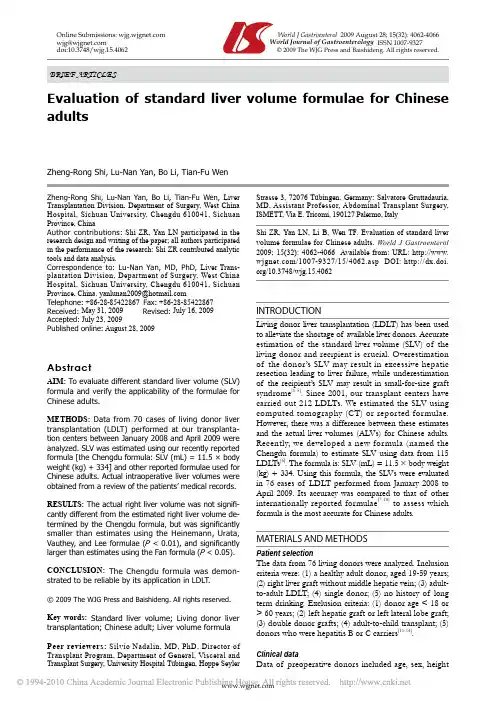
Zheng-Rong Shi, Lu-Nan Yan, Bo Li, Tian-Fu Wen, Liver Transplantation Division, Department of Surgery, West China Hospital, Sichuan University, Chengdu 610041, Sichuan Province, ChinaAuthor contributions: Shi ZR, Yan LN participated in the research design and writing of the paper; all authors participated in the performance of the research; Shi ZR contributed analytic tools and data analysis.Correspondence to: Lu-Nan Yan, MD, PhD, Liver Trans-plantation Division, Department of Surgery, West China Hospital, Sichuan University, Chengdu 610041, Sichuan Province, China. yanlunan2009@ Telephone: +86-28-85422867 Fax: +86-28-85422867 Received: May 31, 2009Revised: July 16, 2009 Accepted: July 23, 2009Published online: August 28, 2009AbstractAIM: To evaluate different standard liver volume (SLV) formula and verify the applicability of the formulae for Chinese adults.METHODS:Data from 70 cases of living donor liver transplantation (LDLT) performed at our transplanta-tion centers between January 2008 and April 2009 were analyzed. SLV was estimated using our recently reported formula [the Chengdu formula: SLV (mL) = 11.5 × body weight (kg) + 334] and other reported formulae used for Chinese adults. Actual intraoperative liver volumes were obtained from a review of the patients’ medical records. RESULTS:The actual right liver volume was not signifi -cantly different from the estimated right liver volume de-termined by the Chengdu formula, but was signifi cantly smaller than estimates using the Heinemann, Urata, Vauthey, and Lee formulae (P < 0.01), and signifi cantly larger than estimates using the Fan formula (P < 0.05). CONCLUSION: The Chengdu formula was demon-strated to be reliable by its application in LDLT.© 2009 The WJG Press and Baishideng. All rights reserved.Key words: Standard liver volume; Living donor liver transplantation; Chinese adult; Liver volume formulaPeer reviewers: Silvio Nadalin, MD, PhD, Director of Transplant Program, Department of General, Visceral and Transplant Surgery, University Hospital Tübingen, Hoppe Seyler Strasse 3, 72076 Tübingen, Germany; Salvatore Gruttadauria, MD, Assistant Professor, Abdominal Transplant Surgery, ISMETT, Via E. Tricomi, 190127 Palermo, ItalyShi ZR, Yan LN, Li B, Wen TF. Evaluation of standard liver volume formulae for Chinese adults. World J Gastroenterol 2009; 15(32): 4062-4066 Available from: URL: http://www. /1007-9327/15/4062.asp DOI: http://dx.doi. org/10.3748/wjg.15.4062INTRODUCTIONLiving donor liver transplantation (LDLT) has been used to alleviate the shortage of available liver donors. Accurate estimation of the standard liver volume (SLV) of the living donor and recipient is crucial. Overestimation of the donor’s SLV may result in excessive hepatic resection leading to liver failure, while underestimation of the recipient’s SLV may result in small-for-size graft syndrome[1-5]. Since 2001, our transplant centers have carried out 212 LDLTs. We estimated the SLV using computed tomography (CT) or reported formulae. However, there was a difference between these estimates and the actual liver volumes (ALVs) for Chinese adults. Recently, we developed a new formula (named the Chengdu formula) to estimate SLV using data from 115 LDLTs[6]. The formula is: SLV (mL) = 11.5 × body weight (kg) + 334. Using this formula, the SLVs were evaluated in 76 cases of LDLT performed from January 2008 to April 2009. Its accuracy was compared to that of other internationally reported formulae[7-10] to assess which formula is the most accurate for Chinese adults. MATERIALS AND METHODSPatient selectionThe data from 76 living donors were analyzed. Inclusion criteria were: (1) a healthy adult donor, aged 19-59 years;(2) right liver graft without middle hepatic vein; (3) adult-to-adult LDLT; (4) single donor; (5) no history of long term drinking. Exclusion criteria: (1) donor age < 18 or > 60 years; (2) left hepatic graft or left lateral lobe graft;(3) double donor grafts; (4) adult-to-child transplant; (5) donors who were hepatitis B or C carriers[11-14].Clinical dataData of preoperative donors included age, sex, heightOnline Submissions: World J Gastroenterol 2009 August 28; 15(32): 4062-4066 wjg@ World Journal of Gastroenterology ISSN 1007-9327doi:10.3748/wjg.15.4062 © 2009 The WJG Press and Baishideng. All rights reserved.Evaluation of standard liver volume formulae for Chinese adultsZheng-Rong Shi, Lu-Nan Yan, Bo Li, Tian-Fu WenBRIEF ARTICLES(BH, measured to the nearest 1 cm), body weight (BW , measured to the nearest 0.5 kg), and body surface area (BSA) calculated using the DuBois formula: BSA (m 2) = BW (kg) 0.425 × BH (cm) 0.725 × 0.007184 or the Mosteller formula: BSA (m 2) = square root BH (cm) × BW (kg)/3600. From the diaphragm to the superior mesenteric artery plane, the entire liver image was scanned using a 7 mm thick layer. In the Leonardo workstation, the LV was measured by venous phase images [15,16]. All preoperative CT examinations of donors were performed by a single radiologist and all donor procedures were performed by the same surgical unit. The volume of the grafts was measured by a 3 L beaker using a drainage method intraoperatively and the error was less than 10 mL [17,18].Right liver graft without middle hepatic vein reconstruction from a living donor was performed as described, with temporary occlusion of the right portal vein (PV) and right hepatic artery and use of ultrasonography to guide parenchymal transection. The right hepatic duct, right hepatic artery, right portal vein branch, and right hepatic vein were transected approximately 2-3 mm from the con fl uence [19,20], leaving the donor’s main PV and confluence intact. The graft was flushed with University of Wisconsin solution through the PV and hepatic artery [21,22].The volume of 70 livers was calculated using the Chengdu standard LV formula [6] as described above. The estimated right LV (ERLV) was obtained by multiplying the SLV by the proportion of the LV contributed by the right lobe on CT. The actual right LV (ARLV) was obtained by intraoperative measurement. The differencebetween the ERLV and ARLV was statistically evaluated. The formulae of Heinemann et al [8], Urata et al [7], Vauthey et al [9], Lee et al [5], and Fan et al [4] in addition to our own formula [6] were used to determine the estimated SLV (ESLV) of our donor livers. The previously reported formulae are shown in Table 1. For each liver, we calculated the difference between the ALV and volume estimated by each formula (ELV).Statistical analysisAfter testing for normal distribution (kurtosis and skewness tests), descriptive statistics were calculated and data were expressed as means ± SD for age (year), BW (kg), BH (cm), body mass index (BMI), and BSA. The ERLV-ARLV and the ELV-ALV were compared by the 2-sided paired-samples t -test. P < 0.05 was considered statistically significant. All statistical analyses were performed using the SPSS (version 13.0) program.RESULTSSeventy donors (all Chinese; 53 men and 17 women; mean age, 32.21 ± 10.07; range, 19-57 years) met the selection criteria. All donors were related to the recipients.The characteristics of donors are shown in Table 2. All donors were considered healthy on the basis of BMI. All but one donor with a BMI of 17 kg/m 2 had a BMI of 18-28 kg/m 2. The mean volume of the right lobe on CT was 658.98 ± 81.14 mL and represented 55.4% ± 3.7% of the whole liver on CT.The mean ELV and mean ERLV using the Chengdu standard formula were 1058.70 ± 96.74 mL and 586.15 ± 67.17 mL, respectively. The mean ARLV was 578.58 ± 72.33 mL. Differences for individual donors between ERLV and ARLV were not signi fi cant (t = -1.882, P = 0.064). A plot of the relationship of ARLV to the ERLV calculated using the Chengdu formula is shown in Figure 1. The mean total LV determined preoperatively on CT was 1189.53 ± 114.75 mL. The mean RLV on CT without the middle hepatic vein was 658.98 ± 81.14 mL, and 55.4% ± 3.7% of the total LV . The ALV calculated from the volume of the graft and the ratio of the RLV to the total LV on CT (%) was 1050.10 ± 107.41 mL. The Heinemann, Urata, Vauthey, and Lee formulae signi fi cantly overestimated the LV (P < 0.01), while the Fan formula significantly underestimated the LV (P <Shi ZR et al . Liver volume formulae for Chinese adults 4063ESLV: Estimated standard liver volume; BSA: Body surface area; BW: Body weight; CT: Computed tomography; LDLT: Living donor liver transplantation.Table 2 Donor characteristicsMHV: Middle hepatic vein.0.05). There was no signi fi cant difference between ALV and ELV using the Chengdu formula (Figure 2).DISCUSSIONCT has become a standard method for assessing livergraft volume in living donors. Estimation of LV by CT (compared to actual volume) has a margin of error of 5%-25%[23,24]. In the present study, all donors had preoperative CT assessment of LV (mean total LV , 1189.53 ± 114.75 mL and mean volume of right lobe graft without middle hepatic vein, 658.98 ± 81.14 mL). The actual volume of the right liver was 578.58 ± 72.33 mL. In the present study, the LV on CT was 10%-20% higher than the ALV [25-27]. The reasons may be as follows: (1) Preoperative CT measurement is carried out under normal blood fl ow conditions. Perioperatively, liver resection interrupts the blood supply causing a loss of liquid volume, collapse of supporting structures, and thereby reduction in the volumeof the liver. (2) Sources of error (partial volume effect, inter-observer variation, and respiratory movements) may account for this difference [28].The difference between the ERLV (using our formula) and ARLV was compared to the difference between ERLV, calculated using the formulae of Heinemann, Urata, Vauthey, Lee, and Fan, and ARLV in our 70 donors. The Heinemann, Urata, Vauthey, and Lee formulae overestimated LV (P < 0.01)[29]. The reasons may include: ethnic differences (patients in Europe and the United States were Caucasian). All except the Sheung Tat Fan and Chengdu formulae were used to estimate LV from CT LV or autopsy LV. Estimates of LV by CT were 5%-25% higher than the ALV [30].Statistical analysis showed that the Fan formula tends to underestimate LV. The weight and height of the donors in our study were higher than of those in the Hong Kong group. This may be one of the reasons both results are very close (Table 3). Above all, we believe thatALV: Actual liver volume; ND: Not determined.Figure 1 Correlation between actual right liver volume (ARLV) and estimated right liver volume (ERLV) by the Chengdu formula. When both were the same, a dot would be on the linear line.500 600 700Graft ARLV700600500E R L VFigure 2 Correlation between actual liver volume (ALV) and estimated liver volume (ELV) by each formula. When both were the same, a dot would be on the linear line. Formulae of Urata, Heinemann, Vauthey, and Lee overestimated LV with respect to ALV. The Fan formula underestimated LV and the Chengdu formula gave a good estimate of ALV.4064 ISSN 1007-9327 CN 14-1219/R World J Gastroenterol August 28, 2009 Volume 15 Number 32700 900 1100 1300 1500ALV150013001100900700U r a t a700 1000 13001600ALV160013001000700H e i n e m a n n700 900 1100 1300 1500ALV150013001100900700L e e700 1000 1300 1600ALV160013001000700V a u t h e y700 900 1100 1300 1500ALV150013001100900700F a n700 800 900 1000 1100 1200 1300ALV14001300120011001000900800700C h e n g d uthe Chengdu formula was demonstrated to be reliable by its application in LDLT. We were limited to use of single center data in the present study, but we hope to improve the formula by using national multicenter data in the future[31].With development of living donor liver transplantation (LDLT), especially improvement of right graft adult-to-adult LDLT, the danger of donating has been paid more and more attention. The exact liver volume is not only relevant for the recipient, but also for the donor to avoid dangerous life-threatening residual liver volumes.Research frontiersScholars of different countries established several standard liver volume (SLV) formulae from clinical data. The authors estimated the SLV using computed tomography or reported formulae. However, there was a gap between these estimates and the actual liver volumes for Chinese adults. Recently, they developed a new formula (named the Chengdu formula) to estimate SLV using data from 115 LDLTs.Innovations and breakthroughsWith the Chengdu formula, the SLVs were evaluated in 76 cases of LDLT performed from January 2008 to April 2009. Its accuracy was compared to that of other internationally reported formulae to assess which formula is the most accurate for Chinese adults.ApplicationsWith national multicenter data in the future, the Chengdu formula for SLV can be improved. It may then be applied to the evaluation of donors for LDLT. TerminologyStandard liver volume: normal liver volume without disease affecting the volume of liver.Peer reviewVery interesting manuscript dealing with a very hot topic: determination of optimal size matching between graft and recipient in LDLT by means of race-adapted calculation of liver volumes. The recently published liver volume formula for Chinese people (Chengdu formula) has been demonstrated to be more reliable than others and therefore it should be adopted especially in this particular form of LT.REFERENCES1 Khalaf H, Shoukri M, Al-Kadhi Y, Neimatallah M, Al-Sebayel M. Accurate method for preoperative estimation of the right graft volume in adult-to-adult living donor liver transplantation. Transplant Proc 2007; 39: 1491-14952 Avolio AW, Siciliano M, Barbarino R, Nure E, AnnicchiaricoBE, Gasbarrini A, Agnes S, Castagneto M. Donor risk index and organ patient index as predictors of graft survival after liver transplantation. Transplant Proc 2008; 40: 1899-19023 Gruttadauria S, Marsh JW, Vizzini GB, di Francesco F,Luca A, Volpes R, Marcos A, Gridelli B. Analysis of surgical and perioperative complications in seventy-five right hepatectomies for living donor liver transplantation. World J Gastroenterol 2008; 14: 3159-31644 Fan ST, Lo CM, Liu CL, Yong BH, Chan JK, Ng IO. Safety ofdonors in live donor liver transplantation using right lobe grafts. Arch Surg 2000; 135: 336-3405 Lee SG, Park KM, Hwang S, Lee YJ, Kim KH, Ahn CS, ChoiDL, Joo SH, Jeon JY, Chu CW, Moon DB, Min PC, Koh KS, Han SH, Park SH, Choi GT, Hwang KS, Lee EJ, Chung YH, Lee YS, Lee HJ, Kim MH, Lee SK, Suh DJ, Kim JJ, Sung KB.Adult-to-adult living donor liver transplantation at the Asan Medical Center, Korea. Asian J Surg 2002; 25: 277-2846 Li FG, Yan LN, Li B, Zeng Y, Wen TF, Xu MQ, Wang W.Estimation formula of standard liver volume for Chinese adults. Sichuan Daxue Xuebao 2009; 40: 302-3067 Urata K, Kawasaki S, Matsunami H, Hashikura Y, IkegamiT, Ishizone S, Momose Y, Komiyama A, Makuuchi M.Calculation of child and adult standard liver volume for liver transplantation. Hepatology 1995; 21: 1317-13218 Heinemann A, Wischhusen F, Puschel K, Rogiers X.Standard liver volume in the Caucasian population. Liver Transpl Surg 1999; 5: 366-3689 Vauthey JN, Abdalla EK, Doherty DA, Gertsch P,Fenstermacher MJ, Loyer EM, Lerut J, Materne R, Wang X, Encarnacion A, Herron D, Mathey C, Ferrari G, Charnsangavej C, Do KA, Denys A. Body surface area and body weight predict total liver volume in Western adults.Liver Transpl 2002; 8: 233-24010 Chan SC, Liu CL, Lo CM, Lam BK, Lee EW, Wong Y, FanST. Estimating liver weight of adults by body weight and gender. World J Gastroenterol 2006; 12: 2217-222211 Trotter JF, Wisniewski KA, Terrault NA, Everhart JE,Kinkhabwala M, Weinrieb RM, Fair JH, Fisher RA, Koffron AJ, Saab S, Merion RM. Outcomes of donor evaluation in adult-to-adult living donor liver transplantation. Hepatology 2007; 46: 1476-148412 Duran C, Aydinli B, Tokat Y, Yuzer Y, Kantarci M, AkgunM, Polat KY, Unal B, Killi R, Atamanalp SS. Stereological evaluation of liver volume in living donor liver trans-plantation using MDCT via the Cavalieri method. Liver Transpl 2007; 13: 693-69813 Morimoto T, Ichimiya M, Tanaka A, Ikai I, Yamamoto Y,Nakamura Y, Takada Y, Inomata Y, Honda K, Inamoto T, Tanaka K, Yamaoka Y. Guidelines for donor selection and an overview of the donor operation in living related liver transplantation. Transpl Int 1996; 9: 208-21314 Yamashiki N, Sugawara Y, Tamura S, Kaneko J, NojiriK, Omata M, Makuuchi M. Selection of liver-transplant candidates for adult-to-adult living donor liver transplantation as the only surgical option for end-stage liver disease. Liver Transpl 2006; 12: 1077-108315 Frericks BB, Kirchhoff TD, Shin HO, Stamm G, MerkesdalS, Abe T, Schenk A, Peitgen HO, Klempnauer J, Galanski M, Nashan B. Preoperative volume calculation of the hepatic venous draining areas with multi-detector row CT in adult living donor liver transplantation: Impact on surgical procedure. Eur Radiol 2006; 16: 2803-281016 Iida T, Yagi S, Taniguchi K, Hori T, Uemoto S, YamakadoK, Shiraishi T. Signifi cance of CT attenuation value in liver grafts following right lobe living-donor liver transplantation.Am J Transplant 2005; 5: 1076-108417 Kim BS, Kim TK, Kim JS, Lee MG, Kim JH, Kim KW, SungKB, Kim PN, Ha HK, Lee SG, Kang W. Hepatic venous congestion after living donor liver transplantation with right lobe graft: two-phase CT fi ndings. Radiology 2004; 232: 173-18018 Cho JY, Suh KS, Lee HW, Cho EH, Yang SH, Cho YB, Yi NJ,Kim MA, Jang JJ, Lee KU. Hypoattenuation in unenhanced CT reflects histological graft dysfunction and predicts 1-year mortality after living donor liver transplantation.Liver Transpl 2006; 12: 1403-141119 Choi JY, Lee JY, Lee JM, Kim SH, Lee MW, Han JK, ChoiBI. Routine intraoperative Doppler sonography in the evaluation of complications after living-related donor liver transplantation. J Clin Ultrasound 2007; 35: 483-49020 Kato H, Usui M, Azumi Y, Ohsawa I, Kishiwada M, SakuraiH, Tabata M, Isaji S. Successful laparoscopic splenectomy after living-donor liver transplantation for thrombocytopenia caused by antiviral therapy. World J Gastroenterol 2008; 14: 4245-424821 Ohdan H, Tashiro H, Ishiyama K, Ide K, Shishida M, IreiT, Ohira M, Tahara H, Itamoto T, Asahara T. Microsurgical hepatic artery reconstruction during living-donor liver transplantation by using head-mounted surgical binocular system. Transpl Int 2007; 20: 970-97322 Oya H, Sato Y, Yamamoto S, Takeishi T, Nakatsuka H,Kobayashi T, Hara Y, Hatakeyama K. Surgical proceduresShi ZR et al. Liver volume formulae for Chinese adults 4065for decompression of excessive shear stress in small-for-size living donor liver transplantation--new hepatic vein reconstruction. Transplant Proc 2005; 37: 1108-111123 Lee SS, Kim KW, Park SH, Shin YM, Kim PN, Lee SG, LeeMG. Value of CT and Doppler sonography in the evaluation of hepatic vein stenosis after dual-graft living donor liver transplantation. AJR Am J Roentgenol 2007; 189: 101-10824 Asakuma M, Fujimoto Y, Bourquain H, Uryuhara K, HayashiM, Tanigawa N, Peitgen HO, Tanaka K. Graft selection algorithm based on congestion volume for adult living donor liver transplantation. Am J Transplant 2007; 7: 1788-179625 del Pozo JL. Update and actual trends on bacterial infectionsfollowing liver transplantation. World J Gastroenterol 2008;14: 4977-498326 Miraglia R, Maruzzelli L, Caruso S, Milazzo M, Marrone G,Mamone G, Carollo V, Gruttadauria S, Luca A, Gridelli B.Interventional radiology procedures in adult patients who underwent liver transplantation. World J Gastroenterol 2009;15: 684-69327 Shoji M, Ohkohchi N, Fujimori K, Koyamada N, SekiguchiS, Kawagishi N, Tsukamoto S, Shirahata Y, Sato K, SatomiS. The safety of the donor operation in living-donor liver transplantation: an analysis of 45 donors. Transpl Int 2003;16: 461-46428 Kawagishi N, Ohkohchi N, Fujimori K, Doi H, SakuradaM, Kikuchi H, Oikawa K, Takayama J, Satomi S. Safety of the donor operation in living-related liver transplantation: analysis of 22 donors. Transplant Proc 1998; 30: 3279-328029 Yoshizumi T, Taketomi A, Kayashima H, Yonemura Y,Harada N, Ijichi H, Soejima Y, Nishizaki T, Maehara Y.Estimation of standard liver volume for Japanese adults.Transplant Proc 2008; 40: 1456-146030 Hirata M, Harihara Y, Kitamura T, Hisatomi S, KatoM, Dowaki S, Mizuta K, Sugawara Y, Kita Y, Kubota K, Takayama T, Kawarasaki H, Hashizume K, Makuuchi M.The infl uence of donor age to graft volume increase rate in living donor liver transplantation. Transplant Proc 2001; 33: 1416-141731 Schiano TD, Bodian C, Schwartz ME, Glajchen N, Min AD.Accuracy and signifi cance of computed tomographic scan assessment of hepatic volume in patients undergoing liver transplantation. Transplantation 2000; 69: 545-550S- Editor Tian L L- Editor Cant MR E- Editor Ma WH4066 ISSN 1007-9327 CN 14-1219/R World J Gastroenterol August 28, 2009 Volume 15 Number 32。
肝功能评估新标准

Vera充分利用肝脏与心脏时间-放射性曲 线计算出参数[ R0 ] [R0 ], LHL15和HH15几个肝功能评价指标优 于Child-Pugh肝功能分级,但是这些指标 只是另一种类型的术前肝总体功能的评估 手,对预测肝切除术风险的价值有限.
结合SPECT的肝脏三维显像
SPECT(single photon emission computed tomography)单电子发射型计算机断层显像 原理:通过模拟肝脏切除,计算剩余肝脏的 功能容积,剩余肝功能占整个肝脏功能的 比例并与代表整体肝脏的指标相结合,可 以用来预测手术的风险。
精品医学课件
肝功能评估
新标准
决定肝切除手术预后的因素
术前肝功能的评估 肿瘤的位置 手术操作技巧 术中出血量 患者的整体状态
很难在术前作出充分的估计
术前肝功能评估的主要指标
转氨酶 胆红素 白蛋白 凝血酶原时间 Child-Pugh肝功能分级 吲哚青绿试验(ICG)
受体指数LHL15:静脉注射99mTc-GSA后第15min肝
ROI的放射性计数与肝ROI,心ROI放射性计 数和的比值 血液清除指数HH15:静脉注射99mTc-GSA后15min与 3min心ROI的放射性计数比值.
LHL15,HH15与传统的肝功能评估指标显著相关,对 肝硬化患者的生存有一定的预测价值.但是它们只 利用了心脏,肝脏时间-放射性曲线的小部分数据.
现代的X线CT三维显像技术,可以用于测量肝脏体积。 正常成年人肝脏的平均体积为(1250±141)cm3 对于肝硬化患者, Child A 级患者平均体积为(1092±276)cm3 Child B 级为(868±163)cm3 Child C 级为(652±76)cm3 Child B 级和Child C级较正常肝脏明显减小。 当病肝体积缩小40%以上时,术后并发症发生率明显增高。 与整体肝脏体积相比,剩余肝脏的体积的预测值价值更大。 当CT检查计算的剩余肝脏体积小于250ml/m2体表面积时, 术后出现肝功能衰竭的风险显著增大。
肝脏功能评估

了修正,得出了新的MELDNa评分:MELD-Na=MELD - Na-0.025MELD(140-Na)+140。
新的MELD-Na评分可以更好地预测自登记后90天内的死亡率,当血钠在1 25mmol/L~140mmol/L这一区间时,血钠每降低1mmol/L,死亡的风险就会升高5%。
三、CT体积计算基于肝脏移植的需要,Urata等在1995年总结了96例日本患者的数据,得到了标准肝脏体积的计算公式,成人单位体重的肝脏体积为20.5±1.9ml/kg,单位体表面积的肝脏体积为712.0±51.2ml/m2,同时肝脏重量和体积之间存在1.19ml/g的转换系数。
欧美各国学者也已总结出了不同种族人群的肝脏体积(或重量)与体重(或体表面积)之间的计算公式,但各种族人群的公式不一定通用。
活体肝移植的经验告诉我们,全肝30%~35%的剩余体积对供体是较为安全的。
一般意义上认为40%的估计标准肝体积或移植物受体重量比为0.8%的供肝对受体是必需的,小于这一低限则容易发生小肝综合征,但目前已有报道的肝移植术后存活的体积极限为受体体重的0.59%。
随着计算机技术的发展,CT体积计算可以较准确地计算出解剖性肝切除后的剩余肝体积。
但肝脏实质病变对肝功能的影响却无法从CT作出准确的判断,CT所能显示的仅仅是肝脏的形态和体积。
因而,在活体肝移植供体的术前评估中,肝脏穿刺组织学检查依然是常规术前项目,在合并肝脏实质病变的肝脏肿瘤安全切除范围的评估中仍需要更多地依赖临床医师的个人经验。
四、去唾液酸糖蛋白受体功能显像技术从前面介绍的几种肝功能评估方法可以看出,除了CT三维成像技术能计算出剩余肝的体积,其余评估均无法预测术后剩余肝脏的功能。
另外,在肝脏病变情况下体积并不能代表功能,故目前尚缺乏一种三维的肝脏功能评估系统,应用该系统,可模拟手术切除,并能反映出剩余肝脏的功能,最后用以推算出手术风险供临床医师。
标准肝体积计算公式

标准肝体积计算公式
肝脏体积是评估肝功能和疾病诊断中的重要指标之一。
下面我将介绍一种常用
的计算肝脏体积的标准公式。
在临床上,常用的计算肝脏体积的公式是根据肝脏的长轴、短轴和横断面面积
来计算的。
这个公式被称为康奈尔公式,公式如下:
肝脏体积(cm³)= 0.52 ×长轴(cm)×短轴(cm)×横断面面积(cm²)
根据这个公式,我们可以通过测量肝脏的长轴和短轴,以及计算肝脏横断面的
面积,来估算肝脏的体积。
这种方法相对简便,并被广泛应用于临床实践中。
为了测量肝脏的长轴和短轴,常常使用超声或影像学技术,如计算机断层扫描(CT)或磁共振成像(MRI)。
通过这些技术,医生可以获取肝脏的长轴和短轴
的尺寸,然后用这些尺寸计算出肝脏的体积。
需要注意的是,在计算肝脏体积时,使用的单位必须一致。
一般情况下,公式
中的尺寸都以厘米(cm)为单位,面积以平方厘米(cm²)为单位。
保持单位的一
致性非常重要,以确保计算结果的准确性。
总结起来,标准肝脏体积计算公式是康奈尔公式,通过测量肝脏的长轴和短轴,并计算出肝脏的横断面面积,可以估算肝脏的体积。
这个公式在临床实践中是一种常用且可靠的计算方法,帮助医生评估肝功能和进行疾病诊断。
肝切除术前评估的重要性

美国东部肿瘤协作组(Eastern Cooperative OncologyGroup,ECOG)-活动状态 (performance status,PS)评分简便、易行,是一个通行评估标准。
KPS描述
一切正常,无不 适病症
能进行正常行为 活动
勉强正常生活, 有一些症状
生活自理但不能 积极工作
生活偶需帮助
HBV:乙型肝炎病毒 APRI:天冬氨酸氨基转移酶(AST)/血小板(PLT)指数
肝切除病人合并
肝硬化
评估APRI指数
可预测术后并发症
的发生
19
肝脏可切除性评估的意义
肝脏基本功能评估
肝脏储备功能评估
剩余肝体积评估
Child-Pugh 评分
C级
肝切除手术禁忌证
经过护肝治疗恢复至A级, 可以考虑手术
B级 <9 分
➢ 危险因素: • 总分≥26分:制作
确实危及生命的手 术 • 总分在13~25分之 间:术前应与心脏 科医师讨论治疗方 案 • 总分<13:多可经 受各种手术
朱维铭 等,中国实用外科杂志 , 2005 , 25 (1) :17-19
➢ 择期手术—肺部危 险评分方案
• 0~3分:低危组 • 4~6分:中间组 • 7~12分:高危组
• 提高患者手术耐受性 • 降低术后并发症的发生 • 促进患者早日康复 • 提高护理工作的积极性 • 建立良好护患关系 • 提供优质服务给患者
17
术前营养风险筛查、重要器官功能评估意义
术前营养筛查
重要器官评估
心
肺
肾
NRS-2002 ≥3 分
围手术期进行营养 支持
促进肝切除术的顺 利施行
➢ 所有病人术前应进行 心电图检查
标准肝体积计算公式
标准肝体积计算公式肝脏是人体内重要的器官之一,它不仅具有排毒、合成蛋白质和胆汁等重要功能,还承担着调节血糖和脂肪代谢的重要作用。
因此,了解肝脏的生理特性和计算肝体积的标准公式对于临床诊断和治疗具有重要意义。
本文将介绍肝体积的计算方法以及其在临床上的应用。
肝体积的计算是通过影像学检查得出的,常用的方法有CT扫描、MRI和B超等。
在进行肝体积计算时,需要准确测量肝脏的长度、宽度和厚度,并根据这些数据应用相应的计算公式得出肝体积。
下面将介绍标准的肝体积计算公式:肝体积(ml)=0.55×长轴(cm)×短轴(cm)×厚度(cm)。
在这个公式中,长轴、短轴和厚度分别代表肝脏在影像上的三个方向的尺寸。
通过测量这些尺寸并代入公式,便可以得出肝体积的近似数值。
需要注意的是,这个计算公式是基于椭球体积的计算方法,因此在实际应用中可能存在一定的误差,但一般来说误差范围在可接受范围内。
肝体积的计算对于临床诊断和治疗具有重要的指导意义。
首先,肝体积的变化可以反映肝脏的生理状态,如肝硬化、脂肪肝等疾病会导致肝体积的改变,因此通过肝体积的计算可以对这些疾病进行诊断和监测。
其次,在肝移植手术中,肝体积的计算可以帮助医生评估移植肝的大小和适配性,从而提高手术的成功率。
此外,肝体积的计算还可以指导肝肿瘤的治疗,如手术切除、放疗和化疗等。
总之,肝体积的计算公式是临床医学中的重要工具,它可以帮助医生了解肝脏的生理状态,指导临床诊断和治疗。
通过准确测量肝脏的尺寸并应用标准的计算公式,可以得出肝体积的近似数值,为临床工作提供重要参考。
希望本文的介绍能够帮助大家更好地理解肝体积的计算方法及其在临床上的应用,为医学工作者和患者提供参考和帮助。
肝癌转化治疗策略要点(完整版)
肝癌转化治疗策略要点(完整版)摘要以外科为主导的综合治疗是肝癌诊疗的重要共识。
肝切除术、肝移植术是肝癌患者获得长期生存的重要手段。
随着肝脏外科技术的发展,肝脏手术已无禁区。
转化治疗为初始不可切除肝癌患者带来了手术根治的希望。
本文对剩余肝体积不足肝癌的转化治疗、肿瘤学不可切除中晚期肝癌的降期转化治疗、转化后手术时机选择等问题进行探讨,并就形成肝癌转化治疗的规范进行展望。
肝癌转化治疗是将不可切除肝癌转为可切除肝癌。
肝癌不可切除的原因主要包括两方面:一是患者全身情况不能承受手术创伤、肝功能不能耐受、剩余肝体积(future liver remnant,FLR)不足等外科学不可切除情况;二是技术可切除,但切除以后不能获得比非手术治疗更好的疗效,称为肿瘤学不可切除。
笔者认为肝癌转化治疗就是运用积极的治疗方法,消除肝癌不可切除因素,将不可切除的手术转化为可根治性切除的手术,在围手术期安全的前提下达到手术安全性和彻底性。
本文对FLR不足和肿瘤学不可切除肝癌的转化治疗方法和应对策略作一探讨。
一、FLR不足肝癌的转化治疗FLR是否足够是影响术后肝功能衰竭和围手术期死亡的决定性因素。
目前临床上评估肝脏储备功能主要通过吲哚氰绿滞留试验定量肝脏储备功能。
吲哚氰绿15 min滞留率(indocyanine green retention rate at 15 minute,ICG R15)<10%的患者可耐受大范围的肝切除,同时必须保留足够的FLR才可以降低肝切除术后肝功能衰竭的发生率:对于正常肝脏,FLR/标准肝体积(standard liver volume,SLV)需大于30%;对于慢性肝病患者,FLR/SLV需大于40%;对于肝硬化患者,FLR/SLV则要超过50%。
对于前期评估FLR不足的患者,或邻近肝内重要管道的肝脏肿瘤,若要达到切缘>1 cm的目标,需实施计划性肝切除。
目前,对于有计划使FLR再生、肥大的过程还没有共识的专业名词,较常用的名词包括"养肝技术""增肝技术""预留肝脏容积扩增技术(future liver remnant augumentation technique,FLRAT)"等,笔者认为"FLRAT"更为贴切。
肝脏体积
肝脏体积(liver volume,LV)测量不仅可以定量评价肝脏大小,还能间接反映肝功能情况,具有广泛而重要的临床应用价值,在评估肝硬化肝功能储备、肝脏肿瘤手术方式选择和预后评价、肝移植中都有重要意义。
1 肝脏体积测量方法常用的肝脏体积测量方法包括水测法、B超、SPECT、CT和MRI。
水测法被认为能够测量肝脏的实际体积,B超、SPECT、CT、MRI测量肝脏体积原理基本相同,又各有其优缺点,以下分别做简单介绍。
1.1 水测法将离体肝脏室温下放入盛满水的容器,放入标本后使容器内水外溢,收集全部溢出的水并测量其体积,即为待测肝脏体积。
该方法只能用于离体肝脏测量,不能用于术前活体肝体积评估。
Heinemann等[1]观察到在死亡当时至死后检查这段时间中LV无明显变化,但由于死亡原因不同,如循环血容量减少或心源性休克,及其他情况导致肝淤血,死后LV可能会比真实情况减少或增多[2]。
又由于肝脏的比重近似于水的比重[3,4],有学者在原位肝移植后,取下的肝脏在去除附着的韧带、胆囊、门静脉结构和其他组织,但不去除移出肝中的血液(因为活体肝含有大量血液)后立即称取肝脏重量,以此作为肝脏的实测体积,认为这种方法避免了经过福尔马林固定后因组织萎缩造成的人为误差[5]。
1.2 B超测量肝脏体积利用超声探头平行或垂直于人体纵轴得到肝脏纵切面或横截面,由计算机分别测出这些平行切面的面积,将所测面积与平行面积体间的距离进行积分,即可得到肝脏体积值。
V an Thiel等[3]发现超声测量肝脏体积值接近水测法体积值,而且比CT更准确。
Hatsuno等[6]比较超声和CT测量左外叶体积,发现没有明显差异,但超声测量值略低于CT测量值。
超声测量肝脏体积优势在于安全、无射线辐射或无需使用造影剂、可重复、价格较低,但超声检查易受操作者经验及腹腔内肠道气体、钙化等因素干扰,这些直接影响到断层的截取、肝脏边界的确定,使最后得出的结果存在误差。
肝切除术围手术期管理专家共识解读(2)_150
1.1 全身状况评估—术前营养风险筛查
• 肝切除术病人大多存在不同程度的营养风险,营养不 良与疾病转归和预后不良相关。
• 欧洲肠内外营养学会2002年推荐NRS-2002营养风险 筛查推表荐,2:简对便拟、行实肝用切(除12的8个病R人C,T临特床别试是验明证显明虚)弱。者,建议行术前营养风险筛查 NRS2002≥3分表明病人存在营养风(险Ⅰ,b需、要A在)围。手术 期进行营养支持(注意与营养不良相区别)
• 肝胆管结石病主要集中在中国等国家 • 肝脏良性肿瘤需要外科手术也为数不少
每年中国需要行肝切除术的数量非常庞大
论术与论道
• 肝脏解剖认识的加深、血流控制技术的完善、新型器械设备的应用。。。 • 肝局部切除、半肝切除、离体肝切除、腹腔镜肝切除、肝移植、活体肝移植。。。 • 肝切除围术期死亡率 远低于5%;但并发症高达15%以上(文献报道最高可达50%)
IV证据源于Biblioteka 家委员会报告或权威专家的临床经验报道
U.S. Preventive Services Task Force. Grade Definitions and Suggestions for Practice. 2012.
推荐意见:5个级别
证据等级
描述
A
良好科学证据提示该医疗行为带来明确获益;建议医师对病人实施该医疗行为。强烈推荐
• 较为常用的除计方式算及肝范实围质的切合除理率选的择方有重法要:意肝义切。除(术IIa前、测B算)。患者标准肝体积, 通过预留肝体积与标准肝体积的比值及肝脏功能、手术类型确定安全合 理的切肝量。
Clavien PA, et,al. N Engl J Med. 2007 Apr 12;356(15):1545-59 董家鸿, 等. 中华消化外科杂志, 2011,10(1):20-25.