
仁爱版英语八年级上册Unit3 Topic2 SectionC教学设计
Unit3Our HobbiesTopic2What sweet music!Section C教学设计[Material analysis]本节课主要活动为1a和2b。
Section A通过歌手席琳·迪翁谈论音乐会,Section B谈论不同风格的音乐,在内容上Section C是对Section A和Section B的升华,从音乐会到不同形式的音乐再到人们熟悉的伟大作曲家莫扎特,通过层层递进的方式步步拓展到阅读和写作的综合能力的培养。
在培养学生能力的方面也从培养学生听说能力过渡到培养写作能力。
老师们在设计课堂的时候应用教材上所设计的表格和问题等多种读中和读后活动。
以此为基础,通过竞赛、将自己已有知识和文章进行对比等方式,逐一完成信息输入、阅读技能培养、信息输出的过程。
[Teaching aims]Knowledge aims:1.在图片、同义句替换等方式的帮助下,能自己拼读下列单词:age,wonder,note,papa,press,smile,amazing。
2.能通过游戏快速记忆本课生词,如:wonder,note,smile,understand等。
3.能在练习中使用感叹句表达自己的情感。
4.能够用感叹句评价某人或某物。
Skill aims:1.能基本听懂本课文本材料,及与其水平相当的伟人介绍。
2.能流利地和他人谈论自己或朋友喜欢的音乐家。
3.能正确地使用因特网、从中获取有用信息并基本读懂其介绍音乐家文章。
4.能正确模仿本课课文,有条理地写出自己喜欢的音乐家的故事。
Emotional aims:通过对伟大人物事迹的学习,从伟人平凡的故事当中领悟做人做事的态度。
明白天才源于汗水和努力。
[The key points and difficult points]Key points:1.用感叹句表达自己的情感。
2.根据关键词复述文章,如:composer,start writing,a child等。
3.学习写作文时,先确定中心,然后围绕中心,找出相应的事例来支撑你的观点。
Difficult points:使用感叹句表达自己的情感。
[Learning strategies]1.借助关键词对你复述本课的文章是很有帮助的。
2.在写作的时候先写出自己的观点,然后用故事或者阐述去支撑你的观点。
这样可以让你的文章条理清楚。
3.交谈的时候注意语音和语调可以帮助你感受语言的艺术。
[Teaching aids]Computer multimedia projector[Teaching procedures]Step Interaction pattern Student activity Teacher activityIntroduction (6minutes)1.The wholeclass workand groupwork2.Individual workand group work3.The wholeclass work4.The wholeclass work1.Take out their notes to share theinformation about Mozart.Theycan only speak English,if they needhelp they can hands up.2.One student comes to the platform.Others check his/her spellingmistakes.3.Read sentences.Know aboutMozart and try to guess the meaningsof new words.(Guess the meaningsaccording to the word-formation andthe context.)pare the knowledge on theblackboard with the facts on1a.Guess the meaning of“age”bycomparing“at the age of three”and“when he was five”.1.Make a competition.Askstudents to discuss Mozart,according to the informationthey searched yesterday.2.Ask each group to chooseone student to come to theplatform to write down theiranswers on the blackboard.3.Ask students to read thesestatements,providing studentswith help,such as new wordsand understanding,becausesome sentences are from theInternet.4.Ask students to compare theknowledge on the blackboardwith the facts on1a.Consolidation (15minutes)1.The wholeclass workand individualwork2.Individualwork3.Group workand individualwork4.The wholeclass work andgroup work1.One student tries to retell thepassage while others can helphim/her.2.Read1a carefully and write downthe answers.Underline the placewhere they can find out the answer.3.Check the answers in groups.Findeach others’mistakes,and tellothers where they find out theanswer.4.Each group answers a question,and tell others where to find theanswer.1.Finish1c.Ask students to try toretell the passage according to thetable.Praise the student no mattergood or not,because this passage islong.2.Give students3minutes to read thepassage for details.Tell students toread and understand the questionsfirst,and then find where the keyinformation occurs.3.Give students2minutes to checkthe answers in groups.4.Check the answers.Production (8minutes)1.Individual work2.The wholeclass work andindividual work3.The wholeclass work4.Individualwork1.Write a short passage.2.Review the new words and readingskills.Review how to write a passageabout a musician.3.Students finish thesehomework after class.4.Students review SectionsA-B to prepare forSection D.1.Ask students to write a shortpassage about their or others’favorite musicians according to1a and2a.2.Teacher summarizes whatstudents learned today:somenew words,how to get the mainidea quickly,how to write apassage of their favoritemusicians.3.Homework.Then homeworkincludes three parts:ask students to(1)Search the information abouta musician on the Internet.(2)Make notes when reading.Take the notes to schooltomorrow.(3)Tell a story about a musicianbefore class.4.Teacher assigns the studentsto review Sections A-C toprepare for Section D.Teaching ReflectionStudents like the story a lot.This kind of topic can attract students’attention very easily. It is necessary for students to search some information about great persons.For students, talking about their own favorite musicians is not easy.Before writing,teachers should give them more chances or provide more information to put in.[Blackboard design]。
Unit3 Topic2 SectionC 教案 仁爱版八年级英语上册
八年级上册Unit 3 Topic 2 What sweet music!Section C【教学构思】一、教材分析:本课属于课标话题人与社会——“历史与社会(History and society)”中著名人物(Famous people)项目,主要谈论伟大作曲家莫扎特。
本课属于课标功能意念表“社会交往(Social communications)”中喜欢和不喜欢(Likes and dislikes)项目,主要学习莫扎特小时候创作乐曲的故事。
主要教学活动为1a和2b。
在内容上Section C是对Section A 和Section B的升华,从音乐会到不同形式的音乐再到人们熟悉的伟大作曲家莫扎特,通过层层递进的方式步步拓展到阅读和写作的综合能力的培养。
通过文本学习,引导学生写出自己喜欢的音乐家的故事。
二、设计说明:根据学情和本课的语法及话题,本节课的教学设计将读与写相结合,以1a阅读文本为载体,学会把握文章主旨和篇章结构,构建思维导图;在语言生成阶段,循序渐进,从文本理解到课文复述,帮助学生深化课文理解,并在小组合作后完成写作任务。
本课在重、难点突破的方法上有所创新,教师通过表格,梳理阅读文本结构,引导学生构建读后思维导图,引导学生在说和读的基础上,通过问题引领和主题词句,确立写作思路和基本结构,进行文章创作。
【教学目标】1.能基本听懂本课文本材料,及与其水平相当的伟人介绍,学会以“听”的方式理解语言意义;2.能流利地和他人谈论自己或朋友喜欢的音乐家,构建语言意识,提升“说”的语言能力;3.能从伟人平凡的故事当中领悟做人做事的态度,明白天才源于汗水和努力,在分析、批判、评价等思维活动中,发展思维品质;4.能正确模仿本课课文,有条理地写出自己喜欢的音乐家的故事,发展学生多元学习策略,提高“写”的语言能力。
【教学重难点】Key points:1.用感叹句表达自己的情感;2.根据关键词复述文章,如:composer,start writing, a child等;3.学习写作文时,先确定中心,然后围绕中心,找出相应的事例来支撑你的观点。
【公开课教案】仁爱英语 八年级Unit3 Topic2 Section C教学设计
Why Father decided to teach him... After Father began to teach him... Wonder Boy.Key word: Wonder。
Focus:Father 对“taught”的变化。
Step-reading 3 1. Mozart, a born musician.2. Mozart, the Wonder Boy.3. Mozart, _________________________.“读-思-言”让学生分步推进、渐进阅读,归纳总结表达。
关键词“WHY”。
Step-reading 4 what an amazing child!1.He learned quickly so that his father wasvery happy.2.He learned quickly so that he could pressthe note by himself....3.阅读教学从易到难。
读并思考:Why hewas an amazing child.Key word:amazingAfter step-reading:improve speaking 1.Talk about your favorite musicians.1) Who is he/she? Young or old?2) What is he/she famous for?3) Talk sth about his/her story.4) How did he/she learnmusic?5) What do you think ofhe/she?通过前面渐进式阅读的学习和铺垫,应该具有一定的理解和应用。
教师创设话题,给学生“言”的机会,为后面的书面表达提供语言基础。
After step-reading: improve writing You can write like thisShow some key words to help the students.在这环节上,用“读-思-言”的理论将step-reading的渐进式课堂学习的应用产生了预期的效果,可以让学生练笔,达到学以致用。
仁爱版八年级英语上册课件UNIT 3 TOPIC 2 Section C
Father Mozart used to give his daughter, Nannerl, music lessons on
the piano.
And little Mozart was in the room. He
watched and listened to every
his sister.
Then he begun to write compose by
himself. This surprised his father.
No one could believe that a little boy of five could
write such beautiful music.
UNIT 3 Our
Hobbies
TOPIC 2 What sweet
music!
Section C
Contents
1 Introduction 2 Content 3 Homework
Introduction
1. What do you know about Mozart? 2. What can we learn from this story?
He was an amazing chilI. Memory all the new words and expressions.
II. Finish the exercises on the textbook.
I. Collect some information about musician on the internet.
Question
If there is no Mozart in the world, what will happen? Talk this with your partner.
仁爱版英语八年级上册Unit3Topic2《Whatsweetmusic》(SectionC)说课稿
仁爱版英语八年级上册Unit 3 Topic 2《What sweet music》(SectionC)说课稿一. 教材分析仁爱版英语八年级上册Unit 3 Topic 2《What sweet music》(Section C)是一篇关于音乐欣赏的阅读材料。
通过讲述一篇关于一位音乐家和他的音乐的故事,让学生在阅读过程中感受音乐的美丽,提高他们的阅读理解能力和音乐鉴赏能力。
此篇课文内容丰富,语言优美,贴近学生生活,有助于激发学生对音乐的热爱。
二. 学情分析八年级的学生已经具备了一定的英语基础,对音乐有一定的了解和兴趣。
但他们在阅读理解、词汇运用和音乐鉴赏方面还存在一定的困难。
因此,在教学过程中,教师需要关注学生的个体差异,充分调动学生的积极性,引导他们主动参与课堂活动。
三. 说教学目标1.知识目标:让学生掌握 Section C 课文中的关键词汇和句型,提高阅读理解能力。
2.能力目标:培养学生运用英语进行交流的能力,提高音乐鉴赏能力。
3.情感目标:激发学生对音乐的热爱,培养他们欣赏美好事物的能力。
四. 说教学重难点1.教学重点:课文的理解和词汇的掌握。
2.教学难点:音乐术语的理解和运用,阅读策略的培养。
五. 说教学方法与手段1.教学方法:采用任务型教学法,让学生在完成任务的过程中提高英语运用能力。
2.教学手段:利用多媒体课件、音频和视频材料,激发学生学习兴趣,提高课堂效果。
六. 说教学过程1.Pre-reading:引导学生谈论自己对音乐的喜爱,激发学习兴趣。
2.While-reading:分组阅读课文,讨论课文内容,回答问题。
3.Post-reading:学生展示自己的音乐作品,进行音乐欣赏和评价。
七. 说板书设计板书设计应简洁明了,突出重点。
可采用思维导图的形式,将课文内容、关键词汇和音乐术语进行整理,帮助学生巩固记忆。
八. 说教学评价1.课堂参与度:观察学生在课堂活动中的积极参与情况,评价他们的学习态度。
仁爱版英语八年级上册Unit3Topic2教案
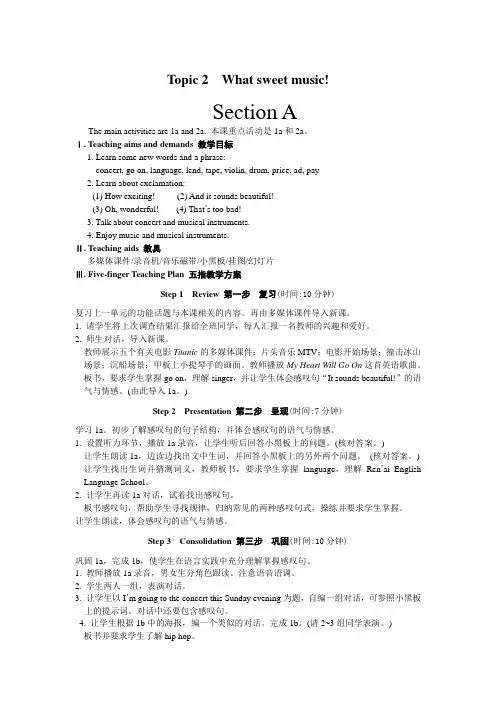
Topic 2 What sweet music!Section AThe main activities are 1a and 2a. 本课重点活动是1a和2a。
Ⅰ. Teaching aims and demands 教学目标1. Learn some new words and a phrase:concert, go on, language, lend, tape, violin, drum, price, ad, pay2. Learn about exclamation:(1) How exciting! (2) And it sounds beautiful!(3) Oh, wonderful! (4) That’s too bad!3. Talk about concert and musical instruments.4. Enjoy music and musical instruments.Ⅱ. Teaching aids 教具多媒体课件/录音机/音乐磁带/小黑板/挂图/幻灯片Ⅲ. Five-finger Teaching Plan 五指教学方案Step 1 Review 第一步复习(时间:10分钟)复习上一单元的功能话题与本课相关的内容。
再由多媒体课件导入新课。
1. 请学生将上次调查结果汇报给全班同学,每人汇报一名教师的兴趣和爱好。
2. 师生对话,导入新课。
教师展示五个有关电影Titanic的多媒体课件:片头音乐MTV;电影开始场景;撞击冰山场景;沉船场景;甲板上小提琴手的画面。
教师播放My Heart Will Go On这首英语歌曲。
板书,要求学生掌握go on,理解singer,并让学生体会感叹句“It sounds beautiful!”的语气与情感。
(由此导入1a。
)Step 2 Presentation 第二步呈现(时间:7分钟)学习1a。
初步了解感叹句的句子结构,并体会感叹句的语气与情感。
仁爱版八年级上Unit3 Topic2 Section C公开课教案

Time: Nov. 30th, 2011Place: Chengnan Middle SchoolTeacher: Ye JianhuaTitle: Unit3 Topic2 Section CⅠ. Aims and demands1. Learn and master the new words and phrases:member, birth, director, weight, height, at last, get up, continue doing/to do2. Know something about U2 and improve reading ability.3. Learn how to set up personal profile and improve writing ability.II.Teaching ProcedureStep1 Review and lead in1.Review some types of music in SectionB after listening to Take Me Home,Country Road. Guide the students to know about band and rock band.2.Show some pictures of Chinese bands and foreign rock bands. Guide the students to know about U2. At the same time, learn some new words.本环节教学预期效果:教学导入遵循学生的认知规律,温故知新,由学生感兴趣的、熟知的到学生未熟知的,循序渐进地引导学生进入新课。
Step2 Presentation1.Get the students to watch the flash of U2 and know something about U2.2.Let the students answer some questions and complete 1b. Guide the students to say out the sentences in the passage.(In this way, the students can improve their reading ability.)本环节教学预期效果:《英语新课程标准》要求学生具备综合阅读的能力,着重提高学生用英语获取信息、处理信息、分析和解决问题的能力;逐步培养学生用英语进行思维和表达的能力。
Unit3 Topic2 Section C导学案 仁爱版八年级上册英语
Topic 2 What sweet music! Section C学习目标:了解音乐天才莫扎特小时候学习钢琴的故事;复习部分不规则动词的过去式。
预习案1.词汇过关默写下面单词和短语单词(words) : 年龄__________ 奇迹__________ 作曲家__________音符,笔记_________ 按__________ 微笑__________ 理解_______短语(Phrases):检查你了解的知识在......的年龄伟大的作曲家___________ 谱曲_____________________ 给某人上课上音乐课每一个音符____________ 上课___________ 来到钢琴边__________________ 按下琴键听起来优美弹得好____________无需任何帮助____________ 和......弹得一样好___________ 如此......以至于如此优美的曲子神童天生的音乐家2.重点句子过关(Sentences)1.)在四岁时,他开始上音乐课。
,he musiclessons.2.)莫扎特的父亲过去常给他的女儿上钢琴课。
Father Mozarthis daughter the piano .3.)小沃尔夫冈来到钢琴边并按下琴键。
Little Wolfgang to the pianoand the .5.)沃尔夫冈无需任何帮助弹得非常好。
Wolfgang was playingany help.6. )沃尔夫冈很快和他的姐姐弹得一样好。
Soon Wolfgang playedhis big sister .7.)他学得如此快以至于他的父亲非常高兴。
He learned his fathervery happy.8.)没有人能够相信一个五岁的小孩会写出如此优美的曲子。
could believe that a little boy could write.9.)他是一个神童,一个天生的音乐家。
仁爱版英语八年级上册Unit 3 Topic 2 section C教案
1.At the age of three, he was able to play the piano by himself.
他三岁时,自己就会弹钢琴。
at the age of ...“在(某人)...岁时
at the age of five...
… on the piano …
… in the room …
… every note …
语法:(1)as well as,
(2)such, so…that
2、教材分析:
本单元主要学习音乐的有关知识,了解感叹句的用法与结构,了解音乐的种类及其各种各样扎特小时候的故事。
A. myself B yourself
C. by myself D. by yourself
4. Lin Mei can sing songs _____-a singer.
A. as well as B. as good as
C. so well as D. so good as
5. ____ what do you think of Mike?
3.He learned so quickly that his father was very happy.
他学得那么快以至于他父亲十分高兴。
So….that如此以致引导结果状语从句。
The book is so interesting that I read it again and again.
stweekour school ________(have) a school sports meet.
4.“you are too little.”_______(say) Father Mozart.
仁爱版八年级上册英语教学设计:Unit3Topic2SectionC
五、作业布置
为了巩固本节课的学习内容,确保学生对知识点的掌握,特布置以下作业:
1.完成教材Section C的练习题,包括填空、选择、匹配等类型,旨在检验学生对听力材料的理解程度,以及词汇和语法的掌握情况。
2.学生互相交换练习题,进行批改和讨论,共同提高。
3.教师选取一些典型错误进行讲解,帮助学生纠正并巩固知识。
(五)总结归纳
1.教师带领学生回顾本节课所学内容,总结一般现在时和一般过去时的运用,以及描述兴趣爱好和日常活动的常用句型。
2.学生分享学习心得,交流在学习过程中遇到的困难和解决问题的方法。
3.教师对本节课的学习情况进行评价,对学生的表现给予肯定和鼓励,并提出下一节课的期望和要求。
1.培养学生对英语学习的兴趣,激发学习积极性,形成自主学习的能力。
2.培养学生尊重、理解和包容他人的兴趣爱好,增进同学之间的友谊。
3.通过学习英语,拓宽学生的国际视野,增强跨文化交际意识。
4.培养学生热爱生活、积极向上的心态,关注个人成长。
5.倡导学生合理安排课余时间,培养良好的生活习惯,提高个人综合素质。
3.通过角色扮演、情景模拟等方式,让学生在实际语境中运用所学知识,提高口语表达能力。
4.鼓励学生开展课后的英语实践活动,将所学知识应用于实际生活中,提高学生的实践能力。
5.教师引导学生进行自我评价和互相评价,培养学生的反思和批判性思维。
(三)情感态度与价值观
在本章节的学习中,学生将形成以下情感态度与价值观:
8.定期进行学习效果评估,通过课堂问答、听力测试、口语表达等方式,全面了解学生的学习情况,为下一步教学提供参考。
仁爱版八年级英语上册unit3topic2section c课堂实录
仁爱版八年级英语上册unit3topic2section c课堂实录课堂实录:仁爱版八年级英语上册Unit 3 Topic 2 Section C一、教学目标1. 知识目标:学生能够掌握本节课的生词和短语,理解课文内容,了解西方餐桌礼仪。
2. 能力目标:学生能够运用所学知识,进行简单的餐桌对话,提高口语交际能力。
3. 情感目标:培养学生的跨文化意识,引导学生尊重不同国家的文化习俗。
二、教学重难点重点:掌握本节课的生词和短语,理解课文内容。
难点:运用所学知识进行餐桌对话,提高口语交际能力。
三、教学方法1. 激活学生的前知:通过提问学生之前学过的关于食物和用餐的词汇,激活学生的相关背景知识。
2. 教学策略:采用情境教学法和小组合作学习法,通过创设情境和小组讨论,引导学生积极参与课堂活动。
3. 学生活动:组织学生进行角色扮演,模拟西方餐桌上的对话,提高口语交际能力。
四、教学过程1. 导入:通过播放一段西方餐桌礼仪的视频,引起学生的兴趣,导入新课。
2. 讲授新课:通过讲解课文内容,引导学生理解西方餐桌礼仪的基本知识和注意事项。
3. 巩固练习:通过小组合作,让学生根据所学知识,编写一段西方餐桌上的对话,并进行角色扮演。
4. 归纳小结:对本节课所学知识进行总结归纳,强调重点和难点。
五、教学评价与反馈1. 设计评价策略:通过观察学生的口语交际表现和小组讨论成果,评价学生的学习效果。
2. 为学生提供反馈:根据学生的表现,给予及时的反馈和指导,帮助学生纠正错误,提高学习效果。
六、作业布置1. 抄写本节课的生词和短语,巩固所学知识。
2. 搜集关于西方餐桌礼仪的信息,准备下节课进行分享交流。