
构词法—派生法(前后缀)
构词法(一)——派生法(Derivation)词根(root)+词缀(affixes)构成新词,前缀法和后缀法。
通常前缀改变意义,后缀改变词性。
一.Prefix 前缀(一)前缀一般不改变词性1. 表达否定意义:dis- 否定,相反,除去(n.前)Eg: dislike v. 讨厌;discover v. 发现im- in- ir- il- ; un- 不,非(adj.或adv.前)Eg: impolite adj. 不礼貌的;impossible adj. 不可能的inconvenient adj. 不方便的incorrect adj. 不正确的;irregular adj. 不规律的;irresponsible adj. 不负责任的;illegal adj. 违法的;illiterate 不识字的unhappy adj. 不开心的;unforgettable adj. 无法忘记的non- 无,非,不(n.或adj.前)Eg: nonconductor n. 绝缘体;nonsense n. 胡说,废话mis- 错,误,恶(v.前)Eg: mistake n.&v. 错误,误解;misunderstand v. 误解for- 弃,禁Eg: forget v. 忘记forbid v. 禁止2. fore- 先,前Eg:forecast v. 预报;foretell v. 语言3. pre- 预先,之前的Eg: predict v. 预测prepare v. 准备4. post- 在……之后Eg: postwar adj.战后的;postgraduate n. 研究生5. mid- 中Eg:mid-term n. 期中的; middle n. 中间6. re- 重新,再一次,复(v.前)Eg: repeat v. 重复;return v. 返回,还;recycle v. 循环7. tele- 远,电(简写中常省略)Eg: telephone n. 电话;telescope v. 望远镜8. ex- 离开,前Eg: exit n. 出口ex-president n. 前总统9. self- 自动,自我Eg: self-assessment n.自我评价self-confident adj. 自信的10. over- 过于,翻Eg: overuse n. 过度使用overturn v. 打翻11. under- 不够Eg: underestimate v. 低估;12. trans- 跨越,移Eg: transportation n. 交通运输;transplant v. 移植13. micro- 微型,微缩Eg: microscope n. 显微镜; microwave n. 微波,微波炉14. mini- 特小的Eg: miniskirt n. 迷你裙minibus 迷你公交车15. semi- 半Eg: semi-final n. 半决赛;semicircle n. 半圆16. mono- 单Eg: monologue n. 独白monopoly n. 垄断17. bi- 双Eg: bicycle n. 自行车bimonthly adj. 双月的18. tri- 三Eg: triangle n. 三角形triplet n. 三胞胎19. multi- 多Eg: multimedia n. 多媒体multinational adj. 多国的20. auto- 自动Eg: automatic adj. 自动的automobile n. 汽车21. sub- 下面的Eg: subway n. 地铁subtitle n. 字幕,副标题22. super- 超级,上层Eg: superman n. 超人;supermarket n. 超市23. inter- 之间的,相互Eg: international adj. 国际的Internet n. 超市(二)改变词性的前缀1. a- 向里,离开,加强(v.或n.前构成adj.或adv.,adj.前构成prep.或adv.)Eg: awake adj. 醒着的; along prep.沿着,顺着;aside prep.&adv. 在……旁边;在旁边2.en- 使成为(n.或adj.前构成v.)Eg: enjoy v. 享受encourage v. 鼓励enable v. 是能够二.Suffix 后缀:(改变词性)1. 名词后缀:1)-ship 状态,身份(n.或adj.后,构成抽象n.)Eg: friendship 友谊;hardship 艰难,困苦2)-ness 状态,性质(adj.后,构成抽象n.)Eg: business 生意;sadness 悲伤;happiness 幸福3)-man 人,男人(n.后)Eg:policeman 警察superman 超人4)-ion 动作,状态(v.后)Eg: action 动作invention 发明decision 决定5)-er, -or 人,动作者,职业(v.后)Eg: writer 作家;waiter 男服务员;actor男演员;doctor 医生6)-ist 职业;主义者(n.后)Eg: pianist 钢琴家;scientist 科学家;revolutionist 革命主义者7)-ese,-(ia)n 人,语言(国名后构成adj.或n.)Eg: Chinese 中国人,汉语;Japanese 日本人,日语;Russian 俄国人,俄语;Italian 意大利人,意大利语8)-th 结果,过程(adj.和v.后,构成抽象n.)Eg:truth 真相;length 长度9)-hood 身份,境遇,状态(n.后)Eg: childhood 童年;neighborhood 邻居10)-ty 性质,状态,程度(adj.后,构成抽象n.)Eg:honesty 诚实;safety 安全11)-age 状态,集合(v.或adj.后)Eg: shortage 短缺;marriage 婚姻12)-ment ……的结果,手段(v.后)Eg: movement 运动;development 发展13)–ure ……的动作或过程(v. 后)Eg: failure 失败;pleasure 愉快;pressure 压力14)–dom ……状态,地位(v.或adj.后)级别、地位(n.后)Eg: kingdom 王国freedom 自由15)–ity (adj.后)Eg: reality 现实;activity 活动;possibility 可能性16)–y 有……倾向的(v后)Eg: difficulty 困难;discovery 发现17)–al ……的过程或状态(v. 后)Eg: arrival 到达;refusal 拒绝;survival 幸存18)–ance ;–ence ……的动作或状态(v.后)Eg: dependence 独立;difference 不同;assistance 协助2. 形容词后缀:1)-ly 品质,……的,每……的(n. 后)Eg: friendly 友好的;weekly 每周的2)-able ;-ible 能够,可……的(v.或n.后)Eg: acceptable 可接受的;unforgettable 无法忘记的3)-ed ……的,动作(v.或n.后)Eg: excited 感到兴奋的;surprised 感到惊讶的4)-ing 属于,性质,动作,状态(n.后构成n.或adj.,加在v.后构成n.)Eg: exciting 令人兴奋的;surprising 令人惊奇的;shopping 购物4)-en 由……制的(n.后)Eg: wooden 木头的;woolen 羊毛的5)-ern 方向(表方向的n.后)Eg: western 西方的;northern 北方的6)-ful 充满,……的(v.或n.后)Eg: colorful 多彩的;wonderful 棒极了7)-less 无……的,没有,不(n.或v. 后)Eg: hopeless 无望的;careless 粗心的8)-ive ……的,有……的(v.后)Eg: active 活跃的;productive 多产的9)-y (充满)……的(n.后)Eg: sporty 运动的;tasty 美味的10)-ish (多为贬义词)像……似的(n.后)Eg:childish 孩子气的,幼稚的;foolish 愚蠢的11)-like 类似;像Eg: childlike 孩子般的,天真的;womanlike 像女人的12)-ous 具有……性质的(n.后)Eg: dangerous 危险的;famous 著名的;courageous 有勇气的13)-some 引起……的;有……倾向的(n.和v.后)Eg: troublesome 麻烦的;handsome 英俊的;tiresome 令人生厌的14)-ary 与……有关的;……的(n. 后)Eg: revolutionary 革命的;customary 通常的,习惯的15)-ate 富于或显示某种性质(n.后)Eg: fortunate 幸运的;passionate 激情的16)-ant;-ent 处于……状态的;进行……动作的Eg: dependent 依赖的;different 不同的;consistent 持续的17)-ic ……的,关于……的Eg: classic 经典的;historic 历史性的;energetic 精力旺盛的18)-al ……的(n.后)……的状态或过程(v.后)Eg: arrival 到达;refusal 拒绝;survival 幸存3. 动词词缀1)-ize; -ise 成为……;使像……;使……化;以……的方式对待或处理;置于(n.或adj.后)Eg: realize 实现;organize 组织;criticize 批评2)-en 使,变得(adj.后)Eg: widen 拓宽;deepen 加深;sadden 使忧伤3)-ify 使得;变得(n.或adj.后)Eg: identify 识别;classify vt.分类,归类4. 副词词缀-ly 品质,……地(adj. 后)Eg: beautifully 优美地;slowly 慢慢地5. 数词词缀:1)-teen 十几(13-19)Eg: fifteen 十五;nineteen 十九2)-ty 几十(整数)Eg: twenty 二十;thirty 三十3)-th 第几(除尾数为1,2,3的)Eg: fifth 第五;ninth 第九6. 代词词缀-self(-selves)反身代词Eg: myself 我自己;ourselves 我们自己。
派生法英语构词法归纳
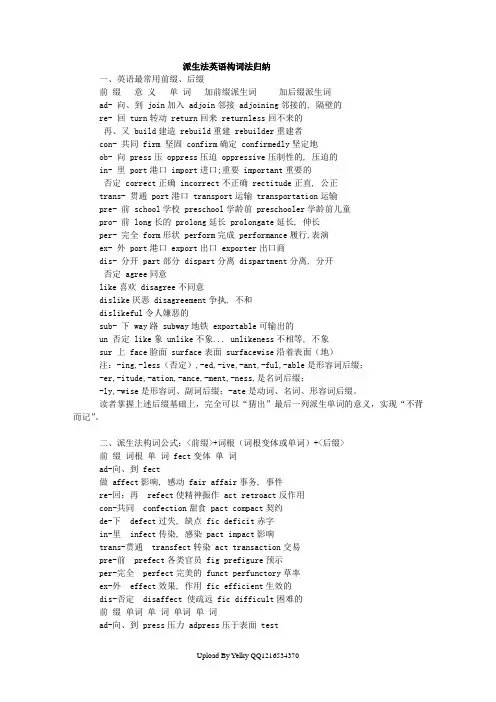
派生法英语构词法归纳一、英语最常用前缀、后缀前缀意义单词加前缀派生词加后缀派生词ad- 向、到 join加入 adjoin邻接 adjoining邻接的, 隔壁的re- 回 turn转动 return回来 returnless回不来的再、又 build建造 rebuild重建 rebuilder重建者con- 共同 firm 坚固 confirm确定 confirmedly坚定地ob- 向 press压 oppress压迫 oppressive压制性的, 压迫的in- 里 port港口 import进口;重要 important重要的否定 correct正确 incorrect不正确 rectitude正直, 公正trans- 贯通 port港口 transport运输 transportation运输pre- 前 school学校 preschool学龄前 preschooler学龄前儿童pro- 前 long长的 prolong延长 prolongate延长, 伸长per- 完全 form形状 perform完成 performance履行,表演ex- 外 port港口 export出口 exporter出口商dis- 分开 part部分 dispart分离 dispartment分离, 分开否定 agree同意like喜欢 disagree不同意dislike厌恶 disagreement争执, 不和dislikeful令人嫌恶的sub- 下 way路 subway地铁 exportable可输出的un 否定 like象 unlike不象... unlikeness不相等, 不象sur 上 face脸面 surface表面 surfacewise沿着表面(地)注:-ing,-less(否定),-ed,-ive,-ant,-ful,-able是形容词后缀;-er,-itude,-ation,-ance,-ment,-ness,是名词后缀;-ly,-wise是形容词、副词后缀;-ate是动词、名词、形容词后缀。
英语主要有三种构词法
Language points (word study)
1.belief n. 信任, 信心, 信仰 常
与in连用
have a belief in 相信, 信任 That man has a strong belief in God. 那个男子虔诚地信仰上帝。 He has lost the belief in God. Beyond belief 无法令人相信;令人难以置信 His story is beyond belief. 他的话难以置信。 a common belief 普通的信念 religious belief 宗教信仰
2.名词转化为动词 e.g The hall can seat two thousand people They have booked their plane ticket.
3.形容词转化为动词
e.g. The car slowed down to half its speed.
The room gradually quieted down.
动词:
-fy (使…化) ; -ize (使…成为) e.g. simplify(简化) , satisfy , realize , organize
副词:
- ly 表示方式,程度 : freely ,badly ,truly -ward (s) 表示方向 :towards, forward, outward
后
缀
例
runner ,
词
swimmer
--er ….. 者
-ese….地方的人
Chinese, Japanese
名
-ian
精通…的人, …地方人 musician, Russian
构词法(派生)
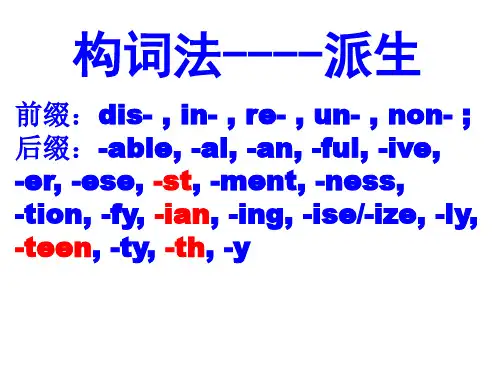
国家或地区的( 语言) 7. -ese 国家或地区的(人;语言) Japanese, Vietnamese, Chinese, 8. -ist 主义的( 信仰… ①主义的(人);信仰…的(人) ②…家;…的操作者 Buddhist, Scottish, socialist, novelist, guitarist
6. -er ①做…动作的人 dancer, dinner 的器具cooker ②做…的器具cooker 住在或来自)… )…地方的人 ③ (住在或来自)…地方的人 Londoner, villager 精通/研究… ④精通/研究…的人 a geographer, ***an inventor, an actor
前缀: 前缀: 1.dis-表示“相反,否定;中断, 1.dis-表示“相反,否定;中断,消 除” 意。 disapprove, dishonesty, disconnect the machine, disinfect the wound, disagree
in- 否定,相反,不足” 2. in- “否定,相反,不足”表示相反 的性质。多用于adj, n.前 的性质。多用于adj, n.前。 insensitive, inattention, non-表示“ 3. non-表示“不,非” nonstop, nonnonalcoholic, nonsmoker, nonstick frying pan, un-表示“否定,相反,不足” 4. un-表示“否定,相反,不足”多 用于adj, verb前 用于adj, adv, verb前
行为(过程); );行为之 9. -ment 行为(过程);行为之 起因/手段/结果; 起因/手段/结果;…的状态 movement, replacement, development (…的 状态/性质/ 10. -ness (…的)状态/性质/程度 happiness,loudness, happiness,loudness, kindness, kindness,sadness
常见英语构词法
英语词汇常见构词法
说明:英语词汇的构词规律一般可分为三种。
一是转换法(conversion),即由一种词类转换为另一种词类;如:walk(名词),也可用作walk(动词)。
二是合成法(composition),即由两个或两个以上的词合在一起构成的词,如:basketball,airport,go-between,brunch,Eurasia,Motel 等。
三是派生法(derivation),又叫词缀法(affixation),即在某些单词前或后加上前缀(prefix)或后缀(suffix)来构成新词。
其中,第三种方法比较普遍,掌握这些构词规律对于我们学习英语和理解记忆英语单词非常有帮助。
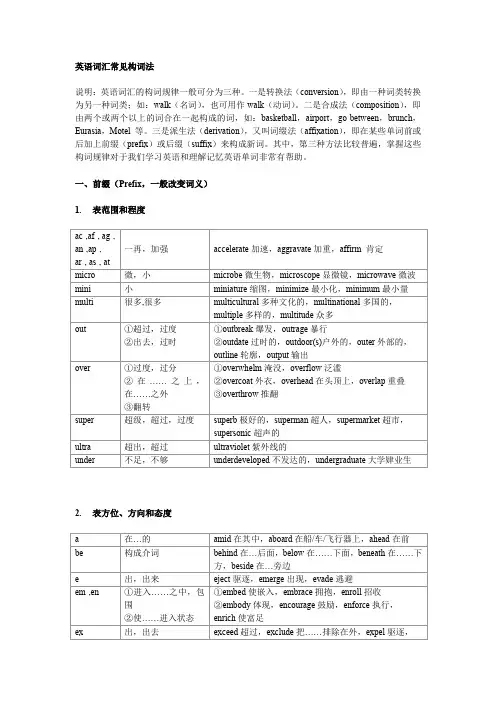
一、前缀(Prefix,一般改变词义)
1.表范围和程度
2.表方位、方向和态度
3.表否定
4.表逆反
5.表数字
6.表贬义
7.其他
二、后缀(Suffix,一般改变词性)
1.名词后缀
2.形容词后缀
3.动词后缀
4.副词后缀。
四种构词法

四种构词法构词法主要有四种:派生法、合成法、转换法和截短法。
一、派生法在一个词的词根的前面或后面加上某个词缀来产生新词,这种构词法称为派生法。
加在前面的词缀叫前缀,加在后面的词缀叫后缀。
(一)后缀:许多名词、形容词、副词和动词是由词根加后缀构成的。
1.构成名词的常用后缀有:(1)-er,-or,-ist,-ee,-ese,-ant等用于构成表示人或物的名称。
(2) -ance, -ence, -(a)tion, -sion, -ics, -ing, -ity, -ment, -ness, -th,-ty,-ure,-ship等用于构成表示行为、性质、状态等抽象名词。
2. 构成形容词的常用后缀有:-able, -ible, -al, -ful, -less, -ish, -ive, -ous, -an, -ary, -en等。
3. 构成副词的常用后缀有:-ly, -ward, -wise等。
4. 构成动词的常用后缀的有:-ise/ize, -en, -ify等。
(二)前缀:词根加前缀多数不改变词性,只引起词义的变化。
1. 表示相反意义的前缀有:un-, dis-, in-, im-, ir-, il-, de-等。
2. 表示其他意思的前缀有:re-(重新),mpost-(后的),fore-(先的)等。
二、合成法由两个或两个以上的词合成一个新词,这种构词法称为合成法(compounding)。
合成词之间有的要用连字符连接,有的直接连接在一起。
三、转换法在词行不变的情况下,一个单词由一种词性转换成另一种词性,称为转换(conversion)。
转换后的词义与转换前的词义通常有密切的联系,但有时差异也很大。
有些双音节的词转换后,重音要发生变化。
通常名词重音在前,动词重音在后,有时读音也有不同。
四、截短法即将单词缩写,词义和词性保持不变,主要有截头、去尾、截头去尾等形式。
关于合成法:合成名词:构成方式例词名词+名词weekend周末;名词+动词daybreak黎明;名词+动名词handwriting书法;名词+及物动词+er/or pain-killer止痛药;名词+介词+名词editor-in-chief总编辑;代词+名词she-wolf母狼;动词+名词typewriter打字机。
常见构词法归纳
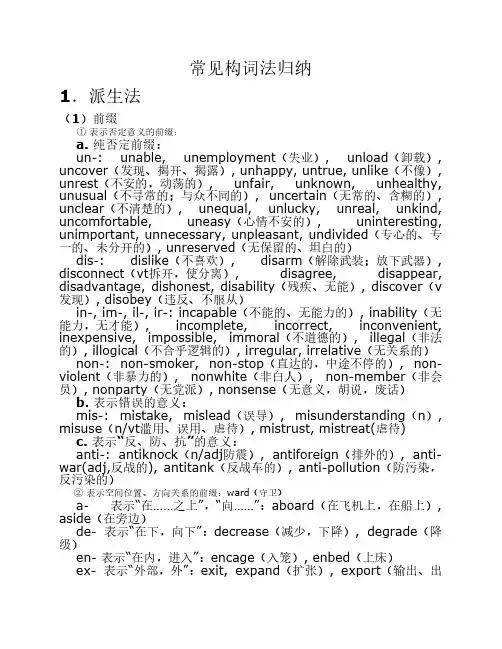
常见构词法归纳1.派生法(1)前缀①表示否定意义的前缀:a. 纯否定前缀:un-: unable, unemployment(失业), unload(卸载), uncover(发现、揭开、揭露), unhappy, untrue, unlike(不像), unrest(不安的,动荡的), unfair, unknown, unhealthy, unusual(不寻常的;与众不同的), uncertain(无常的、含糊的), unclear(不清楚的), unequal, unlucky, unreal, unkind, uncomfortable, uneasy(心情不安的), uninteresting, unimportant, unnecessary, unpleasant, undivided(专心的、专一的、未分开的), unreserved(无保留的、坦白的)dis-: dislike(不喜欢), disarm(解除武装;放下武器), disconnect(vt拆开,使分离), disagree, disappear, disadvantage, dishonest, disability(残疾、无能), discover(v 发现), disobey(违反、不服从)in-, im-, il-, ir-: incapable(不能的、无能力的), inability(无能力,无才能), incomplete, incorrect, inconvenient, inexpensive, impossible, immoral(不道德的), illegal(非法的), illogical(不合乎逻辑的), irregular, irrelative(无关系的)non-: non-smoker, non-stop(直达的,中途不停的), non-violent(非暴力的), nonwhite(非白人), non-member(非会员), nonparty(无党派), nonsense(无意义,胡说,废话)b. 表示错误的意义:mis-: mistake, mislead(误导), misunderstanding(n), misuse(n/vt滥用、误用、虐待), mistrust, mistreat(虐待)c. 表示“反、防、抗”的意义:anti-: antiknock(n/adj防震), antiforeign(排外的), anti-war(adj,反战的), antitank(反战车的), anti-pollution(防污染,反污染的)②表示空间位置、方向关系的前缀:ward(守卫)a- 表示“在……之上”,“向……”:aboard(在飞机上,在船上), aside(在旁边)de- 表示“在下,向下”:decrease(减少,下降), degrade(降级)en- 表示“在内,进入”:encage(入笼), enbed(上床)ex- 表示“外部,外”:exit, expand(扩张), export(输出、出口)fore- 表示“在前面”:forehead(前额), foreground(前景), foreleg, forefootin-, im- 表示“向内,在内,背于”:inland(内地、内陆), inside, indoor(s)(室内的,户内的;(s)在户内), import inter- 表示“在……间,相互”:international, interaction(相互作用), internet, interview(接见,面试)mid- 表示“中,中间”: midposition(中间位置)out- 表示“在外部,在外”:outline(轮廓,大纲,概要), outside, outward(s)(外表、外面;(s)向外地), outdoor(s) over- 表示“在上面,在外部,向上”:overlook(忽视,眺望), overhead(在头顶上,在空中), overcoat(大衣,外套), overdress(外衣), oversea(s)(海外)post- 表示“向后,在后边,次”:postscript(附言)pre- 表示“在前,在前面,提前”:prefix(前缀), preface(前言), preposition(介词)super- 表示“在…..之上,超级”:superstructure(上部建筑,上部构造), supernatural(超自然的,不可思议的), superpower(超强特权,超强大国), superman, supermarket trans- 表示“移上,转上,在那一边”:translate, transform(转变、转换、转移), transplant(移植), transportation(交通)under- 表示“在…..下面,下的”:underline(下划线,强调,在下面划线), underground, underwater, undershirt(贴身内衣,美式)up- 表示“向上,向上面,在上”:upward(s)(向上的,上升的), uphold(支撑,鼓励), uphill(上坡),upload(上传) auto- 表示“自己,独立,自动”:automobile(自动车), autobiography[ɔːtəbaɪ'ɒgrəfɪ(自传)tele- 表示“远离”:television, telephone , telegram(电报), telegraph(电报,抽象名词), telescope(望远镜)③表示时间,序列关系的前缀:fore- 表示“在前面,先前,前面”:foreword(前言), forecast(预报), foretell(预言), foresee(预见), foreknow(先知), foreknowledge(先知)mid- 表示“中,中间”:midnight, midsummer, mid-day, mid-autumn(中秋节)post- 表示“在后,后”:postwar(战后的,战后时期), postgraduate(研究生), postdate(事后日期,推迟日期)pre- 表示“在前,事先,预先”:preheat(预先加热), prewar, prehistory(史前), preview(预习), prebattle, prepay(预付)re- 表示“再一次,重新”:retell(复述), rewrite, renew(续借), reconsider(重新考虑), reuse, remarry, recycle(再生,回收利用), rebuild(重建,改造)④表示比较程度差别关系的前缀:by- 表示“副,次要的”:byproduct(副产品), bywork(副业)extra- 表示“超越,额外”:extraordinary(非凡的,特别的)over- 表示“超过,过度,太”:overeat(吃过多), oversleep(睡过头), overpraise(过奖), overwork, overact(行为过分), overdo(夸张,做得过分)under- 表示“低劣,低下”:undersize(尺寸不足), undergrown(发育不全的), underproduction(生产不足)vice- 表示“副,次”:vice-president, vice –chairman,vice-monitor⑤表示共同,相等意思的前缀:co- 表示“共同,一起”:coexist(共同生存), co-operate, co-worker, coactions(合作行动), coauthor(合作作者)⑥表示某种状态,构成形容词、副词或动词:a- afraid, alive, alone, asleep, ashamed, aloud, ahead, aside, alike, awake⑦表示分离,离开意思的前缀:a- 表示“分离,离开”:away, apartde- 表示“离去,处去”:depart, decolour⑧表示“自我”:self- self-protect(ion), self-made, self-knowledge⑨表示变换词类作用的前缀:be- befrienden- enslave(束缚;征服), enable(使能够), enrich(使充实,使肥沃,使富足), enlarge(扩大,使增大), encourage(鼓励)⑩表示数量关系的前缀:a. 表示“单一”,“一”:uni- uniform(统一服装), unicellular(单细胞)b. 表示“二,两,双”:bi- bicycle(cycle循环,周期)twi- twilight(昏暗的,黎明)c. 表示“半,一半”:semi- semiconductor(半导体), semicircle(半圆), semimonthly(半月刊), semifinal(半决赛)d. 表示“百,百分之一”:centi- centimetere. 表示“千,千分之一”:kilo- kilometer, kilogram, kilowattf. 表示“微小”:micro- microvolt(微伏特), microcomputer(微机), microscope(显微镜)g. 表示“许多,复,多数”:multi- multimedia(多媒体), multicolored, multiform, multinaturalh. 表示“千分之一、毫”:milli- millimeter, milligrami. 表示“微小、微型”:mini- minibus, miniskirt, minipark(2)后缀①名词后缀:a. 具有某种职业或动作的人:-an, -ian, -ician 表示“……地方的人,精通……的人”:American, Asian, Australian, Russian, Italian , historian(历史学家), librarian(图书管理员), electricia(电工)n, magician(魔术师), technician, musician, politician(政客)-ant,-ent 表示“……人”:merchant, servant(仆人,佣人), assistant, agent, student,-ee 表示“动作承受者”:employee(雇员), examinee(应试者), payee(收款人), interviewee-eer 表示“从事于……人”:engineer, volunteer(志愿者)-er 表示“从事某种职业的人, 某地区,地方的人”:banker, observer, Londoner, villager singer, driver, writer, speaker, traveller, buyer-or 表示“……者”:author, doctor, operator, actor, visitor, inventor, educator-ar, -ary 表示“……的人, 从事……的人”:scholar, liar, beggar, secretary, missionary-ese 表示“ ……国人,……地方的人”:Chinese, Japanese, Cantonese(广东人)-ess 表示“阴性人称名词”:actress(女演员), hostess(女主人), manageress(女经理)-ist 表示“从事……研究者,信仰……主义者”:pianist, communist, dentist, artist, chemist, socialist, typist, receptionist-icist 表示“……家,……者, ……能手”:physicist(物理学家), phoneticist(语音学家), technicist(技术师)-logist 表示“……学家,研究者”:biologist(生物学家), geologist(地质学家)b. 构成具有抽象名词的含义:-age 表示“状态,行为,身份及其结果,总称”:courage, storage, marriage, percentage-al 表示“事物的动作,过程”:refusal(拒绝), arrival, survival(幸存), denial(否认), approval(批准,认可,赞成), trial(实验)-ance, -ence 表示“性质,状况,行为,过程,总量,程度”:importance, distance, avoidance(逃避,废止), appearance, performance(性能,绩效,表演), difference, obedience(顺从,服从), presence(出席,参加), existence-ancy, -ency 表示“性质,状态,行为,过程”:frequency(频繁), urgency(紧急), efficiency(高效率),-ity 表示“性质,状态,程度”:purity(纯度(化学)), reality, equality(平等)-bility 表示“动作,性质,状态”:ability, possibility, probability, responsibility-dom 表示“等级,领域,状态”:freedom, kingdom(王国,界), wisdom(智慧,才智)-ery, -ry 表示“行为,状态,习性,性质”:bravery(勇敢,勇气), slavery(奴役)-hood 表示“资格,身份, 年纪,状态”:childhood, girlhood(少女时期), boyhood(少年时代), manhood(男子气概)-ice 表示“行为,性质,状态”:notice, justice(司法), service -ing 表示“动作的过程,结果”:building, writing, learning-ion, -ation, -ition, -sion 表示“行为的过程,结果,状况”:suggestion, action, solution, invention, direction(方向,指导), correction(改正,修正), collection, instruction(指令,指示), destruction (破坏), introduction, congratulation , dictation(听写,口述), invitation(邀请), pronunciation, examination, graduation, operation, education, information, translation, starvation(饿死,绝食), satisfaction, relation, determination(决心,果断), preparation, imagination, explanation(说明,解释), opposition(反对), competition(竞赛,比赛), description, decision, division(除法), conclusion, impression(印象), expression(表达,表示), admission(承认), permission(允许,许可), discussion -ment 表示“行为,状态,过程,手段及其结果”:disappointment(失望), treatment, movement, judgment, punishment, argument, agreement(协议), government, development, improvement(改进,改善), requirement(要求,必要条件), encouragement-ness 表示“性质,状态,程度”:goodness(adj,善良,精华),kindness, tiredness, friendliness(友谊), business, illness, happiness(幸福), willingness(乐意,心甘情愿), weakness, fairness(公平)-ism 表示“制度,主义,学说,信仰,行为”:socialism(社会主义), criticism(批评), heroism(英勇), tourism, communism(共产主义) , Marxism(马克思主义)-ship 表示“情况,性质,技巧,技能及身份,职业”:hardship(困苦,苦难), relationship, membership (资格,会员身份), friendship, ownership(所有权), scholarship(奖学金),-th, 表示“动作,性质,过程,状态”:strength, length, width, depth, wealth, truth, growth, warmth(温暖), youth -ure 表示“行为,结果”:exposure(暴露), pressure(压力), failure, procedure(手续), mixture-craft 表示“工艺”:aircraft, needlecraft, woodcraftc. 带有场所,地方的含义:-age 表示“住所,地点”:village, cottage(小屋,村舍)-ary 表示“住所,场地”:library, granary (谷仓)-ory 表示“工作场所,住处”:factory, dormitory, laboratory, observatory(天文台,气象台)②形容词后缀:a. 带有“属性,倾向,相关”的含义:-able, -ible: movable, comfortable, eatable, enjoyable, acceptable, reasonable, applicable(可适用的), visible(可见物), responsible, terrible(可怕的), horrible(恐怖的)-al: natural, additional(额外的,附加的), educational, national(国家的,国民的)-ant, -ent: distant, important, excellent-ing(表示特征:令人觉得): moving, touching, daring, interesting, exciting, disappointing , boring, amazing -ed(表示情绪:觉得): pleased, interested, surprised, worried, excited, bored, determined(决定了的,果断的), delighted(高兴的,欣喜的)-ish: foolish, bookish(出本上的,好读书的), selfish-ive: active, impressive(感人的,令人钦佩的), decisive(决定性的,果断的), active,expensive, progressive(改革的,进步的)b. 表示“相象,类似”的含义:-ish: boyish, childish(幼稚的,孩子去的)-like: manlike(有男子气概的,像男子的), childlike(天真浪漫的,像孩子的)-some: troublesome(麻烦的,讨厌的), handsome-y: milky, cloudy sunny, windy, rainy, foggy(有雾的,模糊的), healthy, wealthy, worthy, bloody(血腥的), funny, dirty, lucky, noisy, salty, smelly(发臭的), hilly(丘陵的,陡的)-ly: manly, fatherly, motherly, sisterly, brotherly, daily, weekly, monthly, quarterly, yearly, friendly, lonely, orderly, lovely(可爱的,令人愉快的), lively(活泼的,生动的), likely(很可能的), scholarly(博学的,学着风度的)c. 表示“充分的”含义:-ful: beautiful, wonderful, helpful, truthful, successful, harmful, useful, careful, forgetful, merciful(仁慈的,宽容的)-ous: dangerous, courageous(有胆量的,勇敢的), nervous(紧张不安的), mountainous(多山的), humorous(诙谐的,幽默的), various(各种各样的)d. 表示由某种物质形成,制成或生产的含义:-en: wooden, golden, woolen(羊毛的)e. 表示方向的含义:-ern: eastern, western, southern, northern, southeastern, northwestern-ward: downward(向下的), forwardf. 表示“数量关系”的含义:-teen: thirteen-ty: fifty-th: fourth, fiftiethg. 表示国籍,语种,宗教的含义:-an: Roman, European-ese: Chinese, Japanese-ish: English, Spanishh. 表示否定:-less: countless(无数的,数不尽的), stainless(不锈的), wireless, useless, endless(无止境的,连续的), priceless(无价的,贵重的), hopeless③动词后缀:-ize, ise 表示“做成,变成,……化”:modernize(现代化), democratize(民主化), organize, apologize, realize -en 表示“使成为,引起,使有”:quicken,(加快)weaken, soften, harden(变硬,变坚强)-fy 表示“使……化, 使成”:beautify, purify(净化), intensify, signify, simplify(简化), satisfy④副词后缀:-ly: possibly, swiftly(很快地), simply(简单地)-ward(s): downward, inwards(向内地), upward(向上地,上升地)-ways: always, sideways(向侧面的,一旁的)-wise: otherwise(另外的,否则,adj,adv), clockwise(顺时针方向地)注意:有的单词有双重后缀,如:use(用途)→useless(无用的)→uselessness(无用)self(自己)→selfish(自私的)→selfishness(自私)有的单词则是前后缀同时使用,如:important→importance→unimportanceregular(有规律的,有规则的)→irregular(无规律的,不规则的)→irregularity(无规律,不规则)2.合成法(1)合成名词构成方式例词名词+名词weekend周末名词+动词daybreak黎明名词+动名词handwriting书法名词+及物动词+er/or pain-killer止痛药名词+介词+名词editor-in-chief总编辑动词+名词typewriter打字机动名词+名词reading-room阅览室现在分词+名词flying-fish飞鱼形容词+名词gentleman绅士副词+动词outbreak爆发介词+名词afternoon下午代词+名词she-wolf母狼 boyfriend, girlfriend, bus-driver, playground, radioactive(放射性的), headmaster(校长), sunshine, notebook, armchair(扶手椅), wheelchair(轮椅), postcard(明信片), football, spaceship, blackboard,firefighter(消防队员), fireman, gateman(看门人,售票员), chairman(主席,会长), weatherman, businessman, armyman(军人), postman, sportsman, bedroom, reading-room, classroom, newspaper, pickpocket(扒手), she-goat(雌性山羊), editor-in-chief(主编), daybreak(破晓), handshake(握手), silkworm(蚕), outbreak(爆发)(2)合成形容词构成方式例词名词+形容词snow-white雪白的名词+现在分词English-speaking讲英语的brainwashing(洗脑的)名词+to+名词face-to-face面对面的名词+过去分词man-made人造的homemade数词+名词one-way单行的数词+名词+形容词two-year-old两岁的数词+名词+ed five-storeyed五层的four-legged(四条腿的动词+副词see-through透明的形容词+名词high-class高级的形容词+名词+ed kind-hearted, cold-blooded形容词+形容词light-blue浅蓝色的形容词+现在分词good-looking相貌好看的副词+形容词ever-green常青的副词+现在分词hard-working勤劳的副词+过去分词well-known著名的newly-built副词+名词fast-food专门提供快餐服务的介词+名词downhill下坡的由三个词构成的合成形容词: heart-to-heart, two-year-old, eight-metre-long其他合成形容词:everyday(日常的), faraway(遥远的), snow-white(雪白的), lay-off(下岗的)(3)合成动词构成方式例词名词+动词sleep-walk梦游形容词+动词white-wash粉刷副词+动词overthrow推翻(4)合成副词构成方式例词形容词+名词hotfoot匆忙地形容词+副词everywhere到处副词+副词however尽管如此介词+名词beforehand事先介词+副词forever永远(5)合成代词构成方式例词代词宾格+self herself她自己物主代词+self myself我自己形容词+名词anything任何东西(6)合成介词构成方式例词副词+名词inside在……里面介词+副词within在……之内副词+介词into进入3.转化法(1)名词→动词hand(手→传递) back(背部,后面→支持,后退)charge(费用→收费) copy(抄本,复印件→抄写,复印)flood(洪水→淹没) heat(热量→加热)paint(油漆→刷漆) phone(电话→打电话)pin(别针→装订) waste(废物→浪费)face(脸→面对) use(用途→使用)interest(兴趣→使兴趣) surprise(惊讶→使惊讶)taste(味道→品尝) smell(气味→闻)break(短暂休息→折断) present(礼物→赠送)(2)形容词→动词clean(干净→使干净,打扫) clear(清楚→清理)dirty(脏→弄脏) dry(干燥→烘干,晒干)empty(空的→倒空) free(自由→使自由,释放)slow(慢的→放慢) warm(暖和→使暖和)cool(凉的→冷却) quiet(安静→使安静)4.截短法(缩略法)截短法,即将单词缩写,词义和词性保持不变,主要有截头、去尾、截头去尾等形式。
英语构词法派生法
respectable comfortable valuable fashionable loveable
·
• 2. -ful (n./v.→adj.) 表示“充满……的” 如:
beautiful successful wonderful shameful hopeful
·
• 3. -less (n.→adj.) 表示“没有…… 的”。如:
派生法: Derivation 屈折变化: Inflection
Presenter : 田甜
派生法: derivation
·
• 派生法(derivation)是英语主要的构词法, 用以丰富扩大英语的词汇量。这方法是借 前缀(prefix)或后缀(postfix;suffix)之助, 制造出派生词(derivative words),主 要有名词、形容词和动词三种。
jobless homeless helpless
·• 4. -ous (n.→adj.)表示“具有……性质 的”。 如:
nervous famous dangerous poisonous humorous 幽默的
·
5. -y (n.→adj.)
funny sunny cloudy wealthy
·• 6. -ly (adj.→adv. / n.→adj.)
finally quietly lovely friendly manly
7·. 其它形式:-ish, -ic, -ical, -ive, -al(n.→adj.)
foolish basic scientific medical expensive selfish personal progressive
tall - tallest
语法小结:派生词构词法
语法小结:派生词构词法派生法,也叫前缀、后缀构词法,即由一个词根加上前缀或后缀构成另一个词的构词方法。
一、前缀添加在词根前的构词部分叫前缀,它多数情况下不改变原词的词性。
常见的有以下几种:1. im-, un-, in-, dis-等,表示否定。
如:possible (可能的)→impossible (不可能的), load (装载)→unload(卸货), correct (正确的)→incorrect (不正确的), like (喜欢)→dislike (不喜欢)2. re-,表示“重复”。
如:write (写) →rewrite(重写) 3. mid-,表示“在……中间”。
如:night (夜晚)→midnight(半夜)4. anti-,表示“反对,防止”。
如:war (战争)→antiwar(反战的)二、后缀添加在词根后的构词部分叫后缀,它多数情况下改变原词的词性。
常见的有以下几种:1. 名词后缀:-er, -or, -ist, -ship, -tion, -ment等。
如:sing(唱歌) →singer(歌手), act(表演) →actor(演员), science(科学) →scientist(科学家), friend(朋友) →friendship(友谊), describe(描述) →description(描述), enjoy(享受) →enjoyment(享受)2. 形容词后缀:-ful, -less, -able等。
如:peace(和平)→peaceful(平静的), care(小心)→careless(粗心的),believe(相信) →believable(可信的)3. 动词后缀:-en, -ize等。
如:strength(力量) →strengthen(加强), modern(现代的) →modernize(使现代化)4. 副词后缀:-ly等。
如:slow(慢的)→slowly(慢慢地)【秘笈】词根、前/后缀, 构词数量大。
什么是派生词派生词的举例
什么是派⽣词派⽣词的举例 派⽣词是英语主要的构词法。
这⽅法是借前缀或后缀之助,制造出派⽣词,主要有名词、形容词和动词三种。
那么你对派⽣词了解多少呢?以下是由店铺整理关于什么是派⽣词的内容,希望⼤家喜欢! 派⽣词的释义 派⽣法(derivative)是英语主要的构词法。
这⽅法是借前缀或后缀之助,制造出派⽣词(derivative words),主要有名词、形容词和动词三种。
前缀以否定前缀(negative prefixes)un-, in-, im-, il-, ir-, non-, dis-, mis-, mal-等为主,使延伸出来的派⽣词 变成反义词。
例如:injustice(不公平的), unhappy(不⾼兴的), impossible(不可能的)等。
但要注意:英语中的前缀in-,un-通常表⽰“不”或“…的相反”的含义,因此由其构成的派⽣词⼀般具有否定的意义。
然⽽,有些由这两个前缀构成的派⽣词并⾮有否定的意义,⽽与词根同义或近义。
著名学者周海中教授在《in-,un-不⼀定表⽰“否定”》⼀⽂中就举了若⼲个例⼦,如:coming/incoming(来到),habit/inhabit(居住于),loose/unloose(解开,释放),rip/unrip(撕开)等。
这类派⽣词虽然不多,但值得注意,勿望词⽣义。
Ⅰ名词派⽣词 Balance(平衡)→imbalance(不平衡);pleasure(⾼兴)→displeasure(不⾼兴);management(管理)→ mismanagement(保管不善);efficiency(功效)→inefficiency(⽆效率)````还有很多 Ⅱ形容词派⽣词 Accurate(精准,正确)→inaccurate(不正确);patient(能忍耐的)→impatient(⽆法忍耐的). regular(有规矩的)→ irregular(不规矩的);legal(合法的)→illegal(违法的)·····等 Ⅲ动词派⽣词 Agree(赞同)→disagree(不赞同);judge(判断)→misjudge(对·····判断错误);treat(款待)→maltreat(虐待)·····等 除了否定前缀之外,其他常⽤的前缀还有 anti-, auto-, bi-, co-, counter-, de-, ex-, inter-, mono-, post, pre-, pro-, re-, sub-, super-, trans-, tri-, ultra-等。
英语构词法中的派生法
英语构词法中的派生法派生法(derivation): 在词根前面加前缀或在词根后面加后缀,从而构成一个与原单词意义相近或相反的词。
前缀(prefix): 一般改变意义,不改变词性。
表示否定的:dis-, like---dislike, appear---disappear, agree---disagree,cover---discover,il-, legal---illegal, literate---illiterate;im-, possible---impossible, polite---impolite,mortal-immortal;in-, correct---incorrect, direct---indirect, complete---incomplete;ir-, regular-irregular, relative---irrelative,revocable---irrevocable, capable of being revoked; able to be cancelled, revoke: (transitive) to take back or withdraw; cancel; rescind ? to revoke a law2. (intransitive) cardsto break a rule of play by failing to follow suit when able to do so; renege,renege. (intransitive; often foll by on) to go back (on one's promise, etc)mis-,“错误,坏” take---mistake, understand---misunderstand, fortune---misfortune, lead---mislead, mischievous;mal-, “坏,恶的”function---malfunction, maladroit笨拙的(mal+adroit灵巧的) adjective 1. skilful or dexterous 2. quick in thought or reaction, malevolent恶意的(male+vol意志+ent→坏意志) 1. wishing or appearing to wish evil to others; malicious 2. astrology having an evil influence;non-,“不,非”’ fiction---non-fiction, non-cooperation, non-negotiable, non-stop直达的,non-profit, non-commercial;un-, “不,非”happy---unhappy, fair---unfair, like---unlike(不像),certain-uncertain,known-unknown,usual-unusual,important-unimportant, accessable---unaccessable, accountable---unaccountable, fold-unfold,前缀a-,① 加在单词或词根前面,表示”不,无,非”, acentric 无中心的(a+centric中心的) asocial 不好社交的(a+social好社交的) ;amoral 非道德性的(a+moral道德的;注意:immoral apolitical.不关政治的(a+political政治的) anemia 反常的(a+nomal正常的+ous)② 加在单词前,表示”在…,…的” ,asleep 睡着的(a+sleep睡觉),aside 在边上(a+side旁边),ahead 在前地(a+head头),alive 活的(a+live活) awash .泛滥的(a+wash冲洗),alike(相似的,一样的);前缀中的:anti-, “反对,抵抗, against,opposed to,opposite of,instead”,anti-war, antitrust, antibiotic, antioxidant,antibody, antigen, anti-semitic等;auto-, “自动的,self, personally, 表示自己”,automate, automation 自动化,autograph 亲笔,autoalarm 自动报警器,autocriticism 自我批评,autorotation自动旋转,autobiography 自传,autonomous [??'tɑ?n?m?s]a. 自治的;automatic, automatically, autonomy, automobile,automated, autopsy, autograph亲笔签名,手稿, automotive, ,autocrat 独裁者,autocracy,automata, automaton, autoclave, automaker, autoindex自动索引;co-, “共同”,coworker, collegiate, colleague, cooperate;en-, “使”,enlarge, encourage, enhance, enable, enact, enroll, encompass,inter-,“相互,between在---之间”,international, internet, interview, intercontinental洲际的,interchange, interfere, interrupt, interpose,mini-, “小”,minibus, ,miniskirt, miniature, minify, minimum, minimal最低限度的,pre-,“在---之前”,pre-school, pre-reading, preview,precede v. to go or be before (someone or something) in time, place, rank, etc, precedent. a. If there is a precedent for an action or event, it has happened before, and this can be regarded as an argument for doing it again.president, precedent. unprecedented.re-, “再,又,重复”, repeat, rewrite, retell, return, review, rebound, reflect, reclaimsub-,“在下面”,subway, subordinate, submarine, suburban(urban城区),subconscious,subscribe,super-“超,在---之上”,supermarket, superman, superstar, supersonic, superficial, supervise, supernatural,tele-,“远”,telephone, telescope, television, telecommunication, telegram,后缀(suffix): 通常使词由一种词类转化为另一种词类。