
牛津沪教版六年级上6AUnit9复习教案
Unit9 Picnics are fun同步教案
Ⅰ. Important words and phrases:
Words:
1. fun n. (不可数) 有趣的事
Reading is fun. 读书是一大乐趣。
funny adj. 有趣的,可笑的
Tom told a funny story just now. 刚才汤姆讲了一个有趣的故事。
just for fun 取乐,当笑话
make fun of sb./ sth. 嘲笑某人/某事;拿某人/某事取笑
have fun 玩的愉快(相当于have a good time/enjoy oneself)
for fun 当做玩笑
good/great fun 有趣的人/物
当不同意时,常用No, you may not. / Sorry, I’m afraid you can’t.
May I have an apple?
Sure. Here you are.
May I go to the park with Kitty?
Sorry. I’m afraid you can’t.
4.Why do you like apple juice?
Why do you like … 用来询问别人为什么喜欢某物,回答时用I like … because…
Why do you like lemon tea?
I like lemon tea because it’s tasty.
【课堂小练】
Ⅰ. Choose the best answer(错误率:掌握情况:)
1.I don’t like any chillies because they are too ________.
A. sweet
B. sour
C. salty
D. spicy
2. -- ________ do you like chicken wings?
-- Oh, because they are so delicious.
A. What
B. Why
C. When
D. Which
3. Le t’s __________ a barbecue.
A. have
B. has
C. had
D. having
4. Shall we _________ some fruit?
A. buying
B. buy
C. to buy
D. bought
5. How much pocket money ________ Kitty _______ every month?
A. do; needs
B. does; needs
C. do; need
D. does; need
6. _____________ it is to play with children!
A .What fun B. How fun C. What a fun D How a fun.
7. ______ we do some warm-up exercises together?
A. Shall
B. Will
C. Can
D. Must
I. Choose the best answer (选择) (错误率:掌握情况:)()1.—Could I speak to the headmaster?
It s at 6:30 p.m. and finished at 9:30 p.m. F , we had a karaoke contest(竞赛). Li Hong got the first prize(奖). Then, we guessed riddles(猜谜语),put on short plays and t interesting stories .
I took part in(参加)the group singing, too. In the end, we danced together. Our p also came to the party. It was a wonderful evening. We e every minute of it.
E.Fill in the blanks about the story(阅读短文,回答问题)
Lisa’s birthday is on October 18th
It’s on Wednesday. She is going to have a birthday party. She wants to invite Peter, Gao Wei and Li Yan to her birthday party. They can celebrate after school. Today Lisa’s parents go shopping with Lisa. They want to buy a birthday cake and some other things for her birthday party.
M: What kind of cake would you like?
L: I’d like a fruit cake, please.
D: What shape would you like? A round one or a star one?
L: I’d like the star cake. How nice!
M: Yes, it looks lovely. L: Let’s get some ice cream, too.
D: Yes, and I’ll get some jelly for you.
L: Thank you. I love jelly. Can we get some round balloons and long balloons, too?
D: Certainly.
L: Thank you. I’ll have a great birthday party.
1.When is Lisa’s birthday?
2.Is her birthday on Thursday?
3.Does Lisa invite Kate to her birthday party?
4.What kind of cake would Lisa like?
5.Does she want a round cake?
1.默写单词和词组。
牛津沪教版六年级上6AUnit9复习教案
11 / 11。
牛津上海版6AUnit9 Picnics are fun知识点及语法点教案
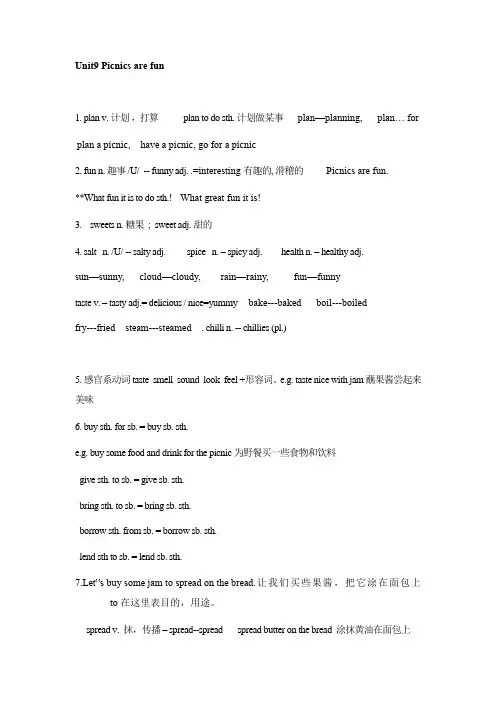
Unit9 Picnics are fun1. plan v. 计划,打算plan to do sth. 计划做某事plan—planning, plan… for plan a picnic, have a picnic, go for a picnic2. fun n. 趣事 /U/ -- funny adj. .=interesting有趣的, 滑稽的Picnics are fun.**What fun it is to do sth.! What great fun it is!3. sweets n. 糖果 ; sweet adj. 甜的4. salt n. /U/ -- salty adj. spice n. – spicy adj. health n. – healthy adj. sun—sunny, cloud—cloudy, rain—rainy, fun—funnytaste v. – tasty adj.= delicious / nice=yummy bake---baked boil---boiledfry---fried steam---steamed . chilli n. -- chillies (pl.)5. 感官系动词taste smell sound look feel +形容词。
e.g. taste nice with jam 蘸果酱尝起来美味6. buy sth. for sb. = buy sb. sth.e.g. buy some food and drink for the picnic为野餐买一些食物和饮料give sth. to sb. = give sb. sth.bring sth. to sb. = bring sb. sth.borrow sth. from sb. = borrow sb. sth.lend sth to sb. = lend sb. sth.7.Let‟s buy some jam to spread on the bread.让我们买些果酱,把它涂在面包上to在这里表目的,用途。
牛津英语上海版六年级6A Unit 9教案设计(4课时)
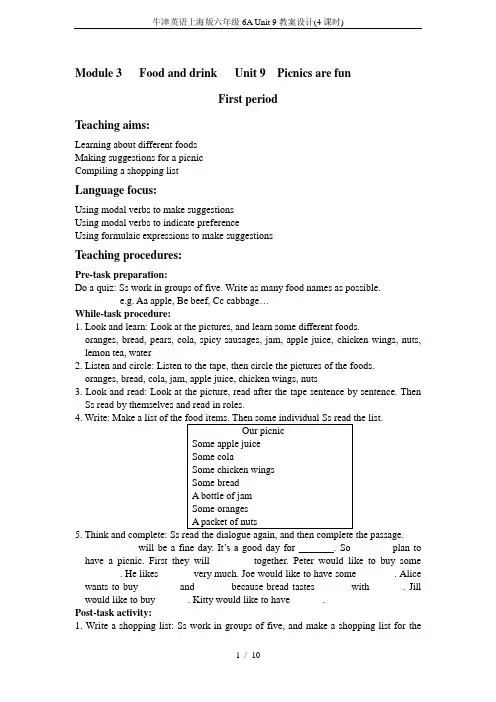
Module 3 Food and drink Unit 9 Picnics are funFirst periodTeaching aims:Learning about different foodsMaking suggestions for a picnicCompiling a shopping listLanguage focus:Using modal verbs to make suggestionsUsing modal verbs to indicate preferenceUsing formulaic expressions to make suggestionsTeaching procedures:Pre-task preparation:Do a quiz: Ss work in groups of five. Write as many food names as possible.e.g. Aa apple, Be beef, Cc cabbage…While-task procedure:1. Look and learn: Look at the pictures, and learn some different foods.oranges, bread, pears, cola, spicy sausages, jam, apple juice, chicken wings, nuts, lemon tea, water2. Listen and circle: Listen to the tape, then circle the pictures of the foods. oranges, bread, cola, jam, apple juice, chicken wings, nuts3. Look and read: Look at the picture, read after the tape sentence by sentence. Then Ss read by themselves and read in roles.______ will be a fine day. It’s a good day for _______. So _______ plan to have a picnic. First they will _______ together. Peter would like to buy some _______. He likes ______ very much. Joe would like to have some _______. Alice wants to buy _______ and ______ because bread tastes ______ with ______. Jill would like to buy ______. Kitty would like to have ______.Post-task activity:1. Write a shopping list: Ss work in groups of five, and make a shopping list for thecoming picnic.2. Act it out: Ss talk in groups of five and make a short dialogue about the picnic. Then act it out.You can use these sentences:•Shall we buy some …?•Let’s buy some …•I’d like to have …•I’d like to buy …•… tastes nice with …Optional activity:1. Make a food dictionary:Ss work in groups, make some cards with food names starting with different letters. Then put all these cards in alphabetical order and make a food dictionary.e.g. apple, banana, carrot, …, peach, …, watermelon, …2. Plan a barbecue: Work in groups of five and make a plan and a shopping list. Suppose you are going to have a barbecue at Shanghai Forest Park this Saturday. What will you buy?Consolidation1. Workbook 6A, page 552. Read and recite P.62Second periodTeaching aims:Learning adjectives to describe tasteMaking suggestions for a picnicGiving reasons for choicesLanguage focus:Using formulaic expressions to make suggestionsUsing modal verbs to make suggestionsUsing adjectives to describe tasteAsking Wh-questions to find out the reasonUsing connectives to give a reasonTeaching procedures:Pre-task preparation:Odd one out: Ss look at the slide and odd out the different one from each group.Group 1 oranges pears strawberries lemon tea (lemon tea)Group 2 nuts biscuits cakes bread (nuts)Group 3 cola lemon tea apple juice chicken wings (chicken wings) Group 4 prawns fish chicken crabs (chicken)Group 5 milk ice cream fish balls frozen vegetables (milk) While-task procedure:1. Look and learn:a. Look at the fruits, odd out the different one. Learn adjectives: sweet, sour.b. Read different foods and learn adjectives to describe taste: cakes, sweet, nuts, salty, chillies, spicy, lemons, sour.2. Look and say:a. Look at the pictures, T invites some Ss to read the model dialogues first, then thewhole class read together:1) S1: Do you like vegetable salad?S2: Yes. I like vegetable salad.S1: Why?S2: I like vegetable salad because it is tasty. It’s sour, salty and sweet.2) S1: Do you like vegetable salad?S2: No. I don’t like vegetable salad.S1: Why not?S2: I don’t like vegetable salad because it is too salty.b. Practise the dialogues: Ss work in pairs, and then make dialogues about fourfoods according to the model.Look at the picture, answer the question: How does coffee taste? Learn the adjective: bitter. Then think and answer the other question: Why do we add sugar to coffee? Try to get the answer: To make it sweet.4. Look and read: Look at the pictures, read after the tape sentence by sentence. Then Ss read by themselves and T invites some Ss to read in roles.5. Read and answer: Answer some questions according to the text.•What kind of juice are they going to buy? Apple juice or orange juice?•Why does Peter like apple juice?•What kind of fruit are they going to buy?•Why does Jill like oranges?•Does Joe like eating spicy sausages? Why or why not?•What does Joe think of chicken wings?Post-task activity:1. Act it out: Ss work in pairs and role-play the text.2. Look, read and write: Look at the pictures, fill in the blanks to complete the dialogues, then read them.3. Do a survey: Ss work in groups of five and survey group members what kind of meat / fruit/ drink/ vegetables/ seafood they would like to eat and why they like1. Find out: Ss can walk round the classroom. Try to find what flavour the people indifferent places have. E.g.: Cantonese (sweet), Shanghainese (sweet and salty), Sichuanese (spicy)2. Make comments:Ss look back at the survey form. Use the cues in the box to make comments on group members’ favourite food. Then T invites some Ss.You can use these sentences:•It’s good for ___’s health.•It’s bad for ___’s health.•It’s too sweet.•It’s too sour.•It tastes bitter.•It is tasty/ terrible.Example: Joe likes chicken, cabbage, kiwi, cola and squid best. Chicken is salty and tasty. But too much is bad for our health. Cola is sweet but I think it’s too sweet. Kiwi is sour and sweet. I also like it very much. It’s good for our health …Consolidation1. Workbook 6A, page 572. Read and recite P.63Third periodTeaching aims:Reading a poem about suggestions for a picnicMaking suggestions for a picnicCompiling a shopping listGiving reasons for choicesLanguage focus:Using modal verbs to make suggestionsUsing adjectives to describe tasteAsking Wh-questions to find out a reasonAsking Wh-questions to find out specific informationTeaching procedures:Pre-task preparation:Look and think: Ss look at the pictures and think what they are probably doing. Try to get the answer: They are having a picnic.While-task procedure:1. Read a poem: Play the cassette of the poem, Ss listen and repeat sentence by sentence. Then T invites individual Ss to read a verse each.according to each poem.1) Shall we have a picnic?Shall we have some bread?Let’s buy some bacon to make some sandwiches.Shall we have a picnic?Shall we have some cakes?Let’s buy some butter to put on the cakes.Shall we have a picnic?Picnics are nice.Let’s buy some soft drinks and a big packet of nuts.2) Shall we have a birthday party for Mum?Shall we have a birthday cake?Let’s buy some candles to put on the cake.Shall we have a birthday party?Shall we have some noodles?Let’s buy some sausages to put on the noodles.Shall we have a birthday party?Birthday parties are wonderful.Let’s buy some sweets and a big bag of fruit.3) Shall we have a barbecue?Shall we have some chicken wings?Let’s buy some honey to make the chicken wings nicer.Shall we have a barbecue?Shall we have some potatoes?Let’s buy some tomato sauce to make the potato nicer.Shall we have a barbecue?Barbecues are fun.Let’s buy some cola and a big bag of ice!4. Look, speak and write:a. Ss work in groups of three, make a dialogue to find out what food and drink theyand their classmates like/ dislike. And complete the shopping list.b. T asks groups to say a dialogue and invites individual Ss to read their shoppinglists.Post-task activity:1. Read and learn: Ss look at the slide, read the sentences from the poem to learn “... to do sth.”e.g. Let’s buy some jam to spread on the bread.Let’s buy some jam.We can spread the jam on the bread.Then rewrite some sentences and read together.2. Write a poem: Re-read the poem on page 64. Write a similar one with other food names. Then T invites some Ss to read their poems in class.Optional activity:Write: Suppose your mother’s birthday is coming. You are going to have a birthday party for her. Write 6 to 8 sentences about the preparation.Consolidation1. Workbook 6A, page 562. Read and recite the poemFourth periodTeaching aims:Reading about pricesCompiling shopping lists with quantities and pricesLanguage focus:Asking How questions to find out quantitiesTeaching procedures:Pre-task preparation:1. Think and say: Ss look at the pictures, answer the question: What do we need to have a picnic? (We need a good day / a nice place / some food / some plates and cups / enough money.)2. Discuss and say: Ss have a discuss and answer following questions:• What kind of weather is good for a picnic?• Where can you have a picnic?• What would you like to have at the picnic? Why?• What wouldn’t you like to have at the picnic? Why not?• How much money do you need for your picnic?• Who will give you the money for the picnic?While-task procedure:1. Look and talk: Look at the pictures, T invites some Ss to read the model dialogues first, then the whole class read together:1) S1: How much are the chicken wings?S2: They are fifteen yuan.2) S1: How much does a packet of chicken wings cost?S2: A packet of chicken wings costs fifteen yuan.Practise the dialogues: Ss work in pairs, and then make dialogues according to theSs read by themselves and T invites some Ss to read in roles.3. Answer questions: Look at the picture and questions, then answer them.∝ How much do these food items cost?They cost __________ yuan.∝ How much money have they got?They have got _________ yuan.∝ Have they got enough money?∝ How much money do they need from Mr Li?They need _________ yuan from Mr Li.Post-task activity:1. Choose and write: Ss work in groups, look at the picture and choose five items they want to buy with ¥80 for a picnic. And complete the table.2. Read and write: Ss read a short passage, then fill in the blanks.Paul’s family are going to have a _______ in Century Park this weekend. ¥ Total: ¥ ¥¥ ¥ ¥ Price Item_________ is Paul’s favourite because it’s a little ________ and ________.His father likes bacon best. His mother is going to buy some _________ and ________. She thinks they are ________ for our health.Optional activity:1.Listen and write: Look at the menu and listen to five short conversations. AfterM: I’d like a b aked potato, a steak and a corn soup.W: W ould you like something to drink?M: N o, thank you. (¥ 43)2) W: Are you ready to order?M: Y es, I’ll have the fried fish, please.W: W ould you like anything else?M: I ced tea, please. (¥ 28)3) W: May I take your order?M: I’d like a steak and a chicken salad, please.W: W ould you like some dessert?M: Y es, I’ll have the apple pie.(¥ 40)4) W: Are you ready to order?M: Y es, I’ll have the chicken wings and a steak. I also want a seafood soup.W: W ould you like anything to drink?M: A hot coffee, please. (¥ 56)5) W: May I take your order?M: W hat’s your special today?W: W e have very good steak. It’s very delicious. Would you like to try it?M: O K, I’ll have the steak and I also want a green salad.W: W ould you like anything to drink?M: Y es, orange juice, please. (¥ 45)2. Look and act: Ss read the menu again and role-play the waiter/waitress and the customer. The waiter/waitress should tell the total price at the end of each conversation.You can use these sentences:•May I take your order?•Are you ready to order now?•What’s special for today?•That’s … yuan in all.Then T invites some Ss to act it out.Consolidation1. Workbook 6A, page 602. Read and recite P.65Fifth periodTeaching aims:Giving reasons for choicesWriting reasons for likes and dislikesLanguage focus:Using modal verbs to ask permissionAsking Wh-questions to find out specific informationUsing connectives to give reasonsUsing formulaic expressions to decline an offerTeaching procedures:Pre-task preparation:1. Look and say: Ss read the model patterns first.Then practise in pairs according to the pictures. T invites some pairs.Model: 1) S1: Would you like some nuts?S2: Yes, please.S1: Why do you like to have nuts?S2: Because they are tasty.2) S1: Would you like some chocolate?S2: No, thanks.S1: Why not?S2: Because it’s too sweet.2. Think and act: Ss look at the seven slides, practise the sentence pattern “Would you like…?”While-task procedure:1. Look and say: Look at the pictures, and practise the dialogue.S1: May I have some cola?S2: OK. Here you are.S1: May I have prawns?S2: Sorry, I haven’t got any.2. Act out: Ss work in pairs, make dialogues according to the pictures.3. Listen and say: Listen to the tape, and then read sentence by sentence. Then Ss read by themselves and read in roles.4. Act out the story: With a classmate, choose different food or drink. And act out the1. Read and answer: Ss read one text, then answer questions.Mandy: Today is a good day for our barbecue.Judy: Yes! It’s hot and sunny. There’s no rain and there’s no wind.Kally: This is a good place.Eddie: Let’s make a fire.Danny: It smells good!Eddie: Our meat will be ready soon.Peter: May I have some corn, please?Judy: OK. Here you are. Why do you like corn?Peter: I like it because it’s delicious.Mandy: Would you like some orange juice?Peter: No, thanks. I don’t want any orange juice.Mandy: Why not?Peter: It’s sour.Mandy: I like orange juice. I think it’s sweet.Questions:•What are the children doing?•What’s the weather like today?•What do they do first?•What are Danny and Eddie talking about?•What does Peter want to eat?•Why does he like it?•Does Peter like orange juice? Why or why not?•What does Mandy think of orange juice?2. Write: Ss think and write 6 to 8 sentences on the topic “_______ is/are fun”. Y ou may choose…–Barbecues are fun.–Picnics are fun.–Food festivals are fun.–Our school life is fun.–…Consolidation1. Workbook 6A, page 59 and 612. Read and recite P.66。
上海牛津英语6AUnit9P66教案通用
上海牛津英语6AUnit9 P66教案通用一、教学内容本节课选自上海牛津英语6A教材,具体内容为Unit 9 “The seasons”中的P66。
详细内容包括了对四季变化及特点的描述,重点词汇包括spring, summer, autumn, winter, warm, hot, cool, cold 等,以及相关句型如“Which season do you like best?”和“I likebecause”。
二、教学目标1. 学生能够理解并描述四季的特点及其变化。
2. 学生能够运用目标词汇和句型进行交流,表达个人喜好。
3. 学生能够通过观察和思考,培养对自然环境的关注和热爱。
三、教学难点与重点教学难点:正确运用目标词汇和句型进行交流。
教学重点:掌握四季的特点及其相关词汇。
四、教具与学具准备1. 教具:多媒体课件、四季图片、单词卡片。
2. 学具:学生用书、练习册、笔、纸。
五、教学过程1. 导入:通过展示四季变化的视频,引发学生对本课主题的兴趣。
2. 新课内容呈现:讲解四季的特点,呈现并学习相关词汇和句型。
3. 实践情景引入:分组讨论,让学生用目标句型表达自己最喜欢的季节及原因。
4. 例题讲解:结合教材P66,讲解如何使用目标词汇和句型进行对话。
5. 随堂练习:让学生模仿例题,进行角色扮演,练习对话。
六、板书设计1. 四季词汇:spring, summer, autumn, winter2. 季节特点:warm, hot, cool, cold3. 目标句型:Which season do you like best? I likebecause七、作业设计1. 作业题目:根据所学的词汇和句型,编写一段对话,讨论四季的喜好。
2. 答案示例:A: Which season do you like best?B: I like summer because it's hot and I can go swimming.八、课后反思及拓展延伸1. 反思:关注学生对四季词汇和句型的掌握程度,及时调整教学方法。
上海牛津版英语六年级上册六上6AUnit9U9同步讲义教案

学员编号:年级:课时数:学员姓名:辅导科目:英语学科教师:授课类型TUnit9(牛津6上)基础知识梳理教学目标使学生能够基本掌握牛津6年级上册Unit9中的基础词汇及重要句型星级★★★★授课日期及时段T同步-U9基础知识梳理(建议2-5分钟)father mother grandfathergrandmother sondaughter批注:上面一幅图片是一家的幸福的在野餐的照片,要求学生快速的针对图片中的人物,对第一单元表示人称的family tree进行快速的复习,然后由学生和教师共同欣赏图片,分析图片中的一家人在做什么,引出今天的主题Picnics are fun(建议20-25分钟)一、词汇与词组Words and words phrases1. 1. 1. fun n.eg. They had lots of fun at the park today. 他们今天在游乐场玩的很高兴。
Reading is fun. 读书是一大乐趣。
【记忆连接】funny adj. 有趣的、可笑的e.g. Tom told a funny story just now. 刚才汤姆讲了一个很有趣的故事。
That's the funniest thing I have ever heard. 这是听到最可笑的事了。
【常见词组】just for fun 取乐,当笑话Make fun of sb/S th 嘲笑某人/某事;拿某人/某事取乐have fun 玩得愉快,相当于have a good lime 和enjoy oneself。
for fun 当做玩笑good fun 有趣的人/事物great fun 有趣的人/事物What fun! 多么有趣!2. 2. 2. nut n.坚果e.g. May I have some nuts? 我可以吃一些坚果吗?The chocolate with nuts is very delicious.果仁巧克力非常好吃。
2024年上海牛津英语6AUnit9P66教案通用
2024年上海牛津英语6AUnit9 P66教案通用一、教学内容二、教学目标1. 能够听懂、会说、会读、会写与未来科技相关的词汇及短语。
2. 能够运用现在进行时态描述未来正在进行的动作。
3. 能够通过小组合作,运用目标词汇进行情景对话,讨论未来生活。
三、教学难点与重点1. 教学难点:现在进行时态的运用,词汇的拼写与用法。
2. 教学重点:学会使用目标词汇进行情景对话,描述未来生活。
四、教具与学具准备1. 教具:PPT,单词卡片,录音机,教材。
2. 学具:练习本,彩笔,词汇表。
五、教学过程1. 导入:通过展示一幅未来城市的图片,引发学生对未来生活的思考,导入新课。
2. 新课内容:学习词汇,讲解语法,进行情景对话。
a. 学习词汇:教师展示单词卡片,引导学生学习新词汇,并进行小组竞赛。
b. 讲解语法:通过例句,解释现在进行时态的用法,并进行练习。
c. 情景对话:播放教材录音,学生跟读,并进行角色扮演。
3. 随堂练习:分组进行词汇填空,句子翻译,巩固所学知识。
4. 小组活动:学生分组,根据所给情景,运用目标词汇进行讨论,描述未来生活。
六、板书设计1. In the future2. 词汇:robot, spaceship, virtual reality, etc.3. 语法:Nowadays, we often use “be + V. ing” todescribe actions happening in the future.4. 对话:Example dialogue using the target vocabulary.七、作业设计1. 作业题目:Write a short passage about your future life, using the target vocabulary and grammar.2. 答案:My future life will be full of advanced technology. In the year 2030, I will live in a smart home controlled a robot. I will travel to other planets in a spaceship and experience virtual reality in my free time.八、课后反思及拓展延伸1. 课后反思:关注学生在课堂上的参与度,及时调整教学方法,提高教学效果。
牛津上海版六上Unit9Picnicsarefunword教案
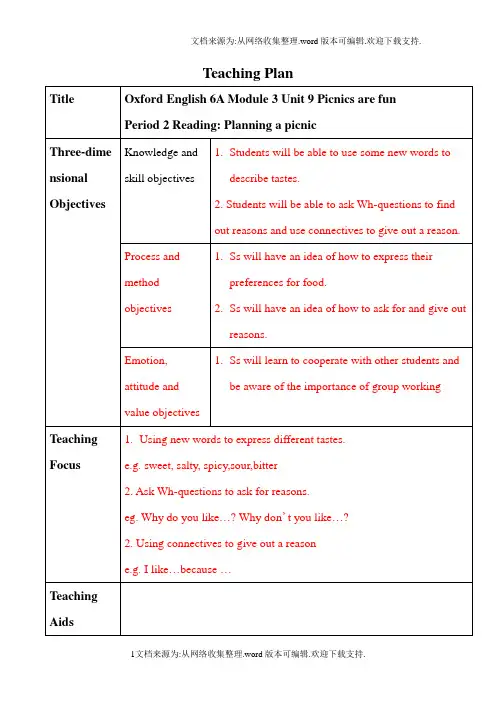
2. Students will be ableto ask Wh-questions to find out reasons and use connectives to give out a reason.
Read together
Finish a chant byusing the new words
Ss choose the food , fill in the blanks and make their own chants.
Ss listen and fill in the blanks.
通过对话来报出答案
3.Ask the Ss to finish a chant by filling in blanks.
4.Show morepicnics of food and drink, ask the students to work in groups of 5 to make their own chants as a competition.
e.g.Ilike…use…
TeachingAids
Steps
Teacher’s activities
Students’ activities
Purposes
Pre-task preparation
While-task procedure
Post-task activities
Assignmen-ts
Ss talk about what food and drink they’d like to buy from the market for the picnic and why they’d like them.
上海牛津英语6AUnit9P66教案通用
上海牛津英语6AUnit9 P66教案通用一、教学内容本节课选自上海牛津英语6A教材,第九单元P66页。
详细内容包括:继续学习一般现在时态,掌握频率副词的使用;学习描述日常习惯和动作的词汇,如“always, usually, often, sometimes, never”等;通过阅读小故事,了解并运用目标词汇和句型。
二、教学目标1. 能够理解并运用频率副词描述日常习惯和动作。
2. 能够在一般现在时态的语境中,运用目标词汇进行交流。
三、教学难点与重点1. 教学难点:频率副词的运用,一般现在时态句子结构。
2. 教学重点:掌握频率副词,如“always, usually, often, sometimes, never”等;熟练运用一般现在时态描述日常习惯和动作。
四、教具与学具准备1. 教师准备:教材、PPT、黑板、卡片等。
2. 学生准备:教材、练习本、彩笔等。
五、教学过程1. 实践情景引入(5分钟)教师展示一幅日常生活场景的图片,引导学生观察并描述图片中人物的日常习惯。
学生运用目标词汇进行描述,教师给予反馈。
2. 例题讲解(10分钟)教师通过PPT展示例题,引导学生分析句子结构和频率副词的使用。
教师讲解并示范解题过程,强调一般现在时态的用法。
3. 随堂练习(10分钟)学生根据教材P66页的练习题,进行随堂练习。
教师巡回指导,解答学生疑问。
4. 小组活动(15分钟)学生分组,运用目标词汇和一般现在时态进行交流,描述组内成员的日常习惯。
教师参与讨论,给予建议和指导。
学生分享学习心得,提出疑问。
六、板书设计1. Unit 9 Describe your daily routines2. 内容:Frequency adverbs: always, usually, often, sometimes, neverSentence structure: Subject + verb (s/es) + object七、作业设计1. 作业题目:描述你的日常习惯和动作,至少使用5个频率副词。
牛津沪教版六年级上6AUnit9复习教案
Unit9 Picnics are fun同步教案Ⅰ. Important words and phrases:Words:1. fun n. (不可数) 有趣的事Reading is fun. 读书是一大乐趣。
funny adj. 有趣的,可笑的Tom told a funny story just now. 刚才汤姆讲了一个有趣的故事。
just for fun 取乐,当笑话make fun of sb./ sth. 嘲笑某人/某事;拿某人/某事取笑have fun 玩的愉快(相当于have a good time/enjoy oneself)for fun 当做玩笑good/great fun 有趣的人/物2. spicy adj. 辛辣的My mother doesn’t like spicy food. 我妈妈不喜欢辛辣的食物。
spice n. 香料chilli n. 辣椒(复数chillies)3. shall model v. 表示提出或征求意见What shall we do this evening? 今天晚上我们做什么?祈使句中表建议Let's..., shall we...?【辨析】Let us…, will you?【复习】我们去公园吧(六种表达法)① Let's go to the park = shall we go to the park?② How about going to the park?=What about going to the park?③ Why don't you go to the park?=Why not go to the park?4. salty adj. 咸的Why is the soup so salty? 为什么这汤这么咸?salt n. 盐You put too much salt in the soup. 你往汤里放了太多盐。
上海牛津英语6AUnit9P66教案通用
上海牛津英语6AUnit9 P66教案通用一、教学内容本节课选自上海牛津英语6A教材,涉及Unit 9的P66页。
详细内容包括:词汇学习(如:transport, vehicle, convenient,traffic等),语法讲解(一般现在时的使用),以及与交通方式相关的阅读理解。
二、教学目标1. 学生能够掌握与交通方式相关的词汇,并能在实际语境中正确运用。
2. 学生能够理解并运用一般现在时描述交通工具的使用。
3. 学生能够通过阅读理解,了解不同交通方式的优势和特点。
三、教学难点与重点教学难点:一般现在时的运用,词汇的准确记忆与运用。
教学重点:交通工具的词汇学习,阅读理解的技巧。
四、教具与学具准备1. 教具:PPT,黑板,交通工具图片,教学录音机。
2. 学具:英语课本,练习本,词汇卡片。
五、教学过程1. 导入:通过展示不同交通工具的图片,引导学生用英语描述,激发学生兴趣。
2. 新课内容:讲解Unit 9 P66的词汇,语法,并进行例句演示。
3. 例题讲解:结合一般现在时,讲解交通工具的使用,让学生通过例题进行实际操作。
4. 随堂练习:分组进行角色扮演,用英语描述不同交通方式的优缺点。
六、板书设计1. 交通工具词汇:bus, train, plane, car, bicycle, underground, boat, ship2. 一般现在时:主语 + 动词原形(第三人称单数主语 + 动词三单形式)3. 例句展示:The bus is convenient for me. / He oftengoes to school bike.七、作业设计1. 作业题目:(1)用一般现在时描述你最喜欢的交通工具。
(2)阅读短文,回答问题:Which transport is the most environmentally friendly? Why?2. 答案:(1)I like the subway because it is fast and convenient.(2)The bicycle is the most environmentally friendly transport because it doesn't produce any pollution.八、课后反思及拓展延伸本节课通过实践情景引入,让学生在实际语境中学习交通工具的词汇和一般现在时的运用。
上海牛津英语6AUnit9P66教案通用
上海牛津英语6AUnit9 P66教案通用一、教学内容本节课我们将学习上海牛津英语6A教材第9单元的第66页内容。
具体内容包括:词汇学习,如“pollution”、“waste”等与环保相关的词汇;语法点,一般现在时的使用;以及通过阅读理解,提高学生对环境保护的认识。
二、教学目标1. 让学生掌握与环保相关的词汇和表达方式,如“reduce pollution”、“save energy”等。
2. 培养学生运用一般现在时描述环境问题的能力。
3. 提高学生的阅读理解能力,使其能够通过阅读文章了解环境保护的重要性。
三、教学难点与重点教学难点:一般现在时的运用,以及环保词汇的掌握。
教学重点:阅读理解能力的培养,以及环保意识的提高。
四、教具与学具准备1. 教师准备:PPT展示、阅读文章、词汇卡片。
2. 学生准备:笔记本、教材、词典。
五、教学过程1. 导入:通过展示污染严重的环境图片,引发学生对环境保护的关注。
2. 新课内容介绍:学习环保词汇和一般现在时的用法。
污染和节约能源。
4. 例题讲解:讲解一般现在时的用法,并通过例句展示。
5. 随堂练习:让学生运用所学的词汇和语法进行句子练习。
6. 阅读理解:阅读文章,了解环保的重要性,并回答相关问题。
六、板书设计1. 环保词汇:pollution、waste、reduce、save、energy等。
2. 语法点:一般现在时的句子结构。
3. 阅读理解文章框架。
七、作业设计1. 作业题目:请运用所学的环保词汇和一般现在时,写一段关于保护环境的建议。
答案示例:We should reduce pollution using public transportation more often. It helps to save energy andimprove the air quality.2. 作业题目:阅读一篇关于环保的文章,回答相关问题。
八、课后反思及拓展延伸1. 教师反思:关注学生对词汇和语法的掌握情况,调整教学方法,提高课堂效果。