
人教PEP版小学英语五年级下册 Unit 5 第二课时 教学设计
Unit 5 第二课时课时内容A Let’s learn Look, say and complete课时分析本课时是人教版五年级下册第五单元第二课时。
围绕“Dog Show”这一话题展开,主要通过对话学习词汇mine, yours, his, hers, theirs, ours,培养学生爱护动物的意识。
第一课时为本课时打下了一定的基础,本课时的重点是四会单词的掌握以及灵活运用。
本课时包括Let’s learn 和Look, say and complete两个板块。
Let’s learn通过呈现Zoom 和Zip谈论报刊墙展出的Dog Show的场景,体现了单词的词形和意义。
此版块设计的学生们比较感兴趣的动物的话题,非常符合学生的心理,贴近学生的生活,更能激发学生学习的兴趣。
Look, say and complete版块是一个综合性的语用活动,通过这个活动操练A 部分Let’s learn所学的词汇和句型,做到学以致用。
本课时虽然是新授课,但是四会单词mine, his, yours, ours在第一课时已经接触过,所以在设计教学过程时,遵循以学生为主体的原则,采用听、说、读、写、玩等多种方法调动全体学生的积极参与。
通过任务型教学法、合作探究教学法等引导学生自主学习。
课时目标(1)能够听、说、读、写单词:mine, yours, his, hers, theirs, ours。
(2)能够在语境中正确运用这六个单词。
(3)能够对物主代词进行总结归纳。
(4)培养学生爱护动物的意识。
课时重难点1.重点(1)能够听、说、读、写单词:mine, yours, his, hers, theirs, ours。
(2)能够在语境中正确运用这六个单词。
(3)能够引导学生对物主代词进行总结归纳。
2.难点(1)能够在语境中正确运用mine, yours, his, hers, theirs, ours这六个单词。
(2)物主代词的归纳。
教学准备多媒体课件、录音机、磁带教学过程Step 1 Warm up1. GreetingT: Good morning, everyone.Ss: Good morning, teacher.T: How are you today?Ss: I’m fine, thank you. And yo u?T: Very well, thanks. Are you ready for English class?Ss: Yes.2.Ask and answerT: Whose English book is this?S1: It’s ...’s.T: Yes, it’s his.S1: Whose ... is this?T: It’s...’s.S1: Yes, it’s hers....(利用学生手里的物品,进行问答练习。
)教学资源:学习物品设计意图:问答操练复习了上节课的词汇和句型,为学习新知做好铺垫。
Step 2 Lead inT: Boys and girls, do you like animals?Ss: Yes.T: Which animal do you like best?S1: I like... best....S4: I like dogs best.T: Why do you like dogs?S4: They are cute /...设计意图:通过和学生们谈论熟悉的动物,既拉近与学生之间的距离,又很自然的引出正文。
Step 3 Presentation1.课件呈现Zoom 和Zip在观看赛狗大会的场景T: Look at the picture. This is a Dog Show. There are kinds of dogs on show. Zoom and Zip are at the dog show. Whose dogs are on show? Let’s have a look.设计意图:出示图片,将学生带入情境,然后整体感知。
2. Teaching the new words “his, hers, yours, mine, ours, theirs”.(1) Teaching “his, hers”a.呈现Mike的图片T: Look at picture 1. Whose dog is that?S1: It’s Mike’s.T: Yes. That is his dog. The dog is his.(板书his dog—his,领读,指名读,齐读。
用红色标注his。
)His dog is big.b. 呈现陈杰的图片T: Look at picture 2. Is that Chen Jie’s dog?S1: Yes. It’s her dog.T: We can say another way “The dog is hers.”(板书her dog—hers, 领读,跟读,指名读,齐读。
用红色标注结尾的s。
)Her dog is cute.(2) Teaching “yours, mine”a. T: Now let’s have a look at Zoom’s and Zip’s dog. How do you like Zoom’s dog?S1: It’s big/cute...T: How do you like Zip’s dog?S2: It’s ...b. Listen to the tape and follow the tape.c. Act Zoom and Zip.学生表演,教师板书your dog—yours,领读,跟读,齐读,用红色标注结尾的s。
d. T: Now I’m Zip. Who wants to be Zoom?(请一名学生与教师对话。
)示例:Zip: Is this your dog?Zoom: Yes, it’s my dog. The dog is mine.Zip: It’s so cute.Zoom: Thank you.e.学生两人一组模仿示例练习。
(教师板书my dog—mine, 指名读,齐读,联系单词nine, 记住音、形。
)(3) Teaching “theirs, ours”a. 呈现两人与狗在一起的图片。
T: Look at the picture They are introducing their dog. Let’s listen.b. 播放录音,学生跟读。
It’s our dog. The dog is ours.(板书our dog—ours,带读,指名读,用红色标注结尾的s。
)c. T: Yes, it’ s their dog. The dog is...Ss: Theirs.(板书their dog—theirs,带读,指名读,齐读,拼读,用红色标注结尾的s,强调同音词there。
)(4)听录音,跟读录音。
his dog—his her dog—hersmy dog—mine your dog—yoursour dog—ours their dog—theirs(5)小组认读,然后讨论名词性物主代词和形容词性物主代词的用法,教师适时补充。
名词性物主代词=形容词性物主代词+名词教学资源:课件、录音机、磁带设计意图:图文结合学习词汇,更好的帮助学生理解。
Step 4 Practice1.快速认读男女生比赛,快速抢读单词。
设计意图:比赛激起学生的兴趣,巩固单词的音义形。
Look, say and complete呈现表格,学生仿照例句写句子,然后问答操练。
参考句型:A: Whose... is that?B: It’s...’s ....A: The ... is hers/his/mine/yours/ours/theirs.设计意图:巩固本课的六个名词性物主代词,做到活学活用。
Step 5 SummaryT: What did you learn about this class?学生自由说,教师小结。
T:1. 学习了六个名词性物主代词:mine, yours, his, hers, theirs, ours2. 名词性物主代词=形容词性物主代词+名词设计意图:总结的环节帮助学生归纳知识点,有助于学生对知识的记忆。
课堂作业一、按要求写单词。
1. 2.名词性物主代词同音词3.4.1.This is _______ jacket.The jacket is _________.2.These are _______ books.The books are_______.3.Look! It isn ’t ________ picture. ________ is yellow.三、按要求完成句子。
1. It ’s Mike ’s book.(对画线部分提问。
) ________ ________ is this?2. This is their dog.(改同义句。
)This dog is ________.板书设计Unit 5 Whose dog is it?his dog — hisher dog — her smy dog —m ineyour dog —your sour dog —our stheir dog —their s形容词性物主代词+名词=名词性物主代词 名词所有格。
PEP小学英语五年级下册Unit 5 Read and write教学设计

PEP小学英语五年级下册Unit 5 Readand write教学设计Activity 2: Review the verbs we learned in the us unit by playing a game of charades。
One student acts out a verb while the others guess what it is.Step 2 n:(呈现)T: Today we are going to learn about different animal ns。
Let's look at some pictures and see if we can guess what the animals are doing.Show pictures of animals dancing。
eating。
running。
walking。
climbing。
flying。
and swimming)T: Can you tell me what the animals are doing in these pictures。
(Allow students to answer and encourage them to use the -ing form of the verb)T: Great job。
Now let's read a story about some animals at the zoo.Read the story aloud while showing the pictures on the PPT)Step 3 Practice:(练)Activity 1: Role-playT: Let's practice asking and answering ns about what we and the animals are doing。
人教版PEP小学英语五年级下册Unit 2教案

Unit2 My favourite season单元分析一、单元教学分析本单元学习的主题是描述最喜欢的季节并陈述原因。
在内容上和四年级下册第四单元有相似之处,描述天气情况的形容词,如:cool,cold,riny, windy,snowy,suny等单词皆已学过,因此教师在教学过程中可以以旧带新,降低学习难度,又做到滚动复习语言知识。
课本中的主情景图通过在美术教室,Amy,John,Zoom和zip的对话场景呈现了本单元要学习的部分核心词汇。
这既可以作为对B部分对话的后续复习,又可以用来导入 Lets learn部分的新词学习。
教学时,教师可以利用教材情境图和相关视频,帮助学生感知和理解语言运用的情境。
本单元的学习重点是问答某人最喜欢的季节并陈述原因,其内容与学生的生活实际、休闲活动联系紧密。
因此,课堂教学要从学生的生活实际出发,鼓励学生积极参与活动,真实地表达对季节的喜好及原因。
在对话和读写教学中,可以渗透以wh开头的疑问词的用法这一语法点,并且在单元总结中再一次强化这一知识点。
本单元将学习字母组合br和gr的发音规则,通过听音拼读、书写等活动培养学生的语音意识,帮助学生借助语音知识提升认读和识记单词的效果。
同时要求学生在单线上完成抄写句子的活动,做到书写规范。
C部分的 Story time综合呈现了本单元的主要词汇和句型,同时还渗透了白色圣诞节的习俗和南北半球气候存在差异的常识。
学生在完成阅读、理解故事的基础上,可以分小组对故事内容进行分角色模仿表演。
二、单元教学目标(一)知识与能力目标:1.句型目标:(1)能够听、说、读、写句型Which season do you like best? Winter. Why? Because I like summer vacation!(2)能够在情景中运用句型 Which season do you like best? Winter.Why? Because I like summer vacation!询问并回答对季节的喜好,并简单陈述喜欢某个季节的理由。
人教版pep五年级英语下册unit5教学设计
人教版pep五年级英语下册unit5教学设计全文共3篇示例,供读者参考篇1Unit 5 of the People's Education Press (PEP) Fifth Grade English textbook covers the topic of "What did you do on vacation?" This unit focuses on past tense verbs and the concept of recounting past events. In this teaching design, I will outline a nine-lesson plan to cover the content of Unit 5 in an engaging and effective manner.Lesson 1: Introduction to Past TenseObjective: Introduce the concept of past tense verbs.Activities: Present sentences in present and past tense, have students identify the differences.Lesson 2: Past Tense Verbs (Simple Past)Objective: Teach the simple past tense of regular verbs.Activities: Practice regular past tense verbs through exercises and games.Lesson 3: Past Tense Verbs (Irregular Verbs)Objective: Introduce irregular past tense verbs.Activities: Have students memorize common irregular verbs and use them in sentences.Lesson 4: Asking and Answering QuestionsObjective: Teach students to ask and answer questions about past events.Activities: Role-play conversations about vacation activities using question words.Lesson 5: Writing about VacationsObjective: Practice writing short paragraphs about past vacation experiences.Activities: Provide prompts for students to write about their own vacations.Lesson 6: What Did You Do on Vacation?Objective: Teach the structure of past tense questions.Activities: Have students ask and answer questions about their vacations in pairs.Lesson 7: Listening ComprehensionObjective: Practice listening for specific information.Activities: Play recordings of vacation stories and ask questions based on the content.Lesson 8: Vocabulary ReviewObjective: Review key vocabulary words from Unit 5.Activities: Play vocabulary games like charades or Pictionary to reinforce learning.Lesson 9: Unit TestObjective: Assess students' understanding of Unit 5 content.Activities: Administer a written test covering past tense verbs, question formation, and vocabulary.Overall, this nine-lesson plan aims to help students grasp the concept of past tense verbs and effectively communicate about their past experiences. By incorporating interactive activities and games, students will stay engaged and motivated throughout the unit. The activities are designed to cater to different learning styles and promote active participation in the classroom.篇2PEP (Primary English Program) is a teaching material issued by the People's Education Press in China. PEP English textbooks are widely used in primary schools across the country. In thislesson plan, I will focus on Unit 5 from the fifth grade of the PEP English textbook.Unit 5 is titled "What Does She Look Like?" and the main topic of the unit is describing people's physical appearances. This unit includes vocabulary related to physical appearance such as hair, eyes, nose, etc. It also covers grammar points such as the verb "to be" and adjectives.Here is a detailed breakdown of the lesson plan for Unit 5:1. Warm-up (10 minutes)Start the lesson by reviewing the vocabulary related to physical appearances. Use flashcards or pictures to help students remember the words. You can also ask students to describe their own physical appearances to practice the vocabulary.2. Presentation (15 minutes)Introduce the grammar point "to be" and adjectives to describe people. Show examples on the board and explain how to use them in sentences. Encourage students to create their own sentences using the grammar point.3. Practice (20 minutes)Divide the class into pairs or small groups and ask them to describe each other's physical appearances using the vocabulary and grammar they've learned. Monitor and provide feedback to each group.4. Listening (15 minutes)Play a recording of a dialogue where two people are describing a third person. Ask students to listen carefully and answer comprehension questions based on the dialogue. This will help them improve their listening skills.5. Speaking (15 minutes)Have students work in pairs and take turns describing a picture of a person to their partner. The partner must listen carefully and draw what they hear. This activity will test students' speaking and listening skills.6. Writing (15 minutes)Ask students to write a short paragraph describing a person's physical appearance. Encourage them to use the vocabulary and grammar they've learned in the unit. Review their writing and provide feedback on grammar and vocabulary usage.7. Review and Homework (10 minutes)Summarize the key points of the lesson and review the vocabulary and grammar covered in Unit 5. Assign homework for students to practice describing people's physical appearances.By following this lesson plan, students will be able to effectively describe people's physical appearances using the vocabulary and grammar they've learned in Unit 5 of the PEP English textbook. It's important to provide a variety of activities to engage students and help them practice their language skills. With the right guidance and support, students will be able to master the content of the unit and improve their English proficiency.篇3Unit 5 of the People's Education Press (PEP) Grade 5 English textbook focuses on the theme of "What Would You Like?" This unit covers vocabulary related to food and drinks, as well as phrases and sentences to express preferences. In this lesson plan, I will outline a series of activities and exercises to help students practice and engage with the material in a fun and interactive way.Lesson Objectives:1. To introduce and teach new vocabulary related to food and drinks.2. To practice using phrases and sentences to express preferences.3. To engage students in speaking and listening activities to reinforce new vocabulary and language structures.4. To promote group work and collaboration among students.Warm-up:To start the lesson, I would begin with a warm-up activity to introduce the theme of the unit. I would show pictures of various food and drink items and ask students to identify them. This will help activate prior knowledge and get students thinking about the topic of the lesson.Vocabulary Presentation:Next, I would introduce the new vocabulary related to food and drinks. I would use flashcards, realia, and other visual aids to help students understand and remember the words. I would also provide pronunciation practice to ensure students are comfortable using the new vocabulary.Practice Activities:After introducing the vocabulary, I would engage students in a series of practice activities to reinforce their understanding. This could include matching games, role-plays, and group discussions. For example, students could work in pairs to practice ordering food and drinks at a restaurant using the new vocabulary.Language Structures:In this section of the lesson, I would focus on teaching students phrases and sentences to express preferences. This could include sentences like "I would like a hamburger, please" or "I don't like broccoli." I would provide examples and opportunities for students to practice using these language structures in context.Speaking and Listening Activities:To promote speaking and listening skills, I would design activities where students can communicate with their peers using the new vocabulary and language structures. For example, students could participate in a role-play where they take on different roles in a restaurant setting and practice ordering food and drinks.Group Work:Finally, I would incorporate group work activities to encourage collaboration and teamwork. Students could work together to create a menu for a restaurant, with each group member contributing different food and drink items. This will allow students to practice using the new vocabulary in a creative and engaging way.Assessment:Throughout the lesson, I would assess students' understanding through observation, participation, and informal assessment tasks. At the end of the lesson, I would provide feedback to students on their progress and encourage them to continue practicing and using the new vocabulary and language structures outside of the classroom.By following this lesson plan, students will have the opportunity to engage with the material in a variety of ways and develop their language skills in a fun and interactive environment. This will help them build confidence in using English to express their preferences and communicate effectively in real-world situations.。
Unit5Whosedogisit?(单元解读)五年级英语下册(人教PEP版)
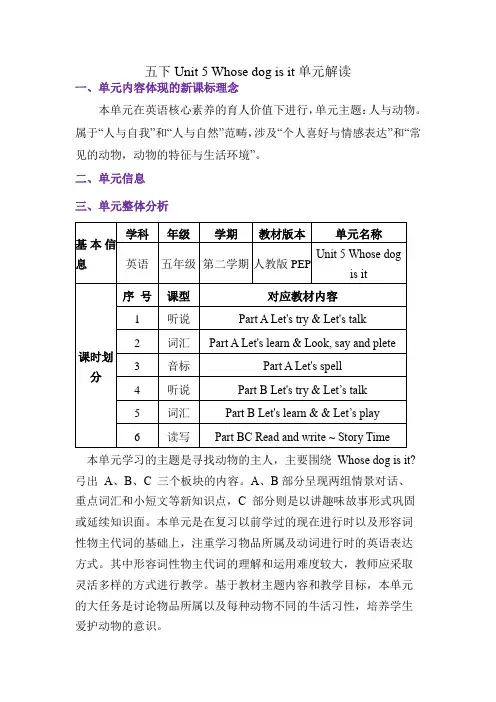
五下Unit 5 Whose dog is it单元解读一、单元内容体现的新课标理念本单元在英语核心素养的育人价值下进行,单元主题:人与动物。
属于“人与自我”和“人与自然”范畴,涉及“个人喜好与情感表达”和“常见的动物,动物的特征与生活环境”。
二、单元信息三、单元整体分析本单元学习的主题是寻找动物的主人,主要围绕Whose dog is it?弓出A、B、C 三个板块的内容。
A、B部分呈现两组情景对话、重点词汇和小短文等新知识点,C 部分则是以讲趣味故事形式巩固或延续知识面。
本单元是在复习以前学过的现在进行时以及形容词性物主代词的基础上,注重学习物品所属及动词进行时的英语表达方式。
其中形容词性物主代词的理解和运用难度较大,教师应采取灵活多样的方式进行教学。
基于教材主题内容和教学目标,本单元的大任务是讨论物品所属以及每种动物不同的牛活习性,培养学生爱护动物的意识。
单元话题内容设计了五个语篇,分别是两节对话词汇融合课,一节语音课,一节读写课和一节故事课,围绕单元子话题“感知动物的可爱”“树立爱护动物的意识”“人和动物和谐相处”展开,用所学语言询向物品的所属权,描述动物的动作,学会爱护动物、保护动物。
语篇一是小学生日常生活对话。
陈杰和Mike 在参观学校美术展时,看到了来目世界不同的几有标志性的景色,如上海的东方明珠、北京天安门等,学生通过美术展感受到了大自然的美。
Let’s learn 部分通过Zoom 和Zip 在谈论报利墙展出的Dog Show 的情景图呈现了核心词汇mine,his,hers,ours.theirs 的词形和意义,感知小动物的可爱。
语篇二是小学生日常对话。
Sam 去Chen Jie 家做客,遇到了Chen Jie 家的狗Fido,并询间Fido去了哪重,他喝水了吗? 表达Sam 对Fido 的关爱之情。
后面Sam 和Chen Jie 一起带着Fido 去公园遛狗,Fido 在公园里攀爬、喝水、吃东西,后面累了睡着了,同时公园里还有很多的兔子,她们在一起玩耍,跳跃、睡觉。
五年级英语下册pep教案

五年级英语下册pep教案【篇一:pep小学五年级下册英语科全册教案】目录unit1 this is my day........................................................unit2 my favourite season...........................................unit3 my birthday..........................................................recycle1...........................................................................unit4 what are you doing? .........................................unit5 look at the monkeys...........................................unit6 a field trip...........................................................recycle2.............................................................................unit 1 this is my day教学目标:1、能够使用频度副词问答作息时间,如:when doyou do morning exercises ? i usually do morning exercises at 8:30.2、能够使用频度副词问答周末活动,如: what do you do on the weekend ? i often go shopping .3、能够听说读写与日常作息有关的动词短语及介词短语,如:eat breakfast , do morning exercises , play sports , eat dinner , in the evening , at noon 等。
Unit2Myfavoriteseason(教学设计)人教PEP版英语五年级下册
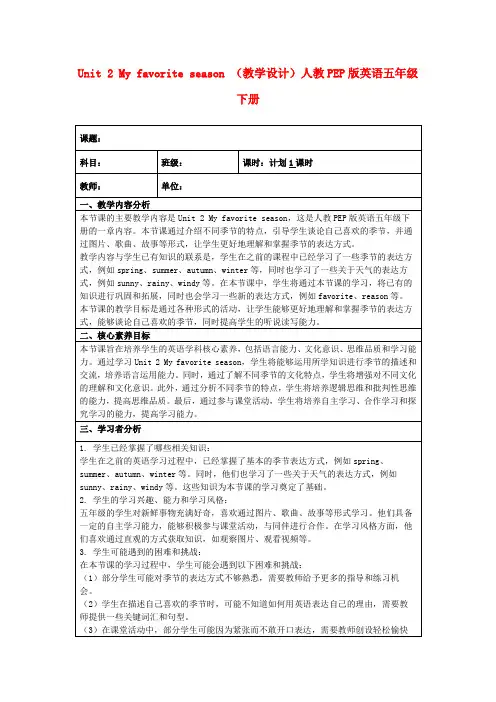
二、核心素养目标
本节课旨在培养学生的英语学科核心素养,包括语言能力、文化意识、思维品质和学习能力。通过学习Unit 2 My favorite season,学生将能够运用所学知识进行季节的描述和交流,培养语言运用能力。同时,通过了解不同季节的文化特点,学生将增强对不同文化的理解和文化意识。此外,通过分析不同季节的特点,学生将培养逻辑思维和批判性思维的能力,提高思维品质。最后,通过参与课堂活动,学生将培养自主学习、合作学习和探究学习的能力,提高学习能力。
2.季节的分类:季节可以分为春季、夏季、秋季和冬季。每个季节都有其独特的气候特征和活动。
3.季节的表达方式:季节的表达方式包括英文单词和中文翻译。例如,春季可以用spring表示,夏季可以用summer表示,秋季可以用autumn表示,冬季可以用winter表示。
4.季节的气候特征:每个季节都有其独特的气候特征。春季气候温和,夏季气候炎热,秋季气候凉爽,冬季气候寒冷。
五、总结回顾(用时5分钟)
内容:今天的学习,我们了解了季节的基本概念、重要性和应用。同时,我们也通过实践活动和小组讨论加深了对季节的理解。我希望大家能够掌握这些知识点,并在日常生活中灵活运用。最后,如果有任何疑问或不明白的地方,请随时向我提问。
六、知识点梳理
1.季节的基本概念:季节是自然界中按照地球自转和公转的规律,每年出现周期性变化的气候特征。
⑦ 季节的植物和动物:每个季节都有与之相关的植物和动物。春季有花朵盛开,夏季有昆虫出现,秋季有树叶变色,冬季有雪景和动物冬眠。
⑧ 描述自己喜欢的季节的方法:要描述自己喜欢的季节,我们可以从季节的气候特征、活动、节日、植物和动物等方面来进行描述。
最新人教PEP版 小学英语 五年级下册 Unit 5 第2课时 优质课教学设计
最新人教PEP版小学英语五年级下册优质课教学设计Unit 5第2课时A (Let's try & Let's talk)教学目标一、知识与技能1.能在语境中灵活应用名词性物主代词。
2.能运用句子“Whose is it?”或“Whose+名词(复数)are these?”来询问物品的所属情况。
3.完成相关练习。
二、过程与方法通过设计多种活动并创设真实的情景,调动学生的学习积极性,激发学生的学习兴趣,帮助学生完成任务。
三、情感、态度与价值观培养学生积极利用所学句型交流的能力。
教学重点能运用句子“Whose is it?”或“Whose+名词(复数)are these?”来询问物品的所属情况。
教学难点掌握whose所引导的两种句型。
教法导航在教学过程中要注重过程评价,促进学生发展,让学生在自主学习、合作学习、探究学习中逐渐形成学习英语的兴趣和爱好。
学法导航学生通过扮演角色,对所学知识进行操练。
在书写环节培养学生好的书写习惯。
教学准备玩具、学习用品、录音机及录音带。
教学过程1. Warm-up(热身及预习展示)(1)Sing the song My weekend.(2)活动:晒一晒,说一说。
活动方式:教师在讲台上晒出学生事先准备的玩具,如:泰迪熊、熊猫、汽车、自行车等,教师指着玩具逐一说:This is not mine.然后问:Whose is it? 玩具的主人听到后要立刻站起来说:It's mine.老师接着说:Oh,it’s yours.Here you are.然后全班同学指着主人说一说:It's his.或It's hers.说完,继续游戏。
2. Presentation and practice(精讲点拨)Let's try(1)教师播放Let's try部分的录音,学生完成听音打勾练习。
(2)教师再次播放Let's try部分的录音,然后问学生:Which is John's picture? 要求学生根据所听到的内容回答。
人教版PEP小学英语五年级下册Unit 5 教案
【标题】PEP 五下 Unit5 A Let’s talk【正文】一、教学内容【正文】二、教学目标(一)知识与技能:1.能够听懂、会说、会认读 Let's talk部分的名词性物主代词his,hers,mine和ours.2.能够理解并运用所学句型来谈论物品的归属。
如:Whose ___is it?It's____'s.It's hers/his/mine/ours或复数形式: Whose____are these? They're_____'s.They're hers /his/mine/ ours.3.能够在情境中合理并灵活运用所学知识,相互之间自如问答。
(二)过程与方法:能通过小组活动与探究,理解名词性物主代词的用法与规律。
并在小组活动中完成任务教学,提高学生的语言运用能力。
(三)情感态度与价值观:通过表达物主代词的概念,培养学生热爱周围物品与保管好自己物品的意识。
三、教学重点难点重点:能运用句型及名词性物主代词进行关于物品归属的话题交流。
难点:能初步了解形容词性物主代词和名词性物主代词的区别,并能正确使用,如:his hat=his;her shoes=hers等。
四、教学准备PPT、学习资源包、词条.学生已有知识储备:(PEP4 Unit5已学部分名词性物主代词)1.Are these yours? No,they aren't.2.Is this John's ? No,it isn't, it's Mike's.3.Whose coat is this? It's mine.4.Whose pants are those?They're your father's.五、教学过程Step1.Warm-up and Revision1.Enjoy a song:Whose hat is this?2.Let’s chant and sing.Whose hat is that? It’s my hat.His hat,her hat,your hat,my hat.Whose coat is that? It’s my coat.His coat,her coat,your coat,my coat. 设计意图:开篇用歌曲和chant,激发学生学习兴趣,同时,通过歌曲唤起学生已有的旧知,为本课要学习的内容做一个铺垫。
人教版五年级下册第五单元第二课时教学设计
人教版PEP小学英语5年级下册Unit5第二课时教学设计一、设计理念:在教学过程中能充分发挥学生的主体地位和教师指导作用。
以激发学生的学习兴趣和积极性为目的,让学生在玩中学、学中玩,寓教于乐。
让学生能把所学对话联系到实际,在真实的情景中使用英语。
二、学情分析:在第一课时的学习中,学生已经初步掌握了在情景中用现在进行时进行简单的表达,因此本课时的教学内容对于学生来说不会太难。
本节课通过以旧引新的方法来降低学生的学习难度。
三、教学内容:Part A Let’s talk Let’s try Let’s play四、教学目标:1、语言知识【词汇和句子】●复习5个现在分词:flying walking running jumping swimming●学习句型:What is she/it doing? She’s/It’s....2、语言技能学生能够听懂、会说“What is she/it doing? She’s/It’s.... 并能在真实的情境中运用。
3、学习策略通过结对练习、小组竞赛、游戏等活动帮助学生掌握本课知识点。
4、情感态度a)学生能对英语课堂活动感兴趣,积极参与各种活动。
b)培养学生热爱动物,热爱大自然的良好品质。
五、教学重难点分析:1、本课时的教学重点是掌握句型:What is she/it doing?She’s/It’s....2、本课时的教学难点是能够在实际情景中正确运用所学对话。
六、教学辅助手段:ppt课件、flash、卡片。
七、教学过程:Step 1: Warming up学生齐唱chant: Koalas are sleeping.【设计意图】:课前唱歌谣,活跃课堂气氛。
Step 2:Preview1、Sharp eyes(1)学生看ppt,大声读出单词。
(2)教师把单词强调的末尾部分颜色变浅,学生抢答。
【设计意图】:利用Powerpoint的动画功能,让单词一个接一个以一定的速度出现,要求学生迅速辨认并开口朗读。
人教版pep五年级下册英语全册教案教学设计
1全册教学计划本学期我将担任五年级下册的英语教学工作。
根据学生的实际情况,拟定以下教学计划。
指导思想全面贯彻“三个面向”战略指导思想,渗透和灌输可持续发展的战略思想。
以素质教育为根本宗旨,坚持以德育为首、教学为中心的原则,紧紧围绕构建“高效课堂”这一主题,狠抓常规教学,推进课程改革,加强教育科研,全面推进素质教育,与时俱进,以培养学生创新精神和实践能力为重点,充分发挥学生的潜能,提高学生的全面素质和自学能力。
教材分析本册教材的编写思路是:话题——功能——结构——任务,以话题为纲,以交际为主线,兼顾语言结构,逐步引导学生运用英语,完成有实际意义的语言任务。
本册教材共6个单元加2个复习单元,每个单元分A\B\C三部分,A\B部分要求掌握,B部分是A部分的语言扩展,C部分是选学部分。
A、B部分的Let's learn/ Let's talk是每个单元的重点。
本册教材的特点是:1.强调语言运用。
2.注重能力培养3.突出兴趣激发4.重视双向交流5.融合学科内容6.重视灵活扩展7.实现整体设计。
学习目标1、能听、说、读、写69个短语和单词以及14组句子和6个谚语句子。
(包括日常活动、季节、生日、电话用语、动物和野营等几个话题)。
要求能在真实语境中正确运用并能读懂简短语篇。
2、能听、说、认读85个单词。
3、能听懂、会唱6首歌曲。
4、能理解6个幽默小故事。
5、能了解6项简单的语法知识。
学习重点难点1.重点:(1)四会句型、单词。
(2)在任务型教学的过程中运用相关的语言知识和技能,完成某项任务。
(3)运用所学的日常交际用语进行简单的日常交流,并做到大胆开口,积极参与,发音清楚,语调正确。
2.难点:养成良好的听英语、读英语、说英语的习惯。
学情分析.五年的班容量大,每班学生数均在65以上。
学生已学过两年多的英语,具备了一定的听、说、读、写英语的能力。
通过两年半的英语学习,大多数学生已能听懂有关熟悉话题的语段和简短的故事。