
七年级英语上册 Unit 2 Our daily life Writing课件 牛津广州版
Fang Fang is my best friend. She lives a healthy life. She gets up at six o’clock every morning._____________________________ ____________________________________ ____________________________________ ____________________________________ ____________________________________ ____________________________________ ____________________________________ ____________________________________
Can you find name conjunctions(连接词)? first; then; later; after that; after a while; at last; finally; soon; in the end; while, during; when; as soon as; before …
She often goes jogging from 6:30 to 7:00 in the morning.
She has breakfast at 7:10 a.m. She always eats two pieces of bread, an apple, and drinks a glass of milk.
Unit 2 Our daily life
1. Pre-writing (写作前) --- 审题 认真读图,把握中心 初步构思,注重细节
a - 6 6 1
b - 5
c - 8 d - 3
5
7 4
e - 1
f - 7
8
g - 4
3 2 h - 2
2. While-writing (写作过程中)
抓要点、配动词 扩展成句 连句成文 词与词搭配 句与句相连 增加细节和连接词
3. Post-writing (写作后)
• (1) Check the article. • 完整性 • 准确性 • 流畅性 • (2) Read out your article in groups, • trying to get new ideas from others. • (3) Choose some articles as examples.
She gets up at 6:00 a.m. every day. Then she washes her face and brushes her teeth.
She does some exercise on her balcony from 6:15 a.m. every morning.
She lives nearby and always walks to school She goes to school at 7:30 a.m. and usually arrives at 8 a.m.
A day in the life of Fang Fang
She plays basketball with her friends from 4:00 to 4:30 in the afternoon at school once a week.
She often leaves school at 4:45 p.m.
She usually finishes her homework before dinner and sometimes watches TV. She goes to bed at 9 p.m.
Please write a short article about Fang Fang for the onal Children’s Newspaper according to the pictures.
七年级英语上册 Unit 2 Our daily life课件 牛津广州版
go to school
have a class
do homework
play football
watch TV
climb mountain
H play the pn to the tape.
H
8
1. 高 材 生 2. 她所有的家人 3. 穿 上 4. 早 餐 时 5. 坐自己的车 6. 打 电 话 7. 在去的路上 8. 考试不及格 9. 一星期两次
9 When she goes to bed ___w_r_i_t_in__g_c__o_m__p_u_ter games
at 11 pm
H
11
recite the text
In the morning At noon In the afternoon
get up at 6 a.m. go to school have lessons
1 What she writes _____________
2 When she gets up
________6__a__._m.
3 How she gets to school? _________in___her car
4 What she something does on the way
Have lunch with a client
have lessons attend a club play basketball / Have violin lessons
In the evening
At night
do homework
have dinner with parents and discuss business
H
the top student all of her family put on at breakfast in my own car make phone calls on the way to fail an exam twice a week
初中英语:Unit2 Daily life(课件)
My chat room Sam: Is your school close to your home,
Mandy? Mandy: Yes, it is, so I go to school __o_n__fo_o_t_. Sam: Do you have a lunch __b_r_ea_k___?
A day at my school (at noon)
Our morning classes…at 11:50 a.m.From 11:50 to 12:30,our headmaster and teachers... with us.We enjoy… play table tennis,play piano.
4. Afternoon classes end at 3.30 p.m.
a stop
b begin
5. We make great music together.
a with each other b every day
p18 C2
Complete the conversation between Sam and Mandy.
['nevə] ['ɑːtɪk(ə)l] ['deɪlɪ]
1.Every day,I r_i_d_e_____ a bike to school. (得分率 97%,错误1人)
2.I get up at 7:00 am,so I am s_el_d_o_m___late for school.
(得分率82%,错误1人)
A day at my school (in the morning)
七年级上册人教版第二单元英语作文

七年级上册人教版第二单元英语作文全文共3篇示例,供读者参考篇1The second unit of the seventh grade textbook, People's Education Press, focuses on daily routines and schedules. In this unit, students will learn how to talk about their daily activities, including getting up, going to school, having meals, doing homework, and going to bed. They will also learn how to ask and answer questions about other people's routines.To start with, let's talk about my daily routine. I usually wake up at 7:00 a.m. and have breakfast with my family. Then, I go to school by bus. My classes start at 8:00 a.m. and end at 3:00 p.m. After school, I have lunch with my friends and then go home to do my homework. In the evening, I watch some TV or play games before having dinner with my family. Finally, I brush my teeth and go to bed at around 10:00 p.m.In addition to my own routine, I also know about the daily schedules of some of my friends. For example, my best friend, Lisa, usually wakes up at 6:00 a.m. to go jogging. After that, she has breakfast and goes to school. She is the captain of the schoolbasketball team, so she has basketball practice after school. In the evening, she does her homework and then watches a movie before going to bed.Overall, daily routines are an important part of our lives. By learning how to talk about our schedules in English, we can better communicate with others and understand their lifestyles. It is essential for students to grasp the vocabulary and grammar related to daily activities in order to use English effectively in their daily lives. I believe that practicing talking about routines will help students become more confident in using English in real-life situations.篇2Unit 2 My School DayIn this unit, we are learning about our school day. My school starts at 8:00 am and finishes at 3:30 pm. I have six classes each day – four in the morning and two in the afternoon. Here is a typical day for me:My first class is English. I really enjoy English class because my teacher is very interesting and makes learning fun. We learn new vocabulary, practice grammar, and read different texts. Ialways try to participate in class discussions and ask questions when I don't understand something.Next, I have math class. Math is not my favorite subject, but I try my best to pay attention and understand the concepts. My teacher is very patient and always helps me when I am struggling with a problem. I try to do my homework every day so that I can practice and improve my math skills.After math, I have a short break. I usually chat with my friends, eat a snack, and relax before my next class.My third class is science. I love science because I get to learn about the world around me and conduct experiments. We recently learned about the solar system and even had a chance to observe the stars through a telescope. It was a fascinating experience!After science, I have history class. History is not my favorite subject, but I try to pay attention and remember important dates and events. My teacher is very knowledgeable and makes the lessons engaging by sharing interesting stories and videos.After lunch, I have two more classes – art and physical education. In art class, we get to be creative and express ourselves through drawing, painting, and other forms of art. Ialways look forward to art class because it is a nice break from academic subjects.In physical education, we play different sports and activities to stay active and healthy. I enjoy playing soccer, basketball, and running laps around the track. It's a great way to release energy and have fun with my classmates.After school, I usually attend extracurricular activities such as music club, debate team, or tutoring sessions. I like to stay busy and continue learning outside of the classroom.Overall, my school day is busy but fulfilling. I enjoy learning new things, spending time with my friends, and challenging myself to do better each day. School may be tough at times, but I know that it is preparing me for a bright future ahead. I am grateful for the opportunities and experiences that my school provides, and I look forward to making the most of them.篇3Unit 2 My School DayHello, everyone! Today, I am going to share with you a typical school day of mine. I hope you will enjoy reading about my daily routine at school.My school day starts early in the morning, at around 7:00 am.I wake up, brush my teeth, wash my face, and get dressed in my school uniform. Then, I have a quick breakfast with my family before heading out to catch the school bus.Once I arrive at school, I have my first class, which is usually English. I really enjoy learning English, so I pay close attention to the lesson and participate actively in class discussions. After English, I have Math, Science, and Chinese classes before it's time for lunch.During lunchtime, I eat with my friends in the school cafeteria. We chat and laugh together, sharing stories about our families and hobbies. After lunch, we have a short break, during which we usually play basketball or soccer in the schoolyard.In the afternoon, we have more classes, such as History, Geography, and Art. I particularly enjoy Art class, as I love drawing and painting. I always try my best to create beautiful artworks that reflect my creativity and imagination.Finally, the school day ends at around 4:00 pm. I take the school bus back home, where I have a snack and relax for a bit. Then, I start doing my homework, reviewing the lessons I learned throughout the day and preparing for the next day's classes.In the evening, I spend time with my family, having dinner together and watching TV before bedtime. Before going to sleep, I reflect on my day at school and think about all the things I learned and experienced.Overall, my school day is busy but fulfilling. I enjoy learning new things, making friends, and exploring my interests. I am grateful for the opportunities I have to study and grow every day.I look forward to many more exciting and rewarding school days ahead. Thank you for reading about my school day!。
School life 第4课时Writing课件
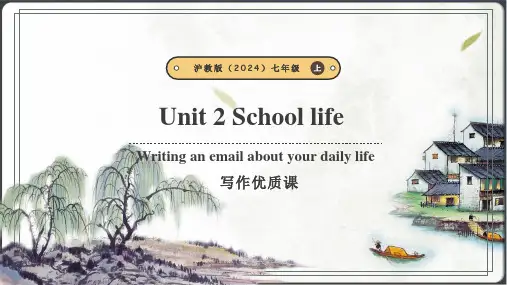
3 Pre-writing greeting称呼 body正文
signature署名
receiver 收件人 subject主题
closing结束语
3 Pre-writing
Read Su Wen’s email and find his time line.
3 Pre-writing Read Su Wen’s email and finish his time line.
5 Post-writing
Dear Teen Life Magazine, My name is Lucy, and I am writing to tell you about my daily
life. I am a Grade 7 student and my school day is very interesting and
3 Pre-writing
Read the email writen by Su Wen and learn how to write
an email.
3 Pre-writing Label the parts of the email wຫໍສະໝຸດ th the words below.
greeting称呼 signature署名 receiver 收件人 closing结束语 body正文 subject主题
at 7:20 a.m.
at 8:00 a.m. during the breaks
have breakfast
Classes start.
at 9:30 p.m.
help his parents clean up do his homework play the piano
沪教版七年级英语上册Unit 2 Daily life -Period 5 公开课PPT课件
6:30 a.m. 7 a.m. 7:30 a.m.
get up have breakfast go to school
4–4:30 p.m. 4:45 p.m. 6:30 p.m.
play basketball with friends (twice a week) go home have dinner
She sometimes watches TV in the evening. goes to bed at 9 p.m. She always (8)____________________.
Work in pairs and list your daily schedule.
Time Activity
8:30 a.m. – 4 p.m.
have classes
9 p.m.
go to bed
While-writing
Describe the schedule. Follow the example.
6:30 a.m. 7 a.m. get up have breakfast 4–4:30 p.m. 4:45 p.m. play basketball with friends (twice a week) go home
Many people around the world keep a diary. They write in it every day.In a diary, you can write about your daily life. People often start by writing “Dear Diary”. They think of the diary as a friend.
Homework
英语七年级上册《Unit 2 Daily life Fang Fang‘s daily life》_9

Unit 2 Teaching PlanSpeaking & writing Daily lifeI. Teaching features of our school1.Integration of the teaching materials(课程资源统整)2.Guidance by the worksheet(学案导学)3.Cooperative learning(小组合作学习)4.Stimulating evaluation(激励性评价)II. My teaching beliefs1. A good teacher should be reflective. In language teaching, the teacher should always thinkabout what Ss have learnt and find out their weak points through different ways, whichhelps the teacher better understand his teaching and his students. Therefore, when I foundmy students were weak in using the simple present tense with the singular form in 3rdperson from their homework and exercises, I designed this lesson to help them overcomethis weak point.2.Practice makes perfect. Language learning will be best achieved in activities. The morethe students involve, the better they understand the language. So I would like to put thelanguage learning into some interesting activities, which can arouse students’ interest andget them to learn and use the language while having fun. For example, in this lesson, Idesigned many kinds of interesting activities for my students, including typhoon, guessing game, jigsaw and so on. They get my students to practise using the wh-questions and thesimple present tense with the singular form in 3rd person.III. Analysis of the teaching material1.This is the 5th period of Unit 2, Oxford English, 7A. The previous periods of this unit hasalready taught Ss many key words and expressions about daily life and rules of the simplepresent tense as well as the adverbs and adverbial phrases of frequency. So this is a revision period and focuses on the language using, especially using the simple present tense with the singular form in 3rd person in speaking and writing.2.This period requires students to talk about someone’s daily life and write an article about it.3.In order to let Ss be more familiar with the topic, Ss are going to talk about one of theirteachers’ daily lives instead of Fang Fang’s daily life in this period. This is one of ourschool’s teaching features – integration of the teaching material.IV. Analysis of the students1.The students are active and want to do well in English learning, so they should be givenmore chances to use the language in class.2.They have learnt many words and expressions about daily life as well as the simple presenttense. Also, they know how to use the adverbs and adverbial phrases of frequency in theprevious lessons.3.They still make mistakes when using the simple present tense with the singular form in 3rdperson, especially in speaking and writing.V. Teaching objectives1. Knowledge objectives1) Get Ss to master the key words and expressions about daily life.2) Get Ss to better understand the usage of the simple present tense with the singular form in 3rdperson.3) Get Ss to organize an article according to the time sequence.2. Ability objectives1)Develop Ss’ speaking ability of using wh-questions to talk about daily life.2)Develop Ss’ writing ability of organizing an article in time order.3)Get Ss to use the simple present tense correctly in speaking and writing.3. Moral objectives1)Help Ss develop the ability of cooperation.2)Get Ss to understand their teaches’ hard work and respect them.VI. Teaching methods1.Situational methodmunicative approach3.Group cooperationVII. Learning methodCooperative learningVIII. Teaching important points and difficult points1.Get Ss to use wh-questions to talk about daily life.2.Get Ss to use the simple present tense with the singular form in 3rd person correctly inspeaking and writing.IX. Teaching procedures。
牛津深圳初中英语七年级上册Unit 2 Our daily life 课件
Action Get up On the way to school Have English class Have lunch Correct homework Prepare for the lesson
What about your daily life?
the title: A day in the life of … The subtitle: Whiz-kid Cheng Na
5. Does Cheng Na always have lunch at school? DK
6. Is Cheng Na good at basketball? DK
7. Do Cheng Na and her family talk about business at breakfast and at dinner? DK
2. What do you often do in the afternoon/ evening?
12:15 p.m. 5:00 p.m. 8 p.m. p.m. = in the afternoon/evening
Time 6 a.m. 7:30 a.m. 8 a.m. 12:30 p.m. 4:15 p.m. 8 p.m.
8. Does Cheng Na sleep for about five hours a night? N
Read the passage again and answer the questions:
1 How old is Cheng Na? 15 years old.
2 What does she do every morning?
Discusses business with her parents at breakfast.
牛津版七年级上册 同步练习 课件Unit 2 第5课时—写作
I take part in the football match once a week. My school life is very interesting. I like it. 我一周参加一次足球比赛。我的校园生活很有趣,我很喜欢。
★ 课时过关
答案见:P5
请你根据下表,介绍自己的校园生活,80 词左右。
English and PE. So she often goes swimming or plays badminton after school. Then she does her homework carefully. Sometimes she helps her mother cook supper. She always eats healthy food. She seldom eats sweets or cakes. At last she goes to bed at 10:30 p.m.
主要作息时间及内容; 课余爱好及特长; 我对校园生活的评价。
二、怎么写——遣词句,重结构 第一点:主要作息时间及内容;
我是一名初中生。我每天早上 7:00 起床,然后刷牙、 洗脸,7:30 吃早餐。
IIamama jaunjuionriohrighhigshchsocohl osotul dsetnutd.eIngt.etIugpeat tup at 77::0000..AAfftteerrIIwwaasshhmmyyfafacceeaannddbbrruushshmmyyteteetehth, , I
I have a good time at school. 我在学校过得很愉快。 When the bell rings, I run to the playground to play football with my best friends Tom and Jack. 当铃声响起的时候,我和我最好的朋友汤姆和杰克跑到操场上
Unit 2 Our daily life(通用2篇)
Unit 2 Our daily life(通用2篇)Unit 2 Our daily life 篇1Unit 2 Our daily life 篇2 (一)a day in the life of…whiz-kid cheng na神童程娜的一天title n. 标题subtitle n.副标题similar adj.相像的,类似的be similarto 与……相像be differentfrom 与……不同,不同于expect v.期盼whiz-kid. 神童business n.生意,公司(=company)manager n.经理client n. 客户,顾客,主顾achieve v.得到,实现grade n.分数fail v. 失败,不及格exam n.考试collect v. 接走return v.回,返回attend v.参与,出席continue v. 连续(二)comb n.梳子 v.梳头nearby 和 near byarrive v. 到达get 的用法walkhome 步行回家once aweek 一周一次spend……on 花费……在……上the onlychild 独生子女makebreakfast 做早饭(三)in the green dress穿着绿色礼服的, in the redshirt穿着红色衬衫的(在此留意in 的用法)holdcousin 表兄妹或表姐弟, nephew外甥或外甥女exceptfor 除……之外(四)completetimetablequarter , a quarter 一刻钟(=15分钟)biology 生物-----其它科目?go on foot = walk 步行去,步行前往on weekdays 和 on the weekend二重点难点解析(一)1. cheng na, one of the top students inguangzhou.程娜,广州的高材生之一。
牛津深圳版七年级上册英语U2 Writing-最新
Linda gets up at …
I get up at …
Unit 2 Writing
Part IV Post-Learning
Composition
Unit 2 Writing
Interview one of your best friends and write a passage about his or her daily life. The passage on page 25 is a good example.
数字在后,首字母大写。
七年级一班
Class One, Grade Seven 我在七年级一班。
I am in Class One, Grade Seven.
Unit 2 Writing
Part III While-Learning
While-writing
Unit 2 Writing
Describe the schedule. Follow the example.
Time
Activity
Unit 2 Writing
______ is my best friend. He/She___________ ______________________________________ ______________________________________ ______________________________________ ______________________________________ ______________________________________ ______________________________________