
英语(新目标)七年级下册Unit1教案_5
英语(新目标)七年级下册Unit 1教案Unit1 Where is your pen pal from?Topic:Countries, nationalities, and languagesFunctions:Talk about countries, nationalities and languagesAsk and tell about where people liveStructure:Where's/Where're ...from?Where does/do ...from?What questions----What language does/do ...speak?Target language:Where is she from? She is from....Where does she live? She lives in....What language does she speak? She speaks....Vocabulary:words about countries, languagesTeaching design:The whole unit needs 5 periods, 4 for new lessons and 1 for testPeriod 1 ( 1a----Grammar Focus )Key points:Where is your/John's pen pal from? He/She is from...Where does he/she live? He/She lives in....(Homework for preview)Pre-task:Let the Ss give themselves pen pals and they should write down their pen pals' information, such as their names, countries and cities they live even the language they speak.T can give the Ss an example meanwhile T gives the different countries which can be used by the Ss. T gives the Ss Chinese words for the countries, they are following: 加拿大,法国,日本,美国,澳大利亚,新加坡,英国,中国( The Ss can look them up in the dictionary if they are new for them) The example is following:Name: Curry MurayAge: 75From(Nationality): the United StatesCity: New YorkLanguage: EnglishTeaching Steps:Key points:Where is your/John's pen pal from? He/She is from...Where does he/she live? He/She lives in....(Homework for preview)Pre-task:Let the Ss give themselves pen pals and they should write down their pen pals' information, such as their names, countries and cities they live even the language they speakT can give the Ss an example meanwhile T gives the different countries which can be used by the Ss. T gives the Ss Chinese words for the countries, they are following: 加拿大,法国,日本,美国,澳大利亚,新加坡,英国,中国( The Ss can look them up in the dictionary if they are new for them)The example is following:Name: Curry MurayAge: 75From(Nationality): the United StatesCity: New YorkLanguage: EnglishTeaching Steps:Step 1 Leading-inThe information of the teacher's own pen pal's information."I have a pen pal. His name is Curry Muray. He is from the United States. Do you have a pen pal? Where is your pen pal from? What's your pen pal's name?"Different students say the information about their own pen pals. T should choose the different countries. T writes the different countries on the Bb(both Chinese and English)Step 2 LearningSection A 1a Learn the new words on the Bb. The new words are:pen pal; Canada; France; Japan; the United States(the US/the USA/America); Australia; Singapore; the United Kingdom(the U.K./Great Britain/England)Pay attention to the pronuciation of the new words.Step 3 Listening1b Listen and circle the countries in 1a they learnedStep 4 CompetitionTwo groups of students to write the new words to see which group does better. First write down the Chinese words with looking at the English meanings, then write down the English words with looking at the Chinese meanings.(This step is a memory game. It can help the Ss consolidate the new words they learned)Step 5Pairwork1c Practise the following conversation:---Do you have a pen pal? ---Yes, I do.---Where's your pen pal's from? ----He/She is from ....(Write it down on the Bb)First T has a conversation with one student as an example then let the Ss practise in pairs. At last let several pairs do it again in class.Step 6Leading-inRevise the countries names with looking at the Bb. Then T writes down the city names on the Bb. Let the Ss try to find out which countries the cities are in. The city names are following:Toronto; Paris; Tokyo; New York; Sydney; Singapore; London;Step 7 Learning2a Learn the city names together with the whole class just like Step 22b Listen and circle the cities and countries2c Listen and complete the chartHave a similar competition to consolidate the new words in this part.Step 8PairworkT has a conversation with one student like the following:---Do you have a pen pal? ---Yes, I do.---What's your pen pal's name? ---His/Her name is....---Where is your pen pal from? ---He/She is from...---Where does he/she live? ---He/She lives in....(Write it down on the Bb)Let the Ss practise after the T's example in pairs then several pairs do it in class.Step 9ExerciseMy pen pal is from Australia.(划线提问)John's pen pal is from Japan. (划线提问)He lives in Paris. (划线提问)Homework:Read and copy the new words .Copy the sentences in Grammar FocusMake up the questions about Jodie in 2c The questions are:Does Jodie have a pen pal? Where is Jodie's pen pal from? Where does he/she live? What's his/her name?(This one can be chosen by themselves)。
人教新目标七年级下册英语市级优质课获奖教案-Unit1Canyouplaythe..
Unit1Can you play the guitar?第二课时Section A(la-2d)Learning Goals一、功能1.学会使用can的基本用法。
2.能够使用can进行提问及回答。
3.能够使用can谈论某人的能力。
4.能够根据自己的能力选择适合自己的俱乐部。
二、常用词汇、短语和表达1.词汇:1)名词n.guitar,swim,dance,chess,club,2)动词v. sing,swim,dance,draw,speak,join3)词组play chess,speak English2.句型:Can you...?Yes,I can./No, I can't.I want to join the...club.三、学习策略通过大量的听说练习让学生掌握本课以上的知识和技能。
四、情感态度通过讨论同学们的才艺和能力,使他们互相学习进步。
借机教育学生养成良好地生活和学习习惯。
Teaching steps:Step I Preview:Translate the following Chinese into English.一、你能用英语读出下列单词和短语吗?并试着写下来I.跳舞2.游泳3.唱歌4.画画5.加入,参加6.下象棋7.弹吉他8.说英语9.英语俱乐部10.加入象棋俱乐部—II.游泳俱乐—12.音乐俱乐部13.艺术俱乐部二、你能通过自主探究说出下的句子吗?(每空一词)1.-你会游泳吗?you?-不,我不能。
No,.2.-你想加入什么俱乐部?do you want to?■我想加入象棋俱乐部。
I want to.3.-Lisa想加入什么俱乐部?Lisa want to?■她想加入音乐俱乐部。
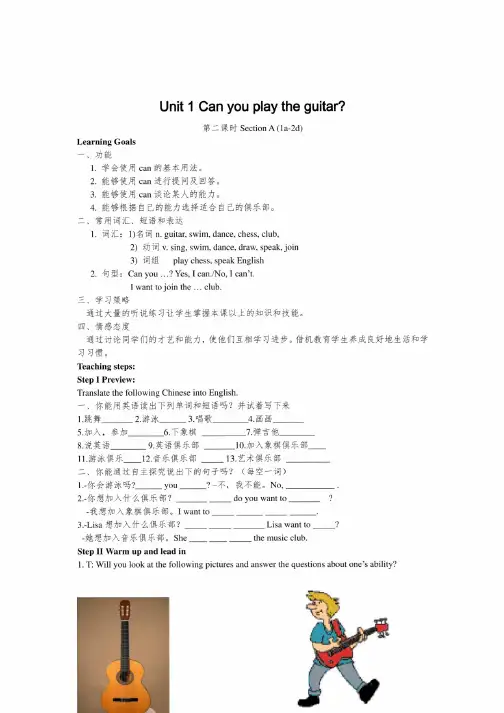
She the music club.Step II Warm up and lead in1.T:Will you look at the following pictures and answer the questions about one's ability?guitar[gl'ta:]play the guitar Can you play the guitar?温暖我心窝:.是谁在唱歌-Can you sing?sing[sin |dance[da:ns]—Can you dance?draw[dro:l-Can youdraw?play chess[tfes]—Can you play chess?speak English[spi:k]Can you speak English?Help them to answer:Yes,I can./No,I can't.(设计意图:实物展示形象、直观地引出本单元的课题。
人教版新目标七年级英语下册全册教案
人教版新目标英语七年级下册全册教案Unit 1 Can you play the guitar?一. Knowledge and abilities goals:1.vocabulary:dance,swim,sing,play chess , paint ,speak English, play the guitar2. How to use Model verb” can”.3. Listening and speaking skills and communicative competence. Content of courses:In this period, students will learn some names of clubs ,such as art , music, chess club, swimming club, etc. students will learn the drills :Do you want to join…club ?Can you …?四. Importance and difficulty: canTeaching Aids: A tape recorder. Some pictures. A projector Some sports things, such as volleyball, basketball, etc. Preparation test paper for lessons before class.Period 1 (Section A: 1a-2d)授课人:______ 授课班级: _____ 授课时间:年___月___日____ 1.Knowledge Objects: Learn to talk about abilities.Know something about the culture of clubs. Can you/he..?What can you do? What club do you want to join?can, can’t, draw, dance, swim, speak, walk.2.Teaching key point: can3. Teaching Difficult point: can4.Teaching Procedures:Step 1. Lead-inEnjoy a song I’m a musicianT: Do you want to be a musician? S:T: Can you play the piano? S…T: What can you do? S: I can…T: What about you? S:T: OK, now please show your talent and tell us what you can do.Ask one of the students come to the front and do the action. Ask other students to guess what he or she can do.Step 2. PresentationT: Look at the pictures. What are they doing? S:Step 3 Pair workLook at the pictures. Ask and answer like this:A: Can you play basketball?B: Yes, I can. / No, I can’t.Can you…?Step 4 PresentationShow some pictures of famous stars. Practice the third person “he, she, they”T: Where can you play chess? S:T: Yes, in a chess club. This term, we have a lot of clubs. What club do youwant to join? S…T: Sounds great. Can you…?S: Yes, I can/ No, I can’tIf the answer is negative, guide students to say:S: No, I can’t. But I can learn it from others.Step5 Pair workA: What club do you want to join?B: I want to join the…A: Can you …?B: Yes, I can . No, I can’t. But I can learn it from others.Step 6 ListeningListen to 1bListen to 2a and 2b. Tell them to give special attention to listening activity (names of the clubs). Finish the tasks.Step 7 Pair workLook at 2b and talk about what the people can do the clubs they want to join.Step 7 Role-play the conversation 2dT: If you like telling stories. What club can you join?S: Story telling club.T: Right. Please read the conversation following the recording. Who wants to join the story telling club? Then role-play the conversation.Step 8 Explain some language points.Step 9 HomeworkPeriod 2 (Section A: 3a-3c)授课人:______ 授课班级: _____ 授课时间:——年___月___日____1. Knowledge Objects: go on learning to talk about abilities.—Can you play the guitar? —Yes, I can./ No, I can't.—What can you do? —I can dance.—What club do you want to join? —I want to join the chess club.2. Teaching key points: Conclude the usage of ‘can’; put all new language into practice through different activities.3. Teaching Difficult points: Distinguish “say, speak, tell, talk”4.Teaching Procedures:Step1:Greeting, Warming up and duty report.Watch a flash about the content of the Just for fun.Talk something about the flash: Why is the other boy unhappy?Introduce because of the difference of time zones, the time in different places are different.Revision: show the time in six places: Beijing, Tokyo, Paris, Los Angeles, New York, and London. Elicit the sentence pattern: What time is it?It’s……Draw attention to the “am” and “pm”. For instance, Beijing is seven o’clock in the morning. We can say Beijing i s seven am. Los Angeles is three in the afternoon. So we can say Los Angeles is three pm. (teacher helps students answer).Step2:Review the words learnt in the last period and add more.(1)T:Here are some Chinese, let us see what time do they usually get up/ take a shower…get up take a shower eat breakfast go to school eat lunch run go homedo homework eat dinner go to bed(2)ask students to make a surveyAsk your friend 5 questions about his /her day. Then make a report. A: What time do you usually…?B: I usually…at…Step3:presentation.(1)Ben’s day. Introduce something about Ben.Using the sentence pattern: What time does he usually get up/go to school/…Pay attention to the verb form of the third person.Discuss Do you like ben’;s routines.(2)Show the picture of Scott. He usually gets up at 5 pm.Ask students to predict what his job is?(3)listen to the tape,and try to answer this question. then read through the passage,and match the pictures with the times.(4)read it again and fill in the chart.(5)answer the following questions1.Where does he work?2.How does he go to work?Step4:Work on 3a.(1)Read through the passage and tell me what his job is.(2)Read it again and match the pictures.(3)Answer questions:What does he do after he get up?Does he go to work after breakfast? What does he do?How does he go to work? By bus or on foot?What does he do before he goes to bed?What does“What a funny time to eat breakfast!”mean?Step5:Follow up.T:My friend Da Bao likes Scott's work, so he gets to Sai Te Hotel . But he doesn't find him.T: There are many children in the hotel. Look, they are coming. Please ask them questions to find the real Scott.Step6:Work on part4.T:Now six people make a group, and ask the other students when theyusually go to bed . The leader lines up from the earliest to the latest bedtime.T: Let's listen Group1…Group2…Step7:Work on part 3 of self –check.T: Now I want to know something about what you do on weekends. You can go, ask your classmates and fill in the forms. Then you have a report. T: You may begin it like this "Ma Li gets up at …"Step8:Homework.Oral work:(1)Read 3a and recite it.(2)Go on making a survey to find out what your classmates do on weekends.Period 3 (Section B: 1a-1f)授课人:______ 授课班级: _____ 授课时间:——年___月___日____1. Knowledge Objects: go on learning to talk about abilities. drum, play the drum, piano, play the piano, violin, play the violin2. Teaching key points: Improve listening and speaking3. Teaching Difficult points: Improve listening and speaking4. Teaching Procedures:Step 1 Warming- up and revisionDaily greeting.Check the homework. Let some Ss report what his/her family members can do.Step 2 PresentationPlay the sound of different kinds of instruments. Let Ss guess what it is.Act and show your classmates your talent.T: Please stand in front of your classmates. Act and say what you can.S1: (sing and dance) I can sing and dance.S2: (play the drum) I can play the drum..Step 3 ListeningTell the Ss that they will listen to some sounds of the instruments. Listen and number the words [1-4] in the order of the sounds you hear in 1a. Play the recording again and check the answers.T: Now let's work on 1c. First, let one student read the words and phrases aloud.Then listen to the 1d and circle the words and phrase you hear.Check the answers:T: Now please look at the chart in 1e. What can Bill, Cindy and Frank do? What can't they do? You'll listen to the recording again. Then try to fill in the blanks.Step 4 Group workWork in groups. Take turn to talk about what Bill, Cindy and Frank can and can't do.S1: Bill can play the guitar, but he can't sing.S2: Cindy can sing and play the drum, but he can't play the piano. Teacher can walk around the classroom, and give some help to the Ss. Step 5 HomeworkMake up a conversation between a volunteer and a person who is in charge of a sports club/old people’s home/music club.Period 4 (Section B: 2a-self check)授课人:______ 授课班级: _____ 授课时间:——年___月___日____ 1. Knowledge Objects: go on learning to talk about abilities. also, people, help (sb) with sth, center, home, today, be good with, make, make friends, weekend, on weekends/on the weekend, teach, musician2. Teaching key points: Also, too; be good with, help with3. Teaching Difficult points: Describe one’s ability4. Teaching Procedures:Step 1 Warming-upCheck the homeworkAsk some pairs to show their conversationsStep 2 ReadingFirst, show some pictures of the boys and girls and some key words in 2a.T: Here are some pictures and information about Peter, Alan and Ma Huan. Can you describe them according to the pictures and key words?S1: Guide Ss to use “also, too”, and distinguish how to use these two words.Give comments on Ss’ descriptions.T: Now we’ll read three ads. What's the main idea of each ad? What's each ad's title? Now let's read the three ads and select a title for each ad. Ss read carefully and try to select a title for each ad. Check the answers with the class.Step 3 Review the usage of “tell”,Review and distinguish the usage and function of “help”T: Suppose Peter, Alan and Ma Huan want to help to do something after school. Which ad is right for him/her? Now read the descriptions in 2a and the ads in 2b again. Select a right ad for each person.Ss read the descriptions in 2a and the ads in 2b again. Try to select a right ad for each person. They can talk about the answers in their groups. Check the answers with the class.Step 4 Homework1. Recite 2a and 2b2. Finish the exercise on p6Unit 2 What time do you go to school?1. Teaching Aims:1) Aims of Basic Knowledge:①V ocabulary: time, shower, usually, O’clock, what time, go to school,take a shower.②Grammar: What time do you…? What time does he / she…?③ Function: Use the simple tense to talk about the daily life.2) Aims of Abilities: Listening skill. Speaking skill. Reading skill. Writing skill.3) Aims of Emotion: Love life.2. Analysis of the Material:1) Brief Introduction of the teaching material:What time / When do you…?” “ What time / When does he…?”2) Teaching Focu s: What time do you…? What time does he/ she…?3) Teaching Difficulties: Present tense.3. Learning Methods: Make a plan. Culture.4. Teaching Methods: Student- centered. Task-based Teaching.5. Teaching Time: 4 periodsPeriod 1(Section A: 1a-2a)授课人:______ 授课班级: _____ 授课时间:——年___月___日____Step One: Warming-upGreetingT: Good afternoon, everyone.Ss: Good afternoon, Miss Yang.Step Two: Presentation1.Adjust the time, and ask students questions.T: What time is it? Ss: It’s 12 o’clock. ( Write on Bb )( Help Ss to say )T: What time is it? Ss: It’s 10:15.( Help Ss to say )2.Ask one student to come to the front, adjust the time and ask theother students.S1: What time is it? Ss: It’s 9 o’clock.3.Teach the new words & phrases.Show some pictures of different clocks and the activities.T: I’m very busy these days. Can you guess what time I get up / eat breakfast / go to school / run / take a shower? ( Write on Bb)T: I usually get up at 6:35. ( Teach Ss the new word “ usually” )S1: You usually eat breakfast at …S2: You usually run at…S3: You usually take a shower at …4.Ask Ss to do the exercise of 1a, and then check the answers.Step Three: Listening1.Show Ss the timetable of Rick’s ( write on small Bb )Rick’s timetableAsk Ss listen to the recorder and fill in the chart.Then check the answers.2.Ask and answer.T: What time does Rick get up / eat breakfast / run / go to school / take a shower ?Ss: He gets up / eats breakfast / runs / goes to school / takes a shower at…( Ask Ss pay attention to the underlined phrases.)Step Four: Consolidation1.Ask Ss to look at the pictures and tell their days.Example: I usually get up at …. I eat breakfast at …. I go to school at ….At …, I take a shower.Step Six: Homework1.Try to remember all the words & phrases.2.Survey: Ask your classmates their routines, and give your report.3.Plan: January 1st is coming. Please plan it, and make your daywonderful.Step Seven Blackboard DesignPeriod 2 (Section A: 2b-Grammar Focus)授课人:______ 授课班级: _____ 授课时间:——年___月___日____1. Aims and demands :1) Language skills :Ss learn to talk about kinds of transportation, and how long it takes to go places, and how far apart places are.2) Target Language : Words : how far , get to , bicycle , subway , bus stop, train station , minute, kilometer, mile , transportation , calendar Sentences: How do you get to school ? / How long does it take ? / How far is it ?3) Moral object : Through learning this unit , Ss can enable them to care for each other whenever crossing the roads and pay attention to the sign of traffic.2. Analysis of the material:Students have learned the transportation before.. In this unit ,they need to learn more details about the transportation. At the same time ,they need tolearn “How long and How far” and they can use them freely.3. Teaching methods:pairwork , groupwork ,listening and speaking, practicing4, learning strategies:Personalizing Inferring vocabulary5.Teaching aids:Tape recorder, a projector or a computer6.Teaching period:Four periods.Period 3 (Section B: 3a-3c)授课人:______ 授课班级: _____ 授课时间:——年___月___日____1. Aims and Demands: Key vocabulary, How do you get to school ? Howdoes he get to school ?2. Teaching methods : Listening Writing Pairwork3. Teaching Aids : A tape recorder.Step I Leading inT: Good morning, everyone! You know I live far away ,so I go to school by bus every day. What about you? David, “How often do you go to school?”S:--------T: So we will talk about how to get to places in this unit.Step IINow I will show you pictures and let’s review the transportations we know. Then we will learn more about it .(take the subway) Please open your books and finish 1a.Step III1. There are five names in 1b.Now they are in the picture. We should find them.2. Play the tape .They should listen carefully and find the persons .Write the numbers next to the correct students in the picture above. After listening , check the answers together .Step IVPoint to the example in the box , ask two students to read it .then ask them to make up their conversations about how the people in the picture get to school .Teacher choose some pairs to act their conversations.Step VPracticing the listening :T: I will play two conversations The people are talking about how students get to school and how long it takes .The first time check the kinds of transportation that you hear. The second time match the time with the kinds of transportation activity 2a.Step VI1. Pay attention to the picture and dialogue.2. Make your own dialogue into pairs.3. Act it in front of the students.Step VIISummary and homework: This class we have learnt some key vocabulary and the target language .I hope after class you can survey how does your friends get to school .and pre-revise the 3a,3b.Step VIII Blackboard DesignPeriod 4授课人:______ 授课班级: _____ 授课时间:——年___月___日____Unit 3 How do you get to school ?Period 1 (Section A: 1a-1C)授课人:______ 授课班级: _____ 授课时间:——年___月___日____ 【学习目标】1.掌握本节课的5个单词:train bus subway ride bike 和5个短语: take the train take the bus take the subway ;ride the bike walk to2.熟练运用问方式的句型。
人教版新目标七年级下册英语Unit1说课稿SectionA(1a2c)表格教案

在学习本节课之前,学生可能已经具备了一些英语基础知识,如基本的字母和单词识别能力,以及简单的日常交流用语。然而,他们在学习本节课时可能面临以下学习障碍:首先,对于一些较为复杂的语法结构,如一般现在时态的运用,学生可能会感到困惑。其次,由于缺乏实际的语言环境,学生可能难以将所学词汇和句型应用到真实场景中。此外,对于一些文化背景知识,如不同国家的姓名表达方式,学生可能不太了解,这可能会影响他们对课文内容的理解。
2.句型:询问和回答个人信息的句型,如“How old are you? I am... years old.”、“What’sபைடு நூலகம்your name? My name is...”等。
3.语法:一般现在时态的运用,以及如何使用“be”动词和“have”动词描述个人信息。
4.文化背景:介绍不同国家的姓名表达方式,以及如何礼貌地询问他人信息。
(五)作业布置
课后作业的布置旨在帮助学生进一步巩固课堂所学内容,并培养他们的自主学习能力。我会布置以下作业:
1.书面作业:要求学生编写一段自我介绍,使用本节课学到的词汇和句型。
2.录音作业:让学生录制一段电话问候或自我介绍的录音,以便他们能够练习发音和语调。
3.在线作业:通过在线学习平台,布置一些互动练习,如在线测试或讨论话题,让学生在家中也能进行有效的学习。
(二)教学反思
在教学过程中,我预见到可能出现的问题包括学生的参与度不高、对语法规则理解不深刻以及对文化背景知识的不熟悉。为了应对这些问题,我会通过设计互动性强的问题和活动来提高学生的参与度,采用直观的教学工具来解释语法规则,并在教学中穿插文化背景知识的介绍。课后,我将通过学生的课堂表现、作业完成情况和学生的反馈来评估教学效果。具体的反思和改进措施包括:对学生的参与度进行观察,根据学生的反馈调整教学方法;分析学生的作业,针对普遍存在的问题进行集中讲解;收集学生的意见和建议,不断优化教学设计和教学策略。
七年级下人教版新目标英语Unit1Canyouplaytheguitar导学案教案1
初一英语下册Unit 1 Can you play the guitar?导学案Section A【学习目标】:1.掌握表示爱好的单词;2.熟练的谈论表示能力的话题,以及自己的意愿;3. 掌握有关乐器的单词;4.能表达自己在某一方面所具备的才能及喜好与意愿;5.学会询问某人能力的句型;6. 学会书写应聘广告。
【学习重点】:学会谈论自己或别人的能力;【体验学习】:1.情态动词can小结:后面总是接动词原形,没有人称和数的变化。
意思是“能,会”。
用法口诀:情态can表能力,和行为动词不分离。
不管主语如何变,can的模样永不变。
只要出现动词can,动词原形后面站。
一般疑问can提前,否定can后添not。
2. play的用法小结:play与体育、棋类词语连用时,不加定冠词the; eg: play basketball, play chess, play cards …play与乐器类词语连用时要加定冠词the; eg: play the guitar, play the piano play the drum, play the violin…【预习导学】:学习任务一:认读并书写本单元单词1.个人自读,记忆单词,小组互相检查读写情况;2. 预习课本并翻译:单词:唱歌_____________ 跳舞_____________ 游泳_____________ 画画_____________故事____________ 演出;节目_____________ 吉他_____________ 俱乐部_______________词组:下国际象棋_____________________________________ 下中国象棋_____________________________________ 打牌___________________________________________ 打篮球_________________________________________ 弹吉他_________________________________________ 弹钢琴_________________________________________ 拉小提琴_______________________________________ 打鼓___________________________________________ ……怎么样/如何?(2种) __________________________ 擅长(2种) _____________________________________ 加入音乐俱乐部_________________________________ 加入运动俱乐部_________________________________ 加入故事会俱乐部_______________________________加入英语俱乐部_________________________________ 加入象棋俱乐部_________________________________ 加入美术俱乐部_________________________________ 参加比赛_______________________________________ 参军/入党______________________________________ 听起来不错/有趣/糟糕____________________________ 想做某事_______________________________________ 想让某人(别)做某事______________________________ 为……招聘……_________________________________ 为学校节目招募学生_____________________________ 说英语_________________________________________ 说法语_________________________________________ 讲故事_________________________________________ 学校表演_______________________________________ 跟……说/谈话(2种) _____________________________ 谈论关于……___________________________________ 放学后_________________________________________ 课余,课后的(adj.)________________________________ 在音乐教室里___________________________________ 会(中国)功夫____________________________________ 喜欢音乐_______________________________________ 喜欢画画_______________________________________ 不会唱歌_______________________________________学习任务二:1.掌握Grammar Focus中重点句型及用法;2.独立翻译句子:1)—你会做什么?—我会跳舞但我不会弹钢琴。
人教版初中英语七年级下册全册英教案(全英文版)

新目标人教版英语七下全册教案(全英文版)Unit 1 Wheres your pen pal from?Language goals:•In this unit students learn to talk about countries, nationalities and Ian guages.•Ask and tell where people live.New languages:•Where's he / she from?•He / She is from Australia / England / China / France / Singapore / Australia. •Where does he / she live? He / She lives in Sydney.•What language do you speak? I speak English.•What's your / his / her favorite subject?•My / His / Her favorite subject is English.•Does he / she have any brothers and sisters? Yes, he/ she does. / No, he / she doesn't.Difficult points:1. Liste ning for the in formation about cou ntries, natio nalities and Ian guages. Write an e-mail about on eself. Describe the new stude nts in class.2. Where questions with fromWhere questions with liveWhat questi onsTeaching aids:• A tape recorderTeaching periods:•Period 1:Section A 中1a, 1b, 1c•Period 2:Section A 中2a, 2b, 2c, 2d•Period 3:Section A 中3a, 3b, 4•Period 4:Section B 中1,2a, 2b, 2c•Period 5:Section B 中3a, 3b, 3c, 4•Period 6:Self CheckPeriod 1Teaching aims:1. Teach vocabulary words.2. Target Ianguages:Where's your pen pal from?He is from Australia.3. Enable the students to learn to talk about nationalities.4. Help the students learn how to talk about nationalities.Teaching procedures:Step 1. Free talk2 Say: Do you have any friends? Where is she from?Help the students make the same sentences and give them more chances to say.Step 2. Talking about the picture (1a)Hold up the picture on page 1 and point at the map. Ask students toread the picture.Ask some of you to read them aloud to the class. Make the studentstalk about where people are from.Say: Du Chuan, where is your pen pal from?Ask the students to read the conversations in the picture.Step 3. Listening (1b)Point to the numbered list of words and play the recording for a secondtime.Ask the students to listen to the recording and circle the countries in 1a.Ask students to listen to and repeat after the recording and then checkthe answers.Step 4. Pair work(1c)1. Now work in pairs and read the conversations in 1a with your partner.You can talk about your own pen pal.2. Ask the students to look at their own clothes and the things in theirbackpack. Ask and answer questions about where they are from.Homework1. Ask the students to practice talking about where people are from and make up real dialogues.2. Learn the words in this unit (on page 115) by heart.Period 2Teaching aims:1. Learn the vocabulary words and useful expressions.2. Target languages: Where does he live? He lives in Toronto.3. Let the students learn to talk about where people live.4. Help the students learn how to talk about where people live.Teaching procedures:Step I.StepI RevisionCheck the homework. And then ask several students to answer questi ons.Say: Where are you from? Do you have a pen pal? Where is your pen pal from?Step 2. Presentation (2a)Put a map of the world on the blackboard.Say: What's the meaning of capital? Can you guess? Help them to answer.Write Australia, the United States, Canada, France, and Japan on theleft of the blackboard. And write Sydney, New York, Paris, Toronto, andTokyo on the right of the blackboard. And the teacher reads them aloudand asks students to repeat.Then ask students to match the cities with the countries.Step 3. Talk about countries and citiesAsk the students to work in pairs, asking about the cities and the countries.Say: Now work in pairs and ask where the city is. For example, the firststudent asks "Where is Beijing?” the second student answers “It's inChina."Then tell the students to ask question about Chinese cities.Step 4. Listening (2b, 2c)Tell the students to read the list of countries and cities in 2a.Say: Now let's look at the list of countries and cities in Activity 2a. I will ask some students to read them aloud to the class.Call the students' attention to the chart in 2c.Tell the students to listen to the conversations in Step 4 again to complete the chart.Step 5. Pair work(2d)Ask the students to read the conversations in the bubble. Then askthem to talk about the in formation in the chart in 2c.Then ask the students to work in groups and make up new dialogueswith their own information.Step 6.GrammarfocusReview the grammar box.Say: You have to pay attention the word "from". It always follows verb be, while live comes out alone in where sentences. Now make more sentences with where, from and live.Write the following on the blackboard.Say, now work in pairs and make dialogues after the model above.Homework1. Ask the stude nts to learn the sentence patter ns in Grammar Focus by heart. Try to use them freely.2. Remember the words in this unit (on page 115).3. Make a similar dialogue according to the conversation in 2d.Period 3Teaching aims:1. Teach vocabulary words.2. Target Ianguages: What Ianguage does she speak? She speaks English.3. Enable the students to learn to talk about what Ianguage people speak.4. Help the students to learn how to talk about what language people speak.Step 1. Free talkSay, Morning, boys and girls. Nice to see you again. Do you remember we have learned about how to ask where people are from and how to ask where people live? Now I want some of you to answer my questi ons.(Turn to a student.)Where are you from?Give more students chances to speak in class.Step 2. Presentation (3a)Say: Do you know the meaning of "Ianguage"? Listen: Tim is from England and he speaks English. So English is his Ianguage. I'm fromChina, so Chinese is my language .Now look at activity 3a.on page 3.Read the instructions to the class. Ask students to work in pairs as theyanswer the questions.Show the flowing and ask the students to make conversations after themodel.Step 3. Pair work (3b)Ask the students to pay attention to the conversation in Activity 3b.Say, Read the dialogue by yourselves. Then I will ask some pairs to act out the dialogue in class.Show a map of the world. Ask students to work in pairs.Step 4. Quiz(4)Ask the students to look at activity 4 then work in pairs and do the quiz.HomeworkAsk the students to work with their friends and practice the dialogue in activity 3b.Period 4Teaching aims1. Teach vocabulary words.2. Target languages:Does she have any brothers and sisters?Is that your new pen pal?Yes, it is.3. Enable the students to learn to talk about their new pen pals.4. Help the students learn how to talk about their new pen pals.Step 1. RevisionAsk the students to make conversations talking about their new pen pal.Ask some pairs to the front to talk about their pen pals. Greet each otherand have a free talk with classmates.Talk about the persons they admire.Step 2.Match work (1)Ask the students to pay attention to the notebook page with the countries listed.Ask the students to write the letter of the correct country in the box next to the title of each Ianguage textbook on the desktop.Step 3. Listening (2a, 2b)First, read the instructions and tell the students to read the conv ersati on bubbles.Check the answers. Then ask the students to read the questions again.Ask the students to fill in the chart.Give students 1 minute to finish the task. Check the answers with the stude nts.Then play the recording again and ask the students to repeat.Step 4. Pair work (2c)Ask two students to work in pairs, practicing the questions in activity 2a.Then tell the students to practice dialogues similar to the dialogue inactivity 2a in pairs. They can use their own names.HomeworkAsk the students to make up similar dialogues using the following words: Sam, the Unites Sates, New York, a brother and a sister, English and French.Period 5Teaching aims1. Teach vocabulary words.2. Target languages:I think China is a very interesting country.I like going to the movies with my friends and playing sports.My favorite subject in school is P.E.It's fun. / It's too difficult.3. Enable the students to write a pen pal letter.4. Help the students learn how to write to a pen pal.Step 1 .Warming upSay, Do you have a pen pal? Whafs his name? Does he have any brothers and sisters? What Ianguage does he speak?Then ask the students to work in pairs to talk about their pen pal.Step 2. Reading (3a)Ask the students to read the letter on page 5.Point the four questions beneath the letter.When the students finish reading the letter, ask the four questions orally and ask them to answer orally.Ask the students to retell the letter, using their own words.Step 3. Reading and writing (3b)Ask the students to pay attention to the letter from Tom King.Point out the blanks in the letter and the information card on the right.Correct the an swers. Then draw the in formation card on the blackboard and then ask the students try to retell the letter.Step 4. WritingAsk the students make their own information card.After they are finished, ask several students to read their e-mails in class.HomeworkAsk the students to choose one of the following tasks as homework.1. Show a name card to the students and ask them to write something about it.2. The students change their information card with their partner and writesomething about their partner.Period 6Teaching aims:1. Teach vocabulary words.2. Enable the students to describe the new students in the class.3. Help the students learn to describe the new students in the class.Teaching procedures:Step 1. RevisionPractice talking about one of the students.Say, Take out your information cards. And change it with your partner.Read it carefully and make up an oral practice, talking about yourpartner.Step 2.Key word checkAsk the students to read all the words in this part.Say: In learning to talk about where people are from, you learned many words on the topic. Now read and check the words you know in 1 on page6. Then say a sentence with each of them.Step 3.Vocab-BuildersAsk students to write five new words in their Vocabulary-Builder on page 112. After they are finished, ask two students to write their words down on the blackboard. And ask them to read the words and the whole class repeat. And tell the whole class to remember them after class.Step 4.WritingLet the students pay attention to the pictures.Say, Look at the picture of Sally. How old do you think she is? Where do you think she is from? What language do you think she speaks? What do you think she likes? What do you think she dislikes?The same step goes with Jim and Julie.After a few minutes, ask some students to read their descriptions to the class.Step 5.SpeakingAsk the students to do an oral practice about the new classmates.Say, There are several new students in our class this term. Who do youlike best? Why do you like him or her? Please tell us. First you can tellyour partner.Ask some students to present their work to the class.Step 6. Just for Fun!Ask all students to read the conversation.Let the students practice in pairs.HomeworkAsk the students to summarize what they have learned in this unit and prepare for the next unit.Unit 2 Where is the post office?Language goals:•In this unit students learn to talk about asking for and give directions on the street.New languages:•Excuse me, is there a bank near here?•Yes, there is. It's on Center Street.•Where is the pay phone?•lt*s across from / next to / in front of / behind the library.•lt*s between the post office and the library.•Just go straight and tum left.•Turn left on First Avenue.•Take a walk through the park on Center Avenue.•There is a clean / dirty park near my house.Difficult points:1. Listening for the information of the names of the neighborhoodRead the tour guide and an e-mail from a friend you're going to visitWrite the dialogues about asking the way and giving directions.2. Where questions.Affirmative statementsPrepositions of placeTeaching aids:• A tape recorder•Some picturesTeaching periods:Period 1: Section A1a, 1b, 1cPeriod 2: Section A2a, 2b, 2cPeriod 3: Section A3a, 3b, 4Period 4: Section B 1a, 1b, 1c, 2a, 2b, 2cPeriod 5: Section B 3a, 3b, 3c, 4Period 6: Self CheckPeriod 1Teaching aims:1. Teach vocabulary words.2. Target Ianguages: Is there a bank near here? Yes, there is. It's on CenterStreet.3. En able the stude nts to ask for and give di recti ons on the street.4. Help the students to ask for and give directions on the street.Teaching procedures:Step 1. Warming upShow three pictures prepared before class to the students. There is acat in a box in picture 1. There is a cat on a box in picture 2. There is acat under the box in picture 3.Then ask some students to ask and answer these questions.Step 2.Match work (2a)Ask the students to read the picture and the words in the numbered list.Ask the students to match each word or phrase on the list with one of the pictures.Then check the answers.Present the new sentence patterns.Then ask the students to read the dialogue in the picture.Step 3. Listening (1b)Ask the students to listen to the conversations and circle the places in 1a.Change the roles and do the same again.Then students ask and answer without the help of the recording.Step 4. PracticePoint to the different locations shown in the picture. Ask different students to name each one.Then point to more locations and let the students to practice more.Homework1. Practice the conversation in the picture on page 7.2. Learn the new words and phrases in this period by heart.Period 2Teaching aims:1. Learn the vocabulary words and useful expressions.2. Target languages:The pay phone is across from the library.The pay phone is next to the library.The pay phone is between the post office and the library.The pay phone is on Greet Street.The pay phone is in front of the library.The pay phone is behind the library.3. Enable the students to talk about the position of a place.4. Help the students to talk about the position of a place.Teaching procedures:Step 1. Revision and warming upCheck the homework by talking about the pictures on page 7 with thestudents or prepare some other pictures with different buildings in itand let the students practice asking and answering questions about theplaces.Ask the students to practice more.Step 2. Presentation (2a)Introduce the items across from, next to, between, in front of, behind and on.Draw the following picture on the blackboard.Park 3 Centre StreetEncourage or help the students to answer: It's across from the library.The same way goes with next to, on and in front of.Ask the students to match each sentence with one of the pictures.Then ask the students to read the six sentences and match thesentences the pictures.Check the answers.Step 3. Listening(2b)Review the buildings and street names in Activity 1a and the six sentences in 2a.The read the six sentences in 2b to the class.Ask the students to listen to the recording and fill in the blanks.Play the tape. Check the answers.Step 4. Practice (2c)Ask the students to repeat the conversations after the recording.Ask the students to do the Pair work asking and answering questions about the places in 1a.Step 5.Grammar FocusAsk the students to read the sentences in the grammar box aloud. The ask them to answer the following questions. Explain some Ianguage points if the students can't understand.Homework• Ask the students to practice talking about their neighborhood in pairs.Period 3Teaching aims:1. Teach vocabulary words.2. Target Ianguages:Just go straight and turn left.It*s down Bridge Street on the right.Ifs next to a supermarket.3. Enable the students to talk about the neighborhood.4. Help the students to talk about the neighborhood.Teaching procedures:Step 1. RevisionLet the students look at the picture in activity 1a. And ask some studentsto answer some questions in order to check the homework.Say, Is there a library near here? Where is it? Is there a bank near here?Where is it?Put up the picture of activity 2a on the blackboard and ask them to makeconversations.Step 2. Presentation (3a)Guide the students to guess the meanings of the three traffic signs. Show the pictures and ask some questions about the pictures.Then ask the students to hold up their left hands and then their right hands to practice “left” and "right".Point to the picture and let the students read the conversation.Ask the students to read the conversations. Then ask them to find Paul and Nancy in the picture.Ask the students to role play the conversation then point out the place that Paul wants to get to.Step 3. Complete the conversations (3b)Ask the students to make conversations and answer the questionsbelow each picture.The students point out the place in the picture. And write down theanswers on the line in the pictures. Or ask a pair of students to say theconversation, the others point to the speakers' place.Step 4. GameAsk the students to look at the picture in Activity 1a and name all thebuildi ngs.Ask some students to read the conversation in the picture in Activity 4.And then explain the instruction to the student.Then ask some groups to present their work.Homework• Ask the students to make a similar conversation to that in Activity 3a.Period 4Teaching aims:1. Teach vocabulary words.2. Target languages:Is there a big supermarket near your house?Yes, there is.There is a big supermarket.No! There is a small supermarket.3. Enable the students to describe the neighborhood.4. Help the students to describe the neighborhood.Teaching procedures:Step 1. RevisionCheck the homework by asking the following questions.Say, Look at the picture in activity 3a. Suppose you are standing nearthe building on the side of New Street. Please answer my questions.Excuse me. Is there a pay phone in the neighborhood?Ask another student to answer questions.Give more students chances to practice this dialogue.Step 2.Match work (1a)Bring in some objects or pictures to the students. (Two rulers, one is old, the other is new. Two boxes, one is big and the other is small. Two bottles, one is clean and the other is dirty. Two pictures of a street, one is busy and the other is quiet.)Say, Look at the rulers, please. Can you find the differenee between them?Yes. This one is old. (Show the old ruler.) And this one is new. (Show the new ruler.) Do you understand old and new?Ask the students to talk about the picture.Point to each half of each picture and ask about the differenee between the halves.Go on with the other pictures to teach the language items. Ask thestudents to match the words with the pictures.Step 3. Pair workCall attention to the conversation in the picture.Then ask the students to work in pairs and take turns asking each other questions about the things on the list of phrases in activity 1a on page 7.Step 4. Listening (2a, 2b)Ask the students to listen to the tape and circle the places in 1a.Say: Now please listen to the tape again. Listen to it and draw the places in Michael's neighborhood on the street map. Just listen.Play the recording.Play the recording again.Then have some students show their completed drawing to the class. Step 5. Pair workAsk the students to work in pairs talking about drawings to the class. Then ask some pairs to present their dialogues to the class.Ask the students to work in pairs, draw a map of their own neighborhood and practice asking and answering questions about the places they live in.Homework• Ask the students to make similar conversations to that in Activity 1 b.Period 5Teaching aims:1. Teach vocabulary words.2. Target languages:Turn left on First Avenue and enjoy the city's quiet streets and small parks.Take a walk through the park on Center Avenue.This is the beginning of the garden tour.Bridge is a good place to have fun.3. Enable the students to write a tour guide and draw the rout to somewhere.4. How to write a tour guide and draw the rout to somewhere.Teaching procedures:Step 1. RevisionCheck the homework by asking about the students neighborhood.Ask the students to work in pairs.Ask the students to work in pairs.Then ask some pairs to present their conversations to the whole class. Step 2. Reading (3a, 3b)Ask the students to read the tour guide.Divide the whole class into four groups to have a quiz.Tell the students to keep these words down and make at least twosentences with each word after class.After that ask the students to look at the pictures and fill in the blanks for this tour guide.Step 3.WritingAsk the students to write a tour guide with the students.Names of buildings and locations.Description wordsWords that talk about positions.Words that talk about di recti ons.Step 4. Pair work (4b)Learn to draw a picture of neighborhood. First ask the students toanswer the questions according to the pictures.Then ask the students to draw a picture according to the following conversati on.Then ask students to present their drawings to the whole class.Homework1. Ask the students to talk about the street and buildings in their own neighborhood.2. Ask the students to make sentences with the description words they keptdown in the class.Period 6Teaching aims1. Teach vocabulary words.2. Target Ianguages:I know you are arrivi ng n ext Sun day.Let me tell you the way to my house.I hope you have a good trip.3. Enable the students to write about the neighborhood.4. Help the students to learn how to write about the neighborhood.Teaching procedures:Step 1. RevisionCheck the homework by asking and answering some questions.Give more students chances to practice.Step 2.Key word check(1)Ask the students to check the words they know.Then ask the students to do the some exercises.Step 3.Vocab-Builders (2)Expand the students' vocabulary.After that ask the students to share their list with other students.Step 4. ReadingAsk the students to read the letter and draw the rout on the map.Ask the students to change the letter into a telephone conversation.Let the students pay attention to the pictures.Say, Look at the picture of Sally. How old do you think she is? Where do you think she is from? What language do you think she speaks? What do you think she likes?What do you think she dislikes?The same step goes with Jim and Julie.After a few minutes, ask some students to read their descriptions to the class.Step 5. Just for Fun!Call attention to the conversation in the cartoons.Ask the students to read the conversation and then answer the questi ons.Homework• Ask the students to do the following:1. Suppose your frie nd is going to visit you. He does n't know the way toyour house. Write a letter to him to tell him the route from the bus stop to your house.2. Review the next unit.Unit 3 Why do you like koalas?Language goals:•In this unit students learn to describe animals and express preferences.New languages:•Let's see the pandas first.•Why do you like want to see the pan das?•Because they are very cute.•Because they*re kind of shy.•Because they're kind of interesting.•Because they are fun.•Because they are smart.•Do you like giraffes?•Where are lions from?•They are from South Africa.•The animal is ugly / beautiful / friendly / small / shy / clever / cute / scary. •She likes to play with her friends and eat grass.•She's very beautiful, but she's very shy, so please be quiet•He sleeps during the day, but at night he gets up and eats leaves.Difficult points:1. Listening for the names of animals. Listen for the description words about animals.2. Read the description words about animals. Write about the animal you know.3. why, what, where questions, because, adjectives of qualityTeaching aids:• A tape recorder•Some picturesTeaching periods:•Period 1: Section A1a, 1b, 1c•Period 2: Section A2a, 2b, 2c•Period 3: Section A3a, 3b, 4•Period 4: Section B 1a, 1b, 1c, 2a, 2b, 2c•Period 5: Section B 3a, 3b, 3c, 4• Period 6: Self CheckPeriod 1Teaching aims:1. Teach vocabulary words.2. Target languages:Let's see the pan das.Why do you want to see the lions?Because they*re cute.3. Enable the students to talk about animals.4. Help the students learn how to listen to and talk about animals.Teaching procedures:Step 1. Warming upTalk about animals using pictures.Teach new words about animals by the pictures.Step 2.Match work (1a)Ask the students to read the words and the picture, and then match thenames with the pictures a-h.Encourage or help the students to say something about the picture anddo the match work.Step 3. Listening (1b)Point to the numbered list of words in activity 1a and play the recording.Ask the students to listen to the recording and circle the countries in 1a.Play the tape and then check the answers.Ask the students to listen to and repeat after the recording and thencheck the answers.Further activity: Ask the students to do some pair work in the followingway if they can understand the listening material well.Step 4. Pair work (1c)Ask the students to make conversations in pairs.Show the following.—Let's see the pan das / giraffes / lions / penguins / dolphi ns / koalas / elepha nts / tigers?—Why?——Because they're cute / interesting / fun / interesting / smart.Say: Now please make conversations in pairs, using the animals in activity 1a and the description words in activity 1c.Homework1. Ask the students to remember the new words in this period (on page 116) by heart.2. Ask the students to practice the conversation in activity 1 c.Period 2Teaching aims:1. Learn the vocabulary words and useful expressions.2. Target languages:I like dolphins.Why do you like dolphins?Because they are kind of interesting.3. Enable the students to talk about animals and tell why they like them.4. Help the students learn to talk about animals and tell why they like them. Teachi ng procedures:Step 1. Free talk and lead-inRevise the names of the animals.Say: In last period we learnt the names of some animals. Now let's do some revision. Please look at the pictures one by one and you have to tell me the name of the animal in the picture. OK?Show the students the animal pictures one by one.Revise the conversation learnt in the last period.Give more chances to more students to practice talking about the animals and expressing why they like the animals.Step 2. Listening (2a, 2b)First ask the students to listen and fill in the chart in activity 2a.Play the recording for the first time. Ask the students to listen carefully and write down the animals.Play the tape the second time.Ask the students to pay attention to the words in the box in Activity 2b.Ask the students to pay attention to the conversation in activity 2b. After that, check the answers.Then ask the students to listen to and repeat the dialogue after therecording.After this, ask the students to practice the conversation without the help of the recording.Step 3. Pair work (2c)Ask the students to work in pairs, ask and answer about animals they know.Ask the students to practice: Why? Because they are...Step 4.GrammarfocusAsk the students to read the sentences in the grammar box and sum up the sentence structure.Practice suggest!on: Ask the students to work in groups and write down。
七年级英语下册《Unit5Whydoyoulikepandas》教案1(新版)人教新目标版

七年级英语下册《Unit5Whydoyoulikepandas》教案1(新版)⼈教新⽬标版Why do you like pandas单元教材分析课标要求:基础教育阶段英语课程的总体⽬标是培养学⽣的综合语⾔运⽤能⼒。
综合语⾔运⽤能⼒的形成建⽴在学⽣语⾔技能、语⾔知识、情感态度、学习策略和⽂化意识等素养整体发展的基础上。
七年级学⽣达到的⽬标应该是:对英语学习表现出积极性和初步的⾃信⼼。
能听懂有关熟悉话题的语段和简短的故事。
能与教师或同学就熟悉的话题(如学校、家庭⽣活)交换信息。
能读懂⼩故事及其他⽂体的简单书⾯材料。
能参照范例或借助图⽚写出简单的句⼦。
能参与简单的⾓⾊扮演等活动。
能尝试使⽤适当的学习⽅法,克服学习中的困难。
能意识到语⾔交际中存在的⽂化差异。
单元内容分析:本单元的中⼼话题是运⽤⼀些描述性的词语来描述⼀些动物,并说明⾃⼰对这些动物喜好的原因以及简要的介绍动物的源地。
第⼀部分通过动物与图⽚的配对,引导出本部分中关于各种动物的名称的重点词汇和句型,利⽤问句Why do you like …?及回答Because they are…来练习巩固⽬标语⾔。
在第⼆部分主要训练学⽣的听说演及归纳总结的能⼒,并且通过调查和谈论⾃⼰或他⼈喜爱的动物来巩固⽬标语⾔。
第三部分在训练听⼒的同时,⼜增加了⾃⼰喜爱动物的原因,并对学⽣进⾏热爱动物的情感教育。
第四部分主要是让学⽣⾃⼰运⽤描述性词语来综合介绍⾃⼰所喜爱的动物,巩固整单元⽬标语⾔。
教学⽬标:1.知识⽬标:单词及短语:panda, zoo, tiger, elephant, koala, lion, giraffe, animal, cute, lazy, smart, beautiful, scary, kind, Australia, south, Africa, pet, leg, cat, sleep, friendly, shy, save, symbol, flag, forget, place, water, danger, cut, down, tree, kill, ivory, over, kind of, south Africa, be friendly to, get lost/be lost, be in danger, cut down, be made of , let’s, kind of interesting, be from/come from, walk on two legs, have a pet, sleep all day, a good name for her, black and white, save the elephants, one of the Thailand’s symbols, a symbol of good luck, for a long time, lose their homes, save the trees句型:Why do you like pandas? —Because they’re kind of cute.What animals do you like? I like lions.Where are the lions from? They’re from South Africa.She is beautiful but she is very shy.They can also remember places with food and water.语法:⑴特殊疑问句( 特殊疑问词+ ⼀般疑问句) 与特殊疑问词 What,Who,Where,Why,Whose,When,How,Where are you from? Who is he? How is your mother?Why do you want to go to Beijing?⑵ Why 引导的特殊疑问句Why do you like pandas?—Because they are kind of cute.2.能⼒⽬标:能够谈论⾃⼰喜欢的动物并陈述原因。
新目标英语 2012年新版 七年级下 教案 Unit1 Can you play the guitar Period 5
Check the answers.
Step 4Writing
T:Do you want to makeaposter in English by yourself? Now work with your group members, think of an even at our school. Then try to make a poster by yourselves.
Ss work in groups. Try to make as many phrases as they can. They should write down their phrases on their notebooks.
Let some Ss read their phrases. Let other students add more phrases.
T: Who's he?
Ss: He's Liu Huan.
T: What does he do?
Ss: (Help Ss to answer) He's a famous musician.
Write the words musician on the Bb.
musicmusician magic magician
Step 5 Self Check
Tell Ss what they should do. You can add as many words as you can to make phrases. Give Ss an example: play the drum, play the piano, play the violin, play the guitar; play chess, play volleyball…
新目标七下(1教案课件
新目标七下(1-2)教案-课件随着教育信息化的推进,越来越多的学校开始利用课件来辅助教学,目的是让教学更加生动、易于理解,提高学生的课堂参与度和学习效果。
其中,“新目标英语”作为全国中小学英语教学资源,便是以其丰富的教学资源和深厚的英语教学经验,开发了一系列优质的课件,广受师生欢迎。
一、新目标七年级下册(1-2)教案-课件的概述新目标七年级下册(1-2)教案-课件共包含60个教学单元,涵盖了丰富多彩的英语知识。
其中,教学单元中不仅包含了听、说、读、写等基础技能的培养,还通过课程设置,将语言知识与生活实践和文化背景相结合,为学生提供了全面的语言学习和文化素养培养。
1.课程设置教学单元从学生的日常生活出发,以话题为主线设置了一系列具有实用性、趣味性、文化性和启发性的话题,如"Going to a movie", "Family", "Pets"等。
在教学单元的设计上,综合了常见的任务型教学模式和交际教学模式,使学生在语言学习的过程中,不仅培养了语言技能,还增强了学生的交往能力和文化视野。
2.教材编写教材编写方面,新目标英语严格按照 "活生生的英语,活学活用"的原则,突出实用性、语境性和趣味性,经过反复修改、试讲和测试等环节后,呈现给学生的教材已具有良好的排版和图文结合,注重学生的感性认识和逻辑思维的发展,深受广大学生和教师的喜欢。
3.课件制作随着信息技术的不断发展和网络学习的普及,新目标英语课件的应用逐渐成为中小学英语教学的一种常见方式。
此次课件的开发有以下亮点:1)动画效果多,增强学生的视觉感受,使学生更易于理解和接受知识点。
2)题目设置富有启发式和针对性,能够激发学生的思考和兴趣。
3)配图清晰、美观,让学生对课堂内容进行更深入的了解和记忆。
4)配合教材,还原本意,让学生在学习中快速掌握知识点。
二、新目标七年级下册(1-2)教案-课件的实际应用新目标七年级下册(1-2)教案-课件已得到广泛的应用。
2022春七年级英语下册Unit1Canyouplaytheguitar教学设计新版人教新目标版
七年级英语下册教学设计新版人教新目标版:Unit 1 教学设计Title Unit 1 Can you play the guitar?Teaching aimsKnowledgeWhat club do you want to join?I want to join the … club.Can you …?Yes, I can. / No, I can’t.Can you … well?Yes, I can. / No, I can’t.Why do you want to j oin our … club?Because I like … / Because I can …What else can you do?I can …Skills1. Learn to talk about what they cando. Tell others their strong points.2. Through practice, learn to askothers what they can or can’t do.Emotionsand CultureTo find a job is not so easy. The chances onlywork for those who are well prepared.Key wordsEnglish club, music, art, sport, chess, English poem, sing, dance, play the guitar, violin, piano, flute, trumpet, drum, paint, draw, swim, run, pla y chess, Chinese chess, …Important & difficult points What club do you want to join? What else can you do?Why do you want to join our club? We want … to join our club.Solving Task-based learningmethodsTeaching Process1. Review the words and expressions. Ask and answer.2. Want advertisements show3. Students’ example----an interview.4. Interview5. Show the interviews.6. Brief discussion7. Show the results and fill the forms out.8. Homework.TeachingaidsComputer, real object projector.Teaching proceduresTask 1 ReviewStep 1Teacher’s Activity: Lead in. “In our school there’re five clubs: English club, music club, art club, sport club and chess club. Today, these clubs come to our class and want some of you to join them”. “Do you want to join these clubs?”Students’ Activity: Listen to the teacher and answer the questions.Step 2Teacher’s activity: ask students questions:What club do you want to join?Can you…? Can you … well?Students’ ac tivities: answer the questions.Step 3Teacher’s a ctivity: ask students questions:What club do you want to join?Can you…? Can you … well?Why do you want to join the … club?Students’ activities: Answer the questionsStep 4Teacher’s activity: ask students questions:What club do you want to join?Can you…? Can you … well?Why do you want to join the … club?What else can you do?Students’ activities: Answer the questionsTask 2 Want Advertisements ShowTeachers activity: Ask the interviewers to show their want advertisements. Ok, now theinterviews are going to begin. Before the interviews, these clubscome to the dais and show their want advertisements show. Welcome!Students’ activities: The interviewers applaud for the clubs. And the interviewers show their advertisements to the class one by one.Task 3 What can you say in interview? Show an example.Teacher’s activity: “Do you want to join these clubs? Do you know what you can say in your interviews? Ok, I’d like to ask two of the English clubs to show an example to you.” and show the slide.Students’ activities: Volunteers in English club come to the dais and show the words and expressions. The interviewer shows the form they are going to use and fill it out according to their conversation. The other students listen to them carefully and know what to do next.Task 4 InterviewsStep 1Teacher’s activity: “Now what you can say through an interview. You’re going to fill intell the wholeclass to listen to the interviewers and take notes. F ill in the forms they have.Task 8 Show the final resultTeacher’s activity: “Now I’d like to ask one student to come here and show us his orher form. He or she can use this sentence.”(Slide show) … arein … club. Ask one student to come to the real object projector andshow the others his or her form.Students’ activities: Listen to the reporter carefully.Task 9 HomeworkTeacher’s activity: Slide show first. “OK, it is the end of the interviews. After class youstill have two tasks. First, the new club members, you should makea new plan for your clubs and make your forms like this.” Point tothe screen. “Your activities, time, place and the names of yourgroup member s. Second, some of you haven’t found your clubsyet. So after class, you should go to some other clubs and haveinterviews with them. Find yo ur own clubs, OK?”Students’ activi ties: Listen to the teacher. Take notes if possible.Writing on blackboardUnit 1 Can you play the guitar?1. Review. Ask and answer.2. Want advertisements show3. Students’ example----an interview.4. Interview5. Show the interviews6. Brief discussion7. Show the results and fill the forms out.8. Homework.Forms for tasksForm 1 For Engli sh ClubName: ___________Club: ___________1. Can you…?² Speak English² Read in English² Sing English songs² Write English poems² Write English plays2. Can you …well?² Speak English² Read in English² Sing English songs² Write English poems² Write English plays3. Why do you want to join our club? _______________________________________________4. What else can you do?_______________________________________________ Form 2 For Music ClubName: ___________Club: ___________1. Can you … ?² SingForm 3 For Art Club² Make oil painting² Make Chinese painting² Make flower painting² Make fruit painting2. Can you … well?² Paint² Draw² Sketch² Cartoon² Make oil painting² Make Chinese painting² Make flower painting² Make f ruit paintin g3. Why do you want to join our club?_________________________________________ 4. What else can you do?_________________________________________ Form 4 Sport ClubName: ___________Club: ___________1. Can you … ?² Run² Swim² Play basketball² Play baseball² Play volleyball² Play soccer² Play tennis² Play ping pong² Play bowling² Play badminton2. Can you … well?² Run² Swim² Play basketball² Play baseball² Play volleyball² Play soccer² Play tennis² Play ping pong² Play bowling² Play badminton3. Why do you want to join our club?_________________________________________ 4. What else can you do?_________________________________________ Form 5 For Chess ClubName: ___________Club: ___________1. Can you … ?² Play chess² Play Chinese chess² Play I-go² Play black and white chess ² Play flight chess² Play go bangForm for task 9。
新目标七年级下Unit5 I'm watching TV(SectionA 1a--1c)教学中的互联网搜索教案设计
新目标七年级下Unit5 I'm watching TV (SectionA 1a--1c)教学中的互联网搜索教案设计教案背景:结合互联网搜索引擎合理组织教学。
教学课题:七年级下Unit5 I'm watching TV(SectionA 1a--1c)作者单位:辽宁省铁岭市铁岭县莲花中学刘瑾枫liu1jin2feng3@教材分析:本单元是Go for it ( 下 ) Unit 5。
主要围绕“What are you doing?”这一主题展开各种教学活动,并以这一主题引出现在进行时的一般疑问句,否定句以及特殊疑问句等语言功能。
本单元旨在创造一个轻松、愉快的学习、交流环境,通过听、说、读、写来培养学生综合运用这些知识的能力。
并让学生能在“做中学”(learning by doing),通过有限的课堂实践活动,注意观察别人的行动,能准确地用英语来表达。
SectionA 1a--1c部分是本单元的第一课时,这一课时通过常见的一些动词短语引出现在进行时的教学,学好本课对以后的SectionB部分的学习起了很好的铺垫作用。
教学方法:1.情景教学法2.讲授法3.任务型教学法4.分组讨论法教学过程:1.知识与技能(即语言)目标用英语谈论正在做什么What are you doing? I'm doing...What is he/she doing? He/She's doing...2.过程与方法1)运用肢体语言2)强调视觉作用3)运用合作学习(pairwork)3. 情感态度通过对本单元的任务性活动,我的目的是能培养培养学生学习英语的强烈兴趣,乐于参加各种活动的积极情感,乐于合作,培养学生团结合作的精神。
Step 1. GreetingT: Class begins.Ss: Good afternoon, Miss Qiu.T: Good afternoon, boys and girls.T: I want to know something about you. Who can answer my questions? T: What is your name? (Ask one student.)S1:My name is ….T: What’s the weather like today?S1:It is ….T: When is your birthday?S1:It’s …T: I want to have a birthday party for you .Would you like to join u s?Ss: Yes , we’d love to.(通过师生对话,使学生在轻松自然的环境中学习,调动学习的积极性。