
六年级下册英语教案Unit2 Good habits Story time译林版(三起)
Unit 2 Good habits
一、教学内容:
Story time
二、教学目标:
1、能听、说、读、写单词:habit、never、finish、tidy、fast。
2、能听、说、读、写句型He gets up early in the morning. He never goes to bed late.
He also does well at home.
3、能分清好习惯和坏习惯。
4、懂得好习惯的重要性。
5、提高学生的语言运用能力和思维能力。
三、教学重点:
1、能听、说、读、写单词:habit、never、finish、tidy、fast。
2、能听、说、读、写句型He gets up early in the morning. He never goes to bed late.
He also does well at home.
3、能分清好习惯和坏习惯。
4、懂得好习惯的重要性。
5、提高学生的语言运用能力和思维能力。
四、教学难点:
1、能听、说、读、写单词:habit、never、finish、tidy、fast。
2、能听、说、读、写句型He gets up early in the morning. He never goes to bed late.
He also does well at home.
3、提高学生的语言运用能力和思维能力。
五、教学准备:
课件
六、教学过程:
Step 1 Warm up
1. Greetings
2. Game: If you think it’s right, please say “ Good, good, good”. If you think it’s wrong, please say “ Bad, bad, bad”.
3. Teach: habit
T: You think these are right. I think so. Because these are good habits.
Do you get up early/ …?
S: …
T: So these are …
Ss: Bad habits.
4. T: Today, we’ll talk about habits.
Read the title
5. T: What good habits do you have?
S:…
Step 2 Presentation
1. Discuss
T: You have some good habits. Wang Bing and Liu Tao have some habits too. What habits do they have? Please discuss with your deskmates.
Watch and answer
T: Let’s watch the cartoon.
S:…
2. March and learn
What habits does Wang Bing/ Liu Tao have?
Teach: finish, put… in order
3. Look and say
T: First, let’s look at Wang Bing. What does he do?
S:…
T: Really? Please read it.
Teach: never
T: Can you say something about Wang Bing’s habits?
4. Read and answer
T: Wang Bing is a good boy. Liu Tao is a good boy too. What good habits does he have?
5. Look and say
T: Liu Tao has some good habits, but he also has some bad habits. Look at the picture, what bad habit does he have?
S: …
6. Compare and say, teach: sleepy
T: How about Wang Bing?
S:…
T: Yes, he goes to bed early, so he feels well in the morning. But Liu Tao feels sleepy.
7. Imagine
T: He feels sleepy, what will happen?
S:…
T:: Are you right? Let’s watch.
8. Read and think
T: Liu Tao hit himself. Wang Bing says “You shouldn’t go to bed late.” If you were Wang Bing, what will you say?
9. Follow
10. Read together
11. Try to say their habits
Step 3 Consolidation
Think and write
T: Good habits are important for us. Look, there are some good habits, please complete them. T: Do you know other good habits? Please write down.
Step 4 Homework
1. Read the story.
2. Find your bad habits and try to change.
3. Learn others’ good habits.
七、教学板书:
Unit 2 Good habits
What habits do they have?
Wang Bing Liu Tao
get up early listen to his teachers
brush his teeth keep his room clean and tidy do well
put his things in order
never go to bed late feel sleepy
finish his homework early。
2015年六年级英语下册Unit2 Good habits教案(译林英语)

2015年六年级英语下册Unit2 Good habits教案(译林英语)Unit2 Good habits Teaching content鍜宐eВ?Teaching aims and learning objectives By the end of the lesson, students will be able to 1鏂嘒ood habits 2锛?e/She gets up / goes to school in the morning. He/She never goes to bed late. 3锛?鑳藉惉鎳傘€佷細璇淬€佷細璇汇€佷細鍐欒瘝姹噋ut n order, bad ,sleepy, last night, go into, slowly, badly 4. 鑳藉惉鎳傘€佷細璇淬€佷細璇昏瘝姹嘽hild, habit, never, late, finish, tidy, fast 5. 鑳藉惉鎳傘€佷細鍞辨瓕鏇睺his is the way 6. 鑳藉惉鎳備細璇翠笖鍑嗙‘鍙戦煶瀛楁瘝or€?Teaching important points 1.彞鍨婬e/She gets up / goes to school in the morning. He/She never goes to bed late.2. 鑳藉惉鎳傘€佷細璇淬€佷細璇汇€佷細鍐欒瘝姹噋ut n order,bad ,sleepy, last night, go into, slowly, badly 3. 鑳藉惉鎳傘€佷細璇淬€佷細璇昏瘝姹嘽hild, habit, never, late, finish, tidy, fast 4. 鑳藉惉鎳傘€佷細鍞辨瓕鏇睺his is the way 5. 鑳藉惉鎳備細璇翠笖鍑嗙‘鍙戦煶瀛楁瘝or闊?Teaching difficult points 1.鍨婬e/She gets up / goes to school in the morning. He/She never goes to bed late. 2.鑳藉惉鎳傘€佷細璇淬€佷細璇汇€佷細鍐欒瘝姹噋ut n order, bad ,sleepy, last night, go into, slowly, badly 3. 鑳藉惉鎳傘€佷細璇淬€佷細璇昏瘝姹嘽hild, habit, never, late, finish, tidy, fast Periods ?Story time 绗?璇炬椂Grammar time and Fun time 绗?璇炬椂Sound time and Cartoon time 绗?璇炬椂Song time, Check time and Ticking time 绗?璇炬椂Review and do some exercises of Unit 2 绗?璇炬椂?璇炬椂Teaching content Story time. Teaching aims and learning objectives By the end of the lesson, students will be able to 1.?2. 鑳藉惉鎳傘€佷細璇汇€佷細璇村崟璇? tidy, messy, habits, in order, finish always sleepy bedtime. 3.儻銆?4. ?5. 鑳藉垎娓呭ソ鍧忎?Focus of the lesson and predicted area of difficulty 1.?2. 鑳藉惉鎳傘€佷細璇汇€佷細璇村崟璇? tidy, messy, habits, in order, finish always sleepy bedtime. 3.殑涔犳儻銆?Teaching aids 澶撮グ锛屾澘涔﹀埗浣滐紝PPT Teaching procedures Step1 Warming-up 1. T: Let鈥檚look what do we learn today. Show the learning aims. 2. T: Do you want to know me well? 3. Listen to my chant carefully.(? Step2 Presentation 1. T: You know in my chant, I say, I get up early, never go to bed late. Think about: never go to bed late, means A or B? 锛坰how the pictures锛?Read the new word骞舵澘涔︺€?T: Do you get up early and go to bed early? I think we should go to bed early. T: And I often put my things in order. I want to know do you often put your things in order. S: Yes, I do. /No, I don鈥檛. T: Good .Because I often put my things in order, so I can keep my room clean and tidy. Teach: clean and tidy = not messy. 2. Look at the four sentences. What are theyabout? They are about my habits. So today we鈥檒l learn a new lesson good habits.(? ?3. T: You know a lot about my habits. Look, here comes Liu Tao and Wang Bing. What habits do they have? (? T: First let鈥檚read the choices together. S:鈥︹€?T: Now, let鈥檚listen to the tape and try to find the answer. Listen and answer: 4. T: You did a very job. But I think there are more habits in the story. Please read the test again and try to find them out. 5. T: Good. They have a lot of habits here. But what are the good habits? And what are the bad habits? S: Talk about in groups. Then say the answer. 6. Reading time. T: Let鈥檚read the test please. Look at the signs here.7. Listen to the tape, read it one by one.8. Read it together. 9. Retell the story Step3 Consolidation 1. Think and talk T: Hello, class. We know Liu Tao has three good habits, and two bad habits. He wants to do better. Can you help him to change the bad habits? (犵煡閬撶殑濂界殑涔犳儻) 2. Try to write. T: You say a lot of things about good habits. Now let鈥檚make a video to let all of us have more good habits. Step 4 Homework 1. Review story time and retell the story. 2. Make a poster锛堟捣鎶ワ級of the good habits. 3. Copy some important phrases and sentences Blackboard design Unit 2 Good habits Wang Bing: Liu Tao: get up early, never鈥?listen to the teachers鈥?brush teeth鈥?keep the room 鈥?put things in order do homework late 鈥?finish the homework鈥?feel sleepy鈥?Teaching reflection?璇炬椂Teaching content Fun time and Grammar time Teaching aims and learning objectives By the end of the lesson, students will be able to 1. 鑳?2.o you ...鈥?鈥漎es, I do./No, I don鈥檛.鈥濊繘琛岄棶绛斻€?3.銆?Focus of the lesson and predicted area of difficulty 1.?2.ュ瀷鈥淒o you ...鈥?鈥漎es, I do./No, I don鈥檛.鈥濊繘琛岄棶绛斻€?Teaching aids 鎸傚浘锛屽崱鐗囷紝褰曢煶鏈?Teaching procedures Step 1 Free talk T: Do you get up early in the morning? S: ... T: That鈥檚a good/bad habit! T: I have some habits too, Can you ask me?(鍑虹ず鍔ㄤ綔鍥剧墖) S: Do you have your meals in the morning? T: Yes, I do. I always... S: Do you read books? T: Yes, I do. I usually.... S: Do you clean the room T: Yes, I do. I sometimes... T: I have some good habits but I have bad habits too. Look at my panda eyes, I always go to bed late at night, it is a bad habit, you should go to bed early. Step 2 Presentation T: As a good students, we should have good habits, let鈥檚make a good habits proposal step by step. 1. Step 1 is how to ask others. You know my habits, how about you? Let鈥檚play a game. Who want to be my partner? Fun time----(1) T: Pick one.... (2)S: pick one... (3)pair work T: Now, it鈥檚your turn, pick one picture from the envelope and practice in pairs! Magic box----T: Good job, boys and girls, you can ask other about their habits. Let鈥檚have a rest. 2. Step 1 is how to make. First, Pick 4 different color papers from the box. Second, discuss in groups and make them into a sentence, then stick it to the long paper. Third, read in group and show us in your own way. 璇勪环锛歩t鈥檚interesting/funny... Here are some sentences for you, can you read them? Look, these words are subjects/adverb of frequency/verb/adverbial modifier. Do you understand? Step 3 Consolidation 1. Do a survey T锛欸reat, let鈥檚move to step 3 do a survey. First, let鈥檚make a survey form. Here is an example, fill one word into the blank and make it a good habit. S锛歟arly. T: Can you read it S: Go to bed early at night. T锛歨ere is another form, can you fill this line with your group member Let 鈥檚check together. The first one is early, please read it. The first one is well, please read it The first one is early, please read it They are all good habits. Now, let鈥檚do a survey. Do you go to school early in the morning?(? S: Yes,I do. () Do a survey in your groups with this form. 鎻愮ず鍙ュ瀷锛?Do you ... ? Yes, I do./no, I don鈥檛. T: Ok, times up, I am going to be the first one.(鏁欏笀绀鸿寖).... It鈥檚time for you, who want to tell us about your group members S: ... 2. Make a good habits proposal T: Let鈥檚make a good habits proposal according to your group survey. Here is my good habit proposal. Work in group to finish your good habits proposal. Here are some tips for you. 璇勪环锛?If everyone in your group says one sentence, you will get 3 stars. If all the members in your group say together, you will get 2 stars. If only group leader say, you will get 1 star. Step 4 Homework 1. Think of some more good habits and share with your classmates. 2. Put up your good habit proposal in the classroom or at home. 3. Review the two parts and then copy the sentences in Grammar time.Blackboard design Unit 2 Good Habits A: Do you...? B: Yes, I do. / No, I don鈥檛. always usually often sometime neverTeaching reflection厓绗?璇炬椂Teaching content Sound time and Cartoon time Teaching aims and learning objectives By the end of the lesson, students will be able to 1. 鑳界悊瑙e苟浣撲細瀛楁瘝缁勫悎or鍦ㄥ崟璇嶄腑鐨勫彂闊筹紝骞堕€傚綋鎵╁睍涓嶅悓鐨勫彂闊炽€?2. artoon time鐨勫唴瀹瑰苟鍔ㄦ墜瀹炶返3. 鑳芥剰璇嗗埌good habits鐨勯噸瑕佹€у疄闄呯敓娲?Focus of the lesson and predicted area of difficulty 1.哄悎浣滅殑鑳藉姏銆?2. 鑳芥剰璇嗗埌good habits鐨勯噸瑕佹€у庡疄闄呯敓娲汇€?Teaching aids 鍗$墖锛岀數鑴戯紝缁冧範绾?Teaching procedures Step 1 Preparation 1锛嶨reeting and make a self-introduction Show a picture of me and let Ss ask me questions about my English name, hobby, best friend, and favorite color. 2锛嶵ina鈥檚e-mail My best friend Tina invited me and other friends to her house. We should bring some presents. Encourage the Ss to get my apples and flowers for Tina. Step 2 Presentation 1. Sound time Challenge1: Reading.Rule: You can get my flowers by reading the words correctly and well. Let鈥檚enjoy a rhyme about my favorite animal 鈥?horses. Let鈥檚read some words in the rhyme and think the pronunciation of 鈥渙r鈥? Make a conclusion: or /蓴:/ Let鈥檚read the rhyme and words in four. (Flowers) Challenge2: Picking apples. Rule: You can get my apples by knowing the different pronunciations of 鈥渙r鈥? Find and discuss in 4. 鎽樹笅or 瀛楁瘝缁勫悎鍙?蓴:/鐨勮嫻鏋溿€?Apples: forty, morning, or, corn, pork, north锛寃ork, world, actor, doctor. Make a conclusion: 鈥渙r鈥?can not only be pronounced /蓴:/, it can also be pronounced /蓹/ and /蓹:/. 2. Cartoon time We got some apples and flowers for Tina, so let鈥檚go into Tina鈥檚house. Miss Rabbit and Mr. Duck come to Tina鈥檚house, too. They are talking. Let鈥檚listen. Q: How many rooms do they talk about? What are they? S1: Three. They are a living room, Tina鈥檚bedroom and Bobby鈥檚bedroom. Let鈥檚go into Tina鈥檚house and look at the rooms. Read and underline in 2. Room How is it? A living room big and clean Tina鈥檚bedroom small but nice Bobby鈥檚bedroom messy and dirty 3. Listen and repeat. Step 3 Consolidation 1. Look and talk Bobby鈥檚bedroom is messy and dirty. (鍑虹ず鍥剧墖) Let鈥檚help him and give him some suggestions. We can say: We should鈥?Make a conclusion: We should put our things in order and keep good habits. 2. Write a diary. Tip: Write down three suggestions. Thursday, Dec.11th Today we took some _____ and ______to Tina鈥檚_____. Firstly, we ____ ____ the living room. It 鈥檚____and _____. Then we went into____ bedroom. It鈥檚_____ but ____. At last we went into _______ _______. It鈥檚_____ and ____. There were a lot of_____ and ____ on the floor. Tina was very _____ because Bobby had ____ habits. She told Bobby that he should ____ everything ___ ____. I thought he should____________ , _____________, and _______________. Step 4 Homework 1. Read sound time and the story three times. 2. Tell the story to your parents. Blackboard design Unit 2 Good habits sport horse for short or /蓴:/ We should put our things inorder.Teaching reflection?璇炬椂Checkout time, ticking time and song time Teaching aims and learning objectives By the end of the lesson, students will be able to 1. I know some good habits and bad habits. 2. I can use 鈥?early鈥? 鈥?late鈥? etc.銆?Focus of the lesson and predicted area of difficulty 1. I can use 鈥渆arly鈥? 鈥渓ate鈥? etc. Teaching aids x Teaching procedures Step1 Warming- up 1. Greetings Firstly, let鈥檚do some exercise together. Music! Let鈥檚go. Hello, boys and girls. Just now, we did some exercise. Doing exercise is a good habit. 2. Show the learning aims Step2 Revision T: Firstly, we are going to talk about good habits and bad habits of Wang Bing and Liu Tao. (鏁欏笀鍦ㄩ粦鏉夸笂鏉夸功)If you can鈥檛remember, you can find some clues from these pictures. Now, please work in four. Step3 Presentation and practice 1. We have known Liu Tao and Wang Bing鈥檚good habits and bad habits very well. What about Su Hai and Su Yang鈥檚habits? Please turn to P25. Let鈥檚listen carefully and choose the right answer. Listen and choose. 1. They have some good habits, but they have some bad habits too. Can you give some advice on these bad habits? 2. Ticking time Let鈥檚come to Ticking time. Who can read them? T: Now please do ticking time by yourself.3. T: You鈥檝e done a good job. Now we can talk about good habits and bad habits. Can you use 鈥渆arly鈥? 鈥渓ate鈥? etc? Let鈥檚check. Now, please turn to p24. Look at the pictures carefully and circle the right answer. 4. Please use the verbs and adverbs to make a sentence. Now work in four and try to make as many sentences as possible. Step4 Homework 1. Give more advice on bad habits 2. Write about good habits and bad habits Blackboard design Unit 2 Good habits WangBing(澶撮グ) good habits bad habits Liu Tao(澶撮グ) gets up early does his homework late never goes to bed late does not go to bed early He finishes his homework before dinner feels sleepyTeaching reflection ?璇炬椂Teaching content Review and do some exercises of Unit 2 Teaching aims and learning objectives By the end of the lesson, students will be able to 1. ?2. 瀹屾垚鐩稿叧缁冧範Focus of the lesson and predicted area of difficulty?Teaching aids 缁冧範绾?Teaching procedures Step 1 Revision 1. Free talk What habits does Wang Bing have? What habits does Liu Tao have? As a good student, what habits should we have? 2. Have a dictation 1) have many good habits 2) never go to bed late 3) before bedtime 4) put his things in order 5) finish his homework before dinner 6) keep his room clean and tidy 7) do his homework late at night 8) feel sleepy 9) show you around our house Step 2 Do some exercise A. 鐢ㄦ墍缁欒瘝鐨勯€傚綋褰㈠紡濉1.My father has many good _________( 涔犳儻).2. Rubbish makes the streets _________().3. I鈥檓not _________(鍥扮殑). I can read books.4. She always puts her things in o_________.5. He gets up early and n_________ goes to bed late.6. Your cousin usually _______(finish) his homework before dinner. B锛1. 浠栧湪琛椾笂璧板緱?He_________ _________ in the street. 2. ?My mother_________ _________ to bed late. 3.銆?The child __________ _________ every morning. 4.?His sister always _________ ________ homework early at weekends. Step 3. Homework 1. Review this unit 2. Copy and recite the phrases and sentences underlined in this unit Blackboard design Unit 2 Good habits gets up early does his homework late never goes to bed late does not go to bed early He finishes his homework before dinner feels sleepyTeaching reflection。
译林版《英语》六(下)Unit 2 Good habits Story time
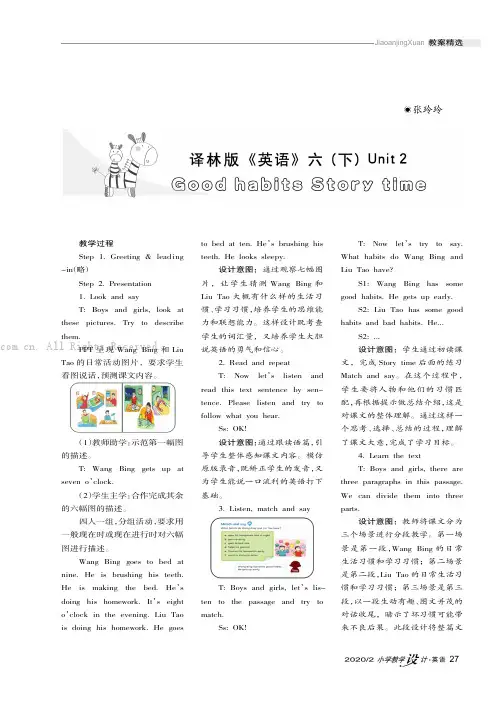
张玲玲教学过程Step 1.Greeting &leading -in (略)Step 2.Presentation 1.Look and sayT:Boys and girls,look atthese pictures.Try to describe them.PPT 呈现Wang Bing 和LiuTao 的日常活动图片,要求学生看图说话,预测课文内容。
(1)教师助学:示范第一幅图的描述。
T:Wang Bing gets up atseven o ’clock.(2)学生主学:合作完成其余的六幅图的描述。
四人一组,分组活动,要求用一般现在时或现在进行时对六幅图进行描述。
Wang Bing goes to bed atnine.He is brushing his teeth.Heismakingthebed.He ’sdoing his homework.It ’s eighto ’clock in the evening.Liu Taois doing his homework.He goesto bed at ten.He ’s brushing his teeth.He looks sleepy.设计意图:通过观察七幅图片,让学生猜测Wang Bing 和Liu Tao 大概有什么样的生活习惯、学习习惯,培养学生的思维能力和联想能力。
这样设计既考查学生的词汇量,又培养学生大胆说英语的勇气和信心。
2.Read and repeat T:Nowlet ’slistenandread this text sentence by sen-tence.Please listen and try to follow what you hear.Ss:OK!设计意图:通过跟读语篇,引导学生整体感知课文内容。
模仿原版录音,既矫正学生的发音,又为学生能说一口流利的英语打下基础。
3.Listen,match and sayT:Boys and girls,let ’s lis-ten to the passage and try to match.Ss:OK!T:Now let ’s try to say.What habits do Wang Bing and Liu Tao have?S1:Wang Bing has some good habits.He gets up early.S2:Liu Tao has some goodhabits and bad habits.He...S2:...设计意图:学生通过初读课文,完成Story time 后面的练习Match and say 。
六年级下册英语教案-Unit2 Good habits Story time 译林版
英语(六年级下册)Unit 2 Good habitsStory timeTeaching contents 教学内容Story timeTeaching aims and learning objectives 教学目标1. 能听懂、会说、会读、会写He gets up early in the morning. He never goes to bed late. He also does well at home. 等句型以及messy, tidy, early, late, habit, never, finish, fast, put... in order, bad, sleepy, last night等词汇。
2. 能正确朗读课文,理解其大意,并能复述课文内容。
3. 能尝试根据所学短语和句型来描述自己和别人的习惯。
4. 能分清好坏习惯,并知道以好的习惯来要求自己,让自己拥有更多好的习惯。
Focus of the lesson and predicted area of difficulty 教学重点和难点教学重点:1. 能听懂、会说、会读、会写He gets up early in the morning. He never goes to bed late. He also does well at home.等句型以及messy, tidy, early, late, habit, never, finish, fast, put... in order, bad, sleepy, last night等词汇。
2. 能正确朗读课文,理解其大意,并能复述课文内容。
教学难点:能尝试根据所学短语和句型来描述自己和别人的习惯。
Teaching procedures 教学过程Step1 Learning aimsT: Let’s look at what will we learn today. (PPT呈现本节课学习目标)T: First, we can read the story. Second, we can retell the story. Third, we can try to talk about the good habits.Step2: Presentation1. T: We have a good friend, Yang Ling. Do you want to know her well?Listen to my chant carefully. (初步感知新的短语词汇)2. T: You know my good friend in my chant. She gets up early and never goes to bedlate. (板书get up early, never…) What does “never goes to bed late mean”, A or B? (PPT呈现小图,新授early & late)T: Do you get up early and go to bed early?I think we should get up early and go to bed early.T: And Yang Ling often puts her things in order. (板书put… in order, 通过before, morning引导学生读order)T: Do you often put your things in order?S: Yes, I do./No, I don’t.T: Good. She often puts her things in order, so she keeps her room clean and tidy.(新授tidy = not messy)T: In the chant, do you remember when she finishes her work?S: She finishes her work before nine o’clock. (PPT呈现句子)T: When do you usually finish your homework? (板书finish one’s homework…) S: I usually finish my homework at/ before...3. T: Look at the four sentences. What are they about? They are about habits.So today we’ll learn a new lesson——Unit2 Good habits.(揭示并带读课题)Step3: Story time1. T: You know a lot about Yang Ling’s habits. Look, who are they?S: They're Wang Bing and Liu Tao. (贴人物头像)T: What habits do they have? Discuss in pairs.S: Maybe Wang Bing.../ Maybe Liu Tao...T: Well, I have some choices. Let’s read them first.T: Please watch the cartoon, and then finish the match in groups of four. (教师先播放卡通,然后学生小组讨论后一起回答)S: Wang Bing finishes his homework early. Wang Bing puts his things in order.Wang Bing gets up early.Liu Tao does his homework late at night. (板书do one’s homework late)Liu Tao goes to bed late. Liu Tao helps his parents. (板书help…)2. T: What other habits do they have? Please read the story again and find them.S: Wang Bing brushes his teeth in the morning and before bedtime. (板书brush one’s teeth…)T: Before bedtime means he brushes teeth…S: He brushes teeth before he goes to bed.Liu Tao listens to his teachers and keeps his room clean and tidy.(板书listen to the teachers …keep the room …)3. T: Good. They have a lot of habits here.But what are the good habits? And what are the bad habits?(学生小组讨论后汇报答案)T: We know Liu Tao often does his homework late at night and goes to bed late, so he often feels … in the morning.S: So he often feels sleepy in the morning. (板书feel sleepy…)4. Think & write指导学生完成P18 Think and write5. Reading time1) Listen & imitate2) S: Read the story in boys/ girls. (Boys read “Wang Bing”, Girls read “Liu Tao”)6. Retell the storyStep4: ConsolidationT: We are going to have a class meeting to talk about good habits and bad habits.a. Name some good/ bad habits.b. Talk about your good habits and bad habits.c.Talk about your friend’s good habits and bad habits.(学生可以两人或四人一组,小组讨论并课堂汇报)Homework 家庭作业1. Listen and read the Story time three times.2. Retell the story to your friends.3. Talk about your good habits and bad habits to your parents.4. Find out more good habits and bad habits.Teaching aids 教学准备教学准备:PPT板书设计:Unit 2 Good habitsWang Bing (人物头像) Liu Tao(人物头像)get up early, never… listen to the teachers…brush teeth… keep the room …put… in order help...finish one’s homework… do one’s homework late…feel sleepy…说课本课以习惯为话题开展教学,源于生活,学生有话可说,有感可谈。
六年级下册英语教案-Unit2 Good habits Grammar time 教案 译林版
六年级下册英语教案-Unit2 Good habits Grammar time 教案译林版教学目标1.了解英语中现在进行时的构成方式和用法。
2.学会运用现在进行时表述正在进行的动作以及习惯和规律。
3.通过对实例的分析和练习,掌握现在进行时的语法点。
教学重点难点1.现在进行时的构成方式。
2.现在进行时表述正在进行的动作的语法点。
3.现在进行时表述习惯和规律的语法点。
教学准备1.教材课本和练习册。
2.录音机和音频文件。
3.课堂教学PPT。
教学过程步骤一:引入话题通过图片或录音等来引入课堂话题,比如“看,Tony正在打篮球”,强调正在进行的动作。
步骤二:梳理语法知识点讲解现在进行时的构成方式:be动词(am、is、are)+ 现在分词(-ing)。
举例说明:I am playing basketball.She is watching TV.They are playing computer games.讲解现在进行时表述正在进行的动作的语法点,强化现在进行时的使用场景。
举例说明:The children are swimming in the pool.She is cleaning her room now.Tom is playing chess with his friends.讲解现在进行时表述习惯和规律的语法点,强化现在进行时除了表述正在进行的动作外的其他用法。
举例说明:I am practicing speaking English every day.The students are always playing basketball after school.She is often reading books in the library.步骤三:教学实践通过创设情境或提供练习题,让学生进行实践。
举例说明:请用现在进行时表述下列动作:1.孩子们正在玩玩具。
2.她正在写信。
3.我们正在听录音。
六年级英语下册Unit 2 Good habits(Story time)译林版 (5)
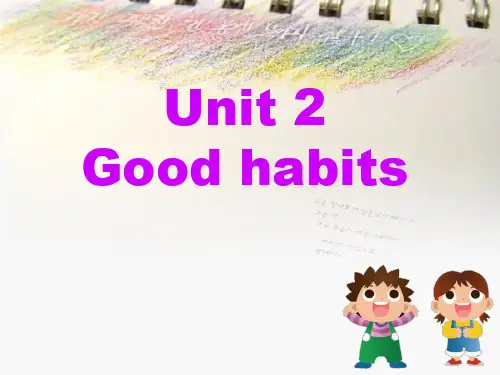
They
often do their homework in the evening.
He sometimes feels sleepy
in the morniபைடு நூலகம்g.
He never
goes to bed
late.
人称代词 频度副词
动词 时间/地点
Good habit
如果你觉得always做某件事很困难,可以 选择usually/often/sometimes/never…
morning
at home
at night
Do a survey
Name
Activities
How
When/Where
go to bed
early
at night
Tip: 如果是第三人称,不要忘记动词的变化哦!
Name
Activities
How
When/Where
go to school early in the morning
I keep my room clean and tidy.
Fun time Pick and say
Pick one!
OK.
Do you go to bed early?
Yes, I do.
That’s a good habit.
Thank you!
Pair work
Tip: Pick one picture and practice in pairs.
I have breakfast
on time. I get up early, never go to bed late.
I finish my work before nine o’clock!
小学英语6BUnit2Goodhabitsstorytime教案(译林英语)
小学英语6B Unit2 Good habits story time教案(译林英语)译林英语6B Unit2 Gd habits第一时(str tie)一、Teahing ntents教学内容:str tie二、Teahing ais and betives教学目标:1 能正确理解、朗读并可以根据提示复述内容。
2 能听懂、会读、会说单词: tid, ess, habits, in rder, finish alas sleep bedtie3 能尝试根据所学短语和句型描述自己的习惯。
4 能初步根据提示写出好的习惯。
能分清好坏习惯,并知道以好的习惯要求自己,让自己拥有更多好的习惯。
三、Fus f the lessn教学重点:1 能正确理解、朗读并可以根据提示复述内容。
2 能听懂、会读、会说单词: tid, ess, habits, in rder, finish alas sleep bedtie3 能尝试根据所学短语和句型描述自己的习惯。
四、predited area f diffiult教学难点:1 能尝试根据所学短语和句型描述自己的习惯。
2 能初步根据提示写出好的习惯。
3 能分清好坏习惯,并知道以好的习惯要求自己,让自己拥有更多好的习惯。
五、Preparatin前准备:挂图,头饰,多媒体(PPT)六、Teahing predures教学过程:Step1 ar up1 Let’s l hat d e learn tda Sh the learning ais2 I a ur ne English teaher nae is Fann I a thirt D u ant t n e ell?3 Listen t hant arefull(初步感知新的短语词汇。
)hant: I’Fann,I a thirtI get up earl, never g t bed lateI eep r lean and tidI ften put things in rderI finish r befre nine ’lStep2 Presentatin1 T: u n in hant , I sa, I get up earl ,never g t bed late Thin abut :never g t bed late, eans A r B?(sh the pitures)Read the ne rd并板书。
译林六下unit2Goodhabits五课时教案
译林六下unit2 Good habits 五课时教案Teaching contentStory time.Teaching aims and learning objectivesBy the end of the lesson, students will be able to1. 能正确理解、朗读课文并可以根据提示复述课文内容。
2. 能听懂、会读、会说单词: tidy, messy, habits, in order, finish always sleepy bedtime.3. 能尝试根据所学短语和句型来描述自己的习惯。
4. 能初步根据提示写出好的习惯。
5. 能分清好坏习惯,并知道以好的习惯来要求自己,让自己拥有更多好的习惯。
Focus of the lesson and predicted area of difficulty1. 能正确理解、朗读课文并可以根据提示复述课文内容。
2. 能听懂、会读、会说单词: tidy, messy, habits, in order, finish always sleepy bedtime.3. 能尝试根据所学短语和句型来描述自己的习惯。
Teaching aids 头饰,板书制作,PPTTeaching proceduresStep1 Warming-up1. T: Let ' s look what do we learn today. Show the learning aims.2. T: Do you want to know me well?3. Liste n to my cha nt carefully.初步感知新的短语词汇。
)Step2 Presentation1. T: You know in my chant, I say, I get up early, never go to bed late. Think about: never go to bed late, means A or B?(show the pictures)Read the new word 并板书。
译林版英语六年级下册Unit2 Good habits 教学设计
译林版英语六年级下册Unit2 Good habits 教学设计教学目标•了解并掌握Good habits的相关单词和短语;•掌握Good habits的重要性和影响;•能够以英语表达自己的好习惯。
教学准备•Good habits相关的课件或教材;•单词卡片、图片、小黑板等教具;•计算机、投影仪等多媒体设备。
教学步骤步骤一:导入首先,用适合六年级学生的方式引入主题“Good habits”,例如可以展示一些有趣的图片,例如一个宠物狗在地上玩耍,或一个干净整洁的房间。
然后,老师可以问学生有哪些个人习惯是好习惯,并让学生讨论和交流。
步骤二:学习相关单词和短语在这一步骤中,老师将向学生介绍一些与好习惯相关的词汇和短语。
例如:•brush teeth:刷牙•wash hands:洗手•eat breakfast:吃早餐•do exercise:做运动•clean room:打扫房间•be polite:有礼貌•be helpful:有帮助性老师可以将每个单词或短语写在黑板上,并使用图片或卡片等教具进行辅助,以帮助学生记忆。
步骤三:了解Good habits的重要性和影响在这一步骤中,老师将向学生介绍良好习惯的重要性。
老师可以与学生一起讨论以下问题:•什么是好习惯?好习惯有哪些好处?•如果没有良好的习惯,会发生什么?反之,拥有良好的习惯会给我们带来什么好处?•如何养成好习惯?学生们对此有何建议?步骤四:运用所学知识在这一步骤中,老师将鼓励学生运用所学知识表达自己的好习惯,并与同学分享。
老师可以准备卡片或者其他的小道具,让学生们在上面写下自己的好习惯,然后鼓励他们和同桌一起分享。
学生可以使用英语,描述他们的习惯并向同学解释这些习惯的好处。
步骤五:巩固知识最后,老师可以测试学生对所学知识的掌握程度,例如可以准备一些练习题,并让学生独立完成。
老师也可以通过提问的方式对学生进行复习和测试。
总结通过本次课程,学生将学习Good habits的相关单词和短语,了解良好习惯的重要性,并学会用英语表达自己的习惯。
译林版英语六年级下册Unit2 Good habits 教案
译林版英语六年级下册Unit2 Good habits 教案一、教学目标1.掌握本课时的单词和短语。
2.听、说、读、写本课时的故事和对话。
3.了解交通规则,养成良好的交通安全习惯。
二、教学内容1. 单词和短语1.traffic light2.crosswalk3.pedestrian4.car5.stop6.go7.wait8.safe9.dangerous10.habit2. 故事和对话本课时的故事和对话主要围绕交通安全习惯展开,以培养学生的交通安全意识和良好习惯。
3. 交通规则介绍基本交通规则,如行人应走人行道,遇到红灯停,遇到绿灯走等。
4. 交通安全意识通过故事和对话的讲解,培养学生的交通安全意识,增强学生的交通安全知识。
三、教学方法1.情境教学法:通过故事情境和对话情境来引导学生学习和理解。
2.归纳法:通过解释单词和短语的含义,让学生通过归纳的方式掌握更多相关单词和短语。
3.听说读写训练法:通过多种训练方式,培养学生听说读写的能力,帮助学生更好地理解和掌握知识。
四、教学步骤第一步:导入通过文字、图片等多种方式,让学生对本课时的主题有所了解,调动学生的学习兴趣。
第二步:单词和短语通过灵活的方式引导学生掌握本课时的单词和短语,如通过分类、图片、句子等方式。
第三步:故事和对话通过故事和对话的讲解,让学生了解和学习交通安全习惯,培养学生的交通安全意识。
第四步:交通规则通过讲解基本的交通规则,让学生了解和掌握交通常识,如何在日常生活中保护自己。
第五步:练习通过听说读写等多种方式,让学生巩固所学的知识和技能。
第六步:总结通过小组合作或个人发言的形式,让学生回顾所学知识,总结本课的重点和难点。
五、教学评价1.观察学生的听说读写能力,了解学生的学习情况。
2.通过小组合作或个人发言等方式,了解学生对本课的理解和掌握情况。
3.提供多种评价方式,如测验、考试等,评价学生的学习效果。
Unit2Goodhabits第1课时(教学设计)storytime六年级英语下册(译林版三起)
Unit2 Good habits Story time
生的发散思维,还能通
过这样的问题引导学生
“人与自我”意识的觉
醒,水到渠成地实现了
人文性的渗透。
板书设计:Unit 2 Good habits (Story time)
教学反思:
通过形式多样的教学活动,激发学生的兴趣,调动学生学习的积极性,提高学习效率。
通过Enjoy a song和Brain storm激活学生已有知识储备,为课文学习做铺垫。
设计层层递进教学环节极大地激发了学生的学习兴趣,助推了学生判断、分析、评价、创造等高阶思维品质的发展,为学生的语言表达提供了支撑,促进了学生综合语用能力的发展。
联系自己生活实际谈论习惯的好坏以及如何培养好的习惯,旨在培养学生运用语言做事的能力,助于良好习惯的养成,唤醒学生“人与自我”意识,渗透立德树人的育人目标。