
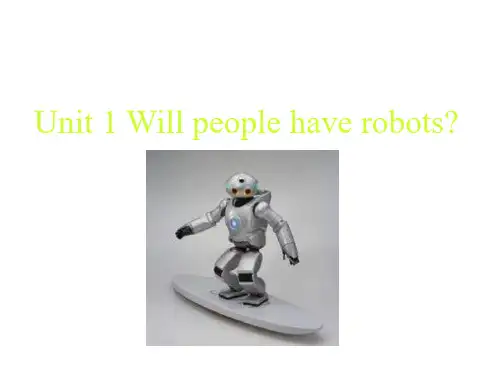
八年级英语新目标下Unit 1 Will people have robots 第三课时课件
After 100 years….
Will
there
be
less
free
time ?
Yes, there will.there will be less free time
Will there be more pollution? Yes, there will.
He/she played… He/she plays… He/she had… He/she has…
1.People will have robots in their homes b 100 years. A at b in c after d with 2. Will there c more cars in people’s homes? A have b has c be d / 3. I think there will be c people and pollution. A fewer, many b less, fewer c more less d less, fewer 4. There won’t be any d in 100 years. A paper moneys b papers money c papers moneys d paper money 5.I think every home will b a car. A be b have c has d there be 6.There are two white d on the desk. you can have one. A paper b piece of paper c papers d pieces of paper 7 will there be more trees? Yes, b . A they will b there will c there will be d there have
Five years ago, I was in primary school, I played football with classmates after class, and I had a dog. Now I’m a middle school student, I like playing tennis . I am good at English and I have good grades. In five years, I will be a doctor, I will make much money, and I will travel around the world. I will play the guitar . I will have a parrot .
对活动进行提问
1.Five years ago, Sally was in high school . 2.She played Soccer . 3.She had a cat .
4. Today, Sally is in college. 5. She plays the guitar. 6. She has a dog.
A: Do you think there will be robots in people’s homes? B: Yes , there will. I think every home will have a robot. A: Will kids go to school? B: Kids won’t go to school. They will study at home on computers.
Now write about yourself.
Five years ago I was I played I had
Today, I am I play I have
In five years, I will be I will play I will have
Practice : Write a short passage about yourself
Do a survey about your friends and finish the following chart.
Five years ago He /she was… Today He/she is … In five years He/she will be… He/she will play… He/she will have…
Make dialogues of 1a.
Will there be fewer cars ?
No, there won’t. There will be more cars.
Will
there
be
more
people ?
Yes, there will.
Will
there
be
fewer
trees ?
7. In five years, Sally will be a doctor. 8. She will play tennis. 9. She will have a car/a c: What do you think Sally will be in ten years? B: I think she’ll be a doctor. A: What sport will she play? B: She’ll play… A: Will she have a baby ? B: Yes, she will have a baby.
Yes, there will.
six years ago,
I was in high school I played Ping-Pong I had electric dictionary Today I am a middle school teacher I play computer games I have a computer In six years I will be a businesswoman I will play tennis I will have a nice family
新目标英语八年级下unit1-will-people-have-robots
2. I ____________(go) to see your father as soon as I get to Beijing.
3. I think it _____________ (be) rainy tomorrow.
4. My father ___________ (send) me a new bike when I am tall enough.
5. We ___________ (visit) the Great Wall next Monday.
6. Who __________(give) us a talk on the computer in two days?
7. They _________ (build) a new modern house near the river next year.
(A D A C D C)
7. A bird can ______ but I can’t. A. flies B. flying C. flew D. fly
8. They _______ to see me yesterday evening. A. will come B. comes C. are coming D. came
Activity 3a
Do this part following the structure.
A task
Get the students to do a survey about their best friends and finish the following chart.
人教版新目标八年级下册《Unit1Willpeoplehaverobots》教案
人教版新目标八年级(下)第1单元第1课时学案Unit 1Will people have robots?Section A (1a—2c)【学习目标】1、学习并掌握以下单词或短语:will; won’t (=will not); robot(s); everything; paper (不可数); fewer (few的比较级); tree(s)2、学习并掌握“一般将来时态的概念、构成和用法”。
【重点难点】1、教学重点:学习并掌握“一般将来时态的概念、构成和用法”。
2、教学难点:学会运用一般将来时态,谈论将来要发生的事情。
【新知预习】根据所给汉语提示完成单词。
1. A ________ (机器人) can help people do the housework.2. ___________ (每件东西) is ready now.3. I need two big pieces of __________ (纸).4. There will be _________ (更少的) cars in 100 years.5. ________ (污染) makes fish die (死亡) in the river.6. There are more and more _______ (树木) in our country.【课堂探究】一般将来时表示将来某个时间要发生的动作或存在的状态,也表示将来经常或反复发生的动作。
一般将来时的肯定式为“助动词will + 动词原形”,否定式为“will + not”,其疑问式是“把will置于主语前”。
Will没有人称和数的变化。
常与表示将来的时间状语tomorrow, next week, in the future, in five years等连用。
will在名词或代词后常缩略为’ll,will not 常缩略为won’t。
请体验:1. He ________ ________ (come) over to our school next week. (动词填空)2. He ________ ________ (come) over to our school next week. (把第1题变成否定句)3. ________ he ________ over to our school next week? (把第1题变为一般疑问句)4. ________ ________ he come over to our school? (根据第1题划线部分提问)【达标练习】一、用括号中所给单词的适当形式填空,每空一词。
新目标八年级下Unit1 Will people have robots_课件

B: No, they won’t. Everything will be free. Will people live to be 200 years old?
A: Yes, they will.
Will there be omnolyreopneocpoleun?try?
No, they won’t=will not. They’ll study at home on computers.
= They will
Will people use money in the future?
Yes, they will. No, they won’t. Everything will be free.
2b: Listen again. Check the predictions you hear.
1. _____There will be more / less / fewer people. 2. _____There will be more / less /fewer free time. 3. _____There will be more / less / fewer cars. 4. _____There will be more / less / fewer pollution. 5. _____There will be more / less / fewer trees.
DIot mwoisltl psewopeleephatvheerofblootosrnofowr? me.
Will people have robots in the future(未来)?
人教新目标英语八下Unit1 Will people have robots教案9

Unit1 Will people have robots?Section ATeaching Aims and Demands1.Knowledge and Ability Objects(1)key vocabulary:Prediction; robot; will; won’t; pollution; use(2)Key structures:Will people have robots in people’s homes?Yes, there will / No, there won’t.Will there be less pollution?Yes, there will / No, there won’t.(3)To train students’ listening skill and communicative competence.2.Method Objects in Teaching(1)listening and speaking methods(2)Discussion method(3)Pairwork and Groupwork3.Sensibility and ValueTo be interested in learning English.Teaching DifficultyTo master the key structuresTeaching Aids1. A tape recorder2. A computer for multimedia useTeaching ProceduresStepⅠ Greetings and lead-inT: Hi! Boys and girls!S: Hi! Teacher!T: Have you got a good winter vacation?S: Yes / No.T: Ok. Now can you tell me where you went?S1: I went to…..S2: I visited my grandma……S3: I stayed at home……T: Ok. Where are you going in your next vacation? Well, in this unit we will learn to say what isgoing to happen before it happens. That’s to say, we will learn to make predictions.(Teacher writes “prediction’’ on the board and teaches this word to the students.)Ste pⅡLanguage StudyDraw a simple time line on the blackboard. Point to the date and ask the students some questions to teach them how to make predictions.T: Will you live in the same house in a year?S: Yes / No……T: When you want to say what is going to happen before it happens, we use “will”or“won’t”. “in a year”means“after a year”.Now think ahead, will you live in this city in five years from now? Volunteer!S1: I won’t live in this city……S2: Yes, I think so…….T: what about ten years? What job will you have? Will you have children?S: Yes / No…………T: In 100 years , will people have robots?S: Yes, they will. / No, they won’t.T: Will people/kids……?……Ste pⅢPairworkGive an example on the screen. Ask students to read them (Boys ask, girls answer/exchange) Have students work in pairs. As students work, move around the room giving support as needed. And have some pairs to show their conversations.Ste pⅣGuessing GameDivide students into two groups. Do a competition of answering the question according to the pictures. If their answers are right, their groups will get a star. The group which get the more stars, they will win the prize.Ste pⅤlistening practiceDo the listening practice in the Activtity1a.Play the recording.Check the answersSte pⅥPairworkPoint out the new sentence pattern. “Will there be……? Yes, there will. / No, there won’t.”Ask some questions about the them.Have students work in pairs. After some minutes. invite some pairs to say their conversations.Ste pⅦListening practiceDo the listening practice in Activity 2b.Play the recording.Check the answers.Ste pⅧGroupworkHave students work in four or five. Put the two sentences patterns together, make their own conversations. As students work , move around the room giving support as needed. Then check their conversations.Ste pⅨFree TalkHave students talk with their partners. Make the predictions about the city.Then let students talk about their ideas one by one.Ste pⅩDrawingStudents find their own partners. Draw a picture of the city tomorrow, and describe it to the class. They can use“will”or“won’t”Then put the pictures anywhere in the classroom. Next, invite a teacher to choose the best one and give the prize to the students.StepⅪSummaryToday, we have learned some key words and key structures. Pay attention to the simple future tense……Ste pⅫHomewokPractice the sentences patterns after class. Draw a picture showing what life will be like in 100 years.。
八年级英语下册Unit1Willpeoplehaverobots教案1人教新目标版

八年级英语下册Unit1Willpeoplehaverobots教案1人
教新目标版
福建省长泰县第一中学八年级英语下册《Unit1Willpeoplehave
第一课时教学内容与分析教学内容:(ectionA1a—2c)教学目标:a:学会用将来时态预言,学会比较级和最高级(fewmorele)b:训练学生听
力和交际能力。
教学重点和难点分析教学重点:在预言中会使用将来时态进行交际活动。
教学难点:学会使用将来时态来预言。
课前准备:1.教
师准备多媒体或教学挂图。
教师准备磁带和录音机。
课时安排5课时
第一课时:SectionA(1a—2c)第二课时:
SectionA(3a---3c)第三课时:SectionB(1a----2c)第四课时:SectionB(3a---3b)第五课时:
Section1---2单元目标与要求1.掌握有关预言的词汇2.学会使用fewer,le,more来谈论可数与不可数名词3.掌握
Therewillbe…,omebodywill…的将来时态及答语。
4.学会谈论将来以及同学对将来世界的变化的想法。
5.通过本单元的学习,引导学生懂得珍
惜今天的时间来学习为将来找份好工作而努力学习。
6.通过本单元对将
来的预言使学生学会保护环境,防止环境污染以及培养学生分析与观察能力。
英语新目标八年级下册unit1Willpeoplehaverobots课文及导学案

英语新目标八年级下册unit1Willpeoplehaverobots课文及导学案Unit 1 Will people have robots? 课文及导学案SECTION A1a SENTENCES1.People will have robots in their homes.2.People won?t use money. Everything will be free.3.Books will only be on computers, not on paper.4.Kids won?t go to school. They?ll study at home on compute rs.5.There will only be one country.6.People will live to be 200 years old.1c PAIRWORKA: Will people use money in 100 years?B: No, they won?t. everything will be free. Will people live to be 200 years old?A: Y es, they will.Grammar Focus—Will there be less pollution? —No, there won?t. There will be more pollution.—Will there be fewer trees? —Y es, there will.—Kids won?t go to school. Kids will study at home on computers.3aFive years ago, Sally was in high school. She played soccer. She had a cat.Today, Sally is in college. She plays the guitar. She has a dog.In five years, Sally will be a doctor. She will play tennis. She will have a car.SECTION B3aIn ten years, I think I?ll be a reporter. I?ll live in Shanghai, because I went to Sh anghai last year and fell in love with it. I think it?s really a beautiful city. As a reporter, I think I will meet lots of interesting people. I think I?ll live in an apartment with my best friends, because I don?t like living alone. I?ll have pets. I can?t have any pets now because my mother hates different pets.I might even keep a pet parrot. I?ll probably go skating and swimming every day. During the week I?ll look smart and probably will wear a suit. On the weekend, I?ll be able to dress more casually. I think I?ll go to Hong Kong on vacation, and one day I might even visit Australia.SELF CHECK2 Predicting the future can be difficult. There are many famous predictions that never came true. Before 1929, there was no sound in movies. The head of one of the biggest movie companies in the United States predicted that no one would want to see actors talk. Of course, he was wrong! In 1977, the head of the largest computer company in the United States said, …“No one will want to have a computer in his or he r home.” He thought that computers would never be used by most people.SECTION 2 While Y ou ReadDo you think you will have your own robot?In some science fiction movies, people in the future have their own robots. These robots are just like humans. They help with the housework and do the most unpleasant jobs.Some scientists believe that there will be such robots in the future. However, they agree it may take hundreds of years. Scientists are now trying to make robots look like people and dothe same things as us. Japanese companies have already made robots walk and dance. This kind of robot will also be fun to watch.But robot scientist James White disagrees. He thinks that it will be difficult for a robot to do the same things as a person. For example, it?s easy for a child to wake up and know where he or she is. Mr. White thinks that robots won?t be able to do this. But other scientists disagree. They think that robots will be able to talk to people in 25 to 50 years.Robot scientists are not just trying to make robots look like people. For example, there are already robots working in factories. These robots look more like huge arms. They do simple jobs over and over again. People would not like to do such jobs and would get bored. But robots will never get bored.In the future, there will be more robots everywhere, and humans will have less work to do. New robots will have many different shapes. Some will look like humans, and others might look like snakes. After an earthquake, a snake robot could help look for people under buildings. That may not seem possible now, but computers, space rockets and even electric toothbrushes seemed impossible a hundred years ago. W e never know what will happen in the future!语法精讲(一)一般将来时1.主语+am/ is/ are going to +动原do2.主语+助动词will+ do (若主语为第一人称,也可用I/ We + shall do)3.部分动词如:come, go, leave, move, start, arrive, fly等常用进行时结构be+ doing 表示将来;4.表示将要有……, 用:There is/ are going to be +主语+其他;或There will be +主语+其他;E.g.: People will have robots in the future.否:People robots in the future.一般疑问句:people robots in the future?回答:Y es, . / No, .划线提问:people in the future?同义句:People robots in the future.(二)many/ much—more—most 表数量多,可修饰可数名词复数或不可数名词few—fewer—fewest 表数量少,只修饰可数名词复数little—less—least 表数量少,只修饰不可数名词用上述词的适当形式填空:1.They’ll do their work well with money.2.There are / buildings in our city than their city.3.There will be pollution if we plant trees.4.There are t oo many people here. It’s too crowded.5.I feel better now.6.He’s new here. He has friends, does he?(三)alone: adj./ adv. 表示形体上“单独的,独自地”lonely: adj. 表示精神上“孤独的,寂寞的”1.She is afraid to go out at night.2.It’s hard for him to finish the work .3.She lives and that makes her feel sometimes.(四)except: prep. 除……之外;(不包含…)All the students finished the homework except Nick. (指Nick 未完成作业)She goes to work every day except Sunday. (Sunday 除外)(五)It?s +adj.+ for sb. to do…= 主语+find (think, believe…) it +adj. to do…对某人来说做…太…了E.g.: Maybe these children find it hard to think for themselveswhen they’re older.= Maybe it’s hard for these children to think for themselves when they’re older.基础夯实一.根据音标和句意拼写单词1.I think r will do housework instead of people.2.Money is im portant, but money isn’t3.He / / a letter to his brother yesterday.4.He is a worker. He works in a5.Don’t worry about me. I can look after / /.6.He is too young to himself.二、选择填空:1.I saw a boy when I walked along the river.A. swimB. to swimC. swimmingD. swims2.are going home on a train.A. Mr. TurnerB. Mr. Turner’sC. The TurnersD. The turners’3.All the fruit is free. Y ou can eat .A. as many as possibleB. as much as possibleC. as more as possibleD. as many as possibly4.We need time a nd freedom ourselves after whole day’s work.A. relaxB. relaxesC. relaxingD. to relax5.We find easy to get along with him.A. isB. itC. thisD. that6.Wang Liqin the national team in 1998 and then he a lot of ping pong matches.A. joins; takes part inB. joins; took part inC. joined; takes part inD. joined; took part in7.People use money to buy food, books, bicycles and other things they need.A. a hundred ofB. hundreds ofC. two hundreds ofD. hundred of8.We’ll go for a picnic if it this Sunday.A. don’t rainB. doesn’t rainC. won’t rainD. isn’t raining9.Are you here on business or fun?A. inB. onC. atD. for10.The TV program was very and we all got .A. boring; boredB. bored; boringC. bored; boredD. boring; boring11.To be here at Christmas time is a dream that has .A. be trueB. comes trueC. come trueD. came true12.Please who broke the window.A. findB. look forC. look atD. find out13.I will see you on the moon .A. a dayB. every dayC. one dayD. everyday14.There will a concert in our city.A. haveB. hasC. isD. be15.—Do you like the city life or the country life?—It’s hard to say. In the city it is interesting, but in the country there is pollution.A. less; moreB. more; lessC. more; fewerD. much; much16.My life will be better than it is now.A. a lotB. a lot ofC. a fewD. more17.What will happen to our human 100 years from now?A. 100 years agoB. 100 years before nowC. since 100 years agoD. in 100 years18.This coat doesn’t fit him well, as he has a huge body and the coat is small.A. so; suchB. so; soC. such; suchD. such; so三、用括号内所给词的适当形式填空We can see robots in some places. There are robots 1 (work) in factories. They do simple jobs over and over again. People don’t want 2 (do) such jobs. In some rest aurants, we can see robots 3 (say) hello to people or serving dishing. Japanese companies have already made robots (walk) and dance. It’s fun 5 (watch). In the future, there (be) more robots everywhere, and humans will have (little) work to do.四、句型转换1.There is going to be a new building here in 2 years. (同义句)There a new building here 2 years .2.She can sing the song in French. (同义句)She the song in French.3.It took her 500 yuan to buy the ticket. (同义句)She 50 yuan / the ticket.She 50 yuan the ticket.4.My parents will go to Beijing in two years. (对划线部分提问) your parents to Beijing?5.He seems to like this book. (同义句)he likes this book.6.Cities will be big and crowded in the future. (否定句) Cities very big crowded in the future.7.We’ll go out for a walk with you. (同义句)We out for a walk with you.8.The weaher will be sunny tomorrow. (对划线部分提问)the weather tomorrow?五、完成句子1.学习使用计算机对你有好处。
新目标八年级下Unit1Willpeoplehaverobots?
新目标八年级下Unit 1 Will people have robots?Teaching goals:1. Words&phrases: robot, paper, less, fewer, simple, unpleasant, factory, seem, etc .2. will 构成的一般将来时态的陈述句、否定句、疑问句及回答.3. There be 句型的一般将来时.4. more , less , fewer 的用法.5. 学习一般将来时态的相关知识,学会对未来进行预测.6. 对five years ago ,today ,in five years 简洁回顾与展望的方式,贴近实际符合学生心理,激发学习兴趣.7. 通过时间对比复习一般过去时态、一般现在时态,巩固一般将来时.Important and difficult points :1. will构成一般将来时态的句式。
2. There be 句型的一般将来时态。
3. more , fewer , less 的用法。
4. How to make predictions .Period 1Teaching procedures:Step 1 Leading in1. Greetings: Welcome to school .What’s the date today ? Who’s on duty today ?Do you enjoy your winter holiday ?Do you finish your homework ?Do you want to live on the moon ?Can you guess what will happen in ten years ?Collect the Ss’ answers and say something about their predictions .Step 2 Pre-taskSB Page 2 ,1a .1. Look at the picture :How will the world be different in the future ,100 year s from now ?We’re going to talk about sth in 100 years .2. Read each predictions to the class .Explain the new vocabulary .3. Read the instructions .Make sure Ss know what they should do .4. Do it by themselves .5. Talk about the answers with the class .Explain :一般将来时态构成: will / be going to +动词原形Step 3 While-taskSB Page 2 ,1b .1. Practise reading the six predictions .2. Read the instructions to Ss .Circle the things you hear on the recording .3. Play the tape twice .4. Play the tape a third time .At the same time ,check the answers .SB Page 2 , 1c .1. Pay attention to the dialogues .2. Read the dialogues fluently .3. Pairwork .Work in pairs to make predictions according to the sample .4. Ask several pairs to share their conversations to the class .SB Page 3 , 2a & 2b .1. Read the predictions .2. Read the instructions and point out the sample answer .3. Play the tape twice .Ss circle the word they hear in eachsentences: more , less , fewer .4. Check the answers .学生探究: less , fewer 的区别。
新目标初中英语八年级下册Unit1 Will people have robots教案
Unit1 Will people have robots? (Revision)一、第一轮复习总策略我个人认为中考第一轮复习至关重要。
教师应以《英语课程标准》和《2013年浙江省初中毕业生学业考试说明》为准绳,以教材为依托,目的是让学生吃透教材,全面掌握课本的语言知识(如词汇、语法等),同时教师要带领学生把语言知识运用到真实语境中,并进行横向及纵向的归纳。
另外,复习过程中,教师可适当增加学生课外知识的积累(如词汇、句子等)。
学生在教师的帮助指导下,快速回忆已学知识的同时,进行查漏补缺,整合考点。
二、本课时复习目标1.语言技能目标(1)复习使用will引导的一般将来时态的各种句型对将来发生的事情进行想象和预测。
(2)复习“more/ less/ fewer”这类形容词的比较级来表达过去与现在或现在与未来的区别。
(3)用一般将来时态规划和憧憬自己的美好未来。
2.语言知识目标(1)复习用(will)引导的一般将来时态的肯定句、否定句、一般疑问句及其肯定与否定的回答,如:Will foreign teachers come to work in the new school?Yes, they will. /No, there won’t.Will there be more buildings in the school?Yes, there will. / No, there won’t.(2)复习“more / less / fewer”这类形容词比较级修饰名词的用法,如:There will be less air pollution at school in the future.(3)复习巩固词汇,如be able to, dress casually, less housework, on paper, in the future, come true, fall in love with, already…3.情感态度目标(1)通过对学校过去、现在和未来的比较,让学生为自己学校的变化感到骄傲自豪,并将为学校的美好未来而努力;(2)用将来时态表达对美好未来的规划,懂得珍惜眼前的机会和时光,努力实现自己的愿望。
新目标八年级英语下册Unit1教学设计
新目标八年级英语下册Unit1教学设计新目标八年级英语下册Unit 1教学设计Unit 1 Will people have robots?单元教学设计方案一、教学内容: Unit 1 Will people have robots?二、教材及学情分析:本单元围绕“谈论问题” 及“提出建议”这两个话题,设计了相关的语言背景。
Section A1a-2c呈现了本单元的重点语法现象一般将来时表示猜测的用法,然后设计了听力活动、结对活动以及小组活动,从听说角度训练了本单元的核心句型,并在Grammar Focus中进行了归纳总结。
Section A3a-Part4所涉及的活动则先通过与一般过去式和一般现在时的对比,让生进一步了解、掌握一般将来时的结构与用法。
Section B1a-2b先通过词类的分组活动,呈现了听力材料中所要用到的词汇;接着设计了两个听力活动,分别从两个层面,从宏观到细节,帮助学生掌握一般将来时的意义、结构和用法。
2c- Part 4设计的活动,则通过说、读、写的活动,对学生的三种时态的运用能力进行了综合训练,旨在帮助学生形成创造性地运用所学三种时态的能力。
Self Check让学生通过活动对自己遣词造句能力及语言综合能力进行了自我评价。
课后所选的阅读材料依然紧扣本单元的语言目标,学习掌握基本的阅读策略,即根据文章标题和相关图片预测文章的大体内容,以获取更多信息的能力,从而让语篇教学成为实现情感态度与价值观目标的有效载体,通过描述未来,调动学生学习积极性,发挥想象力,帮助其树立正确的人生观和价值观:只有付出,才有收获。
八年级上Unit 3 What are you doing for vacation? Unit 10 I’m going to be a basketball player. 已经学习了一般将来时,学生已经学会用现在进行时谈论未来的计划,用be going to句型谈论未来的打算。
八年级英语新目标下 Unit 1 Will people have robots教案.
Unit 1 Will people have robots?I. Teaching goals1)Target languagesWhat do you think life will be like in 100 years?Every home will have a robot.Will kids go to school?No, they won’t. They will study at home.There will be fewer trees.2)Ability goalsrobot ,pollution astronaut apartment space station moon free time3)Language ability goals Make predictionsII. Teaching important pointsMake predictionsIII. Teaching difficult pointsFuture with willYes /No questions with short answersQuestions with more, less, fewerIV. Teaching methods: Listening speaking reading and writingV. Teaching aids: a tape recorderVI.Teaching procedures and waysThe first period1)Teaching stepsStep 1 On the blackboard write a simple time line showing f our dates: today’ date ; a date exactly one year now; a date five years from now; and a date ten years from now.now in 1 year in 5 years In ten years|________|________________|___________________|Step 2 Point to the date “in 1 year” and ask the studentsWhat will be different in your life one year from now?Will you be at this school in a year?Will you live in the same house in a year?Will you be in my class in a year?Repeat the same procedure with the dates 5 years and 10 years in the future. Ask other questions to help students think aheadWill you live in this town five years from now?Will you be in college?Will you have a college five from now?What job will you have ten years from now?Will you have children ten years from now?After the students’ predictions, Underline the word “will” in each one.Step 3 Introduce the key vocabulary and the idea of making predictions Then say, in this activity we’re going to talk about more than five years or ten years in the future we’re going to talk about 100 years in the future.Step 4 Let students practise in understanding the target language in spoken conversationStep 5 Play the recording the first time. Students only listen then listen to the conversation again pe ople are making predictions about the future. Circle the predictions they’re talking about on the recording and correct the answer.2)Writing design on the blackboardnow in 1 year in 5 years In ten years|________|________________|___________________|What will be different in your life one year from now?Will you be at this school in a year?Will you live in the same house in a year?Will you be in my class in a year?Will you live in this town five years from now?Will you be in college?Will you have a college five from now?What job will you have ten years from now?Will you have children ten years from now?3)Homework 1 .Recite the new words2. Practise the conversation made in class.4)Summary afte teaching: T he students have learned to make predictionThe second period1)Teaching stepsStep 1 Revise the words and expressions and ask some students to make predictions in the future. Step 2 In2a point out the list of predictions and ask different students to read the predictions to the class. Read the predictions and point the sample answerStep 3 Play the recording . Students circle the word they hear on the recording in each sentence : more, less, fewer. Then check the answer.Then the students listen to the recording again and check the predictions they hear and check the answersStep 4 Grammer focus : ask the students to say the statements and reponses. Review the concept of countable and uncountable nouns by writing the two words on the blackboard and asking different students to e to the board and write example of each under the heading.Countable nouns uncountable nounseggs watercookies milkapples orange juicebananas meatStep 5 Point to the three pictures and say, this is Sally. This is Sally five years ago, this is Sallynow, and this Sally five years in the future. Read the instructions and ask the students to plete the work on their own. Check the answers by calling on different students to make predictions about Sally.2)Writing design on the blackboardCountable nouns uncountable nounseggs watercookies milkapples orange juicebananas meat3) Homework recite 3a4)Summary afte teaching: The students have learned to make predictionThe third period1)Teaching stepsStep 1 Review making predictions about the future.Step 2 Teach: rocket ,astronaut , space station, puture programmer,crazy, live, moon, transportation, petAsk the students to say in their own words what each heading means. And write these words on the blackboard and using a simple drawing or a brief explanationto describe each one.Step 3 Listen to the recording of 2a. Students will hear three conversations. Decide which conversation goes with each picture. Write the number of each conversation next to one of the pictures. Play the recording a second time ,students number the pictures.Step 4 Listen and write using the target language. Write the correct words from the box on the blank lines.Step 5 Reading and writing (3a)First point to the p aragraph and say: First read Li Ming’s answer. Then write down any questions you would like to ask about the story. We’ll answer these questions together. Ask students to pletethe chart on their own and check the answers:Job: reportPets: parrot, many othersSports: skating swimmingPlace: Shanghai, Hong Kong, AustraliaClothes: smart clothes, to wear a suit (during the week); casual clothes(at the weekend)2)Writing design on the blackboardJob: reportPets: parrot, many othersSports: skating swimmingPlace: Shanghai, Hong Kong, AustraliaClothes: smart clothes, to wear a suit (during the week); casual clothes(at the weekend)3)Homework recite 3a4)Summary afte teaching: The students have learned to make predictionThe fourth period1)Teaching stepsStep 1 for self check Ask students to fill in the blanks on their ownand check the answers.Step 2 Task1: Teacher: you all have your childhood. What did you do when you were young? Now you ‘re middle school students, what do you often do in your school or at home? In some years you’ll leave school, what will you do in the future?Work in groups eg: I was a little boy……years agoI am a middle school student now.I’ll be a teacher….in ….years.Classmates: He was…….He is a…….He’ll be……Task 22008年奥运会时的我Fill in an application formStep 3 reading and prehension:Reading strategy:1.Look at the title and picture and predict what you’ll read about.2.This helps you get ready to acquire new information.Find exmples of the following structures in the reading. Then make your own sentensces: ….the same as…..….make…do…….to take…time to do sth….to help do….….to help with..2)writing design on the blackboardWork in groups eg: I was a little boy……years agoI am a middle school student now.I’ll be a teacher….in ….years.Classmates: He was…….He is a…….He’ll be……3)Homework: 1. Write a position to intreduce yourself.2.To fill in the form“2008年奥运会时的我”4)Summary afte teaching: The students have learned to make prediction。