
仁爱版英语八年级上册Unit1 Topic3 SectionC教学设计
Unit1Playing SportsTopic3The school sports meet is coming.(Section C)教学设计[Material analysis]通过阅读The Modern Olympics,拓展了学生的视野。
在预习本课时,学生需要从报纸、杂志、网络搜寻大量的有关奥运会的相关知识,培养了学生主动探究的精神。
本课有关奥运会的话题,让学生了解了奥运会的历史发展过程,明白运动的历史意义,有助于深化学生对运动的热爱之情,从而促进学生们积极主动地参加运动,让自己的身体更加健康。
本课巩固了本话题的语法重点Future Tense with will,呈现了重点短语:stand for,every four years, become more and more popular,have the chance to do sth.等。
课后要求学生能结合本单元内容,写一篇介绍自己学校运动会的文章。
[Teaching aims]Knowledge aims:1.能正确拼读下列单词:modern,Olympics,ring,stand,least,chance,whether,gold;能明白下列单词或短语的含义:motto,symbol,stand for,at least,nowadays,compete,host,beginning,medal.2.能在英语对话或文章中听懂、读懂下列短语:stand for,every four years,become more and more popular,have the chance todo sth.等。
3.能正确地理解下列句子并能加以运用:In the future,more cities will have the chance to hold the Olympics.The Olympic Games will be more exciting.The Olympics are becoming more and more popular.Skill aims:1.能听懂有关奥运会的对话及类似的英语文字材料。
2.能用英语和同学朋友简单谈论奥运会。
3.能读懂有关奥运会的对话或文章。
4.能介绍自己参加运动会的经历及意义。
Emotional aims:发扬奥运精神,积极锻炼,强身健体。
[The key points and difficult points]Key points:1.In the future,more cities will have…The Olympic Games will be more exciting.2.对every four years,become more and more popular,have the chance to do sth.等短语的理解及运用。
Difficult points:理解下列句子:They are held every four years.The Winter Olympic Games are usually held two years before the SummerOlympic Games.Nowadays,the Olympic Games are held by different cities in turn.[Learning strategies]在预习本课时,学生从有获取其他资源信息的能力,发展到主动探究学习的能力。
[Teaching aids]Computer multimedia projector,flash of Olympic GamesEveryday saying:A sound mind is in a sound body.健全的精神寓于健康的身体。
[Teaching procedures]Step Interactionpattern Student activity Teacher activityIntroduction (8minutes)1.The wholeclass work2.The wholeclass work3.The wholeclass work4.Somestudents’work5.The wholeclass work6.Group work7.The wholeclass work1.Focus their attention on the teacher.2.Students sing with the flash.3.Students show their papers to others.Then they look through others’information,trying to understand as muchas possible.4.V olunteers will introduce somethingabout Olympics.5.Students read with the teacher,thendiscuss and correct pre-reading task.Theyshould finish the pre-reading task beforeclass.6.A volunteer group introduces like this:In2008,the Olympic Games were held byBeijing.They may find the answers in3onP22.7.Students understand the new words withthe help of their background knowledge,thepictures and the teacher’s words.1.Greet students ready forlearning.2.Look the flash“Song ofHealth”sung by Fan Xiaoxuan.3.Ask the whole class to show theinformation about Olympics totheir partners.Then look throughthe information.Teacher writes“Olympics”on the blackboard.4.Teacher asks two or threestudents to say something aboutOlympics.5.Teacher writes“The ModernOlympics”on the blackboardand leads the students to read.Then teacher lets students finishpre-reading task on P21.6.Teacher calls a group tointroduce something about theyear and the place.7.Teacher shows the Olympicmotto and the Olympic rings,andteaches the new words“motto,ring,symbol”.Presentation (12minutes)1.The wholeclass work2.The wholeclass work3.Group work4.The wholeclass work5.The wholeclass work6.Group work1.Students finish1b by using theirbackground knowledge.2.Students read1a silently and finish1b.3.Avolunteer group tells:(1)the first—start(2)host city—Athens(3)motto—Faster Higher,Stronger(4)symbol—Olympic rings(5)five rings—stand for(6)the colors of five rings…(7)the Winter Olympic Games/the SummerOlympic Games—two years before4.All the students check the answers in theirbooks.5.Students try to understand the sentences.6.Students make sentences in groups:(1)We will have the chance to visitAustralia.(2)Our school sports meet will be moreexciting.(3)This song is becoming more and morepopular.1.Teacher asks the students tofinish1b before reading1a.2.Teacher asks the students toread1a and to check1b.3.Teacher lets the studentscommunicate with others aboutthe ways in which they find theanswers.4.Teacher asks other students tocheck the answers.5.Teacher shows something on thecomputer screen:(1)In the future,more cities willhave the chance to hold theOlympics.(2)The Olympic Games will bemore exciting.(3)The Olympics is becoming moreand more popular.6.Teacher asks the students tomake sentences by imitating theexamples.Consolidation (10minutes)1.The wholeclass work2.Group work3.The wholeclass work4.The wholeclass work5.The wholeclass work6.The wholeclass work7.Individualwork1.Students read and underline what theyunderstand.2.Students read in groups and help eachother to read correctly.3.Students look and read with the flash.4.Students underline the language pointsin the books and try to understand.5.Students read and look for somethingthey don’t understand yet.6.Students look through2first and make surethey know what to do,and then finish2.7.Volunteers answer and explain thereason.1.Teacher asks the students to read1a aloud individually.2.Teacher lets the students read ingroups.3.Teacher plays the flash of OlympicGames.4.Teacher shows some languagepoints on the screen.(1)…start/begin…(2)a symbol of…(3)stand for…(4)at least(5)every four years(6)…are becoming more and morepopular…(7)will have chance to do sth.(8)…will be more exciting5.Teacher asks the students to read1athe last time.6.Teacher asks the students tofinish2.7.Teacher checks the students’answers.Practice (5minutes)1.The wholeclass work2.IndividualWork3.Group work4.The wholeclass work1.Students read silently.2.Volunteers say something.3.Students finish3and think about thereason.A group will explain the way to decidethe keys.4.Students read aloud.1.Teacher asks the studentsto read3.2.Teacher asks the students to addsomething about China in theOlympic Games.3.Teacher asks the students tofinish3and to tell the reasontake—tookwin—wonthe23rd28gold medalshosted—2008will win—in the future4.Teacher asks the students toread3aloud.Production (10minutes)1.The wholeclass work2.The wholeclass word3.The wholeclass work4.IndividualWork5.The wholeclass work6.The wholeclass work7.Individualwork1.Students think and understand thequestions in4.2.Students understand the structure.3.Students write down the answers.4.V olunteers read their answers.5.Students finish writing the passage.6.Students summarize Section C with theteacher by doing exercises shown on thescreen.7.Students do the following tasks:(1)Memorize the summary after class.(2)Students review Sections A-C toprepareforSection D.(3)Students write the passage after class,which they have to show to others thenext lesson.1.Teacher asks the studentsabout how to describe a thingand lets the students lookthrough4.2.Teacher leads the students toform a passage:(1)time:when...(2)person:who (3)what:the thing (4)significance:what we can learn…from…3.Teacher asks the students toanswer the questions in4.4.Teacher checks the students’answers.5.Teacher lets the students toconnect all the answers together toform a passage.6.Teacher shows the summary tothe students:(1)Vocabulary.(2)thestructure of future tense.7.Teacher assigns homework:(1)Review the summary afterclass.(2)Read through SectionsA-C,and prepare for Section D.(3)Write about a school sports meetthat you once took part in,finishing4on P22.Teaching ReflectionIt’s not hard for the students to finish4after learning the future tense.They are used to writing with the future tense this week,but there are still some mistakes in their essays.[Blackboard design]Unit1Playing SportsTopic3The school sports meet is coming.Section CIn the future,more cities will have the chance to hold the Olympics.The Olympic Games will be more exciting.The Modern OlympicsThe Olympics are becoming more and more popular.mottoWhen/Where shall we meet?chanceLet’s make it half past six.beginning The school sports meet is coming.whetherPhrases:a symbol of stand for every four yearsbecome more and more popular have the chance to do sth.。
仁爱英语八年级上 unit1 topic 3 section c 教学设计(一)

仁爱英语八年级上 unit1 topic 3 section c 教学设计(一)仁爱英语八年级上 unit1 topic 3 section c 教学设计教学目标1.掌握一些有关电影票房、影评的常见词汇和句型。
2.通过听和说的训练,提高学生的英语听说能力。
3.学习如何分析影评并表达自己的意见。
教学内容•电影票房和影评的相关词汇和句型。
•影评的分析和撰写。
教学过程导入环节•通过听取一段电影票房相关的新闻来激发学生的学习兴趣。
新知讲解1.电影票房和影评的相关词汇和句型•讲解常见的电影票房词汇和表达方式,如 box office, opening weekend, gross revenue等。
•教授影评中常用的句型和词汇,如 plot summary, lead actors, director等。
2.影评的分析和撰写•带领学生分析一篇影评,学习影评中的常用句型和写作结构。
•讲解影评的写作技巧和注意事项,并要求学生用自己的话写一篇150字的影评。
练习与巩固1.听力练习•播放一段影评,要求学生听后回答相关问题。
•听取一段票房相关的新闻报道,学生根据所听内容填写相关信息。
2.口语练习•学生分组进行互相轮流表达自己对某一部电影的意见,使用课上所学的影评句型。
3.写作练习•让学生交换自己写的影评,进行修改和评价,并最终向全班呈现。
课后作业1.阅读一篇英文影评,并分析其中的句型和结构。
2.写一篇英文影评,长度不少于150字。
教学评估•教师根据学生在课堂上表现和课后作业的完成情况评定学生的学习效果,进行结果评估。
教学反思•教师根据学生的学习情况和评估结果进行反思,总结优点和不足,以便于今后的教学改进。
教学评估和反思教学评估本节课主要涉及到电影票房和影评相关的词汇、句型,以及影评的分析和撰写。
主要目的是让学生掌握一定的听、说、读、写技能,培养学生的英语实际运用能力。
在课堂教学中,我采用了多种教学方法,例如导入环节中的听力新闻,新知讲解中的讲解等等。
仁爱版英语 Unit 1 Topic 3 Section C 教案
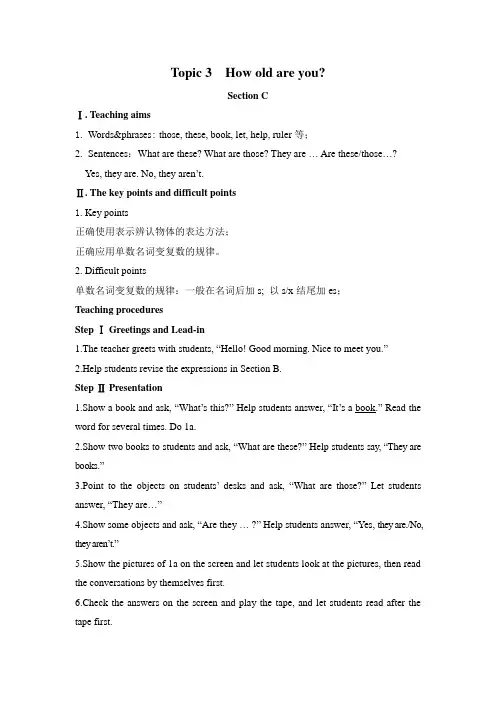
Topic 3 How old are you?Section CⅠ. Teaching aims1.Words&phrases: those, these, book, let, help, ruler等;2.Sentences:What are these? What are those? They are … Are these/those…? Yes, they are. No, they aren’t.Ⅱ. The key points and difficult points1.Key points正确使用表示辨认物体的表达方法;正确应用单数名词变复数的规律。
2. Difficult points单数名词变复数的规律:一般在名词后加s; 以s/x结尾加es;Teaching proceduresStep Ⅰ Greetings and Lead-in1.The teacher greets with students, “Hello! Good morning. Nice to meet you.”2.Help students revise the expressions in Section B.Step Ⅱ Presentation1.Show a book and ask, “What’s this?” Help students answer, “It’s a book.” Read the word for several times. Do 1a.2.Show two books to students and ask, “What are these?” Help students say, “They are books.”3.Point to the objects on students’desks and ask, “What are those?”Let students answer, “They are…”4.Show some objects and ask, “Are they … ?” Help students answer, “Yes, they are./No, they aren’t.”5.Show the pictures of 1a on the screen and let students look at the pictures, then read the conversations by themselves first.6.Check the answers on the screen and play the tape, and let students read after the tape first.Step Ⅲ Consolidation1.Show the pictures of 1b on the screen and give students two minutes to complete the conversations,then choose four pairs to check the answers; Do 1b.2.Let students use their objects to practice the sentences in pairs and choose some pairs to show their conversations.Step Ⅳ Practice1.Show the first group pictures of 2 on screen, then let students make short conversations with the sentences in pairs. Do2.2.Choose two pairs to show the conversations, Then show the next two group pictures of 2, and then give students some time to make up new conversations with the pictures.3.Write down the key sentences on the blackboard and ask students to pay attention to the words.4.Show the word cards and let students try to read the words together; Then choose some students to read the words and ask students to write the words in their books.5.Let students read 3b aloud by themselves and pay attention to the rising tone and the falling tone; Then play the tape and let students read after the tape.Step Ⅴ Summary and Homework1.Put some objects on the desk. Then choose some students to come to the blackboard and make up conversations with them in two minutes, the student who makes more conversations is the winner; Then make a summary about the game.2.Assign homework:Review the key sentences; Make a short dialogue orally;Copy the new words in workbook; Preview Section D—Grammar and Functions. Teaching reflection:本节课由单数句型向复数句型的转换,学生会出现问题,因此,教师在教授过程中,要注意句型转换时词形的变化。
仁爱英语八年级上Unit1Topic3Section-C教案
Section CThe main activities are 1a and 2a. 本课重点活动是1a和2a。
Ⅰ. Teaching aims and demands 教学目标1. Learn some new words and phrases:page, diary, winner, finish, encourage, able, be able to, grass, visitor, improve, environment, ourselves2. Go on learning the future tense with will:(1)I will do more exercise every day and I hope some day I’ll be able to take part in theOlympic Games.(2)We hope that China will win more gold medals in the future.3. Review the simple past tense:(1)Last week our school held a sports meet.(2)Everyone in our class felt very excited because we were the winners.4. Talk about the school sports meet and the Olympic Games:(1)In the boys’ relay race, Michael ran very fast and our class won first place.(2)I did my best and was the first to cross the finish line.(3)The People’s Republic of China took part in the Olympics for the first time in 1952.(4)Xu Haifeng won the first gold medal for China in the 23rd Los Angeles Olympics in 1984.Ⅱ. Teaching aids 教具录音机/幻灯片/小黑板Ⅲ. Five-finger Teaching Plan 五指教学方案Step 1 Review 第一步复习(时间:10分钟)通过复习关于运动会的话题,导入本课生词。
仁爱版英语八年级上册 Unit1 Topic3 SectionC 精品教案
Unit1 Topic3 SectionC 精品教案Ⅰ. Material analysis本节课为单元第四课时,主要活动为Section C 的1a 和4。
通过阅读The Modern Olympics, 拓展了学生的视野。
在预习本课时,学生需要从报纸、杂志、网络搜寻大量的有关奥运会的相关知识,培养了学生主动探究的精神。
本课有关奥运会的话题,让学生了解了奥运会的历史开展过程,明白运动的历史意义,有助于深化学生对运动的热爱之情,从而促进学生们积极主动地参加运动,让自己的身体更加安康。
本课稳固了本话题的语法重点Future Tense with will,呈现了重点短语:stand for, every four years, become more and more popular, have the chance to do sth.等。
课后要求学生能结合本单元内容,写一篇介绍自己学校运动会的文章。
Ⅱ. Teaching aimsKnowledge aims:1. 能正确拼读以下单词:modern, Olympics, ring, stand, least, chance, whether, gold;能明白以下单词或短语的含义:motto, symbol, stand for, at least, nowadays, compete, host, beginning, medal.2. 能在英语对话或文章中听懂、读懂以下短语:stand for, every four years, become more and more popular, have the chance to do sth.等。
3. 能正确地理解以下句子并能加以运用:In the future, more cities will have the chance to hold the Olympics.The Olympic Games will be more exciting.The Olympics are becoming more and more popular.Skill aims:1. 能听懂有关奥运会的对话及类似的英语文字材料。
仁爱版八年级上册英语教学设计:Unit3Topic1SectionC
3.教师要及时检查作业,了解学生的学习情况,并进行针对性的辅导。
(三)学生小组讨论
1.教学活动:学生分成小组,针对以下问题展开讨论:
a. What are the good manners in public places?
b. Can you give some examples of impolite behavior in public places?
c. How can we improve our behavior in public places?
2.对话编写:以小组为单位,编写一段关于公共场合行为规范的对话,要求运用本节课所学的句型和词汇。各小组将对话表演给全班同学,提高学生的合作意识和口语表达能力。
3.阅读理解:请学生阅读本单元的阅读材料,完成相应的练习题,并针对文章内容提出至少两个问题,培养阅读理解和批判性思维能力。
4.家庭作业:请学生观察家人在公共场合的行为,记录下至少三个良好的行为习惯和三个需要改进的行为。在下节课上分享,以培养学生的观察力和实际应用能力。
2.听力理解能力:本章节的听力材料涉及不同场景下的行为规范,要求学生能够理解并评价人物行为。
-教学设想:采用逐步推进的听力训练方法,先让学生听懂关键词汇,再逐步提高至句子和语篇的理解。同时,提供听力策略的指导,如预测、关键词定位等。
3.阅读理解与批判性思维:要求学生能够从阅读材料中提取信息,对人物行为进行评价,并表达自己的观点。
b.句型学习:通过师生互动、小组活动等形式,学习一般现在时描述人们的行为和习惯,如:“He is always polite to others.”、“They behave well in public places.”等。
仁爱版英语八年级上册UNIT 1 TOPIC 3 Section C 教案

UNIT 1 Playing SportsTOPIC 3 The school sports meet is coming.Section C教案Aims1. 让学生读懂课文中内容,根据短文获取相关的信息,培养学生英语阅读的能力。
2. 让学生认识课文中出现的新单词,并能够熟练运用。
3. 将课文主题与生活紧密联系,培养学生在生活中学习英语、运用英语的能力。
4. 通过学习让学生能够熟练运用新学的句型与同学交流。
5. 通过阅读本文能懂得奥林匹克和运动关系并能独立完成课后习题。
Key points:1. 在生活中熟练运用新学的单词和句型。
2. 能说出奥林匹克和人类的关系。
Difficult points:1. 引导学生在活动中、生活中灵活运用句型,培养学生英语阅读的能力。
2. 引导同学能独立进行思考。
3. 理解课文中出现的单词和知识点。
Teaching preparations:PPT, cards, pictures.Teaching procedures:Step 1: Warm-up1. Greeting:T: Good morning, girls and boys. Can you tell us something about Olympics?2. Lead-inT: Talk about the relations between Olympics and human being.Step 2: Presentation1. The teacher shows the pictures of some types of activities and let students guess?展示一些运动的图片,询问同学们这是谁?T: Do you know this is?T: Can you tell us something about this sport?T: I know something about this sport for it’s an important part to constitute sports activities.S: I know…2. The teacher shows the pictures of new words on the blackboard.T: Let’s read the new words.3、看着照片提问题:a. How many activities in the Olympics do you know?b. Do you like this activity?c. What are they doing?4、老师参照课件为同学们展开单词教学。
仁爱版八年级英语上册Unit1_Topic3_SectionC优质课教案设计
Unit1 Topic3 SectionC优质课教案1. The analysis of teaching material:The topic of this unit talks about the school sports meet and the Olympic Games, there are three topics in this unit: “I’m going to play basketball.”, “I’ll kick you the ball again.”, and “The school sports meet is coming.” In this class students will read a passage and finish three tasks. After reading the text and surfing more information on the internet. The students may know something about the modern Olympics.2. The analysis of students:The students are in Grade Eight. This topic is close to their daily life, most students have deep interest in sports, and they look forward to knowing more about the Olympics, so they are eager to learn more. They are active but their vocabulary is limited. They can remember less words and phrases; they hardly are able to write several sentences. What’s more, most boys in our class are afraid of learning English, they aren’t interested in English. Most students seldom preview the text before class, so I lead them to learn the knowledge by looking at the pictures, it will be easier for students to finish the tasks.3. The analysis of teaching goals:(1)To know something about the modern Olympics.(2)To read the passage, understand and complete the tasks.(3)To develop students’ ability of reading skills, individual reading and scanning.4. Key points and difficult points:(1)Key point: To read the passage, and complete the tasks.(2)Difficult point: To develop students’ ability of reading skills, individual reading and scanning.5. Teaching aids: multimedia, textbook, blackboard.6. Teaching methods: Task-Based Language Teaching,Five Steps Teaching.7. Teaching Procedures:Step1 Lead—inLet’s enjoy a song: Pass the flame.The teacher asks students: Do you like this song? And do you know what the song is about?Pass the flame is the theme song of the Olympic Games in Athens in 2004. Do you want to know more about the Olympics?Step2 Presentation (pre—reading)Teacher shows some pictures about the modern Olympics on the PPT, let students find out the years and the host cities. They should learn to say these sentences:The modern Olympics started in Athens, Greece in______.In 2000 ______ held the 27th Olympic Games.In 2004______ hosted the28th Olympic Games.______ hosted the 29th Olympic Games in 2008.London held the 30th Olympics in______.The 31st Olympics was held in ______ in2016.Then ask them to think about the two questions:Do you know when the next Olympics will be held?Which city will host the next Olympic Games?Activity 1: Match the years with the host cities of the Olympic Games.2000 Rio2004 London2008 Beijing2012 Athens2016 SydneyNext we will learn: the symbol of the Olympics and what do the five rings stand for? Olympic motto is: Faster, Higher, Stronger!Step3 Practice (while—reading)Task 1: Read the passage 1a and choose the correct answers.( ) 1. The modern Olympics started in______.A. 1952B. 1896C. 1996D. 2000( ) 2. What is the symbol of the Olympic Games?A. The Olympic emblems(会徽)B. The Olympic mascots (吉祥物)C. The Olympic ringsD. The flag of each country( ) 3. What do the five rings stand for?A. Five parts of the worldB. Five countriesC. Five citiesD. Five colors( ) 4. The Olympic Games are held every ______ years.A. 2B. 3C. 4D. 5( ) 5. Which of the following is TRUE?A. You can find one color in the flag of each country.B. The players from all over the world meet to compete and they can’t be friends.C. Only in Athens the Olympic motto is “Faster, Higher, and Stronger.”D. The Olympic Games will be more and more popular and exciting.While students doing this part, the teacher writes down the key words and phrase on the black board, after finishing the task, teacher retells the passage according to these tips.Task 2: Retell the passageThe modern Olympics started in Athens, Greece in ______. Its motto is “Faster, ______, Stronger”. The Olympic rings are a ______ of the Olympic Games. There are five rings, and they______ (代表)the five parts of the world. The ______ and Winter Olympics are held every four years. Nowadays, different cities hold the Olympics Games______(轮流). The Olympics are becoming______(越来越.......)popular and exciting.Step4 Summary: complete the notes (post—reading)1. The year of the first modern Olympics: __________________________________.2. The host city of the first modem Olympics:_________________________________.3. The motto of the Olympics Games:_______________________________________.4. The symbol of the Olympics Games:______________________________________.6. The colors of the rings:________________________________________________.7. The Summer Olympic Games are held every______ years.Step5 Homework1. Read this passage aloud.2. Finish part 2, 3 on page 228. Blackboard designTopic 3 The school sports meet is coming. (Section C)The modern OlympicsStarted in: 1896Stand for: the five parts of the worldBe held: every four yearsIn the future: more and more excitingThe Olympic motto: Faster, Higher, Stronger!9. Teaching reflectionIn this class, I think there are three successful points:(1) Listen to a song to attract students’ interest.(2) Lead students to learn more by reading other materials.(3) I integrate the textbook effectively that can make students understand easily. But there is also shortcoming, I pay less attention to individual students, focus on their learning results.I believe I will do better after my hard work.。
仁爱版英语八年级上册Unit1_Topic1_SectionC优质课教案
Unit1 Playing SportsTopic 1 I’m going to play basketball.SectionC 优质课教案I. Teaching aims1. To learn some useful words and expressions:Taekwondo/table tennis/badminton/go cycling/go unicycling/spend/take part in/be good at...2. To learn the Simple Future Tense with “be going to”:3. To talk about the favorite sports.Ⅱ.Key and Difficult PointsKey points:1. some phrases about sports2. some important expressions: spend.in doing/on..…, take part in…, There is going to be...Difficult points:1. spend time(in)doing sth./spend time on sth.;2. There is going to be...Ⅲ.Teaching proceduresStep1 Warm—upPlay the video about sportsT: What sports can you find in this video?S: Soccer/basketball /swim/run.Step2 Pre-reading1. Ask and answerT: Do you like them? What’s your favorite sport?S1: My favorite sport is basketball.T: When do you often play basketball?S1: On Sundays.T: S2, please talk about S1 according to what he said.S2: He likes sports very much. He often plays basketball on Sundays.(Ask another student)T: S3, do you like doing exercise?S3: Yes. I do.T: How often do you do exercise?S3: Every day.T: How long do you spend every day?S3: Twenty or thirty minutes.T: S4 please talk about S3 according to what he said.S4: He/She likes exercising. He/She often spends twenty or thirty minutes exercising every day.T: Thirty minutes is half an hour.E.g. swimming/cycling/playing table tennis/badminton/basketball/soccer/riding a unicycle.How often do you do it?I play basketball/soccer/badminton /table tennis twice a week.I run three times a week.I go cycling twice a week.I often go swimming on Sundays.I spent half an hour playing basketball every day.2. Pair—work: I will give you two minutes. Please do a survey, ask your partner these questions and then report the information about him/her. (Begins with He/She likes.)T: Time’s up, which pair wants to have a try?S1: Jack likes playing basketball very much. He spends half an hour playing basketball every day.S2: Tina likes swimming. She goes swimming once a week. And she often swims on Sundays.Step3 While—reading。
仁爱版英语八年级上册Unit1Topic3SectionC说课稿附英文教案
2a、2b是本课教学内容的第二部分。我将2a、2b进行了整合。2a1主要操练There will be将来结构。在这个环节我设计了一个情景:请一名学生扮演来自奥委会的工作人员,在采访人们心目中2008北京的蓝图。通过问答形式巩固句型。2a2主要练习we should…这个句型。在处理2a2时我采用了以小组为单位,大家一起进行头脑风暴,用we should…造尽可能多的句子,为下一步的写作做铺垫。
2)教学原则
活动性原则提倡学生主动参与,体验,交流,合作,探究等多种学习。
合作性原则以学生为主体,师生合作,生生合作,体现教与学的互动。
任务型原则任务驱动——激发动机;任务完成——激励学习积极性;
执行任务——培养责任心和合作精神。
情感性原则激发学生ቤተ መጻሕፍቲ ባይዱ习英语的兴趣和始终保持良好的学习情绪。
3)教法运用
本课主要运用“整体教学法”,并辅助任务型语言教学法、情景交际法和听说法。
3)教学重点及难点
①教学重点:理解课文文章内容;学习本课新单词、短语和句型。培养学生合作学习的意识。
②教学难点:掌握There be的将来结构。掌握本课新单词、短语和句型并能将新知识运用到写作中。
理论依据:①根据教学目标,确定本课新单词、短语。掌握并熟练运用There be的将来结构是本课的重点和难点。一般将来时态是课程标准要求学生掌握的重要时态之一,在本课基本句型There will be…中,学生容易忽略be动词。因此要注意对学生进行正确的语言输入。②本课课型为读写课。《英语课程标准》对初中阶段的写作目标提出了具体的要求:能根据写作要求,收集准备素材;能根据图示写简单的文章、写日记、写信等。教师应引导学生写出书写端正、拼写正确、语句通顺、语法规范、层次分明的一封短信。
仁爱版英语八年级上册Unit 1 Topic 3 Section C教案
本课旨在帮助学生复习一般过去时态、一般将来时的用法。知识点虽然比较简单,但是本班学生英语学科基础较差,部分学生学习兴趣不足。鉴于这一点,上课前应当充分备足课,让学生一点一点归纳出要点,努力提高学生的学习兴趣,帮助学生打好基础。
二、学习目标
1、学习并能说出、写出P21—22的生词。
2、了解奥运会的知识,理解文章大意,并能熟练做题。
自学指导2
自学内容:课本21页1a
自学方法:先听录音注意单词发音
再自主阅读纠正发音
自学时间:10分钟
自学要求:理解文章大意圈出不理解知识点
自学检测2
回答问题并完成课本上的练习。
1.Match the years with the host cities of the Olympic Games.(P21 1a)
Eg:在中国,红色代表着幸运。
Red stands for luck in China.
3.至少:at least
轮流:in turn
越来越受欢迎:more and more popular
有机会去做某事:have the chance to do sth.
当堂训练
1.Replace the underlined words with the words or phrases in the box.
tennis players.( )
4.I don't know whether I can win, but I will
try my best. ( )
2.Read the passage and fill in the blanks with thecorrect forms of the given words.