
青岛港简介(中英文)资料
青岛港简介(中英文)青岛港简介(中英文)在浩瀚的太平洋西海岸,坐落着一座美丽的海滨城市——青岛。
青岛位于中国北方海岸线的中部,是新亚欧大陆桥经济走廊的主要节点城市和“21世纪海上丝绸之路”合作支点城市。
她以世界眼光谋划未来,以国际标准提升工作,以本土优势彰显特色,散发着国际化大都市的耀眼光芒。
On the west coast of the Pacific, the City of Qingdao is at the center of the coastline in North China, standing for a node on the Economic Corridor of New Eurasia Continental Bridge and a pivot for “21st Century Maritime Silk Road”.百年青岛百年港。
青岛港开埠于1892年,至今已走过了120多年的历程。
Development of the City can be traced back to the opening of the port over a century ago. Established in 1892, Port of Qingdao has a history over 120 years.当蓝色的汛风从这里掠过太平洋吹向世界时,历百年而弥新的青岛港正不断迎接时代的挑战和召唤,迈出转型跨越的步伐。
While the wind sweeps from Qingdao across the Pacific to the rest of the world, Port of Qingdao, answering to the calls of the era, is entering into a period of transformation.四大港区打造增长极Power Engine of 4 Port Areas青岛港由青岛大港区、黄岛油港区、前湾港区和董家口港区四大港区组成,拥有可停靠目前世界最大的1.9万TEU船舶的集装箱码头、45万吨级原油码头、40万吨级矿石码头和10万吨级煤炭码头等代表着当今最大最先进船舶的专业化深水码头。
世界上有多大的船舶,青岛港就有多大的码头。
Port of Qingdao consists of four port areas, namely Dagang Port Area, Huangdao Oil Port Area, Qianwan Port area, and Dongjiakou Port Area. The port boasts the world’s largest dedicated deep-water terminals for 19,000TEU container ship, 450,000DWT VLCC, 400,000DWT VLOC, and 100,000DWT coal vessel.青岛港是目前全球最大的综合性港口之一,货物吞吐量和集装箱吞吐量均位居世界第七位,是中国第二大外贸口岸。
多年来,青岛港的经营绩效一直保持稳健增长。
Port of Qingdao is one of the world’s largest comprehensive ports, with total throughput and contai ner volume both ranking world’s No. 7. It is also China’s second largest port for international trade. Over the past decades, the port has maintained a steady growth.青岛港大港港区面积为3.3平方公里,主要从事件杂货作业。
目前正按照青岛市的规划,建设世界级邮轮母港城,加快老港区的转型升级。
According to the plan of Qingdao municipality, the 3.3-square-kilometer Dagang Port Area, mainly handling general cargo, is now under transformation and will be established as a world-class cruise home port.前湾港区面积为12平方公里,主要从事集装箱业务和矿煤干散货业务。
集装箱业务拥有专用泊位21个,泊位最大水深-20米,可满足世界最大船舶全天候靠泊。
前湾港区矿煤业务拥有包括20万吨级矿石码头在内的9个深水泊位。
Qianwan Port Area, with an area of 12 square kilometers, is mainly for container and dry bulk. There are 21 berths for containers. With maximum water depth of 20 meters, it can accommodate the world’s largest container ships. For iron ore and coal, there are 9 deep-water berths, including one for 200,000DWT vessels.油港区面积为0.5平方公里,主要从事石油、化工品、石油液化气装卸、中转、储存作业;拥有5座码头、10个泊位,原油储备能力900万立方米。
With an area of 0.5 square kilometers, Huangdao Oil Port Area is mainly engaged in the handling, storage and transshipment of crude oil, liquid chemicals, and LPG. The area has 5 terminals and 10 berths. It has crude oil storage capacity of 9 million cubic meters.董家口港区规划面积150平方公里,规划码头岸线长约35.7公里、泊位数112个。
已建成世界上最大的40万吨矿石码头、45万吨原油码头、20万吨矿石转水码头、27万立方LNG专用码头,干散货堆存能力5500万吨。
(字幕:港区仓储能力、保税堆存能力均居我国港口首位)Dongjiakou Port Area covers of 150 square kilometers. The planned quay length is 35.7 kilometers and altogether 112 berths will be constructed. So far, the world’s largest 400,000DWT iron ore terminal, 450,000DWT crude oil terminal,200,000DWT iron ore transshipment terminal, and LNG terminal for vessels of 270,000 cubic meters have been completed. The storage capacity for dry bulk amounts to 55 million tons.(possessing the largest capacity for storage and bonded storage among Ports in China)四大港区功能明确、布局合理、联动发展,构筑起青岛港转型升级的强劲新实力。
The four areas, with their reasonable layouts and specific functions, are jointly contributing to the comprehensive strength of Port of Qingdao.抢抓机遇创造新强态Creating New Momentum青岛港坚持国际化发展之路,联合招商局、中远、中海、中国光大等发起设立青岛港国际股份有限公司。
2014年,青港国际在香港成功上市,完成H股全球公开发行。
Upholding the strategy of internationalization, Qingdao Port Group, together with China Merchants Group, COSCO, China Shipping and China Everbright initiated Qingdao Port International Co., Ltd (QPI). In 2014, the IPO of Qingdao Port International was held in Hong Kong.与马士基、迪拜环球、中石化等20多家知名企业实现资本合作;与世界各地180多个国家及地区的700多个港口保持贸易联系;与世界前20大船公司均实现业务合作;与世界14个港口建立友好港关系,构建起面向全球、互联互通的低成本、高效便捷的国际化物流网络。
Qingdao Port Group has established Joint ventures with more than 20 multinational companies, including A.P.-Moller Maersk, DP World, Sinopec, and others. A network of shipping services connects Port of Qingdao with over 700 ports across 180 countries and regions worldwide. The w orld’s top 20 shipping co mpanies all have liner shipping services at Port of Qingdao. It has established sister port relationship 14 ports worldwide. We are developing a reliable, cost-effective and efficient global logistics network.在国家“一带一路”战略中,青岛港是“海上丝绸之路”的“北方门户”和“丝绸之路经济带”的“东方桥头堡”。
青岛港
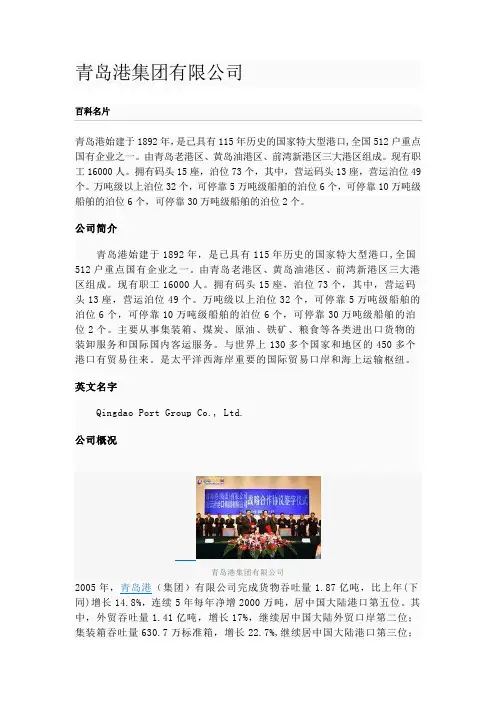
青岛港集团有限公司青岛港始建于1892年,是已具有115年历史的国家特大型港口,全国512户重点国有企业之一。
由青岛老港区、黄岛油港区、前湾新港区三大港区组成。
现有职工16000人。
拥有码头15座,泊位73个,其中,营运码头13座,营运泊位49个。
万吨级以上泊位32个,可停靠5万吨级船舶的泊位6个,可停靠10万吨级船舶的泊位6个,可停靠30万吨级船舶的泊位2个。
公司简介青岛港始建于1892年,是已具有115年历史的国家特大型港口,全国512户重点国有企业之一。
由青岛老港区、黄岛油港区、前湾新港区三大港区组成。
现有职工16000人。
拥有码头15座,泊位73个,其中,营运码头13座,营运泊位49个。
万吨级以上泊位32个,可停靠5万吨级船舶的泊位6个,可停靠10万吨级船舶的泊位6个,可停靠30万吨级船舶的泊位2个。
主要从事集装箱、煤炭、原油、铁矿、粮食等各类进出口货物的装卸服务和国际国内客运服务。
与世界上130多个国家和地区的450多个港口有贸易往来。
是太平洋西海岸重要的国际贸易口岸和海上运输枢纽。
英文名字Qingdao Port Group Co., Ltd.公司概况青岛港集团有限公司2005年,青岛港(集团)有限公司完成货物吞吐量1.87亿吨,比上年(下同)增长14.8%,连续5年每年净增2000万吨,居中国大陆港口第五位。
其中,外贸吞吐量1.41亿吨,增长17%,继续居中国大陆外贸口岸第二位;集装箱吞吐量630.7万标准箱,增长22.7%,继续居中国大陆港口第三位;铁矿石吞吐量6317万吨,增长12.5%,其中进口铁矿石吞吐量4772万吨,继续居进口铁矿石世界第一大港;石油吞吐量3510万吨,增长10%。
安全引领及时靠离船舶2.89万艘次,其中船长超过200米的大型船舶4370艘次。
港口总收入53亿元,增长26%,上缴国家各种税费15.3亿元。
通过港口外贸货物为国家创造海关关税税源247.66亿元。
青岛简介-中英文
青岛简介青岛位于太平洋西岸、中国山东半岛南部(东经119°30′~121°00′、北纬35°35′~37°09′),东、南濒临黄海,西、北连接内陆。
陆地面积11282平方公里,海域面积12240平方公里,常驻人口904.6万人。
现辖市南、市北、李沧、崂山、黄岛、城阳6个区和即墨、胶州、平度、莱西4个县级市。
青岛是中国历史文化名城、中国道教的发祥地之一。
早在五六千年前,就有人类生存和繁衍,留有丰富多彩的新石器时代文化。
青岛有2个国家历史文化名街,144处国家、省和市级文物保护单位。
成功当选“东亚文化之都”。
中国国际儿童电影节、中国国际小提琴赛、中国电影表演艺术家学会“金凤凰奖”、万达东方影都落户青岛,被誉为“影视之城”和“音乐之岛”。
青岛是中国首批对外开放城市。
与国外65个城市结为友好城市或友好合作关系城市。
2000多家国际商社、公司和金融机构在青岛常设办事机构。
2014年,外贸进出口总额799亿美元,到账外资60.8亿美元。
纳入国家“一带一路”战略规划,被确定为新亚欧大陆桥经济走廊主要节点城市和海上合作战略支点城市。
获批国家级财富管理金融综合改革试验区。
青岛是中国区域经济中心城市、重要国际贸易口岸和海上运输枢纽,中国五大外贸口岸之一。
2014年实现生产总值8692.1亿元,一般公共财政预算收入895.2亿元。
汇集了海尔、海信、双星、澳柯玛、青岛啤酒、南车四方等众多知名企业和名牌产品,现有中国驰名商标91个。
青岛港与全球700多个港口有贸易往来,2014年货物吞吐量4.8亿吨,集装箱吞吐量1658万标准箱,进口原油吞吐量居中国港口第一位。
青岛空港有121条国际国内航线,2014年旅客吞吐量1641.2万人次、货邮吞吐量20.44万吨。
青岛是中国优秀旅游城市。
海岸线长863公里,有49个海湾和69个岛屿,岸线曲折,岬湾相间。
属北温带季风区,具有海洋性气候特点,是著名的旅游度假、休闲观光、商务会展目的地城市。
青岛港 东南亚、印巴、中东 港口介绍

COSCO、 TSL
APL、MOL
周四 周六 周日
HANJIN
Jakarta13、Surabaya17
由新加坡转Jakarta17、 Suraba Surabaya20
备注 REMARK
直达 直达 CN1
直达
转船
转船
开船日 ETD
周一 周二
周四 周四 周六 周日 周日
英文港口
Jeddah AQABA SOKHNA Hodeidah ADEN Port Sudan DJIBOUTI
中文港口
吉达 亚喀巴 索克纳 荷台达 亚丁 苏丹港 吉布提
国家
SAUDI ARABIA JORDAN EGYPT YEMEN YEMEN Sudan
DJIBOUTI
印巴特殊港口区别
卡拉奇三个港口(K、P、Q港 ):
直达 严格限重18吨
直达 无严格限重
周三 周三 周三
TSL
KLINE、 HANJIN、NYK
MSC
KARACHI20 Chennai 19 Jeddah 23
直达 直达 直达
英文港口
DUBAI Abbas AJMAN ABU DHABI SHARJAH DAMMAM RIYARD BAHRAIN SOHAR Kuwait DOHA BUSHEHR UMM QASR
中文港口
那瓦西瓦 新德里T港 加尔各达 清耐 班加罗尔 维萨喀巴坦 卡拉奇 吉大港 吉大港 达卡 科钦 科隆
国家
INDIA INDIA INDIA INDIA INDIA INDIA PAKISTAN BANGLADESH BANGLADESH BANGLADESH INDIA SRI LANKA
印巴红海主要港口
青岛港
青岛港港口概况时间:2010年11月18日来源:青岛港(集团)有限公司青岛港始建于1892年,是具有117年历史的国家特大型港口,包括青岛老港区、黄岛油港区、前湾新港区三大港区。
主要从事集装箱、原油、铁矿石、煤炭、粮食等各类进出口货物的装卸、储存、中转、分拨等物流服务和国际国内客运服务,与世界上130多个国家和地区的450多个港口有贸易往来。
青岛港始建于1892年,是具有117年历史的国家特大型港口,包括青岛老港区、黄岛油港区、前湾新港区三大港区。
主要从事集装箱、原油、铁矿石、煤炭、粮食等各类进出口货物的装卸、储存、中转、分拨等物流服务和国际国内客运服务,与世界上130多个国家和地区的450多个港口有贸易往来。
现有员工16000多人。
拥有可停靠15000标准箱船舶的集装箱码头,可停靠30万吨级大船的矿石码头、原油码头,可停靠10万吨级船舶的现代化煤炭码头。
目前,世界上有多大的船舶,青岛港就有多大的码头。
改革开放三十年来,青岛港遵循“坚持党的基本路线,坚持‘三个代表’重要思想,坚持科学发展观,坚持一切从实际出发,把青岛港自己的事情办得更好”的发展思路,以“建设东北亚国际航运中心,营造平安和谐幸福家园”为共同愿景,牢记并肩负好“精忠报国,服务社会,造福职工”的三大使命,大力弘扬“一代人要有一代人的作为,一代人要有一代人的贡献,一代人要有一代人的牺牲”的青岛港精神,时刻坚持好“对国家的贡献要越来越大,港口发展后劲要越来越强,职工生活质量要越来越高,精神文明建设要越搞越好”的核心价值观;全力打造“平安福港、效率快港、实力强港”,走出了一条自主创新型、资源节约型、环境友好型、质量效益型、管理精细型、亲情和谐型发展之路。
多年来艰苦创业,改造了一个百年老港,建设了两个现代化的新港,在全国沿海港口中率先建成了世界级的集装箱、铁矿石、原油等大码头,港口资产由1.8 亿元增值裂变到217亿元。
2008年完成港口吞吐量3亿多吨,居世界第七位;完成集装箱1002万标准箱,居世界第十位;进口铁矿石吞吐量居世界港口第一位,进口原油吞吐量居全国港口第一位,外贸吞吐量居全国港口第二位。
亚洲港口简介(5)----QINGDAO、SHANGHAI、TIANJIN、ZHONGSHAN
读书破万卷,下笔如有神亚洲港口简介(5)----QINGDAO、SHANGHAI、TIANJIN、ZHONGSHAN亚洲港口简介(5)----QINGDAO、SHANGHAI、TIANJIN、ZHONGSHANQINGDAO、SHANGHAI、TIANJIN、ZHONGSHANQINGDAO 青岛港口性质:湾颈港、设有保税区、基本港(C、M)经纬度:36 度04 分N,120 度19 分N位于中国(全称:中华人民共和国THE PEOPLE′S REPUBLIC OFCHINA)东部山东(SHANGDONG)省东南沿海的胶洲(JIAOZHOU)湾入口的两岸,濒临黄海(HUANGHAI)的西侧,是山东原油和山西中部煤炭的出口港。
该港是一个有着百年历史的老港,1984 年被列为全国14 个对外开放的港口城市,现已发展成为我国重要的外贸、能源输出和集装箱进出口港。
港口扼胶州湾的咽喉,不淤不冻,自然条件十分优越。
它有广阔的经济腹地,纵横连接华东、华北、中南等地区。
青岛是山东省水陆交通枢纽和重要工业城市,铁路与胶济线相接通往全国各地,主要工业有棉纺织、榨油、机车车辆和纺织机械制造工业等,沿海盛产的对虾与峙山矿泉水、青岛啤酒扬名世界,港口风景秀丽,绿树成荫,有天然的海滨浴场环绕,素有“东方瑞士”之美称。
是疗养和避暑胜地。
机场具备起降大、中型飞机的能力,有定期航班飞往北京、上海、广州及哈尔滨等地,青岛与香港有宜航包机。
该港属温带季风气候,盛行南及东南风,7~9 月间有台风影响。
年平均气温为12℃,最高曾达36.2℃,最低为-16℃,每年有雾日约55 天,以4~7 月最多。
全年平均降雨量约700mm,雨量集中在7~8 月。
属正规半日潮港,好记性不如烂笔头。
青岛港简介
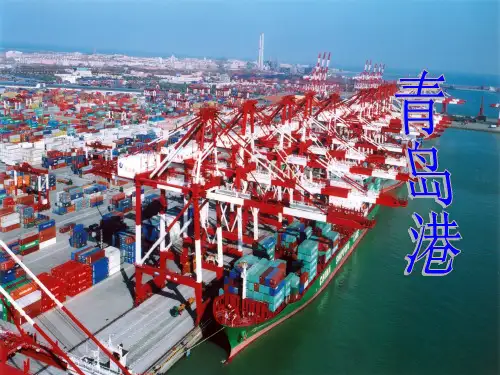
青岛港位于山东半岛南岸的胶州湾内,港内水域宽深, 四季通航,港湾口小腹大,是我国著名的优良港口。青岛 港始建于1892年,是具有117年历史的国家特大型港口, 包括青岛老港区、黄岛油港区、前湾新港区三大港区。 2008年完成港口吞吐量3亿多吨,居世界第七位;完成 集装箱1002万标准箱,居世界第十位;进口铁矿石吞吐量 居世界港口第一位,进口原油吞吐量居全国港口第一位, 外贸吞吐量居全国港口第二位。集装箱作业效率、铁矿石 卸船效率世界港口第一。
冻货装卸
1、青岛是全国最大的水产品加工及进出口基地之一。 2、青岛市区有储存和加工于一体的专业公司十余家,冷藏能力1.5万吨, 年加工能力40万吨。 3、青岛港有规模较大的冷藏专业公司——青岛港盛国际物流冷藏公司, 有先进的双层冷藏库,微机控制,温度自动调节,冷冻温度可达-25度。 4、青岛港的冻货接卸采取车船直取的方式。 5、青岛港开展了冻货卸船转集装箱的中转业 务。 6、青岛港年接卸冻货量处于全国第一的位置。
港口业务
• 煤炭装卸 • 矿石装卸 • 原油装卸 • 化肥装卸 • 氧化铝装卸 • 粮食装卸 • 钢材装卸 • 纯碱装卸 • 冻货装卸
煤炭装卸
一、煤炭装卸泊位共有三个: 1、两个装船专用泊位,泊位长度566米,前 沿水深14.1米 ,可满足10万吨级船舶靠泊作 业 。拥有单机装船能力为4500吨/小时的装 船机两台。其他主要设备有:堆/取料机一台、 取料机两台、输送皮带总长度9.5公里及高精 度自动计量装置等。整套设备采用微机控制, 自动化作业。 2、一个20万吨级的矿石卸船泊位,可兼作 卸煤,泊位长420米,拥有3台桥式抓斗卸 船机,最大起重量62吨、外伸距44米;卸 船能力单1200吨/小时。
二、煤炭卸车 拥有翻车机两台,螺旋卸车机两台,卸车能力 7600吨/小时, 堆场堆存能力200万吨,对不同的 煤种、不同货主的煤炭单堆单放。三、市场开发 1、成功开发了配煤装船新工艺; 2、成功开发了20万吨煤炭船直接中转装船工艺。
青岛港
青岛港:一个城市起航的原点为了能停靠大型船舶,德国人修建了码头。
图为当时码头繁忙景象。
(图片取自《青岛旧影》)德占时期,港口初建时的码头运煤工。
如今的港口工人机械化作业。
上世纪70年代老港口的道路极其狭窄。
如今的前湾港,道路通畅、宽阔。
晚清的海防:李鸿章一道奏折催生青岛建港“说起青岛建港,就不得不提到中国近代史上赫赫有名的人物——李鸿章。
”岛城文史专家鲁海,日前向记者讲述了文史资料中关于青岛港诞生的记载。
1891年6月,李鸿章看完北洋水师的演习后,从威海南下到胶州湾视察。
胶州湾的地形和所处地理位置的险要,让这位革新派大臣深有感触。
“他认为这里是继旅顺、威海以南的第一大隘。
立即上奏朝廷‘胶澳设防,实为要图’,朝廷批准了李鸿章的奏折。
”鲁海介绍说,1891年6月14日,清政府出于军事战略需要,决议在胶澳建置设防,调登州镇总兵章高元移驻胶澳。
这便是青岛建置的开始。
既然是基于海防需要,那相应的军事基础设施必不可少,“1892年,清政府开始在青岛湾内兴建人工码头。
一座是位于小青岛西北向的前海栈桥,以供装卸物资和兵员上下。
青岛栈桥长220米,宽10米,以石头垒筑桥身,水泥铺面,码头两侧装有从旅顺运来的铁制栏杆,前端设有吊架,便于起卸货物,亦称南海栈桥、铁码头、大码头。
另一座位于总兵衙门前方的码头,原是海礁形成的自然码头,经整修建成长100米,宽6米的桥式码头,也是石头垒筑桥身,水泥铺面,亦称衙门桥、蜗牛桥、小码头。
”鲁海介绍说,建成后的前海栈桥码头和衙门桥码头,成为青岛正式建港的标志。
有了海港,这座新兴的城市也有了生机。
“这两座码头对青岛地区的政治、经济、军事、文化都有重要影响。
在港航业方面,船舶往来极盛,航运通达。
青岛港外通朝鲜,北通辽宁,南通江浙闽粤,以及山东诸港,进出口贸易也变得活跃起来。
特别是天后宫庙会期间,船舶云集于青岛口内,甚为可观。
沿港的商铺越来越多,到了1897年春,已经增至65家。
随着港航活动的发展和经济的繁荣,文化生活也活跃起来。
青岛港口资料
青岛港口资料青岛港口资料港口中文名:青岛港口英文名: QINGDAO港口代码: CNQIN港口缩写: TAO所在国家: CHINA经纬度:36°04’N 120°19’05”E时差: -8:00锚地: 36-00-30N120-21-30E泊位吃水:大港航道限制最大吃水13米;前湾航道限制最大吃水14米海图号: 12351甲,12352甲(中)详细介绍:自然条件气象:风况:夏季多南风及东南风,冬季多北风及西北风。
每年大于7级以上大风天约8天;台风每年约发生1~2次,对港口影响甚小。
降水:年平均降水量为755.6毫米,6~7月降雨最多,占全年的70%。
雾况:年平均雾日51.6天,每年4~7月为最多,对航运、生产影响不大。
气温:年平均气温为12.1℃,极端最高气温35.4℃,极端最低气温-16℃。
冰况:水文:潮汐:为正规半日潮型,平均高潮位3.85米,平均低潮位1.08米,最高高潮位5.36米,最低低潮位0.70米。
潮流:属半日潮流,总的特点是涨潮流速大于落潮流速,涨潮历时小于落潮历时,潮流基本属于往复流,最大流速方向同海岸平行。
前湾最大涨潮流速0.51米/秒,最大落潮流速0.33米/秒。
波浪:胶州湾波浪主要为湾内小风区波浪及外海波浪经湾口的折射波、绕射波。
交通状况青岛港具有良好的运输条件。
胶济铁路和胶黄铁路、济青高速公路、烟青高速公路、环胶州湾高速公路与港区相连。
青岛港客运站与青岛国际航空港、青岛火车站连成立体交通服务网络。
发达的铁路、公路、水路、管道运输,使青岛港具有高效的疏港运输能力。
海路可达国内外各港口,货运航线可至东北、华北、华东各省沿海;客运有至上海、日本下关、韩国仁川等航线。
经济腹地青岛港的经济腹地为青岛市、山东省及河南、河北和山西省部分地区,纵横连接华东、华北、中南等地区。
青岛港腹地内工业发达,主要有轻工、纺织、石油化工、机械制造、采掘、冶金等工业。
腹地内矿产资源、建材资源、海产品、农副产品较为丰富。
青岛港介绍
青岛港QINGDAO (Tsingtao): 36_ 04’ N 120_ 19’ EAlso see ‘‘General’’ before first port.DOCUMENTS: See ‘‘Dalian’’.PILOTAGE: Available throughout 24 hours. Pilots will board at the pilot station.ANCHORAGES: No. 1 Quarantine Anchorage (FormerNo. 21 Anchorage):Lat. 36_ 00’ 46 N, Long. 120_ 20’ 41 ELat. 36_ 00’ 40 N, Long. 120_ 21’ 58 ELat. 36_ 00’ 12 N, Long. 120_ 20’ 51 ELat. 36_ 00’ 12 N, Long. 120_ 21’ 42 EDepth: 31.0 –44.0 m.Bottom: Mud and sand with good holding ground.Oil Tanker Anchorage (Former No. 23 Anchorage):Lat. 36_ 05’ 42 N, Long. 120_ 13’ 06 ELat. 36_ 05’ 42 N, Long. 120_ 14’ 00 ELat. 36_ 04’ 51 N, Long. 120_ 13’ 06 ELat. 36_ 04’ 51 N, Long. 120_ 14’ 00 EDepth: 10.0 –37.0 m.Bottom: Mud with good holding ground.Inner Anchorage (Former No. 22 Anchorage):Lat. 36_ 06’ 00 N, Long. 120_ 14’ 30 ELat. 36_ 06’ 00 N, Long. 120_ 16’ 50 ELat. 36_ 04’ 18 N, Long. 120_ 14’ 30 ELat. 36_ 04’ 18 N, Long. 120_ 16’ 50 EDepth: 5.0 –38.0 m.Bottom: Mud and sand with good holding ground.RESTRICTIONS: Harbour manoeuvring speed: 10 knots.Tidal range: Max. 4.75 m., average 2.78 m.Possibility of entry or sailing after sunset: Possible.Masters are strongly recommended to delay vessel’s movements (Entryor sailing)if the visibility is poor.MAX. SIZE: LOA 265 m., beam 39.0 m. and draft 14.0 m.Tankers: Draft 20.5 m.Containers: Super post-Panamax, draft 14.2 m.VHF: Qingdao Radio listens on Channel 16 throughout 24 hours. Pilot works on Channel 9. Port Operations works on Channel 11.Report System: When vessel is approaching Chaolian Dao (35_ 53’ 36 N, 120_ 52’ 48 E), Master should call the Harbour Master through Qingdao Radio (VHF Channel 16). The following is to be reported: Vessel’s name, call sign, flag, ETA, draft fore and aft, if any dangerous cargo onboard and quantity, request of Pilot, permission for anchoring area, etc.When vessel passes Dagong Dao (35_ 57’ 36 N, 120_ 29’ 30 E), Master should report to Harbour Master for further information.Master should also contact the Traffic Control Centre of Qingdao Port, reporting present ship’s position, asking for sailing guidance. If he fails to do so, there might be a penalty.After anchoring, the anchor position should be reported to the ship’s Agentand the Harbour Master.TUGS: 2_1,000 h.p., 2_1,670 h.p. and 5_3,200 h.p.BERTHING: Se e ‘‘Agent’s Report’’ dated June 1999.CRANES: See ‘‘Agent’s Report’’ dated June 1999.Facilities: The terminal is located on the south side of the entrance to the Jiazhou Wan opposite Qingdao city. Approach channel length 4 nautical miles and depth 12.3 m.Total quay length 3,400 m. of which 2,400 m. is currently under construction (Berth No. 69 length 163.8 m. and max. draft 11.6 m. Berth No. 70 length 200.6 m. and max. draft 11.8 m. Berth No. 71 length 401.6 m. and max. draft 14.5 m.)and depth up to 17.5 m., capable of handling the latest generation of super-large container vessel.There are 24 gantry cranes of which 8 are super post-Panamax gantrycranes (3_50 tonnes and outreach 50m., 2_65 tonnes and outreach 60 m.,1_55 tonnes and outreach 60 m., 1_40.5 tonnes and outreach 44.0 m.,1_35.5 tonnes and outreach 44.0 m.), 77 RTGs, 14 forklifts, 11 empty handlers, 78 terminal transfer vehicles, 3,672 reefer points, 5,500 sq.m. container freight station (CFS), capacity 24,306 TEUs and total area 25 ha. When development is completed the terminal will be able to handle total capacity 48,872 TEU with total area of 225 ha.TANKERS:Huangdao Eastern/Western Oil Wharf in position Lat. 36_ 04’ 00 N,Long. 120_ 13’ 30 E.Huangdao Oil Storage Area Oil Wharf in position Lat. 36_ 03’ 00 N,Long. 120_ 14’ 20 E.Also see ‘‘Agent’s Report’’ dated June 1999 and ‘‘Shipmaster’s Reports’’. FRESH WATER: Available at berths and at anchorage.FUEL: Available at berths and at anchorage.REPAIRS: Facilities available.AIRPORT: Liuting Domestic Airport, 45 km.GENERAL:Stores: Contact Qingdao Foreign Supply Corporation.Storage: Warehouse: 57,574 sq.m.Open Storage: 340,253 sq.m.Imports: Steel, ore, fertiliser, timber and other general cargoes.Exports: Crude oil, peanut oil, groundnut cake, corn, cotton, hardware and other general cargoes.SHIPMASTER’S REPORT: May 1989.Vessel: 35,000 g.r.t., 64,440 d.w.t. Vessel discharged 47,250 tonnes of bulk wheat. Length of stay 38 days.Vessel arrived with a draft of 12.0 m. and proceeded to Pier No. 8 –Berth No. 49 and lightened to a draft of 9.6 m. She then proceeded to PierNo. 1 –Berth No. 3.Self-sustaining vessels may lighten into barges at the anchorage.Documents: Officers from Harbour Master’s office, Quarantine Department, Customs, Im migration and Agent’s office board the vessel upon arrival at the Inner Quarantine Anchorage.The following documents are required on arrival:2 Reports of Entry for Foreign Going Vessels2 Reports of Articles Restricted for use in port5 Crew List (IMO Form accepted)4 Passenger List (Not required if no passengers on board)2 Lists of specified articles (Foreign currencies, gold, silver belonging to ship or members of crew)1 Maritime Declaration of Health1 Ammunition List (Not required if no ammunition on board)1 Bonded Stores List3 Ship’s Particulars1 Vaccination List (required if the vessel coming from a suspected country)2 Ports of Call within last 6 months1 Import Manifest1 Bills of Lading.Last Port Clearance and all ship’s certificates submitted for examinationon board.After inspection, Harbour Master’s officers issue 30 days, 60 days or90 days optional Tonnage Dues Certificate as requested by the Master. Pilotage: Compulsory. Pilotage available throughout 24 hours. Mastershould send ETA at Chaolien Dao to Harbour Master through Qingdao Radio 24 hours in advance, any change of ETA must be advised. VHFChannel 16 may be used to contact Pilot Station after passing Chaolien Dao. Within pilot area limited with a circle 3 cables radius centered on positionLat. 36_ 02’ N, Long. 120_ 18.02’ E, one senior Pilot and one junior Pilot board the vessel from a tug, which displays pilot signal while on duty.Anchorage: Vessels may anchor south of pilot area, according to Pilot’s instructions, without a Pilot, otherwise Inner Quarantine Anchorage is used.In case of congestion, west of Inner Quarantine Anchorage may be used.Good holding ground.Health: Vessels should hoist Flag Q on arrival. Pratique is obtained at the Inner Quarantine Anchorage on arrival.Radio: Qingdao Radio (XST).VHF: Qingdao Radio on Channel 16, Pilot on Channels 16 and 14,Sinoagent on Channel 74 and Penavico on Channel 11.Tugs: 7_3,200 b.h.p. tugs operating in the port. Tug’s lines are used for berthing and ship’s lines for unberthing. Tugs join the vessel before entering breakwater. Number of tugs to be used depends on Pilot’s advice andMaster’s demand. Generally, two tugs used for large vessels.Berthing:Pier Berth Cranes and Use(No.)(No.)1 1,2 8_10 tons and 1_15 tons, coal cargoes1 3 5_10 tons, grain cargoes1 4–7 No cranes, bulk and general cargo2 8–11 Cranes, general and ore cargoes2 13, 14 Cranes, general and ore cargoes3 For naval vessels4 For naval vessels5 For naval vessels6 36–38 4_10 ton, general cargo and No. 38 generally forbulk sand7 Coal loading terminal for small size vessels8 45 Clean bulk cargo8 46 Bulk ore8 47 Bulk ore and logs8 48 Logs and large foreign passenger vessels8 49, 50 Lightening deep-draft vessels8 50, 51 Sugar, occasionally foreign passenger vessels.Berths No. 45, 46 and 47 equipped with 13_10 ton cranes.Berths No. 49, 50 and 51 equipped with 11_10 ton cranes.Berth No. 52 (between Piers No. 5 and 8)and Berth No. 53 (at the east end of Pier No. 5)are used by container vessels. Also the berth between Piers No. 6 and No. 1 is used by Chinese passenger liners. The berth between Piers No. 1 and No. 2 is for tugs and passenger catamarans. The berths between Piers No. 2 and No. 3 and Piers No. 3 and No. 4 are for naval use.All shore cranes are on rails and all cargo piers except Berths No. 4 andNo. 48, are rail-served. Cargo can be handled direct between ship and train. Stevedores: Gangs are arranged by the Agent. Crane operators are competent. Hold sweeping is done by stevedores. Generally a few of the foremen can speak English.Medical: 24 hours’ advance notice is required for medical attention.Arranged by Seamen’s Club through Agent. All hospital facilities available.Dental facilities available.Density: 1022.5 at low water and 1024 at high water observed by ship but draft surveys at 1024 all the time.Fresh Water: Good quality water available by pipeline at Piers No. 1,2 and 6 and by barge at all berths at the other piers and at the anchorage. Rate 50 tonnes/hr. Cost US$1.0 per ton by pipeline and US$3.0 per ton if supplied by barge.Fuel: Fuel comes from Dairen and all grades are not available at all times. Appropriate advance notice is required. Minimum supply quantity for fuel oil and diesel oil is 100 tonnes. MDO is not available, only LDO and HDO available at Qingdao.Consuls: No consuls locally. Nearest at Beijing.Dry Docks/Repairs: One dry dock for vessels up to 30,000 d.w.t. at Fushansuo Bay. All kinds of temporary repairs can be undertaken to foreign vessels.Surveyors: Only ZC China Classification Society acts on behalf of other classification societies when authorised.Gangway/Deck Watchman: Gangway watchman compulsory. Maintainedby ship’s crew.Hatches: Opening/closing hatches is optional. If by ship’s crew, Ma ster hasto sign a formal paper on arrival.Customs Allowances: For the first 10 days, 2 cartons of cigarettes and1 bottle spirits for each crewman. 15 cartons of cigarettes and 5 bottles spirits for the Master. Seal can be opened on request after 10 days.Repatriation: Possible.Airport: Located at about 37 km. NW of Qingdao. It only has international connections with Hong Kong. Regular flights once a day on Monday, Wednesday and Saturday, sometimes there is an extra flight on Sunday by China Airlines only.Time: GMT plus 8 hours. Summertime is kept from first Sunday after 10 April until September.Communications: Cable, telex, direct telephone and Fax available for allover the world from the agent’s office. Direct trunk calls also available from large hotels.Shore Leave: Permitted from 0700 –2400 hrs. with ID and shore passes which are issued by Immigration Officer on arrival. The shore passes arevalid for all Chinese ports to be called at consecutively. Shore leave is also possible from the Inner Quarantine Anchorage by launch on request. Regulations: If shifting more than 100 m. or from berth to berth, use of Pilot is compulsory.Approval must be obtained from the Harbour SuperintendencyAdministration in advance through Ship’s Agent, if the following are to be undertaken whilst in port.1. Hull painting.2. Deck cleaning and washing.3. Discharging of ballast water and bilge water (including tail shaft water).4. Discharging of hold washings (including crude oil tanker washing).5. Use of oily water separating equipment to dispose of any sewagecontaining oil.6. Using any type of dispersants.7. Discharging sewage and waste oil into reception facilities.8. Funnel cleaning and boiler water discharging.9. Discharging of any harmful or corrosive substances into the harbour.10. Whistle testing.Approval is generally received from the Agent orally.Provisions &;Supplies: Limited kinds and amounts available at low prices through ship’s Agent (ships supply branch). Chinese charts also available. Garbage: Collecting service is available by barge at anchorage and by truckat berth if requested.REPORT: January 1997.The following report was prepared by an Owner’s representative at the Terminal.General: Range of tide for Qingdao is approximately 3.0 m.Arrival: Arrival/departure position for Qingdao Port is 35_ 37’ N, 121_ 00’ E. The pilot boarding station is at 35_ 53.8’ N, 120_ 17.6’ E for deep draft vessels.The vessel had to anchor and wait due to the weather. Four Pilots boardedat stand-by inner anchor position 35_ 51.4’ N, 120_ 14.1’ E with Lian Dao bearing 321__2.8 miles.Deep-water route for large vessels as follows:Anchor Point A: 35_ 43’ N 120_ 57’ EStart Point B: 35_ 43.25’ N 120_ 53.15’ ETurning Point C: 35_ 51’ N 120_ 49.4’ ETurning Point D: 35_ 51’ N 120_ 13.3’ ETurning Point E: 35_ 56.5’ N 120_ 21.75’ EThe above routing keeps the ship in minimum of 20.0 m. water depth atall times. The vessel berthed during a falling tide with a deep draft of 17.0 m., and at all times had a minimum UKC of 5.0 m. according to the ship’s fathometer. DMA Chart No. 94282 does not have the latest soundings and deep water channel information for Qingdao. Using the above points will route the vessel through a minimum of 20.0 m. All ships should obtain Chinese Chart No. 13052 which shows the deep water approach over the bar and to the dock. Qingdao Port Regulations require that the fathometer be turned off during port entry, however, it was kept on the entire time, and when the Pilot was asked if this was ok, he said ‘‘fine’’.Large tankers go to No. 2 Oil Terminal located at 36_ 02.9’ N, 120_ 14.6’ E, just south of Huangshan Zui Point on DMA Chart No. 94282. The berth is more than adequate for 188,000 d.w.t. vessels and has had ships as largeas 310,000 d.w.t.According to the Master of the vessel, the Pilots were slow (four Pilots to bring the ship in). They used seven tugs and did not take any chances. They brought the ship in parallel to the dock about 600 ft. off and pushed her inbodily.Berthing is port side to. The ship is boomed after it is alongside and the boom lays right up against the stern. The terminal has no regulations about not turning the propeller, therefore a careful watch of the boom at the ship’s stern must be kept so that the propeller does not get fouled at light drafts. Half way through the discharge, the boom was removed from the ship. We asked the terminal what the reason was and they gave two reasons.1. It was low tide and their boom had oil on it and they did not want toget our ship dirty.2. We were an American ship and would not have a spill anyway.Safety Preparation: The ship should follow normal operating proceduresused at US terminals and provide it’s own DOI.Gaugers: The gauger nominated was the official Chinese Government Surveyor CCIB.The surveyor did not have any problems using or understanding the ship’s equipment or tables, but spent over 2 hours on deck gauging and sampling and another 2 hours doing the paperwork. It took the surveyor another hour after the line displacement to reconcile the figures in order to resume the discharge.On completion of cargo, we called for the gaugers to board the ship 3 hours prior to finish in order to survey the dry stripped tanks to save time. They came 30 minutes prior to completion and refused to step outside the control room to gauge until absolute completion of cargo. After completion, they reluctantly agreed to gauge No. 3 Port, so that we could drain the chicksans back to that tank. They then had their dinner onboard. After dinner they still refused to go and start gauging until the terminal called and said ‘‘finished draining chicksans’’ (this can also be a long drawn-out process). Absolutely no amount of begging, etc., would get them out on deck. The CCIB surveyors bring no equipment on board for gauging and will not touch the tapes to gauge, it is all done by a ship’s officer. They have absol utely no concern for expediting the operation. Getting paper work from the cargo surveyors required all the efforts of the Master, Mate, Inchcape Agent and myself. COW: The vessel was not requested to COW, and they were advised thatif they chose to COW, then special attendance is required by a representative of the Harbour Master during the COW operation, at a rate of US$3,000/day. The ship did not COW.Berth: 4_16 in. hydraulic locking chicksans are connected to the ship by shore personnel.Two large pipelines of 1.0 m. diameter each run from the berth to the terminal storage tanks, a distance of 1.5 km. Total tank capacity for crude oil, 12 tanks _50,000 cu.m. each. There is no dirty ballast reception facility. The maximum allowed manifold pressure/discharge rate agreed to in writing with the ship from the terminal was 8.7 kg. or 11,000 cu.m./hr., not to exceed either. No booster pump is available or required due to the proximity of theshore tanks.The vessel was able to maintain about 75,000 bbls./hr. (13,500 cu.m./hr.)with three pumps and about 90 p.s.i. (6.1 kg.)at the rail. Even though the vessel exceeded the parameters set, no complaint was made and the terminal was happy with the rate. There is very little back pressure.Shore Leave: Shore leave is not permitted in Chinese ports without a visa. This is a reciprocal practice initiated by the US Government. If shore leaveis to be arranged in China, the Master must have an original Crew List to send to a Chinese consulate in the US, a ‘‘group visa’’ will be stamped on the Crew List for a nominal fee. The original stamped Crew List should then be overnighted to ISS Shanghai who will then arrange shore leave when the vessel arrives.Documents on Arrival:Crew List, on IMO form (Provided by Sino Agent)Report of Ship’s Particulars, on IMO form (provided by Sino Agent)Crew’s Effects Declaration, on IMO form (provided by Sino Agent)Clearance from Last PortDeclaration of Arms on boardIMO Pilot Card (provided by Sino Agent)Bill of Lading.AGENT’S REPORT: June 1999.Location: Qingdao Iron Ore Terminal is located in position Lat. 36_ 04’ N, Long. 120_ 19’ 05 E.Anchorages:Location Depth Capacity Remarks(No.)Lat. Long. (m.)(d.w.t.)21 36_ 00’ 46 N36_ 00’ 40 N36_ 00’ 12 N36_ 00’ 12 N120_ 20’ 41 E120_ 21’ 58 E120_ 20’ 51 E120_ 21’ 42 E31 –44 10,000 Temporary22 36_ 06’ 00 N36_ 06’ 00 N36_ 04’ 18 N36_ 04’ 18 N120_ 14’ 39 E120_ 16’ 50 E120_ 14’ 30 E120_ 16’ 50 E5 –38 10,000 Quarantine23 36_ 05’ 42 N36_ 05’ 42 N36_ 04’ 51 N36_ 04’ 51 N120_ 13’ 06 E120_ 14’ 00 E120_ 13’ 06 E120_ 14’ 00 E10 –37 10,000 TankerBottom: Mud and sand, good holding ground.Pilot Service: Pilotage is compulsory. Pilots available 24 hours. Pilot boards vessel at Buoy No. 1.Port Entry: Arrival and departure from the port is possible after sunset. Tidal Range: Maximum 4.75 m., average 2.78 m.Draft Limitations: Draft limitations in the Dagang Channel are 13.0 m., and in the Qianwan Channel 14.0 m.VHF: Qingdao Radio operates on Channel 16, 24 hours.Tugs and Work Boats: There are 13 tugs and work boats within the port. Berths:Wharf Berth Length Depth Capacity Cargoes(No.)(m.)(m.)(d.w.t.)Dagang:I 1 146 7.6 20,000 General cargo, oreI 2 181 8.3 20,000 General cargo, oreI 3 217 9.0 30,000 GrainI 4 200 9 10,000 General cargo, steelI 5 140 8.5 10,000 General cargo, steelI 6 120 7.8 7,000 General cargo, steelI 7 120 7.2 6,000 General cargo, steelI 8 120 6.2 3,000 General cargo, steelII 9 120 6.1 3,000 General cargo, steelII 10 160 8.3 8,000 General cargo, steelII 11 160 9 10,000 General cargo, steelII 13 160 8.3 10,000 General cargo, steelII 14 160 8.3 8,000 General cargo, steelII 15 120 8 7,000 General cargo, steelIV 25 160 7.8 5,000 Liquid chemicalsZhonggang:VI 35 146 7.9 8,000 SandVI 36 150 8 8,000 General cargoVI 40 180 5.5 3,000 General cargoVI 41 120 6.8 5,000 General cargoVI 42 162 7.3 8,000 General cargoBeigang:VII 43 120 7 5,000 CoalVII 44 263 8.8 10,000 CoalVIII 45 210 12.8 60,000 OreVIII 46 210 12.8 60,000 OreVIII 47 250 12.4 50,000 ContainerVIII 48 225 11.4 50,000 Bulk cargo, general cargo Wharf Berth Length Depth Capacity Cargoes (No.)(m.)(m.)(d.w.t.)VIII 49 225 12 35,000 Bulk cargo, general cargo VIII 50 198 10.3 20,000 Bulk cargo, general cargo VIII 51 218 10.3 20,000 Bulk cargo, general cargo Container:VIII 52 260 10.3 50,000 ContainerHuangdao East 314 12.5 50,000 Crude oil Huangdao West 314 10 20,000 Crude oil Qianwan 63 279 13.5 50,000 Coal, bulk cargo Qianwan 64 220 13.5 35,000 Coal, bulk cargo Qianwan 65 280 13.5 50,000 General cargo Qianwan 66 220 11 25,000 Timber, cargo Qianwan 67 195 11 20,000 General cargo Qianwan 68 229 11 20,000 General cargoOil 320 22 200,000 Crude oilCargo Facilities:Wharf Berth Remarks(No.)I 1 Shore crane 1_15 t.I 2 Shore crane 1_16 t.I 3 Shore crane 1_16 t.VI 35 Shore cranes 2_10 t.VI 36 Shore cranes 3_10 t.VI 40 Shore cranes 2_10 t.VII 44 ShiploaderVIII 45 Shore cranes 16_10 t.VIII 46 Shore cranes 16_10 t.VIII 47 Bridge cranes 2_35 t.VIII 49 Shore cranes 4_10 t.VIII 50 Shore cranes 4_10 t.VIII 51 Shore cranes 4_10 t.VIII 52 Bridge cranes 2_30 tHuangdao East 3 loading armsHuangdao West 3 loading armsQianwan 65 Shore cranes 2_16 tQianwan 67 Shore cranes 6_(6 t-8 t)Oil 4 loading armsFloating Crane:There is 1_150 tons floating crane available.Supply Services: Fuel, provisions and fresh water can be supplied at both the berth and the anchorage.Repairs: Repairs are possible at the port.Storage Areas: Warehouse 67,000 sq.m., open storage 513,000 sq.m. and container yard 150,000 sq.m.Main Cargo Imports and Exports: General cargo, grain, ore and containers.AUTHORITY: Qingdao Harbour Administration Bureau, 4 Dai Gang Yan Road, Shi Nan District, Qingdao, People’s Republic of China.Tel: _86 (532)298 2024. FAX: _86 (532)282 3053. Contact: Bai Wen-Xuan, Deputy Director.。
青岛港港口概况
青岛港港口概况一、港口位置及综合交通情况青岛港位于山东半岛东南部、黄海北部,地理坐标为东经120°19′、北纬36°05′。
水路距上海港404海里、天津港460海里、广州港1169海里、香港1160海里,距北美、西欧、澳大利亚等港口超过5000海里,目前与150多个国家和地区、450多个港口有贸易往来,现有集装箱班轮航线几十条,并有国际邮轮不定期来港。
陆路距烟台市168公里、日照市104公里、潍坊市135公里、济南市318公里,公路有济青、同三、青威、青银四条高速公路和204、308、309三条国道,以及多条省级干线公路;铁路通过胶济线与全国铁路网衔接。
航空方面,青岛国际机场已开通国内航线78条,国际和地区航线14条,每周航班密度达到1400余班。
二、自然条件(一)气象采用1960~1996年海军团岛气象站实测资料统计。
1、气温青岛年平均气温12.4℃,历年极端最高气温35.4℃(1968年8月1日),历年极端最低气温-16.0℃(1970年1月4日)。
2、降水年平均降水量685.4mm;降雨多集中在每年的6月下旬至9月上旬,降水量约占全年总降水量的70%左右。
3、风况年平均风速5.5m/s。
常风向为SE,频率为12%;次常风向为NNW,频率为11%。
强风向为NNW,最大风速为23m/s;次强风向为N,风速为22m/s。
>6级大风天数年平均为18d。
4、雾年平均雾日46.9d。
每年的春末夏初(4月~7月)海雾盛行,平均每年能见度小于1km的雾日约15.8d。
(二)水文1、潮汐本海区潮汐属正规半日潮。
外海潮波由东向西传播,高潮时间东部早于西部,潮差西部略大于东部;胶州湾的潮差由湾口向湾底逐渐增大。
各港区潮位特征值分述如下(以下给出的潮位值均从当地理论最低潮面起算):(1)老港区①潮位特征值平均高潮位 3.80m;平均低潮位 1.02m;平均潮差 2.78m;平均海平面 2.42m。