
最新牛津英语译林版九年级下册Unit2单元教案
Step 1ackground information:
Step 2Explain the context. Simon is reading an artic le about a famous astronaut, Neil Armstrong. Ask students whether they know when the first man walked on the moon. Also ask them if they know the names of the first two men who walked on the moon. Tell students that they will learn more a bout men visiting the moon in the reading passage.
plete “welcome to the unit” in class. Students can work in pairs to complete the exercises.
ic strips:
a. Play the tape and students listen to the tape to get the main idea.
ANeil Armstrong was born in the 1940s.
BHe flew in an aero plane when he was six.[]
CThe Gemini 8 mission is all about star signs.
DGemini 8 landed in theUSA.
教后反思(红字)
第2单元第2课时教学设计
课题名称
Reading1
Teaching aims:
1. To guess meanings from keywords and context
2. To skim text for overall meanings and scan for details
Step 3Students listen to the recording for the first three paragraphs and then read them after the tape again.
Step 4Do True or False questions to check understanding of the first three paragraphs.
b. Students read after the tape twice.
c. Ask some questions about the conversation
Who does Eddie think is the greatest person in history?
Why does Eddie think so?.
Talk about the great people they know
Talk about the great people they know
Teaching procedures:
Step 1Lead-in:
There are many great people in the world. Ask students to name some of great people they know and say who they like best.
3American,createdover1000 inventions
4Italian,one of the first Europeans to discover America
5Russian, a composer of classical music
6English, a great writer of English literature
d. Students read it in pairs and act it out.
e. Why do people admire great people? Discuss and take down notes.
Homework:
Recite the conversation in the comic.
PartA:Present some pictures of famous people and ask students to guess what these famous people were.
a.Present new vocabulary.
b.Ask students why they can be famous people and introduce what they did to students.
第2单元第1课时教学设计
课题名称
9下Unit 2 Great People Comic strip and Welcome to the Unit
Teaching aims:
To recognize and understand vocabulary about famous people
To learn more about some famous people
Step 2Welcome to the unit:
Part B:a guessing game
Can you guess their names
1Chinese, the pioneer ofChina’s space technology programme
2South African, a fighter for the rights of black Africans all his life
ENeil Armstrong received his student pilot’s license when he was 15.
FNeil Armstrong successfully brought the spacecraft down into the westernPacific Oceanwhen Gemini 8 was out of control.
牛津译林版英语九下Unit 2《Great people》(Checkout)教学设计

牛津译林版英语九下Unit 2《Great people》(Checkout)教学设计一. 教材分析牛津译林版英语九下Unit 2《Great people》主要介绍了三位伟人——爱因斯坦、牛顿和海底捞CEO张勇的事迹。
通过学习他们的故事,学生可以了解这些伟人的品质和成就,培养自己的品质和追求。
本课的语言目标主要是掌握一般过去时的被动语态,以及相关的词汇和短语。
二. 学情分析九年级的学生已经掌握了英语学习的基本知识,具备一定的听说读写能力。
但学生在学习过程中,对一般过去时的被动语态还较难理解,需要通过具体的情境和例子来进行讲解和操练。
同时,学生对伟人的事迹和品质有一定的了解,但还需要通过课堂的学习,进一步深化理解和认识。
三. 教学目标1.语言目标:学生能够掌握一般过去时的被动语态,以及相关的词汇和短语。
2.能力目标:学生能够听懂、会说、会读、会写关于伟人故事的一般过去时的被动语态句子。
3.情感目标:学生通过学习伟人的事迹,培养自己的品质和追求。
四. 教学重难点1.教学重点:学生能够掌握一般过去时的被动语态,以及相关的词汇和短语。
2.教学难点:学生能够运用一般过去时的被动语态,描述伟人的事迹和品质。
五. 教学方法1.情境教学法:通过设定具体的情境,让学生在真实的语境中学习和使用一般过去时的被动语态。
2.交际教学法:通过小组讨论和角色扮演等方式,让学生在实际的语言交流中,掌握和运用一般过去时的被动语态。
3.案例教学法:通过分析伟人的事迹,让学生从中汲取经验和启示,培养自己的品质和追求。
六. 教学准备1.教师准备:教师需要提前熟悉教材内容,了解学生的学习情况,准备好相关的教学材料和课件。
2.学生准备:学生需要预习教材内容,了解本课的学习目标和要求。
七. 教学过程1.导入(5分钟)通过展示爱因斯坦、牛顿和张勇的照片,让学生猜测他们是谁,引起学生对伟人的兴趣和好奇心。
2.呈现(10分钟)教师通过课件,呈现三位伟人的事迹,让学生听懂并理解他们的一般过去时的被动语态句子。
九年级英语下册 Unit2精品教学案(共10课时) 牛津译林版
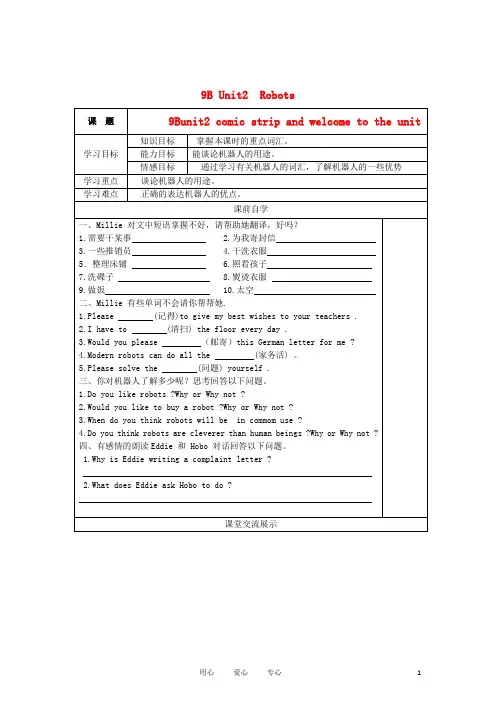
9B Unit2 Robots9BUnit2 Robots参考答案comic strip and welcome to the unit二、用所给词的适当形式填空。
zier2. explorer3.well4.children5.dishes三、根据提示,完成下列句子。
1.explore dangerous places2.nood more3.do post for4.what do 5why did 6.listen to explain.Reading (1)一、根据句意和所给的中文写出句中所缺的词。
Saleman ironed laundry virus dustbin knock mess trouble一、选用所给词组的适当形式填空.1. messing2. own3. in order to4. were made5. rice cooker Reading (2)一、根据句意及中文写出适当的单词。
1.owns2.virus3.dustbin4.mess5. dirty二、完成下列句子1.I don't know when the machine caught a virus .2.By the way ,who is the first perdon to own a rabot ?3.The machine is washing is bought by me yasterday .4.I bought a robot in order to have more time .Vocaburay二、选用所给词组的适当形式填空.1.arms2. hands3.speakers4. wheels5.camera6. batterriesGrammarA一、选择正确的答案。
1.B2.C3.D4. A5.B ;6.A7.B8.B9.C 10.D二、用所给出的疑问词完成下列句子1.where2.what3.who4.which5.when6.how7.what8.why9.what 10.why Grammar B & C一、完成下列句子1. in order to2. as a result3.need in order to4.because of5.to in order to二.用in order to 和as a result完成下列句子。
译林版英语九年级下册_Unit2_Reading(I)优质课教案(南通市)
walked on the Moon?
⑧ After landing on the MoonWhat did he do?/What did
the world think of him?
2. While-reading
Unit2 Reading(I)优质课教案(南通市)
Teaching aims:
1.Let Ss know about Neil Armstrong and his space travel;
2.Enable Ss to understand the new words and phrases and try to remember them.
Teaching procedures
Step One Review and lead-in
① Use pictures and have a free talk
“Do you want to travel into space”?
② Use a picture of Zhai Zhigang to introduce Neil Armstrong:Who are they?/What are they?
③in 1955 a test pilotWhat did he do when he was a
test pilot?
④ in 1966 went into space ★Was he alone?
★Which spacecraftwerethey in?
★Was the Gemini 8 flight a great
Step3.Homework
牛津译林版英语九年级下册 U2 Task 教案
《英语》(九年级下册)Unit 2 Great peopleTaskI. Teaching aims and learning objectivesBy the end of the lesson, students should be able to:1. use the new words and phrases correctly;2. understand how to write about a person;3. write an article about the person who you admire most.II. Teaching contents1. New words and phrases: advantage, increase, development, agriculture, hunger, contribution,production, work as, happen to, die of, be introduced into, at present 2. New structures: I think Yuan Longping is one of the greatest people that have ever lived.In 1960, he saw people die of hunger, so he began research into hybrid rice.Because of his achievements, rice production has been increased by 20%—30%.That is why I admire him so much.III. Focus of the lesson and predicted area of difficulty1. To introduce a person’s major events, using the attributive clauses.2. To tell the reason why I admire him or her.IV. Teaching proceduresStep 1 Lead-inT: In this unit, we have learnt about many great people. Tell me who they are according to the descriptions.T: We call him “Father of Hybrid Rice”. He is a rice scientist. He is a member of the Academy of Engineering.【设计意图:通过对前期所学的伟人的描述让学生热身且快速回顾的同时,导入本课所要介绍的人物袁隆平;通过感动中国袁隆平短片激发学生兴趣。
最新牛津英语译林版九年级下册Unit2单元教案

BHe flew in an aero plane when he was six.[]
CThe Gemini 8 mission is all about star signs.
DGemini 8 landed in theUSA.
Teaching procedures:
Step 1ackground information:
Step 2Explain the context. Simon is reading an artic le about a famous astronaut, Neil Armstrong. Ask students whether they know when the first man walked on the moon. Also ask them if they know the names of the first two men who walked on the moon. Tell students that they will learn more a bout men visiting the moon in the reading passage.
Step 2Listen to the tape about the following four paragraphs and read after recording.
Ask and answer to check comprehension:
1.Which was the first spacecraft to land on the moon?
(3)Armstrong became a naval pilot
初中英语九年级下册(牛津译林版)Unit2Studyskills教学设计
3.引导学生通过自主阅读、总结和反思,培养良好的学习习惯和自主学习能力。
4.设计形式多样的课堂活动,如角色扮演、小组竞赛等,激发学生的学习兴趣,提高学生的学习积极性。
(三)情感态度与价值观
三、教学重难点和教学设想
(一)教学重难点
1.重点:本章节的重点在于帮助学生掌握有效的学习方法和技巧,提高学习效率。具体包括:
-学会运用不同的时态描述学习过程和计划;
-掌握并运用本章节的核心词汇和短语;
-能够结合自身实际,制定合理的学习计划和时间安排。
2.难点:难点在于如何引导学生将这些学习方法内化为自身的学习习惯,并在实际中灵活运用。具体包括:
3.导入新课:在学生讨论的基础上,教师引出本节课的主题——Study skills,并强调学习技巧在提高学习效率方面的重要性。
(二)讲授新知
1.教学内容:本节课主要讲授以下三个方面的学习技巧:
- How to manage your time effectively(如何有效管理时间);
- Different ways to study(不同的学习方法);
1.培养学生树立正确的学习观念,认识到学习方法和技巧在学习过程中的重要性,养成良好的学习习惯。
2.培养学生积极向上的学习态度,鼓励他们勇于面对挑战,克服困难,不断提高自己。
3.培养学生的团队合作精神,让他们在合作中学会互相尊重、互相帮助,共同提高。
4.增强学生的自信心,让他们在学习和生活中都能保持积极的心态,迎接挑战。
3.鼓励学生积极参与作业,培养良好的学习习惯和自主学习能力。
4.作业评价要注重过程和结果,关注学生在作业中的表现,鼓励学生自我反思和改进。
牛津译林英语九年级下Unit 2 Robots教案
Unit 2 RobotTeaching objectives:1. To use “in order to” to introduce the purpose of an action.2. To use “as a result” to introduce the result of something.3. to use “need to” to talk about something we have to do.Teaching procedure:Part one: “in order to/as a result”Step 1:PresentationList the two sentences in the reading passage:① In order to have more free time, I have to buy a robot.② As a result, Mr. Jiang no longer needed to get up early to do thehousework.Step 2:PresentationAsk st udents a question: “What should we do if we want to have more free time?” Writesome of the answers on the blackboard and connect them with “in order to”.Step 3: PresentationExplain t students that “in order to” means “with the purpose of “and that w e can use it to introduce the purpose of an action. It can be used at the beginning or in the middle of the sentences.Step 4: Presentation Same method can be applied to introduce “as a result”. Remind students that we use it to introduce the result of something.Step 5: ExerciseAsk students to read the grammar rules and example sentences at the top of page 26 to the class.Step 6:Exercise Asks students to complete the exercise and check the answers as a whole class. Part two: “need to”Step 7: PresentationExplain to students that “need to” is a strong verb. We use it when we want to talk about something we should do.Step 8: PractiseAsk students what things they need to do today. “ I need to …”Step 9: PractiseAsk students to work on their own to complete the exercise using “need to” and the phrases in the box. Check answers with the class.Step 10:ConclutionAsk students to co mplete “work out the rule”.Homework:1. Review grammar 2 and complete exercises.2. Preview “Integrated skills”。
牛津译林版英语九年级下册 U2 Study skills 教案
《英语》(九年级下册)Unit 2 Great peopleStudy skillsI. Teaching aims and learning objectivesBy the end of the lesson, students should be able to:1. understand differences between formal and informal language;2. use formal and informal language correctly.II.Focus of the lesson and predicted area of difficultyTo understand and use formal and informal language in a correct way.III. Teaching proceduresStep 1 Lead-in1. A letter to a friendT: When we speak or write to different people, do we use the same style of text?Please read a thank-you letter from Sandy.T: Who do you think Sandy is writing to, a friend or an unfamiliar person or a teacher?T: When we write or speak to a friend, we use informal language.2. A letter to an unfamiliar personT: What about this letter? Who is Sandy writing to?T: We use formal language with unfamiliar people or teachers.Step 2 Presentation1. Different greetings and endingsT: What are the differences between formal and informal language? Can you find it?T: We use different greetings and different endings.(1) Different greetingsT: Well, can you classify these greetings? Which are formal? Which are informal?(2) Different endingsT: And when we write to others, we use the endings differently.2. Using idiomsT: What other differences can you find?We can use idioms like “It rains cats and dogs.” in informal language. Well, what are idioms? T: Idioms are phrases and sentences that do not mean exactly what they say. Even if you know the meaning of each word you see or hear, you may not understand the idiom because you don't understand the culture behind it, e.g. It rains cats and dogs.T: Usually we use idioms in spoken English. They are informal. What idioms do you know? T: Do you know these idioms? What do they mean?T: Language is wonderful. Read more, and you will learn more.3. Using contractions and abbreviationsT: What about contractions and abbreviations?T: Contractions are short forms of words when apostrophe replace letters, e.g. we’ll, she’s, can’t.Abbreviations use only the first letters of a name or phrase, or leave out letters to shorten a word, e.g. UK, Dr. They are both used in informal language.T: What other contractions and abbreviations do you know? Work in groups.T: Perfect! Many hands make light work!Step 3 Practice1. Classify the expressionsT: Now can you classify the expressions correctly?T: So formal language is used for unfamiliar people or teachers while informal language is for friends and parents.2. Improve kitty’s letterT: Kitty is writing to J. K. Rowling, the British writer, to tell her something about Harry Potter.Please read her letter.T: Does Kitty need to improve her letter? Why?T: To Kitty, J. K. Rowling is an unfamiliar person.She shouldn’t (use informal greetings or endings.)She shouldn’t (use contractions or abbreviations.)She shouldn’t (use idioms.)She should sign her full name.T: Please rewrite Kitty’s letter.T: Good job! Read it by yourselves.Step 4 ProductionWriting a letter to the headmasterT: Work in groups. Write a letter to the headmaster and advise him to organize a school trip. Pay attention to your expressions. You can use the following expression as an example.IV. HomeworkWrite a letter to your headmaster to recommend yourself as chairperson of the Students’ Union.。
苏教牛津译林版初中英语九年级下册Unit 2 Robot Pronunciation教案
苏教牛津译林初中英语重点知识精选掌握英语语法知识,巩固词汇量和各种语态,学好英语基础一定要扎实,大家一起练习吧!牛津译林初中英语和你一起共同进步学业有成!Unit 2 Robot Pronunciation教学目标: 1.To understand the use of stress in sentences2. To recognize the different meanings of a sentence based onwhere the stress is placed3. To stress the right words in a sentence4. To choose the correct meanings of a sentence based onstressed words.教学重点、难点:The use of stress in sentences and how to read out the stress. 教学方法与手段:Listening and speaking教学过程:教师活动学生活动设计意图Step 1: Lead-in1. To revise the stress in a word.e.g. beautiful country wonderful potato tomorrow Octoberabout today cartoon2. Help students review the stress in sentences in 7B.e.g. Amy thinks rabbits are lovely.Peter is crazy about goldfish.Mr. Jiang has bought a new robot. Read to gether andfeel the stress ina word and asentence.Listen and repeat.To review thestres s in aword and asentence.Step 2 Prese ntation1. Read the three example sentences clearlyand slowly for students to listen to. Ask students to repeat sentence after you paying attention to the words that is stressed. Listen and repeat..To get furtherunderstandingof the stressin sentences.Step 3: Listening1. Play the recording for part A through once and ask students to listen carefully to the stressed words.2. Play the recording again and encourage students to imitate what they hear. Ask students to read the sentences aloud. Read the sentencesaloud .To practicemore.Step 4: Practice1. Explain how the stressed words affect the meanings of the sentences.2. Divide the class into pairs. Ask students to read out the sentences to each other, stressing the words in bold. Listen to the sentences as you walk around the class. Praise areas where students perform well. To feel thefunction of thestress insentences.Make surestudentsunderstand thefunction of thestress insentences.Step 5: PresentationExplain that when w e speak, we can stress different words in a sentence. The words we stress can change the meanings of the sen tence. Write an example sentence on the blackboard:e.g.“The dog ate four tins of beans yesterday.”①Who ate four tins beans yesterday?②How many tins of beans did the dog eatyesterday?③What did the dog eat four tins ofyesterday?④When did the dog eat four tins ofbeans? To read points a, b and c under each sentence. and circle th e letter with the correct meanings for each one.Step 6: Practice1. Read the two sentences in part B aloud,stressing the words “robot andDaniel”.2. Ask students to read points a, b and c undereach sentence. Ask them to circle theletter with the correct meanings for eachone.3. Ask two students to read out their choices.Encourage students to raise their hands ifthey do not understand why these answersare correct.Step7 Homework: 1. Previe Maintask.2. 2. Completesomeexercises.授后小内容不难,但关键是学生在实际朗读中要注意应用重音的有关知识.记:相信自己,就能走向成功的第一步教师不光要传授知识,还要告诉学生学会生活。
牛津译林版英语九下《Unit 2 Robot》(Reading)word教案
Unit 2 RobotReading第一部分简要提示一、年级:九年级二、教学内容:9B Unit 2 Robots三、课型:阅读课四、教学目标1. 知识目标1) 词汇:掌握本课时的四会单词。
2) 词组:to own a robot; change one’s life; in many ways; have more spare time; make a great difference to …; iron shirts; for an extra hour; do the la undry; air the rooms; return home from work; look as good as new; be happy with …; go wrong; catch a virus; cause problems; knock things over; in a mess;3) 句型:In order to have more spare time, I need to buy a robot.As a result, Mr Jiang no longer needed to get up early to do the housework.I need to buy a robot.2. 能力目标通过阅读了解文中所出现的家用机器人的基本情况;学会运用本课所学的主要词汇、句型。
3. 情感目标结合所学内容,引导学生对未来生活展开美好想象,激发学生探索未知世界的热情。
五、教学重难点1. 重点:理解课文内容;掌握四会单词、词组和句型2. 难点:When Mr Jiang got home, he would find his flat in a mess.Coins were spread all over the floor.第二部分教学流程Step 1 Pre-readingT: Hello, everyone! Nice to meet you. I’m Mr. Bao from Wuxi Big Bridge Experimental High School. Look at the picture of my school.T: Is the teaching building tall? It has 12 floors. It may be the tallest teaching building in Jiangsu. Do you know why we built such a tall building? Because the school is close to the city center and we don’t have much space.T: Near the school, there are many shops. Many teachers love going shopping at lunchtime. I don’t like shopping much, but I often go to one of the shops. Can you guess what kind of shop it is?T: Yes, you are right. I often go to the electrical shop. I love to have a look at those TVs, cameras, MP3 players and so on. Last week, I went there again and saw a strange thing. Let’s have a look. T: Do you know what it is? It’s a robot. Do you know what it can help us do? It can help us sweep the floor. Do you like it? Yes? It may help you a lot, but it may also bring you much trouble. You don’t believe that? Today we are going to learn about Mr. Jiang’s robot. Let’s find out how the robot change his life. Before we start to read the article, let’s have a look at these new words.T: Here we have seven new words. Can you match them with the meanings on the right? No. 1, salesman. What does it mean? Yes, it means a man who sells things. No. 2, spare. Yes. Spare means free. For example, spare time, it means free time. No. 3, iron. It means ‘make clothes smooth with an ir on’. No. 4, laundry. What does it mean? Yes. It means the process of washing clothes. We often say do the laundry, which means do the washing. No. 5, virus. It’s something that causes computer problems. No. 6, mess. Mess means a dirty and untidy condition. We often say ‘in a mess’. No. 7, spread. It means covered a large area.T: Now, please read these new words after me.Step 2 While-readingT: V ery good. Now would you please listen to the article on the tape for the main idea? Please listen and answer these two questions.1 Did the robot make a great difference to Mr Jiang’s everyday life?2 What did Mr Jiang decide to do i n the end?T: Let’s check your answers.1 Did the robot make a great difference to Mr Jiang’s everyday life?Yes, it did.2 What did Mr Jiang decide to do in the end?He decided to return the robot to the robot shop.T: Well done! Now, please open your books at Page 24. Please read Paragraph 1 and 2, and then answer these two questions.1. What’s Mr Jiang’s job? (He is a salesman.)2. Why did he decide to buy a robot for himself? (He bought the robot in order to have more spare time.)T: Have you got the answers right? Good! Let’s go on reading. This time, let’s read Paragraph 3, 4 and 5, and then fill in the form below.T: In the morning, the robot makes the breakfast, irons his shirts, makes a lunch box. Mr Jiang can stay in bed for an extra hour. During the day, the robot cleans the flat, does the laundry, washes the dishes, sweeps the floor, makes the bed, airs the rooms, and goes shopping at the supermarket. Mr Jiang is working during the day. In the evening, the robot cooks the dinner and washes the dishes. Mr Jiang relaxes and watches his favourite TV programme.T: Very good! You’ve got all the answe rs right. These are all the good points of the robot. Does it have any bad points? Does he ever do anything wrong? Now, please finish reading the last two paragraphs, and then choose the wrong things that the robot did after he caught a virus.l He cooked breakfast at the right time.l He woke up Mr Jiang at the wrong time.(√)l He threw Mr Jiang’s breakfast into the dustbin.l He threw Mr Jiang’s clean shirts into the dustbin. (√)l He moved around the house and knocked things over. (√)l He went out and often lost his way home.l He made a mess in Mr Jiang’s flat. (√)Step 3 Post-readingT: A ll right. Now, we have known that the robot has some good points and some bad points. Daniel is thinking of the good and bad points of having a robot too. Help him complete the lists below. You have the lists on Page 26 in your books.T: Have you finished? Let’s check the answers together.Good points1 I will have a lot more spare time.2 I can stay in bed/sleep for a bit longer in the morning.3 It can help Mum do the laundry/washing when there are dirty clothes.4 It can iron my shirts after they are washed.5 It can wash the dishes after dinner.6 My flat will be as clean as new.Bad points1 If the robot catches a virus, it will cause a lot of problems.2 I t might put my b reakfast in the washing machine.3 It might even throw my shirts into the dustbin along with the rubbish.4 It might knock things over.5 It might make a mess in my flat.6 I might have to send it back to the robot shop.T: So now Daniel has known about the good points and bad points of the robot. Do you think he will buy a robot? He’s now talking with Millie on the phone. Millie is asking Daniel what it would be like to live with a robot. Here’s their dialogue. Write a T if Daniel’s answer is true. Write an F if it is false.T: Would you read the dialogue in groups? Boys will be Daniel and girls will be Millie.T: Let’s look at Daniel’s answers. No. 1, “Yes.”. It’s false. Do you know why? Because Mr Jiang is the first person in Sunshine Town to own a robot. No. 2, “Maybe. Some changes are good, b ut so me are not. It’s true. No. 3, “From the supermarket.” It’s false Why? Because he can buy a robot from a robot shop, not the supermarket. No. 4, “They want to have more spare time.” Yes, it’s true. No. 5, “It can eat my breakfast for me.” It’s false. Becaus e it can cook breakfast for me, not eat it for me. No. 6, “Yes, I can sleep until noon every day.” It’s false. Because he can sleep for an extra hour in the morning. No. 7, “ It’ll do the housework.” Yes, it’s true. No. 8, “I’m afraid it can’t. It’s false. Because the robot can cook. No. 9, “No. Robots never go wrong.” It’s false. Because sometimes it can go wrong if it catches viruses. No. 10, “I can return it to the shop.” It’s true.Step 4 Language pointsT: Today we’ve learned a lot about robots. So d o you want to buy one? I have got one here. It will teach you some important language points.T: 1. In order to have more spare time, I need to buy a robot. 为了有更多的空余时间,我需要买一个机器人。