
美国FDA医疗器械注册PPT
510(k)——上市前通知
510(k)的内容——21 CFR第807.87部分(三) 第三类器械510(k)申请必须包括: (1)认证和已经进行的文献检索,以及 (2)安全性和有效性不良时间数据总结及引用文献 (3)内容和格式(21CFR第807.94部分)
510(k)——临床
10-15%的510(k)申请需要临床数据 与已上市类似器械的重大差别 必须按照研究用器械豁免(IDE)规定收集资料(21CFR第812部分)
美国FDA食品药品管理局
局长
食品安全与应用营养中心(CFSAN) 药物评价与研究中心(CDER) 生物制品评价与研究中心(CBER) 医疗器械与放射健康中心(CDRH) 兽药中心(CVM) 监管事务办公室(ORA)
美国FDA医疗器械与放射健康中心(CDRH)
Daniel G. Schulta 医学博士,主管
510(k)——上市前通知
实质性等效(SE):
与合法销售器械相比,该器械: - 具有相同的预期用途,而且 - 与已获批准的类似器械具有相同的技术特点; 或者: - 具有相同的预期用途,虽然 - 具有不同的技术特点,但510(k)中提供的信息 未引发新的安全性和有效性问题,而且 证明与已获批准的类似器械相比,具有相当的安全性和有效性
公司注册——2891表格(二)
(21CFR第807部分)
FDA 2891表格—初次注册的医疗器械公司 3、外国公司必须填写其美国代理方信息
- 美国代理商信息变动时,必须于10个工作日内告知FDA - 代理商必须位于美国或者在美国设有实际工作地点—不得使用邮政信息或邮筒 - 美国代理商无需注册 - 美国代理商的职责: (1)协助FDA安排审查;(2)协助FDA进行信息沟通; (3)接收FDA无法直接提供国外公司的信息或文件; (4)回答与进口或待进口产品相关的问题;(5)可作为正式联络人
器械成品制造商
负责成品生产 必须获得美国规定的产品许可: - 注册(FDA 2891表格) - 列名登记(FDA 2892表格) - 510(k)或PMA - 美国代理商 必须符合质量体系要求 - 美国FDA质量体系法规(联邦法典21CFR第820部分) (1)设计控制 (2)生产控制(GMP优良制造规范)
4、每年递交FDA 2891a表格更新注册
医疗器械列名登记—2892表格
(21CFR第807部分)
FDA 2892表格—医疗器械列名登记 1、/cdrh/devadvice/342.html
/scripts/cdrh/cfdocs/cfRL/FDA-2892.pdf - 每份表格可登记 4 件产品; - 每种器械类型(不是每个型号、目录编号和品牌)登记一个列名; - 填写的4件产品中,每件产品均记作独立的条目;
PMA——上市前批准(21CFR第814部分)
仅适用于第三类器械 需要PMA进行分类 器械无“实质等效性”(SE) “新产品”—无“实质等效性”评价基准 临床数据证明器械的安全性和有效性 /cdrh/devadvice/pma
研究用器械豁免规范(IDE)“临床试验” (21CFR第812部分)
/cdrh/devadvice/365.html#cfr_indexes
器械分类
1700个器械类别 16项分类法规 - 21CFR第862-892部分(例如:第870部分=心血管器械) 依分类决定监管的程度 /cdrh/devadice/313.html 法规编号——880.2910 分类名称——电子温度计 分类编号/产品代码——FLL 器械等级/风险分级——II
510(k)——上市前通知
何时需要510(k) 医疗器械初次投放美国市场 已上市医疗器械预期用途变更 已上市器械经过重大改动 /cdrh/devadvice/314.html 免于510(k)审批的器械—798 / 47% 第一类:729 / 93% 2892表格—医疗器械列名登记
510(k)——上市前通知
510(k)的内容——21 CFR第807.87部分(一) 申请人姓名、地址、电话/传真号码/、联系人、代表/顾问姓名、公司注册编号 器械分类名称、CFR编号、器械等级 、产品代码 通用名/常用名、商品名/专有名及型号 与此器械具有实质等效性的已上市器械名称 是否符合第514节特殊控制的规定 计划使用的商标、标识和广告宣传 照片、工程图纸 实质等效性声明及与已上市的类似器械之比较 与已上市的类似器械之相似性和/或差异性声明 改动的器械应附上改动数据
510(k)申请类型
传统 特殊 简略
510(k)申请类型(1)——传统510(k)
包含21 CFR第807.87部分中所列的所有要素 在90天内审核
510(k)申请类型(2)——特殊510(k)
申请人对其合法销售器械进行了重大改动; 申请人认为需要进行新的510(k)申请; 这些改动不影响器械的预期用途或基本科学技术; 申请人按照21CFR第820.30部分(设计控制)对改 动进行评估; 申请人递交510(k)申请的同时,也递交符合设计控制 原则的声明; 在30天内审核。
510(k)——上市前通知
已获批准类似器械的定义(Predicate device): 无需上市前批准(PMA)的合法销售器械,例如: - 在修正案制定前(1976年5月28日)就已合法上市的器械; - 美国FDA认定具有实质等效性的器械;或者 - 重新分类的器械。 510(k)对于实质等效性的判断: - 如果认定不具有实质等效性(NSE): 公司必须提交上市前批准(PMA)、产品开发协议(PDP)或 人道主义设备豁免(HDE)申请,或者 要求将产品依风险等级重新分类(De Novo Process) - 如果认定具有实质等效性: 公司可将器械合法投放美国市场
- 每个独立条目均有各自的登记编号;
- 同一表格上可添加、更改或删除登记信息 - PMA编号、510(k)编号 - 如果产品需要PMA或510(k)编号,而表中无相应号码,表格将被退回
2、国外公司必须在将器械引入美国或者提供进口器械前列名登记
医疗器械列名登记—2892表格
(21CFR第807部分)
法规办公室 器械评价办公室 交流、教育与放射项目办公室
科学与工程技术办公室 监督与生物统计办公室 体外诊断设备评价与安全性办公室
FDA实施《联邦食品、药品和化妆品法案》 (FD&C法案)的权限
医疗器械修正案(1976年5月28日) 执行FD&C法案的法规: 联邦法典第21章(21CFG)第800-1299部分
510(k)的内容和格式 联邦法典(CFR) 21 CFR第807.87部分—内容 21 CFR第807.90部分—格式 器械特别指南,例如:活塞式注射器 CFR在线浏览网址:/cdrh/devadvice/365.html 器械建议
510(k)审批程序的改变
未经批准的器械 用于受试者以收集安全性和有效性数据 保护受试者 /cdrh/devadvice/ide/index.shtml
公司注册——2891表格(一)
(21CFR第807部分)
FDA 2891表格—初次注册的医疗器械公司 1、/cdrh/devadvice/341.html
510(k)审核程序
申请被记录在文件邮件中心(HFZ-401) 主管部门进行行政审核 指派科学审核员 器械与放射健康中心(CDRH)发出决议信 如果认定具有实质等效性,30天内公示于 CDRH主页上
510(k)信息不完整时会出现何种情况?
CDRH审核员将通过电话或信件要求提供其他 必要信息; 510(k)申请转为“停止受理”状态 申请人应于30天内提供其他必要信息 申请人可要求宽限事件
第三方审批程序 /cdrh/thirdparty/index.html 特殊510(k):通过设计控制确保对器械的改进 不影响原器械的安全性及有效性 简略510(k) :遵守公认标准,可减少数据 /cdrh/devadvice/314.html#link_6
510(k)申请类型(3)——简略510(k)
申请人递交新器械的510(k)申请; 器械适用特殊控制规定 - 指导性文件;或 - 公认标准 申请人遵从指导性文件和/或公认标准; 包含21CFR第807.87部分中所列的所有要素; 递交510(k)申请时,同时递交遵从指导性文件或公认标准 的总结信息; 在90天内审核
特殊控制
上市前监督研究 跟踪随访使用产品的患者 使用指南(例如:手套使用方法) 强制的产品性能标准 建议及其他措施 特殊标识(例如:882.5970,头部矫形器)
上市前批准
后面部分将介绍
如何监管医疗器械
上市前——器械进入市场前,必须经过“批准” 或“许可” 上市前和上市后——质量体系确保器械的生产 和设计遵照质量规划完成 上市后——医疗器械报告(MDR)或监督
510(k)——上市前通知
510(k)的内容——21 CFR第807.87部分(二) 510(k)总结或声明 510(k)必须包括下列内容之一: (1)510(k)安全性和有效性资料的“总结”,批准后公示于医疗器械与放射 卫生 中心(CDRH)网站上(21CFR第807.92部分);或者 (2)510(k)”声明“——如获要求,申请人必须在30天内提供510(k)信息 (21CFR第807.93部分) 器械用途声明 真实性和准确性声明 计划使用的标识(广告、盒标) 是否符合自愿标准 财务证明或公告声明或者二者同时提供性能数据(实验室、动物实验、临床试 验) 灭菌、软件和硬件信息(如适用) 特别指南文件所需地址信息
fda培训资料ppt课件

行政审批
FDA会对通过技术评审的申请进行行政审 批,审批周期一般需要几个月左右。
技术评审
FDA会对申请资料进行技术评审,评审周 期根据产品类别和风险等级而有所不同, 一般需要几个月到一年不等。
医疗器械不良事件监测与报告
报告义务
医疗器械生产企业有义务向FDA 报告医疗器械不良事件,包括产
品缺陷、故障、质量问题等。
企业应建立专门的法规合规部门,负 责跟踪和研究FDA的法规更新,并及 时向相关部门传达。
提升员工素质
企业应定期对员工进行FDA法规培训 ,提升员工的法规意识和操作技能。
合理规划生产和质量控制
企业应根据FDA的监管要求,合理规 划生产和质量控制环节,确保产品符 合要求。
与FDA保持良好沟通
企业应与FDA保持良好沟通,及时反 馈产品在市场上的表现,以及遇到的 问题和挑战。
FDA建立了一套完善的监测 机制,以收集和整理生物制 品使用过程中出现的不良事 件。这些信息来源于多个渠 道,包括医生报告、患者投 诉、生产商报告等。
根据法规要求,生产商必须 在获知不良事件后的一段时 间内向FDA提交报告。这些 报告必须包含详细的事件描 述、可能的原因分析以及采 取的措施等内容。同时, FDA也会对不良事件进行调 查和分析,以评估事件的真 实性和因果关系。
食品不良反应监测与报告
不良反应监测
FDA对进口和在美销售的食品进行不良反应监测,包括食品中毒、过敏反应、化学物质超标等。
报告义务
FDA要求企业、消费者和医疗专业人士报告疑似食品不良反应事件,以便及时展开调查和采取措施。
06
FDA对生物制品的监管
生物制品注册与审批流程
申请与受理
申请人需提交完整的申请材料,包括生物制品的名称、活性成分、剂型、适应症等信息, 并缴纳相应的费用。FDA对申请材料进行审核,并对申请进行分类,将符合要求的申请转 至评审部门。
美国FDA_医疗器械体系法规QSR820中英文版
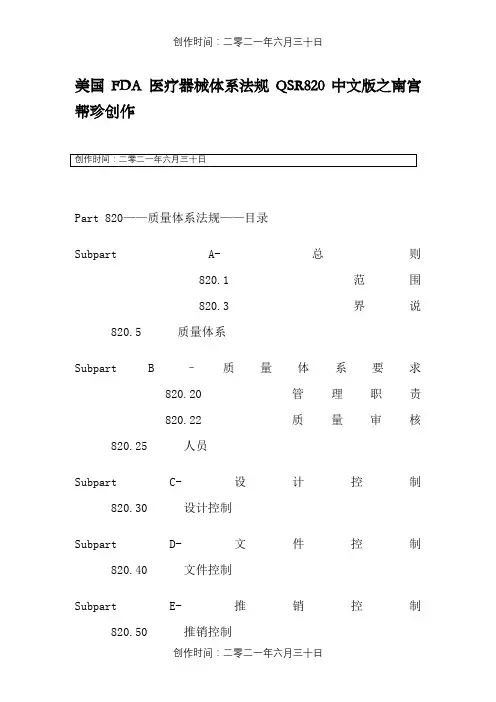
美国FDA 医疗器械体系法规QSR820中文版之南宫帮珍创作Part 820——质量体系法规——目录Subpart A- 总则820.1 范围820.3 界说 820.5 质量体系Subpart B –质量体系要求820.20 管理职责820.22 质量审核 820.25 人员Subpart C- 设计控制 820.30 设计控制Subpart D- 文件控制 820.40 文件控制Subpart E- 推销控制 820.50 推销控制Subpart F- 标识与可追溯性820.60 标识 820.65 可追溯性Subpart G - 生产和过程控制820.70 生产和过程控制820.72 检验、丈量和试验设备 820.75 过程确认Subpart H - 验收活动: 820.80 进货、过程和制品器械检验 820.86 检验状态Subpart I –分歧格品 820.90 分歧格品Subpart J - 纠正和预防办法 820.100 纠正和预防办法Subpart K –标识和包装控制820.120 设备标签 820.130 设备包装Subpart L –搬运/贮存/分销和装置820.140 搬运820.150 贮存820.160 分销 820.170 装置Subpart L –记录820.180 记录的通用要求820.181 设备主要记录820.184 设备历史记录820.186 质量体系记录 820.198 投诉文件Subpart M –服务 820.200 服务Subpart N –统计技术820.250 统计技术Subpart A——总则Subpart A--General Provisions Sec.820.1 范围Sec. 820.1 Scope. (a)适用性Applicability. (1)实质量体系法规说明了以后良好制造法规Current good manufacturing practice(CGMP)的要求.本标准适用于所有预期用于人类的制品器械的设计、制造、包装、标识、贮存、装置和服务中所使用的管理方法、设施和控制.本标准的目的是保证制品器械的平安性和有效性, 并符合联邦食品、药品和化妆品法案Federal Food, Drag and Cosmetic Act (the act).本法规适用于所有的医疗器械制品制造商.如果制造商仅从事本部份有要求服从的某些过程而未从事其它过程, 则只需符合其实施的过程的要求.对Ⅰ类设备, 设计控制仅适用于Sec.820.30(a)(2)中列出的设备.本法规不适用于制品器械的部件或零件制造商, 但鼓励这类制造商把本法规的适当规定作为指南来使用.人血和血液成份制造商不受本部份法规的限制, 但应遵循本章606部份法规的要求.Current good manufacturing practice(CGMP) requirements are set forth in this quality system regulation. The requirements in this part govern the methods used in, and the facilities and controls used for, the design, manufacture, packaging, labeling, storage, installation, and servicing of all finished devices intended for human use. The requirements in this part are intended to ensurethat finished devices will be safe and effective and otherwise in compliance with the Federal Food, Drug, and Cosmetic Act (the act). This part establishes basic requirements applicable to manufacturers of finished medical devices. If a manufacturer engages in only some operations subject to the requirements in this part, and not in others, that manufacturer need only comply with those requirements applicable to the operations in which it is engaged. With respect to class I devices, design controls apply only to those devices listed in 820.30(a)This regulation does not apply to manufacturers of components or parts of finished devices, but such manufacturers are encouraged to use appropriate provisions of this regulation as guidance. Manufacturers of human blood and blood components are not subject to this part, but are subject to part 606 of this chapter. Manufacturers of human cells, tissues, and cellular and tissue-based products (HCT/Ps), as defined in 1271..3(d) of this chapter, that are medical devices (subject to premarket review or notification, or exempt from notification, under an application submitted under the device provisions of the act or under a biologicalproduct license application under section 351 of the Public Health Service Act) are subject to this part and are also subject to the donor-eligibility procedures set forth in part 1271 subpart C of this chapter and applicable current good tissue practice procedures in part 1271 subpart D of this chapter. In the event of a conflict between applicable regulations in part 1271 and in other parts of this chapter, the regulation specifically applicable to the device in question shall supersede the more general.(2)本部份的规定适用于本部份界说的预期用于人体的所有制品器械, 不论其在美国(包括:美国任何州或领土,哥伦比亚特区,波多黎各联邦)外乡制造还是进口,提供进口的产物.(2) The provisions of this part shall be applicable to any finished device as defined in this part, intended for human use, that is manufactured, imported, or offered for import in any State or Territory of the United States, the District of Columbia, or the Commonwealth of Puerto Rico.(3)在本法规中“适用时”(where appropriate)呈现过屡次.当要求根据“where appropriate”被认为是合格时, 其要求应被认为是“适用的”(appropriate), 除非组织能提供文件证明其理由.如果不执行预期结果会招致产物不符合其特定的要求, 或组织不需要执行任何需要的纠正办法, 那么要求就是适用的(appropriate).(3) In this regulation the term "where appropriate" is used several times. When a requirement is qualified by "where appropriate," it is deemed to be "appropriate" unless the manufacturer can document justification otherwise. A requirement is "appropriate" if non-implementation could reasonably be expected to result in the product not meeting its specified requirements or the manufacturer not being able to carry out any necessary corrective action.(b)限制.除非特别规定, 则本部份质量体系法规是本章其它部份法规的弥补要求.在不能符合所有适用的法规, 包括本章此部份和其它部份的情况, 特别是对讨论中的设备, 此法规应取代其它通用要求.(b) The quality system regulation in this part supplements regulations in other parts of this chapterexcept where explicitly stated otherwise. In the event of a conflict between applicable regulations in this part and in other parts of this chapter, the regulations specifically applicable to the device in question shall supersede any other generally applicable requirements.(c)权限.PART820是在(21U.S.C.法令351、352、360、360c、360d、360e、360h、360i、360j、360l、370、374、381、383中)501、502、510、513、514、515、518、519、520、522、701、704、801、803下建立并发布的.不符合本部份(Part 820)的任何适用的规定, 依据法令section 501(h)条款, 可判定该产物为伪劣产物.这类产物及对此不符合负责的任何个人, 将依法被起诉.(c)Authority.Part 820 is established and issued under authority of sections 501, 502, 510, 513, 514, 515, 518, 519, 520, 522, 701, 704, 801, 803 of the act (21 U.S.C. 351, 352, 360, 360c, 360d, 360e, 360h, 360i, 360j, 360l, 371, 374, 381, 383). The failure to comply with any applicable provision in this part renders a device adulterated under section 501(h) of the act. Such a device, as well as any person responsible for the failure to comply, is subject to regulatory action.(d)外国制造商.如果把器械进口到美国的制造商拒绝允许或同意FDA对其外国工厂履行为确定器械是否符合本法规(Part 820)所进行的检查, 可按section 801(a)条款对其提出诉讼.即准备出口到美国的设备, 其设计、生产、包装、标签、贮存或服务中使用的方法和设备控制不符合本法令section 520(f)和本部份(Part 820)的要求, 可按本法令section 501(h)条款判定在此条件下制造的产物为伪劣产物.(d)Foreign manufacturers.If a manufacturer who offers devices for import into the United States refuses to permit or allow the completion of a Food and Drug Administration (FDA) inspection of the foreign facility for the purpose of determining compliance with this part,it shall appear for purposes of section 801(a) of the act, that the methods used in, and the facilities and controls used for, the design, manufacture, packaging, labeling, storage, installation, or servicing of any devices produced at such facility that are offered for import into the United States do not conform to the requirements of section 520(f) of the act and this part and that the devices manufactured at that facility are adulterated under section 501(h) of the act.(e)豁免或特别许可/Exemptions or variances (1)任何人希望得就任何医疗器械质量体系要求的豁免或特别许可, 应符合法令section 520(f)(2)的要求.根据本章Sec.10.30即FDA行政法式, 来提交豁免或特别许可的申请.可以从器械和辐射健康中心和小型制造商援助处获得指导, 地址(HFZ-220), 1350 Piccard Dr., Rockville, MD20850, U.S.A., 德律风1-800-638-2041或1-301-443-6597, 传真301-443-8818. (1) Any person who wishes to petition for an exemption or variance from any device quality system requirement is subject to the requirements of section 520(f)(2) of the act. Petitions for an exemption or variance shall be submitted according to the procedures set forth in 10.30 of this chapter, the FDA's administrative procedures. Guidance is available from the Center for Devices and Radiological Health, Division of Small Manufacturers, International and Consumer Assistance (HFZ-220), 1350 Piccard Dr., Rockville, MD20850, U.S.A., telephone 1-800-638-2041 or 240-276-3150, FAX 240-276-3151.(2)在有关部份确定此种改变符合美国公众健康的最佳利益时, FDA可能发起并同意器械质量体系的特别许可.公在美国公众健康确实需要该设备, 且如无此特别许可, 则器械就不成能充沛有效的生产的情况下, 特别许可才有效.(2) FDA may initiate and grant a variance from any device quality system requirement when the agency determines that such variance is in the best interest of the public health. Such variance will remain in effect only so long as there remains a public health need for the device and the device would not likely be made sufficiently available without the variance.(f)本部份不适用于本章897部份界说的烟草销售商.Sec.820.3 界说/ Definitions (a)法案Act.指明Federal Food, Drug and Cosmetic Act, 如修正的(secs.201-903, 52 Stat. 1040 et sep., 21 U.S.C. 321-394).所有法案section 201中的界说在本部份法规中均适用.(a)Act means the Federal Food, Drug, and Cosmetic Act, as amended (secs. 201-903, 52 Stat. 1040et seq., as amended (21 U.S.C. 321-394)). All definitions in section 201 of the act shall apply to the regulations in this part.(b)投诉Complaint.在设备交付后所有的书面的、电子的或口头的, 对设备的标识、质量、耐用性、可靠性、平安性、有效性和性能方面缺陷的信息.(b)Complaint means any written, electronic, or oral communication that alleges deficiencies related to the identity, quality, durability, reliability, safety, effectiveness, or performance of a device after it is released for distribution.(c)部件Component.所有意图用来包括成为已完成的、包装、标识的器械的一部份的原资料、物资、构件、零件、软件、固件、连接件、标签或它们的集合.(c)Component means any raw material, substance, piece, part, software, firmware, labeling, or assembly which is intended to be included as part of the finished, packaged, and labeled device.(d)控制号Control number.任何鉴别性符号, 如由字母、数字或它们的组合形成的唯一性组合, 由控制号可以确定一批或一个器械的制造、包装、标识和交付的历史.(d)Control number means any distinctive symbols, such as a distinctive combination of letters or numbers, or both,from which the history of the manufacturing, packaging, labeling, and distribution of a unit, lot, or batch of finished devices can be determined.(e)设计历史文件Design history file(DHF).制品器械的设计历史记录的汇总.(e)Design history file(DHF) means a compilation of records which describes the design history of a finished device.(f)设计输入Design input.器械实体和性能要求, 是产物设计的基础.(f)Design input means the physical and performance requirements of a device that are used as a basis for device design.(g)设计输出Design output.是指每个设计阶段和最后所有的设计功效的结果.已完成的设计输出是器械主记录的基础.全部最终完成的设计输出, 由器械及其包装和标识和设备主记录组成. (g)Design output means the results of a design effort at each design phase and at the end of the total design effort. The finished design output is the basis for thedevice master record. The total finished design output consists of the device, its packaging and labeling, and the device master record.(h)设计评审Design review.是指对设计的一个文件化的、全面的、系统的检查, 评价其满足设计要求, 评价其有能力满足要求, 并识别任何问题.(h)Design review means a documented, comprehensive, systematic examination of a design to evaluate the adequacy of the design requirements, to evaluate the capability of the design to meet these requirements, and to identify problems.(i)设备历史记录Device history record(DHR).制品器械历史记录的汇总.(i)Device history record(DHR) means a compilation of records containing the production history of a finished device.(j) Device master record(DMR).制品器械的法式和规范的汇总.(j)Device master record(DMR) means a compilation ofrecords containing the procedures and specifications for a finished device.(k)建立Establish.界说文件(书面或电子的)并执行.(k)Establish means define, document (in writing or electronically), and implement.(l)制品器械Finished device.设备或其附件, 无论其是否包装、标识或灭菌, 能够满足使用要求或者说能够实现其功能.(l)Finished device means any device or accessory to any device that is suitable for use or capable of functioning, whether or not it is packaged, labeled, or sterilized.(m) Lot或batch.一个或多个元件或制品器械, 均为同一种规格、型号、尺寸、成份或软件版本, 在相同条件下生产, 满足相同的特性和质量要求.(m)Lot or batch means one or more components or finished devices that consist of a single type, model, class, size, composition, or software version that are manufactured under essentially the same conditions and that are intended to have uniform characteristics and quality within specified limits.(n)执行职责的管理者Management with executive responsibility.是组织的高级员工, 他们负有建立或更改组织的质量方针和质量体系的职权.(n)Management with executive responsibility means those senior employees of a manufacturer who have the authority to establish or make changes to the manufacturer's quality policy and quality system.(o)制造商/组织Manufacturer.是指设计、制造、制作(fabricate)、装配或加工制品器械的任何人.制造商包括但不单限于根据合同执行灭菌、装置、重新标识、重新制造、重新包装或特定的开发职责的制造商, 和执行这些职责的国外组织的国内分销商.(o)Manufacturer means any person who designs, manufactures, fabricates, assembles, or processes a finished device. Manufacturer includes but is not limited to those who perform the functions of contract sterilization, installation, relabeling, remanufacturing, repacking, or specification development, and initial distributors of foreign entities performing these functions.(p) Manufacturing material.指任何用于或用于催化制造过程的任何原料或物质, 在制造过程中发生的陪伴的成份或副产物, 其在制品器械中/上呈现为残留物或杂质, 它不是制造商的设计或意图.(p)Manufacturing material means any material or substance used in or used to facilitate the manufacturing process, a concomitant constituent, or a byproduct constituent produced during the manufacturing process, which is present in or on the finished device as a residue or impurity not by design or intent of the manufacturer.(q)分歧格Nonconformity.未满足规定的要求.(q)Nonconformity means the nonfulfillment of a specified requirement.(r)产物Product.部件、原资料、在制品、制品和返回品. (r)Product means components, manufacturing materials, in- process devices, finished devices, and returned devices.(s)质量Quality.一组固有特性满足要求的法式, 包括平安和性能.(s)Quality means the totality of features andcharacteristics that bear on the ability of a device to satisfy fitness-for-use, including safety and performance.(t)质量审核Quality Audit.按规定的时间间隙和频率, 对制造商的质量体系进行系统、客观的检查, 以确定质量体系活动及其结果符合质量体系法式, 这些法式获得有效执行, 法式适应质量目标的需求.(t)Quality audit means a systematic, independent examination of a manufacturer's quality system that is performed at defined intervals and at sufficient frequency to determine whether both quality system activities and the results of such activities comply with quality system procedures, that these procedures are implemented effectively, and that these procedures are suitable to achieve quality system objectives.(u)质量方针Quality policy.由制造商的最高管理者发布的组织总的质量宗旨和方向.(u)Quality policy means the overall intentions and direction of an organization with respect to quality, as established by management with executive responsibility.(v)质量体系Quality system.质量管理的组织结构、职责、法式、过程和资源.(v)Quality system means the organizational structure, responsibilities, procedures, processes, and resources for implementing quality management.(w) Remanufacturer.指对制品器械进行处理、修整、修复、重新包装、恢复或其它活动的人, 使制品器械的性能、平安规范或预期用途发生重年夜更改.(w)Remanufacturer means any person who processes, conditions, renovates, repackages, restores, or does any other act to a finished device that significantly changes the finished device's performance or safety specifications, or intended use.(x)返工Rework.为使分歧格品在其交付前符合DMR的要求而采用的办法.(x)Rework means action taken on a nonconforming product so that it will fulfill the specified DMR requirements before it is released for distribution.(y)规范Specification.产物、过程、服务或其它活动应符合的要求.(y)Specification means any requirement with which a product, process, service, or other activity must conform.(z)确认Validation.通过检查和提供客观证据证明满足预期用途的要求.(z)Validation means confirmation by examination and provision of objective evidence that the particular requirements for a specific intended use can be consistently fulfilled.(1)过程确认Process validation.根据客观证据确定过程可继续发生满足预先确定例范的结果或产物.(1)Process validation means establishing by objective evidence that a process consistently produces a result or product meeting its predetermined specifications.(2)设计确认Design validation.根据客观证据确定设备规范符合使用者的需求和预期用途.(2)Design validation means establishing by objective evidence that device specifications conform with user needs and intended use(s).(aa)验证Verification.通过检查和提供客观证据证明满足规定的要求.(aa)Verification means confirmation by examination and provision of objective evidence that specified requirements have been fulfilled.Sec.820.5 质量体系/ Quality system. 制造商应建立并实施适应特定的医疗器械设计或制造, 并符合本部份要求的质量体系.Each manufacturer shall establish and maintain a quality system that is appropriate for the specific medical device(s) designed or manufactured, and that meets the requirements of this part.Subpart B——质量体系要求/Quality System Requirements Sec.820.20 管理职责/Management responsibility (a)质量方针:负有执行职责的管理者应建立质量方针和目标以及在质量方面的许诺, 应保证组织内所有级别都能正确理解并执行质量方针.(a)Quality policy.Management with executive responsibility shall establish its policy and objectives for, and commitment to, quality. Management with executive responsibility shall ensure that the qualitypolicy is understood, implemented, and maintained at all levels of the organization.(b)组织:建立并坚持适宜的组织结构, 确保产物的设计和生产符合本部份(Part 820)的要求.(b)Organization.Each manufacturer shall establish and maintain an adequate organizational structure to ensure that devices are designed and produced in accordance with the requirements of this part.(1)职责和权限.制造商应明确影响质量的管理、把持和评价人员的职责、权限及相互关系, 为其提供执行这些工作必需的自主权和权限.(1)Responsibility and authority.Each manufacturer shall establish the appropriate responsibility, authority, and interrelation of all personnel who manage, perform, and assess work affecting quality, and provide the independence and authority necessary to perform these tasks.(2)资源.制造商应提供适当的资源, 包括由经过培训的人员, 执行管理、把持和包括内部质量审核在内的活动, 以符合本部份(Part 820)的要求.2)Resources.Each manufacturer shall provide adequate resources, including the assignment of trained personnel, for management, performance of work, and assessment activities, including internal quality audits, to meet the requirements of this part.(3)管理者代表.最高管理者应在管理层中以书面方式指定一名管理者代表, 无论其在其它方面的职责如何, 应具有以下方面的职责和权限:(3)Management representative.Management with executive responsibility shall appoint, and document such appointment of, a member of management who, irrespective of other responsibilities, shall have established authority over and responsibility for:(i)确保根据本部份(Part 820)的要求有效地建立、实施和坚持质量管理体系;(i) Ensuring that quality system requirements are effectively established and effectively maintained in accordance with this part; and(ii)向负有执行职责的管理者陈说质量体系运行情况, 以供评审.(ii) Reporting on the performance of the quality system to management with executive responsibility for review.(c)管理评审.负有执行职责的管理者, 应按法式规定的时间间隔对证量体系进行审核.确保质量体系的继续适宜性和有效性, 以满足本标准的要求和组织规定的质量方针和目标.评审的日期和结果应形成文件并记录.(c)Management review.Management with executive responsibility shall review the suitability and effectiveness of the quality system at defined intervals and with sufficient frequency according to established procedures to ensure that the quality system satisfies the requirements of this part and the manufacturer's established quality policy and objectives. The dates and results of quality system reviews shall be documented.(d)质量规画.制造商应建立质量规画, 确定设计和制造设备所需的质量准则、资源和活动, 形成质量计划.组织应确定如何满足质量要求.(d)Quality planning. Each manufacturer shall establish a quality plan which defines the quality practices, resources, and activities relevant to devices that aredesigned and manufactured. The manufacturer shall establish how the requirements for quality will be met.(e)质量体系法式.制造商应建立质量体系法式和规范, 适用时应建立质量体系的文件化的结构描述.(e)Quality system procedures.Each manufacturer shall establish quality system procedures and instructions. An outline of the structure of the documentation used in the quality system shall be established where appropriate. Sec.820.22 质量审核Quality audit.制造商应建立并实施质量审核法式和活动, 以确保质量体系符合既定的质量体系要求, 确定质量体系的有效性.质量审核应由与所审核的活动无直接责任的人员进行.纠正办法, 需要时包括对不符合项的重新审核.每次质量审核和重新审核的结果应形成陈说, 陈说要经对审核负有责任的管理者评审.审核和重新审核的日期和结果应予记录.Each manufacturer shall establish procedures for quality audits and conduct such audits to assure that the quality system is in compliance with the established quality system requirements and to determine the effectiveness of the quality system. Quality audits shall be conducted byindividuals who do not have direct responsibility for the matters being audited. Corrective action(s), including a reaudit of deficient matters, shall be taken when necessary. A report of the results of each quality audit, and reaudit(s) where taken, shall be made and such reports shall be reviewed by management having responsibility for the matters audited. The dates and results of quality audits and reaudits shall be documented.Sec.820.25 人员/Personnel (a)概述.制造商应有足够的人员, 经过需要的教育、工作布景、专业培训和相关的经验, 以保证所有法规要求的活动能够获得正确的执行.(a)General.Each manufacturer shall have sufficient personnel with the necessary education, background, training, and experience to assure that all activities required by this part are correctly performed.(b)培训.制造商应建立培训的文件, 明确培训需求, 保证所有人员都能得充沛的培训, 以保证满足工作的要求.培训应形成记录.(b)Training. Each manufacturer shall establish proceduresfor identifying training needs and ensure that all personnel are trained to adequately perform their assigned responsibilities. Training shall be documented.(1)作为培训的一部份, 应使员工意识到他们的特殊工作中的不正确的把持可造成设备的缺陷.(1) As part of their training, personnel shall be made aware of device defects which may occur from the improper performance of their specific jobs.(2)负有验证和确认职责的人员应意识到, 在其工作中会遇到缺陷和毛病.(2) Personnel who perform verification and validation activities shall be made aware of defects and errors that may be encountered as part of their job functions.(1) Each manufacturer of any class III or class II device,and the class I devices listed in paragraph (a)(2) of this section, shall establish and maintain procedures to control the design of the device in order to ensure that specified design requirements are met.(2) The following class I devices are subject to design controls:(i) Devices automated with computer software; and(ii) The devices listed in the following chart.Device868.6810 导管、呼吸机878.4460 手套、外科医生用手套880.6760 阻止、呵护用品892.5650 生化、涂药器、放射性、手工制造(Manual)892.5740 源、放射治疗(b)设计和开发规画.组织应建立并实施设计和开发计划, 其内容描述或包括了设计和开发的相关活动并界说了执行的职责.计划应明确并描述分歧部份/组间的接口及活动, 其结果是设计输入和开发过程.计划应随着设计和开发的推进进行评审、更新, 并经批准.(b)Design and development planning.Each manufacturer shall establish and maintain plans that describe or reference the design and development activities and define responsibility for implementation. The plans shall identify and describe the interfaces with different groups or activities that provide, or result in, input to the design and development process. The plans shall be reviewed, updated, and approved as design and development evolves.(c)设计输入.组织应建立并坚持法式, 以保证与产物相关的设计要求是适宜的, 并满足设备的预期用途, 包括使用者和患者的需要.这个法式应包括解决任何不完全、不明确和相互矛盾的要求的机制.设计输入要求应经审核, 并经指定的人员审核和批准.审批应包括审批人员的签名和日期, 审批应予记录.(c)Design input.Each manufacturer shall establish and maintain procedures to ensure that the design requirements relating to a device are appropriate and address the intended use of the device, including the needs of the user and patient. The procedures shall include a mechanism for addressing incomplete, ambiguous, or conflicting requirements. The design input requirements shall be documented and shall be reviewed and approved by a designated individual(s). The approval, including the date and signature of the individual(s) approving the requirements, shall be documented.(d)设计输出.组织应建立并坚持文件化的设计输出法式, 使经过评审的设计输出文件满足设计输入的要求.设计输出法式应包括或涉及接收标准, 确保实现设备基本的、适用的功能.设计输出应是文件化的, 在发布前应经评审和批准.审批应文件化, 包括批准人的签名及日期.(d)Design output.Each manufacturer shall establish and maintain procedures for defining and documenting design output in terms that allow an adequate evaluation of conformance to design input requirements. Design output procedures shall contain or make reference to acceptance criteria and shall ensure that those design outputs that are essential for the proper functioning of the device are identified. Design output shall be documented, reviewed, and approved before release. The approval, including the date and signature of the individual(s) approving the output, shall be documented.(e)设计评审.组织应建立并实施法式, 确保在产物设计开发的适当阶段, 有计划地对设计结果进行正式的评审.法式应确保每次设计评审的介入者, 应包括与被评审的设计阶段有关的所有职能部份的代表, 和一名或多名与被评审设计阶段无直接责任的人员, 需要时也可包括其它专家.评审结果, 包括设计标识(identification of design)、日期、评审的人员, 应在设计历史文件中予以记录.(e)Design review.Each manufacturer shall establish and maintain procedures to ensure that formal documented reviews of the design results are planned and conductedat appropriate stages of the device's design development. The procedures shall ensure that participants at each design review include representatives of all functions concerned with the design stage being reviewed and an individual(s) who does not have direct responsibility for the design stage being reviewed, as well as any specialists needed. The results of a design review, including identification of the design, the date, and the individual(s) performing the review, shall be documented in the design history file (the DHF).(f)设计验证.组织应建立并实施设计验证的法式.确保设计输出满足设计输入的要求.设计验证的结果, 包括设计标识(identification of design)、方法、日期、验证的人员, 应在设计历史文件中予以记录.(f)Design verification. Each manufacturer shall establish and maintain procedures for verifying the device design. Design verification shall confirm that the design output meets the design input requirements. The results of the design verification, including identification of the design, method(s), the date, and the individual(s) performing the verification, shall be documented in theDHF.(g)设计确认.组织应建立并实施设计确认法式.设计确认应在规定的把持条件下, 对最初的产物、批次或其等价物上进行.设计确认应确保产物满足规定的用户需求和预期的使用要求, 也包括在实际或模拟的使用条件下对产物单位进行试验.适用时, 设计确认应包括软件确认和风险分析.设计确认的结果, 包括设计标识(identification of design)、方法、日期、确认的人员, 应在设计历史文件中予以记录.(g)Design validation.Each manufacturer shall establish and maintain procedures for validating the device design. Design validation shall be performed under defined operating conditions on initial production units, lots, or batches, or their equivalents. Design validation shall ensure that devices conform to defined user needs and intended uses and shall include testing of production units under actual or simulated use conditions. Design validation shall include software validation and risk analysis, where appropriate. The results of the design validation, including identification of the design, method(s), the date, and the individual(s) performing the validation, shall be documented in the DHF.(h)设计转换.组织应建立并坚持文件化的法式, 以保证产物的设计能够正确的转换成产物的规范.(h)Design transfer. Each manufacturer shall establish and maintain procedures to ensure that the device design is correctly translated into production specifications.(i)设计更改.组织应建立并坚持法式, 在执行前设计更改应被识别、文件化、确认或适用时经验证、评审和批准.(i)Design changes. Each manufacturer shall establish and maintain procedures for the identification, documentation, validation or where appropriate verification, review, and approval of design changes before their implementation.(j)设计历史文件.组织应建立并坚持每个型号的产物的DHF.DHF应包括或涉及需要的记录, 以证明设计的进程符合被批准的设计计划和本部份的要求.(j)Design history file. Each manufacturer shall establish and maintain a DHF for each type of device. The DHF shall contain or reference the records necessary to demonstrate that the design was developed in accordance with the approved design plan and the requirements of this part.Subpart D——文件控制Document ControlsSec.820.40 文件控制Document Controls 组织应建立并实施法式, 以控制所有本部份要求的文件.法式应包括:Each manufacturer shall establish and maintain procedures to control all documents that are required by this part. The procedures shall provide for the following:(a)文件的批准和发布.所有文件在发布前应由授权人员评审、批准其适宜性, 以满足本部份的要求.文件的批准, 包括批准发布人员的签名及日期应形成记录.确保在文件适用的场所能够获得相关文件, 从所有发放或使用场所及时撤出作废文件, 以防止作废文件的非预期使用.(a)Document approval and distribution.Each manufacturer shall designate an individual(s) to review for adequacy and approve prior to issuance all documents established to meet the requirements of this part. The approval, including the date and signature of the individual(s) approving the document, shall be documented. Documents established to meet the requirements of this part shall be available at all locations for which they are designated, used, or otherwise necessary, and all obsolete documents shall be promptly removed from all。
美国FDA-医疗器械体系法规QSR820中英文版2015.06
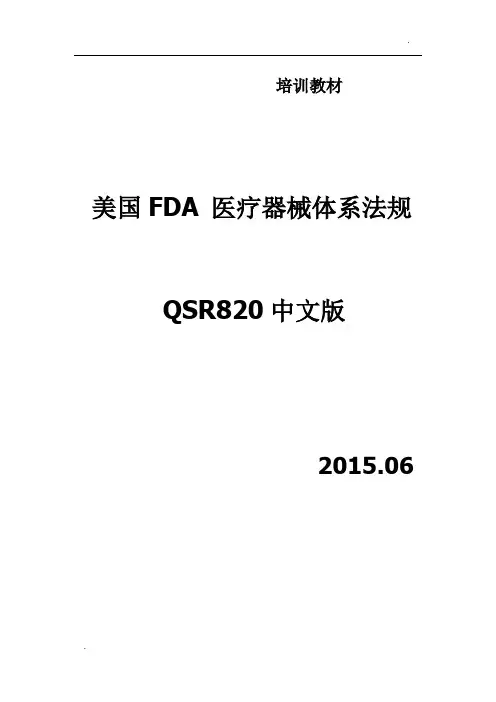
培训教材美国FDA 医疗器械体系法规QSR820中文版2015.06Part 820——质量体系法规——目录Subpart A- 总则820.1 范围820.3 定义820.5 质量体系Subpart B –质量体系要求820.20 管理职责820.22 质量审核820.25 人员Subpart C- 设计控制820.30 设计控制Subpart D- 文件控制820.40 文件控制Subpart E- 采购控制820.50 采购控制Subpart F- 标识与可追溯性820.60 标识820.65 可追溯性Subpart G - 生产和过程控制820.70 生产和过程控制820.72 检验、测量和试验设备820.75 过程确认Subpart H - 验收活动:820.80 进货、过程和成品器械检验820.86 检验状态Subpart I –不合格品820.90 不合格品Subpart J - 纠正和预防措施820.100 纠正和预防措施Subpart K –标识和包装控制820.120 设备标签820.130 设备包装Subpart L –搬运/储存/分销和安装820.140 搬运820.150 贮存820.160 分销820.170 安装Subpart L –记录820.180 记录的通用要求820.181 设备主要记录820.184 设备历史记录820.186 质量体系记录820.198 投诉文件Subpart M –服务820.200 服务Subpart N –统计技术820.250 统计技术Subpart A——总则Subpart A--General ProvisionsSec.820.1 范围Sec. 820.1 Scope.(a)适用性Applicability。
(1)本质量体系法规阐明了当前良好制造法规Current good manufacturing practice (CGMP)的要求。
医疗器械法律法规ppt课件

医疗器械注册是指依照法 定程序,对拟上市销售、 使用的医疗器械的安全性 、有效性进行系统评价, 以决定是否同意其上市销 售、使用的过程。
企业向国家药品监督管理 局提交注册申请,并提交 相关资料。
国家药品监督管理局组织 专家对申请资料进行技术 审评,评估医疗器械的安 全性和有效性。
对于需要进行临床试验的 医疗器械,需获得临床试 验批准后方可开展。
法律法规作用
确保医疗器械的安全性和有效性,保障公众健康和生命安全 ;规范医疗器械的生产、经营和使用行为,维护市场秩序; 促进医疗器械产业的健康发展,推动医疗科技进步。
国内外医疗器械法规比较
国外医疗器械法规概述
国际医疗器械法规主要包括欧盟的CE认证、美国的FDA认证等。这些法规对医 疗器械的监管要求严格,涉及产品的安全性、有效性等方面。
质量监督抽查
定期对医疗器械生产企业进行质量监督抽查,对抽查不合 格的企业和产品依法进行处理,保障医疗器械的质量安全 。
经营环节监管政策及措施
经营许可制度
对医疗器械经营企业实行许可制度,要求企业具备 相应的经营条件、质量管理体系和售后服务能力, 确保经营的医疗器械来源合法、质量可靠。
购销记录管理
要求医疗器械经营企业建立购销记录管理制度,详 细记录医疗器械的购进、销售情况,确保产品流向 可追溯。
根据技术审评结果和临床 试验数据(如适用),国 家药品监督管理局作出是 否批准注册的决定。
备案制度详解及操作指南
01
02
03
04
备案制度定义
医疗器械备案是指医疗器械生 产企业或者进口企业在产品上 市前,向国家药品监督管理局 提交产品相关资料进行登记的 过程。
申请与受理
企业向国家药品监督管理局提 交备案申请,并提交相关资料 。
《医疗器械注册概要》课件

其他证明文件
根据产品特性和注册审查要求,可能 还需提交其他相关证明文件。
变更与延续注册材料
变更注册申请表
产品技术要求变化表
详细说明变更事项、原因及对产品安全性 、有效性的影响。
对比新旧产品技术要求的差异,说明变化 内容和理由。
地方政府的医疗器械产业发展规划
为了促进本地区的医疗器械产业发展,地方政府会制定相关的发展规划,包括对 医疗器械创新的支持、产业集群建设等。
国际法规
《欧盟医疗器械指令》
这是欧盟对医疗器械进行监管的主要法规,对欧盟内部的医疗器械生产和销售有重要影响。
《美国食品药品管理局(FDA)医疗器械监管》
美国FDA负责对国内和进口的医疗器械进行监管,确保其安全有效。
03
CATALOGUE
医疗器械注册申请材料
基本材料
申请人资质证明
申请人需提供合法注册证明文 件,如企业营业执照、事业单
位法人证书等。
产品技术要求
详细描述医疗器械的技术参数 、性能指标、安全要求等,是 产品注册审查的重要依据。
产品说明书
包含医疗器械的使用方法、注 意事项、维护保养等内容,是 指导用户正确使用产品的关键 文件。
失败案例:某未通过审批的医疗器械
总结词
技术不够成熟、安全性存疑
详细描述
某医疗器械在技术上不够成熟,缺乏充分的 安全性和有效性数据支持。在注册过程中, 监管部门对该产品的审查较为严格,发现存 在一些安全隐患和不确定性因素。最终,该 申请未获得注册证,企业需要继续改进技术 和完善相关资料,重新申请注册。
质量管理体系文件
证明申请人具备稳定、可靠的 生产和质量控制能力的文件, 包括质量手册、程序文件等。
美国FDA医疗器械法规解读第一部分
美国FDA医疗器械法规解读第一部分美国FDA(美国食品药品监督管理局)负责监管和批准医疗器械在美国市场的销售和使用。
FDA根据联邦法律和法规制定了一系列规定,以确保医疗器械的安全性和有效性。
以下是美国FDA医疗器械法规第一部分的解读。
美国FDA医疗器械法规的第一部分包括总则和定义。
其中,总则部分详细说明了该法规的范围和目的。
根据总则,该法规适用于涉及医疗器械的各种情况,无论是制造、分销还是使用。
该法规的目的是保护公众,确保医疗器械的安全性、有效性和性能。
该法规对医疗器械的定义进行了详细说明。
根据该定义,医疗器械是用于诊断、治疗、缓解疾病或损伤的产品。
医疗器械可以是器具、设备、器械、材料、试剂、仪器、机械等形式。
然而,根据该法规,医疗器械不包括与设备或产品功能无关的常规办公设备、消费电子产品或个人护理产品。
此外,该法规对临床试验的规定也进行了解释。
根据该法规,临床试验是指在人体上进行的研究,以评估医疗器械的安全性和效果。
临床试验必须符合伦理和科学原则,并获得适当的知情同意。
该法规对临床试验的报告和记录要求也进行了详细阐述。
此外,该法规还对医疗器械的分类制度进行了解释。
根据该制度,医疗器械被分为三个类别:I类、II类和III类。
I类医疗器械是指对人体的影响较少,一般无需预先审查。
II类医疗器械是指对人体的影响较大,需要满足特定性能标准。
III类医疗器械是指对人体的影响最大,需要经过严格的审查和审批程序。
总之,美国FDA医疗器械法规的第一部分给出了关于该法规的总则和定义的解读。
该法规的目的是保护公众,确保医疗器械的安全性和有效性。
该法规包括了有关医疗器械的分类制度、临床试验和报告要求等内容。
深入了解和遵守该法规对于医疗器械制造商、分销商和使用者来说是非常重要的。
美国FDA-医疗器械体系法规QSR820中英文版2015.06
培训教材美国FDA 医疗器械体系法规QSR820中文版Part 820——质量体系法规——目录Subpart A- 总则820.1 范围820.3 定义820.5 质量体系Subpart B –质量体系要求820.20 管理职责820.22 质量审核820.25 人员Subpart C- 设计控制820.30 设计控制Subpart D- 文件控制820.40 文件控制Subpart E- 采购控制820.50 采购控制Subpart F- 标识与可追溯性820.60 标识820.65 可追溯性Subpart G - 生产和过程控制820.70 生产和过程控制820.72 检验、测量和试验设备820.75 过程确认Subpart H - 验收活动:820.80 进货、过程和成品器械检验820.86 检验状态Subpart I –不合格品820.90 不合格品Subpart J - 纠正和预防措施820.100 纠正和预防措施Subpart K –标识和包装控制820.120 设备标签820.130 设备包装Subpart L –搬运/储存/分销和安装820.140 搬运820.150 贮存820.160 分销820.170 安装Subpart L –记录820.180 记录的通用要求820.181 设备主要记录820.184 设备历史记录820.186 质量体系记录820.198 投诉文件Subpart M –服务820.200 服务Subpart N –统计技术820.250 统计技术Subpart A——总则Subpart A--General ProvisionsSec.820.1 范围Sec. 820.1 Scope.〔a〕适用性Applicability。
〔1〕本质量体系法规阐明了当前良好制造法规Current good manufacturing practice 〔CGMP〕的要求。
医疗器械管理培训ppt课件
现场检查结果
*
通过检查 发放《医疗器械生产质量管理规范检查结果通知书》 通知书有效期4年
01
整改后复查 6个月内提交复 查申请和整改报告 复查应当在收到申请后30个工作日内完成 整改复查仍达不到 "通过检查"标准 的,检查结论为"未通过检查"
02
未通过检查 1~6个月后,可重新申请
03
监督检查重点检查内容
医疗器械生产质量管理规范是对医疗器械生产质量管理过程的最低要求。
*
在国际上,GMP已成为药品(包括医疗器械)生产和质量管理的基本准则,是一套系统的、科学的管理制度。实施GMP,不仅仅通过最终产品的检验来证明达到质量要求,而是在药品生产的全过程中实施科学的全面管理和严密的监控来获得预期质量。实施GMP可以防止生产过程中产品污染、产品混淆(规格型号、批号)和人为差错(如错装、少数等)现象。GMP是药品生产的一种全面质量管理制度。
《规范》是医疗器械生产质量管理体系的基本准则,适用于医疗器械生产企业质量管理的设计开发、生产、销售和服务的全过程。 医疗器械生产企业应当根据产品的特点,按照规范的要求,建立质量管理体系,并保持有效运行。 《实施细则》是针对某一大类医疗器械制定的实施要求,其生产过程具有明显区别于其它类器械的特殊环节和要求,而且 这些环节和要求的严格控制对保证企业 质量管理体系有效运行和产品质量控制至关重要 ,根据产品体系特点和产品风险程度不同分别制定。《实施细则》作为各类医疗器械检查中具体实施的配套文件。《实施细则》由两部分组成: ——通用要求,是将规范的内容直接引述过来,与 规范文本中的条款内容完成一样,在不同类别 的细则中,描述也完全相同; ——专用要求,是针对这类产品生产过程特点而制定的专门的软硬件要求。 《检查评定标准》为统一生产企业现场检查,配合《实施细则》制定相应的《检查评定标准》,包括现场检查项目、评定标准和要求,作为检查员的具体操作文件。
美国FDA医疗器械法规解读第一部分
mds美国FDA医疗器械法规解读第部分第一部分MEDevice Services, LLC美德思咨询公司(美国)美国FDA是什么机构美国食品药品监督管理局(FDA,U.S. Foodand Drug Administration)为直属美国健康及人类服务部(DHHS)管辖的联邦政府机康及人类服务部()管辖的联邦政府机构,其主要职能为负责对美国国内生产及进口的食品、膳食补充剂、药品、疫苗、生物口的食品膳食补充剂药品疫苗生物医药制剂、血液制剂、医学设备、放射性设备、兽药和化妆品进行监督管理,同时也负责执行公共健康法案(the Public HealthService Act)的第361号条款,包括公共卫生条件及州际旅行和运输的检查、对于诸多生条件及州际旅行和运输的检查对于诸多产品中可能存在的疾病的控制等等。
2 MEDevice Services, LLC美国FDA是什么机构(续)美国健康及人类服务部(DHHS)(相当于卫生部)国家卫生研究院(NIH)卫生资源与服务管理局(HRSA)保健研究与质量局(AHRQ)印第安人卫生服务(IHS)药品滥用及精神健康服务管理局(SAMHSA)疾病控制及预防中心(CDC)食品药品监督管理局(FDA)3 MEDevice Services, LLC美国FDA的各个部门该管理局由若干个部门组成,每个部门都负责一个相关领域的监管工作:•食品安全和应用营养中心(CFSAN)•生物制品审评和研究中心(CBER)•药品审评和研究中心(CDER)•设备仪器与放射健康中心(CDRH)•兽药中心(CVM)•国家毒理学研究中心(NCTR)•监管事务办公室(ORA)•另外,美国食品药品监督管理局也同包括农业部、联邦禁毒署、美国海关和美国消费品安全委员会等联邦部门以及州政府展开了频繁而广泛的合作繁而广泛的合作。
4 MEDevice Services, LLC美国FDA的各个部门(续)食品药品监督管理局(FDA)食品安全和应用营养中心(CFSAN)生物制品审评和研究中心(CBER)药品审评和研究中心(CDER)设备仪器与放射健康中心(CDRH)兽药中心(CVM)国家毒理学研究中心(NCTR)监管事务办公室(ORA)5 MEDevice Services, LLC美国FDA的历史•成立于:1906•前身为:1)食品、药品和杀虫剂监督管理局(1927.7-1930.7)化学物质美国农业部2)化学物质局,美国农业部(1901.7-1927.7)3)化学物质部,美国农业部(1862年成立)3)化学物质部美国农业部(1862年成立)•地属于:美国联邦政府•总部:美国马里兰州总部•美国食品药品监督管理局局长。
医疗器械PPT讲解(ppt文档)
《医疗器械产品注册管理办法》第二条规定:“进入 中国市场的任何一种医疗器械产品,须由产品生产者 或其委托代理人向中国政府医疗器械行政监督管理部 门提出产品注册申请。”第十三条规定:“未经注册 或未取得注册证件的医疗器械产品,不得进入市场, 不得进行广告宣传及展销活动。”
各国医疗器械法规—中国
FDA检查 FDA检查的主要项目:医疗器械注册审批、生产许可、生产监
医疗器械分类
医疗器械分类
产品分类决定了法规管理的范围,详见《联邦法典》 第21章(21CFR)862—892部份。
分类系统/风险分类
分类器械
风险
I类: 一般控制
低
II类: 一般控制和特殊控制
中
III类:一般控制和上市前批准
高
医疗器械分类
分类: I类是指:通过常规管理足以保证其安全性、有效
医疗器械法规
---监督管理
AML-AT-QS 2007/12/28
本课程目的
让各位了解