
高一英语译林牛津版模块一Unit2 grammar and usage
This school is very famous. in He once studied____this school.
This school which /that/×he once studied in in × / is very famous.
Tommorrow I’ll bring here the magazine. for You asked ____the magazine. Tommorrow I’ll bring here the magazinewhich × / / that /×you asked for. fo序数词,分数和
百分数)
We have three foreign teachers, two of whom ___________are from Canada. (其中的两个)
and/;/.
The factory produces half a million pairs of shoes every year, 80% _______ are sold abroad. A. of which B. which of (How about C?) C. of them D. of that
We ‘ll go to hear the famous singer. We have often talked about _____the famous singer. We ‘ll go to hear the famous singer whom × × / /who /that /×we have often talked about. about
下面两句中的介词能提前吗?
Is this the watch that you are looking for? The old man whom I am looking after is better .
在固定短语中介词不能提前
固定搭配的动词短语中的介词一般不能提前. 常见的这类动词短语有: look for/after/forward to, care for(照顾,喜欢) hear of/about/from, take care of等. This is the right place I’m looking for. The girl whom he is looking after is his sister.
Grammar 2 The attributive clause
This is the boy. with I played tennis _____the boy yesterday.
× / × This is the boy whom /that/×/who I played tennis with. with
The house in which____ I grew up has been taken down and replaced by an office building.
③根据定语从句所表达的意义来确定
Air, ________ which man can’t live, is really without important.
4. 形容词最高级+介词+关系代词
China has thousands of islands, the largest of which is Taiwan _______________ Island.(其中最大的)
There are two buildings, ________ stands nearly a hundred feet high. A. the larger B. the larger of them (Think about B.) C. the larger one that D. the larger of which
preposition+which(指物)
preposition+whom (指人)
How to choose the right prepositions
1. Do you like the book spent $10? 2. Do you like the book paid $10? 3. Do you like the book learned a lot? 4. Do you like the book often talks?
Recently I bought an ancient Chinese vase(花瓶), _______ was very reasonable(合理的). A. which price B. the price of which C. its price (What about C?) D. the price of whose
3. 代词+介词+关系代词(代词有all, both,
none, neither, either, some, any等)
The old woman has two sons, neither of whom are teachers.(两个都是) both __________ (两个都不是)
and/;/.
Last week, two persons came to see the house, ___________wanted to buy it. A. both of they B. neither of whom C. both of them (Think about C.) D. all of whom
—What is this?
—It is a wonderful picture ______________________________
He is the person___________________.
Exercises:
1.The newly-built cafe , the walls of ___are painted light green, is really a peaceful place for us, especially after hard work.(2010江苏,32) A. that B. it C. what D. which
5.介词+关系代词+名词
He spent four years in college, during which time _____________ he studied medicine. (在那段时间内)
In the office, I never seem to have time until after 5:30 p.m., _______ time many people have gone home. A. whose B. that C. on which D. by which
with The pen _____which he is writing now was bought yesterday.
with/for whom 1) The German boss_____________ the actress works is a kind person. with whom 2) The host ______________ the guest speaker works likes singing. to whom 3) The pen friend _______________ the poet writes is good at literature.
1.名词+介词+关系代词 This is the teacher whose daughter is a famous doctor. the daughter of whom =This is the teacher_________________ is a famous doctor.
and/;/.
on which for which
from which about which
she she
she
she
Conclusion
1)根据定语从句中谓语动词的习惯搭 配来决定。
Test yourself
More Practice
1. Do you know the talking to/with /about the girl to/with whom girl_____________________ our head teacher is talking ? pay… for the dictionary for which 2. I can’t find my dictionary ___________I paid over $100 . spend money on the car 3. This is the good car____which on ______I spent all my money. waiting for the teacher for ________you have been 4. The teacher_____ whom waiting is coming in a minute.
Practice makes perfect!
May you succeed in your studies!
Correct the sentences 1.After living in Paris for fifty years he returned to the small town with which he in grew up as a child. 2.The old man has two sons, both of whom are them soldiers. 3.New York is famous for its sky-scrapers(摩天 大楼),the highest of which has more than higher them 100 storeys. 4.luckily, we’d brought a road map. Without which we would have lost our it way.
Unit+2+Grammar+and+usage+课件-高中英语牛津译林版选择性必修第一册+

有一些动词短语也常跟动词-ing形式作宾语,如: insist on (坚持), object to (反对), be good at, lead to, leave off (停 止), put off (推迟), give up, look forward to , feel like(想要), devote to (把......奉献给),get used to (习惯于), pay attention to, can't help (禁不住), can't stand (受不了)等。
在他的国家,询问女士的年龄是不礼貌的
动词-ing 形式作主语
>1.动词 -ing 形式直接置于句首主语的位置上
Saying is easier than doing.
说比做容易。 2.动词-ing形式作主语时常后置,此时须用it 作形式主语,用形容词或名词(短语)作表语。
no useL,onreomgIoposudm, fun, hard work, a hard/difficult job 源自 a waste of time 等。
2.既可接动词-ing形式又可接不定式(短语)作宾语的动词:
begin, start, continue, like, dislike, love, prefer, mean , forget , remember , hate , regret 等。 (1)在 like, love, hate, prefer 等动词之后,用动词 -ing 形式或不定式意义上没有什么不同,只是侧重点有些不同,动词-ing形式表示 泛指的动作,不定式表示具体的一次性动作。 (2)在 begin, start, continue 之后,用动词 -ing 形式和不定式,意义无区别,尤其是 当主语是人的时候。
Unit+2+Grammar+and+usage+教案 高中英语牛津译林版(2020)必修第一册
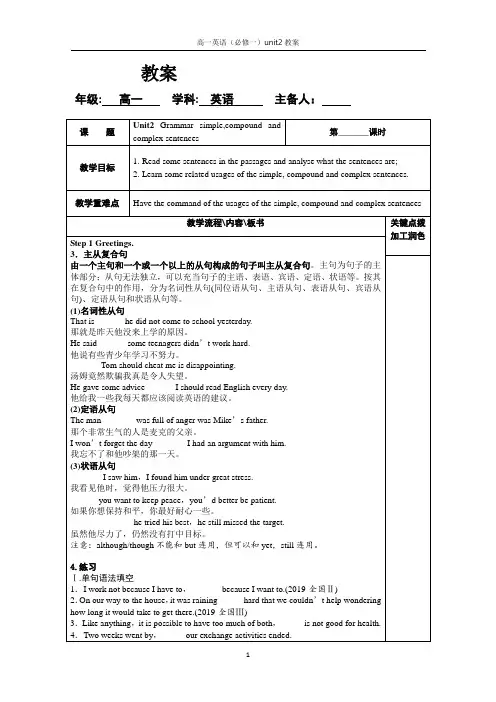
教案年级: 高一学科: 英语主备人:课题Unit2 Grammar simple,compound andcomplex sentences第_______课时教学目标1.Read some sentences in the passages and analyse what the sentences are;2. Learn some related usages of the simple, compound and complex sentences.教学重难点Have the command of the usages of the simple, compound and complex sentences教学流程\内容\板书关键点拨加工润色Step 1 Greetings.3.主从复合句由一个主句和一个或一个以上的从句构成的句子叫主从复合句。
主句为句子的主体部分;从句无法独立,可以充当句子的主语、表语、宾语、定语、状语等。
按其在复合句中的作用,分为名词性从句(同位语从句、主语从句、表语从句、宾语从句)、定语从句和状语从句等。
(1)名词性从句That is ______ he did not come to school yesterday.那就是昨天他没来上学的原因。
He said ______ some teenagers didn’t work hard.他说有些青少年学习不努力。
_______Tom should cheat me is disappointing.汤姆竟然欺骗我真是令人失望。
He gave some advice ______ I should read English every day.他给我一些我每天都应该阅读英语的建议。
(2)定语从句The man _______ was full of anger was Mike’s father.那个非常生气的人是麦克的父亲。
高中教育英语牛津译林高m1u2Grammar and usage

be sure about the idioms
lived here.
强调在某几天时间内要用介词during ③I remember the month __in__w_h_i_c_h__I
stayed there. 在month前介词要用in
3) 根据从句中动词与先行词的逻辑关系。 Is that the newspaper _fo_r__w_h_i_c_h_you often write articles? write for the newspaper
介词+whom/which 引导定语从句拓展
补充: 介词的选用原则
1)根据定语从句中谓语动词的习惯搭 配来决定。如:
①This is the book _o_n__w__h_ic_h__I spenty on sth.为固定搭配
②This is the book _f_o_r_w__h_ic_h__I paid 8
yuan. pay money for sth.为固定搭配
2)根据先行词的搭配习惯来决定。如: ①I remember the day _o_n_w__h_ic_h_I joined
the League. 强调在具体某一天要用介词on ②I remember the daysd_u_r_in_g__w_h_i_c_h_I
高中教育英语必修第一册译林版《1.2 Grammar and usage Iskills》教学课件

即学即练 单句语法填空 ①He gave me a __de_ta_il_ed___ (detail) description of his inner thinking. ②He makes a list of what is needed ____in____ detail in advance at the
4 base vt.以……为基础(依据) n.根据;基础;基底;总部,
大本营 base sth. on/upon sth. 以……为基础/根据 be based on/upon... 基于…… at the base of... 在……底部;在……基础上 basic adj. 基础的;基本的;根本的
归纳拓展 表示“由于,因为”的短语还有:due to, owing to, because of, thanks
to, on account of
即学即练 同义句转换 ①He worked very hard. As a result, he had his English improved. →He had his English improved_a_s_a _re_su_lt_of____ working hard. ②He was lazy so he failed. →He failed _a_s_a _re_su_lt_of____ his laziness. →He was lazy. __A_s a_r_es_ul_t ___,he failed. →His laziness __r_es_ul_te_d _in____ his failure. →His failure _r_es_u_lte_d_fr_om____ his laziness.
_fo_c_us_m_y_a_tte_n_tio_n_on_____ (把我的注意力集中在) study. ④We must __f_oc_us_o_n___ (关注) improving the quality of the products.
牛津译林版英语必修一Unit2Grammarandusage1教案

牛津高中英语教学设计单元:Unit 2 Growing pains板块:Grammar and usageThoughts on the design:本节课是以读、写为主的语法教学课。
语法教学的方法各有不同,本节课的设计除了语言知识的传输外,还着眼于培养学生对于学习策略的掌握。
本节课按照“呈现—思考—归纳—巩固”的模式,在语言知识的传授过程中,强调让学生独立思考并归纳语言规则,从而掌握独立的学习策略。
此外,本节课在内容的选择上参考了05-08年各地高考题,对教学内容作了适当增补。
Teaching aims:After learning this session, the students will be able to grasp the basic rules for attributive clauses —“prep.+which/whom”used to begin attributive clauses. Besides, the students will be able to learn the studying strategy for language learning.Teaching procedures:Step 1Review what the students have learned in the previous unit —relative pronouns —with a blank-filling exercise.Fill in the blanks with relative pronouns.1. This is the story __________ we wrote for our storytelling contest. (which/that)2. The book __________ I borrowed from the library is very interesting. (which/that)3. He likes the birthday gifts _________ his friends gave him. (which/that)4. The girl _________ you have just seen is very good at English. (who/whom/that)5. I don’t know the name of the teacher _________ I met in the computer room. (who/whom/that) After finishing the exercise, ask the students to think about the grammatical principles in the sentences, and then make a conclusion as follows: The relative pronouns serve as the objects of the __________. (verbs)[Explanation]第一和第二步是对第一单元中学习的关系代词引导定语从句的复习。
译林版高中英语必修一Unit2板块小练 Grammar and usage
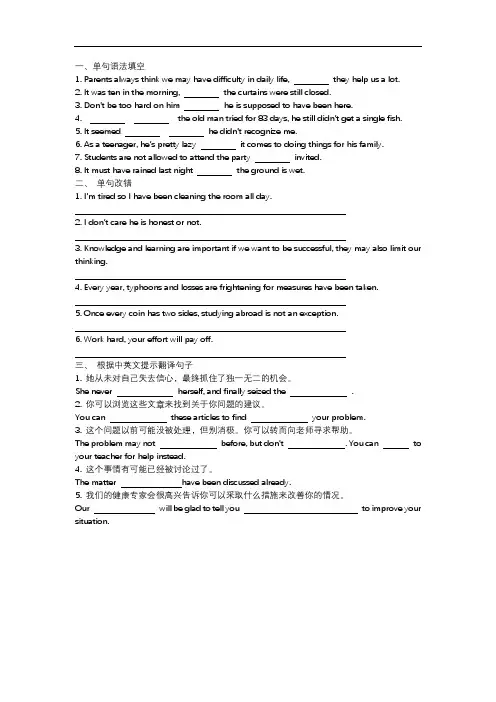
一、单句语法填空1. Parents always think we may have difficulty in daily life, they help us a lot.2. It was ten in the morning, the curtains were still closed.3. Don’t be too hard on him he is supposed to have been here.4. the old man tried for 83 days, he still didn’t get a single fish.5. It seemed he didn’t recognize me.6. As a teenager, he’s pretty lazy it comes to doing things for his family.7. Students are not allowed to attend the party invited.8. It must have rained last night the ground is wet.二、单句改错1. I’m tired so I have been cleaning the room all day.2. I don’t care he is honest or not.3. Knowledge and learning are important if we want to be successful, they may also limit our thinking.4. Every year, typhoons and losses are frightening for measures have been taken.5. Once every coin has two sides, studying abroad is not an exception.6. Work hard, your effort will pay off.三、根据中英文提示翻译句子1. 她从未对自己失去信心,最终抓住了独一无二的机会。
Unit2 Grammar and usage-英语牛津译林版(2020)选择性必修第一册
stop to do sth.
停下来去做某事stop Biblioteka oing sth.停止做某事
mean to do sth.
想要做某事
mean doing sth.
意味着
try to do sth.
努力要做某事
try doing sth.
试着做某事
remember to do sth. 记得要去做某事
remember doing sth. 记得做了某事
• Boya played the qin very well, but he believed no one could
(3) __u_n_d_e_r_s_ta_n__d_h_i_s_m__u_s_icuntil he met Zhong Ziqi.
What
• Zhong was able to recognize the image in Boya’s piece of music: (4) __H__ig_h__M__o_u_n_t_a_in_s__a_n_d_F_l_o_w_i_n_g_W__a_t_e_r____.
examine my eyes. We’re considering paying a visit to the Science Museum.
★ 有些动词后既可跟动词-ing形式作宾语,也可跟动词 不定式作宾语,但用法和意义都有所不同。这些动 词是:remember, forget, stop, regret, try, mean等。 e.g. I remember meeting her at a party once. I want to try playing soccer this spring.
Working out the rules • When the verb-ing form is used as the subject of a
Unit 2 Grammar and usage 课件-高中英语牛津译林版(2020)必修第一册
他们要去和人打架。 They are going to have a fight with someone.
他们要去和人打架,但是我不知道为什么。 They are going to have a fight with someone, but I don’t know why. I don't know why they are going to have a fight with someone.
Unit 2 Let's talk teens
Grammar and Usage
Simple, compound and complex sentences
Watch a video. Try to describe the scene!
• 我想知道他们要去和谁打
noun clauses
adverbial clauses
attributive clause
that, which, who, if, whether…
✓ When to use a comma before conjunctions:
Jack likes chicken, and he loves Nando's. Jack likes chicken, but he hates turkey.
These are both examples of compound sentences. In each example, each sentence features two independent clauses, not one. Note that there is now a comma before the “and” and the “but”.)
2024-2025学年高一英语必修第一册(译林版)UNIT2Grammarandusage教学课件
Summarizing the rules
1. A simple sentence is made up of one independent clause which has one subject-verb combination.
2. A compound sentence contains two or more main clauses. We use linking words such as and, or, but, so or for to link the clauses.
3. A complex sentence contains one main clause and at least one subordinate clause. A subordinate clause can be the subject, predicative, object, attribute or adverbial of the sentence.
Let us know what you think of our forum.
Part B2 on Page 21
and
because
but
how
if that
unless
why
Teresa: I’m under a lot of stress these days(1) because my parents are always comparing me with my friends. They’re never satisfied(2) unless I do better than all my friends—in schoolwork,in hobbies,in everything! Jack: That’s terrible. I can see(3) why you’re anxious. You should tell your parents(4) that you’re trying your best. There’s no point in comparing you with
牛津译林版必修一Unit2 Grammar and usage教案
Grammar and usage教案Target language1. 重点词汇和短语nursery, rhythm, recite, run out of2. Ability goals 能力目标Enable the students to learn to use the subjunctive mood.3. Learning ability goals 学能目标Help the students learn how to use the subjunctive mood.Teaching important & difficult pointsThe subjunctive mood.Teaching methodsTask-based activities.Teaching aidsA computer and a projector.Teaching procedures & waysStepⅠGrammar FocusTalk about “subjunctive mood”.T: During the previous periods, we learned a lot about nursery rhymes for which we practiced a lot on the “if I ...” pattern. The “If I ...” poem works so well because it allows you to follow one of the first rules of writing: Write about the things you know. Write about something that you feel very strongly about. Next we are going to talk about the “if” pattern.Show the following to the students.Ask the students to read the following examples repeatedly.(1) If anything had happened, he would have let her know.I should have talked to mother if I had thought of it.If I had been less cautious I might have been wiser.If it had not been for Margaret, I might not have understood.No doubt I could have earned something if I had really meant to.He did everything for me that my father could have done if he had lived.(2) If wishes were horses, beggars would ride.If I were you, I’d go to night school.If we were men, we’d be doing something decent now.I tell you, you wouldn’t be anywhere at all if it weren’t for Ruth. Indeed, if there were anything to tell, I would tell it to you.If you had your choice, where would you go?Would you mind very much if I asked you to do something?If he went, would you go too?I think it would be much better if you got a job.Wouldn’t it be better if you made an appointment to see him at the office?(3) I thought if you were to speak to him, it would carry more weight.But if she were to lose her place they would be ruined.I’m sure you’d be the first to be sorry if anything was to happen to him.If they were to hear you talking, they’d think you wer e a school teacher.I should be most happy to go down with you if I should not be in the way.If it should be necessary, I could come at six.(4) If it hadn’t been for the doctor’s care, I should not be speaking to you now.I think we should have been told if there was anything up.If you’d listened to me, you wouldn’t be in such trouble now.Then ask the students to do the exercises in the workbook.T: As for the subjunctive mood, we usually have the above structures. The only thing to do is to decide which pattern we should use. Now do Exercises 2, 3 and 4 on Page 51. Step II HomeworkAsk the students to do the task in PROJECT.附件1. 虚拟语气主要用于条件状语从句,其他从句或口语中。