
人教版八年级上册《Unit 2 How often do you exercise》同步练习
《Unit 2 How often do you exercise》同步练习一、单选题1.-How often do you dance?-I dance ________ a week.()A. once and twice timesB. two and three timesC. one or twoD. once or twice2.-What does Lisa do at home?-She usually ________ the Internet to watch movies.()A. useB. usedC. usesD. will use3.Becky is a good student.She ________ late for school.()A. is neverB. never isC. is alwaysD. always is4.-Does your sister often go shopping?-________.She has no time.()A. Yes,she didB. No,she didn'tC. Yes,she doesD. No,she doesn't5.-________?-Five times a week.()A. Where is the music clubB. When do you go to the music clubC. How often do you go to the music clubD. How do you go to the music club6.-________ does Linda watch English movies?-Once a week.()A. How oftenB. How manyC. How farD. How long7.-What ________ your mother________ on weekends?-She usually goes shopping.()A. is;doB. does;doC. do;doesD. do;do8.-May I put the books in the box?-I'm afraid not.The box is ________.()A. oldB. newC. fullD. expensive9.Sports News is my father's favorite ______ and he watches it every night.()A. programB. movieC. bookD. newspaper10.-Would you like a cup of tea?-No,thanks.I ________ drink tea.()A. everB. stillC. hardD. hardly二、完形填空Ted is my brother.He had a(11) lifestyle before.For example,he hardly ever(12) up before seven o'clock in the morning.After supper,he always played computer games(13) doing his homework.He didn't like drinking milk and he ate a lot of(14) every day.Then one day,he got ill.He had to be in hospital (15).Then he knows that he must(16) himself well.Now Ted(17) early every morning.Usually he runs before breakfast.He only plays computer games (18) Saturdays or Sundays.He has good (19) habits,too.He drinks milk every day.(20) he likes junk food very much,he only eats it oncea week.A good lifestyle helps him keep healthy.11. A. good B. healthy C. bad D. fine12. A. get B. gets C. got D. getting13. A. before B. or C. and D. when14. A. fruit B. junk food C. vegetables D. rice15. A. once a week B. two weeks agoC. for three weeksD. twice a week16. A. look after B. look for C. look at D. look up17. A. exercises B. gets up C. sleeps D. goes to bed18. A. in B. on C. at D. for19. A. eat B. eats C. eating D. ate20. A. And B. But C. Although D. Because五、单词拼写1. Let's go to the zoo______ (一起),OK?2. The little girl can______ (摆动) with the music.3. I don't like these______ (节目).What about you?4. Mr.Zhang got the good job______(凭借) his hard work.5. Sixty______ (百分之…) of students in our class like playing soccer.6. Tom got ninety-seven______ (得分) in the math test.7. I'm not sure.M______ she is an English teacher.8. Sam plays soccer at______ (最少) twice a week.9. My grandmother is very______ (健康的) because of her good eating habits.10. I'm______ (忙碌的) now,so I have no time to play tennis with you.六、单句语法填空1. The girl______(visit) her grandmother once a week.2. Susan often______(help) her mother clean the room.3. At school Tom never______(play) sports.4. Sometimes Ms.Hand______(have) lunch at school.5. The Greens always______ (read) newspapers in the morning.6. Doing sports is good for our minds and______(body).7. I read much______(little) now than I did at school.8. Do you like the______(writer) new book?9. Look!The flowers are______(die).Can you get some water?七、句型转换1. I usually______ on weekends.(对画线部分提问)______ do you usually______ on weekends?2. Mike watches TV twice a week.(对画线部分提问)______Mike watch TV?3. Tom does his homework after school.(改为否定句)Tom______his homework after school.4. We like watching Animal World.(对画线部分提问)______program do you______?5. Many students play sports every day.(对画线部分提问)______do many students play sports?八、完成句子1. 我一周至少做两次家务.(at least)______________________________.2. 妈妈不想让我吃垃圾食品.(junk food)______________________________.3. 这家超市的很多东西在打折出售,比如蔬菜和肉.(such as)______________________________.4. 他的姑姑在这所学校工作不到三年就离开了.(less than)_______________________________.5. 通过看足球比赛来放松很不错.(by)_______________________________.答案1. D2. C3. A4. D5. C6. A7. B8. C 9. A 10. D 11. C 12. C 13. A 14. B15. C 16. A 17. B 18. B 19. C 20. C 21. C22. B 23. A 24. D 25. C 26. D 27. A 28. C29. C 30. D四、31. becoming 32. health 33. much 34. helps 35. times 36. runners 37. away 38. relax 39. active 40. keep 五、1. together2. swing3. programs4. through5. percent6. points7. M aybe8. least9. healthy10. busy六、1. visits2. helps3. plays4. has5. read6. bodies7. less8. writer's9. dying七、1. play baseball;What;do2. How often does3. doesn't do4. What;like watching5. How often八、1. I do the housework at least twice a week.2. Mum doesn't want me to eat junk food.3. Lots of things in this supermarket are on sale,such as vegetables and meat4. His aunt worked in this school for less than three years and left.5. It's good to relax by watching football games。
人教版英语八年级上册 Unit 2 How often do you exercise
Unit 2How often do you exercise?
Section B (1a—1e)
一、教学目标
1.熟练掌握重点单词和短语:junk food,coffee,health,be good for,want sb. to do sth.
2. 能够听懂和日常饮食、其他生活习惯有关的对话信息,并能根据信息判断生活习惯健康与否。
3. 能够使用频度副词及How often谈论日常生活习惯话题。
4.合理安排自己的生活,养成良好的生活习惯和饮食习惯,享受健康的生活。
二、教学重点及难点
重点:
能够听懂和日常饮食、其他生活习惯有关的对话信息,并能根据信息判断生活习惯健康与否。
难点:
能够使用频度副词及How often谈论日常生活习惯话题。
三、教学过程
四、板书设计
Unit 2How often do you exercise?
Section B (1a—1e)
Words and phrases:junk food,coffee,health,be good for,want sb. to do sth. How to keep healthy:
A good eating habit.
Exercise often.
Get enough sleep.。
初中英语人教版八年级上册《Unit 2 How often do you exercise》课件
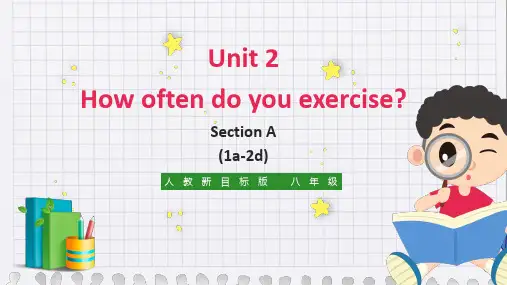
How often do you watch TV?
多长时间看一次电视 Twice a week. 一个星期两次
How often do you play computer games ?
多长玩次电脑? Every day. 每天
• every day / night • once a week / month • twice a week / month • three times a week / month • once or twice a week / month
Presentation
--What does she usually do on weekends? --She often __e_xe_r_c_i_se_s.
Presentation
--What does he usually do on weekends? --He usually __r_e_a_d_s_b_o_o_k.s
once a week
c. shop
twice a week
d. exercise e. read
three times a week once a month
twice a month
2c How often do you do these activities? Fill in the chart
1a Look at the picture. Make a list of the weekend activities.
1. _h_e_lp__w_i_t_h_h_o_u_s_e_w__o_rk__ 2. _w__a_tc_h__T_V__ 3. _r_e_a_d_a__b_o_o_k__ 4. _e_x_e_r_ci_s_e_____ 5.g_o_s_h_o_p__p_in_g___
人教版八年级上册英语Unit2How often do you exercise知识点

Unit2 How often do you exercise? Section A1.How often do you exercise? 你多久做一次运动?2.how often多久一次,对频率提问,如:always,everyday ,once a weekhow long多长时间,对“for+一段时间”或”,“since+时间段+ago”等时间短语提问how far 多远,对距离提问how soon 多久,对“in+一段时间“提问3.exercise v 锻炼exercise n.锻炼(不可数);体操,练习题(可数)do exercise =do sports= play sports做运动do morning exercises 做早操do eye exercises 做眼保健操4.What do you usually do on weekends? 你在周末做什么?5.频度副词always总是,一直>usually通常,经常>often常常,经常>sometimes 有时>hardly ever= almost not几乎从不>never 从不,决不【注】:频度副词用在实义动词之前,系动词、助动词、情态动词之后。
6.(1)some time一段时间,做时间状语It takes sb some time to do sth 做某事花费某人多长时间(2)sometime adv 在某个时候I hope to visit the USA sometime in the future.(3) some times 名词词组,“几次,几倍”(4)sometimes=at times 有时(一般现在时的标志词)7.on weekends =on the weekend= on Saturday and Sunday 在周末on weekdays= from Monday to Friday 在工作日8.hardly ever 几乎从不hard (1)adv 努力地,猛烈地work hard 努力工作study hard 努力学习(2) adj. 困难的,艰难的=difficult◆It’s hard/difficult for sb to do sth 做某事对某人来说是困难的【拓展】hardly adv “几乎不,从来不”,表否定意义9.twice a week 一周两次once = one time一次twice= two times两次三次或三次以上用:“基数词+times”three times 三次four times 四次three or four times 三到四次10.go shopping 去购物do some shopping 购物11.help with housework帮助做家务(1)help sb. (to) do sth=help sb. with sth 帮助某人做某事(2)help oneself to…请随便吃/喝(3)can’t help doing sth 情不自禁做某事12.go to the movies = go to the cinema = see the film 去看电影13. at least = not less than至少;不少于at most至多14. use the Internet 上网15.What’s your favorite program?=What program do you like best?你最喜欢的节目是什么?16.every day 每天= each day 做状语,放在句末,对其提问用how ofteneveryday = daily adj. 每天的,作定语,修饰名词,放在名词之前He exercises every day. 他每天都锻炼。
人教版八年级上册Unit 2 How often do you exercise? 语法知识突破
人教版八年级上册Unit 2 How often do you exercise?语法知识突破人教版英语八年级上册第二单元Unit 2 How often do you exercise 语法知识突破在英语学习中,语法学习,既是一个重点,也是一个难点,每个单元的设计都是围绕一定话题,突破语法和句子知识展开的。
接下来,我们来呈现一下人教版英语八年级上册第二单元的语法如何突破?从标题看语法本单元的标题是:How often do you exercise 从标题可以看出,本单元主要谈论“频率”问题,所以,话题就是“关于日常活动的频率”,既然是询问频率,就牵涉到关于如何询问频率?如何表达频率?等一系列的问题。
语法突破:如何询问频率?英语里面,当我们要询问对方“多久做一次某事”的时候,要用“how often”来询问频率,表示“多久一次”,例如:How often do you exercise 你多久锻炼一次?How often do they go out for a picnic 他们多久出去野炊一次?从Grammar focus看语法。
语法部分从基本句型”What do you usually do “引入,通过回答,给我们展示了频率副词always , often, sometimes等的用法。
接下来,用How often do you go to the movies 再次引出频率副词的用法以及如何表示“次数”。
让我们先看语法中的句子。
What do you usually do on weekends I always exercise.What do they do on weekends They often help with housework.What does she do on weekends She sometimes goes shopping.How often do you go to the movies I go to the movies maybe once a month.How often does he watch TV He hardly ever watches TV.Do you go shopping No , I never go shopping.当询问某人周末通常做什么的时候,用到频率副词usually,它的位置“be动词的后面,行为动词的前面”。
2017人教新目标版英语八上Unit 2《How often do you exercis

Does Tina have good habits?
Yes. No. I don’t know.
Does Bill have good habits?
Yes. No. I don’t know.
1d Listen again. Fill in the blanks in the survey.
热狗对我们的健康有坏处。
1a. Match the words with the pictures.
a
b
c
d
e
f
Check the answers!
1. __b__ junk food 4. ____c_ vegetables
2. ___a__ milk
5. ____f_ sleep
3. ___e__ fruit 6. ____d_ coffee
nine
4.How often do you drink milk? 5.How often do you eat junk food? 6.How often do you drink coffee?
every day 2 or 3 times a week never
nine
never 3 or 4 times a week 4 times a day
healthy: unhealthy:
healthy: salad, soup, broccoli, milk , dumpling, onion, mushroom, milk, fruit, vegetables unhealthy:
cola, hot dog, potato chips, fried chicken, hamburger, junk food, coffee, chocolate
人教版八年级上册Unit2How often do you exercise-全单元教学设计
人教版八年级上册Unit2How often do you exercise?全单元教学设计人教新目标英语八年级上册Unit 2 How often do you exerciseI. Teaching article: Unit TwoII. Teaching aims and demands:What do you usually do on weekendsI sometimes go to the beach.How often do you eat vegetablesEvery day.Most of the students do homework every day.III. Teaching important and difficult points:Talk about how often you do things.IV. Teaching ways:Revision, Learning, Practice and Reading.V. Teaching tools:Tape-recorderV. Teaching time:Six periodsVI. Teaching procedure:The 1st periodStep 1 Greet the classT: I’ll introduce myself first. I’ll be your English teacher this term. Do you like English I hope we’ll get along very well. I’m not only your teacher, but can be your friends. We’ll be happy together. Now let’s begin. This class we’ll learn Unit2. How often do you exercise Please open your books at page9.Step 2 Section A 1aFirst look at the picture. Ask a few students to say what they see in the thought bubbles. Each thought bubble shows something a person does on weekends.Then name each activity. Ask students to repeat each one.One girl is shopping.Another girl is reading.This boy is watching TV.The girl is helping with housework.Point out the sample answer. Then ask students to list all the activities in the thought bubbles. If they don’t know how to write the activities, use bilingual dictionaries.Then ask the students who finishes first to write the answers on the board.Check the answers on the board and ask students to correct their ownactivities.Step 3Display a large calendar that shows the days of the week. Tell students Saturday and Sunday are the weekend. Ask students to repeat Weekend. Then show these new words.How often always usually often sometimes hardly ever never Step 4 1c PairworkFirst ask two students to read the sample in speech bubbles.What do you usually do on weekendsI often go to the movies.Now work with a partner. Make your own conversations about the people in the picture. For example.Step 5 SummaryThis class we’ve learnt some names of activities: watching TV, reading, skateboarding, exercising, shopping. And we’ve also leant some adverbs of frequency: always, usually, often, sometimes, hardly, ever, never. Step 6 Homework:Keep a weekend dairy showing what you do on weekend. You can write down you do from the time you get up until you go to sleep.The 2nd periodStep 1 Greet the class.Step 2 Learn some new wordsStep 3 2aNow please look at the list of activities and read after me.Watch TV Exercise ---ReadStep 4 2bNow please look at the heading. How often In the chart in Activity 2a. Ever day Once a week Twice a week Three times a weekOnce a month Twice a monthStep 5 2c PairworkFirst ask a student to read the list of activities to the class.Watch TV Surf the Internet Read English books Go to the movies ExerciseNow tell me how often do these activities. You can write your answers under the list of How often.Step 6 2dRole play the conversation and underline any difficult point.Lead Ss to read the conversation and explain some difficult ter,make their own conversations in pairs like the sample one.Step 7 Grammar FocusStep 8 Summary and HomeworkThis class we’ve leant some adverbs of frequency: every day, once a week, once a month, twice a month. And we’ve leant to talk about howoften people do things. And also we’ve had a game.The 3rd periodStep 1 Greet the class and check the homework.Step 2 Show the new words on the screen and teach students how to read. And ask them to repeat.Step 3Now please open your books at page11. Look at 3a first. I’ll read each line to plete the questions with ‘do and does’.Then match the questions and st write questions with the words given, and ask and answer them with a partner.Finish 3b.Correct any mistakes.Step 4 3c Group workWhat can you do improve your EnglishCollect the answers on the blackboard. For exampleRead English books Sing English songs See English moviesHow often do you do the thingsStep 5 An activityAsk students to talk about how often their family members do things. For example,My mother cooks dinner every day. We eat in a restaurant once a week.My father goes to the United States once a year.Step 6 SummaryThis class we’ve read a magazine article and done an exercise. I hope you can study hard and be good students. Your parents and teachers are proud of you.Step 7 HomeworkWrite a passage on how to improve your English.The 4th periodStep 1 Greet the class and check the homework.Step 2 Show the new words on the screen and teach the new words. Ask students to repeat them. And make sure everyone knows the meanings. Step 3 Section B 1aNow open your books at page12. Look at Activity 1a. First I’ll read each word. Junk food Milk Fruit Vegetables Sleep CoffeeThere are vegetables on the plate.Step 4 1b PairworkAsk some pairs to present some questions and answers to the class. Step 5 1cNow you’ll hear a reporter interview two people. Tina and Bill.Play the recording the first time. Students only listen. Then play it again. This time ask students to circle Yes, No or I don’t know.Step 6 1dFirst read the questions in the chart to the class.How often do you exercise How often do you eat vegetablesHow often do you eat fruit How many hours do you sleep every nightHow often do you drink milk How often do you eat junk food Listen and fill in the blanks.Check the answers.Step 7 1e PairworkRead the sample in speech bubbles to the class first.Interviewer: How often do you exerciseTina: I exercise every day.Interviewer: And How often do you …Step 8 Summary and HomeworkThis class we’ve leant some words and leant to interview somebody with the sentence, how often… After class please give more practice.The 5th periodStep 1 Greet the class and check the homework.Step 2 Show the new words on the screen and teach them. Read the new words to students and ask them to repeat.Step 3 2aOpen your books at page 13. Look at Activity 2a.Read the instruction to the class.Explain the phrases and rank these activities.Check the answers.Step 4 2b This activity provides reading practiceusing the target language.Read the article and complete the pie charts.Ask students to work individually.Explain some language points and correct mistakes if any.Step 5 2cAsk students to have a quick look at the questions in 2c,then read the passage again and answer the questions.Correct mistakes if any. Then ask some students to read their answers to the class.Step 6 2dAsk Ss to read through the instruction,then do it individually.Check the answers and lead Ss to read the sentences,call attention to the pronunciation and tone.Step 7 2eFree talk Work in groups of five to ask each other how often they do free time activities.Fill the results in the chart and make a pie chart.Check the answers together.Step 8 Summary and HomeworkThis class we’ve learnt a lot. We know what healthy things are and unhealthy things are.Recite activity 2b.The 6th periodStep 1 Greet the class and check the homework.Step 2 Show the new words on the screen and teach them. Read the new words to students and ask them to repeat.Step 3 3aOpen your books at page 15. Look at Activities 3a. Look at the information in the chart and talk about whether they have these good /bad habits or plete the report and check the answers.Read the report and explain some language points.Step 4 3bComplete the chart with your own information.Ask students to work individually and talk about his or her ter, present their work,lead Ss to have a good habit.Step 5 3cAsk students to finish the writing individually. Then ask some students to read their paragraphs to the class.Lead Ss to tell good habits from bad habits.Step 6 4 SurveyTake the health quiz.Who is the healthiestQuestions.1. How often do you exercise2. What sports do you play3. How often do you eat vegetables ---Collect the results,choose the healthiest one.Step 7 Self Check 1and 2Complete the chart and make five sentences. Check the answers.Step 8 Self Check 3(for homework)Complete the conversation,check the answers.Then role play the conversation.Often every day usually three times a week sometimesonce a week always once a month hardly ever neverStep 9 SummaryThis class we’ve reviewed vocabulary and abverbs of requency in unit 2. And we’ve reviewed the target language in this unit and done some exercises.Step 6 HomeworkIf time doesn’t permit, leave some exercises of workbook as homework.。
人教版八年级上册英语Unit2How often do you exercise
----What does she /he usually do on weekends? 他/她周末做什么? ----He/She usually does some exercise.
He/She usually plays football.
----What do they usually do on weekends? 他们周末做什么? ----They often go to the movies.
1help with housework
帮助做家务
2watch TV 看电视
3go shopping=do some shopping
购物
4read books 读书
5exercise 运动
该在书上记一下啦~
知识点
1)help with sth帮助做 某事 2)help sb with sth =help sb (to) do sth帮助 某人干某事 3)can‘t help doing情不 自禁做某事
They usually go shopping.
程涛在讨论他多久做一次这些活动。
2a
按照你听到的顺序给活动标1-5的序号。
2c 你多久做一次这些活动?先填表格然后编对话。
上网:on the Internet 网上冲浪:surf the Internet
2c
A:How often do you watch TV? 你多久看一次电视? B:I watch TV every day . 我每天都看电视。 A: What's your favorite program? 你最喜欢的节目是什么? B:Animal World。 《动物世界》
1b
频率副词
人教版八年级上册英语知识点梳理Unit 2 How often do you exercise
Unit 2 How often do you exercise?Section A:1.how often多久一次(向频度副词或表示频度的短语提问)how long多长时间(向表示一段时间的状语提问);多长(向长度提问)how soon多快;多久以后(向表示将来时态的时间提问)how many多少(后接可数名词复数)how much多少(后接不可数名词;还可以用于询问价格或重量。
)how old多大岁数(向年龄提问)how far多远(向距离提问)How come ?怎么会呢?怎么回事?2. take exercise = exercise = do exercise 锻炼do exercises 做练习do morning exercises 做早操do eye exercises做眼保健操play sports = do sports = have sports 做运动3. make a list of列出......的清单make a list of the weekend activities 列出周末活动的清单4. hardly ever 几乎不at times = sometimes=from time to time 有时sometime某个时候some time 一段时间some times 几次5. watch cartoons on TV在电视上看动画片watch a movie / see a film 看电影watch games 看比赛read books / magazines / newspapers看书/杂志/报纸6. (1)Once upon a time 从前(2)at once 马上(3)Once the sun sets, the air turns cold.一旦at once马上once a month 一个月一次twice a year 一年两次three times a week 一个星期三次7. match…with... 把......和......相连;把......和......相匹配8. be free有时间;有空;免费的be free to do sth.随意做某事;自由自在地做某事in one’s free time在某人的空闲时间9. be full for sb.对于某人来说忙或安排很满be full of充满;装满=be filled with10. have dance and piano lessons上舞蹈课和钢琴课swing dance 摇摆舞11. stay up = sit up 熬夜12. at least至少;不少于;起码at most至多;不超过13. be too busy 太忙了'be busy with sth.忙于某事be busy (in) doing sth.忙于做某事14. add... to...给......添加......add up to 总计15. according to 根据/ 视......而定16. ask sb. about sth. 询问某人有关某事ask sb. for sth.向某人要某物ask sb. to do sth.要求某人做某事17. go online上网;上线surf the Internet / surf online 网上冲浪18. be surprised at sth.对某事感到惊讶be surprised to do sth.惊讶地做某事19. for fun好玩;开玩笑地(不是认真地)20. the answers to our questions我们问题的答案the key to the door这门的钥匙。
人教版八年级上Unit 2 How often do you exercise_Section
Unit 2 How often do you exercise?Section B (la-le)教学目标:1. Talk about daily habits2. Talk about how often you do things.学情分析:The students are similar to everyday activities and the food they eat. So the importance is to use “How often”.教学重点、难点:1. The usage of frequency adverbs:always, usually, often, sometimes, hardly ever, never.2. What kind of food do you like?How often do you eat them?I always eat them. I eat them twice a week.3. How often do you exercise?I exercise 3 or 4 times a week.I exercise 4 or 6 times a week.教学设计:Step 1: Enjoy an English song- Exercise song.Step 2: Practice.Use the verbs in the song to make conversations oryour own verbs and the frequency adverbs:jump, dance wave, nod, wink, clop, singalways, often, usually, sometimes, hardly ever, never. A: Do you like running?B: Yes, I do. I always run (on weekends).No, I don’t. I hardly ever run.Step3: Presentation.1. Show the words in 1a with pictures.2. Ask and answer questions with the words in 1a.①First practice by themselves in groups.②Then act the conversations out.Step 4: Listening1. Listen to an interview about two p eople’s d aily habits. Fill in the blanks in the survey. (Play the tape twice.)2. Check the answer of 1d. Give us the answers by saying out sentences with the answer.3. Look at the chart and find out:Who has good eating habits?Who has good lifestyle?Why?4. Then finish 1c.Step 5: PracticeStudent A is the reporter. He is interviewing some people about their daily habits.Ask and answer questions.Step 6: Conclusion: Today we learned to use the frequency adverbs and lear ned to talk about people’s daily habits.Step 7: Homework.1. Practice the conversations of 1b and 1e.2. Preview 2a and 2b.。
2024年人教版八年级上册英语阅读Unit 2 How often do you exercise?
Unit 2How often do you exercise?Passage1(自我管理)健康对我们来说很重要, 我们怎样才能保持健康?一起来看看吧!How can we keep healthy?One important thing is to exercise 1. The Smith family try to exercise every day. Qiang Smith 2exercise in the morning because he must be at his job at seven o’clock. But he runs every evening. He walks a lot, 3. He walks to school every day and after school he 4basketball with his friends. Qiang goes to a yoga(瑜伽)class 5 a week. But it isn’t 6this way. Last year Mr and Mrs Smith drove everywhere. They thought they should use the 7all the time. Now the Smiths don’t use their car, and they all 8better now. And they think they mustn’t be 9. They don’t have to exercise every day, but they should 10to keep in good health.1. A. sometimes B. oftenC. neverD. always2. A. may B. can’t C. maybe D. can be3. A. either B. also C. too D. well4. A. plays B. watchesC. surfsD. looks5. A. sometimes B. three timeC. three timesD. some time6. A. always B. usuallyC. hardlyD. sometimes7. A. skateboard B. bikeC. carD. ship8. A. have B. make C. feel D. study9. A. lazy B. healthyC. activeD. well10. A. want B. keep C. stay D. tryPassage2(自我管理)“双减”政策实施以来, 河畔高中的学生们有了更多的自由时间。