
新目标英语八年级下1-5单元知识点汇总
1Unit 1 What’s the matter?一.重点短语1.have a fever/cough/ cold发烧/咳嗽/感冒2. have a toothache /stomachache/headache/backache/ nosebleed 牙疼/胃疼/头痛/后背痛/流鼻血3. have a sore back/ throat 背疼/喉咙痛4. talk too much 说得太多too many passengers 太多乘客5. drink enough water 喝足够的水big enough 足够大6. lie down and rest 躺下来休息7. hot tea with honey 加蜂蜜的热茶8. get an X-ray 拍X 光片9. see a dentist 看牙医10. go to a doctor 看医生11. take one’ s temperature 量体温12. put some medicine on sth. 在……上面敷药13. feel very hot 感到很热14. sound like 听起来像15. on the weekend 在周末16. all weekend 整个周末17. in the same way 以同样的方式18. go along 沿着……走19. see sb. do/doing sth. 看见某人做 /正在做某事20. on the side of the road 在马路边21. shout for help 大声呼救22. without thinking twice 没有多想23. get on/off 上/下车24. have a heart problem 有心脏病25. to one’ s surprise 使....... 惊讶的26. thanks to 多亏了;由于27. in/on time 及时/准时28. this/next time 这/下次29. get hit on the head 碰到头30. put her head back 把她的头向后仰31. save a life 挽救生命32. get into trouble 陷入麻烦/苦恼33. right away/ at once 立刻;马上34. because of 由于35. get out of 离开;从……出来36. hurt oneself 受伤37. put a bandage on sth. 用绷带包扎38. fall down 摔倒39. feel sick 感到恶心40. cut his knee 割伤他的膝盖41. be interested in 对…感兴趣42. have problems breathing 呼吸困难43. mountain climbing 登山运动44. be used to doing sth. 习惯做某事45. run out (of) 用完;用尽46. so that 以便47. so. . . that 如此… …以至于…48. be in control of 掌管;管理49. in a difficult situation 在闲境屮50. keep on doing sth. 继续或坚持做某事51. make a decision 做出决定52. take risks 冒险53. give up 放弃54. act quickly 快速行动二.重点句型(一) 医生询问病情的常用语句:1. What's wrong/the matter (with you)?你怎么了?What's your trouble? 你哪里不舒服?When did it start?从何时开始生病的?2. How are you (feeling) now?你现在觉得怎么样?Are you feeling better today?你今天好些了吗?3. Do you feel tired?你觉得疲劳吗?(二) 病人诉说病情的常用语句:1. I don't feel very well. / I'm not feeling well. 我感到不舒服。
2. I have (got) a headache.我头痛。
There's something wrong with my leg.我的腿有毛病了。
3. I feel terrible.我感到很难受。
I feel even worse.我感到情况更糟了.4. It began two days ago. 两天前开始的.(三) 处置或提出建议:1) Open your mouth, please. 张开嘴。
2) Take this medicine three times a day. 这个药一天吃三次。
3) You’d better stay in bed till tomorrow. 最好卧床休息到明天。
4) Drink lots of water and have a good rest. 多喝水,好好休息。
5) You should lie down and rest. 卧床多休息。
6) You shouldn’t eat anything for two hours. 你不应在2小时内吃任何东西。
7) See a dentist and get an X-ray. 看牙医8) Take your temperature.9) Put some medicine on the cut. 在伤口上面敷药10) Put a bandage on it. 用绷带包扎11) Put your head back 把你的头向后仰三:1. What’ s the matter?怎么啦?出什么事情了?【解析】matter/ ' mætə(r)) /n.问题;事情What’ s the matter with you?= What’s the trouble with you?= What’ s wrong with you?= What’s up? = What happens to sb.?你怎么了?【拓展】matter的用法(1) It doesn’t matter 没关系(用来回答别人道歉时的用语)(2) as a matter of fact= in fact 事实上, 实际上2. I have a cold 我感冒了I have a stomachache 我患胃痛I have a sore back. 我背痛。
【解析1】have a cold 受凉;感冒have a/an + 疾病名词“患……病”(cold/fever/cough)have a sore throat 患喉咙痛have a sore back 患背痛have a fever 发烧have a cold =catch a cold 患感冒have a stomachache 患胃痛have a toothache患牙痛have a headache 患头痛have a backache患背痛【解析2】back n 背;背部at the back of......在......的后面go/come back 返回give back 归还3.hand n 手hand in hand 手拉手V 交给;传递hand in 上交hand on 依次传递hand out 分发4. She talked too much yesterday and didn’t drink enough water.她昨天说话太多了并且没有喝足够的水。
2feel like 摸起来像smell like 闻起来像look like 看起来像taste like 尝起来像【解析2】fever/ 'fi:vɜ:(r)/n.发烧have a fever 发烧9. You need to take break away from the computer.你需要远离电脑,休息休息。
【解析】need v 需要may not不分上下,势均力敌使痛;受伤)语。
,这时,司机看见一位老人躺在马路上。
”过程或经常看到动作发生)作正在发生)lying ).车。
语,用连字符后连接,名词用单数。
C. a five-year-oldsC. Six years oldD. put off克服;度过插话get to到达14. But to his surprise, they all agreed to go with him.但令他吃惊的是,所有的乘客都同意和他一起去医院。
【解析】surprise ⑴v 使吃惊→surprising adj. 令人吃惊的→surprised adj. 吃惊的3 surprise sb 使某人吃惊 The bad news surprised me.be surprised at 对……感到吃惊be surprised to do sth 做某事而感到惊讶 be surprised + that 从句 因...而惊讶 Surprise ⑵ n 惊讶”【解析】herself/h3:(r)'self/pron. (she 的反身代词)她自己(2)反身代词的常见搭配:enjoy oneself=have fun =have a good time 玩得高兴 teach oneself=learn …by oneself 自学 by oneself =alone 独自help oneself to 随便吃introduce oneself to 自我介绍(3)反身代词必须与主语保持人称的一致。
20. Did you fall down ?你跌倒了吗?【解析】fall → fell → fallen v 落下; 跌落宾上某人 )后作表语,。
后作表语, 语从句。
词。
词分为关系代词和关系副词。
C. whom 兴趣的(表语/定语)对……感兴趣(只做表语)兴趣 变得感兴趣表现出对……的极大兴趣;感兴趣 兴趣 "。
to learn.A. FromB. WithC. AsD. Of 【解析2】be used to (doing)习惯于(做);适应于(做) 【用法】(1) use v.使用→useful adj. 有用的 use up 用完4 Studying English is__________(use). (2) use sth to do sth 用某物做某事We use Internet __________(find) information.(3) used to do sth 过去常常做某事,表示过去做过的事现在已经不做,只用于过去时态。
新目标英语八年级下册Unit1Willpeoplehaverobots知识点
新目标英语八年级下册Unit1Willpeoplehaverobots知识点Unit1 Will people have robots【重点词语】1.paper n 纸,报纸,试卷,论文a piece of paper 一张纸What do the paper say?报纸上怎么说?a morning (an evening) paper 晨(晚)报a term paper 学术论文look over examination paper 阅卷2.pollution n. 污染,(pollute,vt. 污染)air pollution 空气污染water pollution 水污染noise pollution 噪音污染environmental pollution环境污染3.in prep.(1)在里面,在之内in the room 在房间里in class 在课堂上(2)在(某段时间)之间in the morning 在早上in the past 在过去I′ll come back in a day or two我过一两天就会回来in,after,later 接时间段,都可表示“(一段时间)之后”,它们有什么区别呢?①“in+一段时间”指“(将来的)一段时间之后”。
What will you be in five years?五年之后你干什么?We’ll start off in ten minutes.我们十分钟后出发。
②“after+一段时间”或“一段时间+later”表示“(在过去某个时间看来)一段时间之后”。
He went home after two days.他两天后回家了。
Three years later,she had a baby.三年后,她生了一个婴儿。
4.less adj. 较少的;少量的(little的比较级)They buy less beer and fewer cigarettes now现在他们买的啤酒和香烟比以前少了。
新目标英语八年级下1-5单元知识点汇总
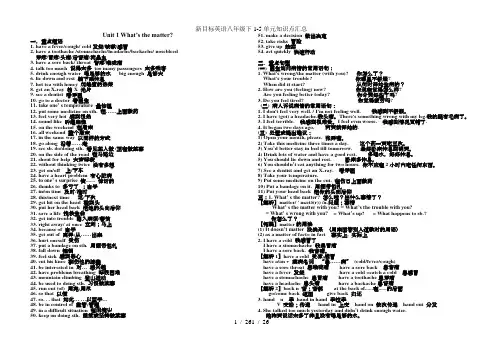
新目标英语八年级下1-5单元知识点汇总1 / 261 / 26Unit 1 What’s the matter?一.重点短语1. have a fever/cough/ cold 发烧/咳嗽/感冒2. have a toothache /stomachache/headache/backache/ nosebleed 牙疼/胃疼/头痛/后背痛/流鼻血3. have a sore back/ throat 背疼/喉咙痛4. talk too much 说得太多 too many passengers 太多乘客5. drink enough water 喝足够的水 big enough 足够大6. lie down and rest 躺下来休息7. hot tea with honey 加蜂蜜的热茶 8. get an X-ray 拍X 光片 9. see a dentist 看牙医 10. go to a doctor 看医生11. take one’ s temperature 量体温12. put some medicine on sth. 在……上面敷药 13. feel very hot 感到很热 14. sound like 听起来像 15. on the weekend 在周末 16. all weekend 整个周末17. in the same way 以同样的方式 18. go along 沿着……走19. see sb. do/doing sth. 看见某人做 /正在做某事 20. on the side of the road 在马路边 21. shout for help 大声呼救22. without thinking twice 没有多想 23. get on/off 上/下车24. have a heart problem 有心脏病 25. to one’ s surprise 使....... 惊讶的 26. thanks to 多亏了 ;由于 27. in/on time 及时/准时 28. this/next time 这/下次 29. get hit on the head 碰到头30. put her head back 把她的头向后仰 31. save a life 挽救生命32. get into trouble 陷入麻烦/苦恼 33. right away/ at once 立刻;马上 34. because of 由于35. get out of 离开;从……出来 36. hurt oneself 受伤37. put a bandage on sth. 用绷带包扎 38. fall down 摔倒 39. feel sick 感到恶心40. cut his knee 割伤他的膝盖 41. be interested in 对… 感兴趣42. have problems breathing 呼吸困难 43. mountain climbing 登山运动 44. be used to doing sth. 习惯做某事 45. run out (of) 用完;用尽 46. so that 以便47. so. . . that 如此… …以至于… 48. be in control of 掌管;管理49. in a difficult situation 在闲境屮50. keep on doing sth. 继续或坚持做某事51. make a decision 做出决定 52. take risks 冒险 53. give up 放弃54. act quickly 快速行动二.重点句型(一) 医生询问病情的常用语句:1. What's wrong/the matter (with you)? 你怎么了? What's your trouble? 你哪里不舒服?When did it start? 从何时开始生病的? 2. How are you (feeling) now? 你现在觉得怎么样? Are you feeling better today? 你今天好些了吗? 3. Do you feel tired? 你觉得疲劳吗? (二) 病人诉说病情的常用语句:1. I don't feel very well. / I'm not feeling well. 我感到不舒服。
新目标八年级下册英语各单元重点语法汇总

新目标八年级下册英语各单元重点语法汇总一. 询问健康及麻烦的表达方法1. 常用结构:What’s the matter (with sb.)?(sb.)怎么了?What’s wrong (with sb.)?(sb.)怎么了?What’s the trouble with sb? sb.出什么事了?What happened to sb? sb.发生了什么事?Are you OK? 你没事吧?Is there anything wrong with sb.?sb.有不舒服/麻烦吗?2. 要表达身体疼痛或不舒服,可用以下结构:①sb. have/has 病症The twins have colds.双胞胎感冒了。
②sb.have/has a headache/toothache/stomachache/backache. She had a stomachache last night. 她昨晚肚子痛。
③sb. have/has a sore 发病部位He has a sore throat. 他喉咙痛。
④sb. hurt(s) 身体部位或反身代词He hurt his leg. 他的腿受伤了。
⑤某部位hurt(s).My head hurts badly. 我头痛得厉害。
⑥sb. have/has a pain in one’s 身体部位I have a pain in my chest. 我胸口痛。
⑦(There is) something wrong with one’s 身体部位There is something wrong with my right eye. 我的右眼有毛病。
⑧其他表达方式She has a heart trouble. 她有心脏病。
He got hit on the head. 他头部受到了撞击。
She cut her finger. 她割破手指了。
二.情态动词should1. should为情态动词,意为“应该;应当”,否定式为shouldn’t,其后接动词原形,无人称和数的变化。
最新版本新目标英语八年级下册Unit_1-unit5期中复习重点短语和句子

Unit 1 What’s the matter?一、重点短语1. have a fever 发烧2. have a cough 咳嗽3. have a toothache 牙疼4. talk too much 说得太多5. drink enough water 喝足够的水6. have a cold 受凉;感冒7. have a stomachache 胃疼8. have a sore back 背疼9. have a sore throat 喉咙痛10. lie down and rest 躺下来休息11. hot tea with honey 加蜂蜜的热茶12. see a dentist 看牙医13.get an X-ray 拍X光片14. take one‟ s temperature 量体温15. put some medicine on sth. 在…上敷药16. feel very hot 感到很热17. sound like 听起来像18. all weekend 整个周末19. in the same way 以同样的方式20. go to a doctor 看医生21. go along 沿着……走22. on the side of the road 在马路边23. shout for help 大声呼救24. without thinking twice 没有多想25. get off 下车26. have a heart problem 有心脏病27. to one‟ s surprise使.......惊讶的28. thanks to 多亏了;由于29. in time 及时30. save a life 挽救生命31. get into trouble 造成麻烦32. right away 立刻;马上33. because of 由于34. get out of 离开;从……出来35. hurt oneself 受伤36. put a bandage on sth. 用绷带包扎37. fa ll down 摔倒38. feel sick 感到恶心39. have a nosebleed 流鼻血40. cut his knee 割伤他的膝盖41. put her head back 把她的头向后仰42. have problems breathing 呼吸困难43. mountain climbing 登山运动44. be used to doing sth. 习惯做某事45. run out (of) 用完;用尽46. so that 以便47. so. . . that 如此… …以致于…48. be in control of 掌管;管理49. in a difficult situation 在困境屮50. keep on doing sth. 继续或坚持做某事51. make a decision 做出决定52. take risks 冒险53. give up 放弃二、重点句型1. What’ s the matter?【What’ s the matter with you?】你怎么了?= Wha t’s the trouble with you?= What’ s wrong with you?2. What should she do? 她该怎么办呢?Should I take my temperature? 我应该量一下体温吗?①.You should lie down and rest. 你应该躺下休息一会儿。
新目标英语八年级下Unit1—5单元语法考点梳理及精练

总复习Unit 1-5一.Grammar Focus(语法专项复习)一般将来时定义:表示将要发生的动作或存在的状态,目前还没有发生。
结构:1. will/shall(将,会,要)+ 动词原形(will可用于任何人称,shall只能用于第一人称I/W e)I/Y ou/He/She/They/We will have robots at home in 200 years.I/We shall dress more casually.2. be going to +动词原形(发生的可能性较大)①.表示主观打算计划要做某事。
I’m going to sell my old house②.表示说话者根据客观现象推断某事是否会发生。
Look at the clouds! It’s going to rain.3. 现在进行时结构(be + 动词ing)表示将来时(表示按计划、安排即将发生的动作,常用于位置转移的动词。
如:go, come, leave, arrive等)Wait a minute. I’m coming.时间状语:next time/ week/month/year, tomorrow, tomorrow evening, the day after tomorrow(后天), this afternoon/evening, tonight, before long(不久), in the future, in+时间(in ten minutes),soon(很快), later(on)(以后)特殊句型:There be 句型1. 表示“某处(某时)有某人(物)”There are fourteen books in her schoolbag.There was a boy at that time.2.遵循“就近原则”There is a pen and two pencils on the desk.There are two boys and a teacher in the room.3.There be句型的将来时:there will be/there is going to be(后者可能性大于前者)There will be more cars in our city in the future.There is going to be a football game tomorrow.小练:1). 翻译There ________(将有)a movie this evening. People ______(将有)robots in their homes. People ________(将活)to be 200 years old. People______(将用)the subways less. Kids _______ (将学习)at home on computers. Kids _________(将不去)to school to study.2). 把上面句子变成一般疑问句(并作肯定和否定回答)和否定句3). There________some yogurt and two tamatoes on the table.(be)4). There________ three children and a teacher in the classroom.(be)5). There________ a beautiful flower and two hats on the floor last night.(be)6). ________ an English party in our school this evening.A. There will beB. There is going to beC. There will haveD. There is going to have过去进行时定义:表示过去某一时刻或某一段时间一直在进行的动作。
新目标八年级下半期unit1--unit6单元知识点归纳总结

八年级下册半期考试u n i t1--u n i t6知识点归纳总结Unit 1 Will people have robots?重点语法:一般将来时态的应用do/does 的一般将来时态形式:(shall/will) dodo/does 的一般将来时态的被动语态:(shall/will) be done一般将来时态的肯定句、否定句、疑问句形式:肯定句例句:People will have robots in a few years.否定句例句:People (will not/won't) have robots in a few years.一般疑问句例句:Will people have robots in a few years?特殊疑问句例句:What will people have in a few years?重点短语:won't = will notthey'll = they willshe'll = she willhe'll = he willI'll = I willfall in love with(sb./sth.) 爱上(某人/某物)be able to do sth. 能够做某事come true 实现in the future 未来hundreds of 数以百计的thousands of 数以千计的look for(sb./sth.) 寻找(某人/某物)wil l → would 情态动词will 的原形和过去式may → might 情态动词may 的原形和过去式Unit 2 What should I do?重点语法:过去将来时态(将来时态的委婉说法)do/does 的过去将来时态形式:(should/would) dodo/does 的过去将来时态的被动语态:(should/would) be done过去将来时态的肯定句、否定句、疑问句形式:肯定句例句:You should write a letter to him.否定句例句:You shouldn't write a letter to him.一般疑问句例句:Should I write a letter to him?特殊疑问句例句:What should I do?重点短语:keep sb. out 不让某人进入What's wrong? = What's the matter? = What's the problem? 怎么了?out of style 不时髦的;过时的call sb. up 给某人打电话pay for sth. 为某事付款pay → paid → paid 动词pay 的原形、过去式和过去分get on [well] with sb. = get along [well] with sb. 与某人相处(好)as ... as possible 尽可能……(eg/ as soon as possible 尽快)all kinds of 各种;许多on the one hand 一方面on the other hand 另一方面ask sb. for sth. = ask sb. to do sth. 请求某人做某事spend (money) on sth. = spend (money) [in] doing sth. 花钱做某事sth. cost sb. (money) 某人花钱为了某事take sb. sometime to do sth. 花某人时间做某事be angry with sb. 生某人的气be angry at sth. 生某事的气not ... until ... 直到……才……it's time for sth. = it's time to do sth. 到该做某事的时间了maybe adv. 或许may be 可能是shall → shou ld 情态动词shall 的原形和过去式Unit 3 What were you doing when the UFO arrived?重点语法:过去进行时态do/does 的过去进行时态形式:(was/were) doingdo/does 的过去进行时态的被动语态:(was/were) being done过去将来时态的肯定句、否定句和疑问句形式:肯定句例句:I was walking down the street when a UFO landed.否定句例句:I wasn't walking down the street when a UFO landed.一般疑问句例句:Were you walking down the street when a UFO landed?特殊疑问句例句:What were you doing when a UFO landed?动词when 和while 的选择:when 后加瞬间动词,while 后加延续性动词。
八年级下册英语1-5单元复习要点(全部)
八年级下册英语1-5单元复习要点(全部)一,课文重点知识详解1, Do you think there will be robots in people's home?(1)Do you think后接宾语从句,从句的语序必须是陈述语序。
引导词that可省略(2)there be句型,表示某处有某物例:There is a book on the desk(3)there be句型的考点There be + 物+ 地点首先,就近原则,即谓语动词be和最靠近它的名词在形式上保持一致there be的一般将来时形式是there will be / there (is/are)going to be(4)people 是一个集合名词,只能作为复数形式使用,没有单数形式2, People will live to be 200 years old.(1)live to be + 基数词+ years old 意为活到……岁(2)live 是动词,意思是居住、生活、活I live in Beijing.(live in + 地点)We live happily.3, There will be more/less/fewer/ people(1)More是many和much的比较级,其后既可以跟可数名词也可跟不可数名词,意思是更多。
最高级是most(2)Less是little的比较级,其后只接不可数名词,意思是较少的,更少的(3)Fewer是few的比较级,其后只接可数名词的复数形式,较少的更少的4,Well, I don't agree. But I think there will be fewer trees.agree with 同意赞同,后接指人或表示意见、看法的词agree to 同意赞同,后接表示建议、计划、安排的词I quite agree with you.Do you agree with what I have said?He has agreed to our suggestion about the holiday.5, what sport will she play?(1)play+球类、棋类Play+the+西洋乐器Play+sportsPlay+with sth/sb(2)sport 作定语时通常使用复数形式a sports meeting 运动会6, I went to Shanghai last year and fell in love with it.Fall in love with sb/sth爱上某人或某物fall behind 落后fall down倒下掉下来fall asleep 入睡熟睡7, Our apartment is too small.Too,―太,真是,非常‖用来修饰形容词或者副词Too……to……太……而不能 She is too young to go to school.8, Keep sb doing sth 让某人一直做某事Sorry, I have kept you waiting so long.Keep doing sth 一直做某事Why do you keep laughing all the time?9, The head of one of the biggest movie companies in the US predicted that no one would want to see actors talk.(1)no one 没有人与nobody同义,作主语时谓语动词用第三人称单数No one/ nobody is in the classroom at the moment.None 为不定代词,意为没有既可以指人也可以指物,其后可接of,作主语的时候谓语动词单复数都可以,但no one 只能指人,且不能与of连用None of these pens work/works.How many tickets do you have?-------None10, some scientists believe that there will be such robots in the future. However, they agree it may take hundreds of years.(1)such如此的,这样的。
八年级(下)新目标Unit1--Unit5重点短语及句型总汇
八年级(下)新目标Unit1--Unit5重点短语及句型总汇Unit 1 Will people have robots?重点短语:1.fewer people 更少的人2.less free time 更少的空闲时间3.in ten years 10年后4.fall in love with…爱上…5.live alone单独居住6.feel lonely感到孤独7.keep/feed a pet pig 养一头宠物猪8.fly to the moon 飞上月球9.hundreds of +复数数百/几百10.the same as 和……相同11.A be different from B A与B不同12.wake up 醒来13.get bored 变得厌倦14.go skating 去滑冰15.lots of/a lot of 许多16.on weekends 在周末17.study at home on computers 在家通过电脑学习18.agree with sb. 同意某人(的意见) 19.I don’t agree. = I disagree.我不同意20.on a piece of paper 在一张纸上21.on vacation 度假22.help sb with sth/help sb do sth 帮助某人做某事23.many different kinds of goldfish许多不同种金鱼24.live in an apartment 住在公寓里live on the twelfth floor 住在12楼25.as a reporter 作为一名记者26.look smart 显得精神/看起来聪明27.Are you kidding? 你在骗我吗28.in the future 在将来29.no more=not …anymore不再30.besides除…之外(还包括)31.be able to与can 能、会32.had to /will have to 33.be big and crowded大而且拥挤34.be in college 在上大学35.dress casually 穿得很随意36.win award 获奖e true 变成现实38.be fun to watch 看起来有趣39.over and over again 一次又一次40.be in different shapes 形状不同41.twenty years from now 今后20年42.be used by 被……使用43.It seems tha t…似乎…… 44.sb happen to do sth.某人碰巧做目标句型:1.What do you think life will be like in 1000 years?2.There will be fewer trees、more buildings and less pollution in the future.3.Will kids go to school? No, they won’t/Yes, they will。
新目标英语八下unit1-5复习总结
新目标英语八下unit1-5复习总结一. 短语句子Unit 1 Will people have robots?1. 免费be free2. 使用某物做某事use sth. to do sth.3. 在家通过电脑学习study at home on computers4. 活到200岁live to be 200 years old5. 在一百年以后in 100 years6. 更少的空闲时间less free time7. 将会有更多/ 更少的污染。
There will be more / less pollution.8. 更少地使用地铁use the subways less9. 拥挤be crowded10. 在大学in college11. 你认为萨利五年后将会成为什么?What do you think Sally will be in five years?12. 住在一所公寓里live in an apartment13. 乘火箭飞往月球fly rockets to the moon14. 住在太空站live on a space station15. 爱上…fall in love with …16. 作为一名记者as a reporter17. 独自生活live alone18. 养一只宠物鹦鹉keep a pet parrot19. 去滑冰go skating20. 看上去很精神look smart21. 穿套装wear a suit22. 在工作日期间during the week(days)23. 在周末at the weekends24. 穿着更随意dress more casually25. 在一张纸上on a piece of paper26. 赢得下一个世界杯win the next World Cup27. 获奖win awards 28. 做着玩do for fun29. 从现在起二十年内twenty years from now30. 为…工作work for…31. 穿校服上学wear a uniform to school32. 飞往月球度假fly to the moon for vocations33. 预测未来predict the future34. 做预言make a prediction35. 实现, 达到come true36. 其中最大一家电影公司的总裁the head of one of the biggest movie companies 37. 在一些科幻小说电影中in some science fiction movies38. 电动牙刷electric toothbrushes39. 在未来in the future40. 帮助做家务活help with the housework= help do the housework41. 成百的hundreds of42. 与…做一样的do the same things as…43. 尽力做某事try to do sth.44. 使某人做某事make sb. do sth.45. 看起来更像…look more like…46. 做简单的工作do simple jobs47. 一遍又一遍over and over again48. 不想做某事would not like to do sth.49. 厌倦get / be bored50. 有更少的工作要做have less work to do51. 许多不同的形状many different shapes52. 一些…, 其他…some…, others…53. 帮助做某事help (to) do sth.Unit 2 What should I do?1. 不让…进入keep out2. 想要某人做某事want sb. to do sth. 5. 过时的,落伍的be out of style6. 时髦的,流行的be in style8. 打电话给某人call up sb. = call sb. up9. 一张球赛的票a ticket to a ball game10. 某物使某人感到惊讶sth. surprise sb.= sb. be surprised at sth.11. 怎么了?What’s wrong? / What’s the matter?12. 电话谈论此事talk about it on the phone13. 付款pay for sth.14. 挣钱get some money15. 找一份兼职工get a part-time job16. 向某人借某物borrow sth. from sb.17. 把某物借给某lend sb. sth. = lend sth. to sb.18. 向某人索要某物ask sb. for sth.19. 青少年论坛Teen Talk20. 为某人买某物buy sb. sth. = buy sth. for sb.21. 请家教get a tutor22. 与…一样the same as…23. 不昂贵be inexpensive24. 与我一样的发型have the same haircut as I25. 需要帮助need help26. 发现,查明find out27. 其他的每个人everyone else28. 做错事do wrong29. 心烦, 沮丧be upset30. 知道该做什么know what to do= know how to do it31. 把某物忘在某地leave sth.+地点32. 运动服sports clothes33. 邀请某人做某事invite sb. to do sth.34. 生某人的气be angry with sb.35. 考试不及格fail the test36. 通过考试pass the test37. 与某人一样年龄be the same age as sb.= be as old as sb.38. 与某人相处(融洽/不好)39. get on ( well / badly ) with sb. 40. 把某物归还给某人return sb.sth.= return sth. to sb. = give back sth. to sb.41. 与某人打架have a fight with sb.42. 给某人建议give sb. some advice43. 请你做…,好吗? Could you please do sth.?44. 课后活动after-school activities45. 足够…adj. + enough46. 从…到…from…to…47. 直到…才…not…until…48. 迅速地吃晚饭have a quick supper49. 是到做某事的时候了. It’s time for sth. It’s time to do sth.50. 格林一家the Greens51. 尽可能多地填满孩子们的生活fit as much as possible into the kids’ lives52. 处于太大的压力中under too much pressure53. 抱怨(做)某事complain about (doing) sth.54. 参加课外活动小组take part in after-school clubs55. 没什么新鲜的nothing new56. 好象要做某事seem to do sth.57. 看到某人做某事see sb. do / doing sth.58. 一位三个孩子的母亲a mother of three59. 了解know about60. 把…送到…去send …to …61. 各种各样的…all kinds of…62. 把…和…相比compare …with …63. 发现/认为做某事很…64. find / think + it + adj. + to do sth.65. 为某人计划某事plan sth. for sb.66. 在一方面on the one hand67. 在另一方面on the other hand68. 需要时间和自由来放松need time and freedom to relax69. 自己做事情do things by oneselfUnit 31. 在…的(外部)前面in front of …2. 在…的(内部)前面in the front of …3. 在理发店in the barber shop4. 睡懒觉sleep late5. 电话聊天talk on the phone6. 淋浴出来get out of the shower7. 从…出来get out of …8. 剪发cut hair9. 航天博物馆the Museum of Flight10. 在某地降落land + 地点11. 沿着街道走walk down / along the street12. 报警call the police13. 起飞take off14. 有一次不寻常的经历15. have an unusual experience16. 跟随某人做某事follow sb. to do sth.17. 某人感到惊讶sb. be surprised18. 在上个星期天早晨9点19. at 9 o’clock last Sunday mor ning20. 你在开玩笑! You’re kidding!21. 爬树climb a tree22. 恐惧be scared23. (从…) 跳下jump down (from…)24. 朝某人喊叫shout to sb.25. (外来物)在树上in the tree26. (本身长)在树上on the tree27. 骑自行车ride a bike28. 警官police officer29. 一份报纸a newspaper30. 跑开, 逃跑run away31. 喊某人的名字shout / call one’s name32. 在车站外outside the station33. 绕着…走walk around …34. 想到做某事think about doing sth.35. 往外看look outside36. 发生了什么事? What happened? 37. 某人发生某事sth. happen to sb.38. 起床get out of bed = get up39. 飞往…的航班a flight to …40. 在诊所at the doctor’s41. 在汤姆家at Tom’s42. 生病住院be ill in hospital43. 赢得金牌win the gold medal44. 在历史上in history45. 最重要的事件之一46. one of the most important events47. 在美国现代历史上48. in modern American history49. 在这天on this day50. 在…城市in the city of …51. 听说hear about52. 日常活动everyday activities53. 40多岁over / more than 40 years old54. 在操场上in / on the playground55. 叫某人(不要)做某事56. ask / tell sb. (not ) to do sth.57. 一起走路回家walk home together58. 沉默地in silence59. (某事)发生(sth.) take place60. 在更近代的时期in more recent times61. 世界贸易中心the World Trade Center62. 对某人来说有了意义have meaning to sb.63. 不是所有的…not all…64. 在月球上行走walk on the moon65. 成为太空中第一位中国宇航员66. become the first Chinese astronaut in space67. 进入太空go into space68. 绕地球的飞行(n.)the flight around the Earth69. 绕地球飞行(v.) fly around the Earth70. 民族英雄 a national hero71. 全世界all over the worldUnit 4 He said I was hard-working.1. 为某人开一个惊喜聚会have a surprise party for sb.2. 生某人的气be mad at sb. = be angry with sb.3. 不再not………anymore = no more4. 带一些饮料和零食bring some drinks and snacks5. 说三种语言speak three languages6. 一个令人兴奋的星期an exciting week7. 首先first of all8. 做家庭作业do a homework project= work on a homework project9. 把某物传给某人pass sb sth = pass sth. to sb.10. 带口信给某人give sb a message11. 为某人捎口信take a message for sb12. 把某物(连续)传递给某人pass on sth. to sb. = pass sth. on to sb.13. 我设想(不…)I (don’t) suppose that +从句14. 被期望, 被认为…be supposed to do sth15. 努力工作的be hard-working16. 在某方面做得好do well in sth. /doing sth. ( do better in ) = be good at sth. / doing sth. ( be better at )17. 一切如何? How’s it going?18. 很遗憾于做某事be sorry to do sth.19. 健康be in good health= be healthy = be well保持健康keep in good health = keep healthy20. 期末考试end-of-year exams21. 收到成绩单get a report card22. 变得紧张get nervous23. 别紧张. Don’t be nervous.24. 做得还行do OK25. 在…方面过得艰难have a hard time with sth. 27. 这学期this semester28. 某人做某事感到惊讶sb. be surprised to do sth.29. bad---worse----worst30. 真实的be true31. 一个令人失望的结果a disappointing result32. 对某人来说做某事是不对的.It’s not right for sb to do sth33. 抄别人的作业copy others’homework 做你自己的作业do your own homework35. 和某人打一架have a fight with sb36. 养成一个坏习惯start a bad habit37. 克服它(某事) get over it(sth)38. 改变某人的生活change one’s life39. 对某人来说听起来像是有意思的事sound like fun to sb.北大毕业生the Peking University graduate= a graduate from Peking University41. 当一名志愿者as a volunteer42. 在一个为期一年的项目中on a one-year program43. 在中国乡村地区in China’s rural areas44. 对某人来说是一种新的经历be a new experience for sb.45. 海拔2000米以上2,000 meters above sea level46. 使某人做某事make sb. do sth.同意某人的决定agree with sb’s decision48. …和…both …and …49. 经历不同的事情experience different things50. 在…和…之间没有不同点There is no difference between … and …51. 无能为力can’t do anything about that52. 开阔某人在…方面的眼界open up one’s eyes to …53. 外面的世界the outside worldgive sb. a good start in life55. 给某人的生活一个好的影响be a good influence in one’s life / lives56. 某事结束sth. be over57. 回到…return to …= go back to…58. 在做某事之后after doing sth. 59. 从事…(的工作) work as…60. 做完某事finish doing sth.61.保护“地球母亲”care for “Mother Earth”( = take care of = look after )62. 处于危险中in dangerUnit 51.过得开心have a great time2. 组织聚会活动organize the party games3. 让某人进入let sb. in4. 不让某人进入keep sb. out5. 半数的学生half (of ) the class6. 为聚会制定的规则the rules for the party7. 把他们带走take them away8. 从其他学校带朋友来bring friends from other schools9. 叫他们离开ask them to leave10. 在聚会期间during the party11. 学校大扫除school clean-up12. 环游世界travel around the world= travel all over the world13. 上大学go to college14. 挣许多钱make a lot of money15. 因…而出名be famous for…16. 作为….而出名be famous as…17. 受教育get an education18. 成为一名职业运动员become a professional athlete19. 似乎像…seem like…20. 将能够will be able to 21. 靠做某事)谋生make a living by doing sth. = do sth. for a living22. 做你爱做的事情do sth. you love捐钱给慈善机构give money to charities24. 一直关注着你watch you all the time25. 到处追随着你follow you everywhere26. 给生活带来麻烦make life difficult27. 靠体育运动来谋生ports for a living = make a living by playing sports28. 一份危险的工作a dangerous job29. 受伤get injured30. 做某事很困难a difficult time doing sth.31. 事实上in fact32. 与….对抗, 反对be / play against…33. 加入俱乐部join the club34. 成为一名律师become a lawyer35. 移动电话mobile phone36. 进行足够的锻炼get enough exercise37. 吃太多的午餐eat too much lunch38. 看太多的电视watch too much TV39. 嘲笑某人laugh at sb.40. 将发生什么事? What will happen?41. 正在发生什么事? What is happening?重点句子:1. When is a good time to have the party? 什么时候是举行聚会的好时间?2. Please give me a chance to explain. 请给我一个解释的机会。
八年级下册英语1~5单元知识点总结
八年级下册英语1~5单元知识点总结
Unit 1: Friends and Friendship
介绍自己和他人的基本信息,如姓名、年龄、国籍等。
描述人物外貌特征和性格特点。
谈论朋友和友谊的重要性。
使用形容词、副词和连词来描述人物和事件。
学习用一般现在时叙述日常活动和喜好。
Unit 2: My School Life
描述学校的位置、设施和规模。
谈论在学校里的日常活动、习惯和时间表。
学习使用一般过去时叙述过去发生的事件。
表达对学校和学习的看法和感受。
Unit 3: Look after Yourself
学习有关健康生活方式的词汇和表达方式。
讨论如何保持健康的饮食习惯和运动习惯。
提出和回答关于个人身体状况、健康问题和建议的问题。
学习一些医疗问题的词汇和表达方式。
Unit 4: Visitors from Space
学习与太空旅行和宇航员有关的常见词汇和表达方式。
谈论太空探索的历史、目的和成就。
描述太阳系的组成和行星的特点。
学习用现在进行时来描述未来计划和安排。
Unit 5: Our World
学习一些有关环境保护和全球变暖的词汇和表达方式。
讨论环境问题以及我们可以采取的行动。
描述不同地理特征和气候条件的国家和地区。
谈论旅游经历和对不同文化的了解。