
unit 2 ways to go to school导学案 2
如果你对了给自己画个笑脸___________
错了,要改正:_________
二、教授新知:
1、听录音,完成let’s try内容.
2、听录音跟读let’s talk.
3、你能流利朗读对话吗?大声读给你的组员听吧!听谁的发音最正确、音调最正确。
________________________________________
四、家庭作业:同步训练
五、课堂小结:
这节课我学到了________________________________________.
六、板书设计:
Unit 2 ways to go to school
1、be early by car? Usually walk
(3)那会是很好的锻炼
_________________________________________
5、小组展示(Group show)
Talk about your classmates ,Do a survey.
三、课堂检测:
1.连词成句。
I howyoucometodoschool(?)
________________________________________
1、第一节课我们所学的单词你记住了吗?让我们一块来背写单词吧。
1.怎样________ 2.上学_____________ 3.步行__________
4.乘公共汽车____________ 5.乘火车______________
6.骑自行车_____________ 7.乘飞机_____________
课题
Unit 2 ways to go to school
课时
2
学习内容
Let’s try Let’s talk
课型
新授课
授课日期
9识与技能:1.能听懂、会说、流利读、正确书写四会句子:
“How do youcometo school?Usually I come on foot. Sometimes I come by bus
学习
重点
四会句子:
“How do youcometo school?Usually I come on foot. Sometimes I come by bus.
学习
难点
Usually sometimes often等频度副词的频率大小以及用法
教学准备
英语书、单词卡片、录音机、磁带
学习过程
一、自学导航:
2、How do youcometo school?
Usually I come on foot.
Sometimes I come by bus.
七、教学反思
(1)小组内自由读。(2)各小组长领读,全班跟读。
(3)小组推荐优秀组员分角色表演。
4.你能用英语写出下面的句子吗?
(1)你怎样来学校?
________________________________________
(2)通常我走着来,有时我骑自行车来。
_________________________________________
Sometimes on come school to I foot
________________________________________
I by come often bike
________________________________________
Good that exercise is
2.能够听懂Let's try的录音内容并选出正确选项
3.能够询问某人如何去某个地方,如:
Howdowe getto school?
Usually……Sometimes……
过程与方法:1.自主学习对话(试读试翻译,可以借助单词表,
不会的注意作标记)
2.流利背诵对话。(自己能独立背诵重点句型)
情感态度与价值观:各个环节激发他们的英语学习兴趣,并培养他们乐于助人的精神。
人教PEP版英语六年级上册Unit2《Waystogotoschool》单元教学设计

人教PEP版英语六年级上册Unit 2《Ways to go to school》单元教学设计一. 教材分析人教PEP版英语六年级上册Unit 2《Ways to go to school》主要围绕交通方式来学校这一主题展开。
通过本单元的学习,学生能够掌握表示交通方式的词汇和句型,如“by bus”, “on foot”, “by trn”等,并能够运用这些词汇和句型进行简单的交流。
教材通过富有趣味性的故事和情境,激发学生的学习兴趣,提高他们的语言运用能力。
二. 学情分析六年级的学生已经具备了一定的英语基础,能够听、说、读、写一些简单的英语单词和句型。
他们在学习过程中,需要通过丰富的教学活动和实践机会,进一步提高自己的语言运用能力。
同时,学生对于交通方式有一定的了解,可以通过生活经验和观察,更好地学习和掌握相关词汇和句型。
三. 教学目标1.知识目标:学生能够掌握表示交通方式的词汇和句型,如“by bus”,“on foot”, “by trn”等,并能够正确运用这些词汇和句型进行交流。
2.能力目标:学生能够通过听、说、读、写的训练,提高自己的语言运用能力,能够用英语简单介绍自己或他人的上学交通方式。
3.情感目标:学生能够激发对英语学习的兴趣,增强学习的自信心,培养合作和分享的良好学习习惯。
四. 教学重难点1.重点:学生能够掌握表示交通方式的词汇和句型,如“by bus”, “onfoot”, “by trn”等,并能够正确运用这些词汇和句型进行交流。
2.难点:学生能够灵活运用所学的词汇和句型,进行创编对话或故事,提高语言运用能力。
五. 教学方法1.情境教学法:通过创设生动、有趣的生活情境,激发学生的学习兴趣,提高他们的语言运用能力。
2.交际法:通过学生之间的互动交流,培养他们的合作意识和语言表达能力。
3.任务型教学法:通过完成具体任务,引导学生主动参与学习过程,提高他们的实践能力。
六. 教学准备1.教学课件:制作精美的教学课件,包括图片、动画、视频等,激发学生的学习兴趣。
六年级unit2复习导学案
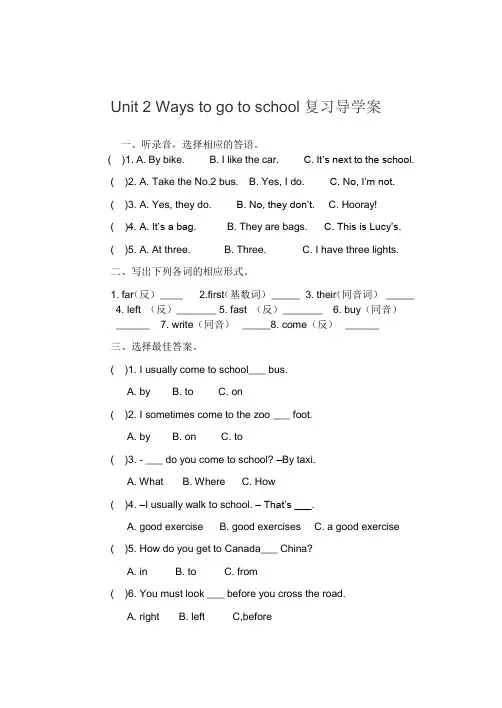
Unit 2 Ways to go to school复习导学案一、听录音,选择相应的答语。
( )1. A. By bike. B. I like the car. C. It’s next to the school. ( )2. A. Take the No.2 bus. B. Yes, I do. C. No, I’m not. ( )3. A. Yes, they do. B. No, they don’t. C. Hooray!( )4. A. It’s a bag. B. They are bags. C. This is Lucy’s. ( )5. A. At three. B. Three. C. I have three lights.二、写出下列各词的相应形式。
1. far(反)____2.first(基数词)_____3. their(同音词)_____4. left (反)_______5. fast (反)_______6. buy(同音)______ 7. write(同音)_____8. come(反)______三、选择最佳答案。
( )1. I usually come to school___ bus.A. byB. toC. on( )2. I sometimes come to the zoo ___ foot.A. byB. onC. to( )3. - ___ do you come to school? –By taxi.A. WhatB. WhereC. How( )4. –I usually walk to school. –That’s ___.A. good exerciseB. good exercisesC. a good exercise ( )5. How do you get to Canada___ China?A. inB. toC. from( )6. You must look ___ before you cross the road.A. rightB. left C,before( )7. I must pay attention___ the traffic lights.A. onB. byC. to( )8. How can I get ___ Fuxing Hospital?A. toB. inC. on( )9. Let me read this ____ you.A.forB. toC. on( )10. I learn ____ home.A. onB. inC. at( )11. In China, people drive on the ___ side.A. rightB. leftC. middle( )12. Chinese food is so different ____British food.A. for B, from C. on( )13. In the UK, you drive on the ____ side.A. rightB. leftC. middle( ) 14. Usually I go to school on foot, because my home is ____.A. farB. nearC.on( )15. How do you ____ Paris?A.to get toB. get toC. gets to( )16. –How ____ Zhang Heng go to school? –He goes to school by bus.A. doB. doesC.is( )17. –How can we go to the zoo? – We cab go ______by bus.A.zoo B, to there C. there( )18. See you ___ 5 0’clock.A. on B, in C. at( )19.-How ___ boys are there?- There’re five.A. many B, much C, for( )20. That woman will ___ to the cinema by train.A. goes B, visits C. go四、按要求完成下列各题。
Pep六上Unit 2 Ways to go to school导学案
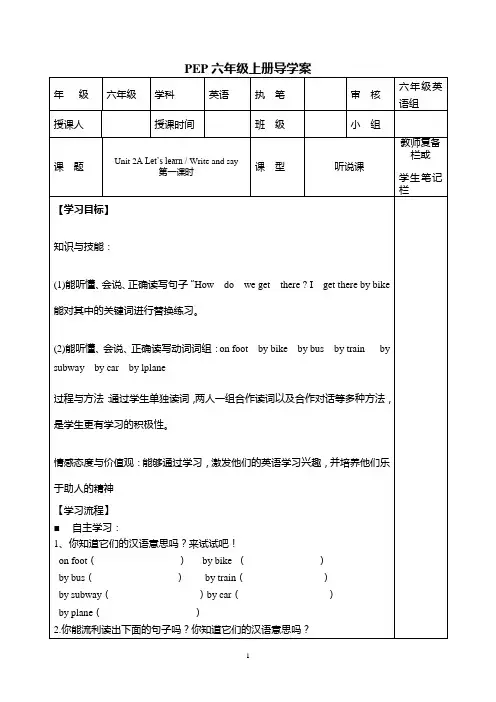
1.( ) ( ) ( ) ( ) ( ) ( )( ) ( )四、选出不同类,将序号写在前面括号里。
1.频率副词:usually(通常,一般)、always(总是)、often(经常)、sometimes(有时候)、never(从不)2.一般现在时:表示现在经常反复发生的动作、存在的状态或习惯性的动作的时态。
■自主学习:(I)旧知复习(Revision)看图写词。
_______________________________ ________ _________ (II).1.你能正确读出下面的词组吗?你能正确翻译它们的汉语意思吗?来试试吧!(自学,可借助单词表)At school()this morning ()talk about () a sports meet()Go by bus()2.你能流利读出下面的句子吗?你知道它们的汉语意思吗?Amy meet Mike at school this morning._______________________________________________________They are talking about a sports meet._______________________________________________________They will go by bus______________________________________________________3. 听录音判断正误(1)They are talking about a sports meet.()(2)They will go by bus。
()(III) Let’s talk1.你能正确读出下面的词组吗?你能正确翻译它们的汉语意思吗?来试试吧!(自学,可借助单词表)be early______________. come to school_______________on foot ______________. usually _______________sometimes______________. often________________good exercise _______________.2.你能流利读出下面的句子吗?你知道它们的汉语意思吗?How do you come to school?___________________________________________________.__________________________________________________________________________________________________________巩固延伸(Consolidation and extension) 你认识下面的标志吗?小组展示(Group show)1.对合作探究中的两个问题进行展示。
人教版英语六年级上册导学案设计Unit 2 单元教案 2
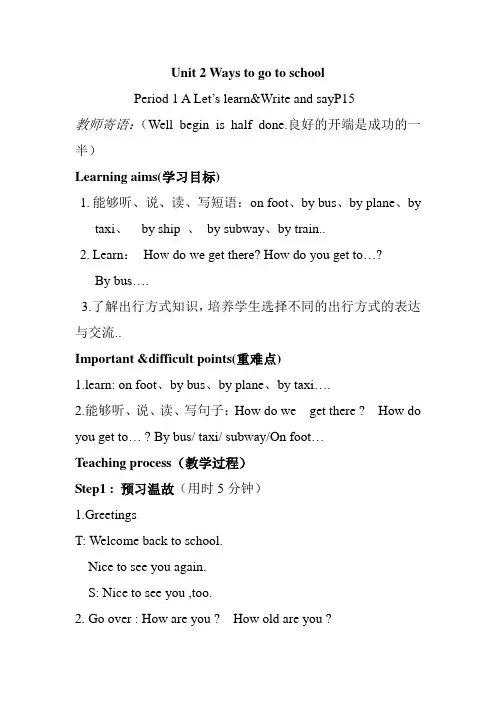
Unit 2 Ways to go to schoolPeriod 1 A Let’s learn&Write and sayP15教师寄语:(Well begin is half done.良好的开端是成功的一半)Learning aims(学习目标)1.能够听、说、读、写短语:on foot、by bus、by plane、bytaxi、by ship 、by subway、by train..2.Learn:How do we get there? How do you get to…?By bus….3.了解出行方式知识,培养学生选择不同的出行方式的表达与交流..Important &difficult points(重难点)1.learn: on foot、by bus、by plane、by taxi….2.能够听、说、读、写句子:How do we get there ? How do you get to… ? By bus/ taxi/ subway/On foot…Teaching process(教学过程)Step1 : 预习温故(用时5分钟)1.GreetingsT: Welcome back to school.Nice to see you again.S: Nice to see you ,too.2. Go over : How are you ? How old are you ?Step 2. 新课内容展示(用时15分钟)1.用图片taxi , train ,plane …的图片引入这些单词..老师教读:taxi…T: by taxi…..2. Use the same way to learn the other words: by bus, by plane, by ship, on foot…3.T: Let’s go to Beijing. S: Great!T: How do we get there? S:By bus.T: How do you get to school?. S: On foot/By bus/bike…4. Q: How many traffic ways can you find? S:sevenQ: What are they?S: on foot/by bus/ plane/taxi/ship / subway/ train.5. Let’s learn page 15. 听录音,仿读对话,并表演对话.. Step 3. 合作交流,师生共建(用时10分钟)Write and say1. Oral practice: I go to school on foot/by bus…2. Discuss in pairs: How do you get to from…? By…2.强调by 短语和on foot: by+ 交通工具表示乘坐……on foot 是固定搭配相当于walk之义..3. 适当拓展by plane/air by ship/sea 的相同含义..Step 4. 达标检测(用时5分钟)一、选一选,读一读,记一记..()1. on foot A. 步行 B. 乘地铁 C. 乘出租车()2. by subway A.乘出租车B. 乘地铁 C.骑自行车()3. by train A. 骑自行车B. 乘出租车 C. 乘飞机()4.by plane A. 乘地铁 B. 乘飞机 C. 步行()5.by taxi A. 乘飞机 B. 乘出租车 C. 乘轮船二、在横线上填上合适的单词使句子完整..1. ______ (怎样)do you go to school?2. I ______ _________ ______(上学) On foot. .3. I come to school________(骑自行车).4.How do we_____ ______(到那儿)?5.Let’s go to the nature ________(公园)..学生小结:这节课我学到了____________________________________安排当堂作业背一背学习目标的词组和句子板书设计:Unit 1How do you go there? !A Let’s learn Write and sayp15on foot by bus by plane by taxiby ship by subway by trainHow do you get there? By bus .../on foot.教学反思:Period 2 A Let’s try Let's talk.P14 Learning aims(学习目标)1.能听懂Let’s try 部分,圈出正确的句子..2.能用简单的口语描述图画内容..3.Learn:How do you come to school?Usually, I come on foot. Sometimes I come by bike. Important &difficult points(重难点)1.Master: A.) How do you come to school?B.)Usually, I come on footC.)Sometimes I come by bike.2.流利朗读Let's talk 部分中对话,并能替换关键词进行问答..Teaching process(教学过程)Step1 : 预习温故(用时5分钟)1.T: Can you read and speak out their meaning?on foot/ by taxi/bus/train/plane/ship/subwayT: How do you get to Chengdu? S:T: How do you get to school from your home?S: on foot/ by taxi/bus….2Learn the new words:usually sometimesoften walk exerciseStep 2. 新课内容展示(用时15分钟)1.T: How do you come to school? S: I come on foot. T: Usually, I come on foot. S: Usually, I come on foot.T: What about you ? S: Sometimes I come by bus. (帮助学生应用Sometimes,多操练)2. Learn Let's talkT: Listen to the tape and find how the people come to school. S:Speak out the right answers.3. 听录音,仿读对话page14.4.Fill in the blanksMrs. Smith: by car/walk Amy: on foot/ by bus Mike: by bikeStep 3. 合作交流,师生共建(用时10分钟)1.学生朗读并表演Let's talk2 Learn Let’s try Listen and cross.3.略讲usually, often, sometimes 的位置,既可以放在句首,也可以放在句中..Step 4. 达标检测(用时5分钟)一、填一填,读一读..1.I get to school ____ ____(步行) .2.I get to school ____ ____(乘火车).3.I go by ____ ____(出租车).4.I get to school ____ ____(乘地铁)二、连词成句(注意标点符号的使用)..1. do, there , you, how, get?2. to I get by bus school .3. often I by bike come .学生小结:这节课我学到了____________________________________Step 5.安排当堂作业1.背诵Let's talk P142.抄写本堂重点句子:板书设计Unit 1How do you go there?A Let’s try Let's talk p15How do you come to school?Usually, I come on foot Sometimes I come by bike. 教学反思:Period 3 B Let’s learn P17教师寄语:(Study harder ,you’ll be better!)Learning aims(学习目标)1、学习单词并掌握:slow, slow down ,stop2、学习并掌握句型:1.Stop and wait at a red light.2. Slow down and stop at a yellow light.3.Go at a green light.3、了解基本的交通规则,即红灯停、绿灯行、黄灯等一等. Important &difficult points(重难点)掌握学习目标单词和重点句型..Teaching process(教学过程)Step1 : 预习温故(用时5分钟)1. Go over words : by subway, by bus …2.T:How do you come to school?S: Usually,I come on foot./Sometimes I come by bus…/I often come by bike.Step 2. 新课内容展示(用时15分钟)1.T:Show traffic light models to teach the new words.Q: What are these?S:Traffic lights.T: Q: What color are they? S: They are red, green and yellow. T: Do you know the traffic rules about traffic lights?S: Answer it in Chinese.2.T: Show word cards to teach:slow slow down stopT: Look at the traffic lights and say traffic rulesS:Stop and wait at a red light. Slow down and stop at a yellow light Go at a green light.3. 出示交通图片,进行表演..Step 3. 合作交流,师生共建(用时10分钟)1.Let’s learn page17. 听录音,看图仿读句子2.教读并讲解重点句子..Step 4. 达标检测(用时5分钟)一、读一读,连一连:slow slow down stop red light green light yellow light 停止红灯慢黄灯绿灯慢行二、根据交通规则Tick or cross.1.Go at a yellow light. ( )2. Stop and wait at a red light. ( )3 . Go at red light. ( )4. Go at a green light. ( )5. Slow down and stop at a yellow light. ( )学生小结:这节课我学到了____________________________________Step 5.安排当堂作业读读,背背学习目标里的重点句子..板书设计Unit 1How do you go there?B Let's Learn Role_play p171. Stop and wait at a red light.2. Slow down and stop at a yellow light3.Go at a green light.教学反思:Period 4 B Let’s try Let’s talk P16教师寄语:(Study harder ,you’ll be better!)Learning aims(学习目标)1. 人们必须遵守交通规则..2. 听力练习..3. 流利朗读Let’s talk部分..Important &difficult points(重难点)Know something about riding a bike and some traffic signs. Teaching process(教学过程)Step1 : 预习温故(用时5分钟)1.T: Red light means…S: Stop and wait.T: Yellow light means…S: Slow down and stop.T: Green light means…S: Go.2.填一填,读一读,译一译..1.S____ and w at a red light.2. S down and stop at a yellow light.3.G at a green light.Step 2. 新课内容展示(用时18分钟)1、Let’s talkT: How do you go to Chengdu/Pan Zhihua?S: By bus/Take the bus .T:Look at the picture and answer: What are the people doing? S: They are riding bikes.T: What are on their heads? S: They are helmets.2、T: Listen to the tape and read the dialogue.3、T: 我们骑自行车应该注意什么?S: In the USA people on bikes must wear helmets.4、小组理解并表演对话..5、Let’s try Listen and tickStep 3. 合作交流,师生共建(用时5分钟)1.记住句子: In the USA people on bikes must wear helmets.2. 看图了解交通规则..Step 4. 达标检测(用时7分钟)一、填一填,读一读,译一译..1. I can see so many___________(picture)2. You must ____________(wear) a helmet when you are on your bike in the USA.3. How can I ____(get) to the hospital? ---On foot .4. Don’t ______ (go) at the red lig ht.5. There are so many ________(bike) in the pictures.二、连词成句..1. green / go/ at /light / a ( .)2. wait / and /a / red/ stop/ light (.)3.down/ and / slow/ a / light / yellow / stop/at(.)Step 5.安排当堂作业1.读读Let’s talk2.记一记本课单词:helmet, must ,wear , attention ,pay attentionto, traffic light.板书设计Unit 2 Ways to go to schoolB Let’s try Let’s talk p16In the USA people on bikes must wear helmets.must 是情态动词+ 动词原型..Eg: must follow the traffic rules Period 5 B Read and write p18,19Learning aims(学习目标)1.Know some words: snow, by sled, fast ,by ferry ,learn at home2.了解世界上不同国家的出行方式.Important &difficult points(重难点)掌握学习目标的词组..Teaching process(教学过程)Step1 : 预习温故(用时5分钟)1.T: Do you know traffic rules ? (引导学生说出P17的三个句子)2.Go over “Let’s talk” ,回答下列问题:Do you have a bike?How do you go to the library?Are there any planes in the pictures ?Step 2. 新课内容展示(用时15分钟)Learn: Read and write1. 可用图片教学:snow, by sled, fast ,by ferry ,learn at home2. T: Discuss: How many ways can you think of to go to school? S: on foot / bury bus/ car/train plane bike subway…3. T:Listen to the tape for 3times( 可选上几幅图)S: 看图仿读课文:Different ways to go to schoolT:纠正读音T:Look at the pictures and read and understand the text in pairs.Step 3. 合作交流,师生共建(用时10分钟)1.Answer the questions:T:How many ways to go to school S:Five.T:Can you find in the text? S:Underline them.T:Does everyone in the text go to school? S: No, they don’t. 3.Choose some suggestions for the kids on page 18.(多操练下列句型)You must …./ Don’t…4. Listen, look and say.(P19)Step 4. 达标检测(用时5分钟)一、填一填,读一读,译一译1.h__ l m __t2.m __ s t3.w__ __r __4. p__ y attention to5.t r __ f f i c6.l__ g ht7. In the USA people____ bikes must wear helmets.8. I must pay attention _____ the traffic lights.二、连一连,读一读..wear a life jacket by sled by ferry by ship drive slowly 乘汽轮乘小船穿救生衣慢行乘雪橇三、判断正误,正确用T,错误用F..1. You must stop at a red light.( )2.Run on the ferry.()3. You must wear a life jacket by ferry. ( )4. Don’t go at a green light . ( )学后反思:叫学生总结((用时1分钟)Step 5.安排当堂作业1.写一写:On foot by sled by ferry by ship by boat by plane2.读一读P19板书设计Unit 2 How do you go there?B Read and write p18,19on foot by sled by ferry by plane教学反思:Period 6B Read and write p20,21Learning aims(学习目标)1.Listening practice2.学习Story time3.学习P12,13Important &difficult points(重难点) Listening practice Teaching process(教学过程)Step1 : 预习温故(用时5分钟)1.T: How do you go to school? S: I go to school on foot/by bus…T: How does… go to school/ S: He/She goes to school…2.读一读,译一译come to school go to the cinema learn at homewear a life jacket by sled by ferry by ship drive slowly Step 2. 新课内容展示(用时15分钟)1.learn:Let’s checkT: Listen and Speak out the answers.2.T: Listen again and answer the 4 questions.3. Learn page 12,13. (听录音并表演对话)4. Let’s wrap it up Tick or cross.(可选上)Discuss come, go.Where is Mike? Tick or cross.Step 3. 合作交流,师生共建(用时10分钟)1.The students tell the story for each other first.2.Q: What do you learn from the story?3、填一填,译一译..1. It’s so good to ____ (see) you .2. I _______( miss) you.3.Let’s _______(take ) a bus home.4.The bus ______(is/ are ) over there.5. _____(Where/ How) is the door ?Step 4. 达标检测(用时5分钟)一、连一连,读一读..1.How does Wu Yifan go to the park? A.on the left side2.How does Amy go home? B.She goes on foot.3.It’s so good to see you! C.He goes by bus.4.In China people drive D.on the right side5. In the UK people drive E.Me too!二、阅读下面的短文,完成后面的练习..正确用T表示,错误用F表示..There are three people in my family. They are my parents and I. My father is a doctor. He goes to work by car. He is a busy all the time. My mother is a teacher. She goes to school by bus. She teaches English. I’m a pupil. My name is Dongdong .I’m eleven years old. I like playing football and watching TV. Tomorrow is Sunday. I’m going to the Great Wall with my parents.( ) There are four people in my family.( ) My father is a doctor.( ) My mother teaches math.( ) I like playing football and watching TV.( ) My father goes to work on foot.Step 5.安排当堂作业Revise Unit 2教学反思:Period 7 B Let’s check&B Let’s wrap it up&C Story time教学目标与要求:1.能熟练,流利朗读Let’s read part.并能理解对话2.能读和中文理解短语:1.go to the park2.this afternoon3. go to the bus stop4.near the post office5.the fifth floor.Room 5A 3.完成Answer the questions.教学重、难点分析能熟练,流利朗读Let’s read part.并能理解对话Teaching process(教学过程)Step1 : 预习温故(用时5分钟)T: 你怎样去上学?S:How do you go to school? T: 我通常走路去上学.. S:Usually I go to school on foot.T: 有时我骑自行则去.. S:Sometimes I go by bike. 汉译英..1. bus stop _______2. go to the park _____3. near the post office______4. the fifth floor,Room5 A _____5. this afternoon6. see you at 2 O'clock __________Step 2. 新课内容展示(用时15分钟)1.T: Look !There are two people in the picture. What arethey talking about?S: They are talking about going to the park.2. Listen to the tape and follow the tape to repeat the dialogue.3. Read the dialogue in pairs4. Four group reading match. Check their pronunciation.5. Reading again and understanding the dialogue.6. Write down the words on the blackboard to help them understand.Who Where How WhenSarah go to the park by bike at 2o’clockZhang on footStep 3. 合作交流,师生共建(用时10分钟)1.领读Let’s read 中的句子..2.Q: How do Sarah and Zhang Peng go to the park?Q: Where is the ZhangPeng’s home?3.S:First, Sarah goes to Zha ngPeng’s home by bike. Next,Sarah and Zhang Peng go to the bus stop on foot. Then they can go to the park by bus.”S:It’s near the post office.4.板书first,next,then,让学生知道恰当使用这三个词有助于表达更为流畅..5.请找出对话中的短语,并朗读..Step 4. 达标检测(用时5分钟)填空: 1. L et’s go to the park ______ _______ .(今天下午)1.We can go to the ______ _______ .(公共汽车站)2.See you ______ 2 o’clock.3.My home is on the _______(第五) floor.学后反思:叫学生总结((用时1分钟)Step 5. 安排当堂作业1. 画四线格抄写句子32.课后读熟对话p6.3.学会用first,next,then 说三个句子,下节课表演..教学反思:。
人教PEP版英语六上《Unit 2 Ways to go to school》(第2课时)教案
人教PEP版英语六上《Unit 2 Ways to go to school》(第2课时)教案一. 教材分析《Unit 2 Ways to go to school》是人教PEP版英语六上册的一单元,主要讲述了人们上学和上班的各种交通方式。
本节课为第2课时,主要围绕课文内容进行深入学习和理解,通过各种教学活动帮助学生掌握核心句型和词汇。
二. 学情分析六上的学生已经具备了一定的英语基础,对于日常生活中的基本交通方式有一定的了解。
但是,对于一些特殊的交通方式可能还需要进一步的引导和拓展。
因此,在教学过程中,需要关注学生的个体差异,因材施教,确保每个学生都能在课堂上得到充分的练习和提高。
三. 教学目标1.能够听懂、会说、会读本节课的核心词汇和句型。
2.能够运用所学知识,描述自己和他人上学或上班的交通方式。
3.能够通过合作交流,提高自己的口语表达能力和团队协作能力。
四. 教学重难点1.核心词汇的掌握,如bus, trn, bike, walk等。
2.核心句型的运用,如“How does she go to school?”“She goes to schoolby bus.”等。
3.特殊交通方式的拓展,如subway, ferry等。
五. 教学方法采用任务型教学法,通过各种有趣的课堂活动,激发学生的学习兴趣,提高学生的参与度和积极性。
同时,运用合作学习法,让学生在小组活动中,相互交流、相互学习,提高自己的语言表达能力。
六. 教学准备1.制作课件,包括图片、视频等教学资源。
2.准备相关交通方式的道具,如玩具车、卡片等。
3.准备课堂活动所需的时间表和任务单。
七. 教学过程1.导入(5分钟)通过播放一首关于交通方式的歌曲,吸引学生的注意力,同时复习上节课所学的词汇。
2.呈现(10分钟)老师出示各种交通方式的图片,引导学生说出对应的英文单词。
然后,老师用核心句型提问,引导学生回答。
如:“How does she go to school?”学生回答:“She goes to school by bus.”3.操练(10分钟)学生分成小组,每组选择一种交通方式,用核心句型进行描述。
新人教版六年级英语上册unit2导学案
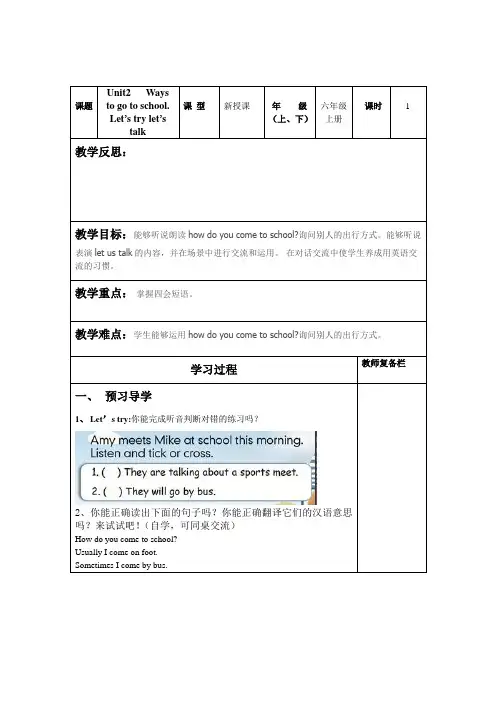
课题Unit2 Waysto go to school.Let’s try let’stalk课型新授课年级(上、下)六年级上册课时 1教学反思:教学目标:能够听说朗读how do you come to school?询问别人的出行方式。
能够听说表演let us talk的内容,并在场景中进行交流和运用。
在对话交流中使学生养成用英语交流的习惯。
教学重点:掌握四会短语。
教学难点:学生能够运用how do you come to school?询问别人的出行方式。
学习过程教师复备栏一、预习导学1、Let’s try:你能完成听音判断对错的练习吗?2、你能正确读出下面的句子吗?你能正确翻译它们的汉语意思吗?来试试吧!(自学,可同桌交流)How do you come to school?Usually I come on foot.Sometimes I come by bus.二、互动研讨(小组内讨论交流展示,组员推荐一人在全班展示。
)1.你能流利朗读对话吗?大声读给你的组员听吧!听谁的发音最正确。
(1)小组内自由读。
(2)各小组长领读,全班跟读。
(3)小组推荐优秀组员分角色表演。
2.你能用英语写出下面的句子吗?(1)你是怎么样来学校的?通常我走路来。
_________________________________________________ (2你是怎么来学校的呢?我经常骑自行车来。
三、达标检测完成书中练习。
四、拓展延伸1.全班同学进行讨论自己的家人和朋友是如何去上学或者上班的。
可以作图来展示并且讲解。
2.Play a chain game.二、互动研讨1.你能正确读出上面的词组吗?大声读给你的组员听吧!听谁的发音最正确。
(1)小组内自由读。
(2)小组推荐优秀组员展示读,并领读,全班同学跟读。
2.你能用英语写出下面的句子吗?(1)我们怎么样到达自然公园?乘公交车去。
________________________________________________(2)你怎么样从中国到达美国?坐飞机去。
Unit 2 Ways to go to school PA Let's learn 教案
Unit 2 Ways to go to school PA Let's learn 教案Unit 2 Ways to go to school PA Let's learn 教案一、教学目标1. 知识目标:a.掌握与交通方式有关的汉字和词汇。
b.学习掌握问答句式“How do you go to school?”2. 能力目标:a. 通过学习,能够自然运用所学的交通词汇,熟练地应对问答句的问法。
b. 设计并介绍自己常用的交通方式。
3. 情感目标:a. 强化学生对遵守交通规则、保护自己安全的重要性的认识。
二、教学重点、难点1. 重点:a. 汉字和词汇的掌握和应用。
b. 问答句式的掌握和熟练应用。
2. 难点:a. 如何自然地运用所学的交通词汇。
b. 如何自信地介绍自己学校的交通情况。
三、教学方法1. 多媒体教学法:通过图片和视频展示不同的交通工具,帮助学生更好地理解和掌握交通词汇。
2. 师生互动教学法:利用互动性练习加深学生对交通工具的理解并让学生提高口语表达能力。
四、教学过程Step 1:Lead-in1. Greet the students and play some music related to transportation to create an atmosphere for the class.2. Ask the students how they get to school.3. Write the question “How do you go to school?” on the board.4. Invite students to share their answers one by one.Step 2:Presentation1. Introduce the vocabulary related to transportation: walk, bike, car, bus, subway, train, and plane.2. Show pictures of each transportation method and play the corresponding sounds if possible.3. Explain the meaning of each word clearly with the help of gestures and facial expressions.Step 3:Practice1. Divide the class into pairs and ask each pair to practice the question “How do you go to school?” using the transportation vocabulary they just learned.2. Encourage them to come up with their own answers based on their actual situation.3. Walk around the classroom and ask some students to share their answers with the class.Step 4:Production1. Ask the students to design a poster that illustrates the transportation situation around their school.2. Instruct them to include the names of the different transportation methods, how many students use each method to get to school, and any safety or traffic rules that they should follow.3. When the posters are finished, ask the students to present them to the class.Step 5:Wrap-up1. Summarize the new vocabulary and sentence structure that they have learned.2. Reiterate the importance of following traffic rules and staying safe while commuting to school.3. Assign homework, which will be to write a short paragraph about their favorite method of transportation and why they prefer it over the others.五、教学评估1. 多媒体教学法的运用程度。
Unit 2 Ways to go to school A Let's talk(教案)人教PEP版
Unit 2 Ways to go to school A Let’s Talk(教案)教学目标1.学生能够正确地用英语表达出如何步行、骑自行车、坐公交车、乘地铁等方式上学;2.学生能够熟练地运用“by + transportation”结构,结合实际情境表述出自己或他人的出行方式;3.学生能够自主思考与交流,提高语言表达和沟通能力。
教学重难点1.教学重点:让学生了解与掌握不同出行方式的英语表达;2.教学难点:让学生能够灵活运用所学词汇结合熟悉场景进行口语表达。
教学步骤Step 1:Warm-up1.Greetings with students.2.Review Unit 1 of the previous class.Step 2:Presentation1.Introduce the topic of the lesson and show some pictures of different ways to go to school (walk, ride a bike, take a bus, take the subway).e visuals to introduce “by + transportation” structure and give examples to show how to use it.Step 3:Practice1.Conduct a group discussion, where students can share their own experiences of getting to school and describe how they get there in English.2.Play a game of charades for transportation words. Have students make gestures and act out different ways of transportation and let the class guess what they are.3.Read all the sentences on the screen or write them on the blackboard, and then have students repeat them until the pronunciation is correct.Step 4:Production1.Ask students to work in pairs to create a conversation about ways to go to school using using “by + transportation” structure. Teacher can walk around the classroom and give students guidance if necessary.2.Have groups perform their conversations for the class.Step 5:Extension1.Encourage students to create a class survey and ask their classmates to choose their favorite ways to go to school. They can then create charts and diagrams to visually represent the data they collected.2.Teacher can show a video clip of students around the world riding bicycles to school and then ask students to describe what they saw in English.Step 6:Summary1.Summarize the lesson and have students repeat the new vocabulary they learned.2.Ask students to share their feelings about the class and challenge them to continue practicing their newly acquired English skills.教学反思本节课主要是通过多种形式和情境营造出不同出行方式的场景,让学生能够自主思考、积极参与、多角度学习、灵活运用英语知识,从而提高英语语言表达和沟通能力。
人教版PEP六年级上册Unit-2-Ways-to-go-to-school第二课时教案
L:How can I get to Wenhua hotal?
T figures out the reason: It’s late.
3) Present “by bus”
L:How can we get to the West lake?
If possible students should tell the reasons.
2. Be able to ask someone his subjects on a certain day using the sentence pattern: “How do you get to ______ from ______? By ______.”
3. Be able to understand and say the chant.
4)Present “on foot”
S: How can I get to Intime?
T emphasizes on foot is very special because the foot is myselves.
5)Present “by subway”
S:How can I get to Xianlin?
2. Be able toask someone his subjects on a certain day using the sentence pattern: “How do you get to ______ from ______? By ______.”
III. Teaching aids:
Step3. Practice.
1. listen and number
2. Let’s chant.
人教版(PEP)六年级上册《unit 2 ways to go to school》教案
人教版(PEP)六年级上册《unit 2 ways to go to school》教案一. 教材分析《PEP教材》六年级上册《Unit 2 Ways to go to school》主要让学生掌握关于交通工具和出行方式的词汇,如bus, car, trn, bike等,以及表达出行方式的句型“How do you go to school/work/home?”和“I go to school/work/home by…”. 同时,学生还需要学会如何用英语询问并回答他人的出行方式。
二. 学情分析六年级的学生已经具备了一定的英语基础,能够听懂并运用简单的英语进行日常交流。
但是,对于一些复杂的交通出行方式,学生可能还难以用英语准确表达。
因此,在教学过程中,教师需要关注学生的个体差异,针对不同程度的学生给予适当的指导。
三. 教学目标1.知识目标:学生能够掌握关于交通工具和出行方式的词汇,如bus,car, trn, bike等,以及表达出行方式的句型“How do you go toschool/work/home?”和“I go to school/work/home by…”.2.能力目标:学生能够在真实情境中运用所学词汇和句型进行交流,询问并回答他人的出行方式。
3.情感目标:培养学生热爱生活,关注环保的意识。
四. 教学重难点1.重点:掌握关于交通工具和出行方式的词汇,如bus, car, trn, bike等,以及表达出行方式的句型“How do you go to school/work/home?”和“I go toschool/work/home by…”.2.难点:能够用英语准确表达复杂的交通出行方式。
五. 教学方法1.情境教学法:通过设定真实的生活情境,让学生在实践中学习和运用英语。
2.交际教学法:鼓励学生积极参与课堂交流,提高口语表达能力。
3.任务型教学法:通过完成具体任务,让学生在实际操作中巩固所学知识。