
外研版七年级英语上册 Starter Module 1 My teacher and my friends(课时检测+综合提升,PDF版)
( EF) V 7Y [7W . 7S 17I " 7H 6 70 4 7! /7] & 7F G 7\ Z7_ # 7( 2 7a 37b $ 7; R7J K7e * 78) 7X , 7f 97` 5 7PQ 7T U 7L M
" " " "
N O G*HIJK # 7Y 7$ :' ./0,!1234567'-7777! V ' 6 , " * 3$ $ 3 V ' ] "L V ' D V ' T V ' W V ' 6 "G V ' ! $ Q* "M $ 9, W ' L " ) "( & ) ) # & ' # 7W 7$ C' +! $ Q* "M $ 9" F . Z, +7777' V ' ! $ Q* "M $ 9" _ & 34 # & 34 W ' H & 3" ", /3Z M $ 9 # 7V 7$ D' +0 $ $ 1[M " ' +7777' V ' 0 $ $ 1[M " V ' ] 2G . Z' Y ' 0 $ $ 12 $ * 3& 34 Y ' ( M32 "& ) F . Z' W ' 0 $ $ 1" 5 " 3& 34 W ' 2 M32 "& ) F . Z' S ' 0 $ $ 1 3& 4 /, S ' ( M32 "& ) G . Z' # 7Y 7$ :E' +P/, & ) M $ 9* 32 " , +7777 s*tuvwJBxy9z{|#Z} V .0 $ $ 12 $ * 3& 34 ' ] ^ 2H 34 6 34 ' Y .:' 7I 7H 34 6 34 ' 7W 7 V .>' Y .] ^ 2S $ 34 1$ 34 ' V .?' 7Y 7 Y .] ^ 2S $ 34 1$ 34 ' V .=' 7V 7 Y .H & 3" ", /3Z M $ 9' ! $ Q* "M $ 9, 7S 7 V .@' V ' ! $ Q* "M $ 9, Y ' 8$ * * M , 7777777777 W ' P/, ^ ) M $ 9* 32 " " R# " ) " , S ' ] ^ 26 & 3", $ $ ", /3Z) ' I ' 0 $ $ 12 $ * 3& 34 " Y ' H & 3" ", /3Z) M $ 9 S ' ] 26 & 3" ", /3Z Y ' 2 $ * 3& 34 Y ' V "Y ' :E Y ' ( Y ' L Y ' 6 "G "4 W ' 3& 4 /, W ' ] "W ' :: W ' a W ' a W ' 4 " K" M Y ' X /& ) & ) 2 M, " . /" * ' S ' ! "& ) ( & Z" ' S ' , /3Z) S ' & "V S ' :> S ' P S ' 0 S ' ] "6 "4 # 7W 7$ >' 8679!17777" 77772367:;<=,! # 7V 7$ ?' & 67 ] -679!'>7777367! # 7W 7$ =' ./67?@ABCDE='-7777! # 7W 7$ @' ./67!F5GH67 ( I1JK455L'-7777! # 7V 7$ A' >A 367!M@67N@O:PCQ'67-7777! # 7W 7$ B' .RST!UM@*V@WXYZ[1\]^_'-7777!
" !
7
7
77777777
Байду номын сангаас
? ; +6 ; $ 6.&4 1 % $ !
MN'OP# .$ QRS
777777777777777777777777777777777 >*g=hi; >A jOk789CD;"lm& "' nBop78# +,:;qr$
"
=> 7 ( ; )=3 &&45&6 7 ( 7 8" F A 5D 0 $ 7/ 0 &7 8"
!"#$%&'()"#*+,-.'()"#/012
!"# $ % & ' $ (% ) *+", ( $ ) * .
8, * , " * ( $ 19# " :# ; :< ; =$ 7
>*?@A";B789CD;
77777777777777777777777777777
=> 7 ( ; !=3 &&45&6 7 ( 7 8" .( , , / 0 &1 "
( L5) 4 $ $ 12 $ * 3& 34 $ $ 12 $ * 3& 34 ! 4
# $ % % &' # ( " !"! ! !" !"#$%&'()*+,-./0123" 4352 ! " # # $ % ! & ' & ' 6! 789! * % +, , # #$$ %&%$' ! )" :;<=9>"?@ABC.DEFGH! IJ3K" L M.N3OPQ2<=R1! .( , , / 0 &1()* ! -" &( & ) ) % ( * ) % ( ) + ST' :UVWX.Y-"Z[\]^_! ( & ) ) * ) ) !V`aWX.Y-"( !VbaWX.Y-" ( * 2cba$`aWdef! ( 2cgXSTh! ( +,) Y-Wij" f2 & ( ) + & ) ) + ST ' $ & ( ST ' " Y * + " . /" * ! -gij"f2& ( ST' "klm2 , 3 &&45 &6 7 ( 7 8' $ 9$ 7 ( 7 8' +: ; $ 6 7 &&7 " -." ' /." ' 01"! ! 2" !#n o p q % rq% s t u v K . w x 3" 4 3 5 2
G*HIJK # 7V 7$ :' >E:? )*+, `abc"defghhG"aij& 7777' ! V ' X /& ) & ) 2 M2 $ 2 ' Y ' X /& ) & ) 2 M11' W ' ! " * "& ) 2 M) & ) , " * ' ( L5) -./01"23& X /& ) % X /, & ) c' 45! , /& ) /, 6789:;<%0=>%, 6789:;?%0=>! @A ! (& BCDEF-.GG' "HI V $ 9S 5 & 1, +7777" ] 2 ' # 7Y 7$ >' +7777 M V ' V * " %a $ Y ' V * " %L " ) W ' V 2 %L " ) ) & , 7777 * $ $ 2 , +L " ) "& , ^ ) 7777 * $ $ 2 ' # 7W 7$ ?' +] V ' 2 M %2 M Y ' M $ 9* %M $ 9* W ' M $ 9* %2 M . Z' # 7V 7$ =' +X /& ) & ) F . Z" ( & Z" ' +7777" F V ' a & . ", $2 " " , M $ 9 Y ' 8& , 1$ Q 3 W ' 8, 31 9R ^ 2S 2 & 34 ' # 7W 7$ @' +7777, +] V ' P/, ^ ) M $ 9* 392 [" * Y ' ! $ Q$ # 1* "M $ 9 W ' P/, ^ ) M $ 9* 32 " X /& ) & ) _ & # M ' 7777 , " . /" * & ) ( * _ & 9' # 7Y 7$ A' V ' ! & ) Y ' ! " * W ' 8/" s*Z} V .7:7" ( V .! $ Q1$M $ 9 1$ , & ) ) F $ 3" ) ' Y .7B7, $ $ 12 $ * 3& 34 ' 7>7 M $ 9* 32 " " R# " ) " , Y .0 2 "& ) F $ " ' V .7?7 3V .a & . ", $2 " " , M $ 9' Y .7=7 * "M $ 9" F $ " , Y .7C7' ^ 26 & 3" ' 7@7 & ) 2 M6 * & " 31' 7A7 32 "& ) F . Z' # " ) "7D7 1$ Q 3' V .] V .; $ 9' Y .! " # # $ "F . Z' Y .7:E7 M W .! " # # $ "( & ) ) F $ 3" ) ' # 7Y 7$ :' V ' ! " # # $ Y ' 0 $ $ 12 $ * 3& 34 W ' 0 $ $ 16 , " * 3$ $ 3 S ' ! & # 7Y 7$ >' V ' P/, Y ' P/, ^ ) W ' X /& ) S ' P/, * " # 7V 7$ ?' V ' ( M Y ' L $ 9* W ' X /& ) S ' ! & ) # 7V 7$ =' V ' ! $ Q Y ' P/, W ' P/& . / S ' P/, . $ # $ 9* # 7V 7$ @' V ' X /& ) Y ' 8/" W ' X /, S ' ! " # 7Y 7$ A' V ' ! " ^ ) Y ' ! & ) W ' ! " * S ' 8/" ^ ) # 7Y 7$ B' V ' ! $ Q* "M $ 9 Y ' ! $ Q1$M $ 9 1$ W ' H & 3" ", /3Z) S ' X /, ^ ) b \ # 7Y 7$ C' V ' b \ Y ' a & . ", $2 " " , M $ 9" , $ $ W ' H & 3" S ' V 31 M $ 9 # 7V 7$ D' V ' ) & , Y ' ) , 31 W ' ) , 31) S ' ) & , ) # 7V 7$ :E' V ' X /3Z Y ' X /3Z) W ' 8" " S ' V 31
新外研版七年级英语上册单词默写表(带音标)

新外研版七年级英语上册单词默写表(带音标)-CAL-FENGHAI.-(YICAI)-Company One1Starter Module 1 My teacher and my friends1、* [hə'ləʊ] int. 喂;你好2、* [klɑ:s,] n. 同学;班级3、* [mai] pron. 我的4、* [neim] n. 名称,名字;姓名5、* [iz, z] v. 是(系动词be的第三人称单数形式)6、* [mis] . n.小姐,女士;对年轻未婚女子的称呼7、* [ɡud] adj. 好的8、* ['mɔ:niŋ] n. 早晨;上午9、早上好10、* [,ɑ:ftə:'nu:n] n. 午后,下午11、下午好12、* [,ɡud'bai] int. 再见(等于goodby)13、 [ai] pron. 我14、 [强æm, 弱əm] v. 是(动词be的第一人称单数形式)15、我是16、* ['mistə] n.先生17、* t [wɒt] pron. 什么18、* [jɔ:, 弱jə] pron. 你的,你们的19、* [pli:z] int. 请(礼貌用语)20、* ['sɔ:ri] int. 对不起,抱歉(表示委婉的拒绝等)21、[kæn, kən] aux. 能,可以22、 [ju:, 弱ju, jə] pron. 你;你们23、 [spel] vt. 拼,拼写24、 [it] pron. 它25、 [jes] adv. 是, 是的26、[θæŋk] vt. 谢谢27、 [hau] adv. 如何怎样28、 [强ɑ:, 弱ə] v. 是(be的第二人称单复数现在式)29、* [fain] adj. 很好的;不错的30、*[θæŋks] int. 谢谢31、 ['misiz] n. 太太;夫人32、* [tu:] adv. 也;还33、*[ðis] pron. 这;这个(指较近的人或事物)34、* [ʃi:] pron. 她(主格)35、* ['ti:tʃə] n. 教师;导师36、* [frend] n. 朋友;助手37、* [hз:,hə] pron. 她的38、* [hiz, 弱iz] pron. 他的39、* [nais] adj. 令人愉快的;美好的40、* [强 tu:, 弱 tu, 辅音前弱tə](与原形动词一起构成动词不定式)41、* [mi:t] vt. 结识;遇见42、* [taim] n. 时间;时代;次数43、* [ɡəu] vi. 走;去44、* [nau] adv. 现在;目前45、* [bai] int. 再见46、* [si:] vi. 看;看见47、* [tə'mɔrəu] n. 明天;未来Module 2 My English lesson1、 [sit] vi. 坐2、 [daun] adv. 向下地;prep.向下;坐下3、 ['əupən] vt. 打开4、 [buk] n. 书;5、 ['lisən] vi. 听,倾听6、 [drɔ:] vt. 画;绘画7、 [put] vt. 放;置8、 [ʌp] adv.向上地;prep.朝上;向上9、[hænd] n. 手,手艺10、[stænd] vi. 站立;位于11、起立12、* [kləuz] vt. 关闭;合上13、* [nju:, nu:] adj. 新的14、* ['stju:dnt] n. 学生;学者15、* [hiə] adv. 在这里;这里16、* [in] prep. 在…里面17、 [wʌn] num. 一18、 [tu:] num. 二19、[θri:] num. 三20、 [fɔ:] num. 四21、 [faiv] num. 五22、 [siks] num. 六23、 ['sevən] num. 七24、 [eit] num. 八25、 [nain] num. 九26、 [ten] num. 十27、 ['telifəun] n. (美)电话28、 ['nʌmbə] n.号码29、 [əuld] adj. ……年龄的;….岁的30、多大,几岁31、 [i'levən] num. 十一;32、 [twelv] num. 十二33、['θз:'ti:n] num. 十三34、 ['fɔ:'ti:n] num. 十四35、 ['fifti:n] num. 十五36、 ['siks'ti:n] num. 十六37、 [,sevən'ti:n] num. 十七38、 ['ei'ti:n] num. 十八39、 [,nain'ti:n] num. 十九40、 ['twenti] num. 二十41、 [bɔi] n. 男孩42、 [ɡə:l] n. 女孩43、 [desk] n. 桌子44、 [tʃεə] n. 椅子45、[[bæɡ]] n.包;书包Module 3 My English book1、* [in] prep.使用(某种语言)2、* ['iŋɡliʃ] n. 英语 adj.来自英格兰的3、用英语4、* [ei] [ə] art. 一(个,件….)5、* [rait] vi. 写6、* [ɒn] prep. 在……之上7、* [ði] art. (指已经谈到或正在谈到的事物)8、* ['blækbɔ:d] n. 黑板9、* ['əu'kei] int. 好;行(用于表示同意,赞成或理解)10、* [pen] n. 钢笔;钢笔11、* [nəu] adv. 不,不是;没有(用于表示否定的问答)12、* ['pensəl] n. 铅笔13、* [du:] v. aux. 助动词(用于构成疑问句和否定句)14、* [bə:d] n. 鸟15、* [kæt] n. 猫;猫科动物16、* [dɔɡ] n. 狗19、* ['flauə] n. 花20、* [help] vi. 帮助21、* [mi:,] pron. 我(宾格)22、* [ɔv, əv] prep. …的23、* [kɔ:s] adv. 当然24、是的,当然25、* ['klɑ:srum] n. 教室26、* [nəu] vt. 知道;懂得27、* [sei] vt. 讲;说28、* [ðæt] pron. 那;那个(指较远的人或事物)29、* [ə'ɡen] adv. 又;再一次30、* ['welkəm] adj. 受欢迎的;int. 欢迎(迎接某人到某地时的用语)31、* 不用谢,别客气32、* [blæk] adj. 黑色的33、* [hwait] adj. 白色的;n. 白色34、* [blu:] adj. 蓝色的;n. 蓝色35、* [ɡri:n] adj. 绿色的;n. 绿色36、* ['jeləu] adj. 黄色的 n. 黄色37、* [red] adj. 红色的;n. 红色38、* [braun] adj. 棕色的;n. 褐色,棕色39、* ['ɔrindʒ] adj. 橙色的;橘色的。
外研版七年级英语上册StarterModule1Myteacherandmyfriends单元知识点归纳
Starter Module 1 My teacher and my friendsUnit 1 Good morning, Miss Zhou.重点单词1.hello int.你好,喂2.class n.同学;班级3.my pron.我的4.name n.名字5.is v.是6.good adj.好的7.Miss n.小姐;老师8.morning n.早晨,上午9.afternoon n.下午10.goodbye int.再见重点短语1.good morning上午好2.good afternoon下午好重点句型1.Hello,my name's Daming.你好,我的名字是大明。
2.Goodbye,Tom.再见,汤姆。
3.Good morning,Lingling.早上好,玲玲。
4.Good afternoon,Carla.下午好,卡拉。
核心考点1.Good afternoon,class.下午好,同学们。
(教材PS2)【考点】class /klɑ?s/ n. 班级,同学,课eg:Class One 一班;have classes 上课【注意】class意为“同学”,作主语时,作为整体时谓语动词用单数形式,考虑其成员时谓语动词可用复数形式。
eg:The whole class are very bright.全班同学都很聪明。
2.My name's Miss Zhou.我是周老师。
(教材PS2)【考点1】Miss/m?s/ n. 小姐;老师eg:Hello, Miss Wang.你好,王老师。
【考点2】Miss,Mrs,Ms,Mr的用法汉语意思用法Miss 小姐用于称呼未婚女子Mrs 夫人;太太用于已婚女子丈夫的姓氏前Ms 女士用于称呼婚姻状况不明的女性Mr 先生用于男士姓氏前Unit 2Good morning.I'm Chen Zhong.重点单词1.I pron.我2.am v.是3.Mr n.先生4.what pron.什么5.your pron.你的,你们的6.please int.请7.sorry adj.对不起的,抱歉的8.can v. aux.能,能够9.you pron.你,你们10.spell v.拼写11.it pron.它12.yes adv.是,是的13.thank v.谢谢14.how adv.怎样,如何15.are v.是16.fine adj.很好的,不错的17.thanks int.谢谢18.Mrs n.夫人,太太19.too adv.也,还重点短语thank you谢谢你重点句型1.What's your name,please? 请问你叫什么名字?2.Can you spell it,please?请问你能拼写一下它吗?3.—How are you?你好吗?—Fine,thank you.很好,谢谢。
初一英语(外研版)Starter-Module-1-My-teacher-and
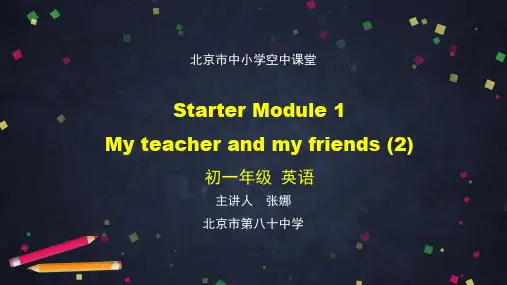
Listen again and repeat.
Lingling: This is Miss Zhou. She’s my teacher. Hello, Miss Zhou.
Miss Zhou: Hello, Lingling. Lingling: Miss Zhou, this is my friend, Tony.
Good afternoon. How are you? I’m fine, thanks. How are you? I’m fine too, thank you. What’s your name, please? I’m Tom. What’s your name? I’m Sarah.
Can you greet people and introduce yourself?
北京市中小学空中课堂
Starter Module 1 My teacher and my friends (2)
初一年级 英语
主讲人 张娜 北京市第八十中学
How do we greet people?
Good afternoon.
Good afternoon.
How are you? I
I’m fine too, thank you.
How can we introduce our friends? This is my friend. His / Her name is ...
Listen and check.
1. This is my friend.
name's Tony.
2. This is my
. Her
外研版七年级(上册)英语StarterModule1Myteacherandmyfriends
21、can [kæn, kən] aux. 能,可以 22、you [ju:, 弱ju, jə] pron. 你;你们 23、spell [spel] vt. 拼,拼写
24、it [it] pron. 它 25、yes [jes] adv. 是, 是的 26、thank [θæŋk] vt. 谢谢 27、how [hau] adv. 如何 怎样 28、are [强ɑ:, 弱ə] v. 是〔be的第二人称单
Work in pairs. Ask and say.
Hello, this is my friend, David Beckham.
A. A; N
B. A; I
C. O; K
D. U; N
5. 下面__B__组都是辅音字母.
A. G, M, I
B. c, d, f
C. H, E, J
D. s, o, n
Unit 2 Good morning, I’m Chen Zhong.
When you see someone you don't know, what do you say?
Listen and read.
Hello,class.My name’s Miss Zhou. Good morning,Miss Zhou. Good afternoon,class. Good afternoon,Miss Zhou. Goodbye,class.
Goodbye,Miss Zhou.
复数现在式
29、* fine [fain] adj. 很好的;不错的 30、* thanks [θæŋks] int. 谢谢 31、Mrs ['misiz] n. 太太;夫人 32、* too [tu:] adv. 也;还 33、* this [ðis] pron. 这;这个〔指较近的
外研版七年级英语上册课件-Starter Module 1 My teacher and my
Language points
What’s your name?用来询问对方的名字,其答语可 用“My name is…/I’m…/直接回答姓名”。 Sorry?用来表示因未听清楚而请求对方再说一遍。 Can you spell it, please?用来询问对方是否能拼写单 词,其答语要用yes或no。 Thank you.当别人帮助、关心、问候祝福我们时,使 用此句型应答,表示谢意。 How are you?询问对方健康状况而提出的问候。
2 Listen again and repeat.
— Hello, class. My name’s Miss Zhou. — Good morning, Miss Zhou. — Good afternoon, class. — Good afternoon, Miss Zhou. — Goodbye, class. — Goodbye, Miss Zhou.
Task2: 听录音,并跟读。
Mr Chen: Good morning. I’m Chen Zhong. Lingling: Good morning, Mr. Chen. Mr Chen: What’s your name, please? Lingling: I’m Lingling. Mr Chen: Sorry? Lingling: I’m Lingling. Mr Chen: Can you spell it, please? Lingling: Yes, L-I-N-G-L-I-N-G, Lingling. Mr Chen: Thank you. Lingling. How are you? Lingling: Fine, thank you. How are you? Mr Chen: Fine, thanks. Lingling.
初中英语外研版七年级上册《Starter Module 1 My teacher and my fr
again and
Mr Chen: Sorry?
repeat.
Lingling: I’m Lingling.
Mr Chen: Can you spell it, please?
Lingling: Yes, L-I-N-G-L-I-N-G, Lingling.
Mr Chen: Thank you. Lingling. How are you?
Work in pairs
A: Good morning. What’s your name, please? B: My name’s …. A: Sorry? B: I’m …. A: Can you spell it, please? B: Yes, …-…-…, …. A: Thank you, …. How are you? B: Fine, thank you. How are you? A: I’m fine, too. Thanks, …
询问对方是否能拼写单词的句型: Can you spell it, please?
表达谢意或当得到对方夸奖或称赞时的句型: Thank you./Thanks.
询问对方身体健康状态的句型: How are you?
Let's do some Exercises
单项挑选:
1. —How are you? —I’mB________ , thanks.
Homewor k
1. 熟读并背诵Part 1对话。
2. Greet your classmates you don’t know.
3. 两个人一组编对话,使用学过的问候语。
谢谢
I’m Sarah.
I’m fine, thanks. How are you?
七年级英语上册 Starter Module 1 My teacher and my friends
七年级英语上册 Starter Module 1 My teacher and my friends教材听力原文(新版)外研版Unit 13 Match.1.Daming:Hello, my name’s Daming.Lingling:Hello, my name’s Lingling.2.Carla:Good morning, Lingling.Lingling:Good morning, Carla.3.Mike:Good afternoon, Carla.Carla:Good afternoon, Mike.4.Tom:Goodbye, Mike.Mike:Goodbye, Tom.8 Listen.1.My name’s Tom, T-O-M, Tom.2. My name’s Carla, C-A-R-L-A, Carla.3. My name’s Mike, M-I-K-E, Mike.Unit 23 Match.1.Mr Chen:Good morning. I’m Chen Zhong.Lingling:Good morning, Mr Chen.2.Mr Chen:What’s your name, please?Lingling:I’m Lingling.3.Mr Chen:How are you?Lingling:Fine, thanks.4 Listen and number.Mrs Wang:Good afternoon.Daming:Sorry?Mrs Wang:Good afternoon. What’s your name?Daming:Good afternoon, Mrs Wang. I’m D aming.Mrs Wang:How are you, Daming?Daming:I’m fine, thanks.5 Write.Mrs Wang:Good morning.Daming:Good morning, Mrs Wang.Mrs Wang:What’s your name?Daming:My name’s Daming.Mrs Wang:How are you?Daming:I’m fine, thanks.Unit 33 Match.1. This is my friend. His name’s Tony.2. She is my friend. Her name’s Betty.3. Hello. Nice to meet you.4. It’s time to go now. Goodbye.4 Listen and number.Lingling:Hello, Daming. This is my friend, Amy. Daming:Hello,Amy, nice to meet you.Amy:Hello, Daming, n ice to meet you too. Lingling:It’s time to go now. Goodbye. Daming:Goodbye.See you tomorrow.7 Write.1. This is my friend. His name’s Tony.2. This is my friend. Her name’s Betty.3. Nice to meet you.4. It’s time to go now. Goodbye.5. Bye. See you tomorrow.。
【精练精析】七年级英语上册 Starter Module 1《My teacher and my friend》练习 外研版
[精练精析]Starter Module 1《My teacher and my friend》(外研版七年级上册)①— ______ , Lucy!— Hello, Mary!②— Hi, Jim!— ______ , Li Lei!答案:①Hello ②Hi①—Lucy, please sit down.— ______ ______ .②—Your English is very good!— ______ ______ .答案:①Thank you ②Thank you—Goodbye, Mum!—______ , Lingling!答案:GoodbyeⅠ. 单项选择(4分钟,10分)1. 下列四组字母中含有相同音素的一组是______.A. AEB. BCC. DFD. MH2. 下列字母中是元音字母的是______.A. CcB. BbC. EeD. Jj3. —Hello, Jim.—______ , Li Lei.A. HelloB. GoodbyeC. OKD. Thank you4. —Please sit down.—______ , Mr Wang.A. HelloB. Yes, tooC. Thank youD. Good morning5. Class, please stand ______.A. downB. upC. toD. inBCACBⅡ. 完成句子(6分钟,10分)1. Daming, ______ ______ , please(请坐).2. ______ , ______ (同学们好).3. ______(你好), Jack.4. ______ ______ (谢谢), Miss Li.5. ______ (再见), Lucy.答案: 1. sit down 2. Hello, class 3. Hello/Hi 4. Thank you 5. Goodbye—What’s your name?— ___________________ (我叫王红).答案:My name’s/name is Wang Hong. /I’m/I am Wang Hong. /Wang Hong.—Good afternoon, Miss Li.— ______ ______ , Daming.答案:Good afternoon①她是个好老师。
七上知识点Sm1-m4知识点总结
外研版七年级上册英语知识点整理(上)目录Starter Module 1 My teacher and my friend (3)Starter Module 2 My English lesson (4)Starter Module 3 My English book (5)Starter Module 4 My everyday life (6)Module 1 My Classmates ..................................................................................................................................................................................................................错误!未定义书签。
Module 2 My family............................................................................................................................................................................................................................错误!未定义书签。
Module 3 My School ..........................................................................................................................................................................................................................错误!未定义书签。
外研七年级上starterModule1Myteacherandmyfriends教案
外研七年级上starter Module 1 My teacher and myfriends 教案七年级上册StarterModule 1 My teacher and my friendsUnit 1 Good morning, Miss Zhou.Ⅰ Analysis of the text:This is the first English lesson. Students should know how to greet with teacher and other students.Ⅱ Arrangement of teaching in this moduleThree periods for this module, one period for one unit.Ⅲ Teaching focus:ⅰ Master language of daily greetings.Key vocabulary and phrases: Hello! Class, my, name, Miss, good morning, afternoon, Goodbye!ⅱ Be skilled in oral expression of greetings.Ⅳ Teaching aims:ⅰ Function: Greetings in students’ daily life.ⅱ Listening: Students can understand others’greetings by listening.ⅲ Speaking: St udents can introduce themselves and greet with othrs.ⅳ Reading: Students can understand the similar dialogue of greetings.ⅴ Writing: Students can write greeting words in their daily life.Ⅴ Character building:Motivate students’ interest in learning English. Make friends with all students.Ⅵ Teaching Procedures:Part I: Lead in:Step 1: Greeting with the students.Step 2: Introduce myself and ask students to introduce themselves to the class.Part II:Vocabulary study:Step 1:Play the recording and have them point out the words and phrases in Activity 1.Step 2: Play the recording again and have them read after the tape.Step 3: Have the students match the phrases and pictures in PPT.Step 4: Have the students match the phrases and pictures in Activity6 and check their answer with their partner.Part Ⅲ: Dialogue study:Step 1: Practise the dialogue with the whole class and have them make corresponding reacts.Step 2: Have students to practise the previous dialogue with their partner.Step 3: Work in pairs and do the Activity 7.Step 4: Work in pairs and practise the dialogue in Activity 8. Have some of them to perform their dialogue for the whole class.Part Ⅳ: Letters study:Step 1: Listen letters in Activity 5 and read after the tape.Step 2: write letters in Activity 7 and have them number the letters in Activity 7.Step 3: Have some of them to write down letters on the blackboard and check in the calss.Step 4: Listen the song in Activity 6 and sing.Unit 2 Go od morning. I’m Chen Zhong.Ⅰ Analysis of the text:In this text students will learn how to introduce themselves to others, and make relative greetings.Ⅱ Arrangement of teaching in this moduleThree periods for this module, one period for one unit.Ⅲ Teaching focus:ⅰ Master language of self-introduction and greetings in the situation of first meeting.Key vocabulary and phrases: Good morning. What’s your name? How are you? Fine, thanks.ⅱ Be skilled in oral expression of self-introduction and greetings in the situation of first meeting.Ⅳ Teaching aims:ⅰ Function: Self-introduction and greetings in the situation of first meeting.ⅱ Listening: Students can understand others’ introduction and greetings by listening.ⅲ Speaking: Students can introduce th emselves and greet with othrs.ⅳ Reading: Students can understand the similar dialogue of self-introduction and greetings .ⅴ Writing: Students can write their self-introduction.Ⅴ Teaching Procedures:Part I: Lead in:Step 1: Review the greeting phrases in the previous period by having the whole class play the dialoge in real situation .Step 2: Ask students to introduce themselves to the class.Part II: Vocabulary study:Step 1:Play the recording and have them point out the words and phrases in Activity 1.Step 2: Play the recording again and have them read after thetape.Step 3: Have the students match the sentences in Activity 3 and check their answer with their partner.Step 4: Listen the dialogue in Activity 3 and check their answes.Step 5: Write the sentences in Activity 5.Part Ⅲ: Dialogue study:Step 1: Listen sentences in Activity 4 and have them number the sentences in Activity 4.Step 2: Teacher practise a dialogue with single student as follows:Teacher: Good morning.Student: Good morning.Te acher: What’s your name?Student: My name is …Teacher: How are you?Student: Fine, thanks.Step3: Work in pairs and practise the dialogue in Activity 6. Have some of them to perform their dialogue for the whole class.Unit 3 This is my friend.Ⅰ Analysis of the text:In this text students will learn how to introduce their friends and family members to others.Ⅱ Arrangement of teaching in this moduleThree periods for this module, one period for one unit.Ⅲ Teaching focus:ⅰ Master language of introducing f riends and famliy to others.Key vocabulary and phrases: friend, teacher, father, mother, This is… , meet,time,go, now, bye, tomorrow.ⅱ Be skilled in oral expression of introducing someone to others.Ⅳ Teaching aims:ⅰ Function: Introduction of friends an d family members.ⅱ Listening: Students can understand others’ introduction of someone.ⅲ Speaking: Students can introduce their friends and family members to others.ⅳ Reading: Students can understand the similar dialogue of introducing others.ⅴ Writing:Students can write the introduction of their friends and their family members.Ⅴ Teaching Procedures:Part I: Lead in:Step 1: Review the greeting phrases in the previous period by having the whole class play the dialoge in real situation .Step 2: Ask students to introduce themselves to the class.Part II: Vocabulary study:Step 1:Play the recording and have them point out the words and phrases in Activity 1.Step 2: Play the recording again and have them read after the tape.Step 3: Have the students match the sentences in Activity 3 and check their answer with their partner.Step 4: Listen the dialogue in Activity 4 and check their answers.Step 5: Write the sentences in Activity 5.Part Ⅲ: Dialogue study:Step 1: Listen sentences in Activity 6 and have them number the pictures in Activity 6.Step 2: Work in group of 4 and fill the blanks in Activity 7, then have some groups of them to perform the dialoge for the whole class.Step3: Work in group of 3, and introduce your partner to the other student. Have some groups to perform the dialoge for the whole class.。