
2015年中考英语(安徽,外研版)教材知识梳理七年级(上)Modules1-4(含Starter)课件
He will arrive after three o’clock. 他将在3点
后到达。
考点七 How about some orange juice?一些橘汁 怎么样? (P21)
【用法归纳】 辨析some与any
◆some和any既可以修饰可数名词,也可以修饰 不可数名词。 ◆some一般用在肯定句中,any一般用于疑问句 和否定句中。如:I have some American
考点三 It’s nice to meet you all.很高兴见到大家。
(P4) 【用法归纳】 辨析all与both
考点四 This is a photo of Tony’s family. 这是托
尼家人的照片。(P8) 【用法归纳】 辨析family,home与house
着重指家庭, family 家庭成员或家
How many 提问可数名词的数量,意为“多少” 提问价格时意为“多少钱”;也可 How much 提问不可数名词的数量,意为“多 少”
如:How many students are there in your
class?你们班里有多少学生?
How much is one plus one?一加一等于多少?
My family has lived in
this village for over twenty years.我家在这个 村子里住了20多年了。
中人口
home意为“家; 家乡”,指一个 home
He lives in China for many years. And this is his second home.他 在中国生活了许多年。
考点八
We’ve got lots of apples.我们买了很多
苹果。 (P21) 【用法归纳】 辨析lots of, a lot of与a lot ◆lots of同a lot of,意思为“许多,大量”,可 以修饰可数名词,也可以修饰不可数名词。如:
There are lots of /a lot of people in the park. 公园
(P2)
【用法归纳】 What about...?句型 What about...? 意为“„„怎么样?„„好 吗?”,用于引出话题或向对方询问前面已提到 过的事情,也可以用来表示征求对方的意见或向
对方提出意见。about是介词,其后跟名词、代
词或 v.-ing 形式作宾语。如:What about going fishing this afternoon?今天下午去钓鱼怎么样?
supermarket.王先生正站在超市的前面。
There is a big tree in front of our classroom.
我们的教室前面有一个大树。
考点六 How many students are there in your
class in Beijing?在北京你们班有多少学生?(P14) 【用法归纳】 辨析How many 与How much
考点五
—Who are the boy and the girl in front
of Paul? 保罗前面的男孩和女孩是谁? —Those are Paul’s son and daughter, my cousins, Mike and Helen.他们是保罗的儿子和女儿,我的 堂兄妹,迈克和海伦。(P9)
人出生或居住的
地方,含有感情 色彩,强调家里 的氛围和环境。
这是他的第二个家乡。
house意为
They moved to their new house.他们搬进了新家。
house
“房屋;住 宅”,指居 住的房屋。
We went to my aunt’s
house for dinner.我们去 姑姑家吃饭。
【用法归纳】 辨析in front of 与in the front of
(2009年34题考查)
in front of 表示位置 “在„„(外部)的
前面”
in the front of 表示
位置“在„„(内部)
的前面”
如:Mr. Wang is standing in the front of the
里有许多人。 There are a lot of/lots of famous movie stars in the USA. 美国有许多著名的电影明星。
注意 :family 可以用作集体名词,表示“家
庭”,作主语时谓语动词用单数形式;也可以用 作个体名词,表示“家人”,作主语时谓语动词 用复数形式。如:His family is large.他有个大家 庭。
My family are all waiting for the good news.
我全家人都在等待这个好消息。
friends. 我有一些美国朋友。
There aren’t any flowers in the garden. 花园里 没有任何花。
◆some也可表示邀请、请求,用在期望得到对 方肯定回答的疑问句中。如:—Would you
like some tea? 你想喝点茶吗?
—Yes, please. 是的,请给我一些。
◆in以现在为起点,“in+时间段”表示
“在„„以 后”,常用于将来时态的句子中,对其提问用 how soon“多久后”。如:She will go there in three days. 她3天后将去那里。
考点二
—I’m thirteen years old. 我十三岁。
—Good. Hello, what about you? 好。你好,你呢?
第一部分
教材知识梳理
七年级(上) Modules 1-4 (含Starter)
考点精讲
考点一 Let’s play football after school.我们课 后一起打篮球吧。(Starter P24) 【用法归纳】 辨析after与in(2014年32题、2011
年42题、2010年33题考查)
Units1-2单元+语法+课文知识点 外研版七年级英语上册
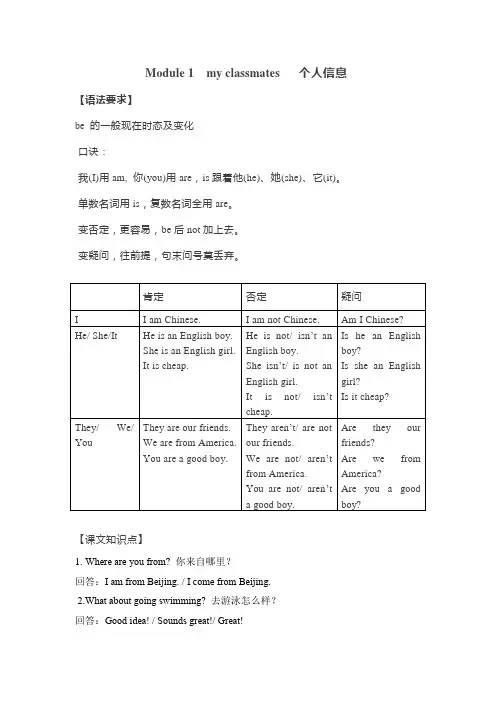
Module 1 my classmates 个人信息【语法要求】be 的一般现在时态及变化口诀:我(I)用am, 你(you)用are,is跟着他(he)、她(she)、它(it)。
单数名词用is,复数名词全用are。
变否定,更容易,be后not加上去。
变疑问,往前提,句末问号莫丢弃。
肯定否定疑问I I am Chinese. I am not Chinese. Am I Chinese?He/ She/It He is an English boy.She is an English girl.It is cheap. He is not/ isn’t anEnglish boy.She isn’t/ is not anEnglish girl.It is not/ isn’tcheap.Is he an Englishboy?Is she an Englishgirl?Is it cheap?They/ We/ You They are our friends.We are from America.You are a good boy.They aren’t/ are notour friends.We are not/ aren’tfrom America.You are not/ aren’ta good boy.Are they ourfriends?Are we fromAmerica?Are you a goodboy?【课文知识点】1.Where are you from? 你来自哪里?回答:I am from Beijing. / I come from Beijing.2.What about going swimming? 去游泳怎么样?回答:Good idea! / Sounds great!/ Great!用法:what about= How about, about 是介词,后接动词ing.例:What about ___ (listen)to music?3.Everyone is here. 每个人都在这里。
Modules1-2知识点总结 外研版英语七年级上册
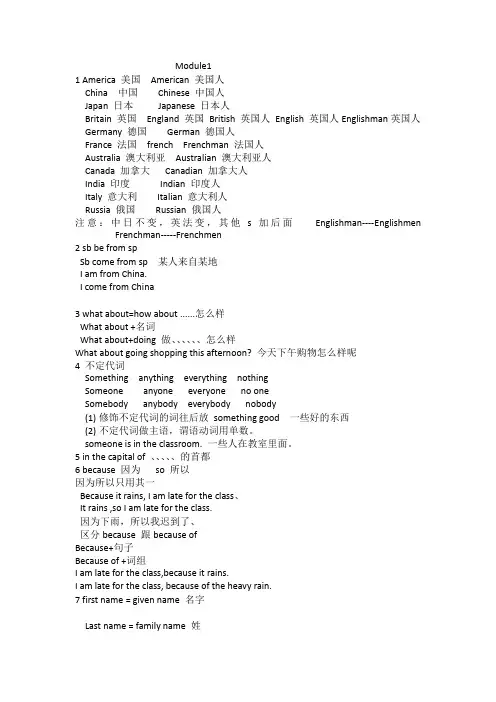
Module11 America 美国American 美国人China 中国Chinese 中国人Japan 日本Japanese 日本人Britain 英国England 英国British 英国人English 英国人Englishman英国人Germany 德国German 德国人France 法国french Frenchman 法国人Australia 澳大利亚Australian 澳大利亚人Canada 加拿大Canadian 加拿大人India 印度Indian 印度人Italy 意大利Italian 意大利人Russia 俄国Russian 俄国人注意:中日不变,英法变,其他s加后面Englishman----Englishmen Frenchman-----Frenchmen2 sb be from spSb come from sp 某人来自某地I am from China.I come from China3 what about=how about ......怎么样What about +名词What about+doing 做、、、、、、怎么样What about going shopping this afternoon? 今天下午购物怎么样呢4 不定代词Something anything everything nothingSomeone anyone everyone no oneSomebody anybody everybody nobody(1)修饰不定代词的词往后放something good 一些好的东西(2)不定代词做主语,谓语动词用单数。
someone is in the classroom. 一些人在教室里面。
5 in the capital of 、、、、、的首都6 because 因为so 所以因为所以只用其一Because it rains, I am late for the class、It rains ,so I am late for the class.因为下雨,所以我迟到了、区分because 跟because ofBecause+句子Because of +词组I am late for the class,because it rains.I am late for the class, because of the heavy rain.7 first name = given name 名字Last name = family name 姓9 Class One, Grade Seven 七年级一班(注意:首字母都要大写)10 history 历史不可数Have a long history 有一个悠久的历史Module21 in the front of 在内部的前面The blackboard is in the front of the classroom. 黑板在教室的前面、In front of 在整体的前面The car is in the front of the house.车在屋子的前面。
外研版英语七年级上册模块知识点归纳
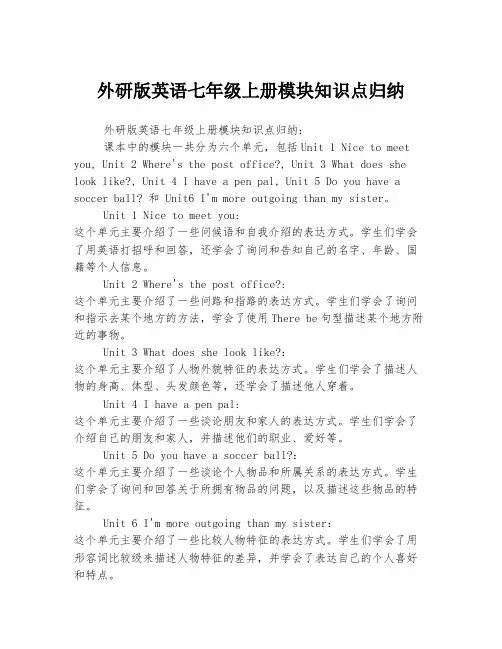
外研版英语七年级上册模块知识点归纳外研版英语七年级上册模块知识点归纳:课本中的模块一共分为六个单元,包括Unit 1 Nice to meet you, Unit 2 Where's the post office?, Unit 3 What does she look like?, Unit 4 I have a pen pal, Unit 5 Do you have a soccer ball? 和 Unit6 I'm more outgoing than my sister。
Unit 1 Nice to meet you:这个单元主要介绍了一些问候语和自我介绍的表达方式。
学生们学会了用英语打招呼和回答,还学会了询问和告知自己的名字、年龄、国籍等个人信息。
Unit 2 Where's the post office?:这个单元主要介绍了一些问路和指路的表达方式。
学生们学会了询问和指示去某个地方的方法,学会了使用There be句型描述某个地方附近的事物。
Unit 3 What does she look like?:这个单元主要介绍了人物外貌特征的表达方式。
学生们学会了描述人物的身高、体型、头发颜色等,还学会了描述他人穿着。
Unit 4 I have a pen pal:这个单元主要介绍了一些谈论朋友和家人的表达方式。
学生们学会了介绍自己的朋友和家人,并描述他们的职业、爱好等。
Unit 5 Do you have a soccer ball?:这个单元主要介绍了一些谈论个人物品和所属关系的表达方式。
学生们学会了询问和回答关于所拥有物品的问题,以及描述这些物品的特征。
Unit 6 I'm more outgoing than my sister:这个单元主要介绍了一些比较人物特征的表达方式。
学生们学会了用形容词比较级来描述人物特征的差异,并学会了表达自己的个人喜好和特点。
初中英语 外研社七年级初一上册Module1至Module5知识点

M 1 classmatesUni t 11.Chinese 中国的,中国人的,中国人,汉语其中Chinese指“中国人”时,单复数同形。
We are Chinese.She is a Chinese.国家语言某国人某国人的复数形式China Chinese Chinese ChineseJapan Japanese Japanese JapaneseEngland English Englishman EnglishmenFrance French Frenchman FrenchmenAmerica English American AmericansCanada English Canadian CanadiansRussia Russian Russian Russians Australia English Australian Australians Germany German German Germans2.MS 女士Ms 女士,用来称呼不了解婚姻状况的女性。
Miss 小姐、女士,用来称呼未婚女性。
Mrs 夫人、太太,用来称呼已婚女性。
Mr 先生,用来称呼男性,无论年龄大小结婚与否。
3.our 我们的。
形容词性物主代词。
物主代词:人称单数复数第一人称My我的Our我们的第二人称Your你的Your你们的第三人称His他的Their他们的Her她的Its它的4.Where + be + 主语 + from? “XX来自哪里?”或者“XX是哪里人?”对地点进行提问使用特殊疑问词“where”主语 + be from +地点“XX从哪里来,来自于…..”be from = come fromWe are from China=We come from China.5.How old are you ? How old + be + 主语?“XX多大?”其中,be动词要与主语一致。
6.What abour….?”……怎么样?”7.Welcome to + 地点名词“欢迎来到……”若welcome后跟here there home 等地点副词的时候,去掉to,变为“welcome here! 欢迎来到这里!”Unite 21.everyone 做主语的时候,谓语动词为第三人称单数形式。
中考英语外研版知识点分册总复习七年级(上) Modules 1-4
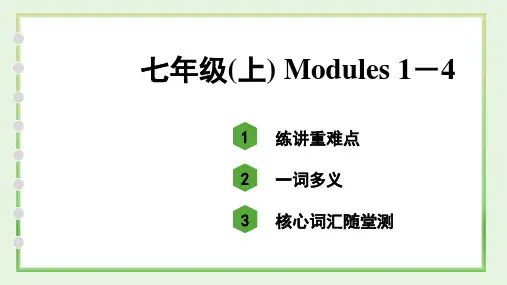
用法
例句
用于“两者之间”,常 Li Lei sits between J im and
用于“between... and...” Tom.李雷坐在吉姆和汤姆中
中
间。
He is the tallest among the 用于三者或三者以上的 five boys.他是五个男孩中最
人或事物之中
15.There is a big supermarket ____A____ the bank and the
bookstore.
A. between
B. beside
C. among
D. behind
16.Damon is the only foreigner _a_m__o_n_g__(在……中)those boys. You can find him easily. 17.We have three classes in the afternoon and we take a break _b_e_tw__e_e_n_(在……之间) them.
太多的肉不健康。[七 后跟不可数名词。
(上)Module 4 P23]
中心词是 many。 Ther e ar e too many people
后跟可数名词复 on the bus. 公交车上有太多
数。
人了。
词组 much too
含义
用法
例句
中心词是 too。后
I'm afr aid that this cap is
B. too many
C. much too
D. so many
19.The sweater is very beautiful, but it's ____C____ expensive and I
【名师面对面】2015中考英语总复习 第1讲 七年级上册 Modules 1-5课件 外研版

第1讲
七年级上册 Modules 1~5
1.China (n.) Chinese (n.&adj.)中国人(的) 2.American (n.&adj.) America (n.)美国 3.England (n.) English (n.&adj.)英语;英国的 4.our (pron.) hour (同音词)小时 5.city (n.) cities (复数形式)城市 6.one (num.) first (序数词)第一 7.all (pron.) none (反义词)一个也没有 8.photo (n.) photos (复数形式)照片 9.these (pron.) this (单数形式)这 those (反义词)那些 10.left (n.&adj.) right (反义词)右
类似的名词还有:exercise(“练习”为可数名词;“操 ”要用复数形式;“锻炼”为不可数名词);fish(“鱼, 鱼肉”为不可数名词;强调“鱼的种类”则为可数名词) ;orange(“橘子”为可数名词;“橘子汁”则为不可数名 词);glass(“玻璃杯”为可数名词;“眼镜”则用复数形 式glasses;“玻璃”则为不可数名词)等。 【活学活用】 (9)We all like chickens(chicken/chickens),because they look very lovely. (10)I like to drink ____ C better. A.an orange B.oranges C.orange D.the oranges
3.family 【典例在线】 This is a photo of Tony‘s family.这是托尼一家 His family all like reading.他的家人都喜欢读书。 【拓展精析】 family当“家,家庭”用时,是可数名词。其复数形式 为families;当“家人”用时,是个集合名词,无复数形式 ,作主语时,谓语动词要用复数形式。 类似的集合名词还有people,class,police等。 【活学活用】 (5)How many people are there in your family (家庭)? (2014,铜仁) (6)Look!Her family are (am/is/are) watching the football match on TV.
七年级上外研社版英语一到五单元语法知识点
七年级上外研社版英语一到五单元语法知识点一、名词1. 名词的分类名词可以分为可数名词和不可数名词两大类。
可数名词可以用来表示可以数清的事物或东西,比如book、student等。
不可数名词则表示不可以数清的事物或东西,比如water、rice等。
2. 可数名词复数形式的变化可数名词的复数形式有三种变化规则:一般在词尾加-s,如books;以s,sh,ch,x,o结尾的名词在词尾加-es,如buses,watches;以辅音字母+y结尾的名词,变y为i再加-es,如cities。
3. 不可数名词的使用不可数名词表示不能数清的事物,通常用作集体名词,表示一类事物,比如food、music等。
二、动词1. 动词的时态英语中的动词有多种不同的时态,例如现在时、过去时、将来时等。
学生需要掌握各种时态的构成和用法,如一般现在时用于表示现在或经常发生的动作,一般过去时用于表示过去发生的动作等。
2. 动词的否定形式英语中的动词否定形式通常在动词前加not构成,例如I am not happy。
3. 动词的被动语态动词的被动语态表示动作的承受者是谁,被动语态的构成是由“be + 过去分词”构成,如The book is read by me.三、形容词与副词1. 形容词的比较级与最高级形容词的比较级和最高级构成规则较多,主要包括一般形容词和部分双音节形容词的比较级在词尾加-er,最高级在词尾加-est;以不规则变化的形容词则需特殊学习,如good-better-best。
2. 副词的用法副词主要用来修饰动词、形容词或其他副词,表示程度、时间、地点或方式等。
学生需要掌握副词的用法和位置,如修饰动词时通常位于动词之前,修饰形容词或副词时通常位于其后。
四、介词1. 介词的用法介词用来表示名词或代词与其他词之间的关系,如位置、方向、时间、原因等。
学生需要掌握各种介词的用法,如in表示在……之内,on表示在……之上等。
2. 介词短语的用法介词短语是构成形式固定的词组,由介词和名词、代词或动名词构成。
【教育资料】【梳理】安徽中考·英语 第一部分·第一讲·七年级(上) Modules1—4(含Starter)学习专用
1)—Let's get some fruit.
教育资源
发胖
教育资源
—What kind of fruit?Apples? 2)—How about some orange juice?
—Yes, good idea. 3)—Cola is bad for you! How about some tea?
v. 写
22.
n. 饮料 v.喝
→
(过去式)
23.
v. 得到;变成;成为
→
(过去分词)
→
(过去式)
7.h
v. 帮助
→
(过去分词)
→
adj. 有用的;有帮助的
24.
adj./pron. 许多(的);很多
8.k
v. 知道;懂得
→
(比较级) 更多的;更加
→
(过去式)
→
(最高级) 最多的;最多
→
(过去分词)
—Oh, too bad!
1.be 动词
4.可数名词与不可数名词
语法回顾 2.指示代词(this, that, these, those) 3.there be 句型
5.have got 6.some 与 any
【参考答案】
【重点单词】
1.between 2.friend; friendly 3.meet 4.see; saw; seen
25.
adj. 坏的;不好的
9.
v.说;讲
→
(比较级) 更坏的;更糟的
教育资源
教育资源
→
(过去式/过去分词)
→
(最高级) 最坏的;最差26.
n. 健康
11.
2015外研版英语七年级上册Modules 1-5知识点总结
2015外研版英语七年级上册Modules 1-5知识点总结Module1一.重点短语1.be from... =come from...来自......2....years old ......岁3.what about... =how about... ......怎么样?4.in Class Ten,Grade Seven在七年级十班5.the capital of... ...... 的首都/省会6.first name =given name名st name=family name姓8.English name英文名字9.Chinese name中文名字二.重点句子1.I’m Chinese,and I’m from China . = I’m Chinese,and I come from China . 我是中国人,我来自中国2. Where are they from? =Wheredo they come from? 他们来自什么哪里?They are from America. =Theycome from America . 他们来自美国.3.How old is that man? 那位男子多少岁了?He is forty-three. 他43岁4. The students are in Class Five,Grade Seven. 这些学生在七年级五班5. Tom is in Class One with Lingling. =Tom with Lingling is in ClassOne.=Tom and Lingling are in Class One. 汤姆和玲玲在一班。
6.What about you?=How about you?=And you? 你呢?/你怎么样?7.Welcome to Class6Grade7 ! 欢迎到七年级六班。
8. Beijing is the capital of China. 北京是中国的首都。
2015-2016新外研版初中英语七年级英语上册全套知识点整理【期末总复习必背】
2015-2016新外研版初中英语七年级英语上册全套知识点整理【期末总复习必背】2015-2016 XXX High School English Grade Seven Volume One Knowledge Points Review【Final Exam Must-Know】Module 1Key Phrases1.be from。
= come from。
- come from。
2.years old。
-。
years old。
3.what about。
= how about。
- how about。
4.in Class Ten。
Grade Seven - in Class Ten。
Grade Seven5.the capital of。
- the capital/provincial capital of。
6.first name = given name - first namest name = family name - last name8.English name - English name9.Chinese name - Chinese nameKey XXX1.I'm Chinese。
and I'm from China。
- I am Chinese and I come from China.2.Where are they from。
- Where do they come from?They are from America。
- They come from America.3.How old is that man。
- How old is that man?He is forty-four。
- He is 44 years old.4.The students are in Class Five。
Grade Seven。
- These students are in Class Five。