
《新起点英语》(五年级下册)-知识总结-
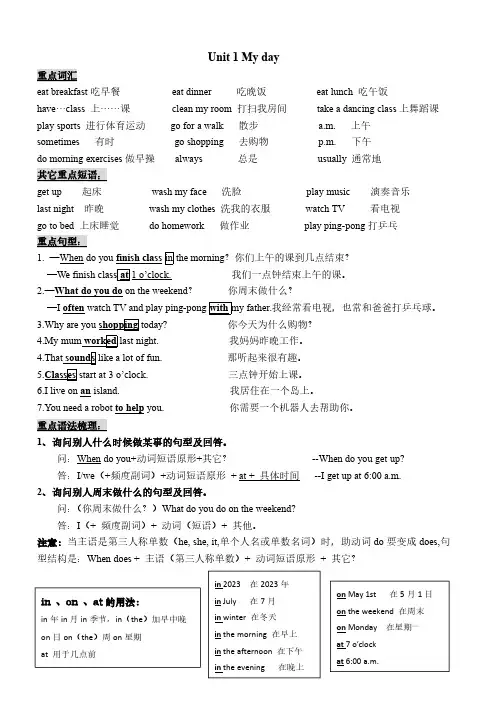
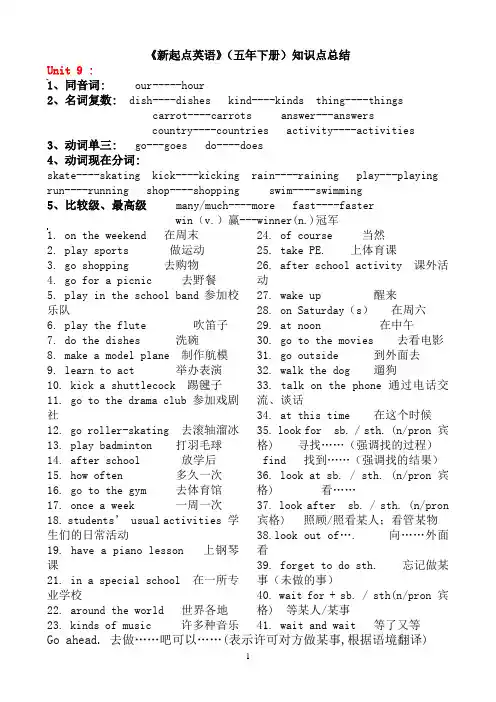
《新起点英语》(五年级下册)-知识总结-《新起点英语》(五年下册)知识点总结Unit 9 :1、同音词: our-----hour2、名词复数: dish----dishes kind----kinds thing----thingscarrot----carrots answer---answerscountry----countries activity----activities3、动词单三: go---goes do----does4、动词现在分词:skate----skating kick----kicking rain----raining play---playing run----running shop----shopping swim----swimming5、比较级、最高级 many/much----more fast----fasterwin(v.)赢---winner(n.)冠军1. on the weekend 在周末2. play sports 做运动3. go shopping 去购物4. go for a picnic 去野餐5. play in the school band参加校乐队6. play the flute 吹笛子7. do the dishes 洗碗8. make a model plane 制作航模9. learn to act 举办表演10. kick a shuttlecock 踢毽子11. go to the drama club 参加戏剧社12. go roller-skating 去滚轴溜冰13. play badminton 打羽毛球14. after school 放学后15. how often 多久一次16. go to the gym 去体育馆17. once a week 一周一次18. students’ usual activities 学生们的日常活动19. have a piano lesson 上钢琴课21. in a special school 在一所专业学校22. around the world 世界各地23. kinds of music 许多种音乐24. of course 当然25. take PE. 上体育课26. after school activity 课外活动27. wake up 醒来28. on Saturday(s)在周六29. at noon 在中午30. go to the movies 去看电影31. go outside 到外面去32. walk the dog 遛狗33. talk on the phone 通过电话交流、谈话34. at this time 在这个时候35. look for sb. / sth. (n/pron 宾格) 寻找……(强调找的过程)find 找到……(强调找的结果)36. look at sb. / sth. (n/pron 宾格) 看……37. look after sb. / sth. (n/pron 宾格) 照顾/照看某人;看管某物38.look out of…. 向……外面看39. forget to do sth. 忘记做某事(未做的事)40. wait for + sb. / sth(n/pron 宾格) 等某人/某事41. wait and wait 等了又等Go ahead. 去做……吧可以……(表示许可对方做某事,根据语境翻译)May I draw a picture here? Go ahead.(去画吧。
)Can I watch TV now? Sure, go ahead.(当然可以,去看吧。
) 句型:What do you do after school?I often do sth....How often do you go there?I do sth once/twice a.... How often does she/he…?She / He does sth....语法1、对含有频率词提问用“how often...?”e.g. I go shopping four times a week?(就划线部分提问)How often do you go shopping?2、乐器前有“the ” ,球类前没有“the ”e.g. play the piano play soccer3、动词现在分词的构成①一般情况下在动词末尾直接加“ing”finish---finishing go----going②动词以不发音“e”结尾,去“e”加“ing”live----living come----coming③在重读闭音节中,以辅音字母结尾,辅音字母前是一个元音字母,双写辅音字母,再加“ing”cut----cutting swim----swimmingUnit 10 :1、set the table 摆放餐具2、clean the living room 打扫客厅3、take out the garbage 倒垃圾4、sweep the floor 扫地5、make the bed 铺床6、clear the table 收拾桌子7、have to 不得不8、a lot of+ c(pl)/u 许多eg: a lot of books 许多书a lot of water 许多水9、do chores 做家务10、look after sb./sth.(宾格) 照看,照顾, 看管eg: look after my sister look after the dog look after her 11. finish the art project 完成手工制作12、practice the piano练习弹钢琴13、study for a test 复习准备考试14、the day after tomorrow 后天15、go ahead 去做……吧!可以……!16、what about+sb./sth./doing sth. ……怎么样?how about+sb./sth./doing sth. ……怎么样?eg: What about you?What about this cap?What about watching TV?17、go swimming 游泳18、watch TV 看电视21、go home 回家23、thank you for 为……而感谢24、go shopping 购物25、go to the library 去图书馆26、listen to music 听音乐27、go to the park 去公园28、It’s time to do sth. 是该做某事的时间了。
It’s time for sth. 到……的时间了。
29、next time下次30、play football 踢足球交际用语:1. go ahead. 去做……吧,可以……(表示许可,允许对方做某事。
根据语境翻译)eg: May I draw a picture here? Go ahead.(去画吧)Can I watch TV now? Sure, go ahead. (当然可以,去看吧)2. Can I go to the movies?Sure, you can. But first you have to finish your project.Sorry, you can’t. You have to practice the violin.句型一:谈论某人必须(不得不)做某事肯定句:主语+ have/ has to do sth.Eg. I have to do sth.否定句: 主语+ don’t have to do sth.Eg. 1. I don’t have to clean the room.2. My mother doesn’t have to go shopping.一般疑问句及答语:Do / Does +主语+have to do sth?Yes, +主语do/does. No, +主语+don’t./ doesn’t.Eg. 1. Do you have to do your homework?Yes, I do. / No, I don’t.2. Does Tom have to do chores every day?Yes, he does. / No, he doesn’t.特殊疑问句: 特殊疑问词 + do / does +主语+ have to do sth?Eg. 1. What chores do you have to do?2. What do you have to do in your spare time?句型二:be going to +动词原形(将来时)eg:肯定句:It is going to be sunny tomorrow.否定句:It isn’t going to be sunny tomorrow.一般疑问句及答语:Is it going to be sunny tomorrow?Yes, it is. / No,it isn’t特殊疑问句:What’s the weather going to be like tomorrow?= How is the weather going to be tomorrow?测试题:It is going to be sunny tomorrow. (写出同意句)—It will be sunny tomorrow.语法:1、在具体某一天的前面用oneg: on Monday 在星期一2、单词以元音开头时,前面冠词用aneg: an e-mail 一封电子邮件 an ear 一只耳朵 an eye 一只眼睛 an elephant 一头大象 an office 一间办公室 an hour 一小时Unit 11 :1. get plenty of sleep保持充足睡眠2. wash your hands before eating吃饭前洗手3. drink milk every day 每天喝牛奶4. clean the desk 擦桌子5. leave garbage everywhere 到处扔垃圾6. drink too much pop 喝太多汽水7. stay up late 熬夜8. eat too much chocolate 吃太多巧克力9. eat too much meat 吃太多肉10. role play 角色表演11. keep fit 保持健康13. tell sb (n/pron宾格)something about doing sth 告诉谋人关于做某事的事吃太多汉堡包太多的牛奶17. have a headache 头痛18. have a running nose 流鼻涕19. have a cold 患了感冒20. have a stomachache 胃疼21. have a toothache 牙痛22. go to bed上床睡觉23. go to see a doctor看医生24. wear a sweater穿着毛衣25.drink more water/milk喝更多水/牛奶26. brush your teeth(27. take some medicine U28. right after29. feel tired感觉累30. feel sleepy感觉困31. get good marks得好的分数32. be good at + sth. (n/pron宾格)/ doing sth.擅长某事/做某事33. have a problem有个问题34. have advice for sb. (n/pron 宾格)有些建议給某人35. do morning exercises做早操36. try these things试着做这些事37. feel better感觉好38. look like看起来像39. want to be 想成为40. healthy habits健康习惯41. school rules 学校规章42. home chores 家务43. wonderful food 很棒的食物44. need to do 需要做45. kinds of food许多种食物46. the bottom of the pyramid金字塔底部47. the top of the pyramid 金字塔顶部48. a little+ U 少许、一点……(强调少而有)a little sugar/ fat 一点盐/脂肪49. junk food 垃圾食品50. be bad for…(n/pron宾格) 对……有害be bad for health对健康有害51. plenty of+pl)大量的……许多的……plenty of fruit and vegetables 许多的水果和蔬菜52. walk by the sea 在海边散步53 wish(es) for…希望……54. come out 出来55. a big dinner 大餐56. good health 好的健康状况57. good habits 好的习惯58. bad habits 坏的习惯59. keep clean 保持干净60. before doing sth. 在做某事之前before eating 吃饭前61. a grade-five student 一名五年级的学生62.talk about sb./sth/doing sth. (n/pron宾格) 谈论某人/某事/做某事63. agree with sb. (n/pron宾格) 同意某人的意见交际用语:1. What’s wrong? 你怎么了2. I have a cold/ headache/ toothache/ stomachache 我感冒/头痛/牙痛/胃痛。
北师大版新起点英语五年级下册重点复习

本册1-4单元重点知识点:
1.Unit 1描述人物外貌、性格的词汇;形容词物主代词;复习:名词
性物主代词;人称代词主格和宾格;颜色;身体部位的词汇;形容人 和物的形容词;有关爱好的词汇;学科的词汇。
2.Unit 2形容词、副词形容词;动词;学习用具;方位介词; 动物;植物;颜色;数字;学科的词汇。
Shanghai China
Beijing
Eiffel Tower 321
Paris
France
Country Russia Canada China Australia
Area(k㎡) 17,000,000 9,900,000 9,600,000 7,600,000
1、1月中旬考英语。
2、考试范围:1-5年级上册。
them 他们的their theirs
11.Read and fill in the blanks. (依照表格内容填空。)
Name
Bob
Liu Fang
Isuzu
Country
America
China
Japan
Hobby
collecting stamps
playing the piano
playing hockey
Unit 5 Shopping 1.Can I help you? 你要买点儿什么? Yes. I want a pair of running shoes. 2.What can I do for you? 你要买点儿 什么?
Yes. I want a bottle of whiteout. 3.How much is it? It’s four yuan. 4.How much are they? They’re 20 yuan. 5.It’s a good deal. I’ll take it. 6.It’s a good deal. I’ll buy them. 7.How much is it altogether? It’s 45 yuan. 8.Try it on./ Try them on.请试穿。
人教新起点英语五年级下册(五下)知识点
2.询问某人生日日期的问句及回答:—When is+形物代/名词所有格+birthday?—It's on+几月几日./形物代/名词所有格+birthday+is on+几月几日.例:—When is your birthday?你的生日是什么时候?—My birthday is on April4th.我的生日是4月4日。
3.①基数词用来表示人或物的数量,后面常跟复数名词(one除外):I have two pencils.我有两支铅笔。
②序数词用来表示顺序先后:Our classroom is on the second floor.我们的教室在二楼4.基数词变序数词的变化规则:(1)一般情况,在基数词后直接+th。
seven-seventh;thirteen-thirteenth;four-fourth(2)一、二、三,特殊记one-first;two-second;three-third(3)九去e,ve要用f替nine-ninth;five-fifth;twelve-twelfth(4)以-ty结尾时,边y为i再加-th。
twenty-twentieth;thirty-thirtieth(3)表示几十几,变个位即可。
twenty-two→twenty-second;thirty-five→thirty-fifthUnit5Whose dog is it?重点词汇:her她的playing(正在)玩耍yours你(们)的his他的jumping(正在)跳theirs他/她/她们的mine我的eating(正在)吃excited兴奋的;激动的ours我们的climbing(正在)攀爬like像.....那样its它的drinking(正在)喝sleeping(正在)睡觉重点短语:a beautiful painting一幅美丽的画look at看in the kitchen在厨房a picture of Shanghai一幅上海的图each other相互listen to music听音乐take him to the park把他带到公园come here过来play with him和他一起玩耍swim like a fish像鱼一样游泳of course当然run so fast跑得这么快dance like a bear像熊一样跳舞take pictures拍照so cute这么可爱run like a tiger像老虎一样跑drink water喝水walk like an elephant像大象一样走路重点句型1.The yellow picture is mine.这幅黄颜色的画是我的。
人教版新起点五年级英语下册知识汇总
人教版新起点五年级英语下册知识汇总人教版新起点五年级英语下册知识汇总编辑整理:尊敬的读者朋友们:这里是精品文档编辑中心,本文档内容是由我和我的同事精心编辑整理后发布的,发布之前我们对文中内容进行仔细校对,但是难免会有疏漏的地方,但是任然希望(人教版新起点五年级英语下册知识汇总)的内容能够给您的工作和学习带来便利。
同时也真诚的希望收到您的建议和反馈,这将是我们进步的源泉,前进的动力。
本文可编辑可修改,如果觉得对您有帮助请收藏以便随时查阅,最后祝您生活愉快业绩进步,以下为人教版新起点五年级英语下册知识汇总的全部内容。
人教版新起点五年级英语下册知识汇总人教版新起点五年级英语(下册)知识要点汇总,预习必备Unit 1 Keep Healthy一、单元词汇(小朋友,千里之行,始于单词哦!)too much 太多 candy 糖果go to bed 去睡;就寝 early 早exercise 锻炼 tired 困倦的;疲倦的drink 喝;饮 before 在。
...。
之前dirty 肮脏的 always 总是stomachache 胃疼 headache 头疼toothache 牙痛 a lot of 大量;许多sleepy 困的;欲睡的 subject 学科mark 分数 advice 建议 more 更多的二、单元句型(小朋友,学会了这些句子,会变得更加优秀哦!)1。
A:What’s wrong? 怎么了?B: I’ve got a stomachache。
我肚子疼。
2。
A: I often have stomachaches. What should I do?我经常肚子疼。
我应该怎么办?B: You should drink some water. 你应该喝些水.3. Here you are。
给你.4。
A: Do you eat a lot of candy?你吃了很多糖吗?B: Yes, I eat some after every class。
《新起点英语》(五年级下册)语言知识

《新起点英语》(五年下册)语言知识梳理Unit 9语言知识:1. on the weekend 在周末2. play sports 做运动3. go shopping 去购物4. go for a picnic 去野餐5. play in the school band参加校乐队6. play the flute 吹笛子7. do the dishes 洗碗8. make a model plane 制作航模9. learn to act 学表演10. kick a shuttlecock 踢毽子11. go to the drama club 参加戏剧社12. go roller-skating 去滚轴溜冰13. play badminton 打羽毛球14. after school 放学后15. how often 多久一次16. go to the gym 去体育馆17. once a week 一周一次句型:What do you do after school?I often do sth....How often do you do sth?I do sth once/twice a.... How often does she/he…?She / He does sth....语法1、对含有频率词提问用“ho w often...?”e.g. I go shopping four times a week?(就划线部分提问)How often do you go shopping?2、乐器前有“the ” ,球类前没有“the ”e.g. play the piano play soccerUnit 10语言知识:1、set the table 摆放餐具2、clean the living room 打扫客厅3、take out the garbage 倒垃圾4、sweep the floor 扫地5、make the bed 铺床6、clear the table 收拾桌子7、have to 不得不8、a lot of+ c(pl)/u 许多eg: a lot of books 许多书a lot of water 许多水9、do chores 做家务10、look after sb./sth.(宾格) 照看,照顾, 看管eg: look after my sisterlook after the dog look after her 11. finish the art project 完成手工制作12、practice the piano练习弹钢琴13、study for a test 复习准备考试14、the day after tomorrow 后天15、go ahead 去做……吧!可以……!16、go swimming 游泳17、watch TV 看电视18、go home 回家19、go shopping 购物20、go to the library 去图书馆21、listen to music 听音乐22、go to the park 去公园交际用语:1. go ahead. 去做……吧,可以……(表示许可,允许对方做某事。
《新起点英语》(五年级下册)_知识总结_
《新起点英语》(五年下册)知识点总结Unit 9 :1、同音词: our-----hour2、名词复数: dish----dishes kind----kinds thing----thingscarrot----carrots answer---answerscountry----countries activity----activities3、动词单三: go---goes do----does4、动词现在分词:skate----skating kick----kicking rain----raining play---playing run----running shop----shopping swim----swimming5、比较级、最高级 many/much----more fast----fasterwin(v.)赢---winner(n.)冠军1. on the weekend 在周末2. play sports 做运动3. go shopping 去购物4. go for a picnic 去野餐5. play in the school band参加校乐队6. play the flute 吹笛子7. do the dishes 洗碗8. make a model plane 制作航模9. learn to act 举办表演10. kick a shuttlecock 踢毽子11. go to the drama club 参加戏剧社12. go roller-skating 去滚轴溜冰13. play badminton 打羽毛球14. after school 放学后15. how often 多久一次16. go to the gym 去体育馆17. once a week 一周一次18. students’ usual activities 学生们的日常活动19. have a piano lesson 上钢琴课21. in a special school 在一所专业学校22. around the world 世界各地23. kinds of music 许多种音乐24. of course 当然25. take PE. 上体育课26. after school activity 课外活动27. wake up 醒来28. on Saturday(s)在周六29. at noon 在中午30. go to the movies 去看电影31. go outside 到外面去32. walk the dog 遛狗33. talk on the phone 通过电话交流、谈话34. at this time 在这个时候35. look for sb. / sth. (n/pron 宾格) 寻找……(强调找的过程)find 找到……(强调找的结果)36. look at sb. / sth. (n/pron 宾格) 看……37. look after sb. / sth. (n/pron 宾格) 照顾/照看某人;看管某物38.look out of…. 向……外面看39. forget to do sth. 忘记做某事(未做的事)40. wait for + sb. / sth(n/pron 宾格) 等某人/某事41. wait and wait 等了又等Go ahead. 去做……吧可以……(表示许可对方做某事,根据语境翻译)May I draw a picture here? Go ahead.(去画吧。
新起点五年级英语下知识梳理
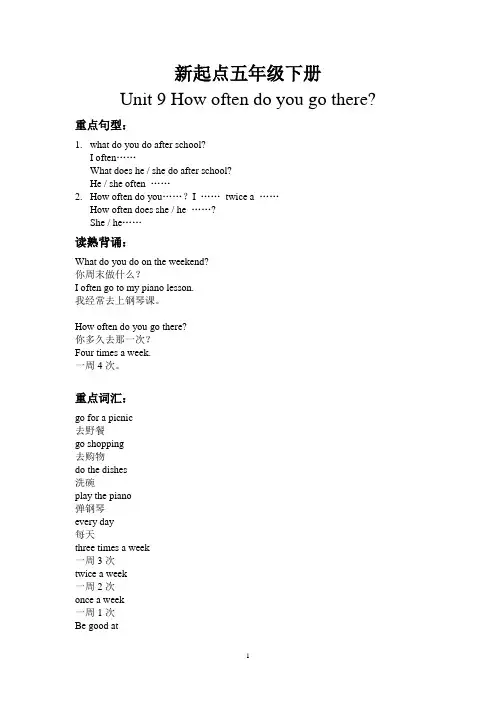
新起点五年级下册Unit 9 How often do you go there? 重点句型:1.what do you do after school?I often……What does he / she do after school?He / she often ……2.How often do you……?I ……twice a ……How often does she / he ……?She / he……读熟背诵:What do you do on the weekend?你周末做什么?I often go to my piano lesson.我经常去上钢琴课。
How often do you go there?你多久去那一次?Four times a week.一周4次。
重点词汇:go for a picnic去野餐go shopping去购物do the dishes洗碗play the piano弹钢琴every day每天three times a week一周3次twice a week一周2次once a week一周1次Be good at擅长做Unit 10 Doing things重点句型:1.What do you have to do in your spare time? I have to ……2.Can I go to the movies? Sure, you can. But first you have to finish your project. /Sorry, you can’t. Y ou have to practice the violin.读熟背诵:What chores do you have to do at home?你在家必须做哪些家务?I have to do the dishes, sweep the floor, take out the garbage and make my bed.我必须洗碗,擦地,倒垃圾还有铺床。
人教新起点英语五年级下册Unit 1 Keep Healthy知识点汇总
人教新起点英语五年级下册Unit 1 Keep Healthy知识点汇总Unit 1 Keep Healthy(保持健康)一、单元词汇too much 太多candy 糖果go to bed 去睡;就寝early 早exercise 锻炼tired 困倦的;疲倦的drink 喝;饮before 在......之前dirty 肮脏的always 总是stomachache 胃疼headache 头疼toothache 牙痛a lot of 大量;许多sleepy 困的;欲睡的subject 学科mark 分数advice 建议more 更多的二、单元句型1. A: What s wrong? 怎么了?B: I ve got a stomachache. 我肚子疼。
2. A: I often have stomachaches. What should I do?我经常肚子疼。
我应该怎么办?B: You should drink some water. 你应该喝些水。
3. Here you are. 给你。
4. A: Do you eat a lot of candy? 你吃了很多糖吗?B: Yes, I eat some after every class. 是的,我每节课后都吃很多。
5. You shouldn t eat too much candy. 你不该吃太多糖。
6. A: Do you wash your hands before eating? 你饭前洗手了吗?B: Not always. 不总洗。
7. You shouldn t eat with dirty hands. 你不该用脏手吃饭。
8. You should always wash your hands before eating.你应该坚持饭前洗手。
9. I always feel tired and sleepy. 我总觉得很累很困。
人教新起点英语五年级下册第4单元知识总结汇总
Unit 4 Last Weekend 知识总结一、单元词汇Cleaned the window (过去式)擦窗子watched TV (过去式)看电视climbed a hill (过去式)爬山visited grandparents(过去式)看望祖父母danced(dance的过去式)跳舞jumped rope(过去式)跳绳listened to music(过去式)听音乐rowed a boat(过去式)划船played computer games(过去式)玩电子游戏stayed at home(过去式)呆在家里played the piano(过去式)弹钢琴played chess(过去式)下棋washed clothes (过去式)洗衣服boring 乏味的badminton 羽毛球won (win的过去式)赢;获胜二、单元句型1. A: What did you do last weekend? 你上周末做了什么?B: I visited my grandparents. 我去拜访了祖父母。
2. A: How was your weekend? 你周末过得怎么样?B: It was wonderful. 很棒。
3. A: What did you do last weekend? 你上周末做什么了?B: I watched a football match with my friends, and then we played football together. 我和朋友看了足球赛,然后一起踢足球了。
B: On Sunday, I played the violin in a music club. 周日,我在音乐社拉小提琴了。
A: That really sounds fun. 听起来很有趣。
4. A: How was your weekend? 你的周末怎么样?B: It was great on Saturday. 周六很棒。
小学英语-人教新起点-五下单词及句型总结
人教新起点五下单词及句型总结
candy early exercise tired drink(drank, drunk) before dirty always should do sth shouldn't do sth too much go to bed shouldn't do sth should do sth shouldn't do sth should do sth toothache stomachache(stomach ache) headache a lot of sleepy subject mark advice more birthday fifth tenth twelfth twenty-fifth plant When is ...? What do/does ... do? It's on January 1st/... New Year's Day Tree Planting Day(Tree-planting Day, the Tree Planting Day) Mother's Day Children's Day Father's Day Teachers' Day National Day Christmas Day(Christmas) What do/does ... do? It's on January 1st/... sb often/usually/sometimes/always ... do/does … celebrate be going to do sth How is/are going to ...? make a poster have a picnic office together special What do/does ... want to ...? want to do sth send an e-mail(send e-mails) write a letter(write letters)
新起点五年级英语下册知识汇总
人教版新起点五年级英语下册知识要点汇总,预习必备Unit 1 Keep Healthy一、单元词汇小朋友,千里之行,始于单词哦too much 太多 candy 糖果go to bed 去睡;就寝 early 早exercise 锻炼 tired 困倦的;疲倦的drink 喝;饮 before 在......之前dirty 肮脏的 always 总是stomachache 胃疼 headache 头疼toothache 牙痛 a lot of 大量;许多sleepy 困的;欲睡的 subject 学科mark 分数 advice 建议 more 更多的二、单元句型小朋友,学会了这些句子,会变得更加优秀哦1. A: What's wrong 怎么了B: I've got a stomachache. 我肚子疼;2. A: I often have stomachaches. What should I do我经常肚子疼;我应该怎么办B: You should drink some water. 你应该喝些水;3. Here you are. 给你;4. A: Do you eat a lot of candy 你吃了很多糖吗B: Yes, I eat some after every class. 是的,我每节课后都吃很多;5. You shouldn't eat too much candy. 你不该吃太多糖;6. A: Do you wash your hands before eating 你饭前洗手了吗B: Not always. 不总洗;7. You shouldn't eat with dirty hands. 你不该用脏手吃饭;8. You should always wash your hands before eating.你应该坚持饭前洗手;9. I always feel tired and sleepy. 我总觉得很累很困;10. I have some advice for you. 我给你一些建议;11. Try these things. I think you'll soon feel better. 尝试这些;我觉得你很快就会感觉好起来的;三、四会单词和四会句型“听说读写”全都会感觉自己棒棒哒too much 太多 candy 糖果go to bed 去睡;就寝 early 早exercise 锻炼 tired 困倦的;疲倦的drink 喝;饮 before 在......之前dirty 肮脏的 always 总是stomachache 胃疼 headache 头疼toothache 牙痛1. A: What's wrong 怎么了B: I've got a stomachache. 我肚子疼;2. A: I often have stomachaches. What should I do我经常肚子疼;我应该怎么办B: You should drink some water. 你应该喝些水;3. You shouldn't eat too much candy. 你不该吃太多糖;四、重点音标从今天起, 做一个发音标准的英语侠ea /e/ head bread sweater weather healthy heavyea /i:/ speak meat tea cleanUnit 2 Special Days一、单元词汇小朋友,千里之行,始于单词哦New Year's Day 新年Tree Planting Day 植树节Mother's Day 母亲节 Children's Day 儿童节Father's Day 父亲节Teacher's Day 教师节National Day 国庆节Christmas Day 圣诞节birthday 生日 fifth5th 第五 tenth 第十twelfth 第十二 twenty-fifth 第二十五plant 种植 make a poster 制作海报celebrate 庆祝 have a picnic 野餐office 办公室 together 在一起 special 特别的二、单元句型小朋友,学会了这些句子,会变得更加优秀哦1. A: When is Tree Planting Day 植树节是什么时候B: It's on March 12th. 是3月12日;2. A: What do you do on that day 你那天做什么B: We often plant trees. 我们经常种树;3. A: What are you doing 你在做什么B: I am going to make a poster for Tree Planting Day.我要给植树节做一个海报;4. A: How are you going to celebrate it 你怎么庆祝它B: Before Tree Planting Day, we are going to read some books about trees. 在植树节前,我们要读一些和树相关的书;B: Then we are going to make a poster about trees.然后我们要做一张和树相关的海报;B: On Tree Planting Day, we are going to plant trees with our classmates. 在植树节,我们要和同学植树;B: After that, we are going to climb a hill and fly our kites. 在那之后,我们要爬山和放风筝;B: We are also going to have a picnic together. 我们要一起野餐;5. That sounds great. 哇;听起来不错;6. On Teachers' Day, children say "thank you" to their teachers. 教师节,孩子们对他们的老师道谢;7. Children can thank their fathers on Father's Day.孩子们在父亲节感谢他们的爸爸;8. Children can show their love to their mothers on Mother's Day.孩子们能在母亲节向妈妈示爱;9. They can make breakfast for them, or help them do chores.他们能给她们做早饭,或者帮她们做家务;10. Christmas is a special day in Western countries for all the family. 圣诞节对于西方国家和所有家庭来说都是特殊的一天;11. People give presents to their friends and family. 人们给朋友和家人送礼;12. Many people put Christmas trees in their homes, too.许多人还把圣诞树放在家里;三、四会单词和四会句型“听说读写”全都会感觉自己棒棒哒New Year's Day 新年Tree Planting Day 植树节Mother's Day 母亲节 Children's Day 儿童节Father's Day 父亲节Teacher's Day 教师节National Day 国庆节Christmas Day 圣诞节birthday 生日 fifth5th 第五 tenth 第十 twelfth第十二 twenty-fifth 第二十五 plant 种植make a poster 制作海报celebrate 庆祝 have a picnic 野餐1. A: When is Tree Planting Day 植树节是什么时候B: It's on March 12th. 是3月12日;2. A: What do you do on that day 你那天做什么B: We often plant trees. 我们经常种树;3. A: What are you doing 你在做什么B: I am going to make a poster for Tree Planting Day.我要给植树节做一个海报;4. A: How are you going to celebrate it 你怎么庆祝它B: On Tree Planting Day, we are going to plant trees with our classmates. 在植树节,我们要和同学植树;四、重点音标从今天起, 做一个发音标准的英语侠tr /tr/ try trick tree traveltr /dr/ dry drink dress driveUnit 3 Making Contact一、单元词汇小朋友,千里之行,始于单词哦send an email 发电子邮件write a letter 写信make a phone call 打电话send a short message 发送短消息mail a present 邮寄礼物make a video call 打视频电话say 说;讲make a card 制作卡片everywhere 到处 flower show 花展二、单元句型小朋友,学会了这些句子,会变得更加优秀哦1. A: What do you want to do on New Year's Day你新年想做什么B: I want to write a letter to my father. 我想给爸爸写一封信;2. It's Mother's Day tomorrow. 明天是母亲节;3. A: What would you like to do 你想做什么B: I would like to say "I love you" to my mother.我想和妈妈说“我爱你”;4. Well, you can make a card for your mother.好,你可以给你妈妈做一张卡片;5. You can write "I love you" on the card.你可以在卡片上写“我爱你”;6. That's a great idea. 听起来不错;7. I'd like to do that. 我喜欢做那些;8. I would like to go to Xin Yuan Park with my parents.我想和父母一起去心愿公园;9. Would you like to go with us 你想和我们一起去吗三、四会单词和四会句型“听说读写”全都会感觉自己棒棒哒send an email 发电子邮件write a letter 写信make a phone call 打电话send a short message 发送短消息mail a present 邮寄礼物make a video call 打视频电话say 说;讲make a card 制作卡片1. A: What do you want to do on New Year's Day你新年想做什么B: I want to write a letter to my father. 我想给爸爸写一封信;2. A: What would you like to do 你想做什么B: I would like to say "I love you" to my mother.我想和妈妈说“我爱你”;四、重点音标从今天起, 做一个发音标准的英语侠ight /at/ night light rightigh /a/ high sigh thighUnit 4 Last Weekend一、单元词汇小朋友,千里之行,始于单词哦Cleaned the window 过去式擦窗子watched TV 过去式看电视climbed a hill 过去式爬山visited grandparents 过去式看望祖父母danceddance的过去式跳舞jumped rope 过去式跳绳listened to music 过去式听音乐rowed a boat 过去式划船played computer games 过去式玩电子游戏stayed at home 过去式呆在家里played the piano 过去式弹钢琴played chess 过去式下棋washed clothes 过去式洗衣服boring 乏味的badminton 羽毛球won win的过去式赢;获胜二、单元句型小朋友,学会了这些句子,会变得更加优秀哦1. A: What did you do last weekend 你上周末做了什么B: I visited my grandparents. 我去拜访了祖父母;2. A: How was your weekend 你周末过得怎么样B: It was wonderful. 很棒;3. A: What did you do last weekend 你上周末做什么了B: I watched a football match with my friends, and then we played football together. 我和朋友看了足球赛,然后一起踢足球了;B: On Sunday, I played the violin in a music club. 周日,我在音乐社拉小提琴了;A: That really sounds fun. 听起来很有趣;4. A: How was your weekend 你的周末怎么样B: It was great on Saturday. 周六很棒;B: It was rainy in the afternoon. 下午在下雨;B: I played in the rain. It was a lot of fun. 我在雨中玩;很有趣;A: Wow, that was cool. 哇,那很酷;5. A: What did you do last Sunday 你上周日做了什么B: I stayed in bed all day. I was ill. 我一直呆在床上;我病了;A: Oh, what a pity I'm sorry to hear that.哦,太遗憾了我很抱歉听到这个消息;三、四会单词和四会句型“听说读写”全都会感觉自己棒棒哒Cleaned the window 过去式擦窗子watched TV 过去式看电视climbed a hill 过去式爬山visited grandparents 过去式看望祖父母danceddance的过去式跳舞jumped rope 过去式跳绳listened to music 过去式听音乐rowed a boat 过去式划船played computer games 过去式玩电子游戏stayed at home 过去式呆在家里played the piano 过去式弹钢琴played chess 过去式下棋washed clothes 过去式洗衣服boring 乏味的1. A: How was your weekend 你周末过得怎么样B: It was wonderful. 很棒;2. A: What did you do last weekend 你上周末做什么了B: I watched a football match with my friends, and then we played football together. 我和朋友看了足球赛,然后一起踢足球了;四、语音知识从今天起, 做一个发音标准的英语侠动词过去式字母组合ed的发音规则:在清辅音后的发音为/t/,如:helped, asked在浊辅音和元音后的发音为/d/,如:stayed,learned在t, d后的发音为/d/,如: wanted, needed五、语法知识一般过去时1. 含义:过去某个时间里发生的动作或状态;过去习惯性、经常性的动作或行为;过去主语所具备的能力和性格;2. 时间标志词:yesterday, last week...3. 结构:1陈述句肯定形式:主语 + 动词过去式 + 其他.否定形式:主语 + didn't + 动词原形 + 其他.2一般疑问句①Did + 主语 + 动词原形 + 其它②Was/Were + 主语 + 表语3特殊疑问句疑问词 + did + 主语 + 动词原形 + 其他4. 变化规则:1规则变化①动词 + ed;②不发音e结尾的单词,只加d;2不规则变化:①A-A型原形和过去式同形:如:let, put, read, cut, cost②A-B型原形和过去式不同:如:come-came, run-ranUnit 5 Have a Great Trip一、单元词汇小朋友,千里之行,始于单词哦went to the beach 过去式去海边drank cold drinks 过去式喝冷饮swam swim的过去式游泳ate ice-cream 过去式吃冰淇淋the Stone Forest 石林bought some gifts 过去式买礼物took photos 过去式拍照片saw flowers 过去式赏花slept sleep的过去式睡觉delicious 美味的felt happy 过去式觉得高兴sad 悲哀的 left leave过去式离开French fries 法式炸薯条were are的过去式是二、单元句型小朋友,学会了这些句子,会变得更加优秀哦1. A: How was your summer vacation 你暑假过的怎么样B: It was fun. 很有趣;2. A: Where did you go 你去了哪B: I went to Beijing with my parents. 我和父母一起去北京了;3. A: What did you do there 你在那里做了什么B: We went to Beijing Zoo and saw many lovely animals there. 我们去了北京动物园,看了很多可爱的动物;4. We took lots of photos in Tian'anmen Square. 我们在天安门广场照了很多照片;5. We also ate Beijing duck. It was delicious 我们还吃了很多北京烤鸭;很美味6. We went to the Summer Palace. 我们去了颐和园;7. I rowed a boat on Kunming Lake. 我们在昆明湖划船了;8. I felt very happy. 我觉得很开心;9. That sounds like a great trip. 听起来是场很棒的旅行;三、四会单词和四会句型“听说读写”全都会感觉自己棒棒哒went to the beach 过去式去海边drank cold drinks 过去式喝冷饮swam swim的过去式游泳ate ice-cream 过去式吃冰淇淋the Stone Forest 石林bought some gifts 过去式买礼物took photos 过去式拍照片saw flowers 过去式赏花slept sleep的过去式睡觉delicious 美味的felt happy 过去式觉得高兴1. A: How was your summer vacation 你暑假过的怎么样B: It was fun. 很有趣;2. A: Where did you go 你去了哪B: I went to Beijing with my parents. 我和父母一起去北京了;3. A: What did you do there 你在那里做了什么B: We went to Beijing Zoo and saw many lovely animals there. 我们去了北京动物园,看了很多可爱的动物;四、重点音标从今天起, 做一个发音标准的英语侠le /l/ apple maple bottle turtle table bubbleUnit 6 Growing Up一、单元词汇小朋友,千里之行,始于单词哦was born 出生started to speak 过去式开始说话learned to walk 过去式学走路learned to ride a bike 过去式学骑自行车went to kindergarten 过去式上幼儿园went to school 过去式上学learned to swim 过去式学游泳fifteenth15th 第十五started to buy things 过去式开始学买东西started to study English 过去式开始学英语started to use a computer 过去式开始使用电脑all over 到处out of 离开某处into 进入chopsticks 筷子wet 湿的二、单元句型小朋友,学会了这些句子,会变得更加优秀哦1. A: Tell us one of your growing-up stories and talk about your photos. 告诉我们你的成长故事之一,谈谈你的照片吧;B: I was born on May 15th, 2004. 我出生于2004年5月15日;B: I started to speak when I was ten months old.我十个月时开始说话的;2. A: When did you start to use a computer你什么时候开始用电脑的B: When I was four. What about you 四岁;你呢I started when I was six. 我六岁开始的;3. A: When did you start to buy things 你什么时候开始买东西的B: When I was five. I bought an ice-cream.在我五岁的时候,我买了一个冰淇淋;4. A: What did you learn to do when you were five你五岁的时候在学什么B: When I was five, I learned to swim and started to study English.我五岁的时候,开始学游泳和英语;5. A: When did you go to kindergarten 你什么时候去的幼儿园B: Oh, I went to kindergarten when I was three.哦,我三岁去的幼儿园;A: Me too. 我也是;三、四会单词和四会句型“听说读写”全都会感觉自己棒棒哒was born 出生started to speak 过去式开始说话learned to walk 过去式学走路learned to ride a bike 过去式学骑自行车went to kindergarten 过去式上幼儿园went to school 过去式上学learned to swim 过去式学游泳fifteenth15th 第十五started to buy things 过去式开始学买东西started to study English 过去式开始学英语started to use a computer 过去式开始使用电脑1. A: When did you start to use a computer你什么时候开始用电脑的B: When I was four. What about you 四岁;你呢I started when I was six. 我六岁开始的;四、语音知识从今天起, 做一个发音标准的英语侠1. 在同一个重读音节或次重读音节内, 清辅音/p/前的音是/s/, 且清辅音/p/后还有元音时,sp组合中p的发音是/b/;如:sports spring speak2. 在同一个重读音节或次重读音节内, 清辅音/k/前的音是/s/, 且清辅音/k/后还有元音时,sk组合中k的发音是/g/;如:skate ski skirt。