
大学英语精读预备级教学大纲
《大学英语》(College English)课程教学大纲(艺术本科)一、课程代码:二、课程类型:必修课三、课程性质:公共课四、学分:16课时:256五、考核方式:考试六、先修课程:高中英语七、适用专业:艺术设计专业(本科)八、课程教学目标:学生能在大学一,二年级的英语学习中,将英语学习的听,说,读,写,译各个方面能力提高到一个新的阶段。
教学环节应覆盖课前预习,课堂讲授,习题讨论,课后深化扩展各个环节,教学内容应体现教学目的。
具体要求如下:①词汇:学生应从800词起点逐步掌握4200词。
其中复用式掌握2500词。
掌握的重点在于这些词的a)语言中最常见的词形。
b)词汇的核心用法c)它们构成的典型组合搭配,并具有按照词语基本构成,词法识别生词的能力。
②语法:巩固和加强基本语法知识,提高在语篇水平上运用语法知识的能力。
③阅读能力:阅读是掌握语言知识,打好语言基础,获取信息的重要渠道。
阅读能力是大部分大学生今后工作所需要的主要语言技能,在大学英语教学要始终注重阅能力的培养。
具体来说,学生应能通过学习,顺利阅读语言难度中等的一般性题材的文章。
掌握中心大意以及说明中心大意的事实和细节,并能进行一定的分析,推理和判断。
领会作者的观点和态度。
阅读速度达到每分钟70词。
在阅读篇幅较长,难度较低,生词不超过总阅读3%的材料时,能掌握中心大意,抓住主要事实和有关细节。
阅读速度达到每分钟100词。
④听的能力:随着交际的需要和大学英语四级题型的改变我们发现对学生听的能力做了进一步的提高,在此基础上,学生应能基本听懂英语授课,并能听懂题材熟悉,句子结构比较简单,基本上无生词,语速为130-150词的简短会话,谈话,报道和讲座,掌握其中心大意,抓住要点和有关细节,领会讲话者的观点和态度。
⑤说的能力:能就教材内容和适当的听力材料进行问答和复述,能用英语进行一般的日常会话,能就听熟悉的话题经过准备后做简短发言,表达思想比较清楚,语音语调基本正确。
⑥写的能力:能在阅读难度与课文相仿的书面材料时做笔记,回答问题,写提纲,能就一定的话题或提纲在半小时内写出120-150的短文,能写短信和便条,表达思想清楚,无重大语言错误。
⑦译的能力:能借助词典将难度稍低于课文的英语翻译成汉语,理解正确,译文达意,译速为每小时300英语单词,能将内容熟悉的汉语文字材料翻译成英语,译文达意,无重大语言错误,译速为每小时250汉字。
随着国际交往的饿日益扩大,全面提高大学生的听,说,读,写,译等技能已经越来越重要。
同时,英语应用能力是各种语言技能的综合反映,这些技能是相辅相成,互相促进的。
在具体的教学过程中,听,说,读,写,译的训练可以根据学生的特点和需要有所侧重,但要作到协调发展。
在培养听,说,读,写,译各项技能时,既要掌握和应用语言知识的准确性,又要注意应用语言时的流利程度和得体性。
九、说明大学英语课程是大学生的一门必修的基础课程,大学英语教学是高等教育的一个有机组成部分,它是以英语语言知识与应用技能、学习策略和跨文化交际为主要内容,以外语教学理论为指导,并集多种教学模式和教学手段为一体的教学体系。
在大学基础阶段作为公共课程培养学生逐步具有较强的阅读能力和一定的听、说、读、写、译多位一体的能力。
能够具备逐步用英语交流信息,表达自我,与人沟通。
掌握良好的语言学习方法,能在以后的学习进行自我学习,提高文化素质,以适应社会发展和经济建设的需要。
1.使用教材《大学英语精读》,董亚芬,上海外语教育出版社出版。
2.主要参考书《英语快速阅读》,汪士彬,南开大学出版社。
《大学英语泛读》,张砚秋,上海外语教育出版社。
十、基本教学内容(分章介绍)(一)教学内容第一学期(大学英语精读Sub-Band)Unit 1 How to Be a Successful Language Learner【教学目的与要求】:掌握重要的词汇和短语,掌握段落中what…clause的使用,学会运用一些英语学习的策略。
【主要内容】:(1)Text A: Learning to talk all over again(2) Usage/Word formation(3) Structure(4) Text B: Learning grammar by “feel”【教学重点】:活用课文中的重要短语和词汇;从句的使用。
【教学难点】:what…clause的使用【作业】:课后练习Unit 2 Parents【教学目的与要求】:掌握重要的词汇和短语,学会如何保持良好的父子关系。
【主要内容】:(1)Text A: A father, a son and an answer(2) Usage/Word formation(3) Structure(4) Text B: Father and Biscuits【教学重点】:活用课文中的重要短语和词汇;Emphatic sentences的使用。
【教学难点】:Emphatic sentences的使用【作业】:课后练习Unit 3 Children’s Education【教学目的与要求】:掌握重要的词汇和短语,灵活运用本单元的重要词汇进行短文写作练习,as soon as的使用。
【主要内容】:(1)Text A: We’re all here to learn(2) Usage/Word formation(3) Structure(4) Text B: A teacher’s story【教学重点】:重要考核词汇;as soon as的使用。
【作业】:课后练习,短文写作。
Unit 4 The Generation Gap【教学目的与要求】:熟练运用重要的词汇和短语,学会与父母沟通交流。
【主要内容】:(1)Text A My daughter, my friend(2) Usage/Word formation(3) Structure(4) Text B: Dear daughter【教学重点】:课文中的一些考核词汇;not only…but also的使用。
【作业】:课后练习Unit 5 Mobile Phone【教学目的与要求】:能活用课文中重要的词汇和短语,识别并运用双重否定。
【主要内容】:(1)Text A:Mobile phones with manners(2) Usage/Word formation(3) Structure(4) Text B: Cell phone etiquette【教学重点】:课文中的一些考核词汇;双重否定的使用。
【教学难点】:双重否定的使用。
【作业】:课后练习Unit 6 Compassion【教学目的与要求】:掌握重要的词汇和短语,在阅读中能抓住段落和篇章的中心思想,注意词性转换。
【主要内容】:(1)Text A: The old bag lady(2) Usage/Word formation(3) Structure(4) Text B: Compassion of a great man【教学重点】:课文中的一些考核词汇;词性转换。
【作业】:课后练习Unit 7 The Child in Our Heart (1) 课后自学【教学目的与要求】:掌握重要的三级词汇和短语,学会在阅读中记忆单词。
【主要内容】:(1)Text A: Alice’s adventures in wonderland(2) Usage/Word formation(3) Structure(4) Text B: The lion and the mouse【教学重点】:课文中的一些三级词汇;find oneself +doing的用法。
【教学难点】:find oneself +doing的用法。
【作业】:课后练习Unit 8 The Child in Our Heart (2) 课后自学【教学目的与要求】:掌握重要的三级词汇和短语,在阅读中能识别重要的事实和细节。
【主要内容】:(1)Text A: Alice’s adventures in wonderland(2) Usage/Word formation(3) Structure(4) Text B: The princess and the pea【教学重点】:课文中的一些三级词汇;so…as to的用法。
【教学难点】:so…as to的用法。
【作业】:课后练习Unit 9 Famous Woman课后自学【教学目的与要求】:掌握重要的词汇和短语,学会如何使用双重宾语。
【主要内容】:(1)Text A: Wilma Rudolph(2) Usage/Word formation(3) Structure(4) Text B: Clara Barton【教学重点】:课文中的一些考核词汇;双重宾语的使用。
【作业】:课后练习Unit 10 Success【教学目的与要求】:掌握重要的词汇和短语;强调句的用法。
【主要内容】:(1)Text A: It’s never too late for success(2) Usage/Word formation(3) Structure(4) Text B: The 8 keys to success【教学重点】:课文中的一些考核词汇;强调句的用法。
【教学难点】:强调句的用法。
【作业】:课后练习Unit 11 Summer Jobs课后自学【教学目的与要求】:掌握重点词汇和短语,学会使用infinitive clause, so…that。
【主要内容】:(1)Text A: A summer job story(2) Usage/Word formation(3) Structure(4) Text B: Why and where teens work【教学重点】:课文中的一些三级词汇;infinitive clause, so…that的用法。
【教学难点】:infinitive clause的用法。
【作业】:课后练习Unit 12 War and Family课后自学【教学目的与要求】:掌握重要的词汇和短语,理解课文中心思想及其我们的启发。
【主要内容】:(1)Text A: Carve her name with pride(2) Usage/Word formation(3) Structure(4) Text B: The history of a family and a war through letters【教学重点】:课文中的三级词汇;quite a/an的用法。
【作业】:课后练习Unit 13 Born to Buy课后自学【教学目的与要求】:掌握重要词汇和短语,通过文章的学习审视自己,发扬节约的美德。
大学英语精读预备级第三版第九单元教案

大学英语精读预备级第三版第九单元教案湖南第一师范学院课程教案(章节、专题首页)课程名称章、专题 1. Social knowledge Through learning this unit, the Ss are supposed to understand the idea of independence bees stronger and stronger as we grow up. Doing part-time jobs is a good way for us to prove to the world that we are grown up. 教学目标及基本要求 2. Language development By learning this unit, the students are supposed to develop a better mastery of the key words, phrases, grammatical points and the collocations. 3. Listening, speaking, reading andwriting ability Understanding the conversations and passages related to summer jobs. Talking about language learning. Writing a short position about summer activities students once took part in. 4. Team workspirit Guide the students to strengthen their team work spirit by the activities of investigation, discussion, petition, cooperation study group work and so on. 1. Help Ss to grasp the main idea and the structure of the text; 教学 2. Explain the usage of the key words and phrases; 重点 3. Grammar points: “to” infinitive clause after“be”; 4. Make the Ss clear the listening, speaking, reading and writing skills introduced. 大学英语(一)预备级读写:Unit9 Text A; 教学 1. Guide the Ss to master the reading and listening skills introduced; 难点 2. Lead the Ss to use the active words and expressions freely. 1. Teacher’s work: 教学方法 Introduction, organization, direction, guidance, checking and explanation. 2. Students’ activities: Presentation, discussion, investigation, petition, debate, answering and raising questions, cooperation study, group work, etc.1教学内容与时间分配The 1st and 2nd period: Warming up exercises; Text A (cultural background, global reading; words and expressions(finish vocabulary activities on page154) ) The 3rd and 4th period: Detailed Reading (Text A: reading skills, text study, notes to the text, summary of the text) Text A’s exercises2湖南省第一师范学校课程教案(分页)课程名称大学英语(一)预备级授课内容 Unit 9 Famous Women The 1st and 2nd period (第1,2课时) Key points: 1) Let the Ss know the learning objectives of this unit; 2) Help the Ss understand the text as a whole and know some background knowledge; 3) Have the Ss get some idea of how to deal with the problems occurred in language learning; 4) Guide the Ss use the new words and expressions freely. Difficult points: Make the Ss use freely some of the active words, expressions, key grammatical points and sentence patterns in this text. Teaching procedures: Step1 Warming up 1. Introductory Remark Eleanor Roosevelt said, “You gain strength, courage, and confidence by every experience in which you stop to look fear in the face. You must do the thing which you think you cannot do.” Wilma Rudolphlived up to Eleanor’s idea and she is a great exle for all of us. 2. Lead-in Discussion: Group One: Do youthink it more difficult for women to succeed in our society? Group Two: Do you think women can hold up half the sky? Group Three: What difficulties are likely to face women when they try to advance their career? Step2 Background introduction Famous woman: Wilma Rudolph wasthe first American woman runner to win three gold medals in the Olympic Games. Her performance was all the more remarkable in light of the fact that she could not walk without braces(支架) until age 11. Wilma Rudolph Foundation was founded in Indianapolis in 1982 by Wilma Rudolph to encourage munity-based track and field programs and to nurture young athletes and to teach them that they, too, can succeed despite all odds(逆境 ) against them. Step 3 Global reading3Read the passage very quickly and answer questions on page125: speaking activity 3. Step 4 New words & phrases learning Voiced reading Key words: Nouns: polio, porter, maid, treatment, massage, coach, medal, relay, ankle, foundation, discipline, cancer, influence Verbs: suffer, rub, support, encourage, ignore, retire Adjectives: gloomy, barefooted, senior, make matters worse, qualify for, make matters worse: make an alreadydifficult situation more difficult Her attempts to calm them down only m ade matters worse. There’s no point arguing with him; it will only make matters worse. afford:买得起;担负得起;提供;给予He even couldn’t afford anew refrigerator. Love is what we can’t afford to lose. qualify for: 具有……资格 Will our team qualify for the second round? He qualifies for the legal aid. Step 5 assignment Finish exercises from page125 to page128. The3rd and 4th period (第3,4课时) Key points: 1) 1)Discuss with the Ss about the writing skills text A employed; 2) Have the Ss use freely some of the active words, expressions, key grammatical points and sentence patterns in this text. 3) Guide the Ss to learn to skimand scan a long passage; 4) Do the explanations on the difficult points of the text. Difficult points: 1) Leadthe Ss to organize language well while writing;2) Guide the Ss gets the main idea of each part in theirown words. Teaching procedures: Step I. Presentation and homework checking 1. Ask some students to read the new words and expressions loudly. 2. Translate some sentencesab out the new words and expressions. Detailed Reading ①Ss read the passage paragraph by paragraph and try tograsp the keywords or main idea of 4each paragraph; ② ③ ④ Explain each paragraphsentence by sentence; Ss read the passage again ifpossible, and try to retell; Explain language pointsafter the prehension of the whole passage. Step2 Text Study: Q: What does Paragraph 1 tell us? A: Wilma Rudolph got a bad disease and couldn’t get good medical care. When Wilma Rudolph was four years old, she had a disease called polio which causes people to be crippled and unable to walk. task: structure analysis To make matters worse, her family was poor and could not afford good medical care. make matters worse: make an already difficult situation more difficult Her attempts to calm them down only made matters worse. There’s no point arguing with him; it will only make matters worse. afford:买得起;担负得起;提供;给予He even couldn’t afford a new refrigerator. Love is what we can’t afford to lose. Q: What’s the main idea of this paragraph? A: Her family tried their best to help her. It didn’t help, but the doctors said she needed to give Wilma a massage every day by rubbing her legs. Q: What does “it” refer to? A: The treatment. Task: structure analysis & Exercise on Page127 Q: What do Para. 3-4 tell us? A: By and by she could play basketball. Three years later, her mother came home tofind her playing basketball by herself barefooted. Q: What’s the function of “barefooted”? A: adverbial Task:Exercise(p126-127) Q: What do Para. 5-7 talk about? A: With the encouragement of a track coach, she qualifiedfor the Olympic Games and won 35gold medals. She ran so well that during her senior year in high school, she qualified for the 1956 Olympics in Melbourne, Australia. qualify for: 具有……资格 Will our team qualify for the second round? He qualifies for the legal aid. Q: What’s the main idea of these two paragraphs? She retired from running and started Wilma Rudolph Foundation. Translation: Wilma thought that God had a greater purpose for her than to win three gold medals. A: 除了赢得三枚金牌外,上帝还赋予她的人生更远大的目标。
(完整版)《大学英语精读预备级1》课程教学大纲
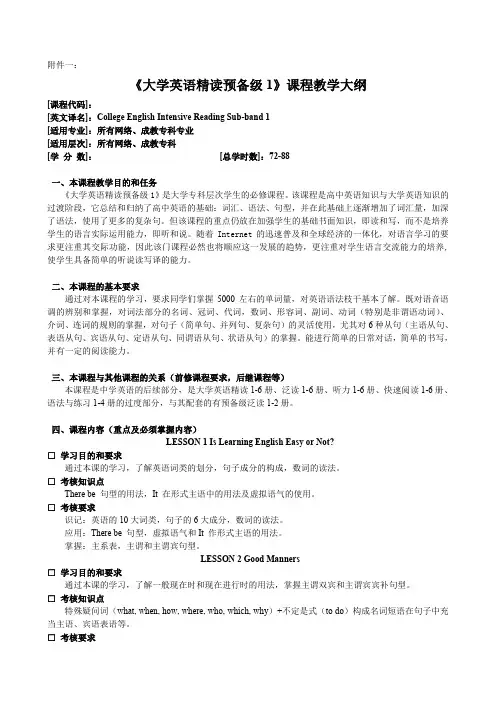
附件一:《大学英语精读预备级1》课程教学大纲[课程代码]:[英文译名]:College English Intensive Reading Sub-band 1[适用专业]:所有网络、成教专科专业[适用层次]:所有网络、成教专科[学分数]:[总学时数]:72-88一、本课程教学目的和任务《大学英语精读预备级1》是大学专科层次学生的必修课程。
该课程是高中英语知识与大学英语知识的过渡阶段,它总结和归纳了高中英语的基础:词汇、语法、句型,并在此基础上逐渐增加了词汇量,加深了语法,使用了更多的复杂句。
但该课程的重点仍放在加强学生的基础书面知识,即读和写,而不是培养学生的语言实际运用能力,即听和说。
随着Internet的迅速普及和全球经济的一体化,对语言学习的要求更注重其交际功能,因此该门课程必然也将顺应这一发展的趋势,更注重对学生语言交流能力的培养,使学生具备简单的听说读写译的能力。
二、本课程的基本要求通过对本课程的学习,要求同学们掌握5000左右的单词量,对英语语法枝干基本了解。
既对语音语调的辨别和掌握,对词法部分的名词、冠词、代词,数词、形容词、副词、动词(特别是非谓语动词)、介词、连词的规则的掌握,对句子(简单句、并列句、复杂句)的灵活使用,尤其对6种从句(主语从句、表语从句、宾语从句、定语从句、同谓语从句、状语从句)的掌握。
能进行简单的日常对话,简单的书写,并有一定的阅读能力。
三、本课程与其他课程的关系(前修课程要求,后继课程等)本课程是中学英语的后续部分,是大学英语精读1-6册、泛读1-6册、听力1-6册、快速阅读1-6册、语法与练习1-4册的过度部分,与其配套的有预备级泛读1-2册。
四、课程内容(重点及必须掌握内容)LESSON 1 Is Learning English Easy or Not?□学习目的和要求通过本课的学习,了解英语词类的划分,句子成分的构成,数词的读法。
□考核知识点There be 句型的用法,It 在形式主语中的用法及虚拟语气的使用。
《大学英语精读》(预备级)教学大纲

《大学英语》(College English)课程教学大纲(艺术本科)一、课程代码:二、课程类型:必修课三、课程性质:公共课四、学分:16课时:256五、考核方式:考试六、先修课程:高中英语七、适用专业:艺术设计专业(本科)八、课程教学目标:学生能在大学一,二年级的英语学习中,将英语学习的听,说,读,写,译各个方面能力提高到一个新的阶段。
教学环节应覆盖课前预习,课堂讲授,习题讨论,课后深化扩展各个环节,教学内容应体现教学目的.具体要求如下:①词汇:学生应从800词起点逐步掌握4200词。
其中复用式掌握2500词.掌握的重点在于这些词的a)语言中最常见的词形。
b)词汇的核心用法c)它们构成的典型组合搭配,并具有按照词语基本构成,词法识别生词的能力。
②语法:巩固和加强基本语法知识,提高在语篇水平上运用语法知识的能力。
③阅读能力:阅读是掌握语言知识,打好语言基础,获取信息的重要渠道。
阅读能力是大部分大学生今后工作所需要的主要语言技能,在大学英语教学要始终注重阅能力的培养。
具体来说,学生应能通过学习,顺利阅读语言难度中等的一般性题材的文章。
掌握中心大意以及说明中心大意的事实和细节,并能进行一定的分析,推理和判断。
领会作者的观点和态度.阅读速度达到每分钟70词。
在阅读篇幅较长,难度较低,生词不超过总阅读3%的材料时,能掌握中心大意,抓住主要事实和有关细节。
阅读速度达到每分钟100词.④听的能力:随着交际的需要和大学英语四级题型的改变我们发现对学生听的能力做了进一步的提高,在此基础上,学生应能基本听懂英语授课,并能听懂题材熟悉,句子结构比较简单,基本上无生词,语速为130—150词的简短会话,谈话,报道和讲座,掌握其中心大意,抓住要点和有关细节,领会讲话者的观点和态度.⑤说的能力:能就教材内容和适当的听力材料进行问答和复述,能用英语进行一般的日常会话,能就听熟悉的话题经过准备后做简短发言,表达思想比较清楚,语音语调基本正确。
大学英语精读第三版预备级教案1-6单元

IntensiveReading: Unit2A father, a Son and an Answer
ExtensiveReading: Unit2Culture and Recreation
授课方式
The course emphasizes the application of targeted language skills and English expressions through class activities such as group discussions, answering content-based questions,comparative translationand doing a reasonable amount of drill work both in and outside the classroom. (强调应用)
e the structure learned in this unitbydoing drills anddeveloping astructured mini speech
难点
1.Summarize the content in their own languages.
2.Talk abouttheir own English learning experiences and thencomment
6. Read Text B on their own andwith the teacher’s assistancedo the exercisesattached.
7. Summarize Text B in their own languages.
8.Read the4essays inUnit 1Campus Lifeand answertherelated questions.
现代大学英语精读1-4册大纲及教案
现代大学英语精读1-4册大纲及教案现代大学英语精读1-4册大纲及教案一、教材概述《现代大学英语精读》是中国大学英语教学研究会主编的一套综合性教材,共分为1-4册,用于高校本科英语专业或非英语专业学生的英语阅读教学。
该教材的目标是培养学生的阅读能力,提升其英语交流和写作能力。
二、教学目标1. 培养学生对英语文章的阅读理解能力;2. 培养学生的英语写作能力,使其能够进行英文写作;3. 培养学生的英语听力和口语能力,提高其英语交流能力;4. 培养学生的独立学习能力,提高其自主学习能力。
三、教学内容与安排1. 《现代大学英语精读1》本册共10个单元,包括文章阅读、词汇训练、听力训练和口语训练,旨在帮助学生提高阅读理解能力和听说能力。
每个单元包括以下教学内容:- 预习导入:通过复习所学词汇和引入相关话题,激发学生学习的兴趣;- 文章阅读:学生阅读一篇有关话题的文章,并回答相关问题,培养其阅读理解能力;- 词汇训练:帮助学生学习文章中的生词和短语,并进行相关的词汇练习;- 听力训练:提供与文章话题相关的听力材料,让学生提高听力理解能力;- 口语训练:通过对话和口语练习,训练学生的口语表达能力。
2. 《现代大学英语精读2》本册共12个单元,内容包括了不同主题的文章阅读、词汇练习、听力练习和口语训练。
教学内容安排如下:- 预习导入:导入本单元的主题,激发学生兴趣;- 文章阅读:学生阅读一篇较长的英语文章,并回答相关问题,提高理解能力;- 词汇训练:学习并掌握文章中的生词和短语,进行词汇练习;- 听力训练:提供与文章话题相关的听力材料,训练学生的听力理解能力;- 口语训练:通过对话和口语练习,提高学生的口语表达能力。
3. 《现代大学英语精读3》本册共10个单元,每个单元都包括了与不同主题相关的文章阅读、词汇练习、听力练习和口语训练。
教学内容安排如下:- 预习导入:引入本单元的话题,激发学生学习的兴趣;- 文章阅读:学生阅读一篇相关主题的英语文章,提高其阅读理解能力;- 词汇训练:学习文章中的生词和短语,进行词汇练习;- 听力训练:提供与文章话题相关的听力材料,训练学生的听力理解能力;- 口语训练:通过对话和口语练习,训练学生的口语表达能力。
《大学英语精读》课程教学大纲

《大学英语精读》课程教学大纲课程代码:课程中文名称:新视野大学英语读写教程课程英文名称:New Horizon College English课程类别:基础课课程学分数:无课程学时数:12×2=24授课对象:预科前导课程:无一、教学目的精读是基础阶段教学的一门必修课,也是帮助学生打下较扎实的语言基础的一门实践基础课。
英语精读课的目的在于培养学生掌握良好的语言学习方法,增强自主学习能力,提高综合文化素养,使他们具有较强的英语综合应用能力。
同时旨在提高学生应用语言的能力,具体包括培养学生听、说、读、写、译五个方面的能力,扩大学生词汇量,使学生具备较强的运用语言的能力。
精读选材注重趣味性、信息性、可思性和前瞻性。
题材广泛,内容丰富,主要涉及语言、文化、习俗、伦理、信息、科学、社会焦点等。
精读课要加强学生基础知识的学习,以培养读、写、译的能力为主,辅以听说训练,全面培养运用语言的能力。
二、教学要求本课程以每单元的Section A为精讲内容,深入讲解课文语言点、语法点、重点词汇及句型的运用。
Section B只要以理解课文大意为主,扩大词汇量,提高学生阅读理解能力。
Section C作为泛读材料,提供给学生课外阅读,在课堂上进行必要的检查。
三、教学方式针对精读课教学的特点,课堂教学应贯穿以学生为主体、教师为主导的教学模式。
在讲解重点词汇,句型运用的同时应辅以大量的翻译和写作实践,在大量的翻译和写作训练中培养学生运用语言的能力。
在加强训练的同时,采用启发式、讨论式、发现式和研究式的教学方法,充分调动学生学习的积极性,激发学生的学习动机,最大限度地让学生参与学习的全过程。
指导学生利用现有图书资料和网上信息获取知识。
四、课程内容与学时分配第二学期:第一讲:Unit 4 section A: Stopping Smoking in Public Places?I.Main content:ⅰ. Listen to recording of new words and learn new wordsii. Lead-in questionsII. Comprehension of the text第二讲:Unit 4 section A: Stopping Smoking in Public Places?Main content: I. Language points of the textprehension exercise of the textIII. Discussion on the topic of “How Does Smoking Hurt People’s Health?”第三讲:Unit 4 section A: Stopping Smoking in Public Places?I. Main content:Exercises of translation and vocabularyII. Grammar: sentences of implied conditionIII.Pronunciation reviewIV.Practicing of pronunciation第四讲:Unit 4 section B: A Decision Made Too LateMain content: ⅰ. Review the words in section Aii. Learn the new words and language points in section Bprehension of the textIII. ExercisesIV. Instruction of section C第五讲:Unit 5 Section A: Too Many Choices in ShoppingI.Main content: ⅰ. Check the answers of unit 4 section Cii. Listen to recording of new words and learn new wordsⅲ. Lead-in questionsprehension of the textIII. Discussion on the topic of “The Advantages and Disadvantages in Advertising”第六讲:Unit 5 Section A: Too Many Choices in ShoppingI. Main content: ⅰ. Review the new words in section Anguage points of the textII. Comprehension exercise of the textIII. Practice of some important expressing and language points第七讲:Unit 5 Section A: Too Many Choices in ShoppingI. Main content:I. Grammar: bare infinitivesii. Review the learned vowels.II.Practice of pronunciationIII.Exercise of translation and vocabulary第八讲:Unit 5 Section B: Advertising EverywhereI. Main content: ⅰ. Review the words in section Aii. Learn the new words and language points in section B prehension of the textIII. . ExercisesIV. Instruction of section C第九讲:Middle Examination第十讲:Unit 6 Section A: The More You Give, the Happier You BecomeⅠMain content: ⅰ. Check the answers of unit 5 section Cii Listen to recording of new words and learn new wordsⅲ. Lead-in questionsnguage points of the textIII.Discuss the story of Lei Feng第十一讲:Unit 6 Section A: The More You Give, the Happier You BecomeI. Main content: ⅰ. Review the words in section Aii. Exercises of translation and new words第十二讲:Unit 6 Section A: The More You Give, the Happier You BecomeMain content:Ⅰ.Grammar: comparison of to do patterns and -ing patternsII. Pronunciation of consonants第十三讲:Unit 6 Section B: Keep Alive Your Sense of HumorⅠMain content: ⅰ. Review the words in section Aii. Learn the new words and language points in section B prehension of the textIII. Exercises of vocabularyIII.Instruction of section C第十四讲:Unit 7 Section A: Why Getting Married So YoungⅠMain content:ⅰ. Check the answers of unit 6 section Cii. Listen to recording of new words and learn new wordsⅲ. Lead-in questionsII. Discussion on the topic: Campus Lovenguage points of text.第十五讲:Unit 7 Section A: Why Getting Married So YoungⅠ.Main content:II. Review the words in section AIII. Language points of text.第十六讲:Unit 7 Section A: Why Getting Married So YoungⅠGrammar: the verb tense in wish clause.II. Pronunciation of consonantsIII. Practice of pronunciation第十七讲:Unit 7 Section B: Love or Infatuation?ⅠMain content: ⅰ. Review the words in section Aii. Learn the new words and language points in section B prehension of the textIII. . ExercisesIV. Instruction of section C第十八讲:Review the new words and language points in unit 4 to unit 7五、教材与参考书《新视野大学英语读写教程》(预备级1)外语教学与研究出版社总主编:郑树棠顾嘉祖,陆昇.《语言与文化》[M].上海外语教育出版社,2002.张道真.《实用英语语法》[M].外语教学与研究出版社,2002.六、考核方式1.考核形式:闭卷考试。
《大学英语精读》(预备级)教学大纲
《大学英语》(College English)课程教学大纲(艺术本科)一、课程代码:二、课程类型:必修课三、课程性质:公共课四、学分:16课时:256五、考核方式:考试六、先修课程:高中英语七、适用专业:艺术设计专业(本科)八、课程教学目标:学生能在大学一,二年级的英语学习中,将英语学习的听,说,读,写,译各个方面能力提高到一个新的阶段。
教学环节应覆盖课前预习,课堂讲授,习题讨论,课后深化扩展各个环节,教学内容应体现教学目的。
具体要求如下:①词汇:学生应从800词起点逐步掌握4200词。
其中复用式掌握2500词。
掌握的重点在于这些词的a)语言中最常见的词形。
b)词汇的核心用法c)它们构成的典型组合搭配,并具有按照词语基本构成,词法识别生词的能力。
②语法:巩固和加强基本语法知识,提高在语篇水平上运用语法知识的能力。
③阅读能力:阅读是掌握语言知识,打好语言基础,获取信息的重要渠道。
阅读能力是大部分大学生今后工作所需要的主要语言技能,在大学英语教学要始终注重阅能力的培养。
具体来说,学生应能通过学习,顺利阅读语言难度中等的一般性题材的文章。
掌握中心大意以及说明中心大意页脚内容1的事实和细节,并能进行一定的分析,推理和判断。
领会作者的观点和态度。
阅读速度达到每分钟70词。
在阅读篇幅较长,难度较低,生词不超过总阅读3%的材料时,能掌握中心大意,抓住主要事实和有关细节。
阅读速度达到每分钟100词。
④听的能力:随着交际的需要和大学英语四级题型的改变我们发现对学生听的能力做了进一步的提高,在此基础上,学生应能基本听懂英语授课,并能听懂题材熟悉,句子结构比较简单,基本上无生词,语速为130-150词的简短会话,谈话,报道和讲座,掌握其中心大意,抓住要点和有关细节,领会讲话者的观点和态度。
⑤说的能力:能就教材内容和适当的听力材料进行问答和复述,能用英语进行一般的日常会话,能就听熟悉的话题经过准备后做简短发言,表达思想比较清楚,语音语调基本正确。
英语精读教学大纲
《英语精读》教学大纲课程编码:05010301 课程名称:英语精读课内学时:600 课程类型:专业核心课适用专业:应用英语开课单位:外国语学院开课学期:1-5学期大纲撰写人:一、课程的性质与任务(一)本课程的性质《英语精读》是我校应用英语专业学生的一门专业必修课,是该专业核心课程中的核心课程,是一门实践性很强的英语综合能力训练课程。
本课程旨在通过英语基本技能的反复操练、语篇的讲解与分析、语法知识的传授和实践,培养和提高学生综合运用英语的能力,从而达到新《大纲》所规定的英语听、说、读、写、译等基本技能的基本要求,为学生在英语方面的进一步学习和深造打下良好的基础。
(二)本课程的任务本课程的任务在于传授系统的基础语言知识(语音、语法、词汇、篇章结构、语言功能等),训练基本语言技能(听、说、读、写),培养学生运用英语进行交际的能力,同时指导学习方法,培养逻辑思维能力。
重点应放在口笔头复用能力的训练上。
在语言技能训练方面,一、二年级侧重点有所不同:一年级狠抓听说(使学生一入学就养成开口说英语的良好习惯),但不忽视读写;二年级要加强读写训练,但听说训练还要进行。
在非外语环境中,基础阶段的学习在很大程度上是通过课堂教学进行的,课堂中必须坚持精讲、多练、以练为主的原则,用多种手段进行大量练习,为高年级阶段打下扎实的语言基本功。
二、课程的基本要求及重点、难点(一)课程的基本要求英语精读是一门综合英语技能课。
本课程主要通过语言的基础训练与篇章讲解分析,使学生逐步提高语篇阅读理解能力,了解英语各种文体的表达方式和特点,扩大词汇量和熟练运用各种英语常用句型,具备基本的口头与笔头表达能力。
学生通过积极参与课堂的各种语言交际活动,获得基本的交际技能,并达到大纲所规定的听、说、读、写、译等技能要求。
英语精读课的教学要求按新《大纲》的规定可以分为四级,每一级对学生的语音、语法、词汇、听力、口语、阅读、写作、翻译等都有相应的规定。
《大学英语精读》第三版预备级Unit_3
arrive (v.): reach a place, esp. at the end of a journey Examples: — She finally arrived in New York. 她终于到达纽约。 — We arrived at the station as the train was leaving. 我们到达车站时火车就要开出了。
settle (v.): decide; make an agreement about Examples: — It was settled that Joe would visit us on the weekend. 事情定下来了,乔下周末来看我们。 — Until we know the full value of the picture, we can’t settle the price. 不了解这幅画的全部价值,我们无法 给它定价。
(n.): a formal meeting at which someone is asked questions in order to find out whether he /she is suitable for a job, course of study, etc. Examples: — He has an interview next Thursday for a job at IBM. — As we all know, not everybody who writes in can be invited for interview. Same-rooted word: interviewer n. 会见者;面谈者;进行面试者 interviewee n. 被接见者;被访问者
Examples: — Please transfer the money to my account. 请把这笔钱转到我的账上。 — John has been transferred to the headquarters of the company in Beijing. 约翰已经被调到北京的公司总部了。
大学英语预备级教案
大学英语预备级教案第一章:英语语音基础1.1 教学目标了解英语音标及其分类掌握元音和辅音的发音规则能够正确拼读单词和朗读短文1.2 教学内容英语音标及其分类元音和辅音的发音规则单词和短文的拼读练习1.3 教学方法讲解法:讲解音标分类、发音规则练习法:进行单词和短文的拼读练习1.4 教学步骤1.4.1 引入:介绍英语音标及其分类1.4.2 讲解:讲解元音和辅音的发音规则1.4.3 练习:进行单词拼读练习1.4.4 应用:朗读短文并进行发音纠正第二章:英语语法基础2.1 教学目标了解英语句子结构掌握基本语法规则,如时态、语态、句型转换等能够运用所学语法知识进行简单的句子编写2.2 教学内容英语句子结构基本语法规则,如时态、语态、句型转换等句子编写练习2.3 教学方法讲解法:讲解句子结构、语法规则练习法:进行句子编写练习2.4 教学步骤2.4.1 引入:介绍英语句子结构2.4.2 讲解:讲解基本语法规则,如时态、语态、句型转换等2.4.3 练习:进行句子编写练习2.4.4 应用:修改并完善句子,进行小组展示第三章:日常英语交流3.1 教学目标掌握日常英语交流的基本词汇和表达方式能够进行简单的日常英语对话提高学生的英语口语表达能力3.2 教学内容日常英语交流的基本词汇和表达方式日常英语对话的编写和表演3.3 教学方法讲解法:讲解日常英语交流的词汇和表达方式练习法:进行日常英语对话的编写和表演3.4 教学步骤3.4.1 引入:介绍日常英语交流的词汇和表达方式3.4.2 讲解:讲解日常英语对话的编写和表演技巧3.4.3 练习:分组进行日常英语对话的编写和表演3.4.4 应用:展示表演并进行评价第四章:英语阅读理解4.1 教学目标提高学生的英语阅读理解能力掌握阅读技巧,如主旨大意、细节理解、推理判断等能够正确回答阅读理解题目4.2 教学内容阅读理解技巧的讲解和练习阅读理解题目的编写和解答4.3 教学方法讲解法:讲解阅读理解技巧练习法:进行阅读理解题目的编写和解答4.4 教学步骤4.4.1 引入:介绍阅读理解的重要性及技巧4.4.2 讲解:讲解阅读理解技巧,如主旨大意、细节理解、推理判断等4.4.3 练习:进行阅读理解题目的编写和解答4.4.4 应用:互相批改并讨论阅读理解题目第五章:英语写作基础5.1 教学目标掌握英语写作的基本格式和结构学会使用恰当的词汇和句型进行写作5.2 教学内容英语写作的基本格式和结构写作技巧的讲解和练习英语作文的编写和修改5.3 教学方法讲解法:讲解写作格式和结构,写作技巧练习法:进行作文编写和修改5.4 教学步骤5.4.1 引入:介绍英语写作的基本格式和结构5.4.2 讲解:讲解写作技巧,如开头结尾的写法、过渡句的使用等5.4.3 练习:进行作文编写和修改5.4.4 应用:展示作文并进行评价第六章:英语听力基础6.1 教学目标提高学生的英语听力理解能力掌握听力技巧,如预测、关键词定位、主旨判断等能够正确回答听力题目听力理解技巧的讲解和练习听力题目的编写和解答6.3 教学方法讲解法:讲解听力理解技巧练习法:进行听力题目的编写和解答6.4 教学步骤6.4.1 引入:介绍听力理解的重要性及技巧6.4.2 讲解:讲解听力理解技巧,如预测、关键词定位、主旨判断等6.4.3 练习:进行听力题目的编写和解答6.4.4 应用:互相批改并讨论听力题目第七章:英语口语表达7.1 教学目标提高学生的英语口语表达能力学会使用恰当的词汇和句型进行口语表达能够流利地进行日常英语对话7.2 教学内容日常英语对话的编写和表演口语表达技巧的讲解和练习7.3 教学方法讲解法:讲解口语表达技巧练习法:进行口语表达练习和对话编写7.4.1 引入:介绍日常英语对话的重要性和技巧7.4.2 讲解:讲解口语表达技巧,如如何开始和结束对话、如何表达观点等7.4.3 练习:进行口语表达练习和对话编写7.4.4 应用:展示表演并进行评价第八章:英语词汇拓展8.1 教学目标扩大学生的英语词汇量学会使用词汇关联和记忆技巧能够正确运用新词汇进行表达8.2 教学内容词汇拓展的方法和技巧新词汇的讲解和练习8.3 教学方法讲解法:讲解词汇拓展的方法和技巧练习法:进行新词汇的讲解和练习8.4 教学步骤8.4.1 引入:介绍词汇拓展的重要性和方法8.4.2 讲解:讲解词汇关联和记忆技巧8.4.3 练习:进行新词汇的讲解和练习8.4.4 应用:运用新词汇进行表达并进行评价第九章:英语文化常识增加学生对英语国家文化的了解学会如何理解和尊重不同文化差异能够运用英语进行简单的跨文化交流9.2 教学内容英语国家的文化常识跨文化交流的技巧和注意事项9.3 教学方法讲解法:讲解英语国家的文化常识讨论法:进行跨文化交流的讨论和练习9.4 教学步骤9.4.1 引入:介绍英语文化常识的重要性9.4.2 讲解:讲解英语国家的文化常识和跨文化交流的技巧9.4.3 练习:进行跨文化交流的讨论和练习9.4.4 应用:展示讨论结果并进行评价第十章:综合测试与复习10.1 教学目标检验学生对预备级英语知识的掌握程度提高学生的应试能力巩固所学知识,为后续学习打下基础10.2 教学内容综合测试题目的编写和解答复习所学知识,查漏补缺10.3 教学方法自测法:让学生自主完成测试题目讲解法:讲解测试题目的答案和解析10.4 教学步骤10.4.1 引入:介绍综合测试的目的和重要性10.4.2 自测:让学生自主完成测试题目10.4.3 讲解:讲解测试题目的答案和解析10.4.4 复习:查漏补缺,巩固所学知识重点和难点解析重点环节1:英语语音基础补充说明:通过对比和实例演示,帮助学生理解和掌握正确的发音技巧。