
常见构词法归纳汇编
常见构词法归纳 1 .派生法1 )前缀① 表示否定意义的前缀: a. 纯否定前缀:unpleasant, undivided (专心的、专一的、未分开的) , unreserved (无保留的、坦白的)dis-: dislike (不喜欢), disarm (解除武装;放下武器) , disconnect (vt 拆开,使分离), disagree, disappear , disadvantage, dishonest,disability (残疾、无能) , discover (v 发现) , disobey (违反、不服从)in-, im-, il-, ir-: incapable(不能的、 无能力的) , inability (无能力, 无才能) , incomplete, incorrect, inconvenient, inexpensive,impossible, immoral (不道德的) , illegal (非法的) , illogical (不合乎逻辑的) , irregular , irrelative (无关系的)non-: non-smoker , non-stop (直达的,中途不停的) , non-violent (非暴力的) , nonwhite (非白人) , non-member (非会员) nonparty (无党派) , nonsense (无意义,胡说,废话)b. 表示错误的意义: mis-: mistake, mislead(误导) , misunderstanding(n ), misuse (n/vt 滥用、误用、虐待) , mistrust, mistreat (虐待)c. 表示“反、防、抗”的意义: anti-: antiknock (n/adj 防震) , antiforeign (排外的) , anti-war (adj, 反战的 ), antitank (反战车的) , anti-pollution (防污染,反污染的)② 表示空间位置、方向关系的前缀 : ward (守卫)a- 表示“在……之上” ,“向……”aboard (在飞机上,在船上) , aside (在旁边)de- 表示“在下, 向下” : decrease (减少,下降) , degrade (降级) en- 表示“在内,进入” : encage ( 入笼) , enbed (上床)ex- 表示“外部, 外” :exit, expand (扩张) , export (输出、 出口) fore- 表示“在前面” : forehead (前额) , foreground (前景) , foreleg, forefootin-, im- 表示“向内,在内,背于” :inland (内地、内陆) , inside, indoor (s ) (室内的,户内的; ( s )在户内) , import inter- 表示"在 ...... 间,相互” :international, interaction 相互作用),internet, interview(接见,面试)mid- 表示“中,中间” : midposition (中间位置)out- 表示“在外部,在外” :outline (轮廓,大纲,概要),outside, outward (s )(外表、外面;(s )向外地),outdoor (s )over- 表示“在上面, 在外部, 向上”: overlook (忽视,眺望) , overhead (在头顶上, 在空中) , overcoat (大衣,外套) , overdress 外衣) , oversea (s )( 海外 )更多精品文档失业) , unload (卸载) un-: unable, unemployment不安的,动荡的) , unfair , unknown, unhealthy, unusual , uncover 不寻常的; 发现、揭开、揭露) , unhappy, untrue, unlike 与众不同的) , uncertain (无常的、含糊的) (不像) , unrest , unclear (不清楚的) , unequal, unlucky, unreal, unkind, uncomfortable,uneasy心情不安的) , uninteresting, unimportant,unnecessary,post- 表示“向后,在后边,次” pre- 表示“在前,在前面,提前”.. 之上,超级” , superman, supermarket 转上,在那一边” .. 下面,下的” super- 超强特权,表示“在… 超强大国) : postscript (附言) : prefix (前缀) , preface (前言) , preposition (介词): superstructure (上部建筑,上部构造), supernatural (超自然的,不可思议的) , superpowertrans- under- 美式)表示“移上,: translate, transform (转变、转换、 下划线,强调,在下面划线) 转移) , transplant (移植) : underline, underground, underwater, transportation (交通) , undershirt (贴身内衣,up- 表示“向上,向上面,在上” auto- 表示“自己,独立,自动” tele- 表示“远离” : television, telephone , telegram : upward(s ) :向上的,上升的) , uphold (自动车) , autobiography 电报) ,(支撑,鼓励) , uphill (上坡) [? ? t?ba? '? gr ?f? (自传) (电报,抽象名词) , telescope,upload (上传 ) 望远镜)学习-- 好资料③表示时间,序列关系的前缀:fore- 表示“在前面,先前,前面” :foreword (前言), forecast (预报), foretell (预言), foresee (预见), foreknow (先知)foreknowledge (先知)mid- 表示“中,中间” :midnight, midsummer , mid-day, mid-autumn (中秋节)post- 表示“在后,后” :postwar (战后的,战后时期), postgraduate (研究生), postdate (事后日期,推迟日期)pre- 表示“在前,事先,预先” :preheat (预先加热), prewar , prehistory (史前), preview (预习), prebattle, prepay (预付)re- 表示“再一次,重新” :retell (复述), rewrite, renew (续借), reconsider (重新考虑), reuse, remarry, recycle (再生,回收利用), rebuild (重建,改造)④表示比较程度差别关系的前缀:by- 表示“副,次要的” :byproduct (副产品), bywork (副业)extra- 表示“超越,额外” :extraordinary (非凡的,特别的)over- 表示“超过,过度,太” :overeat (吃过多), oversleep (睡过头), overpraise (过奖), overwork, overact (行为过分)overdo (夸张,做得过分)under- 表示“低劣,低下” :undersize (尺寸不足), undergrown (发育不全的), underproduction (生产不足)vice-表示"副,次” :vice-president, vice -chairman , vice-monitor⑤表示共同,相等意思的前缀:co- 表示“共同,一起” :coexist (共同生存), co-operate, co-worker , coactions (合作行动), coauthor (合作作者)⑥表示某种状态,构成形容词、副词或动词:a- afraid, alive, alone, asleep, ashamed, aloud, ahead, aside, alike, awake⑦表示分离,离开意思的前缀:a- 表示“分离,离开” :away, apartde- 表示“离去,处去” :depart, decolour⑧表示“自我” :self- self-protect(ion), self-made, self-knowledge⑨表示变换词类作用的前缀:be- befrienden- enslave(束缚;征服), enable (使能够), enrich (使充实,使肥沃,使富足), enlarge (扩大,使增大), encourage (鼓励)⑩表示数量关系的前缀:a. 表示“单一” ,“一”:uni- uniform (统一服装), unicellular (单细胞)b. 表示“二,两,双” :bi- bicycle (cycle 循环,周期)twi- twilight (昏暗的,黎明)c. 表示“半,一半” :semi- semiconductor (半导体), semicircle (半圆), semimonthly (半月刊), semifinal (半决赛)d. 表示“百,百分之一” :centi- centimetere. 表示“千,千分之一” :kilo- kilometer , kilogram, kilowattf. 表示“微小”:micro- microvolt (微伏特), microcomputer (微机), microscope (显微镜)g. 表示“许多,复,多数” :multi- multimedia (多媒体), multicolored, multiform, multinaturalh. 表示“千分之一、毫” :milli- millimeter , milligram更多精品文档i. 表示“微小、微型” :mini- minibus, miniskirt, minipark (2 )后缀 ① 名词后缀:a. 具有某种职业或动作的人:-an, -ian, -ician 表示“ ....... 地方的人,精通 .... 的人” :American, Asian, Australian, Russian, Italian , historian (历史学家)librarian (图书管理员) , electricia (电工) n, magician (魔术师) , technician, musician, politician(政客)-ant,-ent 表示“ ...... 人” :merchant, servant(仆人,佣人) ,assistant, agent, student,-ee 表示“动作承受者” : employee (雇员) , examinee (应试者) , payee (收款人) , interviewee -eer 表示“从事于 .... 人” :engineer , volunteer(志愿者)-er 表示“从事某种职业的人 , 某地区,地方的人” : banker , observer , Londoner , villager singer , driver , writer , speaker , traveller buyer -or 表示“ .... 者” :author , doctor , operator , actor , visitor , inventor , educator-ar, -ary 表示“ ....... 的人 , 从事 .... 的人” :scholar , liar , beggar , secretary, missionary -ese 表示“ ..... 国人, ... 地方的人” :Chinese, Japanese, Cantonese(广东人)-ess 表示“阴性人称名词” : actress (女演员) , hostess (女主人) , manageress (女经理) -ist 表示 “从事 .. 研究者,信仰 .... 主义者”:pianist, communist, dentist, artist, chemist, socialist, typist, receptionist-icist 表示“ ..... 家, ..... 者, .... 能手” :physicist (物理学家),phoneticist (语音学家),technicist (技术师)-logist 表示“..... 学家,研究者” :biologist (生物学家),geologist(地质学家)b. 构成具有抽象名词的含义:-age 表示“状态,行为,身份及其结果,总称” : courage, storage, marriage, percentage-al 表示“事物的动作,过程” : refusal (拒绝) , arrival, survival (幸存) , denial (否认) , approval (批准,认可,赞成) , trial ( 实-ance, -ence 表示“性质,状况,行为,过程,总量,程度”: importance, distance, avoidance (逃避,废止) , appearance, performance性能,绩效,表演) , difference, obedience (顺从,服从) , presence (出席 , 参加) , existence-ancy, -ency 表示“性质,状态,行为,过程” : frequency (频繁) , urgency (紧急) , efficiency (高效率) , -ity 表示“性质,状态,程度” : purity (纯度(化学) ) , reality, equality (平等) -bility 表示“动作,性质,状态” : ability, possibility, probability, responsibility-dom 表示“等级,领域,状态” : freedom, kingdom (王国,界) , wisdom (智慧,才智) -ery, -ry 表示“行为,状态,习性,性质” : bravery (勇敢,勇气) , slavery (奴役)-hood 表示“资格,身份 , 年纪,状态” : childhood, girlhood (少女时期) , boyhood (少年时代) , manhood (男子气概) -ice 表示“行为,性质,状态” : notice, justice (司法) , service -ing 表示“动作的过程,结果” : building, writing, learning -ion, -ation, -ition, -sion表示“行为的过程,结果,状况” : suggestion, action, solution, invention, direction(方向,指导) ,correction (改正,修正) , collection, instruction (指令,指示) , destruction (破坏) , introduction, congratulation , dictation (听写,口述) , invitation (邀请) , pronunciation, examination, graduation, operation, education, information, translation, starvation 表示) , admission (承认) , permission (允许,许可) , discussion-ism 表示“制度,主义,学说,信仰,行为” : socialism (社会主义) , criticism (批评) , heroism (英勇) , tourism, communism 更多精品文档饿死, 绝食) , satisfaction, relation, determination反对) , competition (竞赛,比赛) , description, decision, division 决心, 果断) , preparation, imagination, explanation除法) , conclusion, impression(说明,解释) , opposition 印象) , expression (表达,-ment 表示“行为,状态,过程,手段及其结果” : disappointment (失望) , treatment, movement,argument, agreement (协议) , government, development, improvementjudgment, punishment,改进,改善) , requirement (要求,必要条件)encouragement-ness 表示“性质,状态,程度” : goodnesshappiness (幸福) , willingness (乐意,心甘情愿)adj ,善良,精华) , kindness, tiredness, friendliness 友谊) , business, illness,, weakness, fairness公平)(共产主义) , Marxism (马克思主义)-ship 表示“情况,性质,技巧,技能及身份,职业":hardship (困苦,苦难)‘relationship, membership (资格,会员身份),friendship,ownership (所有权) , scholarship (奖学金) ,-th, 表示“动作,性质,过程,状态” :strength, length, width, depth, wealth, truth, growth, warmth (温暖) , youth-ure 表示“行为,结果” : exposure (暴露) , pressure (压力) , failure, procedure ( 手续 ), mixture -craft 表示“工艺” :aircraft, needlecraft, woodcraft c. 带有场所,地方的含义:-age 表示“住所,地点” : village, cottage(小屋,村舍)-ary 表示“住所,场地” :library, granary ( 谷仓 )-ory 表示“工作场所,住处” : factory, dormitory, laboratory, observatory (天文台,气象台)② 形容词后缀:a. 带有“属性,倾向,相关”的含义:-able, -ible: movable, comfortable, eatable, enjoyable, acceptable, reasonable, applicable (可适用的) , visible (可见物)responsible, terrible (可怕的) , horrible (恐怖的)-al: natural, additional(额外的,附加的) , educational, national (国家的,国民的)-ant, -ent: distant, important, excellent-ing (表示特征:令人觉得) : moving, touching, daring, interesting, exciting, disappointing , boring, amazing : pleased, interested, surprised, worried, excited, bored, determined (决定了的,果断的) , delighted(出本上的,好读书的) , selfish(感人的,令人钦佩的) , decisive (决定性的,果断的) , active,expensive, progressive(改革的,进步b. 表示“相象,类似”的含义:, childlike (天真浪漫的,像孩子的), handsome(有雾的, 模糊的) , healthy, wealthy, worthy, bloodynoisy, salty, smelly (发臭的) , hilly (丘陵的,陡的)-ly: manly, fatherly, motherly, sisterly, brotherly, daily, weekly, monthly, quarterly, yearly, friendly, lonely, orderly, lovely 可爱的,令人愉快的) , lively (活泼的,生动的) , likely (很可能的) , scholarly (博学的,学着风度的)c. 表示“充分的”含义:-ful: beautiful, wonderful, helpful, truthful, successful, harmful, useful, careful, forgetful, merciful (仁慈的,宽容的)-ous: dangerous, courageous (有胆量的,勇敢的) , nervous (紧张不安的) , mountainous (多山的) , humorous (诙谐的,幽默的) , various (各种各样的)d. 表示由某种物质形成,制成或生产的含义: -en: wooden, golden, woolen (羊毛的)e. 表示方向的含义:-ern: eastern, western, southern, northern, southeastern, northwestern -ward: downward (向下的) , forward f. 表示“数量关系”的含义: -teen: thirteen -ty: fifty-th: fourth, fiftiethg. 表示国籍,语种,宗教的含义: -an: Roman, European 更多精品文档-ed (表示情绪:觉得) (高兴的,欣喜的)-ish: foolish, bookish -ive: active, impressive 的)-ish: boyish, childish 幼稚的,孩子去的)-like: manlike (有男子气概的,像男子的) -some: troublesome (麻烦的,讨厌的) -y: milky, cloudy sunny, windy, rainy, foggy血腥的) , funny, dirty, lucky,-ese: Chinese, Japanese-ish: English, Spanishh. 表示否定:-less: countless (无数的,数不尽的),stainless (不锈的),wireless, useless, endless (无止境的,连续的),priceless (无价的,贵重的),hopeless③动词后缀:-ize, ise 表示“做成,变成,... 化” : modernize (现代化),democratize (民主化),organize, apologize, realize-en表示"使成为,引起,使有”:quicken, (加快) weaken, soften, harden (变硬,变坚强)-fy 表示使...... 化,使成” :beautify, purify (净化),intensify, signify, simplify (简化),satisfy④副词后缀:-ly: possibly, swiftly(很快地),simply (简单地)-ward(s): downward, inwards (向内地),upward (向上地,上升地)-ways: always, sideways (向侧面的,一旁的)-wise: otherwise (另外的,否则,adj,adv ), clockwise (顺时针方向地)注意:有的单词有双重后缀,如:use (用途)T useless (无用的)宀uselessness (无用)self (自己)T selfish (自私的)T selfishness (自私)有的单词则是前后缀同时使用,如:important T importance T unimportanceregular (有规律的,有规则的)T irregular (无规律的,不规则的)T irregularity (无规律,不规则)2 .合成法boyfriend, girlfriend, bus-driver , playground, radioactive (放射性的),headmaster (校长),sunshine, notebook, armchair(扶手椅),wheelchair (轮椅),postcard (明信片),football, spaceship, blackboard, firefighter (消防队员),fireman, gateman (看门人,售票员),chairman (主席,会长),weatherman, businessman, armyman (军人),postman, sportsman, bedroom, reading-room, classroom, newspaper , pickpocket (扒手),she-goat (雌性山羊),editor-in-chief (主编),daybreak (破晓)handshake (握手),silkworm (蚕),outbreak (爆发)(2)合成形容词由三个词构成的合成形容词:heart-to-heart, two-year-old, eight-metre-long其他合成形容词:everyday (日常的),faraway (遥远的),snow-white (雪白的),lay-off (下岗的)3 .转化法(1)名词f动词hand (手f传递)back (背部,后面f支持,后退)charge (费用f收费)copy (抄本,复印件f抄写,复印)flood (洪水f淹没)heat (热量f加热)paint (油漆f刷漆)phone (电话f打电话)pin (别针f装订)waste (废物f浪费)face (脸f面对)use (用途f使用)interest (兴趣f使兴趣)surprise (惊讶f使惊讶)taste (味道f品尝)smell (气味f闻)break (短暂休息f折断)present (礼物f赠送)(2)形容词f动词clean (干净f使干净,打扫)clear (清楚f清理)dirty (脏f弄脏)dry (干燥f烘干,晒干)empty (空的f倒空)free (自由f使自由,释放)slow (慢的f放慢)warm (暖和f使暖和)cool (凉的f冷却)4.截短法(缩略法)quiet (安静f使安静)截短法,即将单词缩写,词义和词性保持不变,主要有截头、去尾、截头去尾等形式。
常见构词法归纳
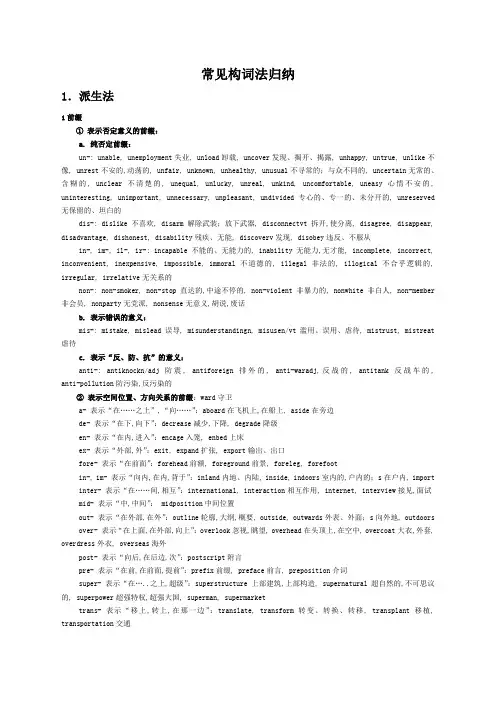
常见构词法归纳1.派生法1前缀①表示否定意义的前缀:a. 纯否定前缀:un-: unable, unemployment失业, unload卸载, uncover发现、揭开、揭露, unhappy, untrue, unlike不像, unrest不安的,动荡的, unfair, unknown, unhealthy, unusual不寻常的;与众不同的, uncertain无常的、含糊的, unclear不清楚的, unequal, unlucky, unreal, unkind, uncomfortable, uneasy心情不安的, uninteresting, unimportant, unnecessary, unpleasant, undivided专心的、专一的、未分开的, unreserved 无保留的、坦白的dis-: dislike不喜欢, disarm解除武装;放下武器, disconnectvt拆开,使分离, disagree, disappear, disadvantage, dishonest, disability残疾、无能, discoverv发现, disobey违反、不服从in-, im-, il-, ir-: incapable不能的、无能力的, inability无能力,无才能, incomplete, incorrect, inconvenient, inexpensive, impossible, immoral不道德的, illegal非法的, illogical不合乎逻辑的, irregular, irrelative无关系的non-: non-smoker, non-stop直达的,中途不停的, non-violent非暴力的, nonwhite非白人, non-member 非会员, nonparty无党派, nonsense无意义,胡说,废话b. 表示错误的意义:mis-: mistake, mislead误导, misunderstandingn, misusen/vt滥用、误用、虐待, mistrust, mistreat 虐待c. 表示“反、防、抗”的意义:anti-: antiknockn/adj防震, antiforeign排外的, anti-waradj,反战的, antitank反战车的, anti-pollution防污染,反污染的②表示空间位置、方向关系的前缀:ward守卫a- 表示“在……之上”,“向……”:aboard在飞机上,在船上, aside在旁边de- 表示“在下,向下”:decrease减少,下降, degrade降级en- 表示“在内,进入”:encage入笼, enbed上床ex- 表示“外部,外”:exit, expand扩张, export输出、出口fore- 表示“在前面”:forehead前额, foreground前景, foreleg, forefootin-, im- 表示“向内,在内,背于”:inland内地、内陆, inside, indoors室内的,户内的;s在户内, import inter- 表示“在……间,相互”:international, interaction相互作用, internet, interview接见,面试mid- 表示“中,中间”: midposition中间位置out- 表示“在外部,在外”:outline轮廓,大纲,概要, outside, outwards外表、外面;s向外地, outdoors over- 表示“在上面,在外部,向上”:overlook忽视,眺望, overhead在头顶上,在空中, overcoat大衣,外套, overdress外衣, overseas海外post- 表示“向后,在后边,次”:postscript附言pre- 表示“在前,在前面,提前”:prefix前缀, preface前言, preposition介词super- 表示“在…..之上,超级”:superstructure上部建筑,上部构造, supernatural超自然的,不可思议的, superpower超强特权,超强大国, superman, supermarkettrans- 表示“移上,转上,在那一边”:translate, transform转变、转换、转移, transplant移植, transportation交通under- 表示“在…..下面,下的”:underline下划线,强调,在下面划线, underground, underwater, undershirt贴身内衣,美式up- 表示“向上,向上面,在上”:upwards向上的,上升的, uphold支撑,鼓励, uphill上坡,upload上传auto- 表示“自己,独立,自动”:automobile自动车, autobiography tba'grf自传tele- 表示“远离”:television, telephone , telegram电报, telegraph电报,抽象名词, telescope望远镜③表示时间,序列关系的前缀:fore- 表示“在前面,先前,前面”:foreword前言, forecast预报, foretell预言, foresee预见, foreknow 先知, foreknowledge先知mid- 表示“中,中间”:midnight, midsummer, mid-day, mid-autumn中秋节post- 表示“在后,后”:postwar战后的,战后时期, postgraduate研究生, postdate事后日期,推迟日期pre- 表示“在前,事先,预先”:preheat预先加热, prewar, prehistory史前, preview预习, prebattle, prepay预付re- 表示“再一次,重新”: retell复述, rewrite, renew续借, reconsider重新考虑, reuse, remarry, recycle再生,回收利用, rebuild重建,改造④表示比较程度差别关系的前缀:by- 表示“副,次要的”:byproduct副产品, bywork副业extra- 表示“超越,额外”:extraordinary非凡的,特别的over- 表示“超过,过度,太”:overeat吃过多, oversleep睡过头, overpraise过奖, overwork, overact 行为过分, overdo夸张,做得过分under- 表示“低劣,低下”:undersize尺寸不足, undergrown发育不全的, underproduction生产不足vice- 表示“副,次”:vice-president, vice –chairman,vice-monitor⑤表示共同,相等意思的前缀:co- 表示“共同,一起”:coexist共同生存, co-operate, co-worker, coactions合作行动, coauthor合作作者⑥表示某种状态,构成形容词、副词或动词:a- afraid, alive, alone, asleep, ashamed, aloud, ahead, aside, alike, awake⑦表示分离,离开意思的前缀:a- 表示“分离,离开”:away, apartde- 表示“离去,处去”:depart, decolour⑧表示“自我”:self- self-protection, self-made, self-knowledge⑨表示变换词类作用的前缀:be- befrienden- enslave束缚;征服, enable使能够, enrich使充实,使肥沃,使富足, enlarge扩大,使增大, encourage 鼓励⑩表示数量关系的前缀:a. 表示“单一”,“一”:uni- uniform统一服装, unicellular单细胞b. 表示“二,两,双”:bi- bicyclecycle循环,周期twi- twilight昏暗的,黎明c. 表示“半,一半”:semi- semiconductor半导体, semicircle半圆, semimonthly半月刊, semifinal半决赛d. 表示“百,百分之一”:centi- centimetere. 表示“千,千分之一”:kilo- kilometer, kilogram, kilowattf. 表示“微小”:micro- microvolt微伏特, microcomputer微机, microscope显微镜g. 表示“许多,复,多数”:multi- multimedia多媒体, multicolored, multiform, multinaturalh. 表示“千分之一、毫”:milli- millimeter, milligrami. 表示“微小、微型”:mini- minibus, miniskirt, minipark2后缀①名词后缀:a. 具有某种职业或动作的人:-an, -ian, -ician 表示“……地方的人,精通……的人”:American, Asian, Australian, Russian, Italian , historian历史学家, librarian图书管理员, electricia电工n, magician魔术师, technician, musician, politician政客-ant,-ent 表示“……人”:merchant, servant仆人,佣人, assistant, agent, student,-ee 表示“动作承受者”:employee雇员, examinee应试者, payee收款人, interviewee-eer 表示“从事于……人”:engineer, volunteer志愿者-er 表示“从事某种职业的人, 某地区,地方的人”:banker, observer, Londoner, villager singer, driver, writer, speaker, traveller, buyer-or 表示“……者”:author, doctor, operator, actor, visitor, inventor, educator-ar, -ary 表示“……的人, 从事……的人”:scholar, liar, beggar, secretary, missionary-ese 表示“……国人,……地方的人”:Chinese, Japanese, Cantonese广东人-ess 表示“阴性人称名词”:actress女演员, hostess女主人, manageress女经理-ist 表示“从事……研究者,信仰……主义者”:pianist, communist, dentist, artist, chemist, socialist, typist, receptionist-icist 表示“……家, ……者, ……能手”:physicist物理学家, phoneticist语音学家, technicist技术师-logist 表示“……学家,研究者”:biologist生物学家, geologist地质学家b. 构成具有抽象名词的含义:-age 表示“状态,行为,身份及其结果,总称”:courage, storage, marriage, percentage-al 表示“事物的动作,过程”:refusal拒绝, arrival, survival幸存, denial否认, approval批准,认可,赞成, trial实验-ance, -ence 表示“性质,状况,行为,过程,总量,程度”:importance, distance, avoidance逃避,废止, appearance, performance性能,绩效,表演, difference, obedience顺从,服从, presence出席,参加, existence -ancy, -ency 表示“性质,状态,行为,过程”:frequency频繁, urgency紧急, efficiency高效率,-ity 表示“性质,状态,程度”:purity纯度化学, reality, equality平等-bility 表示“动作,性质,状态”:ability, possibility, probability, responsibility-dom 表示“等级,领域,状态”:freedom, kingdom王国,界, wisdom智慧,才智-ery, -ry 表示“行为,状态,习性,性质”:bravery勇敢,勇气, slavery奴役-hood 表示“资格,身份, 年纪,状态”:childhood, girlhood少女时期, boyhood少年时代, manhood男子气概-ice 表示“行为,性质,状态”:notice, justice司法, service-ing 表示“动作的过程,结果”:building, writing, learning-ion, -ation, -ition, -sion 表示“行为的过程,结果,状况”:suggestion, action, solution, invention, direction方向,指导, correction改正,修正, collection, instruction指令,指示, destruction 破坏, introduction, congratulation , dictation听写,口述, invitation邀请, pronunciation, examination, graduation, operation, education, information, translation, starvation饿死,绝食, satisfaction, relation, determination决心,果断, preparation, imagination, explanation说明,解释, opposition反对, competition竞赛,比赛, description, decision, division除法, conclusion, impression印象, expression 表达,表示, admission承认, permission允许,许可, discussion-ment 表示“行为,状态,过程,手段及其结果”:disappointment失望, treatment, movement, judgment, punishment, argument, agreement协议, government, development, improvement改进,改善, requirement要求,必要条件, encouragement-ness 表示“性质,状态,程度”:goodnessadj,善良,精华, kindness, tiredness, friendliness友谊, business, illness, happiness幸福, willingness乐意,心甘情愿, weakness, fairness公平-ism 表示“制度,主义,学说,信仰,行为”:socialism社会主义, criticism批评, heroism英勇, tourism, communism共产主义 , Marxism马克思主义-ship 表示“情况,性质,技巧,技能及身份,职业”:hardship困苦,苦难, relationship, membership 资格,会员身份, friendship, ownership所有权, scholarship奖学金,-th, 表示“动作,性质,过程,状态”:strength, length, width, depth, wealth, truth, growth, warmth 温暖, youth-ure 表示“行为,结果”:exposure暴露, pressure压力, failure, procedure手续, mixture-craft 表示“工艺”:aircraft, needlecraft, woodcraftc. 带有场所,地方的含义:-age 表示“住所,地点”:village, cottage小屋,村舍-ary 表示“住所,场地”:library, granary 谷仓-ory 表示“工作场所,住处”:factory, dormitory, laboratory, observatory天文台,气象台②形容词后缀:a. 带有“属性,倾向,相关”的含义:-able, -ible: movable, comfortable, eatable, enjoyable, acceptable, reasonable, applicable可适用的, visible可见物, responsible, terrible可怕的, horrible恐怖的-al: natural, additional额外的,附加的, educational, national国家的,国民的-ant, -ent: distant, important, excellent-ing表示特征:令人觉得: moving, touching, daring, interesting, exciting, disappointing , boring, amazing-ed表示情绪:觉得: pleased, interested, surprised, worried, excited, bored, determined决定了的,果断的, delighted高兴的,欣喜的-ish: foolish, bookish出本上的,好读书的, selfish-ive: active, impressive感人的,令人钦佩的, decisive决定性的,果断的, active,expensive, progressive改革的,进步的b. 表示“相象,类似”的含义:-ish: boyish, childish幼稚的,孩子去的-like: manlike有男子气概的,像男子的, childlike天真浪漫的,像孩子的-some: troublesome麻烦的,讨厌的, handsome-y: milky, cloudy sunny, windy, rainy, foggy有雾的,模糊的, healthy, wealthy, worthy, bloody血腥的, funny, dirty, lucky, noisy, salty, smelly发臭的, hilly丘陵的,陡的-ly: manly, fatherly, motherly, sisterly, brotherly, daily, weekly, monthly, quarterly, yearly, friendly, lonely, orderly, lovely可爱的,令人愉快的, lively活泼的,生动的, likely很可能的, scholarly 博学的,学着风度的c. 表示“充分的”含义:-ful: beautiful, wonderful, helpful, truthful, successful, harmful, useful, careful, forgetful, merciful仁慈的,宽容的-ous: dangerous, courageous有胆量的,勇敢的, nervous紧张不安的, mountainous多山的, humorous诙谐的,幽默的, various各种各样的d. 表示由某种物质形成,制成或生产的含义:-en: wooden, golden, woolen羊毛的e. 表示方向的含义:-ern: eastern, western, southern, northern, southeastern, northwestern-ward: downward向下的, forwardf. 表示“数量关系”的含义:-teen: thirteen-ty: fifty-th: fourth, fiftiethg. 表示国籍,语种,宗教的含义:-an: Roman, European-ese: Chinese, Japanese-ish: English, Spanishh. 表示否定:-less: countless无数的,数不尽的, stainless不锈的, wireless, useless, endless无止境的,连续的, priceless无价的,贵重的, hopeless③动词后缀:-ize, ise 表示“做成,变成,……化”:modernize现代化, democratize民主化, organize, apologize, realize-en 表示“使成为,引起,使有”:quicken,加快 weaken, soften, harden变硬,变坚强-fy 表示“使……化, 使成”:beautify, purify净化, intensify, signify, simplify简化, satisfy④副词后缀:-ly: possibly, swiftly很快地, simply简单地-wards: downward, inwards向内地, upward向上地,上升地-ways: always, sideways向侧面的,一旁的-wise: otherwise另外的,否则,adj,adv, clockwise顺时针方向地注意:有的单词有双重后缀,如:use用途→useless无用的→uselessness无用self自己→selfish自私的→selfishness自私有的单词则是前后缀同时使用,如:important→importance→unimportanceregular有规律的,有规则的→irregular无规律的,不规则的→irregularity无规律,不规则2.合成法boyfriend, girlfriend, bus-driver, playground, radioactive放射性的, headmaster校长, sunshine, notebook, armchair扶手椅, wheelchair轮椅, postcard明信片, football, spaceship, blackboard, firefighter 消防队员, fireman, gateman看门人,售票员, chairman主席,会长, weatherman, businessman, armyman军人, postman, sportsman, bedroom, reading-room, classroom, newspaper, pickpocket扒手, she-goat雌性山羊,由三个词构成的合成形容词: heart-to-heart, two-year-old, eight-metre-long3.转化法1名词→动词hand手→传递back背部,后面→支持,后退charge费用→收费copy抄本,复印件→抄写,复印flood洪水→淹没heat热量→加热paint油漆→刷漆phone电话→打电话pin别针→装订 waste废物→浪费face脸→面对use用途→使用interest兴趣→使兴趣surprise惊讶→使惊讶taste味道→品尝smell气味→闻break短暂休息→折断present礼物→赠送2形容词→动词clean干净→使干净,打扫clear清楚→清理dirty脏→弄脏dry干燥→烘干,晒干empty空的→倒空free自由→使自由,释放slow慢的→放慢warm暖和→使暖和cool凉的→冷却quiet安静→使安静4.截短法缩略法截短法,即将单词缩写,词义和词性保持不变,主要有截头、去尾、截头去尾等形式; 1截头telephone→phone aeroplane→plane omnibus→bus2去尾mathematics→maths co-operate→co-op examination→examkilogram→kilolaboratory→labtaxicab→taxi3截头去尾influenza→flu refrigerator→fridge prescription→script 5.混合法混成法混合法,即将两个词混合或各取一部分紧缩而成一个新词;后半部分表示主体;前半部分表示属性;news broadcast→newscast新闻广播television broadcast→telecast电视播送smoke and fog→smog烟雾helicopter airport→heliport直升飞机场6.首尾字母缩略法首尾字母缩略法,即用单词首尾字母组成一个新词;读音主要有两种形式,即各字母分别读音;作为一个单词读音;very important person→VIP 读字母音要人;大人物television→TV 读字母音电视Testing of English as a Foreign Language→TOEFL托福练习动词变名词work---___________工作者 sing---___________歌手 teach---___________教师 drive---___________司机 write---___________作家dance---___________舞蹈家win---___________获胜者 run---___________赛跑者 swim---___________游泳者act---___________演员 collect---___________收藏家 direct---___________主管visit---___________参观者 invent---___________发明家 translate---___________翻译家educate---___________教育 describe---___________描述 predit---___________预言collect---___________收藏 invent---___________发明 build---___________建筑物mean---___________意思 meet---___________会议 cross---___________路口turn---___________转弯处 decide---___________决定 die---___________死亡fly---___________飞行 know---___________知识 please---___________高兴pronounce---___________发音 mix---___________混合物please---___________令人高兴的---___________感到高兴的surprise---___________令人惊讶的的 ---___________感到惊讶的excite---___________令人兴奋的 ---___________感到兴奋的interest---___________令人感兴趣的---___________ 感兴趣的worry---___________令人担忧的 ---___________感到担忧的amaze, annoy, bore, disappoint, embarrass, frustrate, relax, terrify, thrill, tire等形容词的变化;A: 形容词变副词;quick---____________ strong---____________ heavy---____________ angry---____________ happy---____________ lucky---____________ healthy---____________ noisy---____________ usual---____________ careful---____________ real---____________ successful---____________ terrible---____________ possible---____________B: 形容词变名词;Kind---____________ happy---____________ill---____________ safe---____________confident---____________ important---____________different---____________ true---____________high---____________巩固练习1. That man was ________enough not to tell the manager that he would not do the job.A. careB. carefulC. carelessD. carelessness2. The soldier died for saving the child,so his________ is heavier than Mount Tai.A. dieB. deadC. diedD. death3. The child looked ________at his brother who was badly wounded.A. sadlyB. sadnessC. saddlyD. sad4. He is an expert at chemistry. We all call him a ________.A. chemistryB. chemicalC. chemistD. physician5.The three- ________chair isn’t suitable for a young child. He may fall off.A. leggingB. leggedC. legsD. leged6. Stephenson became the________railway engineer in the world.A. leadB. leaderC. leadingD. leadership7.When the teacher praised him for working out the maths problem,Jack looked________about at his classmates.A. proudB. proudlyC. prideD. pridely8.To everyone’s ________,the girl finished the job quite well.A. satisfiedB. satisfactoryC. satisfyingD. satisfaction9.—What are you doing here—Oh,my teacher asked me to write a passage about ________in English.—You can write________passage in EnglishA. 600 words;a 600-wordsB. 600-word;a 600-wordsC. 600 words;a 600-wordD. 600 words;a 600-words10. No one should enter the spot without the________of the police.A. permitB. permissionC. permittingD. permittence11. You must come with us to the police ________.Our head is waiting for you.A. headquartersB. headlineC. headmasterD. headache12.Letting that animal escape was no accident;you did it ________.A. intendB. intentionC. intentionallyD. intentional13. The shop owner welcomed all the guests with a________smile.A. practiceB. practiseC. practicalD. practiced14. The________ordered him to pay a $100 fine.A. judgerB. judgmentC. judgeD. judgement15. My TV is out of order. Can you tell me what is the________news about Iraq WarA. latelyB. latestC. laterD. latter16. The Great Wall is more than 6000 li in ________.A. longerB. lengthC. longD. longing17.To my ________,I passed the exam easily.A. joyB. joyfulC. joylessD. joyness18. Canada is mainly an________country.A. English-speakingB. speak-EnglishC. spoken-EnglishD. English-spoken19. How________ he is He is always acting________.He is really a ________.A. foolish;foolishly;foolB. fool;foolish;foolC. foolish;fool;foolD. foolishly;foolish;fool20. The necklace that she lost is very expensive. It’s of great ________.A. valuableB. valueC. valuelessD. unvaluable21. There were________fish in the river in South America.A. in dangerB. dangerC. dangerousD. dangerless22.The letter “b” in the word “doubt” is________.A. soundB. silentC. silenceD. sounded23. The child looked at me________.A. strangerB. strangelyC. strangeD. strangeless24.The black people were against slavery and fought for their________bravely.A. freeB. freelyC. freedomD. frees25. What you said sounded________ but in fact it was untrue.A. reasonableB. reasonfulC. reasonlessD. unreason26. We have to learn ________technology from other countries.A. advanceB. advancingC. advantageD. advanced27. The children live in a village ________.They come here almost every day.A. nearbyB. nearC. nearlyD. near by28.Mr Black is an ________in the army,not an ________in the government. You can not easily find him in his________.A. official;officer;officeB. officer;office;officialC. official;official;officialD. officer;official;office29.You’d better give up smoking if you want to keep ________.A. healthB. healthyC. healthilyD. healthier30.________ speaking,I didn’t do it on purpose.A. HonestlyB. HonestC. HonestyD. Dishonest参考答案1-5 BDACB 6-10 CBDCB 11-15 ACDCB 16-20 BAAAB21-25 CBBCA 26-30 DA。
英语单词构词法总结

英语单词构词法总结英语单词构词法是指通过添加前缀、后缀或者改变词根形式来创造新的单词的语法规则。
构词法在英语中起到了丰富词汇、表达更多意义和灵活运用语言的作用。
下面是一些常见的构词法总结及其应用。
1. 前缀:常见的前缀有'un-'、're-'、'dis-'、'mis-'等,它们可以改变词的原始意义或者表示否定、逆转、分离等。
例如:unhappy (不开心的),rebuild (重建),disappear (消失),misunderstand (误解)2. 后缀:常见的后缀有'-er/-or'、'-ing'、'-ed'、'-s/-es'等,它们可以改变词的词性、时态或者表示复数等。
例如:teacher (教师),running (跑步中的),cooked (煮熟的),cats (猫们)3. 词根变化:通过改变词根的形式,可以创造出新的词汇。
例如:friend (朋友) → friendship (友谊),strong (强壮的) → strength (力量)4. 组合:将两个或多个单词组合在一起,形成一个新的词汇。
例如:black + board = blackboard (黑板),sun + flower = sunflower (向日葵)5. 缩略词:将词组中的单词缩写,并形成一个新的单词。
例如:radar (雷达),scuba (水下呼吸器)6. 借词:从其他语言中借用的词汇。
例如:pizza (披萨),karaoke (卡拉OK)构词法的灵活应用使得英语词汇十分丰富多样。
掌握常见的构词法规则有助于我们扩展词汇量,提高英语表达能力。
(完整版)英语构词法(常用的词根词缀总结)
英语词汇构词法及相应的词根词缀构词法是组成单词的一种方法,它有其清晰严谨的结构形式,本身有规律可循。
利用构词法记忆单词,可以记忆成串、举一反三。
构词法已在历届高考试题中大量应用。
掌握和运用构词法,对高考取得好成绩有一定的保证。
英语最基本的构词法有三种:派生(Derivation),合成(Compounding)和转化(Conversion)。
1. 派生法(也称词缀法)派生法(也称词缀法),即由一个词根加上前缀或后缀,构成另一个单词的构词法。
添加在词根前面的构成部分叫前缀,它一般不改变原词的词性,只改变其词义。
添加在词根后面的构成部分叫后缀,它改变了原词的词性,有时也改变其词义。
如:以形容词happy(幸福的)为词根,加前缀un-就是其反义词unhappy(不幸的);加后缀-ly,就是其副词形式happily(幸福地);加后缀ness,就是其名词形式happiness (幸福)。
同样还可以得到unhappily和unhappiness。
再如:动词care(关心),加后缀-ful,就是其形容词形式careful(细心的),接着再加上后缀-ly,就是其副词形式carefully(仔细地);如果在care后加-ness,就是其名词形式careness(小心);在它的后边再加上-less,就是careful的反义词careless(粗心的),如果在careless后加后缀-ly,就是其副词形式carelessly(粗心地),在careless后加后缀-ness,就是careless的名词形式carelessness(粗心) 。
前缀、后缀是构词的要素,具有一定的作用和意义。
懂得了前后缀的含义,就容易了解由前(后)缀和词根结合而成的单词的意义。
现把英语中我们常见的前后缀列举如下:1)前缀anti-反对: antisocial反社会的auto-自: automobile小汽车,autonomy自治bi-双: biannual 一年两次的, bicycle自行车by-在旁:bystander 旁观者, by-product副产品co- 同: co-operation合作,co-existence共处,co-worker同事counter-反:counter-attack反攻,counter-revolutionary反革命的dis-否定,除去: discover发现,disorder混乱,杂乱en-使成为: enable使能够,enslave奴役, encourage鼓励extra-外: extraordinary非常的,格外的for-,fore-,先,前,预: forward向前,foresee 预见,forearm前臂,foretaste先尝for-禁,弃: forbid禁止,forget忘记,forgo放弃in-,il-,im-,ir-不,非: informal非正式的,incomplete不完全的,indefinite不定的, illegal非法的,immoral不道德的,irregular不规则的inter-间,相互:internationalism国际主义,interview会见micro-微: microscope显微镜,microfilm微型胶片mid-中:midday 中午,midnight夜半,mid-autumn中秋的mis-误: misunderstand 误会,misuse误用,misfortune不幸non-非,不:non-moral非道德范围内的,nonsense胡言,nonexistent不存在的post-后于: postwar战后的pre-先于: prewar战前的re-重,再,复: rewrite重写, return返回, review复习super-上,超: superman超人,supermarket 超级商场tele-远: telephone电话,telescope望远镜,television电视un-不: unable不能的,unimportant不重要的,untrue不真实的vice-副:vice-chairman副主席,vice-premier副总理2)后缀-age状态,集合: marriage婚姻, shortage缺少,village 村庄-an人: American美国人,Italian意大利人,意大利籍,African 非洲人-ation,-ition动作,状态:determination决心,industrialization工业化,preparation 准备,competition竞争,repetition重复-dom状态,领界: freedom自由,kingdom王国-eer人: engineer工程师,volunteer志愿者-er人,动作者:fighter战士,worker工人,writer作家,thinker思想家,harvester收割机-ese人,语言:Chinese中国人,中文, Japanese日本人,日文-ess女性:actress女演员,princess公主,goddess女神-hood身分,境遇,状态: childhood 童年,womanhood女性-ian人: musician音乐家, guardian卫护者, Christian基督教徒-ism主义,教:communism共产主义,socialism社会主义,revisionism修正主义-ist主义者,人: communist共产主义者, artist 艺术家-ity (抽象名词): possibility 可能性, ability能力,equality平等-man人: Englishman英国人,英格兰人, postman邮递员-ment运动,结果: movement运动,development发展,judgement判断-ness状态,性质:kindness和善,carefulness小心,correctness正确,tiredness疲倦-or人,动作者: actor男演员,visitor访问者-ship状态,身份: friendship友谊,comradeship同志之友谊,sportsmanship 体育道德,hardship苦难-sion动作,状态: tension紧张状态,revision修订-tion动作,状态: attention注意,action行动-less无:fearless 无所畏惧的,careless 不小心的,useless 无用的,meaningless 无意义的-ly品质,的: comradely 同志般的, friendly 友好的, weekly 每星期的-some引起,适于,易于: troublesome 烦人的,tiresome 令人感到厌倦的2. 合成法(也称复合法) 把两个单词或两个以上的词合成一个新词,这种构词的方法叫做合成法。
英语八大构词法及举例
英语八大构词法及举例文章一:英语八大构词法及举例英语是一种十分复杂的语言,同时也是构词能力最为强大的语言之一,它的构词能力源于其采用的不同构词法。
构词法是指语言使用何种方式构成词汇,英语语言中共有八种构词法,如下:1. 仿形构词法:是语言中最古老的构词形式,它以类似的音节相互组合形成新的词汇,是最常见的构词方式,如:rain(雨)→rainy (多雨的);man(男人)→manly(男子气的)。
2. 合成构词法:是将两个或两个以上的词组合成一个词的构词方式,构成的新词有其独立的语义,如:book(书)+case(箱子)→bookcase(书柜); white+board→whiteboard(白板)。
3. 转换构词法:也叫转型构词法,即将原有单词的词性转换为其他词性来构成新词,如:teach(教)→teacher(教师);night (夜晚)→nightly(每晚的)。
4. 派生构词法:即从原有单词当中分离出一个或几个词根,再根据特殊的语法规则加以构成新的词,如:happy(快乐的)→happiness(快乐);beauty(美丽)→beautiful(美丽的)。
5. 后缀构词法:是将某一个后缀添加到一个单词的尾部,从而构成新的词,如:dark(黑暗)→darken(变暗);happy(快乐)→happiness(快乐)。
6. 前缀构词法:是将某一个前缀加到原有单词的首部,从而构成新的词,如:happy(快乐)→unhappy(不快乐);legal(合法的)→illegal(非法的)。
7. 借词构词法:是指借用他语中的词汇作为英语词汇的来源,如:Alps(阿尔卑斯山)→kaiser(凯撒,皇帝);science(科学)→borracho(醉鬼);cafe(咖啡馆)→tortilla(玉米饼)。
8. 固定结构构词法:是指某些特定的词汇结构,如:is+形容词+enough(够)→enough(够);do+动词+the+形容词+way(方式)→dothe+形容词+way(以…方式做)。
英语构词法归纳和总结
英语构词法归纳和总结
英语构词法主要有以下几种:
1. 转化法:不添加任何词素,而把一个单词由一种词类转化为另一种词类。
例如:hand(n.手)—hand(v.传递),water(n.水)—water(v.浇水),等。
2. 派生法:在词根前面加前缀或在词根后面加后缀,从而构成一个与原单词意义相近或截然相反的新词。
例如:unable(不能),unhappy(不高兴),等。
3. 合成法:把两个或两个以上的单词结合在一起,构成一个新词。
例如:blackboard(黑板),classroom(教室),等。
4. 截短法:把一个较长的单词截取一部分,从而构成一个新词。
例如:photo(照片)—photo,zoo(动物园)—zoo等。
5. 首尾字母结合法:取单词的首尾字母,从而构成新词。
例如:bus(公共汽车)—ABS防抱死刹车系统,fan(扇子)—fanfare喇叭声等。
6. 混成法:把两个词各取一部分结合在一起构成一个新词。
例如:smoke and fog(烟雾),television (电视)等。
7. 音变构词法:通过发音的变化来构成新词。
例如:knife-knives,live-lives,man-men等。
以上就是英语构词法的归纳和总结,希望对你有所帮助。
英语构词法(全)

英语词汇构词法I,合成法(Compound)由两个或两个以上的单词合成的新单词,占英语词汇总量的20%以上,这些新生词的含义可以很据它所包含的单词的含义推断出来。
例如:classmate同班同学schoolmate校友roommate室友workmate同事再如:homework家庭作业homemade家制的homecoming回家,想家hometown家乡homesick想家的,思乡的1.合成名词:(1)n.+n. sportsman,bathroom,spaceship,workshop(2)n.+-ing water-skiing,sightseeing,sunbathing(3)adj.+n. blackboard,midnight,barefoot,highway(4)v.+ing+n. living-room,swimming-pool,starting-point(5)adv.+v. out+put,income,down-fall,outbreak(6)v.+adv. get-together,break-through,tryout(7)v.+n. postcard,pickpocket,salesman(8)n.+v. daybreak,sunrise,earthrise,waterfall(9)n.+v.+er story-teller,peace-lover,trouble-maker(10)prep./adv.+n. underground,afternoon,upside(11)other formations: fisherman,breakfast,editor-in-chief2.合成形容词:(1)adj+n.-ed blue-eyed,middle-aged,four-legged(2)n.+V.-ed heart-broken,man-made,state-owned(3)n.+adj. ice-cold,self-confident,world-famous(4)adj.+n. open-air,half-way,full-time,second-hand(5)n.+v-ing English-speking,hardworking,peace-loving(6)adj./adv.+v-ed well-educated,newly-published,wide-spread(7)other formations: take-away,face-to-face,arm-in-arm,upset 3.合成动词:(1)n.+v. moonwalk,self-design,typewrite(2)adj.+v. dumbfound,whitewash,ill-treat(3)adv./prep. + v. overcome,underline,overtake4.合成副词: however, maybe, indoors5.合成代词: himself,everyone,somethingII,转化法(Conversion)单词的词类发生转化,而词形不变。
构词法单词整理详细
英语常见构词法单词一、常见前缀1. 前缀anti- “反,抗,阻,排斥”anti-bacterial 抗菌的bacteria 细菌anti-body 抗体anti-fascist 反法西斯主义者anti-gas 防毒气的anti-imperialist 反帝的imperial 帝国的anti-Japanese War 抗日战争anti-popular 反人民的anti-virus 抗病毒2. 前缀auto- “自动的”、“自己的”autoalarm 自动报警器autobiographer 自传autocoder 自动编码器autography 亲笔签名automatically 自动地automobile 汽车、机动车3. 前缀bi- “二”bicentury 两百年的bicycle 自行车bilingual 双语的bi-monthly 双月的binocular 双目的、双筒的bioxide 二氧化物4. 前缀co- “共同”、“一起”、coauthor 合著者之一coheir 共同继承人co-operation 合作5.前缀counter- “反”、“逆”counteragent 反作用剂counter-attack 反击countercharge 反诉、反告countercurrent 逆向电流counter-revoluntionist 反革命分子countermarch 反向行进countermine 反水雷的水雷counterproposal 反提案counterspy 反间谍6.前缀de- (反动作) “离开、否定、减少”decentralize 分散centralize 集中decentre 使离开中心decompose 分解compose 构成组成decontrol 解除对...的管制decrease 减少deform 使变形degrade 使降级depress 压下、降低press 按压desalt 除去...的盐分devalue 降低价值7. 前缀dis- “否定或相反”disable 使无能disability 无能disadvantage 缺点、弱势advantage 优点长处advance 前进disagree 不同意disappear 消失disapprove 不赞同approve 通过赞同disarrange 使混乱arrange 安排discharge 卸解雇charge 收费指控disclose 揭开discolour 使褪色disconnect 分离discontinuous 不连续的discontinue 中止discount 折扣discourage 使泄气courage 勇气discover 发现diseconomy 不景气economy 经济economic 经济的disemployed 失业的disengage 解除engage 答应保证订婚disfavour 不喜欢、不赞成favour或favor 赞成喜欢disillusion 使幻灭、醒悟illusion 幻觉错误的观念或信仰disloyal 不忠诚的loyal 忠诚的loyalty 忠诚disobedient 不服从的(obey v. 服从,顺从obedient adj.顺从的,服从的,孝顺的obedience n.顺从,服从,遵守)disorder 混乱disorganize 瓦解organize v.组织8.前缀en- em- “使…,加强”embitter 使痛苦bitter 苦涩的痛苦的enable 使能够encase 把…装箱enclose 包围enchain 使…链接chain 链条连锁encourage 使…有勇气endanger 使…危险enlarge 使…扩大enrich 使富裕enrobe 用…包住enslave 使…成为奴隶slave 奴隶slavery 奴隶制enthrone 加冕throne 王座王权君主entrain 登上火车9. 前缀ex- “前”exceed (免除、离开)超出exception (完全)除外except 除了expense 支出expensive 昂贵的expose (向外;超过) 揭露ex-soldier 退伍军人ex-husband/wife 前夫、妻10. 前缀for- ,fore- “先,前,预”forehead 前额foreman 工头、工长forward 向前11.前缀for- “禁,弃”forbid 禁the Forbidden City 紫禁城forget 忘记forgive 原谅forever 永远12.前缀il-,im-,in-,ir- “不”,“非”illegal 非法的legal 合法的impossible 不可能的inaccurate 不精确的accurate 精确的accurately 精确地inactive 不活动的active 积极的活跃的action 行动inadvisable 不可取的advise 建议advice n. 建议advisable 可取的明智的适当的inadaptable 不能适应的adapt (to)适应…adaptation 适应改编adaptive适应/合的inapplicable 不适用的apply(for)申请application 应用申请applicant 申请人applicable 可适用的可申请的inconsequent 不合理的consequent adj.作为结果的随之发生的consequence 结/效果inconsiderable 不值得考虑的considerable 值得考虑的consider v.考虑considerate 体贴的consideration 考虑关心considerably 相当地非常地inconstant 不连贯的,不稳定的易变的inconstancy 不定性constant 连/持续的constantly持续地inconvenient 不方便的convenient方便的便利的incredible 难以置信credit 信用信誉credible 可信/靠的credit card信用卡incurable 治不好的cure 治疗curable 可治疗的incurious 不好奇的be curious about对..好奇的independent 不独立的depend on 依靠.. dependent依靠的从属的取决于..的dependency 属国从属dependence n. 依靠依赖indignity 无礼、污辱dignity 尊严ineffective 无效的effect 效果影响v.产生effective 有效的inexistence 不存在exist 存在inexpert 不熟练的expert 专家adj.熟练的内行的inextensible 不能伸展的extendable 可延展的extend 延展infertile 不肥沃的fertile 肥沃的fertilizer 肥料informal 非正式的formal 正式的form形式表格infrequent 很少发生的frequent 频繁的frequently 频繁地injustice 非正义的Justice 公正正义司法invisible 看不见的visible 可见的可视的irregular 不规则的regular 有规则的有规律的irremovable 不能移动的remove 移除irrespective 不考虑、不顾respect尊重respective分别的各自的respectful 有礼貌的respectable 值得尊敬的irresponsible 不承担责任的responsible 负责的responsibility 责任13.前缀inter- “相互,之间”interchange 交换change 改变intercommunication 相互交流communicate 沟通交流communication(n.)interconnect 使相互联系connect 连接联系international 国际的national 国家的民族的internet 互联网net 网15.前缀macro- (大),micro-,“微,小”macroclimate 大气候climate 气候macroworld 宏观世界microscope 显微镜产品microclimate 小气候microphone 麦克风microwave 微波16.前缀mid-,“中,半”midday 中午midnight 半夜midterm 期中的mid-aged 中年的17. 前缀mini- “微小的”minibus 中客车、面包车minicab 微型出租车minicam 微型摄像机camera 照相机minicomputer 微机minimize 使缩到最小minimum 最小量minipark 小公园miniskirt 超短裙、迷你裙18.前缀mis-,“坏、错、误”misapply 误用、滥用misbecome 不适合于、对…不合适misbehave 使行为不当behave 行为举止misbehavior 不正当行为misbelief 错误的信仰belief 信仰信念misbirth 流产、堕胎birth 出生birthdaymiscalculate 算错、估错calculate 计算calculator 计算器计算者miscarry (信件)送错misconduct 办错、对…处理不当conduct n.实施进行v.管理misdate 写错日期misdeed 不端行为、罪行deed 行动indeed adv.的确确实misdirect 指错方向direct adj.直接的v.指导director 导演指挥directly 直接地misdoing 坏事、恶行miseducation 错误教育educate v.教育misfortune 不幸、灾祸fortune 财富运气fortunate 幸运的(un)fortunately adv. misguide 误导、误入岐途guide (v.)指导引领n.导游midinterpret 曲解、译错interpret 翻译mislead 错导lead 领导mislike 厌恶mismatch (婚姻)错配misname 叫错名misplace 放错地方misread 读错mistake 错解mistime 使不合时宜mistrust 不信任trust 相信信任misunderstand 误解misuse 误用19.前缀multi-,“多”multiform 多形式的multilingual 多语言的multimedia 多媒体multi-national 多民族的multipolar 多极的multipurpose 多种用途的purpose 目的20.前缀non-,“非”,“不”nonmetal 非金属noncooperation 不合作noneffective 无效力的nonessential 不重要的essential 必要的必需的nonexistence 不存在nonfulifilment 不履行、不实现fulfill 满足履行实现noninvolvement 不干涉involve 涉及卷入干涉nonlogical 不合逻辑的logical 合乎逻辑的non-mechanized 非机械化的nonnatural 非天然的nonpayment 不支付nonperformance 不履行、不实行perform v.执行完成表演。
初中英语常见构词法大全!
初中英语常见构词法大全!一、转化英语单词的词性非常活跃,名词用作动词,动词转化为名词,形容词用作动词等现象非常普遍,这种把一种词性用作另一种词性的方式就叫做词性的转化。
阅读中经常出现转化词,只要抓住单词的原始意思,结合句子成分,就容易弄清它们的引申义。
1. 动词和名词之间的相互转化。
有时意思变化不大,有时有一定的变化。
1) 动词转化为名词。
如:Shall we go out for a drive next Sunday?下个星期天咱们出去驱车旅行,好吗?句中的drive由动词转化为名词(词意引申为“驱车旅行”)I often go there for a walk.我经常去那里散步。
(句中walk由动词转化为名词)2) 名词转化为动词。
如:Have you booked your ticket?你的票订好了吗?(句中book由名词转化为动词,词意引申为“订购”)Hand me your knife, please.请把你的刀子递给我。
(句中hand由名词转化为动词,词意引申为“传递”)2. 少部分形容词转化为动词。
The train slowed down to half its speed.火车速度减慢了一半。
(句中slow由形容词转化为动词,词意引申为“减速”)Don't dirty your clothes.别把你的衣服弄脏了。
(句中dirty由形容词转化为动词,词意引申为“弄脏”)3. 形容词和名词之间的相互转化。
The poor were not allowed to go into this park those days.那个时候,穷人是不允许进入这个公园的。
个别前缀也可以引起词类的变化,如:en-可以和名词或形容词构成动词:enlarge(扩大)enable(使能够), encourage(鼓励)a-可以和名词构成形容词:asleep(睡着的)4. 合成副词或代词。
如:maybe, forever, myself, whole-heartedly, however, everyone, something 5. 有时一个名词可以构成许多合成词。
高中英语构词法大全
高中英语构词法大全学习构词法的意义是什么呢?没错,就是它可以使我们能够轻松容易的认识更多单词,以一种巧妙的方式扩大词汇量。
英语中的构词法主要有三种,即转化法、合成法和派生法。
下面是小编整理的高中英语构词法大全,希望大家喜欢。
1转化法 (conversion)在英语中,一个单词由一种词性转化为另一种或几种词性而词形不变的方法叫做转化法。
1. 动词转化为名词Let me have a try. 让我试试。
They are only allowed to sell soft drinks at school.在学校里只准许他们出售不含酒精的饮料。
2. 名词转化为动词He shouldered his way through the crowd.他用肩膀推开人群前进。
The smell from the kitchen made his mouth water.从厨房传来的气味使他流口水。
3. 形容词转化为动词We will try our best to better our living conditions.我们要尽力改善我们的生活状况。
They tried to perfect the working conditions.他们努力改善工作条件。
4. 形容词转化为名词He didn’t know the difference between right and wrong.他不辨是非。
The old in our village are living a happy life.我们村的老年人过着幸福的生活。
5. 形容词转化为副词How long have you lived there?你在那儿住多久了?6. 个别词在一定场合中可转化为名词Warm clothes are a must in the mountains.穿暖和的衣服到山区去是必须的。
Life is full of ups and downs.人生有得意时也有失意时。
英语词汇构词法汇总.
用构词法猜单词或造单词英语构词法在诸多的构词法中,最常见的有转化(conversion)、合成(composition)、派生(derivation)三种构词法。
现将三种主要的构词法逐一作个基本介绍。
以此为基础举一反三,可解决词汇量的不足的问题。
合成将两个或两个以上独立的单词按一定的次序排列而成新词的方法称为合成法。
由合成法构成的词叫复合词(compound words)。
复合词在英语中是比较活跃的,涉及面相当广泛,涵盖了政治、军事、经济、文化、科技等领域。
对大多数复合词,我们一般都能从其构成分中猜出其词义,如:birth-control, whiteboard, banknote, faultfinding, manservant等;但必须特别注意的是,有些复合词的词义并不是其中每个字的词义的简单相加,而是从中引用全新的含义,因此,切不可望文生义。
例如:touch-me not(凤仙花),blueblood(贵族出身),blue-moon (不可能有的东西)blackmail(勒索),old-line(老资格),green horn(新手),shorthand(速记),rat race(你死我活的竟争)等。
科技新词大都这样构成的,请从阅读文本中找出来补充:转化由一个词类转化为另一个词类,这种构词法叫转化法,也称为零位派生法。
主要特点是某类词不经过任何变化而用做另一类词。
例如:She likes playing bowling very much. Like (动词)It looks like rain. (动词介词)I don’t welcome Tom and the like. (动词名词),意为“之类”。
They are as like as two peas. like (动词-形容词)If you agree, please circle the letter. (名词-动词)Do you know who is going to chair the conference? Chair(名词-动词),7.Let me have a try. Nice try. (动词-名词)He is about the same build as me. ( 动词-名词)This is a decision move. (名词) Move! (动词)Women have equal say in everything. (动词—>名词)The room can seat a thousand people. ( 名词动词)It pictures the life of our family before the year of 2000. (名词动词)The work must be properly timed. (名词动词)The Pearl River empties into the South China Sea. (形容词-动词)My mum has been always backing me up. ( 名词-动词)派生派生是英语的主要构词方法。